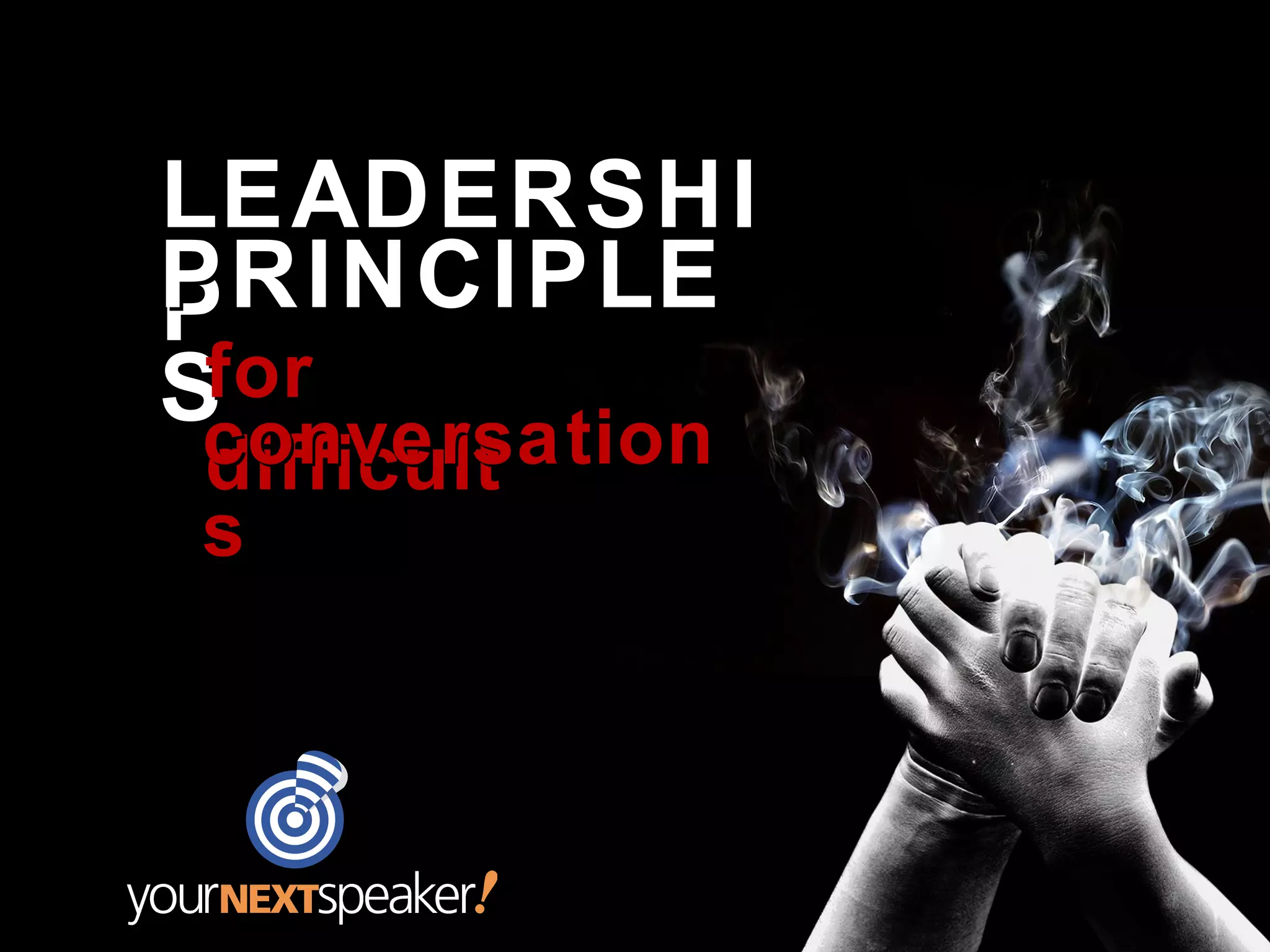



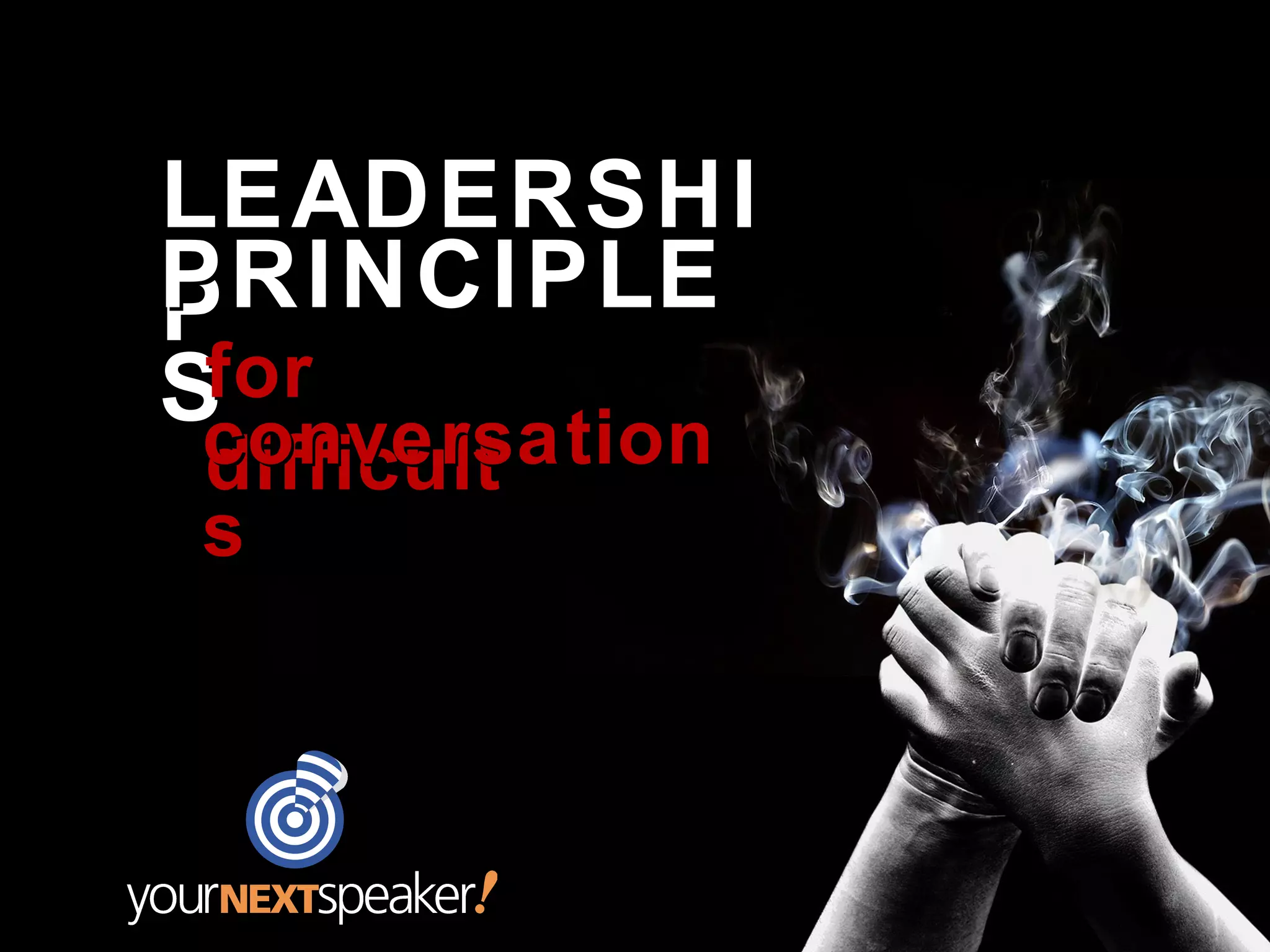
LEADERSHIP
PRINCIPLES
for difficult
conversations
DIFFICUL
CONVERSATIONS
T
•   Explaining why someone is not getting a promotion.
•   Confronting repeating unacceptable behavior.
•   Providing honest feedback on poor performance.
•   Respectfully challenging a colleague or customer.
•   Holding someone accountable for their output.
•   Sharing tough decision outcomes.
•   Delegating responsibility.
•   Discussing a taboo issue like hygiene or dress.
•   Thoughtfully saying no.
•   Addressing opportunities for improvement.
•   Explaining options in the face of adversity.
DIFFICUL Why don’t we do this?
CONVERSATIONS
T
•   Explaining why someone is not getting a promotion.
•   Confronting repeating unacceptable behavior.
•   Providing honest feedback on poor performance.
•   Respectfully challenging a colleague or customer.
•   Holding someone accountable for their output.
•   Sharing tough decision outcomes.
•   Delegating responsibility.
•   Discussing a taboo issue like hygiene or dress.
•   Thoughtfully saying no.
•   Addressing opportunities for improvement.
•   Explaining options in the face of adversity.
Difficult Conversations
Require Leadership
and leadership is hard.


5 Principles of Leadership
PRINCIPLE #1
    Others first. Self second.


•    Be committed to seeing the other person succeed.
•    Focus on the behavior or necessary changes.
•    Be focused on the conversation. Remove distractions.
•    Arrange for a private setting.
PRINCIPLE #2
    Difficult is not an excuse to delay.


•    We can do more damage by not having the conversation.
•    The process might not be good, but the end result can be.
PRINCIPLE #3
An adaptive approach is the only approach.


Ask these questions beforehand:


  How will I be helping this person?
  Will telling them this make them better in the long run?
  Why am I delaying telling them this?
  If I was in their position, would I prefer to know?
  How will they react? How do I know?
  Will they accept advice from me?
PRINCIPLE #4
Find the common ground. Build from there.


 Find something early on that you both can agree on.
 Get them saying yes.
 Be preemptive by fostering relationships.
PRINCIPLE #5
Goals and values guide action.


 Be clear on the best possible outcome.
 Be specific with discussion items, needed changes, etc.
 Be clear on which organization value is driving the need.
LEADERSHIP
PRINCIPLES
for difficult
conversations

Leadership Principles for Difficult Conversations

  • 1.
  • 2.
    DIFFICUL CONVERSATIONS T • Explaining why someone is not getting a promotion. • Confronting repeating unacceptable behavior. • Providing honest feedback on poor performance. • Respectfully challenging a colleague or customer. • Holding someone accountable for their output. • Sharing tough decision outcomes. • Delegating responsibility. • Discussing a taboo issue like hygiene or dress. • Thoughtfully saying no. • Addressing opportunities for improvement. • Explaining options in the face of adversity.
  • 3.
    DIFFICUL Why don’twe do this? CONVERSATIONS T • Explaining why someone is not getting a promotion. • Confronting repeating unacceptable behavior. • Providing honest feedback on poor performance. • Respectfully challenging a colleague or customer. • Holding someone accountable for their output. • Sharing tough decision outcomes. • Delegating responsibility. • Discussing a taboo issue like hygiene or dress. • Thoughtfully saying no. • Addressing opportunities for improvement. • Explaining options in the face of adversity.
  • 4.
    Difficult Conversations Require Leadership andleadership is hard. 5 Principles of Leadership
  • 5.
    PRINCIPLE #1 Others first. Self second. • Be committed to seeing the other person succeed. • Focus on the behavior or necessary changes. • Be focused on the conversation. Remove distractions. • Arrange for a private setting.
  • 6.
    PRINCIPLE #2 Difficult is not an excuse to delay. • We can do more damage by not having the conversation. • The process might not be good, but the end result can be.
  • 7.
    PRINCIPLE #3 An adaptiveapproach is the only approach. Ask these questions beforehand: How will I be helping this person? Will telling them this make them better in the long run? Why am I delaying telling them this? If I was in their position, would I prefer to know? How will they react? How do I know? Will they accept advice from me?
  • 8.
    PRINCIPLE #4 Find thecommon ground. Build from there. Find something early on that you both can agree on. Get them saying yes. Be preemptive by fostering relationships.
  • 9.
    PRINCIPLE #5 Goals andvalues guide action. Be clear on the best possible outcome. Be specific with discussion items, needed changes, etc. Be clear on which organization value is driving the need.
  • 10.