









HR Forum
                  April 2013


                 Having
                Difficult
              Conversations

Dec 13 2010
A step by step
              Checklist to help you
                manage Difficult
                Conversations

                      A few
                interesting cases
June 7 2010
You know you need to
   have a ‘conversation’
   ….you want to, but
   something is holding
   you back……
June 7 2010
Maybe you’ve
       tried before, but it
       didn’t go well and
       you’re still feeling
           the scars!?!
June 7 2010
Could be that
              you’re worried
              that you’ll just
              make matters
June 7 2010
                 worse?!
Or perhaps you’re
         just not sure
      where to start, or
       confident about
      what you can and
          can’t say??
June 7 2010
Remember this….
                       You are the employer
                        You pay the wages
              You are entitled to speak to an employee
               about any concerns you have with their
                performance, conduct or behaviour.

                          PROVIDING
     You are fair and reasonable in how you do it.
June 7 2010
June 7 2010
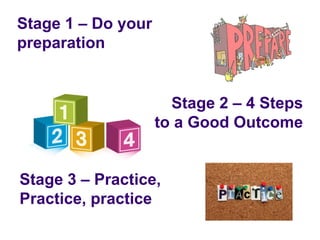
Stage 1 – Do your
   preparation


                         Stage 2 – 4 Steps
                       to a Good Outcome


    Stage 3 – Practice,
    Practice, practice
June 7 2010
Stage 1 – Do your preparation!
 Ask yourself some key questions:

 1. Why are you having the conversation?
 2. What assumptions have you or are you making
    about the persons intentions?
 3. What ‘buttons’ of yours are being pushed?
 4. How is your attitude toward the conversation
    influencing your perception of it?
 5. Who is the opponent?
 6. What are your needs and fears?
 7. Have you contributed towards the problem, if so
    how?

June 7 2010
Stage 2 – 4 Steps to a Good Outcome
 Step 1 - Inquiry

 • Go on a voyage of discovery, be curious, pretend
   you know nothing and try and learn as much as
   possible about the person and their point of view.
 • Watch their body language, what are they ‘really’
   saying?
 • Let them talk until they’re finished and  DON’T
   INTERRUPT!
 • Don’t take things personally
 • Wait your turn to speak.


June 7 2010
Stage 2 – 4 Steps to a Good Outcome
 Step 2 - Acknowledgement

 • Show that you have heard and understood
 • Explain back or summarise what you think they’re
   really going for.
 • Recognise and respect their position.
 • Acknowledge whatever you can including your own
   defensiveness if it comes up.
 • Acknowledgement is not agreement – don’t
   confuse the two!


June 7 2010
Stage 2 – 4 Steps to a Good Outcome

 Step 3 - Advocacy

 • When you sense that they’ve expressed all they
   want to say (make sure you check..), its your turn
   to speak.
 • What can you see from your perspective that
   they’ve missed?
 • Help by clarifying your position without minimising
   theirs.


June 7 2010
Stage 2 – 4 Steps to a Good Outcome

 Step 4 – Problem-Solving

 • Now you’re ready to build solutions
 • Ask them what they think might work, find
   something you like together and build on it.
 • If the conversation becomes adversarial, switch
   back to Step 1 – Inquiry.
 • Ask for their point of view – this creates safety and
   encourages them to engage.
 • Don’t sit on a principle, adjust your       attitude to
   achieve a positive outcome.

June 7 2010
Stage 3 – Practice, practice, practice!
 • A successful outcome will depend on 2 things, how you
   behave and what you say.
 • Acknowledge both your own & their emotional energy
   and feelings and direct it towards a useful purpose.
 • Remember the objective of why you set out to have the
   conversation in the first place & return to it at difficult
   moments.
 • Don’t take verbal attacks personally or react.
 • Don’t assume they can or will see things from your
   view – sometimes you simply need to           agree to
   differ and accept that’s OK.
 • Practice the conversation before you go ‘live’

June 7 2010
Next time, you’ll
              be prepared, so
                you won’t be
               collecting any
June 7 2010
                more scars!
Next time, you
    will be prepared
    so you will make
        progress!
June 7 2010
Next time, you will
       know where to
        start and be
      confident about
     what you can and
         can’t say!
June 7 2010
Good luck!
                    and
               don’t forget to
                 practice!
June 7 2010
…and finally, a
                couple of
               interesting
                 cases…
June 7 2010
Novak v Phones 4 U Ltd


   Comments made by employees about another employee
   on Facebook can amount to continuing acts of
   discrimination.

   Mr Novak had a disability as a result of an accident at work. A number of
   colleagues made fun of him & made comments on Facebook over a
   period of 6 months. As a result he brought claims of disability, race
   discrimination, harassment & victimisation. The EAT decided that the 2
   sets of FB comments were linked as one continuous act and that there
   was clearly a connection in terms of individuals, subject matter and
   timing. They concluded that he did could have a claim for discrimination.

June 7 2010
Novak v Phones 4 U Ltd


   The case is worth noting for 2 reasons:

   1. It serves as a reminder that comments made by employees about
      other employees on social media sites can form basis of
      discrimination claims and in these cases, the employer can be held
      liable for the acts of its employees.

   1. If there is a series of postings, they are likely to be considered part of
      a continuing act and an employee will then be able to bring a claim
      within 3 months of the last act, which is particularly relevant for social
      media cases where comments will go backwards and forwards and
      might be made over a long period of time.
June 7 2010
Bancroft v Interserve


Is it reasonable for an employer to dismiss an employee if
asked to do so by a client or customer?
Bancroft had raised concerns that hostel staff left sharp knives in the sink and smoked
when passing through the kitchen, which led to a difficult relationship with the
Manager, Mr Laughton. Mr Laughton raised a variety of minor matters with Interserve
about Bancroft’s conduct with the intention of getting Interserve to discipline him, but
no disciplinary action was ever taken. Later, another member of hostel staff
complained about Bancroft and he was suspended and ultimately issued with a final
written warning.

Meanwhile, Mr Laughton wrote to the Home Office demanding that Bancroft not be
allowed to return to the hostel regardless of the outcome of the disciplinary hearing as
there had been a breakdown in the relationship. The Home Office invoked their right
to request his removal.
June 7 2010
Bancroft v Interserve


As a result, Bancroft was suspended again, but no efforts were made by Interserve to
persuade the Home Office to change its mind and was advised by HR to take no
action other than to accept the request for Bancroft’s removal.

They tried to redeploy Bancroft, but he refused as it would have meant a 30 mile
journey and lower wages due to working less hours.

The EAT disagreed with the ET and said that Interserve should have taken steps
earlier to try and resolve the issues before events that led to his dismissal. The case
was remitted to the ET to make further findings of fact and reach a conclusion on the
fairness in the light of those facts.

The case is a timely reminder that an employer cannot simply dismiss at the behest of
a third party without first taking all reasonable steps to seek to mitigate the injustice
caused to the employee and to make sure it picks up and deals with problems as they
arise rather than wait until it all comes crashing down.
June 7 2010
June 7 2010
Change Partner
               Consultancy
                Providing tailored
                  HR, Payroll &
                  Legal Practice
               Management services

              Advice and guidance for
               Employees to resolve
                workplace disputes


                www.changepartner.co.uk
                    01202 377270
Dec 13 2010

Dorset HR Forum April - Having Difficult Conversations

  • 1.
    HR Forum April 2013 Having Difficult Conversations Dec 13 2010
  • 2.
    A step bystep Checklist to help you manage Difficult Conversations A few interesting cases June 7 2010
  • 3.
    You know youneed to have a ‘conversation’ ….you want to, but something is holding you back…… June 7 2010
  • 4.
    Maybe you’ve tried before, but it didn’t go well and you’re still feeling the scars!?! June 7 2010
  • 5.
    Could be that you’re worried that you’ll just make matters June 7 2010 worse?!
  • 6.
    Or perhaps you’re just not sure where to start, or confident about what you can and can’t say?? June 7 2010
  • 7.
    Remember this…. You are the employer You pay the wages You are entitled to speak to an employee about any concerns you have with their performance, conduct or behaviour. PROVIDING You are fair and reasonable in how you do it. June 7 2010
  • 8.
  • 9.
    Stage 1 –Do your preparation Stage 2 – 4 Steps to a Good Outcome Stage 3 – Practice, Practice, practice June 7 2010
  • 10.
    Stage 1 –Do your preparation! Ask yourself some key questions: 1. Why are you having the conversation? 2. What assumptions have you or are you making about the persons intentions? 3. What ‘buttons’ of yours are being pushed? 4. How is your attitude toward the conversation influencing your perception of it? 5. Who is the opponent? 6. What are your needs and fears? 7. Have you contributed towards the problem, if so how? June 7 2010
  • 11.
    Stage 2 –4 Steps to a Good Outcome Step 1 - Inquiry • Go on a voyage of discovery, be curious, pretend you know nothing and try and learn as much as possible about the person and their point of view. • Watch their body language, what are they ‘really’ saying? • Let them talk until they’re finished and DON’T INTERRUPT! • Don’t take things personally • Wait your turn to speak. June 7 2010
  • 12.
    Stage 2 –4 Steps to a Good Outcome Step 2 - Acknowledgement • Show that you have heard and understood • Explain back or summarise what you think they’re really going for. • Recognise and respect their position. • Acknowledge whatever you can including your own defensiveness if it comes up. • Acknowledgement is not agreement – don’t confuse the two! June 7 2010
  • 13.
    Stage 2 –4 Steps to a Good Outcome Step 3 - Advocacy • When you sense that they’ve expressed all they want to say (make sure you check..), its your turn to speak. • What can you see from your perspective that they’ve missed? • Help by clarifying your position without minimising theirs. June 7 2010
  • 14.
    Stage 2 –4 Steps to a Good Outcome Step 4 – Problem-Solving • Now you’re ready to build solutions • Ask them what they think might work, find something you like together and build on it. • If the conversation becomes adversarial, switch back to Step 1 – Inquiry. • Ask for their point of view – this creates safety and encourages them to engage. • Don’t sit on a principle, adjust your attitude to achieve a positive outcome. June 7 2010
  • 15.
    Stage 3 –Practice, practice, practice! • A successful outcome will depend on 2 things, how you behave and what you say. • Acknowledge both your own & their emotional energy and feelings and direct it towards a useful purpose. • Remember the objective of why you set out to have the conversation in the first place & return to it at difficult moments. • Don’t take verbal attacks personally or react. • Don’t assume they can or will see things from your view – sometimes you simply need to agree to differ and accept that’s OK. • Practice the conversation before you go ‘live’ June 7 2010
  • 16.
    Next time, you’ll be prepared, so you won’t be collecting any June 7 2010 more scars!
  • 17.
    Next time, you will be prepared so you will make progress! June 7 2010
  • 18.
    Next time, youwill know where to start and be confident about what you can and can’t say! June 7 2010
  • 19.
    Good luck! and don’t forget to practice! June 7 2010
  • 20.
    …and finally, a couple of interesting cases… June 7 2010
  • 21.
    Novak v Phones4 U Ltd Comments made by employees about another employee on Facebook can amount to continuing acts of discrimination. Mr Novak had a disability as a result of an accident at work. A number of colleagues made fun of him & made comments on Facebook over a period of 6 months. As a result he brought claims of disability, race discrimination, harassment & victimisation. The EAT decided that the 2 sets of FB comments were linked as one continuous act and that there was clearly a connection in terms of individuals, subject matter and timing. They concluded that he did could have a claim for discrimination. June 7 2010
  • 22.
    Novak v Phones4 U Ltd The case is worth noting for 2 reasons: 1. It serves as a reminder that comments made by employees about other employees on social media sites can form basis of discrimination claims and in these cases, the employer can be held liable for the acts of its employees. 1. If there is a series of postings, they are likely to be considered part of a continuing act and an employee will then be able to bring a claim within 3 months of the last act, which is particularly relevant for social media cases where comments will go backwards and forwards and might be made over a long period of time. June 7 2010
  • 23.
    Bancroft v Interserve Isit reasonable for an employer to dismiss an employee if asked to do so by a client or customer? Bancroft had raised concerns that hostel staff left sharp knives in the sink and smoked when passing through the kitchen, which led to a difficult relationship with the Manager, Mr Laughton. Mr Laughton raised a variety of minor matters with Interserve about Bancroft’s conduct with the intention of getting Interserve to discipline him, but no disciplinary action was ever taken. Later, another member of hostel staff complained about Bancroft and he was suspended and ultimately issued with a final written warning. Meanwhile, Mr Laughton wrote to the Home Office demanding that Bancroft not be allowed to return to the hostel regardless of the outcome of the disciplinary hearing as there had been a breakdown in the relationship. The Home Office invoked their right to request his removal. June 7 2010
  • 24.
    Bancroft v Interserve Asa result, Bancroft was suspended again, but no efforts were made by Interserve to persuade the Home Office to change its mind and was advised by HR to take no action other than to accept the request for Bancroft’s removal. They tried to redeploy Bancroft, but he refused as it would have meant a 30 mile journey and lower wages due to working less hours. The EAT disagreed with the ET and said that Interserve should have taken steps earlier to try and resolve the issues before events that led to his dismissal. The case was remitted to the ET to make further findings of fact and reach a conclusion on the fairness in the light of those facts. The case is a timely reminder that an employer cannot simply dismiss at the behest of a third party without first taking all reasonable steps to seek to mitigate the injustice caused to the employee and to make sure it picks up and deals with problems as they arise rather than wait until it all comes crashing down. June 7 2010
  • 25.
  • 26.
    Change Partner Consultancy Providing tailored HR, Payroll & Legal Practice Management services Advice and guidance for Employees to resolve workplace disputes www.changepartner.co.uk 01202 377270 Dec 13 2010

Editor's Notes

  • #21 Discuss – flip chart
  • #22 Who is an employee?According to section 230(1) of the Employment Rights Act 1996, an employee is someone who works under a contract of employment. This, however, is not defined by statute so the courts have constructed a number of tests to help them decide whether someone is an employee.Although each case is decided on its own merits, there are some essential elements that must be satisfied: 
The individual has to have a contract with the employer
The individual has to carry out the work personally
There has to be "mutuality of obligation" between the two parties
The employer has to have "control" over the work that the employee does
  • #23 Who is an employee?According to section 230(1) of the Employment Rights Act 1996, an employee is someone who works under a contract of employment. This, however, is not defined by statute so the courts have constructed a number of tests to help them decide whether someone is an employee.Although each case is decided on its own merits, there are some essential elements that must be satisfied: 
The individual has to have a contract with the employer
The individual has to carry out the work personally
There has to be "mutuality of obligation" between the two parties
The employer has to have "control" over the work that the employee does
  • #24 Who is an employee?According to section 230(1) of the Employment Rights Act 1996, an employee is someone who works under a contract of employment. This, however, is not defined by statute so the courts have constructed a number of tests to help them decide whether someone is an employee.Although each case is decided on its own merits, there are some essential elements that must be satisfied: 
The individual has to have a contract with the employer
The individual has to carry out the work personally
There has to be "mutuality of obligation" between the two parties
The employer has to have "control" over the work that the employee does
  • #25 Who is an employee?According to section 230(1) of the Employment Rights Act 1996, an employee is someone who works under a contract of employment. This, however, is not defined by statute so the courts have constructed a number of tests to help them decide whether someone is an employee.Although each case is decided on its own merits, there are some essential elements that must be satisfied: 
The individual has to have a contract with the employer
The individual has to carry out the work personally
There has to be "mutuality of obligation" between the two parties
The employer has to have "control" over the work that the employee does