Neuroleadership
What Brain Science Teaches Us
About Leadership
Presented to OD Network WNY
May 15, 2014
Matilda Lorenzo, SPHR
Concentric Leadership Partners
www.concentricleadership.com
http://concentricleadership.com
Housekeeping items
http://concentricleadership.com
Objectives
• Learn how science impacts leadership
• Understand why change resistance is
so strong and what can be done
• Gain insights that help shift from
resistance to engagement
• Gain an introduction to the SCARF
model – a communications approach
• Become more self-aware
http://concentricleadership.com
Neural basis of leadership
and change management
practices
http://concentricleadership.com
Why is Change So Difficult?
http://concentricleadership.com
What is Neuroleadership?
• Decision-making and problem-solving
• Emotional regulation
• Collaborating
• Facilitating change
http://concentricleadership.com
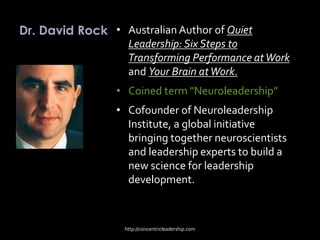
Dr. David Rock • Australian Author of Quiet
Leadership: Six Steps to
Transforming Performance atWork
and Your Brain atWork.
• Coined term "Neuroleadership”
• Cofounder of Neuroleadership
Institute, a global initiative
bringing together neuroscientists
and leadership experts to build a
new science for leadership
development.
http://concentricleadership.com
6 Insights about the Brain
1. The brain is a connection machine
2. Up close, no two brains are alike
3. Hardwires everything it can
4. Hardwiring drives automatic perception
5. Practically impossible to deconstruct
our old wiring
6. We can create new wiring
http://concentricleadership.com
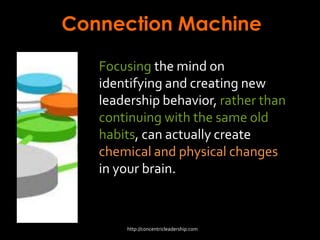
Connection Machine
Focusing the mind on
identifying and creating new
leadership behavior, rather than
continuing with the same old
habits, can actually create
chemical and physical changes
in your brain.
http://concentricleadership.com
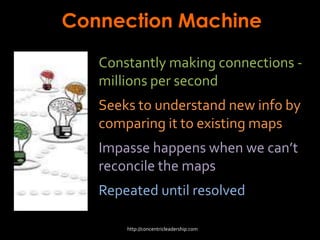
Connection Machine
Constantly making connections -
millions per second
Seeks to understand new info by
comparing it to existing maps
Impasse happens when we can’t
reconcile the maps
Repeated until resolved
http://concentricleadership.com
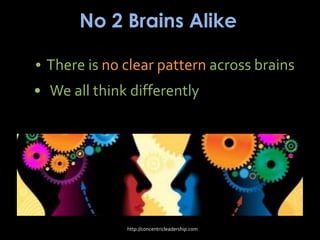
No 2 Brains Alike
• There is no clear pattern across brains
• We all think differently
http://concentricleadership.com
Our Brains Hardwire Everything
Working Memory
Limitations
Long-Term Memory
Hard-wiring
http://concentricleadership.com
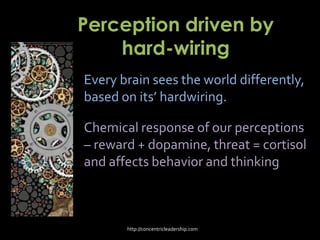
Perception driven by
hard-wiring
Every brain sees the world differently,
based on its’ hardwiring.
Chemical response of our perceptions
– reward + dopamine, threat = cortisol
and affects behavior and thinking
http://concentricleadership.com
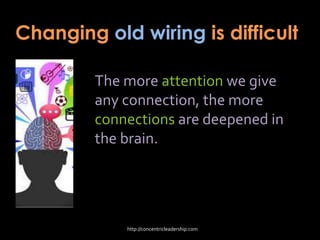
Changing old wiring is difficult
The more attention we give
any connection, the more
connections are deepened in
the brain.
http://concentricleadership.com
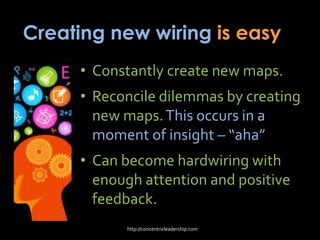
Creating new wiring is easy
• Constantly create new maps.
• Reconcile dilemmas by creating
new maps.This occurs in a
moment of insight – “aha”
• Can become hardwiring with
enough attention and positive
feedback.
http://concentricleadership.com
10 x 3
http://concentricleadership.com
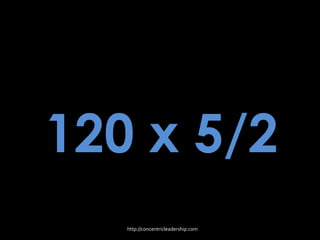
120 x 5/2
http://concentricleadership.com
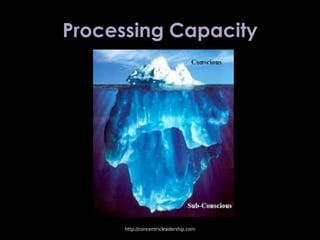
Processing Capacity
http://concentricleadership.com
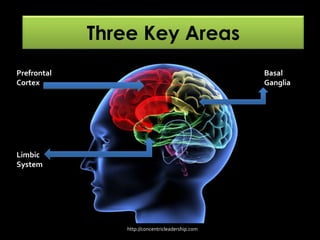
Three Key Areas
Prefrontal
Cortex
Limbic
System
Basal
Ganglia
http://concentricleadership.com
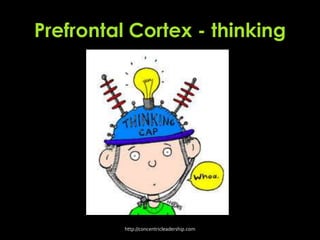
Prefrontal Cortex - thinking
http://concentricleadership.com
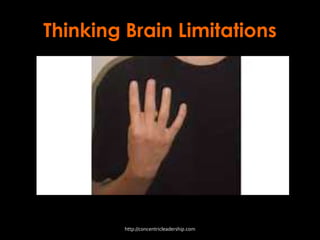
Thinking Brain Limitations
http://concentricleadership.com
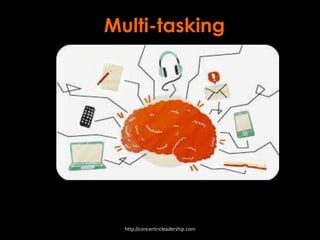
Multi-tasking
http://concentricleadership.com
Basal Ganglia - habits
http://concentricleadership.com
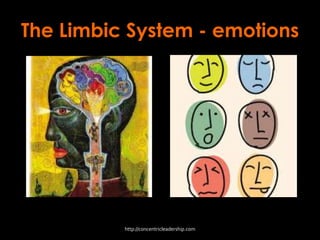
The Limbic System - emotions
http://concentricleadership.com
Detecting Threats
http://concentricleadership.com
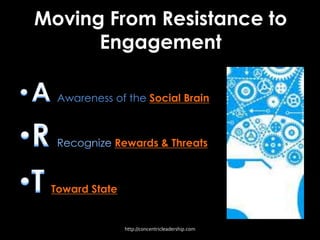
Moving From Resistance to
Engagement
http://concentricleadership.com
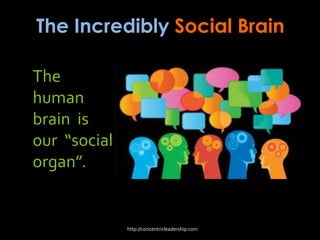
The Incredibly Social Brain
The
human
brain is
our “social
organ”.
http://concentricleadership.com
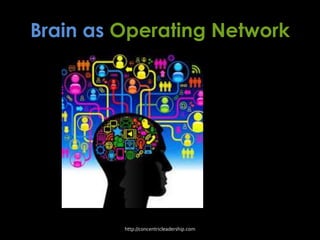
Brain as Operating Network
http://concentricleadership.com
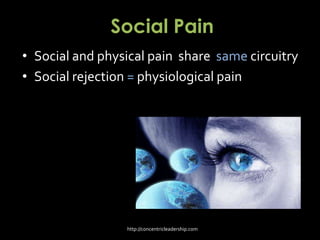
Social Pain
• Social and physical pain share same circuitry
• Social rejection = physiological pain
http://concentricleadership.com
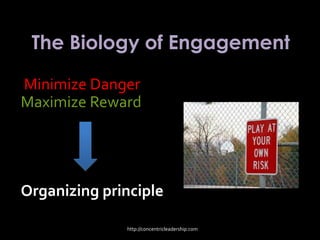
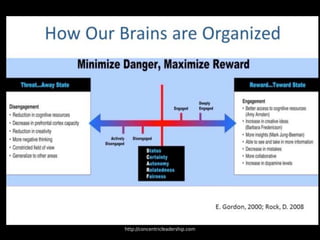
The Biology of Engagement
Minimize Danger
Maximize Reward
Organizing principle
http://concentricleadership.com
Fear - Stronger than Motivation
http://concentricleadership.com
When threatened, the increased
overall activation in the brain
inhibits people from perceiving the
more subtle signals required for
solving non-linear problems,
involved in the insight or “aha!”
experience
(Subramaniam et al, 2007).
http://concentricleadership.com
And … with the amygdala activated,
the tendency is to generalize more,
which increases the likelihood of
accidental connections.
There is a tendency to err on the safe
side, shrinking from opportunities, as
they are perceived to be more
dangerous. People become more
likely to react defensively to stimuli.
http://concentricleadership.com
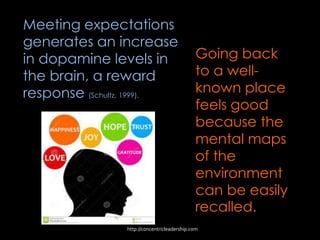
Meeting expectations
generates an increase
in dopamine levels in
the brain, a reward
response (Schultz, 1999).
.
Going back
to a well-
known place
feels good
because the
mental maps
of the
environment
can be easily
recalled.
http://concentricleadership.com
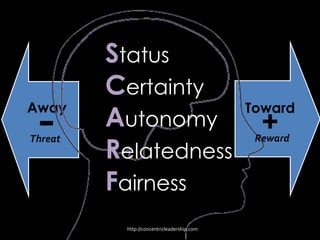
Away Toward
+
Status
Certainty
Autonomy
Relatedness
Fairness
Threat Reward
http://concentricleadership.com
Status
• Relative
Importance to
Others: How
We Compare
http://concentricleadership.com
Increasing Status
• Status can be increased
without cost to others of an
effect on relatedness
• Playing against oneself
• Changes the community
one focuses on
http://concentricleadership.com
Reducing status threat
When threatened,
people may defend a
position that doesn’t
make sense, to avoid
the perceived pain of a
drop in status.
http://concentricleadership.com
The human resistance to
change is really … the
human resistance to pain.
http://concentricleadership.com
Certainty
The brain likes to be able to predict
and have a say in the future.
http://concentricleadership.com
Even a small amount of
uncertainty generates
an ‘error’ response in
the orbital frontal
cortex (OFC).
.This takes attention away from one’s
goals, forcing attention to the error
(Hedden, Garbrielli, 2006)
http://concentricleadership.com
Autonomy
The brain likes to be
able to predict.
A feeling of having a
choice dramatically
reduces stress levels
http://concentricleadership.com
“Even if we have the
illusion that we are in
control, our cognitive
functions are
preserved.”
Amy Arnsten, Professor of
Neurobiology, Yale Medical School
http://concentricleadership.com
Relatedness
Friend or foe
Trust or distrust
Connect or don’t connect
Foe is the default
http://concentricleadership.com
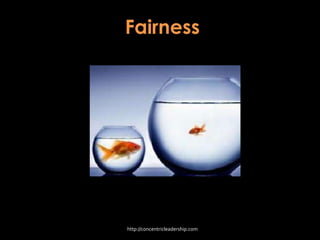
Fairness
http://concentricleadership.com
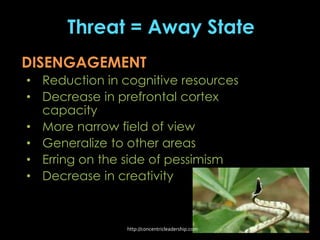
Threat = Away State
DISENGAGEMENT
• Reduction in cognitive resources
• Decrease in prefrontal cortex
capacity
• More narrow field of view
• Generalize to other areas
• Erring on the side of pessimism
• Decrease in creativity
http://concentricleadership.com
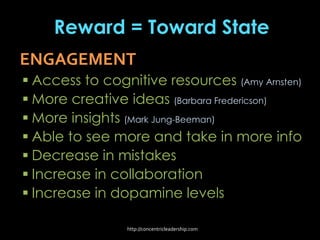
Reward = Toward State
ENGAGEMENT
 Access to cognitive resources (Amy Arnsten)
 More creative ideas (Barbara Fredericson)
 More insights (Mark Jung-Beeman)
 Able to see more and take in more info
 Decrease in mistakes
 Increase in collaboration
 Increase in dopamine levels
http://concentricleadership.com
What Does this Mean For Leaders?
The workplace is a social system, not just
a contract where labor is exchanged for
a paycheck.
Commitment, engagement levels and
performance are profoundly impacted
by the social context of the workplace
http://concentricleadership.com
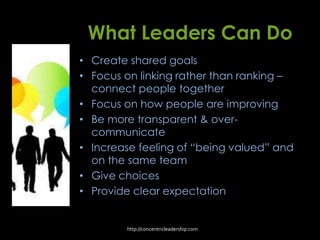
What Leaders Can Do
• Create shared goals
• Focus on linking rather than ranking –
connect people together
• Focus on how people are improving
• Be more transparent & over-
communicate
• Increase feeling of “being valued” and
on the same team
• Give choices
• Provide clear expectation
http://concentricleadership.com
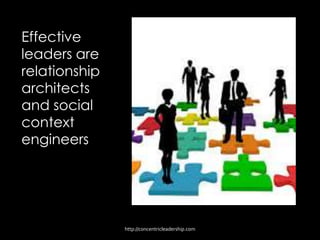
Effective
leaders are
relationship
architects
and social
context
engineers
http://concentricleadership.com
Compounding Threat
Leaders can activate the
threat response in multiple
domains
Creates a powerful inability
to think differently, take a
novel perspective or stay
attuned to the vision
http://concentricleadership.com
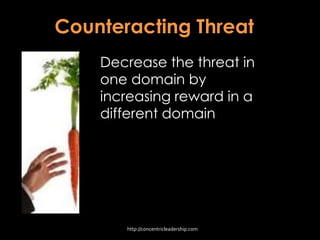
Counteracting Threat
Decrease the threat in
one domain by
increasing reward in a
different domain
http://concentricleadership.com
Model the Way
http://concentricleadership.com
What Science Tells Us Works
• A toward state … reducing threat
• Helping people come to their own insights
• Leading with the social brain in mind
• Focus on the “attention” to solutions and
new habits
• A quiet brain
• Self awareness
• Emotion regulation
http://concentricleadership.com
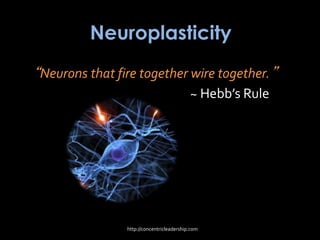
Neuroplasticity
“Neurons that fire together wire together.”
~ Hebb’s Rule
http://concentricleadership.com
“The ability to
intentionally address
the social brain in the
service of optimal
performance will be a
distinguishing
leadership capability
in the years ahead.”
- David Rock
http://concentricleadership.com
“Brain development is the same
as leadership development.”
~ Dr. Paul McDonald ddd
http://concentricleadership.com

NeuroLeadership in Organization Development

  • 1.
    Neuroleadership What Brain ScienceTeaches Us About Leadership Presented to OD Network WNY May 15, 2014 Matilda Lorenzo, SPHR Concentric Leadership Partners www.concentricleadership.com http://concentricleadership.com
  • 2.
  • 3.
    Objectives • Learn howscience impacts leadership • Understand why change resistance is so strong and what can be done • Gain insights that help shift from resistance to engagement • Gain an introduction to the SCARF model – a communications approach • Become more self-aware http://concentricleadership.com
  • 4.
    Neural basis ofleadership and change management practices http://concentricleadership.com
  • 5.
    Why is ChangeSo Difficult? http://concentricleadership.com
  • 6.
    What is Neuroleadership? •Decision-making and problem-solving • Emotional regulation • Collaborating • Facilitating change http://concentricleadership.com
  • 7.
    Dr. David Rock• Australian Author of Quiet Leadership: Six Steps to Transforming Performance atWork and Your Brain atWork. • Coined term "Neuroleadership” • Cofounder of Neuroleadership Institute, a global initiative bringing together neuroscientists and leadership experts to build a new science for leadership development. http://concentricleadership.com
  • 8.
    6 Insights aboutthe Brain 1. The brain is a connection machine 2. Up close, no two brains are alike 3. Hardwires everything it can 4. Hardwiring drives automatic perception 5. Practically impossible to deconstruct our old wiring 6. We can create new wiring http://concentricleadership.com
  • 9.
    Connection Machine Focusing themind on identifying and creating new leadership behavior, rather than continuing with the same old habits, can actually create chemical and physical changes in your brain. http://concentricleadership.com
  • 10.
    Connection Machine Constantly makingconnections - millions per second Seeks to understand new info by comparing it to existing maps Impasse happens when we can’t reconcile the maps Repeated until resolved http://concentricleadership.com
  • 11.
    No 2 BrainsAlike • There is no clear pattern across brains • We all think differently http://concentricleadership.com
  • 12.
    Our Brains HardwireEverything Working Memory Limitations Long-Term Memory Hard-wiring http://concentricleadership.com
  • 13.
    Perception driven by hard-wiring Everybrain sees the world differently, based on its’ hardwiring. Chemical response of our perceptions – reward + dopamine, threat = cortisol and affects behavior and thinking http://concentricleadership.com
  • 14.
    Changing old wiringis difficult The more attention we give any connection, the more connections are deepened in the brain. http://concentricleadership.com
  • 15.
    Creating new wiringis easy • Constantly create new maps. • Reconcile dilemmas by creating new maps.This occurs in a moment of insight – “aha” • Can become hardwiring with enough attention and positive feedback. http://concentricleadership.com
  • 16.
  • 17.
  • 18.
  • 19.
  • 20.
    Prefrontal Cortex -thinking http://concentricleadership.com
  • 21.
  • 22.
  • 23.
    Basal Ganglia -habits http://concentricleadership.com
  • 24.
    The Limbic System- emotions http://concentricleadership.com
  • 25.
  • 26.
    Moving From Resistanceto Engagement http://concentricleadership.com
  • 27.
    The Incredibly SocialBrain The human brain is our “social organ”. http://concentricleadership.com
  • 28.
    Brain as OperatingNetwork http://concentricleadership.com
  • 29.
    Social Pain • Socialand physical pain share same circuitry • Social rejection = physiological pain http://concentricleadership.com
  • 30.
    The Biology ofEngagement Minimize Danger Maximize Reward Organizing principle http://concentricleadership.com
  • 31.
    Fear - Strongerthan Motivation http://concentricleadership.com
  • 32.
    When threatened, theincreased overall activation in the brain inhibits people from perceiving the more subtle signals required for solving non-linear problems, involved in the insight or “aha!” experience (Subramaniam et al, 2007). http://concentricleadership.com
  • 33.
    And … withthe amygdala activated, the tendency is to generalize more, which increases the likelihood of accidental connections. There is a tendency to err on the safe side, shrinking from opportunities, as they are perceived to be more dangerous. People become more likely to react defensively to stimuli. http://concentricleadership.com
  • 34.
    Meeting expectations generates anincrease in dopamine levels in the brain, a reward response (Schultz, 1999). . Going back to a well- known place feels good because the mental maps of the environment can be easily recalled. http://concentricleadership.com
  • 35.
  • 36.
    Status • Relative Importance to Others:How We Compare http://concentricleadership.com
  • 37.
    Increasing Status • Statuscan be increased without cost to others of an effect on relatedness • Playing against oneself • Changes the community one focuses on http://concentricleadership.com
  • 38.
    Reducing status threat Whenthreatened, people may defend a position that doesn’t make sense, to avoid the perceived pain of a drop in status. http://concentricleadership.com
  • 39.
    The human resistanceto change is really … the human resistance to pain. http://concentricleadership.com
  • 40.
    Certainty The brain likesto be able to predict and have a say in the future. http://concentricleadership.com
  • 41.
    Even a smallamount of uncertainty generates an ‘error’ response in the orbital frontal cortex (OFC). .This takes attention away from one’s goals, forcing attention to the error (Hedden, Garbrielli, 2006) http://concentricleadership.com
  • 42.
    Autonomy The brain likesto be able to predict. A feeling of having a choice dramatically reduces stress levels http://concentricleadership.com
  • 43.
    “Even if wehave the illusion that we are in control, our cognitive functions are preserved.” Amy Arnsten, Professor of Neurobiology, Yale Medical School http://concentricleadership.com
  • 44.
    Relatedness Friend or foe Trustor distrust Connect or don’t connect Foe is the default http://concentricleadership.com
  • 45.
  • 46.
  • 47.
    Threat = AwayState DISENGAGEMENT • Reduction in cognitive resources • Decrease in prefrontal cortex capacity • More narrow field of view • Generalize to other areas • Erring on the side of pessimism • Decrease in creativity http://concentricleadership.com
  • 48.
    Reward = TowardState ENGAGEMENT  Access to cognitive resources (Amy Arnsten)  More creative ideas (Barbara Fredericson)  More insights (Mark Jung-Beeman)  Able to see more and take in more info  Decrease in mistakes  Increase in collaboration  Increase in dopamine levels http://concentricleadership.com
  • 49.
    What Does thisMean For Leaders? The workplace is a social system, not just a contract where labor is exchanged for a paycheck. Commitment, engagement levels and performance are profoundly impacted by the social context of the workplace http://concentricleadership.com
  • 50.
    What Leaders CanDo • Create shared goals • Focus on linking rather than ranking – connect people together • Focus on how people are improving • Be more transparent & over- communicate • Increase feeling of “being valued” and on the same team • Give choices • Provide clear expectation http://concentricleadership.com
  • 51.
  • 52.
    Compounding Threat Leaders canactivate the threat response in multiple domains Creates a powerful inability to think differently, take a novel perspective or stay attuned to the vision http://concentricleadership.com
  • 53.
    Counteracting Threat Decrease thethreat in one domain by increasing reward in a different domain http://concentricleadership.com
  • 54.
  • 55.
    What Science TellsUs Works • A toward state … reducing threat • Helping people come to their own insights • Leading with the social brain in mind • Focus on the “attention” to solutions and new habits • A quiet brain • Self awareness • Emotion regulation http://concentricleadership.com
  • 56.
    Neuroplasticity “Neurons that firetogether wire together.” ~ Hebb’s Rule http://concentricleadership.com
  • 57.
    “The ability to intentionallyaddress the social brain in the service of optimal performance will be a distinguishing leadership capability in the years ahead.” - David Rock http://concentricleadership.com
  • 58.
    “Brain development isthe same as leadership development.” ~ Dr. Paul McDonald ddd http://concentricleadership.com
  • 59.
  • 60.

Editor's Notes

  • #50 Pierre Balthazard, associate professor and the principal investigator of The Neuroscience of Leadership Project at Arizona State University - Leaders who work to ensure that people feel included vs. rejected create workplaces that promote healthy collaboration and better overall performance.