BBardeenardeen
CCooperooper
SSchriefferchrieffer
Theory ofTheory of
SuperconductivitySuperconductivity
Presented toPresented to
Prof. Dr. Jameel Un NabiProf. Dr. Jameel Un Nabi
Presented ByPresented By
Assad Ur RehmanAssad Ur Rehman
ES-1717ES-1717
Faculty Of Engineering SciencesFaculty Of Engineering Sciences
Ghulam Ishaq Khan Institute Of EngineeringGhulam Ishaq Khan Institute Of Engineering
Sciences & TechnoogySciences & Technoogy
ContentsContents
 Introduction.Introduction.
 Theories.Theories.
 Cooper Pairs.Cooper Pairs.
 BCS Theory.BCS Theory.
 Drawbacks.Drawbacks.
 Summary.Summary.
IntroductionIntroduction
 BCS successfully and completely explains theBCS successfully and completely explains the
microscopic origin of super conductivity.microscopic origin of super conductivity.
 It is a mean filed theory.It is a mean filed theory.
 Applicable to conventional super conductors only.Applicable to conventional super conductors only.
SuperconductivitySuperconductivity
 Superconductivity is a phenomenon displayed bySuperconductivity is a phenomenon displayed by
certain conductors that demonstrate no resistance tocertain conductors that demonstrate no resistance to
the flow of an electric current. Superconductors alsothe flow of an electric current. Superconductors also
exhibit strong diamagnetism; that is, they are repelledexhibit strong diamagnetism; that is, they are repelled
by magnetic fields. Superconductivity is manifestedby magnetic fields. Superconductivity is manifested
only below a certain critical temperatureonly below a certain critical temperature TTc and ac and a
critical magnetic fieldcritical magnetic field HHc, which vary with thec, which vary with the
material used. Before 1986, the highest Tc was 23.2material used. Before 1986, the highest Tc was 23.2
K (-249.8°C, -417.6° F) in niobium-germaniumK (-249.8°C, -417.6° F) in niobium-germanium
compounds.compounds.
SuperconductivitySuperconductivity
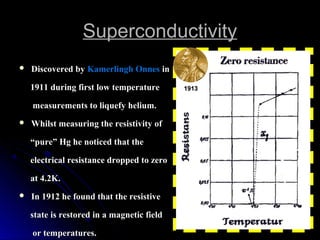
 Discovered byDiscovered by Kamerlingh OnnesKamerlingh Onnes inin
1911 during first low temperature1911 during first low temperature
measurements to liquefy helium.measurements to liquefy helium.
 Whilst measuring the resistivity ofWhilst measuring the resistivity of
““pure” Hg he noticed that thepure” Hg he noticed that the
electrical resistance dropped to zeroelectrical resistance dropped to zero
at 4.2K.at 4.2K.
 In 1912 he found that the resistiveIn 1912 he found that the resistive
state is restored in a magnetic fieldstate is restored in a magnetic field
or temperatures.or temperatures.
19131913
TypeType II SuperconductorsSuperconductors
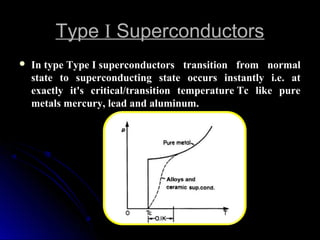
 In type Type I superconductors transition from normalIn type Type I superconductors transition from normal
state to superconducting state occurs instantly i.e. atstate to superconducting state occurs instantly i.e. at
exactly it's critical/transition temperature Tc like pureexactly it's critical/transition temperature Tc like pure
metals mercury, lead and aluminum.metals mercury, lead and aluminum.
TypeType IIII SuperconductorsSuperconductors
In Type II superconductors  transition  from  a 
normal state to a superconducting state occurs 
"slowly" i.e. as temperature decreases from it's 
critical  temperature  superconducting 
properties  increase.  Examples  of  type  II 
superconductors  are  alloys  and  ceramic  like 
niobium-titanium and niobium-tin. 
TheoriesTheories
 Drude  Model  of  Metals  failed  to  explain  the Drude  Model  of  Metals  failed  to  explain  the 
superconductivity.superconductivity.
 London  Equations  explained  superconductivity  with London  Equations  explained  superconductivity  with 
some limitations.some limitations.
 Giznberg    Landaue  proposed  a  macroscopic  model Giznberg    Landaue  proposed  a  macroscopic  model 
based on thermodynamic parameters.based on thermodynamic parameters.
BCS TheoryBCS Theory
 Bardeen-Cooper-Schrieffer theory ofBardeen-Cooper-Schrieffer theory of
superconductivity explains the origin ofsuperconductivity explains the origin of
superconductivity as effect caused by thesuperconductivity as effect caused by the
condensation ofcondensation of Cooper-pairsCooper-pairs into a boson-likeinto a boson-like
state[2].state[2].
19721972
Cooper PairsCooper Pairs
 In condensed matter physics, aIn condensed matter physics, a Cooper pairCooper pair oror
BCSBCS pairpair is ais a pairpair of electrons (or other fermions)of electrons (or other fermions)
bound together at low temperatures in a certainbound together at low temperatures in a certain
manner first described in 1956 by American physicistmanner first described in 1956 by American physicist
LeonLeon Cooper[3]Cooper[3]..
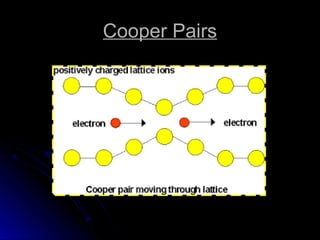
 The physical idea is that, the first electron polarizesThe physical idea is that, the first electron polarizes
the medium bythe medium by attracting positive ions &attracting positive ions &
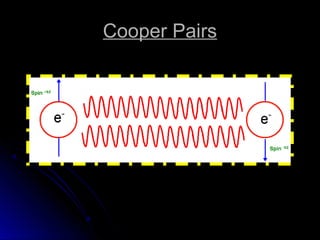
 These excess positive ions in turn attract the secondThese excess positive ions in turn attract the second
electron (with opposite spin and momenta), giving anelectron (with opposite spin and momenta), giving an
effective attractive interaction between the electrons.effective attractive interaction between the electrons.
Cooper PairsCooper Pairs
DrawbacksDrawbacks
 Does not explain the superconductivity of Type II
superconductors.
 Valid at low temperatures only.Valid at low temperatures only.
 Does not predict which materials may be
superconductors.
SummarySummary
 BCS successfully explains the microscopic origin ofBCS successfully explains the microscopic origin of
superconductivity.superconductivity.
 An attractive interaction between electrons will resultAn attractive interaction between electrons will result
in forming bound Cooper pairs.in forming bound Cooper pairs.
 BCS can only explain superconductivity in type IBCS can only explain superconductivity in type I
superconductors only.superconductors only.
ReferencesReferences
1.1.Dirk (2007) Freezing physics, Heike Kamerlingh Onnes and the quest for cold, Edita,
Amsterdam.
2. Phys. Rev. 108, 1175 (1957)
3.3.Cooper, Leon N. (1956). "Bound electron pairs in a degenerate Fermi gas". Physical
Review. 104 (4): 1189–1190.
THANK YOUTHANK YOU

ASSAD BCS theory

  • 1.
    BBardeenardeen CCooperooper SSchriefferchrieffer Theory ofTheory of SuperconductivitySuperconductivity PresentedtoPresented to Prof. Dr. Jameel Un NabiProf. Dr. Jameel Un Nabi Presented ByPresented By Assad Ur RehmanAssad Ur Rehman ES-1717ES-1717 Faculty Of Engineering SciencesFaculty Of Engineering Sciences Ghulam Ishaq Khan Institute Of EngineeringGhulam Ishaq Khan Institute Of Engineering Sciences & TechnoogySciences & Technoogy
  • 2.
    ContentsContents  Introduction.Introduction.  Theories.Theories. Cooper Pairs.Cooper Pairs.  BCS Theory.BCS Theory.  Drawbacks.Drawbacks.  Summary.Summary.
  • 3.
    IntroductionIntroduction  BCS successfullyand completely explains theBCS successfully and completely explains the microscopic origin of super conductivity.microscopic origin of super conductivity.  It is a mean filed theory.It is a mean filed theory.  Applicable to conventional super conductors only.Applicable to conventional super conductors only.
  • 4.
    SuperconductivitySuperconductivity  Superconductivity isa phenomenon displayed bySuperconductivity is a phenomenon displayed by certain conductors that demonstrate no resistance tocertain conductors that demonstrate no resistance to the flow of an electric current. Superconductors alsothe flow of an electric current. Superconductors also exhibit strong diamagnetism; that is, they are repelledexhibit strong diamagnetism; that is, they are repelled by magnetic fields. Superconductivity is manifestedby magnetic fields. Superconductivity is manifested only below a certain critical temperatureonly below a certain critical temperature TTc and ac and a critical magnetic fieldcritical magnetic field HHc, which vary with thec, which vary with the material used. Before 1986, the highest Tc was 23.2material used. Before 1986, the highest Tc was 23.2 K (-249.8°C, -417.6° F) in niobium-germaniumK (-249.8°C, -417.6° F) in niobium-germanium compounds.compounds.
  • 5.
    SuperconductivitySuperconductivity  Discovered byDiscoveredby Kamerlingh OnnesKamerlingh Onnes inin 1911 during first low temperature1911 during first low temperature measurements to liquefy helium.measurements to liquefy helium.  Whilst measuring the resistivity ofWhilst measuring the resistivity of ““pure” Hg he noticed that thepure” Hg he noticed that the electrical resistance dropped to zeroelectrical resistance dropped to zero at 4.2K.at 4.2K.  In 1912 he found that the resistiveIn 1912 he found that the resistive state is restored in a magnetic fieldstate is restored in a magnetic field or temperatures.or temperatures. 19131913
  • 6.
    TypeType II SuperconductorsSuperconductors In type Type I superconductors transition from normalIn type Type I superconductors transition from normal state to superconducting state occurs instantly i.e. atstate to superconducting state occurs instantly i.e. at exactly it's critical/transition temperature Tc like pureexactly it's critical/transition temperature Tc like pure metals mercury, lead and aluminum.metals mercury, lead and aluminum.
  • 7.
    TypeType IIII SuperconductorsSuperconductors In Type II superconductors transition  from  a  normal state to a superconducting state occurs  "slowly" i.e. as temperature decreases from it's  critical  temperature  superconducting  properties  increase.  Examples  of  type  II  superconductors  are  alloys  and  ceramic  like  niobium-titanium and niobium-tin. 
  • 8.
    TheoriesTheories  Drude  Model of  Metals  failed  to  explain  the Drude  Model  of  Metals  failed  to  explain  the  superconductivity.superconductivity.  London  Equations  explained  superconductivity  with London  Equations  explained  superconductivity  with  some limitations.some limitations.  Giznberg    Landaue  proposed  a  macroscopic  model Giznberg    Landaue  proposed  a  macroscopic  model  based on thermodynamic parameters.based on thermodynamic parameters.
  • 9.
    BCS TheoryBCS Theory Bardeen-Cooper-Schrieffer theory ofBardeen-Cooper-Schrieffer theory of superconductivity explains the origin ofsuperconductivity explains the origin of superconductivity as effect caused by thesuperconductivity as effect caused by the condensation ofcondensation of Cooper-pairsCooper-pairs into a boson-likeinto a boson-like state[2].state[2]. 19721972
  • 10.
    Cooper PairsCooper Pairs In condensed matter physics, aIn condensed matter physics, a Cooper pairCooper pair oror BCSBCS pairpair is ais a pairpair of electrons (or other fermions)of electrons (or other fermions) bound together at low temperatures in a certainbound together at low temperatures in a certain manner first described in 1956 by American physicistmanner first described in 1956 by American physicist LeonLeon Cooper[3]Cooper[3]..  The physical idea is that, the first electron polarizesThe physical idea is that, the first electron polarizes the medium bythe medium by attracting positive ions &attracting positive ions &  These excess positive ions in turn attract the secondThese excess positive ions in turn attract the second electron (with opposite spin and momenta), giving anelectron (with opposite spin and momenta), giving an effective attractive interaction between the electrons.effective attractive interaction between the electrons.
  • 11.
  • 12.
  • 13.
    DrawbacksDrawbacks  Does notexplain the superconductivity of Type II superconductors.  Valid at low temperatures only.Valid at low temperatures only.  Does not predict which materials may be superconductors.
  • 14.
    SummarySummary  BCS successfullyexplains the microscopic origin ofBCS successfully explains the microscopic origin of superconductivity.superconductivity.  An attractive interaction between electrons will resultAn attractive interaction between electrons will result in forming bound Cooper pairs.in forming bound Cooper pairs.  BCS can only explain superconductivity in type IBCS can only explain superconductivity in type I superconductors only.superconductors only.
  • 15.
    ReferencesReferences 1.1.Dirk (2007) Freezingphysics, Heike Kamerlingh Onnes and the quest for cold, Edita, Amsterdam. 2. Phys. Rev. 108, 1175 (1957) 3.3.Cooper, Leon N. (1956). "Bound electron pairs in a degenerate Fermi gas". Physical Review. 104 (4): 1189–1190.
  • 16.