RETURNS TO
SCALE
Presented by:
Shivam Jhajj (Roll No. 05)
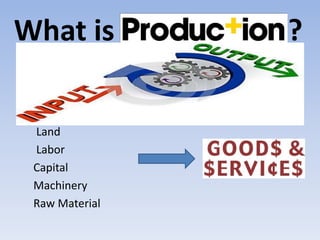
What is ?
Inputs Outputs
Land
Labor Goods or
Capital Services
Machinery
Raw Material
Production Function
Production Function is an equation which specifies
the maximum no. of output which can be generated
from the available set of inputs.
Q= f ( L,K,M….)
Q= Quantity
L= Labor
K= Capital
M= Machinery
Long Run
As in short-run, only one factor of production is considered
variable, all others are fixed.
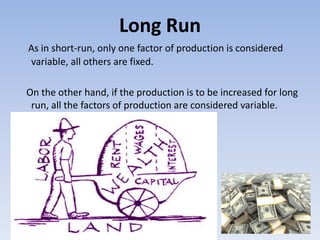
On the other hand, if the production is to be increased for long
run, all the factors of production are considered variable.
Two Input Production Function
Set of inputs will vary from firm to firm.
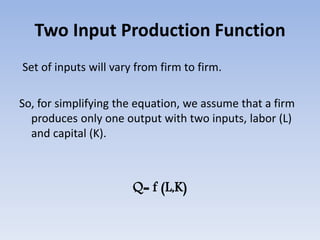
So, for simplifying the equation, we assume that a firm
produces only one output with two inputs, labor (L)
and capital (K).
Q= f (L,K)
ISO-QUANT CURVE
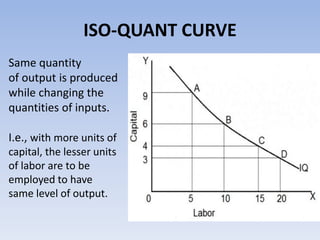
Same quantity
of output is produced
while changing the
quantities of inputs.
I.e., with more units of
capital, the lesser units
of labor are to be
employed to have
same level of output.
Features of Iso-quant
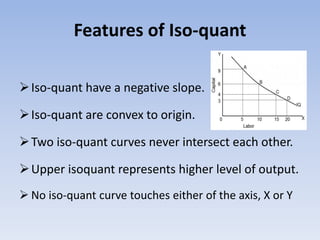
Iso-quant have a negative slope.
Iso-quant are convex to origin.
Two iso-quant curves never intersect each other.
Upper isoquant represents higher level of output.
 No iso-quant curve touches either of the axis, X or Y
RETURNS TO SCALE
 Degree by which output will change as a result of
change in quantity of all the factors of input
 Applies in long run.
Three stages of returns to scale:-
1. Constant returns to scale.
2. Increasing returns to scale.
3. Decreasing returns to scale.
Assumptions of the law
All the factors of production are variable. (such as
land, labor, capital)
Technology remains constant.
Outputs are measured in physical terms.
The market is perfectly competitive.
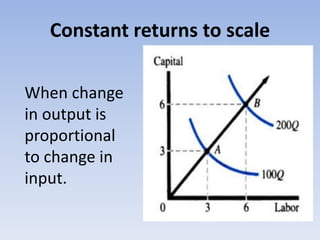
Constant returns to scale
When change
in output is
proportional
to change in
input.
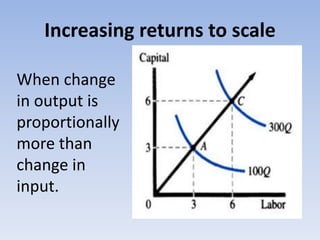
Increasing returns to scale
When change
in output is
proportionally
more than
change in
input.
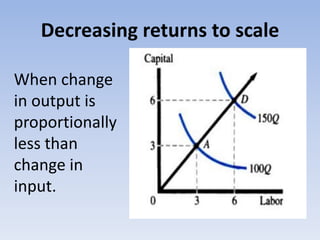
Decreasing returns to scale
When change
in output is
proportionally
less than
change in
input.
Thank You

Returns to scale

  • 1.
  • 2.
    What is ? InputsOutputs Land Labor Goods or Capital Services Machinery Raw Material
  • 3.
    Production Function Production Functionis an equation which specifies the maximum no. of output which can be generated from the available set of inputs. Q= f ( L,K,M….) Q= Quantity L= Labor K= Capital M= Machinery
  • 4.
    Long Run As inshort-run, only one factor of production is considered variable, all others are fixed. On the other hand, if the production is to be increased for long run, all the factors of production are considered variable.
  • 5.
    Two Input ProductionFunction Set of inputs will vary from firm to firm. So, for simplifying the equation, we assume that a firm produces only one output with two inputs, labor (L) and capital (K). Q= f (L,K)
  • 6.
    ISO-QUANT CURVE Same quantity ofoutput is produced while changing the quantities of inputs. I.e., with more units of capital, the lesser units of labor are to be employed to have same level of output.
  • 7.
    Features of Iso-quant Iso-quanthave a negative slope. Iso-quant are convex to origin. Two iso-quant curves never intersect each other. Upper isoquant represents higher level of output.  No iso-quant curve touches either of the axis, X or Y
  • 8.
    RETURNS TO SCALE Degree by which output will change as a result of change in quantity of all the factors of input  Applies in long run. Three stages of returns to scale:- 1. Constant returns to scale. 2. Increasing returns to scale. 3. Decreasing returns to scale.
  • 9.
    Assumptions of thelaw All the factors of production are variable. (such as land, labor, capital) Technology remains constant. Outputs are measured in physical terms. The market is perfectly competitive.
  • 10.
    Constant returns toscale When change in output is proportional to change in input.
  • 11.
    Increasing returns toscale When change in output is proportionally more than change in input.
  • 12.
    Decreasing returns toscale When change in output is proportionally less than change in input.
  • 13.