LATERITE
MANU MALIEKAL
PRASHINPRASHANTH
MALAVIKA M
ATHIRAD
AMRITAS
Abdulla farhan
Background
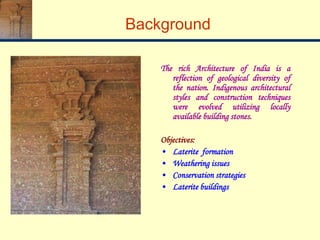
The rich Architecture of India is a
reflection of geological diversity of
the nation. Indigenous architectural
styles and construction techniques
were evolved utilizing locally
available building stones.
Objectives:
• Laterite formation
• Weathering issues
• Conservation strategies
• Laterite buildings
LATERITE STORY
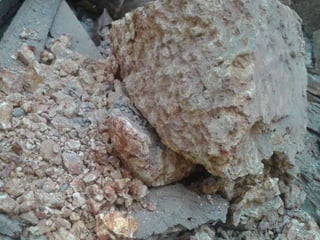
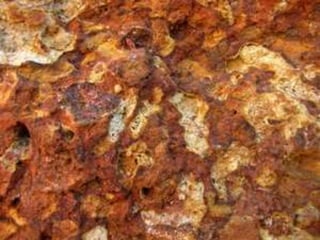
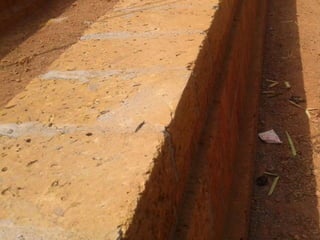
Of the various soil types that occur in the tropics and sub-tropics,
laterites are
of special interest in conjunction with building construction. These
are highly
weathered soils, which contain large, though extremely variable,
proportions
of iron and aluminium oxides, as well as quartz and other minerals.
They are found abundantly in the tropics and sub-tropics, where they
generally
occur just below the surface of wide grasslands or forest clearings in
regions
with high rainfall. The colours can vary from ochre through red,
brown, violet to
black, depending largely on the concentration of iron oxides
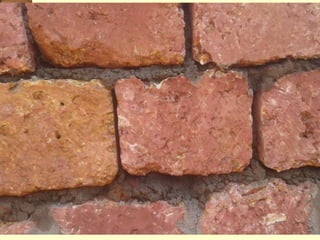
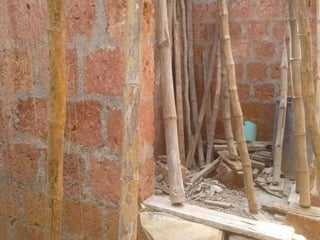
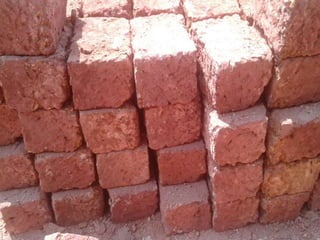
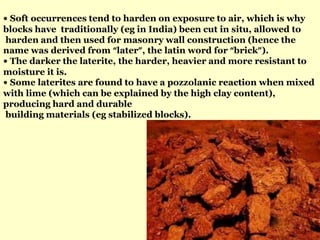
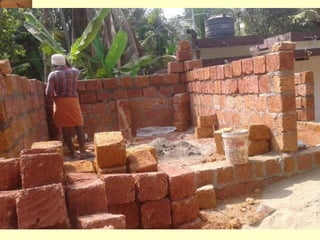
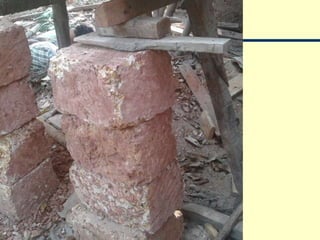
• Soft occurrences tend to harden on exposure to air, which is why
blocks have traditionally (eg in India) been cut in situ, allowed to
harden and then used for masonry wall construction (hence the
name was derived from “later”, the latin word for “brick”).
• The darker the laterite, the harder, heavier and more resistant to
moisture it is.
• Some laterites are found to have a pozzolanic reaction when mixed
with lime (which can be explained by the high clay content),
producing hard and durable
building materials (eg stabilized blocks).
Outline of Presentation
• Laterite- Background
• Laterite Monuments in India
– Prehistoric megaliths
– Maritime Forts
– Religious monuments
– Traditional residences
– Ancillary structures
• Laterite – Properties and weathering
mechanisms
• Conservation Strategies
• Summary & Conclusions
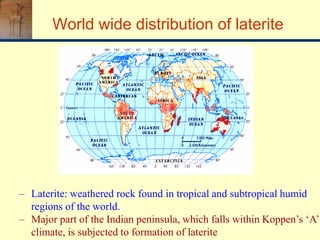
World wide distribution of laterite
– Laterite: weathered rock found in tropical and subtropical humid
regions of the world.
– Major part of the Indian peninsula, which falls within Koppen’s ‘A’
climate, is subjected to formation of laterite
About laterite…
• Laterite, tropical weathered rock, defined for the first time by
Buchanan(1807) as a versatile building material of Malabar region of
India
• It is considered as metasomatic rock (different from other type of
rocks) altered form of other rock types- igneous, sedimentary or
metamorphic
• Laterite is treated as a weak rock for building applications; also as a
soil group. Methods of testing-different from other rock types
• Cost effective, energy efficient and environment friendly
building material in Malabar region of Kerala
• Good aesthetics, easiness to cut and hardening with age,
makes it unique compared to other natural stones
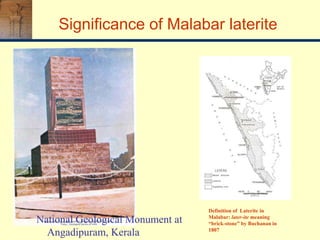
Significance of Malabar laterite
National Geological Monument at
Angadipuram, Kerala
Definition of Laterite in
Malabar: later-ite meaning
“brick-stone” by Buchanan in
1807
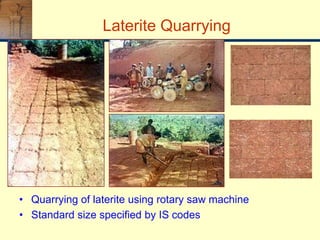
Laterite Quarrying
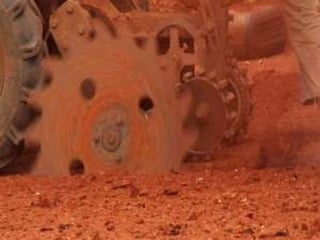
• Quarrying of laterite using rotary saw machine
• Standard size specified by IS codes
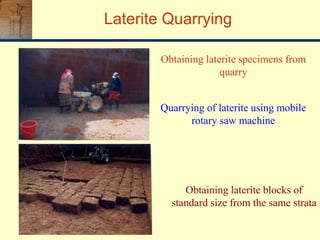
Laterite Quarrying
Quarrying of laterite using mobile
rotary saw machine
Obtaining laterite blocks of
standard size from the same strata
Obtaining laterite specimens from
quarry
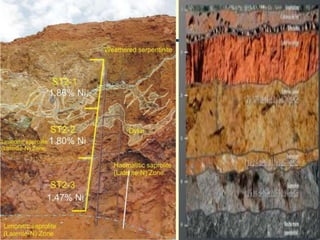
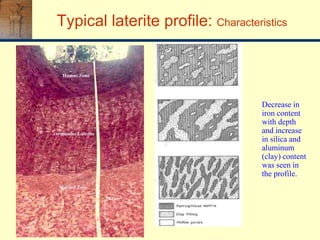
Decrease in
iron content
with depth
and increase
in silica and
aluminum
(clay) content
was seen in
the profile.
Typical laterite profile: Characteristics
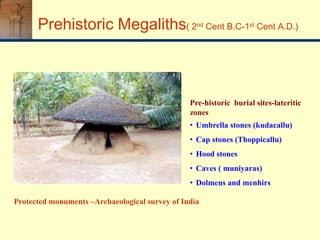
Prehistoric Megaliths( 2nd Cent B.C-1st Cent A.D.)
Pre-historic burial sites-lateritic
zones
• Umbrella stones (kudacallu)
• Cap stones (Thoppicallu)
• Hood stones
• Caves ( muniyaras)
• Dolmens and menhirs
Protected monuments –Archaeological survey of India
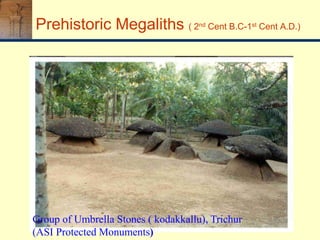
Group of Umbrella Stones ( kodakkallu), Trichur
(ASI Protected Monuments)
Prehistoric Megaliths ( 2nd Cent B.C-1st Cent A.D.)
Maritime Forts of Malabar
• Bekkal Fort, Kasarkode (16th Century)
• Tellicherry Fort ( 18th century)
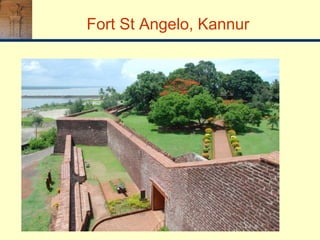
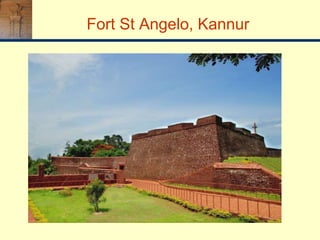
• Fort St. Angelo, Kannur ( 15th Century)
These heritage monuments and natural sites with its environmental settings has
been recommended by ASI to include in the World Heritage list of UNESCO
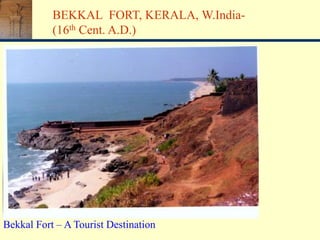
Bekkal Fort – A Tourist Destination
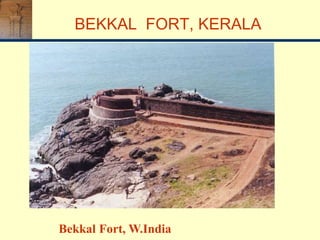
BEKKAL FORT, KERALA, W.India-
(16th Cent. A.D.)
Bekkal Fort, W.India
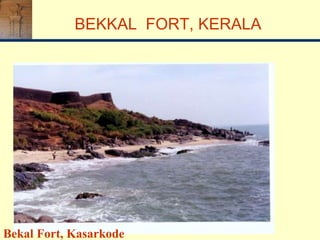
BEKKAL FORT, KERALA
Bekal Fort, Kasarkode
BEKKAL FORT, KERALA
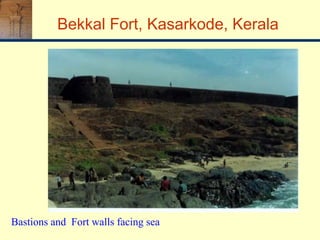
Bastions and Fort walls facing sea
Bekkal Fort, Kasarkode, Kerala
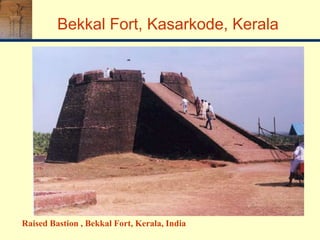
Raised Bastion , Bekkal Fort, Kerala, India
Bekkal Fort, Kasarkode, Kerala
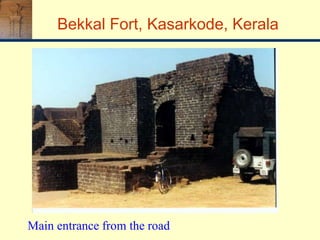
Main entrance from the road
Bekkal Fort, Kasarkode, Kerala
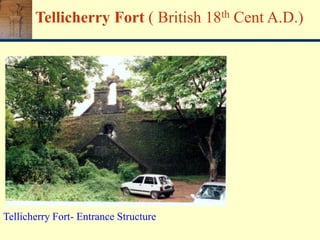
Tellicherry Fort- Entrance Structure
Tellicherry Fort ( British 18th Cent A.D.)
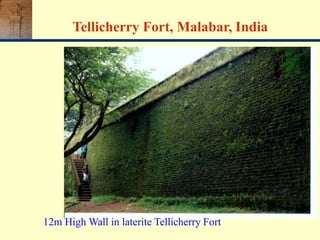
12m High Wall in laterite Tellicherry Fort
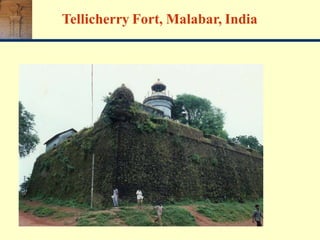
Tellicherry Fort, Malabar, India
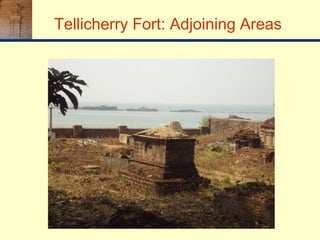
Tellicherry Fort: Adjoining Areas
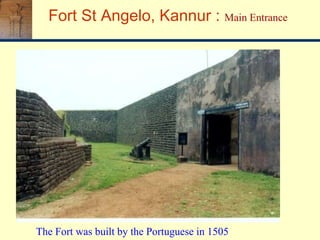
The Fort was built by the Portuguese in 1505
Fort St Angelo, Kannur : Main Entrance
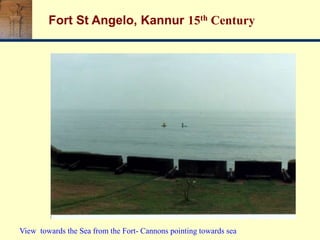
View towards the Sea from the Fort- Cannons pointing towards sea
Fort St Angelo, Kannur 15th Century
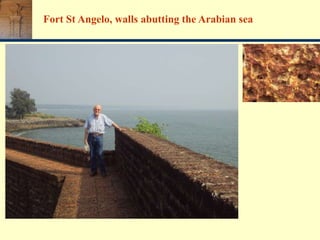
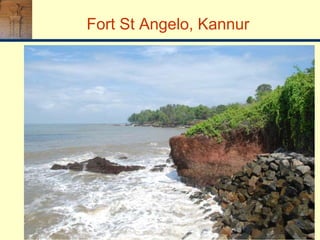
Fort St Angelo, walls abutting the Arabian sea
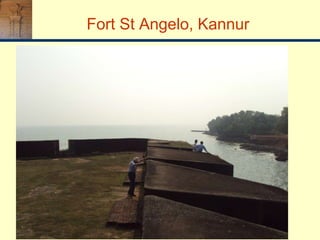
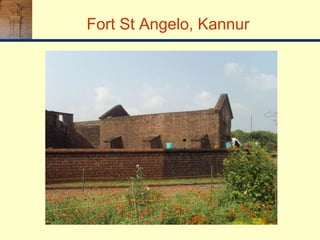
Fort St Angelo, Kannur
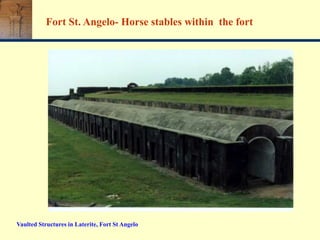
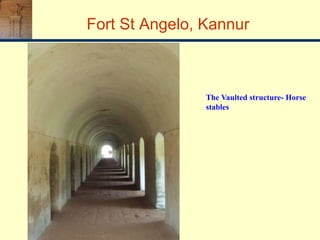
Vaulted Structures in Laterite, Fort St Angelo
Fort St. Angelo- Horse stables within the fort
The Vaulted structure- Horse
stables
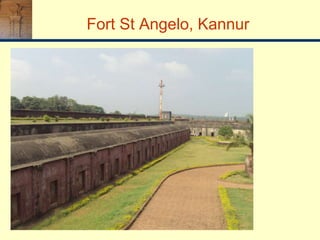
Fort St Angelo, Kannur
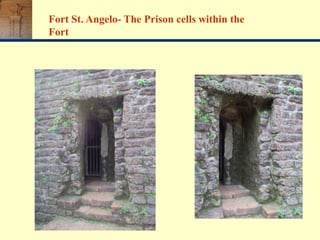
Fort St. Angelo- The Prison cells within the
Fort
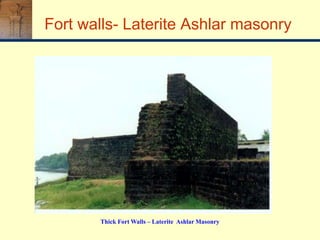
Thick Fort Walls – Laterite Ashlar Masonry
Fort walls- Laterite Ashlar masonry
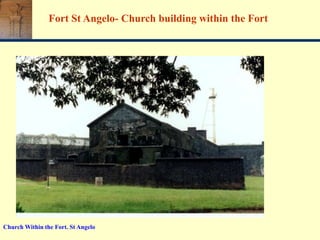
Church Within the Fort. St Angelo
Fort St Angelo- Church building within the Fort
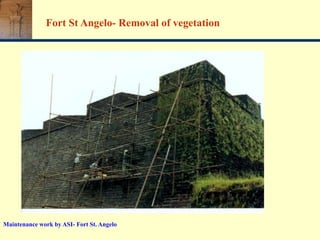
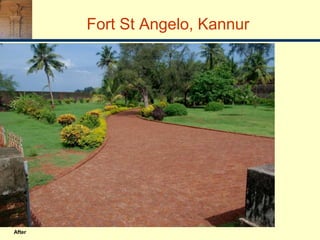
Maintenance work by ASI- Fort St. Angelo
Fort St Angelo- Removal of vegetation
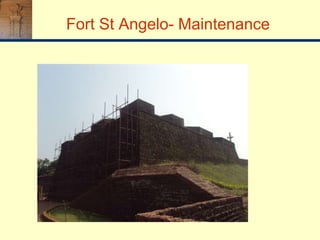
Fort St Angelo- Maintenance
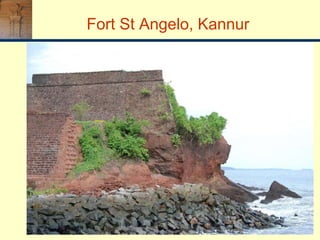
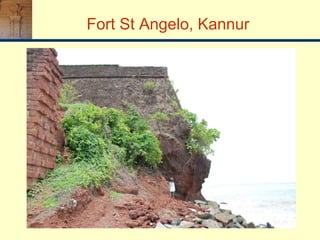
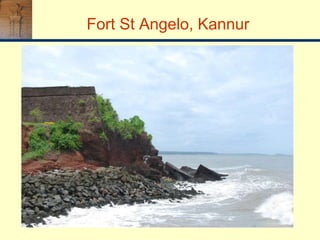
Fort St Angelo, Kannur
After
Fort St Angelo, Kannur
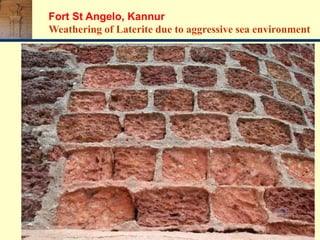
Weathering of Laterite due to aggressive sea environment
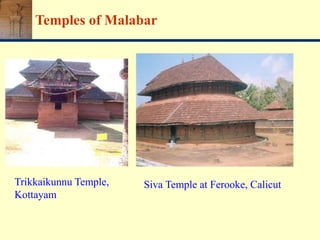
Temples of Malabar
Trikkaikunnu Temple,
Kottayam
Siva Temple at Ferooke, Calicut
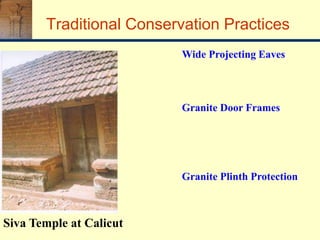
Siva Temple at Calicut
Wide Projecting Eaves
Granite Door Frames
Granite Plinth Protection
Traditional Conservation Practices
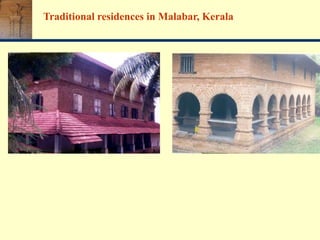
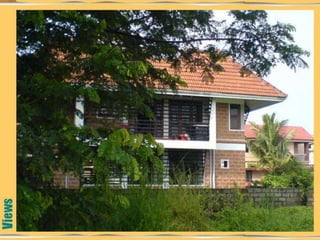
Traditional residences in Malabar, Kerala
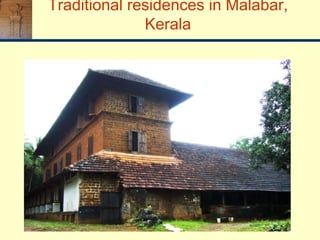
Traditional residences in Malabar,
Kerala
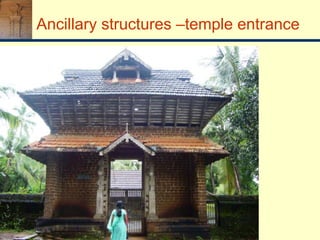
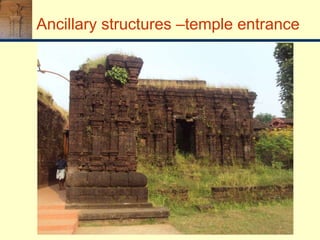
Ancillary structures –temple entrance
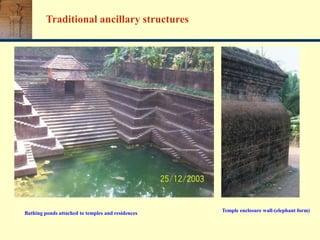
Traditional ancillary structures
Bathing ponds attached to temples and residences
Temple enclosure wall-(elephant form)
World heritage monuments: Churches and
convents of Goa
Church of St. Francis of Asissi, Goa
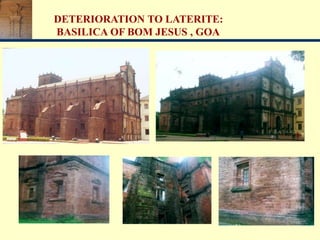
DETERIORATION TO LATERITE:
BASILICA OF BOM JESUS , GOA
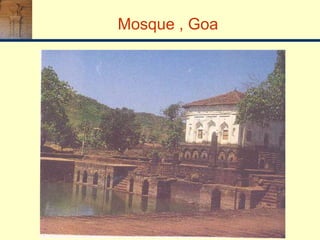
Mosque , Goa
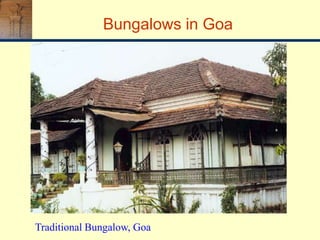
Traditional Bungalow, Goa
Bungalows in Goa
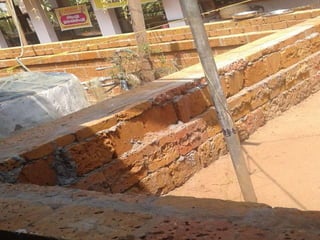
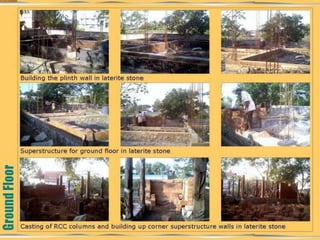
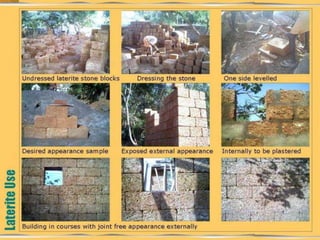
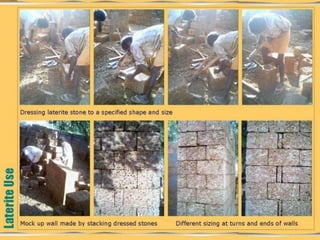
CONSTRUCTION
OF LATERITE
BUILDINGS
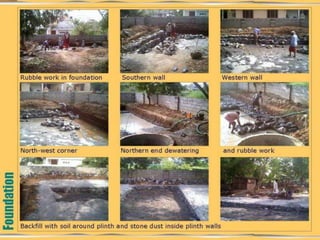
Foundation
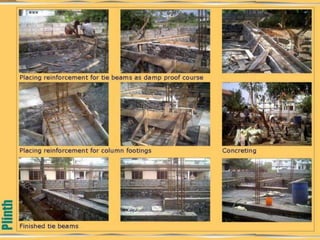
PLINTH
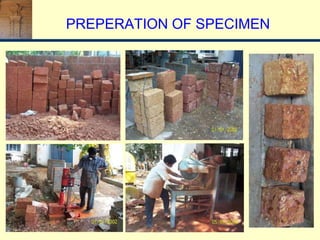
PREPERATION OF SPECIMEN
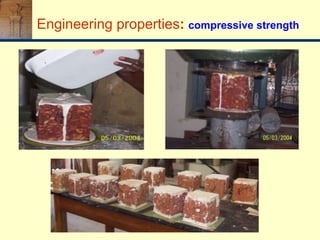
Engineering properties: compressive strength
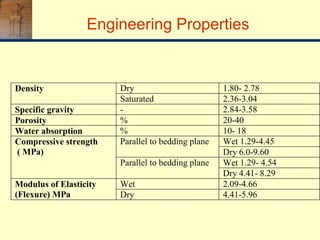
Engineering Properties
Density Dry 1.80- 2.78
Saturated 2.36-3.04
Specific gravity - 2.84-3.58
Porosity % 20-40
Water absorption % 10- 18
Compressive strength
( MPa)
Parallel to bedding plane Wet 1.29-4.45
Dry 6.0-9.60
Parallel to bedding plane Wet 1.29- 4.54
Dry 4.41- 8.29
Modulus of Elasticity
(Flexure) MPa
Wet 2.09-4.66
Dry 4.41-5.96
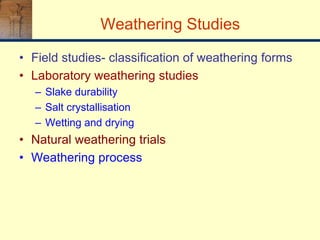
Weathering Studies
• Field studies- classification of weathering forms
• Laboratory weathering studies
– Slake durability
– Salt crystallisation
– Wetting and drying
• Natural weathering trials
• Weathering process
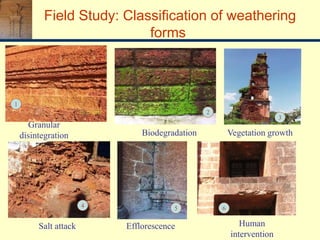
Field Study: Classification of weathering
forms
1
4
2
5 6
3
Granular
disintegration Biodegradation Vegetation growth
Human
intervention
EfflorescenceSalt attack
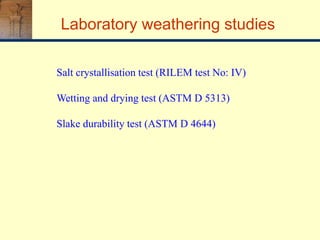
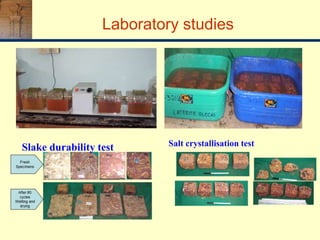
Laboratory weathering studies
Salt crystallisation test (RILEM test No: IV)
Wetting and drying test (ASTM D 5313)
Slake durability test (ASTM D 4644)
Laboratory studies
Salt crystallisation testSlake durability test
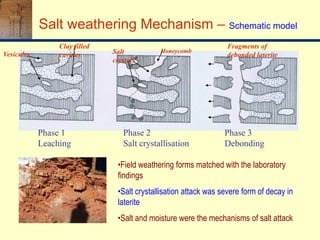
Salt weathering Mechanism – Schematic model
Phase 1
Leaching
Phase 2
Salt crystallisation
Phase 3
Debonding
Vesicules
Clay filled
cavities Salt
crystals
Fragments of
debonded laterite
Honeycomb
•Field weathering forms matched with the laboratory
findings
•Salt crystallisation attack was severe form of decay in
laterite
•Salt and moisture were the mechanisms of salt attack
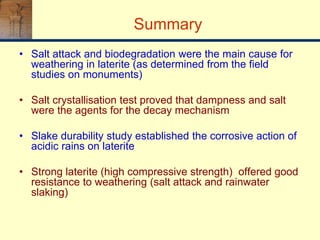
Summary
• Salt attack and biodegradation were the main cause for
weathering in laterite (as determined from the field
studies on monuments)
• Salt crystallisation test proved that dampness and salt
were the agents for the decay mechanism
• Slake durability study established the corrosive action of
acidic rains on laterite
• Strong laterite (high compressive strength) offered good
resistance to weathering (salt attack and rainwater
slaking)
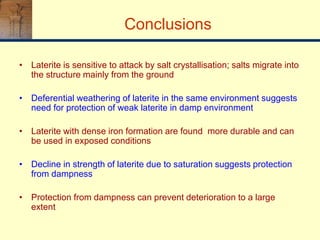
Conclusions
• Laterite is sensitive to attack by salt crystallisation; salts migrate into
the structure mainly from the ground
• Deferential weathering of laterite in the same environment suggests
need for protection of weak laterite in damp environment
• Laterite with dense iron formation are found more durable and can
be used in exposed conditions
• Decline in strength of laterite due to saturation suggests protection
from dampness
• Protection from dampness can prevent deterioration to a large
extent
THANK YOU

Laterite

  • 1.
  • 2.
    Background The rich Architectureof India is a reflection of geological diversity of the nation. Indigenous architectural styles and construction techniques were evolved utilizing locally available building stones. Objectives: • Laterite formation • Weathering issues • Conservation strategies • Laterite buildings
  • 7.
    LATERITE STORY Of thevarious soil types that occur in the tropics and sub-tropics, laterites are of special interest in conjunction with building construction. These are highly weathered soils, which contain large, though extremely variable, proportions of iron and aluminium oxides, as well as quartz and other minerals. They are found abundantly in the tropics and sub-tropics, where they generally occur just below the surface of wide grasslands or forest clearings in regions with high rainfall. The colours can vary from ochre through red, brown, violet to black, depending largely on the concentration of iron oxides
  • 8.
    • Soft occurrencestend to harden on exposure to air, which is why blocks have traditionally (eg in India) been cut in situ, allowed to harden and then used for masonry wall construction (hence the name was derived from “later”, the latin word for “brick”). • The darker the laterite, the harder, heavier and more resistant to moisture it is. • Some laterites are found to have a pozzolanic reaction when mixed with lime (which can be explained by the high clay content), producing hard and durable building materials (eg stabilized blocks).
  • 9.
    Outline of Presentation •Laterite- Background • Laterite Monuments in India – Prehistoric megaliths – Maritime Forts – Religious monuments – Traditional residences – Ancillary structures • Laterite – Properties and weathering mechanisms • Conservation Strategies • Summary & Conclusions
  • 10.
    World wide distributionof laterite – Laterite: weathered rock found in tropical and subtropical humid regions of the world. – Major part of the Indian peninsula, which falls within Koppen’s ‘A’ climate, is subjected to formation of laterite
  • 11.
    About laterite… • Laterite,tropical weathered rock, defined for the first time by Buchanan(1807) as a versatile building material of Malabar region of India • It is considered as metasomatic rock (different from other type of rocks) altered form of other rock types- igneous, sedimentary or metamorphic • Laterite is treated as a weak rock for building applications; also as a soil group. Methods of testing-different from other rock types • Cost effective, energy efficient and environment friendly building material in Malabar region of Kerala • Good aesthetics, easiness to cut and hardening with age, makes it unique compared to other natural stones
  • 12.
    Significance of Malabarlaterite National Geological Monument at Angadipuram, Kerala Definition of Laterite in Malabar: later-ite meaning “brick-stone” by Buchanan in 1807
  • 18.
    Laterite Quarrying • Quarryingof laterite using rotary saw machine • Standard size specified by IS codes
  • 19.
    Laterite Quarrying Quarrying oflaterite using mobile rotary saw machine Obtaining laterite blocks of standard size from the same strata Obtaining laterite specimens from quarry
  • 21.
    Decrease in iron content withdepth and increase in silica and aluminum (clay) content was seen in the profile. Typical laterite profile: Characteristics
  • 24.
    Prehistoric Megaliths( 2ndCent B.C-1st Cent A.D.) Pre-historic burial sites-lateritic zones • Umbrella stones (kudacallu) • Cap stones (Thoppicallu) • Hood stones • Caves ( muniyaras) • Dolmens and menhirs Protected monuments –Archaeological survey of India
  • 25.
    Group of UmbrellaStones ( kodakkallu), Trichur (ASI Protected Monuments) Prehistoric Megaliths ( 2nd Cent B.C-1st Cent A.D.)
  • 26.
    Maritime Forts ofMalabar • Bekkal Fort, Kasarkode (16th Century) • Tellicherry Fort ( 18th century) • Fort St. Angelo, Kannur ( 15th Century) These heritage monuments and natural sites with its environmental settings has been recommended by ASI to include in the World Heritage list of UNESCO
  • 27.
    Bekkal Fort –A Tourist Destination BEKKAL FORT, KERALA, W.India- (16th Cent. A.D.)
  • 28.
  • 29.
  • 30.
    Bastions and Fortwalls facing sea Bekkal Fort, Kasarkode, Kerala
  • 31.
    Raised Bastion ,Bekkal Fort, Kerala, India Bekkal Fort, Kasarkode, Kerala
  • 32.
    Main entrance fromthe road Bekkal Fort, Kasarkode, Kerala
  • 33.
    Tellicherry Fort- EntranceStructure Tellicherry Fort ( British 18th Cent A.D.)
  • 34.
    12m High Wallin laterite Tellicherry Fort Tellicherry Fort, Malabar, India
  • 36.
  • 37.
    The Fort wasbuilt by the Portuguese in 1505 Fort St Angelo, Kannur : Main Entrance
  • 38.
    View towards theSea from the Fort- Cannons pointing towards sea Fort St Angelo, Kannur 15th Century
  • 39.
    Fort St Angelo,walls abutting the Arabian sea
  • 40.
  • 41.
  • 42.
    Vaulted Structures inLaterite, Fort St Angelo Fort St. Angelo- Horse stables within the fort
  • 43.
    The Vaulted structure-Horse stables Fort St Angelo, Kannur
  • 45.
    Fort St. Angelo-The Prison cells within the Fort
  • 46.
    Thick Fort Walls– Laterite Ashlar Masonry Fort walls- Laterite Ashlar masonry
  • 47.
    Church Within theFort. St Angelo Fort St Angelo- Church building within the Fort
  • 48.
    Maintenance work byASI- Fort St. Angelo Fort St Angelo- Removal of vegetation
  • 49.
    Fort St Angelo-Maintenance
  • 50.
  • 51.
  • 52.
  • 53.
  • 54.
  • 55.
  • 56.
  • 57.
  • 58.
    Fort St Angelo,Kannur Weathering of Laterite due to aggressive sea environment
  • 59.
    Temples of Malabar TrikkaikunnuTemple, Kottayam Siva Temple at Ferooke, Calicut
  • 60.
    Siva Temple atCalicut Wide Projecting Eaves Granite Door Frames Granite Plinth Protection Traditional Conservation Practices
  • 61.
  • 62.
  • 63.
  • 64.
  • 65.
    Traditional ancillary structures Bathingponds attached to temples and residences Temple enclosure wall-(elephant form)
  • 66.
    World heritage monuments:Churches and convents of Goa Church of St. Francis of Asissi, Goa
  • 67.
  • 68.
  • 69.
  • 70.
  • 76.
  • 77.
  • 83.
  • 84.
  • 85.
    Engineering Properties Density Dry1.80- 2.78 Saturated 2.36-3.04 Specific gravity - 2.84-3.58 Porosity % 20-40 Water absorption % 10- 18 Compressive strength ( MPa) Parallel to bedding plane Wet 1.29-4.45 Dry 6.0-9.60 Parallel to bedding plane Wet 1.29- 4.54 Dry 4.41- 8.29 Modulus of Elasticity (Flexure) MPa Wet 2.09-4.66 Dry 4.41-5.96
  • 86.
    Weathering Studies • Fieldstudies- classification of weathering forms • Laboratory weathering studies – Slake durability – Salt crystallisation – Wetting and drying • Natural weathering trials • Weathering process
  • 87.
    Field Study: Classificationof weathering forms 1 4 2 5 6 3 Granular disintegration Biodegradation Vegetation growth Human intervention EfflorescenceSalt attack
  • 88.
    Laboratory weathering studies Saltcrystallisation test (RILEM test No: IV) Wetting and drying test (ASTM D 5313) Slake durability test (ASTM D 4644)
  • 89.
    Laboratory studies Salt crystallisationtestSlake durability test
  • 90.
    Salt weathering Mechanism– Schematic model Phase 1 Leaching Phase 2 Salt crystallisation Phase 3 Debonding Vesicules Clay filled cavities Salt crystals Fragments of debonded laterite Honeycomb •Field weathering forms matched with the laboratory findings •Salt crystallisation attack was severe form of decay in laterite •Salt and moisture were the mechanisms of salt attack
  • 91.
    Summary • Salt attackand biodegradation were the main cause for weathering in laterite (as determined from the field studies on monuments) • Salt crystallisation test proved that dampness and salt were the agents for the decay mechanism • Slake durability study established the corrosive action of acidic rains on laterite • Strong laterite (high compressive strength) offered good resistance to weathering (salt attack and rainwater slaking)
  • 92.
    Conclusions • Laterite issensitive to attack by salt crystallisation; salts migrate into the structure mainly from the ground • Deferential weathering of laterite in the same environment suggests need for protection of weak laterite in damp environment • Laterite with dense iron formation are found more durable and can be used in exposed conditions • Decline in strength of laterite due to saturation suggests protection from dampness • Protection from dampness can prevent deterioration to a large extent
  • 93.