Maulana Azad National Institute of Technology
 Good farming conditions
 Provided fish and
freshwater
 Easy to travel
 Easy to trade (way
goods and ideas
moved from place
to place)
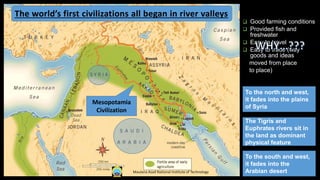
The world’s first civilizations all began in river valleys
Mesopotamia
Civilization
To the north and west,
it fades into the plains
of Syria
The Tigris and
Euphrates rivers sit in
the land as dominant
physical feature
To the south and west,
it fades into the
Arabian desertMaulana Azad National Institute of Technology
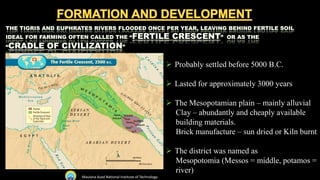
 Probably settled before 5000 B.C.
 Lasted for approximately 3000 years
 The Mesopotamian plain – mainly alluvial
Clay – abundantly and cheaply available
building materials.
Brick manufacture – sun dried or Kiln burnt
 The district was named as
Mesopotomia (Messos = middle, potamos =
river)
Maulana Azad National Institute of Technology
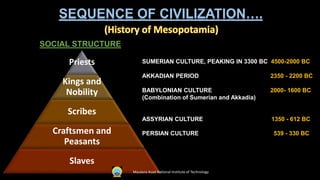
SEQUENCE OF CIVILIZATION….
SUMERIAN CULTURE, PEAKING IN 3300 BC 4500-2000 BC
AKKADIAN PERIOD 2350 - 2200 BC
BABYLONIAN CULTURE 2000- 1600 BC
(Combination of Sumerian and Akkadia)
ASSYRIAN CULTURE 1350 - 612 BC
PERSIAN CULTURE 539 - 330 BC
Priests
Kings and
Nobility
Scribes
Craftsmen and
Peasants
Slaves
SOCIAL STRUCTURE
Maulana Azad National Institute of Technology
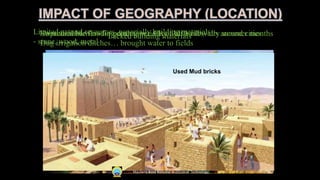
Unpredictable flooding during periods of little rain / dry summer months
Dug irrigation ditches… brought water to fields
No natural barriers for protection…City wall built walls around citiesLimited natural resources, especially building materials
‐ stone, wood, metal
Trade
Traded with people around them for the
products they lacked
Lacked building materials
Used Mud bricks
Maulana Azad National Institute of Technology
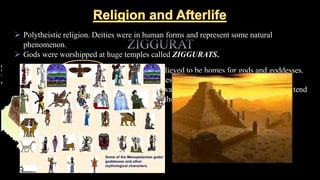
 Polytheistic religion. Deities were in human forms and represent some natural
phenomenon.
 Gods were worshipped at huge temples called ZIGGURATS.
• Believed to be homes for gods and goddesses.
• Priests were permitted inside the ziggurat
• It was their duty to care for the gods and attend
to their needs.
CELLA
From about 3000 B.C. many cities grew up in Sumer such as:
 Ur
 Uruk
 Eridu
 Mari
The Sumerians became powerful under ruler Ur- Nammu who
reigned from 2113-2046 B.C.
He constructed the famous Ziggurat at Ur.
City of Ur was at its highest glory and capital of Sumer.
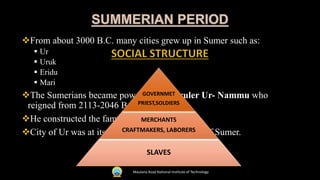
GOVERNMET
PRIEST,SOLDIERS
MERCHANTS
CRAFTMAKERS, LABORERS
SLAVES
Maulana Azad National Institute of Technology
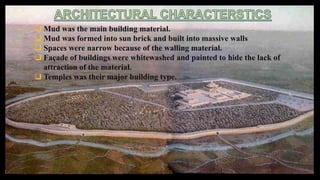
 Mud was the main building material.
 Mud was formed into sun brick and built into massive walls
 Spaces were narrow because of the walling material.
 Façade of buildings were whitewashed and painted to hide the lack of
attraction of the material.
 Temples was their major building type.
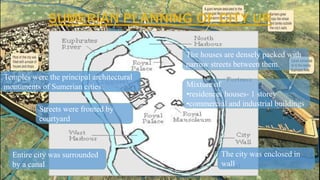
Entire city was surrounded
by a canal
The houses are densely packed with
narrow streets between them.
The city was enclosed in
wall
Temples were the principal architectural
monuments of Sumerian cities.. Mixture of
•residences houses- 1 storey
•commercial and industrial buildings
Streets were fronted by
courtyard
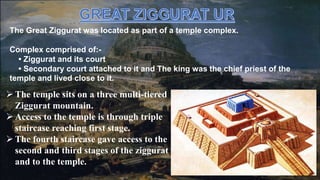
 The temple sits on a three multi-tiered
Ziggurat mountain.
 Access to the temple is through triple
staircase reaching first stage.
 The fourth staircase gave access to the
second and third stages of the ziggurat
and to the temple.
The Great Ziggurat was located as part of a temple complex.
Complex comprised of:-
• Ziggurat and its court
• Secondary court attached to it and The king was the chief priest of the
temple and lived close to it.
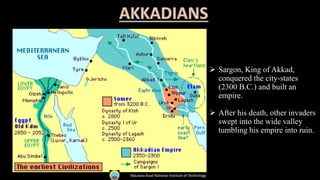
 Sargon, King of Akkad,
conquered the city-states
(2300 B.C.) and built an
empire.
 After his death, other invaders
swept into the wide valley
tumbling his empire into ruin.
Maulana Azad National Institute of Technology
The fifth king of the first Dynasty was
Hammurabi(1792-1750B.C.)
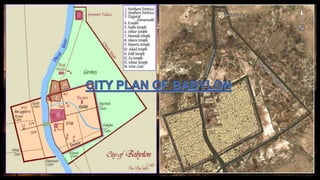
Babylonian civilization mainly developed in
the central southern region of the
Mesopotamia. (Present day Iraq)
Babylonians invented the idea of a circle
containing 360 degrees and the hour
containing sixty minutes.
The king build new walls to protect the city and new canals and dikes to improve
crops
Economy was based on agriculture and wool / cloth
Individuals could own land around cities
Grain used as the medium of exchange.
Hammurabi’s Legacy: Law code
To enforce his rule, Hammurabi collected all the laws of
Babylon in a code that would apply everywhere in the
land.
Code of 282 laws inscribed on a stone pillar placed in the
public hall for all to see
Hammurabi Code was an origin to the concept of “eye for
an eye…”
Consequences for crimes depended on rank in society (ie.
only fines for nobility) Maulana Azad National Institute of Technology
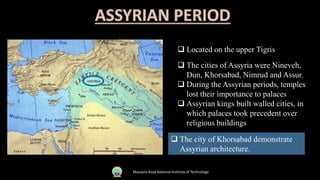
 The city of Khorsabad demonstrate
Assyrian architecture.
 Located on the upper Tigris
 The cities of Assyria were Nineveh,
Dun, Khorsabad, Nimrud and Assur.
 During the Assyrian periods, temples
lost their importance to palaces
 Assyrian kings built walled cities, in
which palaces took precedent over
religious buildings
Maulana Azad National Institute of Technology
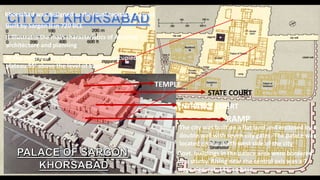
TEMPLE
STATE COURT
ENTRANCE COURT
RAMP
Khorsabad was designed as the royal capital of Assyria
Built by Sargon II in 720 BCE
It illustrates the main characteristics of Assyrian
architecture and planning
At the centre of the city 25acre palace occupied a
plateau 55’ above the level of town
The city was built on a flat land and enclosed by a
double wall with seven city gates. The palace was
located on the north west side of the city
Govt. buildings in the palace area were bordered
by a sturby. Rising near the central axis was a 7
stage ziggurat. 143’ sq base
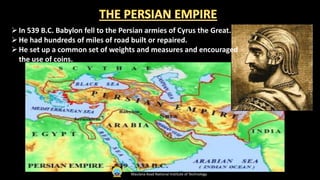
In 539 B.C. Babylon fell to the Persian armies of Cyrus the Great.
He had hundreds of miles of road built or repaired.
He set up a common set of weights and measures and encouraged
the use of coins.
Maulana Azad National Institute of Technology
Mesopotamia presentation

Mesopotamia presentation

  • 1.
    Maulana Azad NationalInstitute of Technology
  • 2.
     Good farmingconditions  Provided fish and freshwater  Easy to travel  Easy to trade (way goods and ideas moved from place to place) The world’s first civilizations all began in river valleys Mesopotamia Civilization To the north and west, it fades into the plains of Syria The Tigris and Euphrates rivers sit in the land as dominant physical feature To the south and west, it fades into the Arabian desertMaulana Azad National Institute of Technology
  • 3.
     Probably settledbefore 5000 B.C.  Lasted for approximately 3000 years  The Mesopotamian plain – mainly alluvial Clay – abundantly and cheaply available building materials. Brick manufacture – sun dried or Kiln burnt  The district was named as Mesopotomia (Messos = middle, potamos = river) Maulana Azad National Institute of Technology
  • 4.
    SEQUENCE OF CIVILIZATION…. SUMERIANCULTURE, PEAKING IN 3300 BC 4500-2000 BC AKKADIAN PERIOD 2350 - 2200 BC BABYLONIAN CULTURE 2000- 1600 BC (Combination of Sumerian and Akkadia) ASSYRIAN CULTURE 1350 - 612 BC PERSIAN CULTURE 539 - 330 BC Priests Kings and Nobility Scribes Craftsmen and Peasants Slaves SOCIAL STRUCTURE Maulana Azad National Institute of Technology
  • 6.
    Unpredictable flooding duringperiods of little rain / dry summer months Dug irrigation ditches… brought water to fields No natural barriers for protection…City wall built walls around citiesLimited natural resources, especially building materials ‐ stone, wood, metal Trade Traded with people around them for the products they lacked Lacked building materials Used Mud bricks Maulana Azad National Institute of Technology
  • 7.
     Polytheistic religion.Deities were in human forms and represent some natural phenomenon.  Gods were worshipped at huge temples called ZIGGURATS. • Believed to be homes for gods and goddesses. • Priests were permitted inside the ziggurat • It was their duty to care for the gods and attend to their needs. CELLA
  • 8.
    From about 3000B.C. many cities grew up in Sumer such as:  Ur  Uruk  Eridu  Mari The Sumerians became powerful under ruler Ur- Nammu who reigned from 2113-2046 B.C. He constructed the famous Ziggurat at Ur. City of Ur was at its highest glory and capital of Sumer. GOVERNMET PRIEST,SOLDIERS MERCHANTS CRAFTMAKERS, LABORERS SLAVES Maulana Azad National Institute of Technology
  • 9.
     Mud wasthe main building material.  Mud was formed into sun brick and built into massive walls  Spaces were narrow because of the walling material.  Façade of buildings were whitewashed and painted to hide the lack of attraction of the material.  Temples was their major building type.
  • 10.
    Entire city wassurrounded by a canal The houses are densely packed with narrow streets between them. The city was enclosed in wall Temples were the principal architectural monuments of Sumerian cities.. Mixture of •residences houses- 1 storey •commercial and industrial buildings Streets were fronted by courtyard
  • 11.
     The templesits on a three multi-tiered Ziggurat mountain.  Access to the temple is through triple staircase reaching first stage.  The fourth staircase gave access to the second and third stages of the ziggurat and to the temple. The Great Ziggurat was located as part of a temple complex. Complex comprised of:- • Ziggurat and its court • Secondary court attached to it and The king was the chief priest of the temple and lived close to it.
  • 12.
     Sargon, Kingof Akkad, conquered the city-states (2300 B.C.) and built an empire.  After his death, other invaders swept into the wide valley tumbling his empire into ruin. Maulana Azad National Institute of Technology
  • 13.
    The fifth kingof the first Dynasty was Hammurabi(1792-1750B.C.) Babylonian civilization mainly developed in the central southern region of the Mesopotamia. (Present day Iraq)
  • 14.
    Babylonians invented theidea of a circle containing 360 degrees and the hour containing sixty minutes. The king build new walls to protect the city and new canals and dikes to improve crops Economy was based on agriculture and wool / cloth Individuals could own land around cities Grain used as the medium of exchange. Hammurabi’s Legacy: Law code To enforce his rule, Hammurabi collected all the laws of Babylon in a code that would apply everywhere in the land. Code of 282 laws inscribed on a stone pillar placed in the public hall for all to see Hammurabi Code was an origin to the concept of “eye for an eye…” Consequences for crimes depended on rank in society (ie. only fines for nobility) Maulana Azad National Institute of Technology
  • 15.
     The cityof Khorsabad demonstrate Assyrian architecture.  Located on the upper Tigris  The cities of Assyria were Nineveh, Dun, Khorsabad, Nimrud and Assur.  During the Assyrian periods, temples lost their importance to palaces  Assyrian kings built walled cities, in which palaces took precedent over religious buildings Maulana Azad National Institute of Technology
  • 16.
    TEMPLE STATE COURT ENTRANCE COURT RAMP Khorsabadwas designed as the royal capital of Assyria Built by Sargon II in 720 BCE It illustrates the main characteristics of Assyrian architecture and planning At the centre of the city 25acre palace occupied a plateau 55’ above the level of town The city was built on a flat land and enclosed by a double wall with seven city gates. The palace was located on the north west side of the city Govt. buildings in the palace area were bordered by a sturby. Rising near the central axis was a 7 stage ziggurat. 143’ sq base
  • 17.
    In 539 B.C.Babylon fell to the Persian armies of Cyrus the Great. He had hundreds of miles of road built or repaired. He set up a common set of weights and measures and encouraged the use of coins. Maulana Azad National Institute of Technology
  • 18.
    Maulana Azad NationalInstitute of Technology