Field Lab   By Jacqueline AlvarezMr. LawlerGeology 1 December 5, 2010
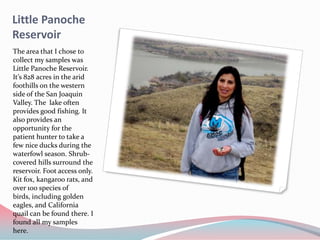
Little Panoche ReservoirThe area that I chose to collect my samples was Little Panoche Reservoir. It’s 828 acres in the arid foothills on the western side of the San Joaquin Valley. The  lake often provides good fishing. It also provides an opportunity for the patient hunter to take a few nice ducks during the waterfowl season. Shrub- covered hills surround the reservoir. Foot access only. Kit fox, kangaroo rats, and over 100 species of birds, including golden eagles, and California quail can be found there. I found all my samples here.
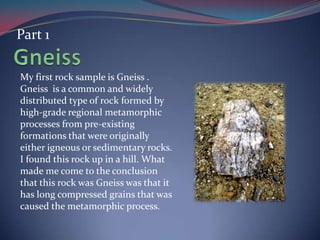
Part 1GneissMy first rock sample is Gneiss . Gneiss  is a common and widely distributed type of rock formed by high-grade regional metamorphic processes from pre-existing formations that were originally either igneous or sedimentary rocks. I found this rock up in a hill. What made me come to the conclusion that this rock was Gneiss was that it has long compressed grains that was caused the metamorphic process.
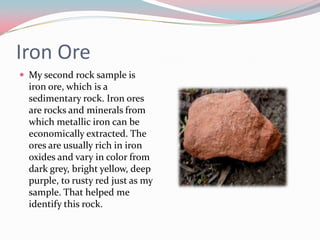
Iron Ore My second rock sample is iron ore, which is a sedimentary rock. Iron ores are rocks and minerals from which metallic iron can be economically extracted. The ores are usually rich in iron oxides and vary in color from dark grey, bright yellow, deep purple, to rusty red just as my sample. That helped me identify this rock.
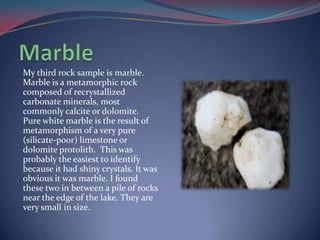
Marble My third rock sample is marble. Marble is a metamorphic rock composed of recrystallized carbonate minerals, most commonly calcite or dolomite. Pure white marble is the result of metamorphism of a very pure (silicate-poor) limestone or dolomite protolith.  This was probably the easiest to identify because it had shiny crystals. It was obvious it was marble. I found these two in between a pile of rocks  near the edge of the lake. They are very small in size.
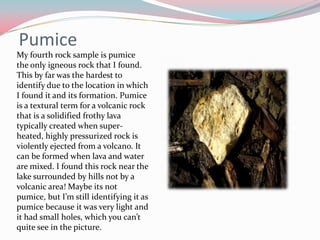
PumiceMy fourth rock sample is pumice the only igneous rock that I found. This by far was the hardest to identify due to the location in which I found it and its formation.Pumice is a textural term for a volcanic rock that is a solidified frothy lava typically created when super-heated, highly pressurized rock is violently ejected from a volcano. It can be formed when lava and water are mixed. I found this rock near the lake surrounded by hills not by a volcanic area! Maybe its not pumice, but I’m still identifying it as pumice because it was very light and it had small holes, which you can’t quite see in the picture.
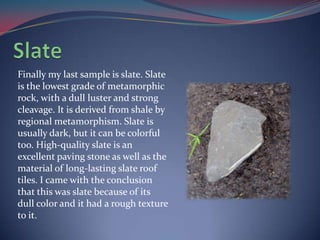
SlateFinally my last sample is slate. Slate is the lowest grade of metamorphic rock, with a dull luster and strong cleavage. It is derived from shale by regional metamorphism. Slate is usually dark, but it can be colorful too. High-quality slate is an excellent paving stone as well as the material of long-lasting slate roof tiles. I came with the conclusion that this was slate because of its dull color and it had a rough texture to it.
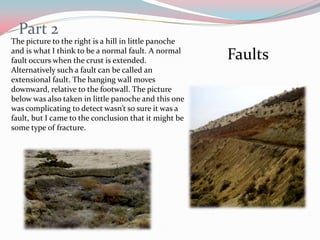
Part 2The picture to the right is a hill in little panoche and is what I think to be a normal fault. A normal fault occurs when the crust is extended. Alternatively such a fault can be called an extensional fault. The hanging wall moves downward, relative to the footwall. The picture  below was also taken in little panoche and this one was complicating to detect wasn’t so sure it was a fault, but I came to the conclusion that it might be some type of fracture. Faults
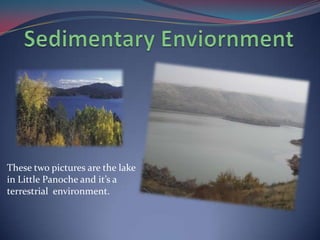
Sedimentary EnviornmentThese two pictures are the lake  in Little Panoche and it’s a terrestrial  environment.
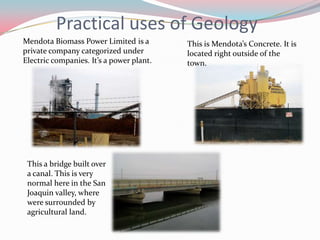
Practical uses of GeologyThis is Mendota’s Concrete. It is located right outside of the town.Mendota Biomass Power Limited is a private company categorized under Electric companies. It’s a power plant. This a bridge built over a canal. This is very normal here in the San Joaquin valley, where were surrounded by agricultural land.
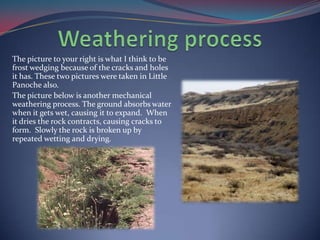
Weathering processThe picture to your right is what I think to be frost wedging because of the cracks and holes it has. These two pictures were taken in Little Panoche also. The picture below is another mechanical weathering process. The ground absorbs water when it gets wet, causing it to expand.  When it dries the rock contracts, causing cracks to form.  Slowly the rock is broken up by repeated wetting and drying. 

Field lab

  • 1.
    Field Lab By Jacqueline AlvarezMr. LawlerGeology 1 December 5, 2010
  • 2.
    Little Panoche ReservoirThearea that I chose to collect my samples was Little Panoche Reservoir. It’s 828 acres in the arid foothills on the western side of the San Joaquin Valley. The lake often provides good fishing. It also provides an opportunity for the patient hunter to take a few nice ducks during the waterfowl season. Shrub- covered hills surround the reservoir. Foot access only. Kit fox, kangaroo rats, and over 100 species of birds, including golden eagles, and California quail can be found there. I found all my samples here.
  • 3.
    Part 1GneissMy firstrock sample is Gneiss . Gneiss is a common and widely distributed type of rock formed by high-grade regional metamorphic processes from pre-existing formations that were originally either igneous or sedimentary rocks. I found this rock up in a hill. What made me come to the conclusion that this rock was Gneiss was that it has long compressed grains that was caused the metamorphic process.
  • 4.
    Iron Ore Mysecond rock sample is iron ore, which is a sedimentary rock. Iron ores are rocks and minerals from which metallic iron can be economically extracted. The ores are usually rich in iron oxides and vary in color from dark grey, bright yellow, deep purple, to rusty red just as my sample. That helped me identify this rock.
  • 5.
    Marble My thirdrock sample is marble. Marble is a metamorphic rock composed of recrystallized carbonate minerals, most commonly calcite or dolomite. Pure white marble is the result of metamorphism of a very pure (silicate-poor) limestone or dolomite protolith. This was probably the easiest to identify because it had shiny crystals. It was obvious it was marble. I found these two in between a pile of rocks near the edge of the lake. They are very small in size.
  • 6.
    PumiceMy fourth rocksample is pumice the only igneous rock that I found. This by far was the hardest to identify due to the location in which I found it and its formation.Pumice is a textural term for a volcanic rock that is a solidified frothy lava typically created when super-heated, highly pressurized rock is violently ejected from a volcano. It can be formed when lava and water are mixed. I found this rock near the lake surrounded by hills not by a volcanic area! Maybe its not pumice, but I’m still identifying it as pumice because it was very light and it had small holes, which you can’t quite see in the picture.
  • 7.
    SlateFinally my lastsample is slate. Slate is the lowest grade of metamorphic rock, with a dull luster and strong cleavage. It is derived from shale by regional metamorphism. Slate is usually dark, but it can be colorful too. High-quality slate is an excellent paving stone as well as the material of long-lasting slate roof tiles. I came with the conclusion that this was slate because of its dull color and it had a rough texture to it.
  • 8.
    Part 2The pictureto the right is a hill in little panoche and is what I think to be a normal fault. A normal fault occurs when the crust is extended. Alternatively such a fault can be called an extensional fault. The hanging wall moves downward, relative to the footwall. The picture below was also taken in little panoche and this one was complicating to detect wasn’t so sure it was a fault, but I came to the conclusion that it might be some type of fracture. Faults
  • 9.
    Sedimentary EnviornmentThese twopictures are the lake in Little Panoche and it’s a terrestrial environment.
  • 10.
    Practical uses ofGeologyThis is Mendota’s Concrete. It is located right outside of the town.Mendota Biomass Power Limited is a private company categorized under Electric companies. It’s a power plant. This a bridge built over a canal. This is very normal here in the San Joaquin valley, where were surrounded by agricultural land.
  • 11.
    Weathering processThe pictureto your right is what I think to be frost wedging because of the cracks and holes it has. These two pictures were taken in Little Panoche also. The picture below is another mechanical weathering process. The ground absorbs water when it gets wet, causing it to expand.  When it dries the rock contracts, causing cracks to form.  Slowly the rock is broken up by repeated wetting and drying.