BUILDING MATERIALS

SAND

Ar. Ravindra Patnayaka
B.Arch, M.Tech (Planning)
Assistant Professor in Architecture
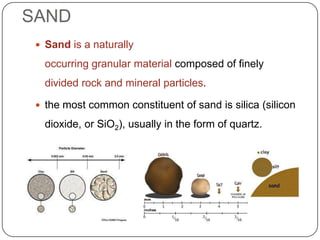
SAND
 Sand is a naturally

occurring granular material composed of finely

divided rock and mineral particles.
 the most common constituent of sand is silica (silicon

dioxide, or SiO2), usually in the form of quartz.
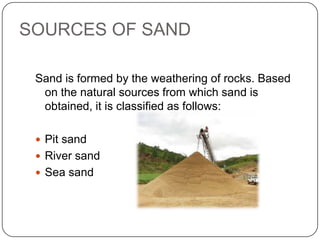
SOURCES OF SAND
Sand is formed by the weathering of rocks. Based
on the natural sources from which sand is
obtained, it is classified as follows:
 Pit sand
 River sand
 Sea sand
PIT SAND
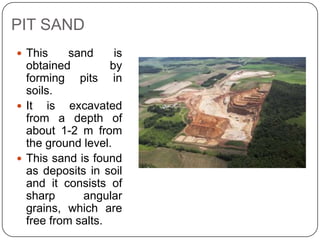
 This

sand
is
obtained
by
forming pits in
soils.
 It is excavated
from a depth of
about 1-2 m from
the ground level.
 This sand is found
as deposits in soil
and it consists of
sharp
angular
grains, which are
free from salts.
Pit Sand
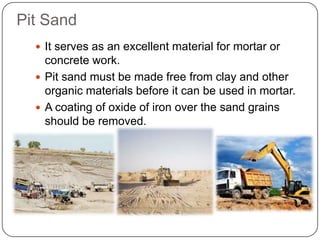
 It serves as an excellent material for mortar or

concrete work.
 Pit sand must be made free from clay and other
organic materials before it can be used in mortar.
 A coating of oxide of iron over the sand grains
should be removed.
RIVER SAND
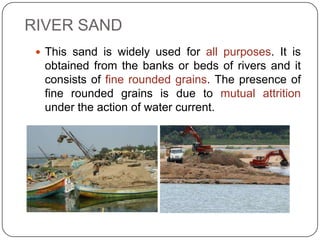
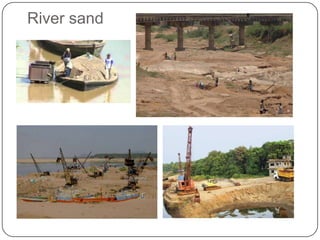
 This sand is widely used for all purposes. It is

obtained from the banks or beds of rivers and it
consists of fine rounded grains. The presence of
fine rounded grains is due to mutual attrition
under the action of water current.
River sand
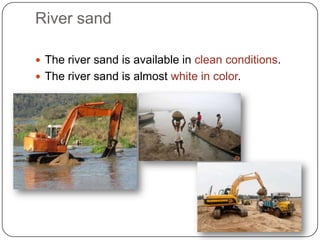
 The river sand is available in clean conditions.
 The river sand is almost white in color.
River sand
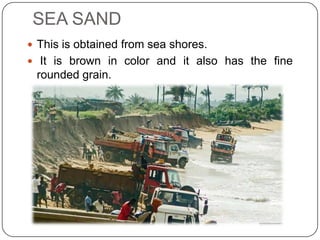
SEA SAND
 This is obtained from sea shores.
 It is brown in color and it also has the fine

rounded grain.
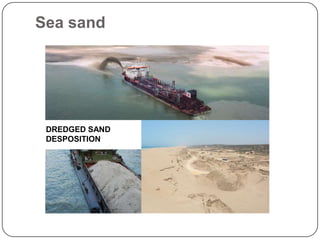
Sea sand

DREDGED SAND
DESPOSITION
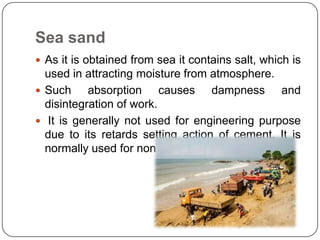
Sea sand
 As it is obtained from sea it contains salt, which is

used in attracting moisture from atmosphere.
 Such
absorption causes dampness and
disintegration of work.
 It is generally not used for engineering purpose
due to its retards setting action of cement. It is
normally used for non structural purposes.
Crushed Stone Sand / Artificial
Sand
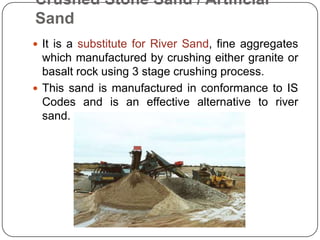
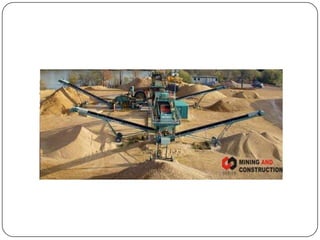
 It is a substitute for River Sand, fine aggregates

which manufactured by crushing either granite or
basalt rock using 3 stage crushing process.
 This sand is manufactured in conformance to IS
Codes and is an effective alternative to river
sand.
CLASSIFICATION OF SAND
 Based on the grain size distribution
 Fine sand: The sand passing through a sieve with

clear openings of 1.5875 mm is known as fine sand.
Fine sand is mainly used for plastering. .
 Coarse sand: The sand passing through a sieve with
clear openings of 3.175 mm is known as coarse sand.
It is generally used for masonry work.
 Gravelly sand: The sand passing through a sieve with
clear openings of 7.62 mm is known as gravelly sand.
It is generally used for concrete work.
Grading of sand:
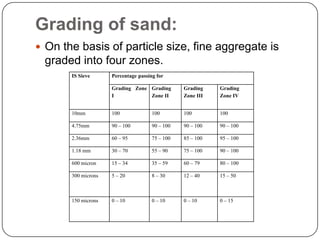
 On the basis of particle size, fine aggregate is

graded into four zones.
IS Sieve

Percentage passing for
Grading Zone Grading
I
Zone II

Grading
Zone III

Grading
Zone IV

10mm

100

100

100

100

4.75mm

90 – 100

90 – 100

90 – 100

90 – 100

2.36mm

60 – 95

75 – 100

85 – 100

95 – 100

1.18 mm

30 – 70

55 – 90

75 – 100

90 – 100

600 micron

15 – 34

35 – 59

60 – 79

80 – 100

300 microns

5 – 20

8 – 30

12 – 40

15 – 50

150 microns

0 – 10

0 – 10

0 – 10

0 – 15
Sand for Construction Works
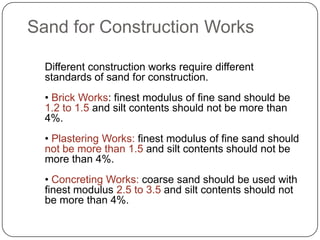
Different construction works require different
standards of sand for construction.
• Brick Works: finest modulus of fine sand should be
1.2 to 1.5 and silt contents should not be more than
4%.

• Plastering Works: finest modulus of fine sand should
not be more than 1.5 and silt contents should not be
more than 4%.
• Concreting Works: coarse sand should be used with
finest modulus 2.5 to 3.5 and silt contents should not
be more than 4%.
PROPERTIES OF GOOD SAND
 It should be clean and coarse.
 It should be free from any organic or vegetable








matter; usually 3-4 per cent clay is permitted.
It should be chemically inert.
It should contain sharp, angular, coarse and durable
grains.
It should not contain salts which attract moisture from
the atmosphere.
It should be well graded, i.e., it should contain
particles of various sizes in suitable proportions.
It should be strong and durable.
It should be clean and free from coatings of clay and
silt.
Tests


To check the quality of fine aggregates or sand;
put some quantity of sand in a glass of water.
Then it is vigorously shaken and allowed to settle.
If the clay is present in sand, its distinct layer is
formed at the top of sand.


To detect the presence of organic impurities in
sand, a solution of sodium hydroxide or caustic
soda is added to sand and stirred. If the color of
solution changes into brown, it shows presence of
impurities.
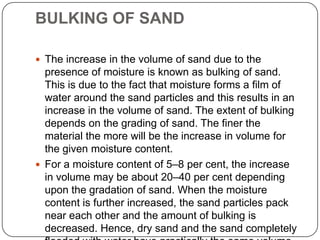
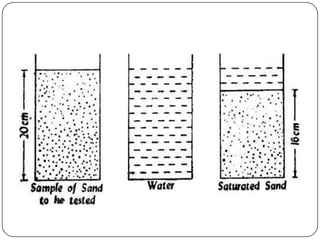
BULKING OF SAND
 The increase in the volume of sand due to the

presence of moisture is known as bulking of sand.
This is due to the fact that moisture forms a film of
water around the sand particles and this results in an
increase in the volume of sand. The extent of bulking
depends on the grading of sand. The finer the
material the more will be the increase in volume for
the given moisture content.
 For a moisture content of 5–8 per cent, the increase
in volume may be about 20–40 per cent depending
upon the gradation of sand. When the moisture
content is further increased, the sand particles pack
near each other and the amount of bulking is
decreased. Hence, dry sand and the sand completely
Deleterious materials in sand
 Sand shall not contain any harmful impurities such as

iron, pyrites, alaklies, salts, coal or other organic
impurities, mica, shale or similar laminated materials,
soft fragments, sea shale in such form or in such
quantities as to affect adversely the hardening,
strength or durability of the mortar. The maximum
quantities of clay, fine silt, fine dust and organic
impurities in the sand / marble dust shall not exceed
the following limits:
 (a) Clay, fine silt and fine dust when determined in
accordance within not more than 5% by mass in IS
2386 (Part-II), natural sand or crushed gravel sand
and crushed stone sand.
 (b) Organic impurities when determined in color of the
liquid shall be lighter in lighter in accordance with IS
2386 (Part –II) than that specified in the code.
references
 http://theconstructor.org/concrete/joints-in-

concrete-structures/970/
 http://www.wikihow.com/Make-Concrete

BUILDING MATERIALS - SAND

  • 1.
    BUILDING MATERIALS SAND Ar. RavindraPatnayaka B.Arch, M.Tech (Planning) Assistant Professor in Architecture
  • 2.
    SAND  Sand isa naturally occurring granular material composed of finely divided rock and mineral particles.  the most common constituent of sand is silica (silicon dioxide, or SiO2), usually in the form of quartz.
  • 3.
    SOURCES OF SAND Sandis formed by the weathering of rocks. Based on the natural sources from which sand is obtained, it is classified as follows:  Pit sand  River sand  Sea sand
  • 4.
    PIT SAND  This sand is obtained by formingpits in soils.  It is excavated from a depth of about 1-2 m from the ground level.  This sand is found as deposits in soil and it consists of sharp angular grains, which are free from salts.
  • 5.
    Pit Sand  Itserves as an excellent material for mortar or concrete work.  Pit sand must be made free from clay and other organic materials before it can be used in mortar.  A coating of oxide of iron over the sand grains should be removed.
  • 6.
    RIVER SAND  Thissand is widely used for all purposes. It is obtained from the banks or beds of rivers and it consists of fine rounded grains. The presence of fine rounded grains is due to mutual attrition under the action of water current.
  • 7.
    River sand  Theriver sand is available in clean conditions.  The river sand is almost white in color.
  • 8.
  • 9.
    SEA SAND  Thisis obtained from sea shores.  It is brown in color and it also has the fine rounded grain.
  • 10.
  • 11.
    Sea sand  Asit is obtained from sea it contains salt, which is used in attracting moisture from atmosphere.  Such absorption causes dampness and disintegration of work.  It is generally not used for engineering purpose due to its retards setting action of cement. It is normally used for non structural purposes.
  • 12.
    Crushed Stone Sand/ Artificial Sand  It is a substitute for River Sand, fine aggregates which manufactured by crushing either granite or basalt rock using 3 stage crushing process.  This sand is manufactured in conformance to IS Codes and is an effective alternative to river sand.
  • 14.
    CLASSIFICATION OF SAND Based on the grain size distribution  Fine sand: The sand passing through a sieve with clear openings of 1.5875 mm is known as fine sand. Fine sand is mainly used for plastering. .  Coarse sand: The sand passing through a sieve with clear openings of 3.175 mm is known as coarse sand. It is generally used for masonry work.  Gravelly sand: The sand passing through a sieve with clear openings of 7.62 mm is known as gravelly sand. It is generally used for concrete work.
  • 16.
    Grading of sand: On the basis of particle size, fine aggregate is graded into four zones. IS Sieve Percentage passing for Grading Zone Grading I Zone II Grading Zone III Grading Zone IV 10mm 100 100 100 100 4.75mm 90 – 100 90 – 100 90 – 100 90 – 100 2.36mm 60 – 95 75 – 100 85 – 100 95 – 100 1.18 mm 30 – 70 55 – 90 75 – 100 90 – 100 600 micron 15 – 34 35 – 59 60 – 79 80 – 100 300 microns 5 – 20 8 – 30 12 – 40 15 – 50 150 microns 0 – 10 0 – 10 0 – 10 0 – 15
  • 17.
    Sand for ConstructionWorks Different construction works require different standards of sand for construction. • Brick Works: finest modulus of fine sand should be 1.2 to 1.5 and silt contents should not be more than 4%. • Plastering Works: finest modulus of fine sand should not be more than 1.5 and silt contents should not be more than 4%. • Concreting Works: coarse sand should be used with finest modulus 2.5 to 3.5 and silt contents should not be more than 4%.
  • 18.
    PROPERTIES OF GOODSAND  It should be clean and coarse.  It should be free from any organic or vegetable       matter; usually 3-4 per cent clay is permitted. It should be chemically inert. It should contain sharp, angular, coarse and durable grains. It should not contain salts which attract moisture from the atmosphere. It should be well graded, i.e., it should contain particles of various sizes in suitable proportions. It should be strong and durable. It should be clean and free from coatings of clay and silt.
  • 19.
    Tests  To check thequality of fine aggregates or sand; put some quantity of sand in a glass of water. Then it is vigorously shaken and allowed to settle. If the clay is present in sand, its distinct layer is formed at the top of sand.  To detect the presence of organic impurities in sand, a solution of sodium hydroxide or caustic soda is added to sand and stirred. If the color of solution changes into brown, it shows presence of impurities.
  • 20.
    BULKING OF SAND The increase in the volume of sand due to the presence of moisture is known as bulking of sand. This is due to the fact that moisture forms a film of water around the sand particles and this results in an increase in the volume of sand. The extent of bulking depends on the grading of sand. The finer the material the more will be the increase in volume for the given moisture content.  For a moisture content of 5–8 per cent, the increase in volume may be about 20–40 per cent depending upon the gradation of sand. When the moisture content is further increased, the sand particles pack near each other and the amount of bulking is decreased. Hence, dry sand and the sand completely
  • 22.
    Deleterious materials insand  Sand shall not contain any harmful impurities such as iron, pyrites, alaklies, salts, coal or other organic impurities, mica, shale or similar laminated materials, soft fragments, sea shale in such form or in such quantities as to affect adversely the hardening, strength or durability of the mortar. The maximum quantities of clay, fine silt, fine dust and organic impurities in the sand / marble dust shall not exceed the following limits:  (a) Clay, fine silt and fine dust when determined in accordance within not more than 5% by mass in IS 2386 (Part-II), natural sand or crushed gravel sand and crushed stone sand.  (b) Organic impurities when determined in color of the liquid shall be lighter in lighter in accordance with IS 2386 (Part –II) than that specified in the code.
  • 23.