LIME
SAYAN MUNSHI
B.ARCH SEM 5
SCHOOL OF PLANNING AND ARCHITECTURE
POORNIMA UNIVERSITY, JAIPUR
PAGE 1
INTRODUCTION1
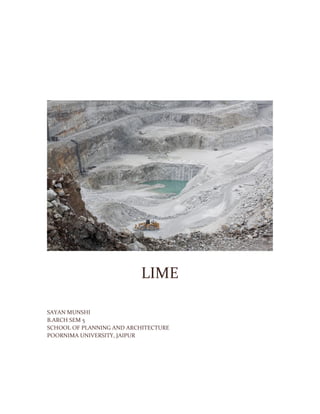
Lime is derived from limestone which is a rocks which contains 80% or more of calcium or
magnesium carbonates, including marble, chalk, oolite, and marl. Lime is a natural mineral
(native lime) CaO which occurs as a product of coal seam fires and in altered limestone
xenoliths in volcanic eject. It is used in large quantities as building and engineering
materials (including limestone products, concrete, and mortar).
Lime used in building materials is broadly classified as "pure", "hydraulic", and "poor" lime
which can be natural or artificial.
USE AS A BUILDING MATERIAL1
The Romans used two types of lime mortar to make Roman concrete, which allowed them
to revolutionize architecture, sometimes called the Concrete Revolution.
Uses include:
o lime mortar
o lime plaster
Figure 1: lime cycle
PAGE 2
o lime render
o lime-ash floors
o tabby concrete
o whitewash
o mineral paint,
PROPERTIES OF LIME
1
Lime has many qualities as a building material which including workability as:
 cohesion
 adhesion
 air content
 water content
 crystal shape
 board-life
 spread ability
 flow ability
 bond strength
 comprehensive strength
 setting time
 sand-carrying capacity
 hydrolocity
 free lime content
 vapor permeability
 flexibility
 resistance to sulfates.
PAGE 3
LIME AS A VERNACULAR MATERIAL2
Lime has been used as a building material
in most part of the Indian sub-continent.
Lime is a widely available material found
almost in every state of India thus being a
locally available material for construction
it has been used for wide purpose from
construction to plastering and even white
washing.
Lime was used by people due to the
significant property of lime which has
made it capable to be used widely as a
construction material.
One of the most important early
references to lime mortar comes from
‘Vitruvius De Architectura’ written c.25
BC. Lime plaster was found to be in wide
use since 6th century in India.
3
Building found to be using lime as a primary building material are:
 Decorative lime plasters of Ellora caves (6th
century)
 Houses of the site of Kali-bangan, Rajasthan
 Structures at the Buddhist settlement of Nagarjuna-Konda
 The city of Kausambi (350AD) in Uttar Pradesh
 The mosques within the region of Bengal
 Charminar (themosque of the four minarets), Hyderabad
 The tomb of Muhammad Qutb Shah in Hyderabad, India
 The Krishan Mandir temple(built in 1830)in the village of Krishankot in Punjab
Figure 2: lime plaster in Hydrabad
PAGE 4
CHARACTERISTICS OF LIME
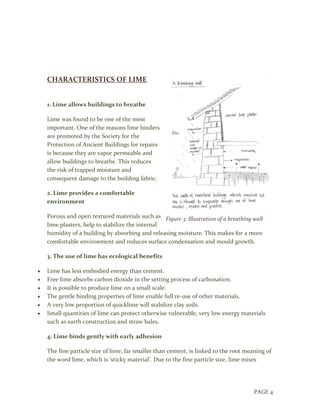
1. Lime allows buildings to breathe
Lime was found to be one of the most
important. One of the reasons lime binders
are promoted by the Society for the
Protection of Ancient Buildings for repairs
is because they are vapor permeable and
allow buildings to breathe. This reduces
the risk of trapped moisture and
consequent damage to the building fabric.
2. Lime provides a comfortable
environment
Porous and open textured materials such as
lime plasters, help to stabilize the internal
humidity of a building by absorbing and releasing moisture. This makes for a more
comfortable environment and reduces surface condensation and mould growth.
3. The use of lime has ecological benefits
 Lime has less embodied energy than cement.
 Free lime absorbs carbon dioxide in the setting process of carbonation.
 It is possible to produce lime on a small scale.
 The gentle binding properties of lime enable full re-use of other materials.
 A very low proportion of quicklime will stabilize clay soils.
 Small quantities of lime can protect otherwise vulnerable, very low energy materials
such as earth construction and straw bales.
4. Lime binds gently with early adhesion
The fine particle size of lime, far smaller than cement, is linked to the root meaning of
the word lime, which is ‘sticky material’. Due to the fine particle size, lime mixes
Figure 3: Illustration of a breathing wall
PAGE 5
penetrate minute voids in the background more deeply than other materials. They
bind gently and the stickiness gives good adhesion to other surfaces.
5. Lime mortar can protect adjacent materials
Lime mortars with a high free lime content are porous and permeable. These
characteristics allow lime mortars to protect adjacent materials by handling moisture
movements through the building fabric and protecting them from harmful salts.
6. Lime renders can assist drying out by evaporation
Dense and impermeable renders can
trap moisture within the building fabric.
Trapped moisture is often the agent for
various decay mechanisms. Dense
renders used in conjunction with softer
materials or on weaker backgrounds can
cause serious problems by creating local
stresses. High calcium lime renders
allow evaporation and reduce the risk of
trapped moisture and decay. In simple
terms, the greater the extent of pure
lime and permeability the better this is
for the building. This needs to be
balanced with durability, however, and
some reduction in permeability may be
necessary to obtain adequate weathering
qualities, hence the advantage of feebly
hydraulic limes for external use.
7. Lime mixes have good workability
The ability of a mortar or plaster to remain smooth and moldable, even against the
suction it may experience from porous building materials, is termed workability. Good
workability greatly assists good workmanship, helping to achieve full joints with good
bonding to the other materials. This is what makes lime based mixes such a pleasure
to use. The workability provided by the lime allows the inclusion of widely graded and
sharp aggregates in the mix. These enhance both the performance and the aesthetic of
the finished work.
Figure 4: Section through soft mortar joints
PAGE 6
8. Lime binders can be durable and have stood the test of time
When used carefully, lime is exceptionally durable. Caesar’s Tower at Warwick Castle
has stood the test of time for over 600 years, and many cathedrals have stood longer.
An outstanding example is the Pantheon Temple in Rome which has a lime concrete
dome spanning over 43 meters (142 feet). This has survived for nearly 2000 years.
9. Lime finishes are beautiful
The double refraction of light through calcite crystals give a unique aesthetic
combining a soft texture with a luster that has a liveliness and delight of its own. The
graceful softness apparent in lime based materials is a visual indication of their
intrinsic permeability, workability and soft binding properties. They can rapidly
develop a rich patina which has a glowing translucent quality.
10. Lime contributes to a healthy environment
Lime is caustic and has been extensively used, often in the form of lime wash, for its
disinfectant qualities. Lime is also used for water purification. Lime mortars, plasters,
renders and lime wash have been used to create hygienic surfaces and improve
comfort conditions within buildings for thousands of years.
11. Self-Healing
The nature of ground conditions and the elements are such that all buildings are
subject to varying degrees of movement over time. When buildings made with lime
are subject to small movements they are more likely to develop many fine cracks than
the individual large cracks which occur in stiffer cement-bound buildings. Water
penetration can dissolve the ‘free’ lime and transport it. As the water evaporates this
lime is deposited and begins to heal the cracks. This process is called autogenous, or
self- healing.
12. Free lime encourages the growth of calcite crystals
Calcite crystals are a different shape to those formed by the more complex compounds
in hydraulic lime and cements. The crystals form in voids in lime rich environments.
The growth of calcite crystals adds strength over time and generally provides a more
open and permeable material than the denser eminently hydraulic and OPC mixes
with little or no free lime.
PAGE 7
13. Local limes enhance regional identity and diversity
The diversity of limestone types provides variety and local distinctiveness. Different
limes will vary in color, texture and setting properties. Local limes have a regional
identity, they give a sense of place and provide a continuous link with the local
aesthetic. Local color is the obvious example in respect of lime washes.
14. Disfiguring by cement can be avoided by the use of lime
On site the temptation to use quick and easy solutions for short term gain can lead to
long term problems. The attraction of using excess cement to be ‘safe’ is
understandable if not desirable. The fact that it is plentiful, inexpensive and readily
available adds to the problem. There is a high probability that over-strong and dense
mixes that are not fit for purpose will be used in excess. The physical damage and
unsightly aesthetic that results from this can be avoided by the use of lime.
15. Indefinite shelf life
Non-hydraulic limes have an indefinite shelf life when stored without access to air,
usually as a putty under water or in sealed containers. In fact the quality of the putty
improves the longer it is stored.
REFFERENCES:
1. WIKIPEDIA.ORG
2. https://www.researchgate.net/publication/259513991_Characterization_of_lime_
plasters_used_in_16th_century_Mughal_monument
3. http://authors.elsevier.com/a/1Rb6A3O1E110bg
4. https://www.academia.edu/415892/A_Short_History_of_the_Use_of_Lime_as_a_B
uilding_Material_Beyond_Europe_and_North_America
5. https://www.buildinglimesforum.org.uk/why-use-lime

LIME: A vernacular Building Material

  • 1.
    LIME SAYAN MUNSHI B.ARCH SEM5 SCHOOL OF PLANNING AND ARCHITECTURE POORNIMA UNIVERSITY, JAIPUR
  • 2.
    PAGE 1 INTRODUCTION1 Lime isderived from limestone which is a rocks which contains 80% or more of calcium or magnesium carbonates, including marble, chalk, oolite, and marl. Lime is a natural mineral (native lime) CaO which occurs as a product of coal seam fires and in altered limestone xenoliths in volcanic eject. It is used in large quantities as building and engineering materials (including limestone products, concrete, and mortar). Lime used in building materials is broadly classified as "pure", "hydraulic", and "poor" lime which can be natural or artificial. USE AS A BUILDING MATERIAL1 The Romans used two types of lime mortar to make Roman concrete, which allowed them to revolutionize architecture, sometimes called the Concrete Revolution. Uses include: o lime mortar o lime plaster Figure 1: lime cycle
  • 3.
    PAGE 2 o limerender o lime-ash floors o tabby concrete o whitewash o mineral paint, PROPERTIES OF LIME 1 Lime has many qualities as a building material which including workability as:  cohesion  adhesion  air content  water content  crystal shape  board-life  spread ability  flow ability  bond strength  comprehensive strength  setting time  sand-carrying capacity  hydrolocity  free lime content  vapor permeability  flexibility  resistance to sulfates.
  • 4.
    PAGE 3 LIME ASA VERNACULAR MATERIAL2 Lime has been used as a building material in most part of the Indian sub-continent. Lime is a widely available material found almost in every state of India thus being a locally available material for construction it has been used for wide purpose from construction to plastering and even white washing. Lime was used by people due to the significant property of lime which has made it capable to be used widely as a construction material. One of the most important early references to lime mortar comes from ‘Vitruvius De Architectura’ written c.25 BC. Lime plaster was found to be in wide use since 6th century in India. 3 Building found to be using lime as a primary building material are:  Decorative lime plasters of Ellora caves (6th century)  Houses of the site of Kali-bangan, Rajasthan  Structures at the Buddhist settlement of Nagarjuna-Konda  The city of Kausambi (350AD) in Uttar Pradesh  The mosques within the region of Bengal  Charminar (themosque of the four minarets), Hyderabad  The tomb of Muhammad Qutb Shah in Hyderabad, India  The Krishan Mandir temple(built in 1830)in the village of Krishankot in Punjab Figure 2: lime plaster in Hydrabad
  • 5.
    PAGE 4 CHARACTERISTICS OFLIME 1. Lime allows buildings to breathe Lime was found to be one of the most important. One of the reasons lime binders are promoted by the Society for the Protection of Ancient Buildings for repairs is because they are vapor permeable and allow buildings to breathe. This reduces the risk of trapped moisture and consequent damage to the building fabric. 2. Lime provides a comfortable environment Porous and open textured materials such as lime plasters, help to stabilize the internal humidity of a building by absorbing and releasing moisture. This makes for a more comfortable environment and reduces surface condensation and mould growth. 3. The use of lime has ecological benefits  Lime has less embodied energy than cement.  Free lime absorbs carbon dioxide in the setting process of carbonation.  It is possible to produce lime on a small scale.  The gentle binding properties of lime enable full re-use of other materials.  A very low proportion of quicklime will stabilize clay soils.  Small quantities of lime can protect otherwise vulnerable, very low energy materials such as earth construction and straw bales. 4. Lime binds gently with early adhesion The fine particle size of lime, far smaller than cement, is linked to the root meaning of the word lime, which is ‘sticky material’. Due to the fine particle size, lime mixes Figure 3: Illustration of a breathing wall
  • 6.
    PAGE 5 penetrate minutevoids in the background more deeply than other materials. They bind gently and the stickiness gives good adhesion to other surfaces. 5. Lime mortar can protect adjacent materials Lime mortars with a high free lime content are porous and permeable. These characteristics allow lime mortars to protect adjacent materials by handling moisture movements through the building fabric and protecting them from harmful salts. 6. Lime renders can assist drying out by evaporation Dense and impermeable renders can trap moisture within the building fabric. Trapped moisture is often the agent for various decay mechanisms. Dense renders used in conjunction with softer materials or on weaker backgrounds can cause serious problems by creating local stresses. High calcium lime renders allow evaporation and reduce the risk of trapped moisture and decay. In simple terms, the greater the extent of pure lime and permeability the better this is for the building. This needs to be balanced with durability, however, and some reduction in permeability may be necessary to obtain adequate weathering qualities, hence the advantage of feebly hydraulic limes for external use. 7. Lime mixes have good workability The ability of a mortar or plaster to remain smooth and moldable, even against the suction it may experience from porous building materials, is termed workability. Good workability greatly assists good workmanship, helping to achieve full joints with good bonding to the other materials. This is what makes lime based mixes such a pleasure to use. The workability provided by the lime allows the inclusion of widely graded and sharp aggregates in the mix. These enhance both the performance and the aesthetic of the finished work. Figure 4: Section through soft mortar joints
  • 7.
    PAGE 6 8. Limebinders can be durable and have stood the test of time When used carefully, lime is exceptionally durable. Caesar’s Tower at Warwick Castle has stood the test of time for over 600 years, and many cathedrals have stood longer. An outstanding example is the Pantheon Temple in Rome which has a lime concrete dome spanning over 43 meters (142 feet). This has survived for nearly 2000 years. 9. Lime finishes are beautiful The double refraction of light through calcite crystals give a unique aesthetic combining a soft texture with a luster that has a liveliness and delight of its own. The graceful softness apparent in lime based materials is a visual indication of their intrinsic permeability, workability and soft binding properties. They can rapidly develop a rich patina which has a glowing translucent quality. 10. Lime contributes to a healthy environment Lime is caustic and has been extensively used, often in the form of lime wash, for its disinfectant qualities. Lime is also used for water purification. Lime mortars, plasters, renders and lime wash have been used to create hygienic surfaces and improve comfort conditions within buildings for thousands of years. 11. Self-Healing The nature of ground conditions and the elements are such that all buildings are subject to varying degrees of movement over time. When buildings made with lime are subject to small movements they are more likely to develop many fine cracks than the individual large cracks which occur in stiffer cement-bound buildings. Water penetration can dissolve the ‘free’ lime and transport it. As the water evaporates this lime is deposited and begins to heal the cracks. This process is called autogenous, or self- healing. 12. Free lime encourages the growth of calcite crystals Calcite crystals are a different shape to those formed by the more complex compounds in hydraulic lime and cements. The crystals form in voids in lime rich environments. The growth of calcite crystals adds strength over time and generally provides a more open and permeable material than the denser eminently hydraulic and OPC mixes with little or no free lime.
  • 8.
    PAGE 7 13. Locallimes enhance regional identity and diversity The diversity of limestone types provides variety and local distinctiveness. Different limes will vary in color, texture and setting properties. Local limes have a regional identity, they give a sense of place and provide a continuous link with the local aesthetic. Local color is the obvious example in respect of lime washes. 14. Disfiguring by cement can be avoided by the use of lime On site the temptation to use quick and easy solutions for short term gain can lead to long term problems. The attraction of using excess cement to be ‘safe’ is understandable if not desirable. The fact that it is plentiful, inexpensive and readily available adds to the problem. There is a high probability that over-strong and dense mixes that are not fit for purpose will be used in excess. The physical damage and unsightly aesthetic that results from this can be avoided by the use of lime. 15. Indefinite shelf life Non-hydraulic limes have an indefinite shelf life when stored without access to air, usually as a putty under water or in sealed containers. In fact the quality of the putty improves the longer it is stored. REFFERENCES: 1. WIKIPEDIA.ORG 2. https://www.researchgate.net/publication/259513991_Characterization_of_lime_ plasters_used_in_16th_century_Mughal_monument 3. http://authors.elsevier.com/a/1Rb6A3O1E110bg 4. https://www.academia.edu/415892/A_Short_History_of_the_Use_of_Lime_as_a_B uilding_Material_Beyond_Europe_and_North_America 5. https://www.buildinglimesforum.org.uk/why-use-lime