Department of mechanical engineering
Faculty of Engineering and Technology
M.J.P. Rohilkhand University, Bareilly
Nov,2015
Co-guide-Mr.
Vineet Tripathi
Introduction
Working principle
Classification
Application
Advantage and disadvantage
Safety
References
Contents:
 Laser micromachining: cutting,
drilling, welding, or other
modification in order to achieve
small features.
 Micro machining implies that
parts are made to the size of 1 to
999 µm. However Micro also
means very small in the fields of
machining, manufacture of small
parts are not easy.
Introduction
Micro pattern machined
on a steel plate in
less than 0.5 seconds
Source-
https://engineering.purdue.edu/L
AMPL/research_micro%20machi
ning.html
Continued...
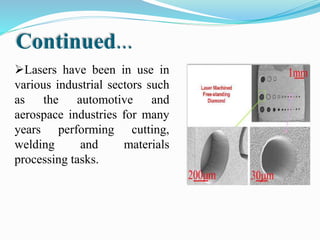
Lasers have been in use in
various industrial sectors such
as the automotive and
aerospace industries for many
years performing cutting,
welding and materials
processing tasks.
Working Principle
 The laser beam is focused onto the work piece and can be
moved relative to it.
 The laser machining process is controlled by switching the
laser on and off, changing the laser pulse energy and other
laser parameters and by positioning either the work piece or
the laser focus.
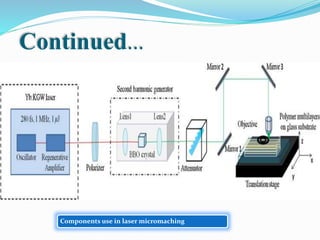
 A laser machine consists of the laser, mirrors for beam
guidance, a focusing optic and a positioning system.
Setup of laser micromaching
Continued...
Components use in laser micromaching
Continued...
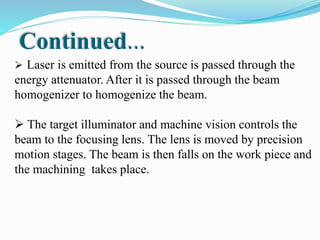
 Laser is emitted from the source is passed through the
energy attenuator. After it is passed through the beam
homogenizer to homogenize the beam.
 The target illuminator and machine vision controls the
beam to the focusing lens. The lens is moved by precision
motion stages. The beam is then falls on the work piece and
the machining takes place.
Types of Laser Micro
Machining
1. Direct writing. 2. Mask Projection
Process Parameters Effect
Wavelength,
Focal length of lens
Feature size
Beam shape Feature shape
Beam energy,
Pulse width
Size of heat affected
zone
Depth of focus Aspect ratio
Continued...
DIFFERENT TYPE OF LASER AND
THEIR USES IN INDUSTRY
APPLICATION LASER TYPE
Cutting
Metals
Plastics
Ceramics
Drilling
Metals
Plastics
Marking
Metals
Plastics
Ceramics
Surface treatment (metals)
Welding (metals)
PCO2; CWCO2; Nd:YAG; ruby
CWCO2
PCO2
PCO2; Nd:YAG; Nd:glass; ruby
Excimer
PCO2; Nd:YAG
Excimer
Excimer
CWCO2
PCO2; CWCO2; Nd:YAG; Nd:glass; ruby
Note: P = pulsed, CW = continuous wave.
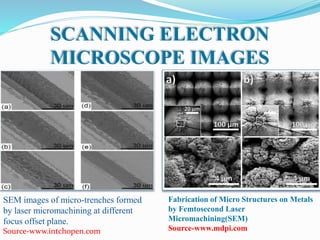
SCANNING ELECTRON
MICROSCOPE IMAGES
SEM images of micro-trenches formed
by laser micromachining at different
focus offset plane.
Source-www.intchopen.com
Fabrication of Micro Structures on Metals
by Femtosecond Laser
Micromachining(SEM)
Source-www.mdpi.com
HEAT AFFECTED ZONE IN LONG-PLUSE
LASER AND ULTRSHORT-PLUSE LASER
Source-www.cmxr.com
For drilling micro holes, laser beam drilling technique
is used.
Applications
High speed drilling
of 20µm holes in
50µm thick foil
Cutting of 1mm
tube
100µm wide v-
grooves
Continued...
100 um holes drilled in 75mm high-density polyethylene with (a) a
twist drill bit (b) a KrF laser.
Source-://www.exitech.co.ukhttp
(a) (b)
Laser Micro machining technique finds application in the
manufacture of micro channels and micro holes in integrated
chips and microchips.
Micro holes on integrated chips Micro channels on integrated chips
Continued...
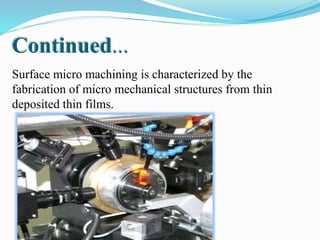
Surface micro machining is characterized by the
fabrication of micro mechanical structures from thin
deposited thin films.
Continued...
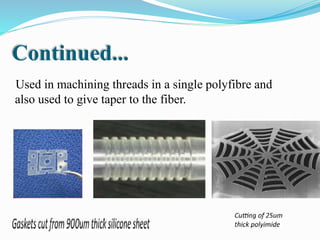
Used in machining threads in a single polyfibre and
also used to give taper to the fiber.
Continued...
Easy capability of being automated
Straightforward process monitoring
Forceless and contactless machining
Minor heat-affected zone
Marginal modifications to the microstructure
High flexibility regarding design of tiny structures
High machining speed
High precision
Constant machining quality
No additional tooling costs by wear
No solvent chemicals used
Material removal rate controllable down to the nanometer scale
Advantages
The equipment required for micro machining is very costly
than other cutting processes.
Need highly skilled persons to operate micro machining
systems.
Material limitations (including crystalline and reflective
materials)
Reflected laser light can present a safety hazard
Disadvantages
High intensity ultraviolet
and infrared light hazardous
to the eyes (cornea) and
skin
During normal operation
of the equipment
Interlocked protective
housing is must.
Required safety labels,
inspections and record
keeping.
Safety
Mechanical safety
 Large motion control systems may pose mechanical
hazards to people
 Mechanical guards
 Machine must be checked regularly
Lethal high voltages in the laser head
Electrical safety covers
Qualified service personnel only
Electrical safety
Toxic and corrosive fluorine and chlorine gases
Compressed gas cylinders need proper handling
Material safety
Micro machining technology not only provides a new
manufacturing route for existing products, but also
allows the creation of completely new products.
The surface micro machining technology
predominates at the present state & this trend will
continue in the future.
Nano is the buzz word of the moment. Thus the
transition from Micro-Electro-Mechanical-Systems
(MEMS) to Nano-Electro-Mechanical systems (NEMS)
is taking place in present technology
Conclusion
Advancements in Laser Micro machining Techniques- By
Nadeem Rizvi and Paul Apte.
Laser Micromachining – By Udo Klotzbach, Andres
Fabian Lasagni, Michael Panzner and Volker Franke.
www.resonetics.com
Internet(Wikipedia, Google etc)
www.mdpi.com
www.extich.co.in
www.itechopen.com
http://www.springer.com
References
Thanks for
Listening!!

Laser micromachining seminar ppt

  • 1.
    Department of mechanicalengineering Faculty of Engineering and Technology M.J.P. Rohilkhand University, Bareilly Nov,2015 Co-guide-Mr. Vineet Tripathi
  • 2.
  • 3.
     Laser micromachining:cutting, drilling, welding, or other modification in order to achieve small features.  Micro machining implies that parts are made to the size of 1 to 999 µm. However Micro also means very small in the fields of machining, manufacture of small parts are not easy. Introduction Micro pattern machined on a steel plate in less than 0.5 seconds Source- https://engineering.purdue.edu/L AMPL/research_micro%20machi ning.html
  • 4.
    Continued... Lasers have beenin use in various industrial sectors such as the automotive and aerospace industries for many years performing cutting, welding and materials processing tasks.
  • 5.
    Working Principle  Thelaser beam is focused onto the work piece and can be moved relative to it.  The laser machining process is controlled by switching the laser on and off, changing the laser pulse energy and other laser parameters and by positioning either the work piece or the laser focus.  A laser machine consists of the laser, mirrors for beam guidance, a focusing optic and a positioning system.
  • 6.
    Setup of lasermicromaching
  • 7.
  • 8.
    Continued...  Laser isemitted from the source is passed through the energy attenuator. After it is passed through the beam homogenizer to homogenize the beam.  The target illuminator and machine vision controls the beam to the focusing lens. The lens is moved by precision motion stages. The beam is then falls on the work piece and the machining takes place.
  • 9.
    Types of LaserMicro Machining 1. Direct writing. 2. Mask Projection
  • 10.
    Process Parameters Effect Wavelength, Focallength of lens Feature size Beam shape Feature shape Beam energy, Pulse width Size of heat affected zone Depth of focus Aspect ratio Continued...
  • 11.
    DIFFERENT TYPE OFLASER AND THEIR USES IN INDUSTRY APPLICATION LASER TYPE Cutting Metals Plastics Ceramics Drilling Metals Plastics Marking Metals Plastics Ceramics Surface treatment (metals) Welding (metals) PCO2; CWCO2; Nd:YAG; ruby CWCO2 PCO2 PCO2; Nd:YAG; Nd:glass; ruby Excimer PCO2; Nd:YAG Excimer Excimer CWCO2 PCO2; CWCO2; Nd:YAG; Nd:glass; ruby Note: P = pulsed, CW = continuous wave.
  • 12.
    SCANNING ELECTRON MICROSCOPE IMAGES SEMimages of micro-trenches formed by laser micromachining at different focus offset plane. Source-www.intchopen.com Fabrication of Micro Structures on Metals by Femtosecond Laser Micromachining(SEM) Source-www.mdpi.com
  • 13.
    HEAT AFFECTED ZONEIN LONG-PLUSE LASER AND ULTRSHORT-PLUSE LASER Source-www.cmxr.com
  • 14.
    For drilling microholes, laser beam drilling technique is used. Applications High speed drilling of 20µm holes in 50µm thick foil Cutting of 1mm tube 100µm wide v- grooves
  • 15.
    Continued... 100 um holesdrilled in 75mm high-density polyethylene with (a) a twist drill bit (b) a KrF laser. Source-://www.exitech.co.ukhttp (a) (b)
  • 16.
    Laser Micro machiningtechnique finds application in the manufacture of micro channels and micro holes in integrated chips and microchips. Micro holes on integrated chips Micro channels on integrated chips Continued...
  • 17.
    Surface micro machiningis characterized by the fabrication of micro mechanical structures from thin deposited thin films. Continued...
  • 18.
    Used in machiningthreads in a single polyfibre and also used to give taper to the fiber. Continued...
  • 19.
    Easy capability ofbeing automated Straightforward process monitoring Forceless and contactless machining Minor heat-affected zone Marginal modifications to the microstructure High flexibility regarding design of tiny structures High machining speed High precision Constant machining quality No additional tooling costs by wear No solvent chemicals used Material removal rate controllable down to the nanometer scale Advantages
  • 20.
    The equipment requiredfor micro machining is very costly than other cutting processes. Need highly skilled persons to operate micro machining systems. Material limitations (including crystalline and reflective materials) Reflected laser light can present a safety hazard Disadvantages
  • 21.
    High intensity ultraviolet andinfrared light hazardous to the eyes (cornea) and skin During normal operation of the equipment Interlocked protective housing is must. Required safety labels, inspections and record keeping. Safety
  • 22.
    Mechanical safety  Largemotion control systems may pose mechanical hazards to people  Mechanical guards  Machine must be checked regularly
  • 23.
    Lethal high voltagesin the laser head Electrical safety covers Qualified service personnel only Electrical safety Toxic and corrosive fluorine and chlorine gases Compressed gas cylinders need proper handling Material safety
  • 24.
    Micro machining technologynot only provides a new manufacturing route for existing products, but also allows the creation of completely new products. The surface micro machining technology predominates at the present state & this trend will continue in the future. Nano is the buzz word of the moment. Thus the transition from Micro-Electro-Mechanical-Systems (MEMS) to Nano-Electro-Mechanical systems (NEMS) is taking place in present technology Conclusion
  • 25.
    Advancements in LaserMicro machining Techniques- By Nadeem Rizvi and Paul Apte. Laser Micromachining – By Udo Klotzbach, Andres Fabian Lasagni, Michael Panzner and Volker Franke. www.resonetics.com Internet(Wikipedia, Google etc) www.mdpi.com www.extich.co.in www.itechopen.com http://www.springer.com References
  • 26.