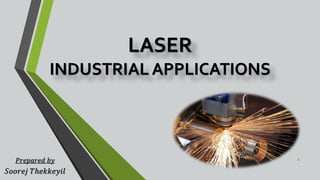
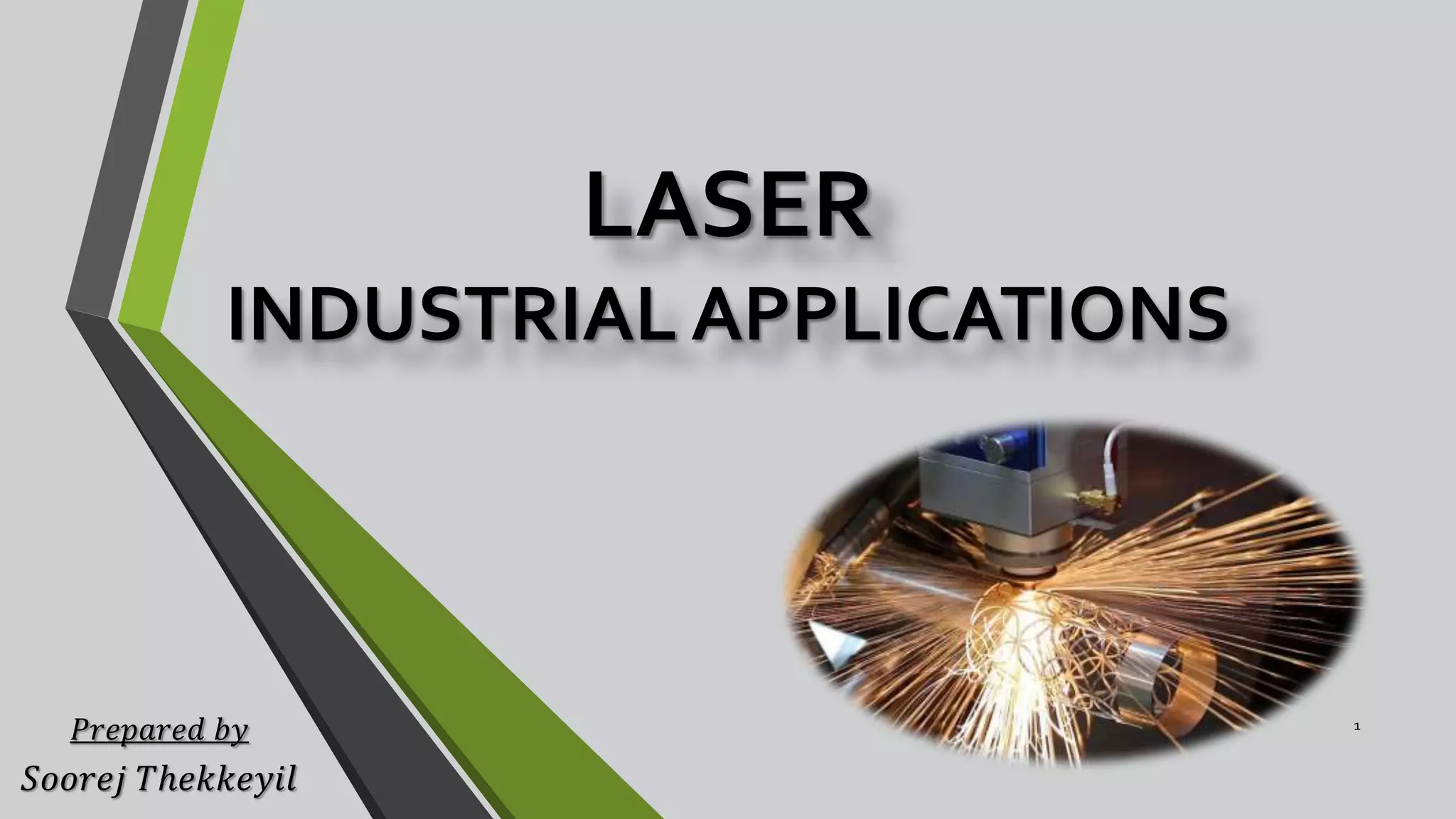

LASER
INDUSTRIAL APPLICATIONS
𝑃𝑟𝑒𝑝𝑎𝑟𝑒𝑑 𝑏𝑦
𝑆𝑜𝑜𝑟𝑒𝑗 𝑇ℎ𝑒𝑘𝑘𝑒𝑦𝑖𝑙
1
Outline
•Introduction
•Materials Interaction
•Laser Cutting
•Laser Drilling
•LaserWelding
•Surface Cleaning
•Laser Safety
•Advantages
2
INTRODUCTION
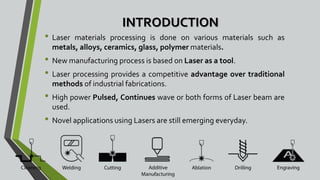
• Laser materials processing is done on various materials such as
metals, alloys, ceramics, glass, polymer materials.
• New manufacturing process is based on Laser as a tool.
• Laser processing provides a competitive advantage over traditional
methods of industrial fabrications.
• High power Pulsed, Continues wave or both forms of Laser beam are
used.
• Novel applications using Lasers are still emerging everyday.
3
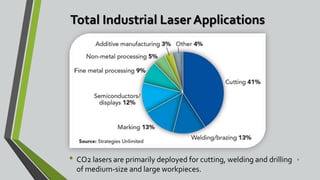
Total Industrial Laser Applications
• CO2 lasers are primarily deployed for cutting, welding and drilling
of medium-size and large workpieces.
4
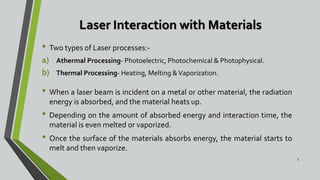
Laser Interaction with Materials
• Two types of Laser processes:-
a) Athermal Processing- Photoelectric, Photochemical & Photophysical.
b) Thermal Processing- Heating, Melting &Vaporization.
• When a laser beam is incident on a metal or other material, the radiation
energy is absorbed, and the material heats up.
• Depending on the amount of absorbed energy and interaction time, the
material is even melted or vaporized.
• Once the surface of the materials absorbs energy, the material starts to
melt and then vaporize.
5
Processing cont..
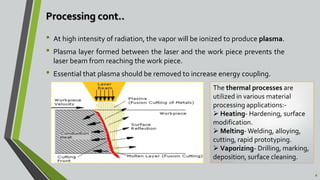
• At high intensity of radiation, the vapor will be ionized to produce plasma.
• Plasma layer formed between the laser and the work piece prevents the
laser beam from reaching the work piece.
• Essential that plasma should be removed to increase energy coupling.
6
The thermal processes are
utilized in various material
processing applications:-
 Heating- Hardening, surface
modification.
 Melting- Welding, alloying,
cutting, rapid prototyping.
 Vaporizing- Drilling, marking,
deposition, surface cleaning.
HOW HOT IS ACTUALLY
THE LASER BEAM?
• Heat is the random motion of matter particles.
(atomic or molecular particles)
• However, the laser beam itself is not made of
matter but of ‘photons’, the so-called ‘light
particles’ which have no mass.
• i.e. that a laser beam can have no temperature.
7
 Depending on the amount of absorbed energy and interaction time,
the material is even melted or vaporized.
Type of Industrial Lasers
8
 CO2 Lasers :
 CO2 lasers operate at 10.6µm. Metals having high reflectivity and Glass
have better absorption at this wavelength.
 Instead of CW CO2 laser, a pulsed mode CO2 laser produces high peak
powers and makes possible to work on metals.
 Nd:YAG lasers :
 Nd:YAG lasers operate at 1.06µm, can be focused to a smaller diameter
and fiber optic beam delivery is possible.
 Nd:YAG lasers offer the advantage of compactness.
 CO2 lasers are cheaper compared to Nd:YAG lasers.
 CO2 lasers are more generally preferred laser.
 Multikilowatt fiber lasers are also used.
 Lasers widely used in material processing are CO2 laser and Nd:YAG laser.
Laser Cutting
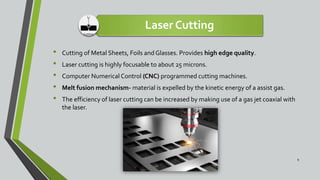
• Cutting of Metal Sheets, Foils and Glasses. Provides high edge quality.
• Laser cutting is highly focusable to about 25 microns.
• Computer Numerical Control (CNC) programmed cutting machines.
• Melt fusion mechanism- material is expelled by the kinetic energy of a assist gas.
• The efficiency of laser cutting can be increased by making use of a gas jet coaxial with
the laser.
9
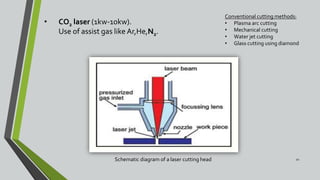
• CO2 laser (1kw-10kw).
Use of assist gas like Ar,He,N2.
10
Schematic diagram of a laser cutting head
Conventional cutting methods:
• Plasma arc cutting
• Mechanical cutting
• Water jet cutting
• Glass cutting using diamond
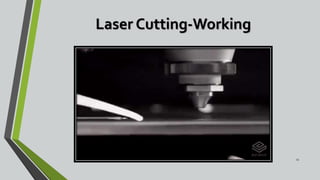
Laser Cutting-Working
11
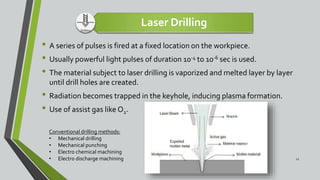
Laser Drilling
12
• A series of pulses is fired at a fixed location on the workpiece.
• Usually powerful light pulses of duration 10-4 to 10-6 sec is used.
• The material subject to laser drilling is vaporized and melted layer by layer
until drill holes are created.
• Radiation becomes trapped in the keyhole, inducing plasma formation.
• Use of assist gas like O2.
Conventional drilling methods:
• Mechanical drilling
• Mechanical punching
• Electro chemical machining
• Electro discharge machining
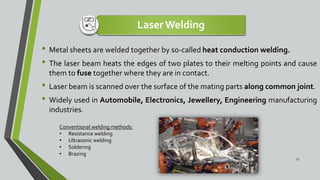
Laser Welding
• Metal sheets are welded together by so-called heat conduction welding.
• The laser beam heats the edges of two plates to their melting points and cause
them to fuse together where they are in contact.
• Laser beam is scanned over the surface of the mating parts along common joint.
• Widely used in Automobile, Electronics, Jewellery, Engineering manufacturing
industries.
13
Conventional welding methods:
• Resistance welding
• Ultrasonic welding
• Soldering
• Brazing
14
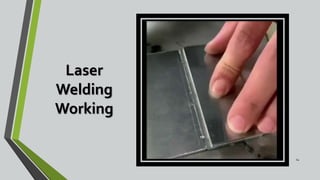
Laser
Welding
Working
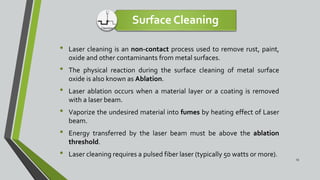
Surface Cleaning
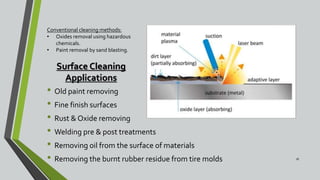
• Laser cleaning is an non-contact process used to remove rust, paint,
oxide and other contaminants from metal surfaces.
• The physical reaction during the surface cleaning of metal surface
oxide is also known as Ablation.
• Laser ablation occurs when a material layer or a coating is removed
with a laser beam.
• Vaporize the undesired material into fumes by heating effect of Laser
beam.
• Energy transferred by the laser beam must be above the ablation
threshold.
• Laser cleaning requires a pulsed fiber laser (typically 50 watts or more).
15
Surface Cleaning
Applications
• Old paint removing
• Fine finish surfaces
• Rust & Oxide removing
• Welding pre & post treatments
• Removing oil from the surface of materials
• Removing the burnt rubber residue from tire molds 16
Conventional cleaning methods:
• Oxides removal using hazardous
chemicals.
• Paint removal by sand blasting.
17
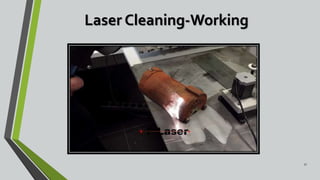
Laser Cleaning-Working
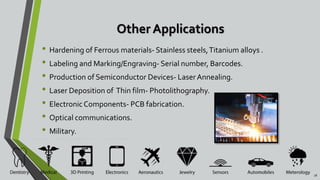
Other Applications
• Hardening of Ferrous materials- Stainless steels,Titanium alloys .
• Labeling and Marking/Engraving- Serial number, Barcodes.
• Production of Semiconductor Devices- LaserAnnealing.
• Laser Deposition of Thin film- Photolithography.
• ElectronicComponents- PCB fabrication.
• Optical communications.
• Military.
18
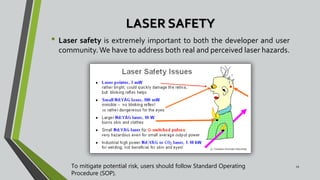
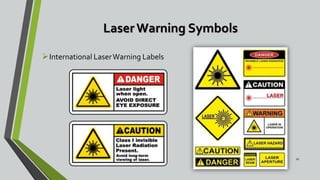
LASER SAFETY
• Laser safety is extremely important to both the developer and user
community.We have to address both real and perceived laser hazards.
19
To mitigate potential risk, users should follow Standard Operating
Procedure (SOP).
LaserWarning Symbols
International LaserWarning Labels
20
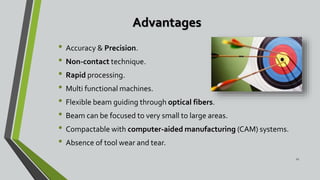
Advantages
• Accuracy & Precision.
• Non-contact technique.
• Rapid processing.
• Multi functional machines.
• Flexible beam guiding through optical fibers.
• Beam can be focused to very small to large areas.
• Compactable with computer-aided manufacturing (CAM) systems.
• Absence of tool wear and tear.
21
Current Research
• Fiber Lasers for manufacturing.
• Building more faster ultrafast lasers.
• Efficient cooling mechanisms-compact chillers.
• Fiber-coupled high-power diode lasers based on GaAs.
• Optimization of material absorption efficiency using tunable laser.
• Artificial Intelligence (AI) to create smart lasers that “understand”
the material being processed.
22
References
• Hans Joachin Eichler (2018) “Laser-Basics, Advances and Applications”
Springer Series in Optical Sciences. ISBN 9783319998930.
• John C Ion (2005) “Laser Processing of Engineering Materials” Elsevier
Butterworth-Heinemann. ISBN 0750660791.
• Tyagarajan and Ghatak (2010) “Laser-Fundamentals and applications”
Second edition, Springer. ISBN 9781441964410.
23
ThankYou
24

Industrial Laser Applications

  • 1.
  • 2.
    Outline •Introduction •Materials Interaction •Laser Cutting •LaserDrilling •LaserWelding •Surface Cleaning •Laser Safety •Advantages 2
  • 3.
    INTRODUCTION • Laser materialsprocessing is done on various materials such as metals, alloys, ceramics, glass, polymer materials. • New manufacturing process is based on Laser as a tool. • Laser processing provides a competitive advantage over traditional methods of industrial fabrications. • High power Pulsed, Continues wave or both forms of Laser beam are used. • Novel applications using Lasers are still emerging everyday. 3
  • 4.
    Total Industrial LaserApplications • CO2 lasers are primarily deployed for cutting, welding and drilling of medium-size and large workpieces. 4
  • 5.
    Laser Interaction withMaterials • Two types of Laser processes:- a) Athermal Processing- Photoelectric, Photochemical & Photophysical. b) Thermal Processing- Heating, Melting &Vaporization. • When a laser beam is incident on a metal or other material, the radiation energy is absorbed, and the material heats up. • Depending on the amount of absorbed energy and interaction time, the material is even melted or vaporized. • Once the surface of the materials absorbs energy, the material starts to melt and then vaporize. 5
  • 6.
    Processing cont.. • Athigh intensity of radiation, the vapor will be ionized to produce plasma. • Plasma layer formed between the laser and the work piece prevents the laser beam from reaching the work piece. • Essential that plasma should be removed to increase energy coupling. 6 The thermal processes are utilized in various material processing applications:-  Heating- Hardening, surface modification.  Melting- Welding, alloying, cutting, rapid prototyping.  Vaporizing- Drilling, marking, deposition, surface cleaning.
  • 7.
    HOW HOT ISACTUALLY THE LASER BEAM? • Heat is the random motion of matter particles. (atomic or molecular particles) • However, the laser beam itself is not made of matter but of ‘photons’, the so-called ‘light particles’ which have no mass. • i.e. that a laser beam can have no temperature. 7  Depending on the amount of absorbed energy and interaction time, the material is even melted or vaporized.
  • 8.
    Type of IndustrialLasers 8  CO2 Lasers :  CO2 lasers operate at 10.6µm. Metals having high reflectivity and Glass have better absorption at this wavelength.  Instead of CW CO2 laser, a pulsed mode CO2 laser produces high peak powers and makes possible to work on metals.  Nd:YAG lasers :  Nd:YAG lasers operate at 1.06µm, can be focused to a smaller diameter and fiber optic beam delivery is possible.  Nd:YAG lasers offer the advantage of compactness.  CO2 lasers are cheaper compared to Nd:YAG lasers.  CO2 lasers are more generally preferred laser.  Multikilowatt fiber lasers are also used.  Lasers widely used in material processing are CO2 laser and Nd:YAG laser.
  • 9.
    Laser Cutting • Cuttingof Metal Sheets, Foils and Glasses. Provides high edge quality. • Laser cutting is highly focusable to about 25 microns. • Computer Numerical Control (CNC) programmed cutting machines. • Melt fusion mechanism- material is expelled by the kinetic energy of a assist gas. • The efficiency of laser cutting can be increased by making use of a gas jet coaxial with the laser. 9
  • 10.
    • CO2 laser(1kw-10kw). Use of assist gas like Ar,He,N2. 10 Schematic diagram of a laser cutting head Conventional cutting methods: • Plasma arc cutting • Mechanical cutting • Water jet cutting • Glass cutting using diamond
  • 11.
  • 12.
    Laser Drilling 12 • Aseries of pulses is fired at a fixed location on the workpiece. • Usually powerful light pulses of duration 10-4 to 10-6 sec is used. • The material subject to laser drilling is vaporized and melted layer by layer until drill holes are created. • Radiation becomes trapped in the keyhole, inducing plasma formation. • Use of assist gas like O2. Conventional drilling methods: • Mechanical drilling • Mechanical punching • Electro chemical machining • Electro discharge machining
  • 13.
    Laser Welding • Metalsheets are welded together by so-called heat conduction welding. • The laser beam heats the edges of two plates to their melting points and cause them to fuse together where they are in contact. • Laser beam is scanned over the surface of the mating parts along common joint. • Widely used in Automobile, Electronics, Jewellery, Engineering manufacturing industries. 13 Conventional welding methods: • Resistance welding • Ultrasonic welding • Soldering • Brazing
  • 14.
  • 15.
    Surface Cleaning • Lasercleaning is an non-contact process used to remove rust, paint, oxide and other contaminants from metal surfaces. • The physical reaction during the surface cleaning of metal surface oxide is also known as Ablation. • Laser ablation occurs when a material layer or a coating is removed with a laser beam. • Vaporize the undesired material into fumes by heating effect of Laser beam. • Energy transferred by the laser beam must be above the ablation threshold. • Laser cleaning requires a pulsed fiber laser (typically 50 watts or more). 15
  • 16.
    Surface Cleaning Applications • Oldpaint removing • Fine finish surfaces • Rust & Oxide removing • Welding pre & post treatments • Removing oil from the surface of materials • Removing the burnt rubber residue from tire molds 16 Conventional cleaning methods: • Oxides removal using hazardous chemicals. • Paint removal by sand blasting.
  • 17.
  • 18.
    Other Applications • Hardeningof Ferrous materials- Stainless steels,Titanium alloys . • Labeling and Marking/Engraving- Serial number, Barcodes. • Production of Semiconductor Devices- LaserAnnealing. • Laser Deposition of Thin film- Photolithography. • ElectronicComponents- PCB fabrication. • Optical communications. • Military. 18
  • 19.
    LASER SAFETY • Lasersafety is extremely important to both the developer and user community.We have to address both real and perceived laser hazards. 19 To mitigate potential risk, users should follow Standard Operating Procedure (SOP).
  • 20.
  • 21.
    Advantages • Accuracy &Precision. • Non-contact technique. • Rapid processing. • Multi functional machines. • Flexible beam guiding through optical fibers. • Beam can be focused to very small to large areas. • Compactable with computer-aided manufacturing (CAM) systems. • Absence of tool wear and tear. 21
  • 22.
    Current Research • FiberLasers for manufacturing. • Building more faster ultrafast lasers. • Efficient cooling mechanisms-compact chillers. • Fiber-coupled high-power diode lasers based on GaAs. • Optimization of material absorption efficiency using tunable laser. • Artificial Intelligence (AI) to create smart lasers that “understand” the material being processed. 22
  • 23.
    References • Hans JoachinEichler (2018) “Laser-Basics, Advances and Applications” Springer Series in Optical Sciences. ISBN 9783319998930. • John C Ion (2005) “Laser Processing of Engineering Materials” Elsevier Butterworth-Heinemann. ISBN 0750660791. • Tyagarajan and Ghatak (2010) “Laser-Fundamentals and applications” Second edition, Springer. ISBN 9781441964410. 23
  • 24.

Editor's Notes

  • #7 Plasma controller is used to removing ionized gas around the molten pool
  • #10 Micrometers to millimeters
  • #16 without altering the bulk.