Presented by:
RAJKUMAR S WAGMARE
1MS15MSE10
1st sem. M.Tech MSE
M.S.RAMAIAH INSTITUTE OF TECHNOLOGY
BANGALORE
(AUTONOMOUS INSTITUTE,AFFILIATED TO VTU)
MICRO MACHINING
PRESENTED BY
RAJKUMAR S
1MS15MSE10
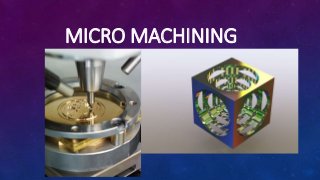
MICRO MACHINING
• INTRODUCTION
Micromachining is the basic technology for fabrication of
micro-components of size in the range of 1 to 500 µm. Their
need arises from miniaturization of various devices in
science and engineering, calling for ultra-precision
manufacturing and micro-fabrication.
MICRO MACHINING
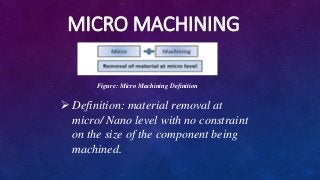
Figure: Micro Machining Definition
 Definition: material removal at
micro/ Nano level with no constraint
on the size of the component being
machined.
MICRO MACHINING
 Removal of material in the form of chips having the
size in the range of microns.
 Creating micro features or surface characteristics
(especially surface finish) in the micro/ Nano level.
WHY MICRO MACHINING?
 Final finishing operations in manufacturing of precise parts are
always of concern owing to their most critical, labour intensive
and least controllable nature.
 In the era of nanotechnology, deterministic high precision finishing
methods are of utmost importance and are the need of present
manufacturing scenario.
 The need for high precision in manufacturing was felt by
manufacturers worldwide to improve interchangeability of
components, improve quality control and longer wear/fatigue life.
WHY MICRO MACHINING?
Present day High-tech Industries, Design requirements are stringent.
• Extraordinary Properties of Materials (High Strength, High heat Resistant,
High hardness, Corrosion resistant etc.)
• Complex 3D Components (Turbine Blades)
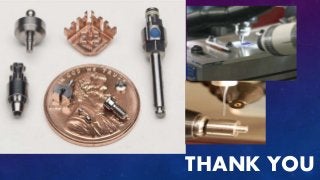
• Miniature Features (filters for food processing and textile industries having
few tens of microns as hole diameter and thousands in number)
• Nano level surface finish on Complex geometries (thousands of turbulated
cooling holes in a turbine blade)
• Making and finishing of micro fluidic channels (in electrically conducting &
non conducting materials, say glass, quartz, &ceramics)
WHAT IS MICRO FABRICATION?
Fabrication of products deals with making of machines, structures or process
equipment by casting, forming, welding, machining & assembling.
Classified into: Macro & micro
Macro: fabrication of structures/parts/products that are measurable /observable
by naked eye( ≥ 1mm in size)
Micro: fabrication of miniature structures/parts/products that are not visible with
naked eye(1 µm ≤ dimension ≤ 1000 µm in size)
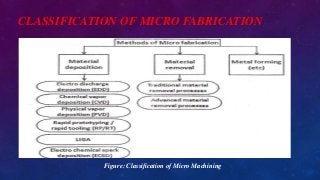
Methods of Micro Fabrication:
Material deposition & Material Removal
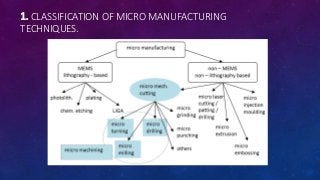
1. CLASSIFICATION OF MICRO MANUFACTURING
TECHNIQUES.
CLASSIFICATION OF MICRO FABRICATION
Figure: Classification of Micro Machining
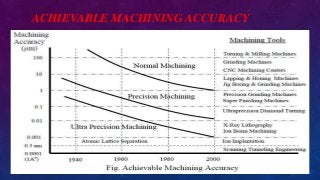
ACHIEVABLE MACHINING ACCURACY
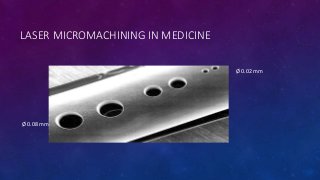
LASER MICROMACHINING IN MEDICINE
Ø 0.08 mm
Ø 0.02 mm
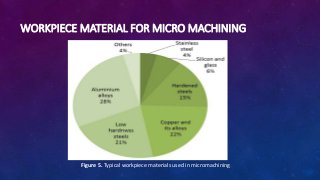
WORKPIECE MATERIAL FOR MICRO MACHINING
Figure 5. Typical workpiece materials used in micromachining
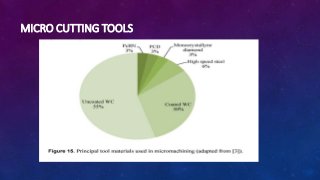
MICRO CUTTING TOOLS
DIFFERENT MICROMACHINING
TECHNIQUES
Photolithography
 Etching
Silicon Micromachining
LIGA
Mechanical Micromachining
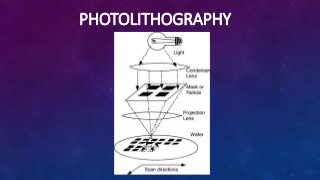
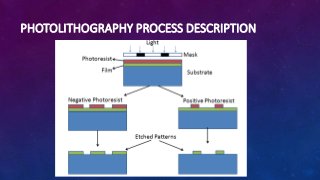
PHOTOLITHOGRAPHY
• Photolithography, also termed optical lithography or UV
lithography, is a process used in micro fabrication to pattern parts
of a thin film or the bulk of a substrate.
• It uses light to transfer a geometric pattern from a photo mask to
a light-sensitive chemical "photoresist", or simply "resist," on the
substrate.
PHOTOLITHOGRAPHY
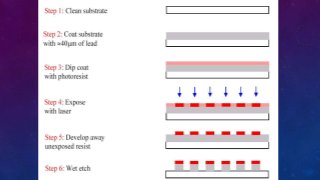
PHOTOLITHOGRAPHY PROCESS DESCRIPTION
ETCHING
• Etching is used in micro fabrication to chemically remove
layers from the surface of a wafer during manufacturing.
• Etching is a critically important process module, and every
wafer undergoes many etching steps before it is complete.
• It is characterized by etch rate , etch selectivity and etch
uniformity
PROCESS VARIATIONS:
1. Wet etching
Etching processes used liquid-phase ("wet") etchants. The wafer can be immersed in a bath of
etchant, which must be agitated to achieve good process control. For instance, buffered
hydrofluoric acid (BHF) is used commonly to etch silicon dioxide over a silicon substrate.
2. Dry etching
• Modern VLSI processes avoid wet etching, and use plasma etching instead.
• plasma etching operates between 0.1 and 5 Torr
• The plasma produces energetic free radicals, neutrally charged, that react at the surface of
the wafer. Since neutral particles attack the wafer from all angles, this process is isotropic
BULK MICROMACHINING
• Bulk and surface micromachining are processes used to create
microstructures on micro-electromechanical (MEMS) devices.
• Micro-Electro-Mechanical Systems (MEMS) is the integration of
mechanical elements, sensors, actuators, and electronics on a
common silicon substrate through microfabrication technology
• While both wet and dry etching techniques are available to both bulk
and surface micromachining, bulk micromachining typically uses wet
etching techniques while surface micromachining primarily uses dry
etching techniques.
• Bulk micromachining selectively etches the silicon substrate to create
microstructures on MEMS devices.
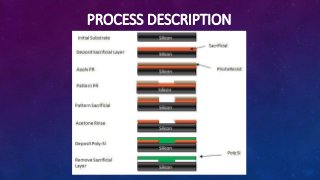
SURFACE MICROMACHINING
• Unlike Bulk micromachining, where a silicon substrate (wafer) is selectively
etched to produce structures, surface micromachining builds microstructures
by deposition and etching of different structural layers on top of the substrate
• Generally polysilicon is commonly used as one of the layers and silicon
dioxide is used as a sacrificial layer which is removed or etched out to create
the necessary void in the thickness direction
• The main advantage of this machining process is the possibility of realizing
monolithic microsystems in which the electronic and the mechanical
components(functions) are built in on the same substrate.
PROCESS DESCRIPTION
LIGA PROCESS
• An important technology of MST
• Developed in Germany in the early 1980s
• LIGA stands for the German words
• Lithography (in particular X-ray lithography)
• Galvanoforming (translated electro deposition or
electroforming)
• Abformtechnik (plastic molding)
• The letters also indicate the LIGA process sequence
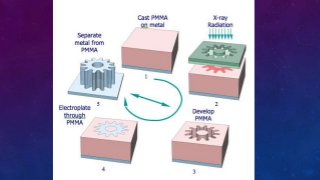
PROCESSING STEPS IN LIGA
• Apply resist, X-ray exposure through mask,
• remove exposed portions of resist,
• electrode position to fill openings in resist,
• strip resist for (a) mold or (b) metal part
ADVANTAGES IN LIGA
• LIGA is a versatile process – it can produce parts by several
different methods
• High aspect ratios are possible (large height-to-width ratios in the
fabricated part)
• Wide range of part sizes is feasible - heights ranging from
micrometers to centimeters
• Close tolerances are possible
DISADVANTAGES IN LIGA
• LIGA is a very expensive process
• Large quantities of parts are usually required to justify its
application
• LIGA uses X-ray exposure
• Human health hazard
MANUFACTURING FACILITIES IN CMTI –BANGALORE
MACHINES FOR MICROMACHINING
• 1. Ultra Precision 5-Axes CNC Micro Machining Centre – KERN Evo
• Machine Features:
• The machine is built with Polymer Concrete bed for high rigidity and damping.
• The spindle rpm is 50,000 with inbuilt cooling system to avoid thermal expansion.
• The positional accuracy of the machine ± 0.001 mm.
• Infrared touch probe facility for tool and work piece setting.
• Minimum size of the drill and milling cutter that can be used are 30 μm and 50 μm
respectively.
• Micro Machining Centre – KERN Evo
Application Examples:
• Application Areas:
• Micro surgical tools
• Optical fiber connections
• Watch parts
• Micro parts for Bio medical applications
2. MICRO WIRE ELECTRO DISCHARGE MACHINE – AGIE
EXCELLENCE 2F
• Machine Features:-
• Submerged machining.
• Temperature controlled dielectric
• Dual measuring system for X and Y axes
• Minimum wire diameter: 30 μm.
• Maximum taper angle: 30º/ 100 mm.
• Auto process parameter selection facility.
• Profile accuracy on machined component: ± 4 μm.
• Taper accuracy on the machined component: ± 5 Arc min.
• Surface finish on machined component: < Ra 0.4 μm
Application Examples:
Application Areas:
Dies & Punches for Electronic & Horological Applications
Micro surgical tools & Bio medical devices
Thin walled structural parts fro Aerospace application
Precision form gauges
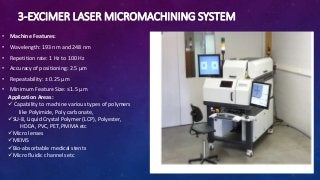
3-EXCIMER LASER MICROMACHINING SYSTEM
• Machine Features:
• Wavelength: 193 nm and 248 nm
• Repetition rate: 1 Hz to 100 Hz
• Accuracy of positioning: 2.5 μm
• Repeatability: ± 0.25 μm
• Minimum Feature Size: ≤1.5 μm
Application Areas:
 Capability to machine various types of polymers
like Polyimide, Poly carbonate,
SU-8, Liquid Crystal Polymer (LCP), Polyester,
HDDA, PVC, PET, PMMA etc
Micro lenses
MEMS
Bio-absorbable medical stents
Micro fluidic channels etc
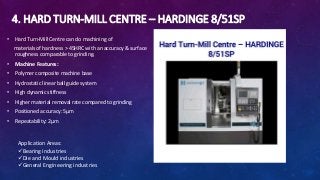
4. HARD TURN-MILL CENTRE – HARDINGE 8/51SP
• Hard Turn-Mill Centre can do machining of
materials of hardness > 45HRC with an accuracy & surface
roughness comparable to grinding.
• Machine Features:
• Polymer composite machine base
• Hydrostatic linear ball guide system
• High dynamic stiffness
• Higher material removal rate compared to grinding
• Positioned accuracy: 5μm
• Repeatability: 2μm
Application Areas:
Bearing industries
Die and Mould industries
General Engineering industries
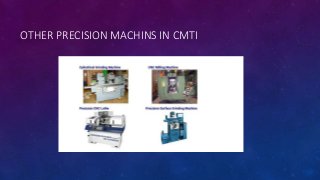
OTHER PRECISION MACHINS IN CMTI
REFERENCES
• 1 -Wikipedia for micromachining
• 2. -WWW.Cmti-india.net(journal published in APRIL-2004 VOL-3 NO-4)
• 3-NICMAP-National information centre for tools and production
• 4-Etch Rates for Micromachining Processing Kirt R. Williams, Student Member, IEEE, and Richard S. Muller, Life Fellow, IEEE
• 5-Vogler, M. P., DeVor, R. E., and Kapoor, S. G., 2004, “On the Modeling and Analysis of Machining Performance in Micro-Endmilling,
Part II: Cutting Force Prediction,” ASME J. Manuf. Sci. Eng., 1264, pp. 695–705.
• 6-Lee, K., and Dornfeld, D. A., 2002, “An Experimental Study on Burr Formationin Micro Milling Aluminum and Copper,” Trans.
NAMRI/SME, 30, pp.255–262.
• 7- Vogler, M. P., DeVor, R. E., and Kapoor, S. G., 2004, “On the Modeling and Analysis of Machining Performance in Micro-Endmilling,
Part I: Surface Generation,”ASME J. Manuf. Sci. Eng., 1264, pp. 685–694.
• 8-Weule, H., Huntrup, V., and Tritschle, H., 2001, “Micro-Cutting of Steel to Meet New Requirements in Miniaturization,” CIRP Ann.,
50, pp. 61–64.
• 9-Yuan, Z. J., Zhou, M., and Dong, S., 1996, “Effect of Diamond Tool Sharpness on Minimum Cutting Thickness and Cutting Surface
Integrity in Ultraprecision Machining,” J. Mater. Process. Technol., 62, pp. 327–330.
THANK YOU

MICROMACHINIG

  • 1.
    Presented by: RAJKUMAR SWAGMARE 1MS15MSE10 1st sem. M.Tech MSE M.S.RAMAIAH INSTITUTE OF TECHNOLOGY BANGALORE (AUTONOMOUS INSTITUTE,AFFILIATED TO VTU)
  • 2.
  • 3.
  • 4.
    • INTRODUCTION Micromachining isthe basic technology for fabrication of micro-components of size in the range of 1 to 500 µm. Their need arises from miniaturization of various devices in science and engineering, calling for ultra-precision manufacturing and micro-fabrication.
  • 5.
    MICRO MACHINING Figure: MicroMachining Definition  Definition: material removal at micro/ Nano level with no constraint on the size of the component being machined.
  • 6.
    MICRO MACHINING  Removalof material in the form of chips having the size in the range of microns.  Creating micro features or surface characteristics (especially surface finish) in the micro/ Nano level.
  • 7.
    WHY MICRO MACHINING? Final finishing operations in manufacturing of precise parts are always of concern owing to their most critical, labour intensive and least controllable nature.  In the era of nanotechnology, deterministic high precision finishing methods are of utmost importance and are the need of present manufacturing scenario.  The need for high precision in manufacturing was felt by manufacturers worldwide to improve interchangeability of components, improve quality control and longer wear/fatigue life.
  • 8.
    WHY MICRO MACHINING? Presentday High-tech Industries, Design requirements are stringent. • Extraordinary Properties of Materials (High Strength, High heat Resistant, High hardness, Corrosion resistant etc.) • Complex 3D Components (Turbine Blades) • Miniature Features (filters for food processing and textile industries having few tens of microns as hole diameter and thousands in number) • Nano level surface finish on Complex geometries (thousands of turbulated cooling holes in a turbine blade) • Making and finishing of micro fluidic channels (in electrically conducting & non conducting materials, say glass, quartz, &ceramics)
  • 9.
    WHAT IS MICROFABRICATION? Fabrication of products deals with making of machines, structures or process equipment by casting, forming, welding, machining & assembling. Classified into: Macro & micro Macro: fabrication of structures/parts/products that are measurable /observable by naked eye( ≥ 1mm in size) Micro: fabrication of miniature structures/parts/products that are not visible with naked eye(1 µm ≤ dimension ≤ 1000 µm in size) Methods of Micro Fabrication: Material deposition & Material Removal
  • 10.
    1. CLASSIFICATION OFMICRO MANUFACTURING TECHNIQUES.
  • 11.
    CLASSIFICATION OF MICROFABRICATION Figure: Classification of Micro Machining
  • 12.
  • 13.
    LASER MICROMACHINING INMEDICINE Ø 0.08 mm Ø 0.02 mm
  • 14.
    WORKPIECE MATERIAL FORMICRO MACHINING Figure 5. Typical workpiece materials used in micromachining
  • 15.
  • 16.
    DIFFERENT MICROMACHINING TECHNIQUES Photolithography  Etching SiliconMicromachining LIGA Mechanical Micromachining
  • 17.
    PHOTOLITHOGRAPHY • Photolithography, alsotermed optical lithography or UV lithography, is a process used in micro fabrication to pattern parts of a thin film or the bulk of a substrate. • It uses light to transfer a geometric pattern from a photo mask to a light-sensitive chemical "photoresist", or simply "resist," on the substrate.
  • 18.
  • 20.
  • 21.
    ETCHING • Etching isused in micro fabrication to chemically remove layers from the surface of a wafer during manufacturing. • Etching is a critically important process module, and every wafer undergoes many etching steps before it is complete. • It is characterized by etch rate , etch selectivity and etch uniformity
  • 22.
    PROCESS VARIATIONS: 1. Wetetching Etching processes used liquid-phase ("wet") etchants. The wafer can be immersed in a bath of etchant, which must be agitated to achieve good process control. For instance, buffered hydrofluoric acid (BHF) is used commonly to etch silicon dioxide over a silicon substrate. 2. Dry etching • Modern VLSI processes avoid wet etching, and use plasma etching instead. • plasma etching operates between 0.1 and 5 Torr • The plasma produces energetic free radicals, neutrally charged, that react at the surface of the wafer. Since neutral particles attack the wafer from all angles, this process is isotropic
  • 23.
    BULK MICROMACHINING • Bulkand surface micromachining are processes used to create microstructures on micro-electromechanical (MEMS) devices. • Micro-Electro-Mechanical Systems (MEMS) is the integration of mechanical elements, sensors, actuators, and electronics on a common silicon substrate through microfabrication technology • While both wet and dry etching techniques are available to both bulk and surface micromachining, bulk micromachining typically uses wet etching techniques while surface micromachining primarily uses dry etching techniques. • Bulk micromachining selectively etches the silicon substrate to create microstructures on MEMS devices.
  • 24.
    SURFACE MICROMACHINING • UnlikeBulk micromachining, where a silicon substrate (wafer) is selectively etched to produce structures, surface micromachining builds microstructures by deposition and etching of different structural layers on top of the substrate • Generally polysilicon is commonly used as one of the layers and silicon dioxide is used as a sacrificial layer which is removed or etched out to create the necessary void in the thickness direction • The main advantage of this machining process is the possibility of realizing monolithic microsystems in which the electronic and the mechanical components(functions) are built in on the same substrate.
  • 25.
  • 26.
    LIGA PROCESS • Animportant technology of MST • Developed in Germany in the early 1980s • LIGA stands for the German words • Lithography (in particular X-ray lithography) • Galvanoforming (translated electro deposition or electroforming) • Abformtechnik (plastic molding) • The letters also indicate the LIGA process sequence
  • 27.
    PROCESSING STEPS INLIGA • Apply resist, X-ray exposure through mask, • remove exposed portions of resist, • electrode position to fill openings in resist, • strip resist for (a) mold or (b) metal part
  • 29.
    ADVANTAGES IN LIGA •LIGA is a versatile process – it can produce parts by several different methods • High aspect ratios are possible (large height-to-width ratios in the fabricated part) • Wide range of part sizes is feasible - heights ranging from micrometers to centimeters • Close tolerances are possible
  • 30.
    DISADVANTAGES IN LIGA •LIGA is a very expensive process • Large quantities of parts are usually required to justify its application • LIGA uses X-ray exposure • Human health hazard
  • 31.
    MANUFACTURING FACILITIES INCMTI –BANGALORE MACHINES FOR MICROMACHINING • 1. Ultra Precision 5-Axes CNC Micro Machining Centre – KERN Evo • Machine Features: • The machine is built with Polymer Concrete bed for high rigidity and damping. • The spindle rpm is 50,000 with inbuilt cooling system to avoid thermal expansion. • The positional accuracy of the machine ± 0.001 mm. • Infrared touch probe facility for tool and work piece setting. • Minimum size of the drill and milling cutter that can be used are 30 μm and 50 μm respectively. • Micro Machining Centre – KERN Evo Application Examples: • Application Areas: • Micro surgical tools • Optical fiber connections • Watch parts • Micro parts for Bio medical applications
  • 32.
    2. MICRO WIREELECTRO DISCHARGE MACHINE – AGIE EXCELLENCE 2F • Machine Features:- • Submerged machining. • Temperature controlled dielectric • Dual measuring system for X and Y axes • Minimum wire diameter: 30 μm. • Maximum taper angle: 30º/ 100 mm. • Auto process parameter selection facility. • Profile accuracy on machined component: ± 4 μm. • Taper accuracy on the machined component: ± 5 Arc min. • Surface finish on machined component: < Ra 0.4 μm Application Examples: Application Areas: Dies & Punches for Electronic & Horological Applications Micro surgical tools & Bio medical devices Thin walled structural parts fro Aerospace application Precision form gauges
  • 33.
    3-EXCIMER LASER MICROMACHININGSYSTEM • Machine Features: • Wavelength: 193 nm and 248 nm • Repetition rate: 1 Hz to 100 Hz • Accuracy of positioning: 2.5 μm • Repeatability: ± 0.25 μm • Minimum Feature Size: ≤1.5 μm Application Areas:  Capability to machine various types of polymers like Polyimide, Poly carbonate, SU-8, Liquid Crystal Polymer (LCP), Polyester, HDDA, PVC, PET, PMMA etc Micro lenses MEMS Bio-absorbable medical stents Micro fluidic channels etc
  • 34.
    4. HARD TURN-MILLCENTRE – HARDINGE 8/51SP • Hard Turn-Mill Centre can do machining of materials of hardness > 45HRC with an accuracy & surface roughness comparable to grinding. • Machine Features: • Polymer composite machine base • Hydrostatic linear ball guide system • High dynamic stiffness • Higher material removal rate compared to grinding • Positioned accuracy: 5μm • Repeatability: 2μm Application Areas: Bearing industries Die and Mould industries General Engineering industries
  • 35.
  • 36.
    REFERENCES • 1 -Wikipediafor micromachining • 2. -WWW.Cmti-india.net(journal published in APRIL-2004 VOL-3 NO-4) • 3-NICMAP-National information centre for tools and production • 4-Etch Rates for Micromachining Processing Kirt R. Williams, Student Member, IEEE, and Richard S. Muller, Life Fellow, IEEE • 5-Vogler, M. P., DeVor, R. E., and Kapoor, S. G., 2004, “On the Modeling and Analysis of Machining Performance in Micro-Endmilling, Part II: Cutting Force Prediction,” ASME J. Manuf. Sci. Eng., 1264, pp. 695–705. • 6-Lee, K., and Dornfeld, D. A., 2002, “An Experimental Study on Burr Formationin Micro Milling Aluminum and Copper,” Trans. NAMRI/SME, 30, pp.255–262. • 7- Vogler, M. P., DeVor, R. E., and Kapoor, S. G., 2004, “On the Modeling and Analysis of Machining Performance in Micro-Endmilling, Part I: Surface Generation,”ASME J. Manuf. Sci. Eng., 1264, pp. 685–694. • 8-Weule, H., Huntrup, V., and Tritschle, H., 2001, “Micro-Cutting of Steel to Meet New Requirements in Miniaturization,” CIRP Ann., 50, pp. 61–64. • 9-Yuan, Z. J., Zhou, M., and Dong, S., 1996, “Effect of Diamond Tool Sharpness on Minimum Cutting Thickness and Cutting Surface Integrity in Ultraprecision Machining,” J. Mater. Process. Technol., 62, pp. 327–330.
  • 37.