NON-CONVENTIONAL MACHINING PROCESS
Presented by
Sribhashyam Phani Krishna Narasimha
Department Of Mechanical Engineering
NON-CONVENTIONAL MACHINING PROCESS
Presented by
Sribhashyam Phani Krishna Narasimha
Department Of Mechanical Engineering
MACHINING PROCESS
 Machining is a process in which a material is cut into a desired final shape and
size by a controlled material-removal process.
 Machining is a part of the manufacture of many metal products , but it can also
be used on materials such as wood, plastic ,ceramics and other composites.
 Machining process are converted into two types. They are
 Conventional or Traditional machining process
 Non-coventional or Non-traditional machining process
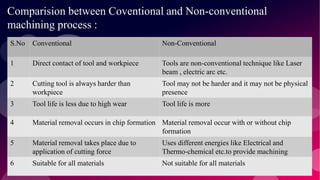
Comparision between Coventional and Non-conventional
machining process :
S.No Conventional Non-Conventional
1 Direct contact of tool and workpiece Tools are non-conventional technique like Laser
beam , electric arc etc.
2 Cutting tool is always harder than
workpiece
Tool may not be harder and it may not be physical
presence
3 Tool life is less due to high wear Tool life is more
4 Material removal occurs in chip formation Material removal occur with or without chip
formation
5 Material removal takes place due to
application of cutting force
Uses different energies like Electrical and
Thermo-chemical etc.to provide machining
6 Suitable for all materials Not suitable for all materials
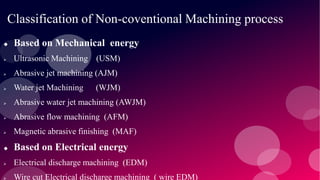
Classification of Non-coventional Machining process
 Based on Mechanical energy
 Ultrasonic Machining (USM)
 Abrasive jet machining (AJM)
 Water jet Machining (WJM)
 Abrasive water jet machining (AWJM)
 Abrasive flow machining (AFM)
 Magnetic abrasive finishing (MAF)
 Based on Electrical energy
 Electrical discharge machining (EDM)
 Wire cut Electrical discharge machining ( wire EDM)
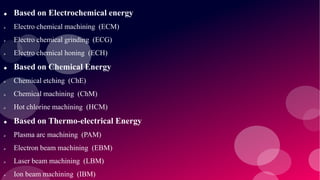
 Based on Electrochemical energy
 Electro chemical machining (ECM)
 Electro chemical grinding (ECG)
 Electro chemical honing (ECH)
 Based on Chemical Energy
 Chemical etching (ChE)
 Chemical machining (ChM)
 Hot chlorine machining (HCM)
 Based on Thermo-electrical Energy
 Plasma arc machining (PAM)
 Electron beam machining (EBM)
 Laser beam machining (LBM)
 Ion beam machining (IBM)
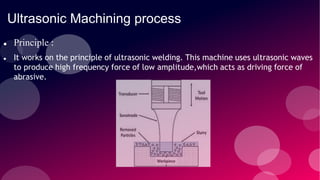
Ultrasonic Machining process
 Principle :
 It works on the principle of ultrasonic welding. This machine uses ultrasonic waves
to produce high frequency force of low amplitude,which acts as driving force of
abrasive.
 Ultrasonic machine generates high frequency vibrating wave of frequency about 2000
to 3000 Hz & amplitude about 25-50 micron.
 This high frequency vibration transfer to abrasive particles contain in abrasive slurry.
This leads indentation of abrasive particle to brittle workpiece and removes material
from the contact surface.
 Construction :
 It consists of a ultrasonic generator and transducer , concentrator, tool , abrasive
slurry & tool feed mechanisms.
 Concentrator is a tool cone which is made from titanium or stainless steel.
 The gap between the tool and work is about 0.02 to 0.1 mm.
 Abrasive slurry is a mixture of abrasive grains and carrier fluid, which is provided
between tool and workpiece. Generally water is used as carrier fluid.
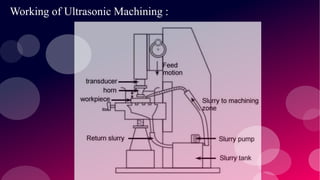
Working of Ultrasonic Machining :
 In this process , the metal removal is faciliated through abrasive action of each grain. These grains are
hammered and forced into work material by high frequency oscillating tool, due to which it is also
named as Ultrasonic grinding or Impact grinding.
 During this operation , an ultrasonic oscillator passes a high frequency electric current to the ultrasonic
transducer. The ultrasonic transducer converts electrical energy into mechanical vibrations.
 The transducer is made of a magnostrictive material for generation of mechanical vibration , which
ranges from 20 kHz to 30 kHz. These vibrations are transmitted through intermediate connecting parts to
the cutting tool. As a result , the tool vibrates in a longitudinal direction.
 A slurry of small abrasive particles is fed into the machining location by menas of a pump. Boron
carbide , silicon carbide , aluminium oxide & diamond dust are the different types of abrasives used in
ultrasonic machining process.
 In addition , a cooling system can also be equipped for keeping the workpiece at lower temperature. The
shape of the cutting tool resembles the cavity produced in the workpiece.
 Advantages :
 Non-conductive materials can also be machined
 Hard material can be easily machined by this method
 Disadvantages :
 Material Removal Rate (MRR) is low
 High power Consumption
 Applications :
 This machining is used to machine hard and brittle material like carbide, ceramics &
glass
 It is used to cut the diamonds in desired shapes
Electrical Discharge Machining
 Principle :
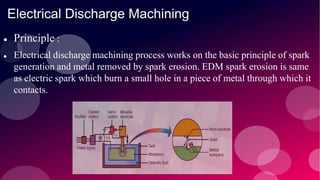
 Electrical discharge machining process works on the basic principle of spark
generation and metal removed by spark erosion. EDM spark erosion is same
as electric spark which burn a small hole in a piece of metal through which it
contacts.
 The spark generated by this process produces heat, which remove metal by erosion &
evaporation. In this machining process both the workpiece and tool must be made by
conductive material.
 Construction :
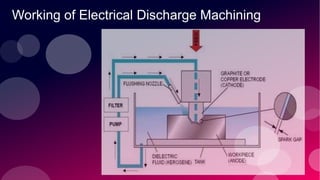
 This system consists of shaped tool , power supply source, dielectric fluid and its
circulation line & servo controlled tool feed mechanism .
 Tool acts as a Cathode (Negative terminal)
 Workpiece acts as Anode (positive terminal)
 Terminals are connected to DC power supply to create potential difference between
work and tool
 Distance between work and tool is known as spark gap & it is filled by dielectric fluid
Working of Electrical Discharge Machining
 This process is also known as “ spark erosion machining” or “Spark over initiated
discharge machining” , as the removal of metal occurs due to erosion caused by
electric spark.
 This machine consists of a dielectric medium, tool ,power supply, rack & pinion
mechanism, speed reduction gear box & an electric circuit.
 The job is connected to positive terminal , which acts as anode whereas the tool is
connected to negative terminal which acts as cathode. Both job & tool is seperated by
a small gap known as Spark gap.
 When appropriate amount of current is passed between tool and job , dielectric
solution occupies the gap & causes breakdown. Due to this an electrical spark with
appropriate force & velocity hits the surface of the job
 A very high temperature of about 1000°c is generated and this temperature melts the
metal. This melten metal are thrown into the gap by electrostatic forces and are
finally drived away by dielectric flowing fluid.
 Advantages :
 This process provides high accuracy for tools & dies.
 Machining time is less
 It allows easy drilling of fine holes
 Disadvantages :
 Machining of sharp corners are difficult to produce.
 This process is not suitable for electrically non-conducting materials
 Applications :
 Resharpening of cutting tools & broaches
 Machining of cavity for dies
 Manufacturing of tools
Laser Beam Machining Process
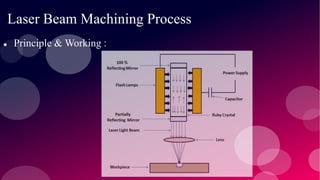
 Principle & Working :
 Working :
 When a light is projected on a laser tube by a flash lamp , the electrons of atoms get excited as
they absorb the radiation of incoming light energy.
 An additional light with characteristics same as light source is emitted by electrons . Then to
and fro motion of light occurs in between the reflecting mirrors.
 Since partial reflecting mirror does’nt reflect the total light back at each travel that comes
from a laser tube,part of the light leaves it and passes through lens.
 Thus , a lens incorporated in between workpiece and partial reflecting mirror converges the
coherent stream of monochromatic light and focuses it to a particular point on the workpiece
surface.
 The material gets melted and vapourised at the point where the converged laser beam of high
intensity falls on the workpiece & the process continues to obtain the desired shape of the
workpiece.
 Since the process is accomplished by melting and vapourising the workpiece , the process is
 LASER is abbreviated as
 Light Amplification for Stimulated Emission of Radiation
 This system consists of ruby laser tube , a pair of mirrors , an amplifying source, a
flash tube , a cooling system , a lens and a enclosure
 Components such as ruby laser tube , pair of mirrors and flash tube are positioned
within the enclosure . Power supply , coolant system and lens are located outside the
enclosure.
 Flash surrounds the ruby tube and totally reflecting mirror, partially reflecting mirror
are setup at either openings of the ruby tube. Depending upon the application the
lasers employed can be solid or gaseous type.
 The solid laser type provides shorter duration of laser beam , while the gaseous type
provides continuous laser beam and are best suited for cutting and welding
operations.
 Advantages :
 Machining of any material can be performed easily.
 Tool wear does’nt occur in this process.
 Heat affected zone around the machined part is very small
 Disadvantages :
 Capital investment is very high
 Rate of production is low
 Applicable to thin cross sectional materials
 Applications :
 Employed in Micro drilling operations
 Micro-machining of thin sectional area
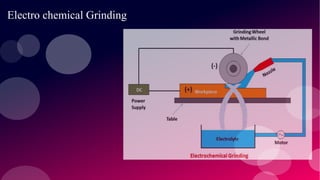
Electro chemical Grinding
 Working :
 In this process the removal of the material takes place by electrochemical deposition as well as
material abrasion. The spindle of electrochemical grinding is supported by bearings.
 Due to rotary motion of the spindle , the grinding wheel rotates. The workpiece which is
placed on the machine table , can be moved in to and fro motion.
 A DC power source supplies the current from cathode to anode and electrolyte flows from the
tank to the gap maintained between wheel and workpiece. Due to this electrochemical
oxidation film is formed on the work surface
 Oxidation film is removed by grinding wheel. Thus, a precise and finished surface is obtained
 Applications :
 This process is more widely used for grinding carbide cutting tools
 It is also used for grinding hard , tough and heat-sensitive materilas.
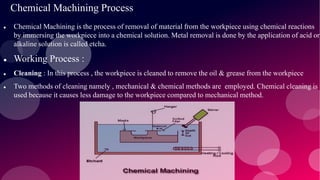
Chemical Machining Process
 Chemical Machining is the process of removal of material from the workpiece using chemical reactions
by immersing the workpiece into a chemical solution. Metal removal is done by the application of acid or
alkaline solution is called etcha.
 Working Process :
 Cleaning : In this process , the workpiece is cleaned to remove the oil & grease from the workpiece
 Two methods of cleaning namely , mechanical & chemical methods are employed. Chemical cleaning is
used because it causes less damage to the workpiece compared to mechanical method.
 2) Masking:
 Masking is done using maskants. These maskants are inert in nature and do not react
with chemicals used in the machining process
 n this masking process, the part of the workpiece which is not to be machined is
masked using the maskants so that only the part to be machined comes in contact with
a chemical used in the machining process. But when the masking process is done, the
whole workpiece is masked.
 3) Scribing:
 After the masking process, scribing is done to remove the maskant from the area of
the workpiece which is to be machined so that the chemical reaction can take place on
that part of the workpiece.
 After the scribing process, only those areas are exposed to the chemical machining
which are to be machined.
 4) Etching :
 After scribing the workpiece is immersed in a container containing the chemical
which undergoes chemical reaction.
 When the workpiece is dipped inside the chemical the area which is masked does'nt
undergoes any chemical reaction and the area which is unmasked undergoes chemical
reaction
 5) Demasking :
 After the etching process, the masked is removed from the area of the workpiece
which is not machined , and also oxide layer is removed from the area of workpiece
which is machined.
 6) Washing :
 After the demasking process the workpiece is washed thoroughly under fresh water to
remove the etchant completely from the workpiece.
Thank You

NON-CONVENTIONAL MACHINING PROCESS

  • 1.
    NON-CONVENTIONAL MACHINING PROCESS Presentedby Sribhashyam Phani Krishna Narasimha Department Of Mechanical Engineering
  • 2.
    NON-CONVENTIONAL MACHINING PROCESS Presentedby Sribhashyam Phani Krishna Narasimha Department Of Mechanical Engineering
  • 3.
    MACHINING PROCESS  Machiningis a process in which a material is cut into a desired final shape and size by a controlled material-removal process.  Machining is a part of the manufacture of many metal products , but it can also be used on materials such as wood, plastic ,ceramics and other composites.  Machining process are converted into two types. They are  Conventional or Traditional machining process  Non-coventional or Non-traditional machining process
  • 4.
    Comparision between Coventionaland Non-conventional machining process : S.No Conventional Non-Conventional 1 Direct contact of tool and workpiece Tools are non-conventional technique like Laser beam , electric arc etc. 2 Cutting tool is always harder than workpiece Tool may not be harder and it may not be physical presence 3 Tool life is less due to high wear Tool life is more 4 Material removal occurs in chip formation Material removal occur with or without chip formation 5 Material removal takes place due to application of cutting force Uses different energies like Electrical and Thermo-chemical etc.to provide machining 6 Suitable for all materials Not suitable for all materials
  • 5.
    Classification of Non-coventionalMachining process  Based on Mechanical energy  Ultrasonic Machining (USM)  Abrasive jet machining (AJM)  Water jet Machining (WJM)  Abrasive water jet machining (AWJM)  Abrasive flow machining (AFM)  Magnetic abrasive finishing (MAF)  Based on Electrical energy  Electrical discharge machining (EDM)  Wire cut Electrical discharge machining ( wire EDM)
  • 6.
     Based onElectrochemical energy  Electro chemical machining (ECM)  Electro chemical grinding (ECG)  Electro chemical honing (ECH)  Based on Chemical Energy  Chemical etching (ChE)  Chemical machining (ChM)  Hot chlorine machining (HCM)  Based on Thermo-electrical Energy  Plasma arc machining (PAM)  Electron beam machining (EBM)  Laser beam machining (LBM)  Ion beam machining (IBM)
  • 7.
    Ultrasonic Machining process Principle :  It works on the principle of ultrasonic welding. This machine uses ultrasonic waves to produce high frequency force of low amplitude,which acts as driving force of abrasive.
  • 8.
     Ultrasonic machinegenerates high frequency vibrating wave of frequency about 2000 to 3000 Hz & amplitude about 25-50 micron.  This high frequency vibration transfer to abrasive particles contain in abrasive slurry. This leads indentation of abrasive particle to brittle workpiece and removes material from the contact surface.  Construction :  It consists of a ultrasonic generator and transducer , concentrator, tool , abrasive slurry & tool feed mechanisms.  Concentrator is a tool cone which is made from titanium or stainless steel.  The gap between the tool and work is about 0.02 to 0.1 mm.  Abrasive slurry is a mixture of abrasive grains and carrier fluid, which is provided between tool and workpiece. Generally water is used as carrier fluid.
  • 9.
  • 10.
     In thisprocess , the metal removal is faciliated through abrasive action of each grain. These grains are hammered and forced into work material by high frequency oscillating tool, due to which it is also named as Ultrasonic grinding or Impact grinding.  During this operation , an ultrasonic oscillator passes a high frequency electric current to the ultrasonic transducer. The ultrasonic transducer converts electrical energy into mechanical vibrations.  The transducer is made of a magnostrictive material for generation of mechanical vibration , which ranges from 20 kHz to 30 kHz. These vibrations are transmitted through intermediate connecting parts to the cutting tool. As a result , the tool vibrates in a longitudinal direction.  A slurry of small abrasive particles is fed into the machining location by menas of a pump. Boron carbide , silicon carbide , aluminium oxide & diamond dust are the different types of abrasives used in ultrasonic machining process.  In addition , a cooling system can also be equipped for keeping the workpiece at lower temperature. The shape of the cutting tool resembles the cavity produced in the workpiece.
  • 11.
     Advantages : Non-conductive materials can also be machined  Hard material can be easily machined by this method  Disadvantages :  Material Removal Rate (MRR) is low  High power Consumption  Applications :  This machining is used to machine hard and brittle material like carbide, ceramics & glass  It is used to cut the diamonds in desired shapes
  • 12.
    Electrical Discharge Machining Principle :  Electrical discharge machining process works on the basic principle of spark generation and metal removed by spark erosion. EDM spark erosion is same as electric spark which burn a small hole in a piece of metal through which it contacts.
  • 13.
     The sparkgenerated by this process produces heat, which remove metal by erosion & evaporation. In this machining process both the workpiece and tool must be made by conductive material.  Construction :  This system consists of shaped tool , power supply source, dielectric fluid and its circulation line & servo controlled tool feed mechanism .  Tool acts as a Cathode (Negative terminal)  Workpiece acts as Anode (positive terminal)  Terminals are connected to DC power supply to create potential difference between work and tool  Distance between work and tool is known as spark gap & it is filled by dielectric fluid
  • 14.
    Working of ElectricalDischarge Machining
  • 15.
     This processis also known as “ spark erosion machining” or “Spark over initiated discharge machining” , as the removal of metal occurs due to erosion caused by electric spark.  This machine consists of a dielectric medium, tool ,power supply, rack & pinion mechanism, speed reduction gear box & an electric circuit.  The job is connected to positive terminal , which acts as anode whereas the tool is connected to negative terminal which acts as cathode. Both job & tool is seperated by a small gap known as Spark gap.  When appropriate amount of current is passed between tool and job , dielectric solution occupies the gap & causes breakdown. Due to this an electrical spark with appropriate force & velocity hits the surface of the job  A very high temperature of about 1000°c is generated and this temperature melts the metal. This melten metal are thrown into the gap by electrostatic forces and are finally drived away by dielectric flowing fluid.
  • 16.
     Advantages : This process provides high accuracy for tools & dies.  Machining time is less  It allows easy drilling of fine holes  Disadvantages :  Machining of sharp corners are difficult to produce.  This process is not suitable for electrically non-conducting materials  Applications :  Resharpening of cutting tools & broaches  Machining of cavity for dies  Manufacturing of tools
  • 17.
    Laser Beam MachiningProcess  Principle & Working :
  • 18.
     Working : When a light is projected on a laser tube by a flash lamp , the electrons of atoms get excited as they absorb the radiation of incoming light energy.  An additional light with characteristics same as light source is emitted by electrons . Then to and fro motion of light occurs in between the reflecting mirrors.  Since partial reflecting mirror does’nt reflect the total light back at each travel that comes from a laser tube,part of the light leaves it and passes through lens.  Thus , a lens incorporated in between workpiece and partial reflecting mirror converges the coherent stream of monochromatic light and focuses it to a particular point on the workpiece surface.  The material gets melted and vapourised at the point where the converged laser beam of high intensity falls on the workpiece & the process continues to obtain the desired shape of the workpiece.  Since the process is accomplished by melting and vapourising the workpiece , the process is
  • 19.
     LASER isabbreviated as  Light Amplification for Stimulated Emission of Radiation  This system consists of ruby laser tube , a pair of mirrors , an amplifying source, a flash tube , a cooling system , a lens and a enclosure  Components such as ruby laser tube , pair of mirrors and flash tube are positioned within the enclosure . Power supply , coolant system and lens are located outside the enclosure.  Flash surrounds the ruby tube and totally reflecting mirror, partially reflecting mirror are setup at either openings of the ruby tube. Depending upon the application the lasers employed can be solid or gaseous type.  The solid laser type provides shorter duration of laser beam , while the gaseous type provides continuous laser beam and are best suited for cutting and welding operations.
  • 20.
     Advantages : Machining of any material can be performed easily.  Tool wear does’nt occur in this process.  Heat affected zone around the machined part is very small  Disadvantages :  Capital investment is very high  Rate of production is low  Applicable to thin cross sectional materials  Applications :  Employed in Micro drilling operations  Micro-machining of thin sectional area
  • 21.
  • 22.
     Working : In this process the removal of the material takes place by electrochemical deposition as well as material abrasion. The spindle of electrochemical grinding is supported by bearings.  Due to rotary motion of the spindle , the grinding wheel rotates. The workpiece which is placed on the machine table , can be moved in to and fro motion.  A DC power source supplies the current from cathode to anode and electrolyte flows from the tank to the gap maintained between wheel and workpiece. Due to this electrochemical oxidation film is formed on the work surface  Oxidation film is removed by grinding wheel. Thus, a precise and finished surface is obtained  Applications :  This process is more widely used for grinding carbide cutting tools  It is also used for grinding hard , tough and heat-sensitive materilas.
  • 23.
    Chemical Machining Process Chemical Machining is the process of removal of material from the workpiece using chemical reactions by immersing the workpiece into a chemical solution. Metal removal is done by the application of acid or alkaline solution is called etcha.  Working Process :  Cleaning : In this process , the workpiece is cleaned to remove the oil & grease from the workpiece  Two methods of cleaning namely , mechanical & chemical methods are employed. Chemical cleaning is used because it causes less damage to the workpiece compared to mechanical method.
  • 24.
     2) Masking: Masking is done using maskants. These maskants are inert in nature and do not react with chemicals used in the machining process  n this masking process, the part of the workpiece which is not to be machined is masked using the maskants so that only the part to be machined comes in contact with a chemical used in the machining process. But when the masking process is done, the whole workpiece is masked.  3) Scribing:  After the masking process, scribing is done to remove the maskant from the area of the workpiece which is to be machined so that the chemical reaction can take place on that part of the workpiece.  After the scribing process, only those areas are exposed to the chemical machining which are to be machined.
  • 25.
     4) Etching:  After scribing the workpiece is immersed in a container containing the chemical which undergoes chemical reaction.  When the workpiece is dipped inside the chemical the area which is masked does'nt undergoes any chemical reaction and the area which is unmasked undergoes chemical reaction  5) Demasking :  After the etching process, the masked is removed from the area of the workpiece which is not machined , and also oxide layer is removed from the area of workpiece which is machined.  6) Washing :  After the demasking process the workpiece is washed thoroughly under fresh water to remove the etchant completely from the workpiece.
  • 26.