FUNDAMENTALS OF MICROWAVE
COMMUNICATION SYSTEM AND RADAR SYSTEMS
PREPARED BY: ER. SARBESH CHAUDHARY
H.O.D
DEPARTMENT OF ELECTRONICS
MANMOHAN MEMORIAL POLYTECHNIC, BUDHIGANGA-4, NEPAL
PRESENTATION ON
CONTENTS
• What is microwave?
• Microwave generation & transmission
• Microwave antenna & propagation
• Typical Microwave communication link
• Advantages & disadvantages of microwave
• Microwave applications
• Introduction to RADAR
• Basic Principle and Operation Of RADAR
• Types of RADAR
• Basic requirements of RADAR
• Applications of RADAR
WHAT IS MICROWAVE?
• Electromagnetic waves with frequencies ranging from 3 GHz to 300 GHz.
• Wavelength is in the order of 10 cm to 1mm – something in between light
waves and radio waves. So, it is also known as millimeter waves.
• Term “micro” refers to the tinyness of the wavelength.
•
• Because of high frequency and short wavelength phase changes
continuously w.r.t time.
WHAT IS MICROWAVE?(CONTINUE)
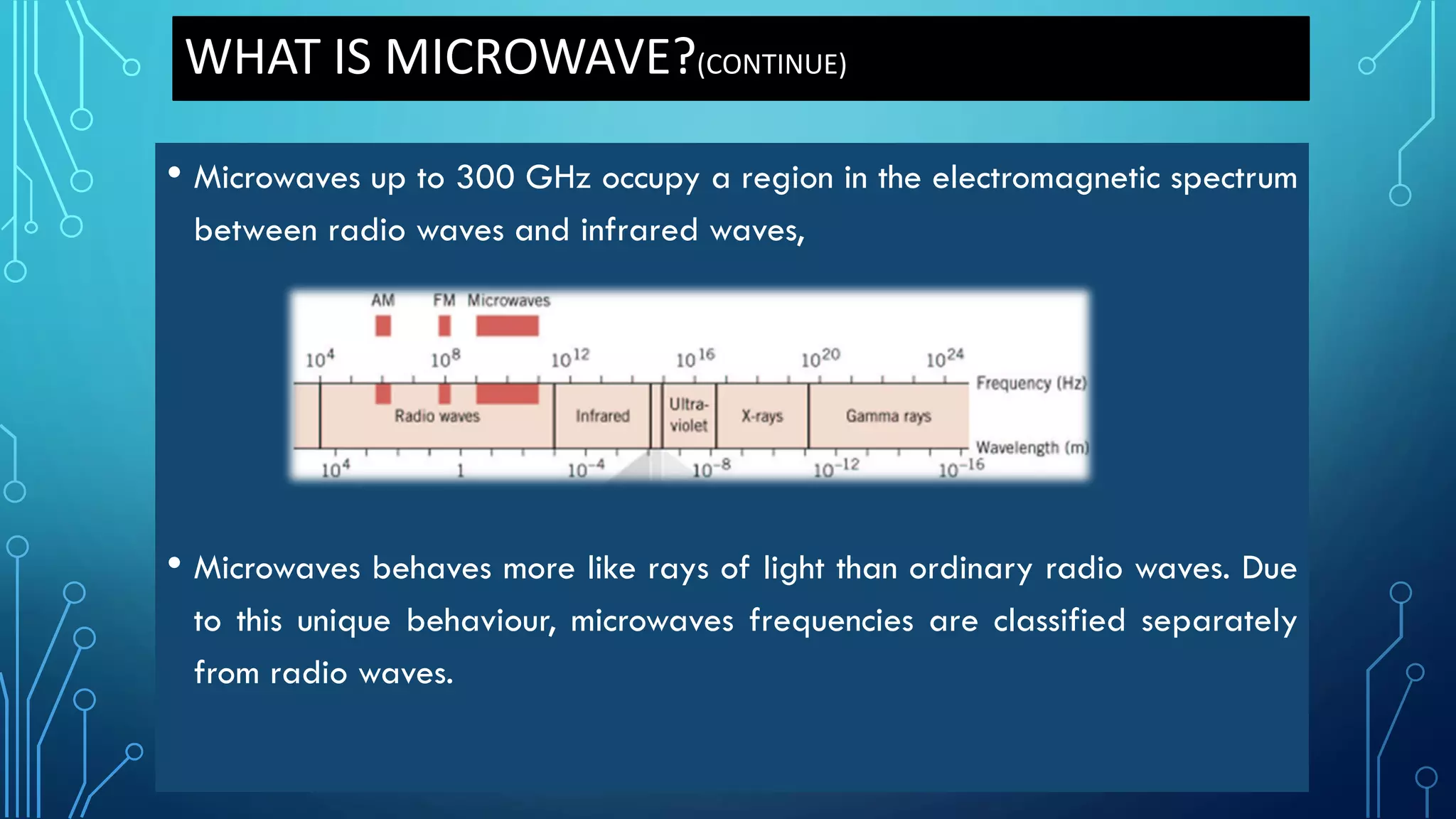
• Microwaves up to 300 GHz occupy a region in the electromagnetic spectrum
between radio waves and infrared waves,
• Microwaves behaves more like rays of light than ordinary radio waves. Due
to this unique behaviour, microwaves frequencies are classified separately
from radio waves.
WHAT IS MICROWAVE?(CONTINUE)
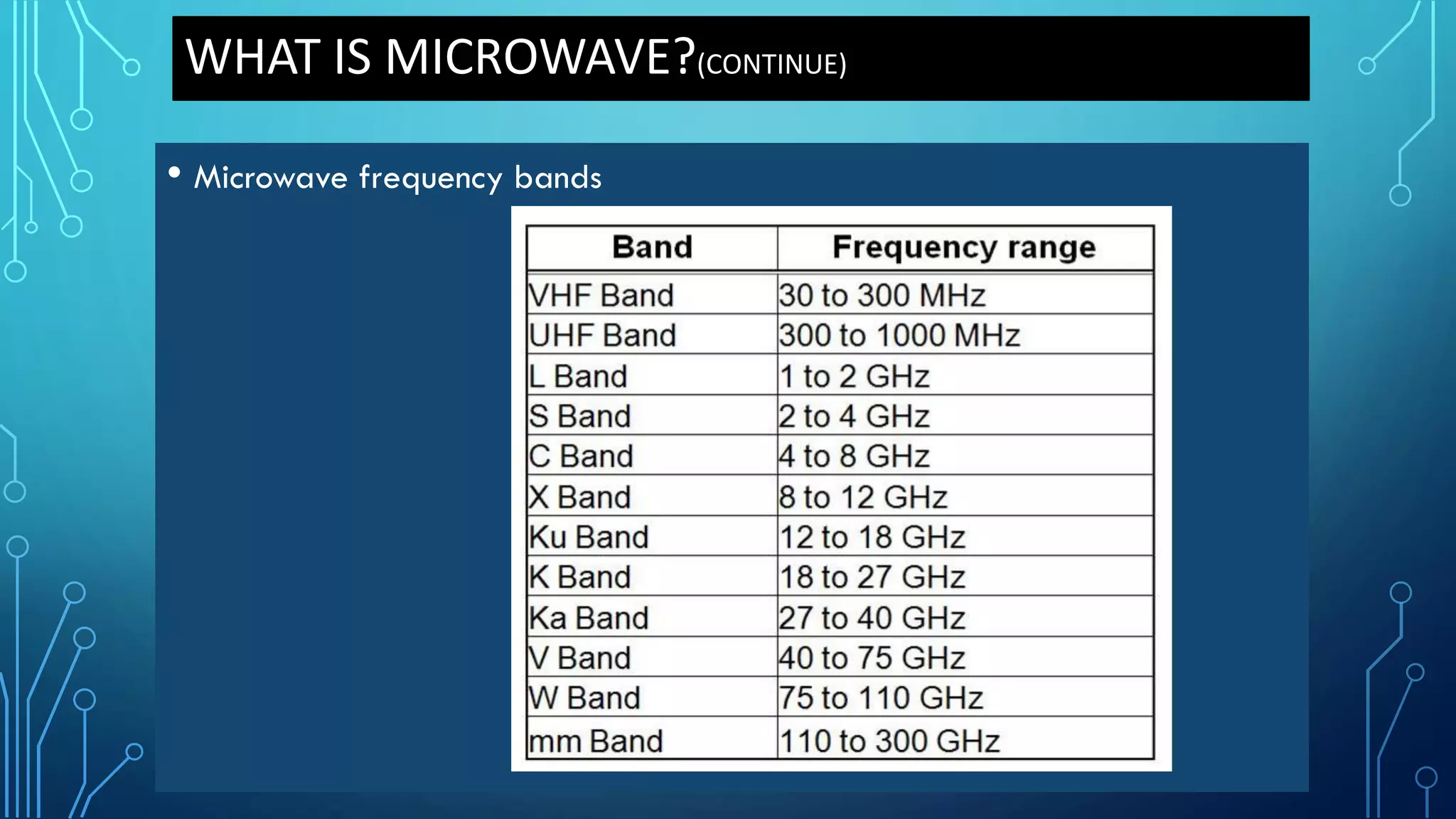
• Microwave frequency bands
MICROWAVE GENERATION & TRANSMISSION
MICROWAVE GENERATION
• The operation of conventional vacuum tubes and solid state devices is
limited by transit time , Inter-electrode capacitance and lead inductance
effects.
• Thus, the development of new devices was essential to exploit the microwave
frequency region.
• Fortunately, numbers of new principle of operations, such as , velocity
modulation, interaction of electrons with electromagnetic fields,
transferred electron techniques etc have enabled the generation of
microwaves.
MICROWAVE GENERATION & TRANSMISSION (CONT…)
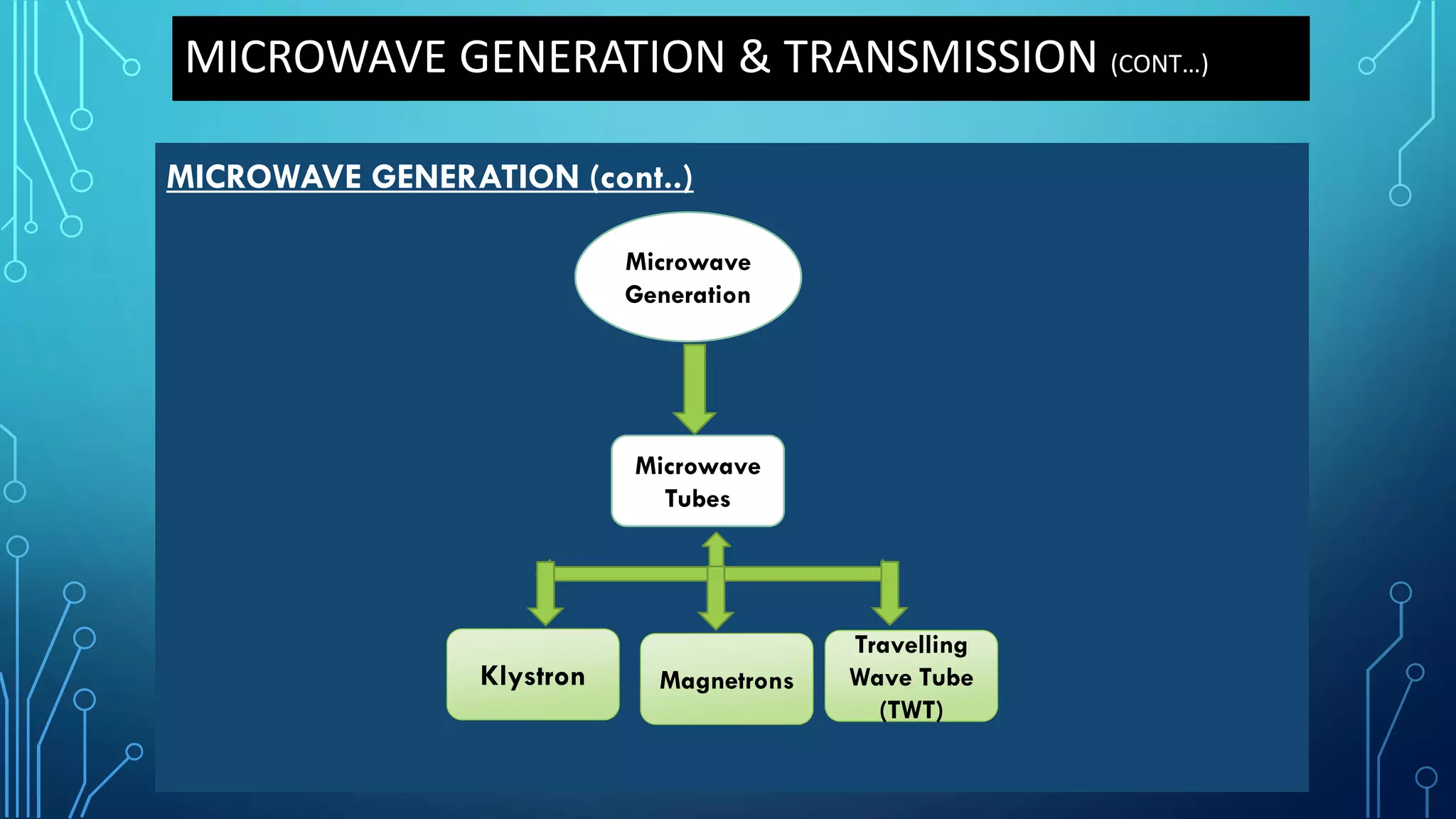
MICROWAVE GENERATION (cont..)
Microwave
Tubes
Microwave
Generation
Klystron Magnetrons
Travelling
Wave Tube
(TWT)
MICROWAVE GENERATION & TRANSMISSION (CONT…)
MICROWAVE TUBES
• Tubes generate and amplify high levels of microwave power more cheaply
than solid state devices.
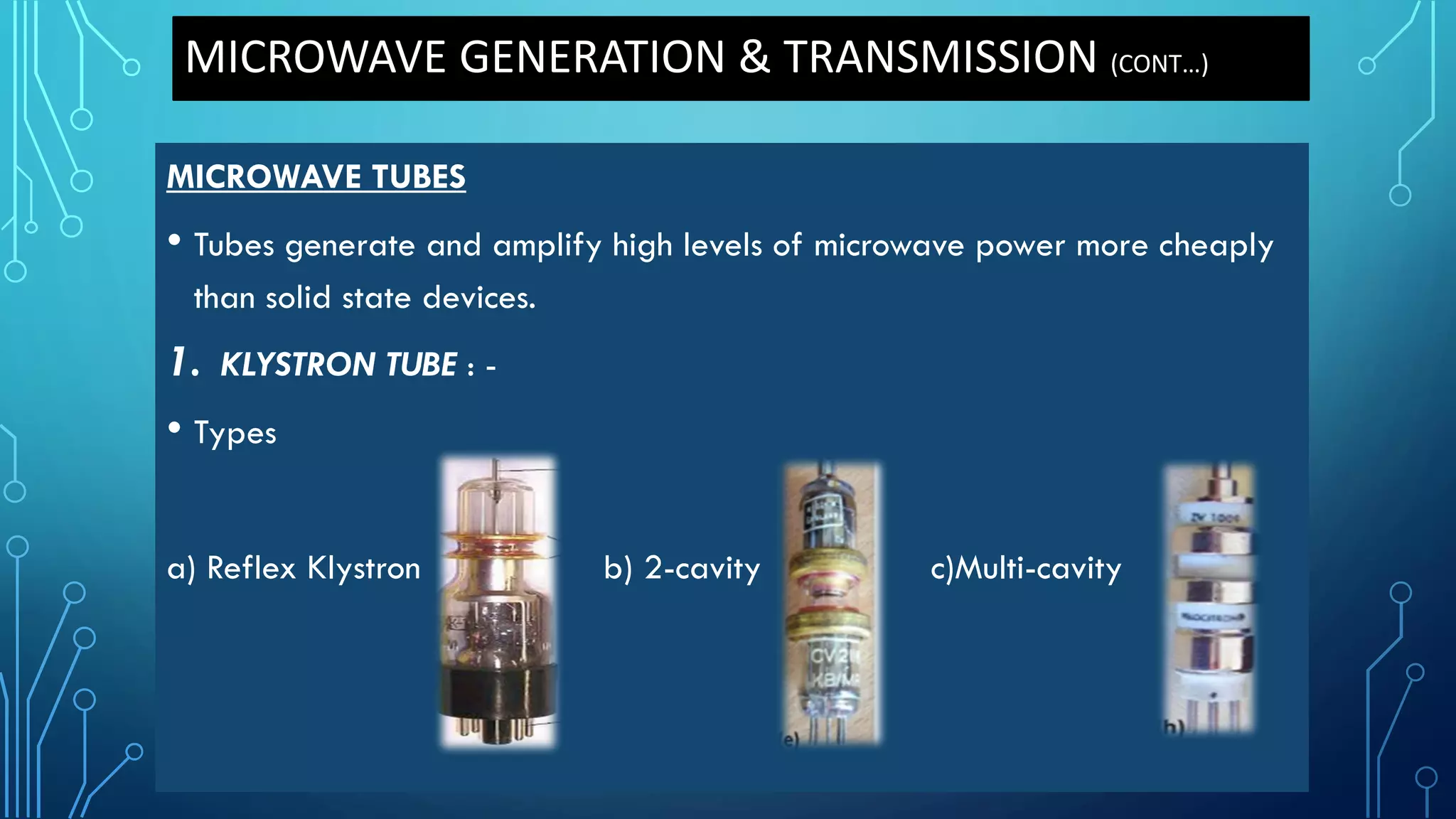
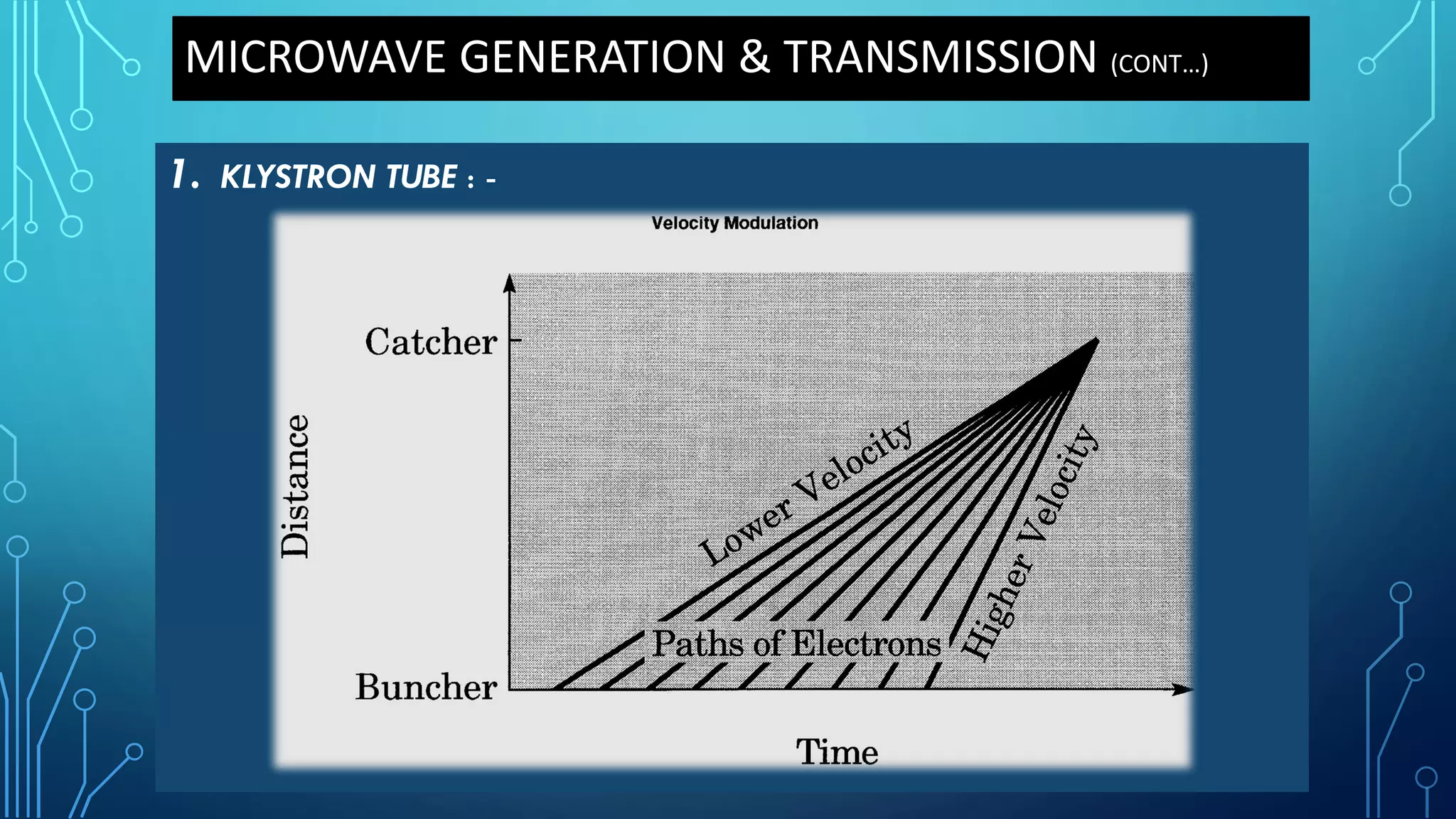
1. KLYSTRON TUBE : -
• Types
a) Reflex Klystron b) 2-cavity c)Multi-cavity
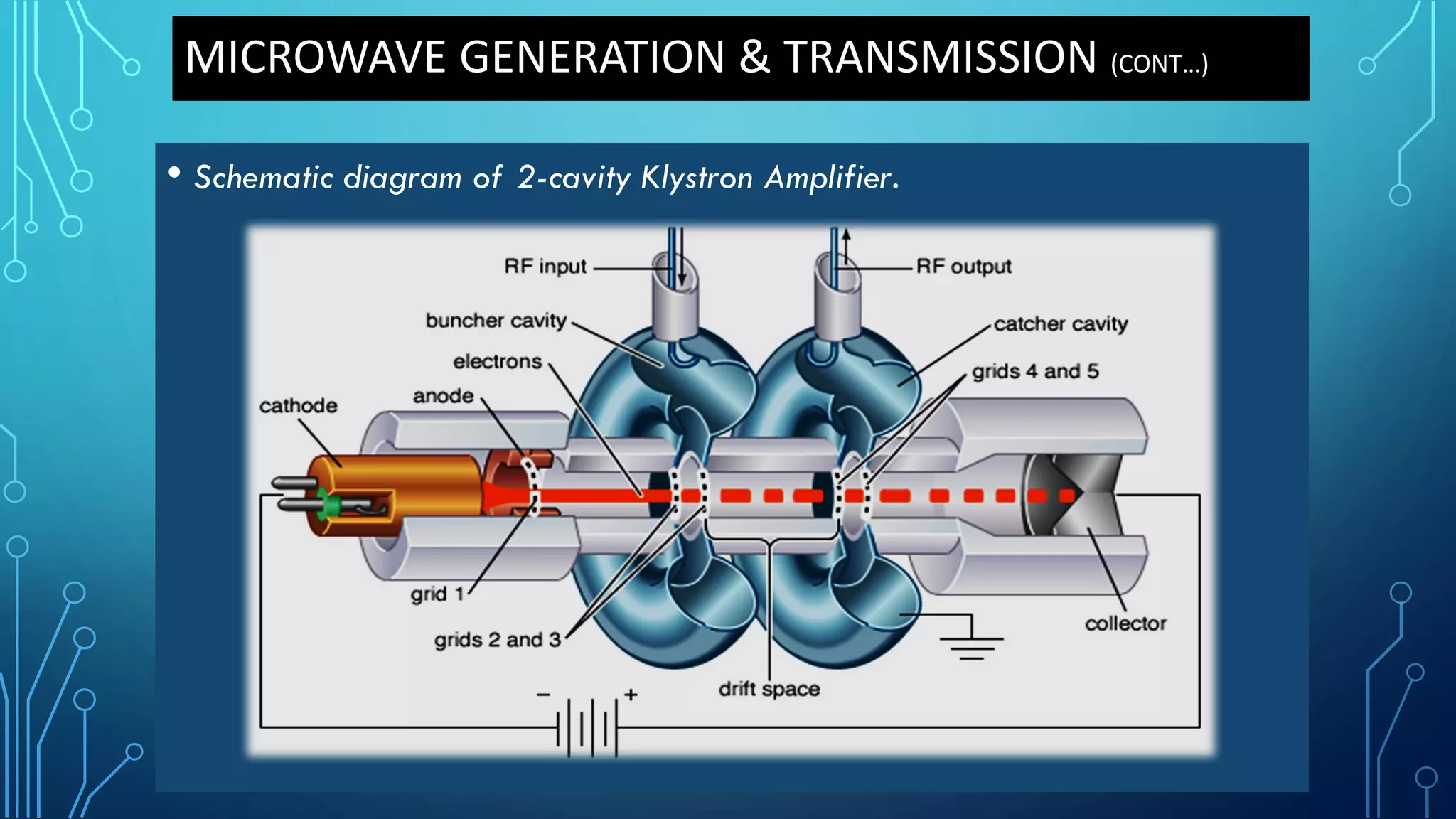
• Schematic diagram of 2-cavity Klystron Amplifier.
MICROWAVE GENERATION & TRANSMISSION (CONT…)
Working :
• Used as an oscillator or high-power amplifiers.
• It makes use of velocity modulation and electron transit time.
• Electron beam moves down tube past several cavities.
• Input cavity is the buncher, output cavity is the catcher.
• Buncher modulates the velocity of the electron beam.
• Electric field from microwaves at buncher alternately speeds and slows electron
beam
• This causes electrons to bunch up
• Electron bunches at catcher induce microwaves with more energy.
1. KLYSTRON TUBE : -
MICROWAVE GENERATION & TRANSMISSION (CONT…)
MICROWAVE TUBES
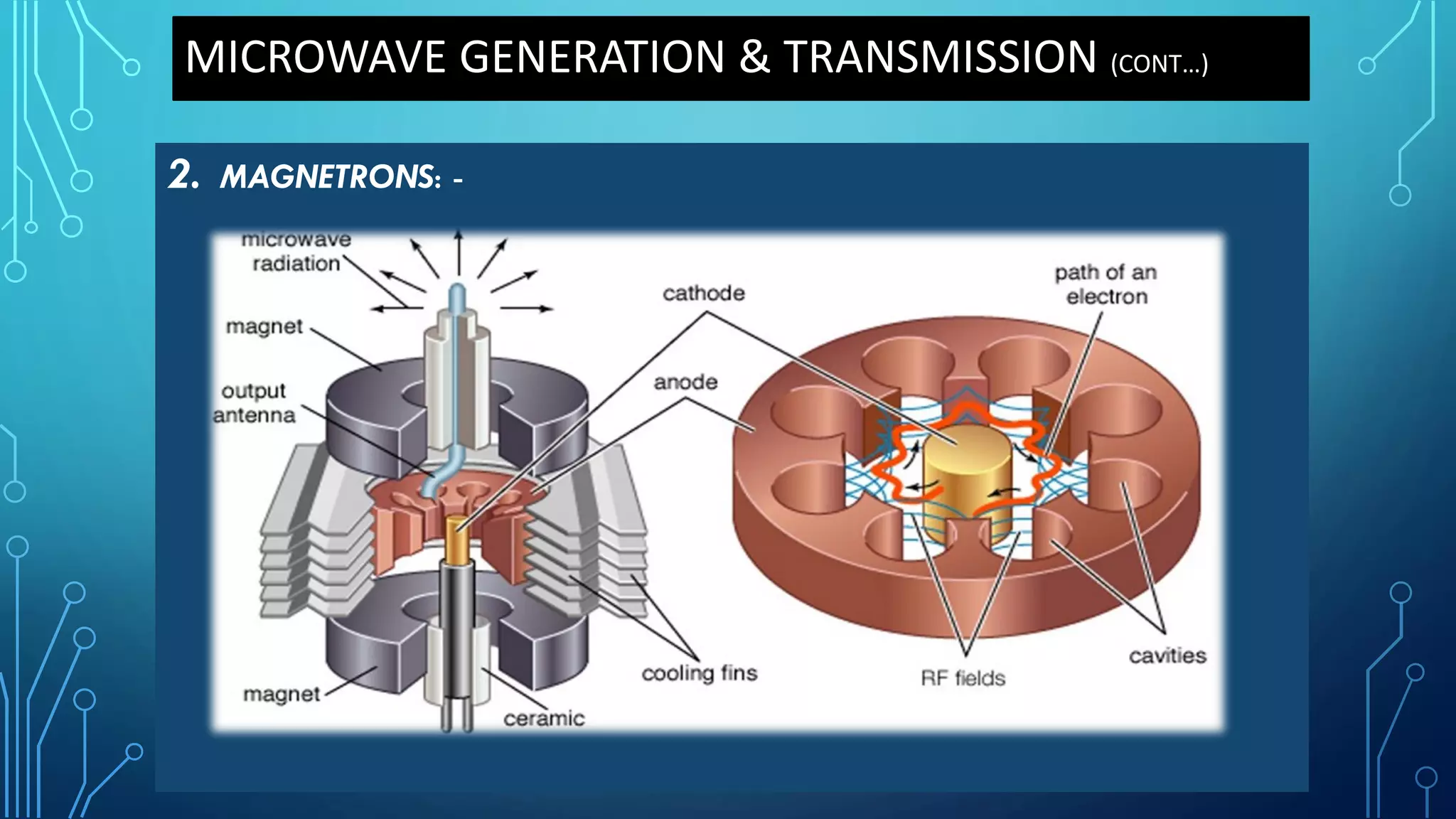
2. MAGNETRONS: -
• High-power oscillator
• Common in radar and microwave ovens.
• Working :
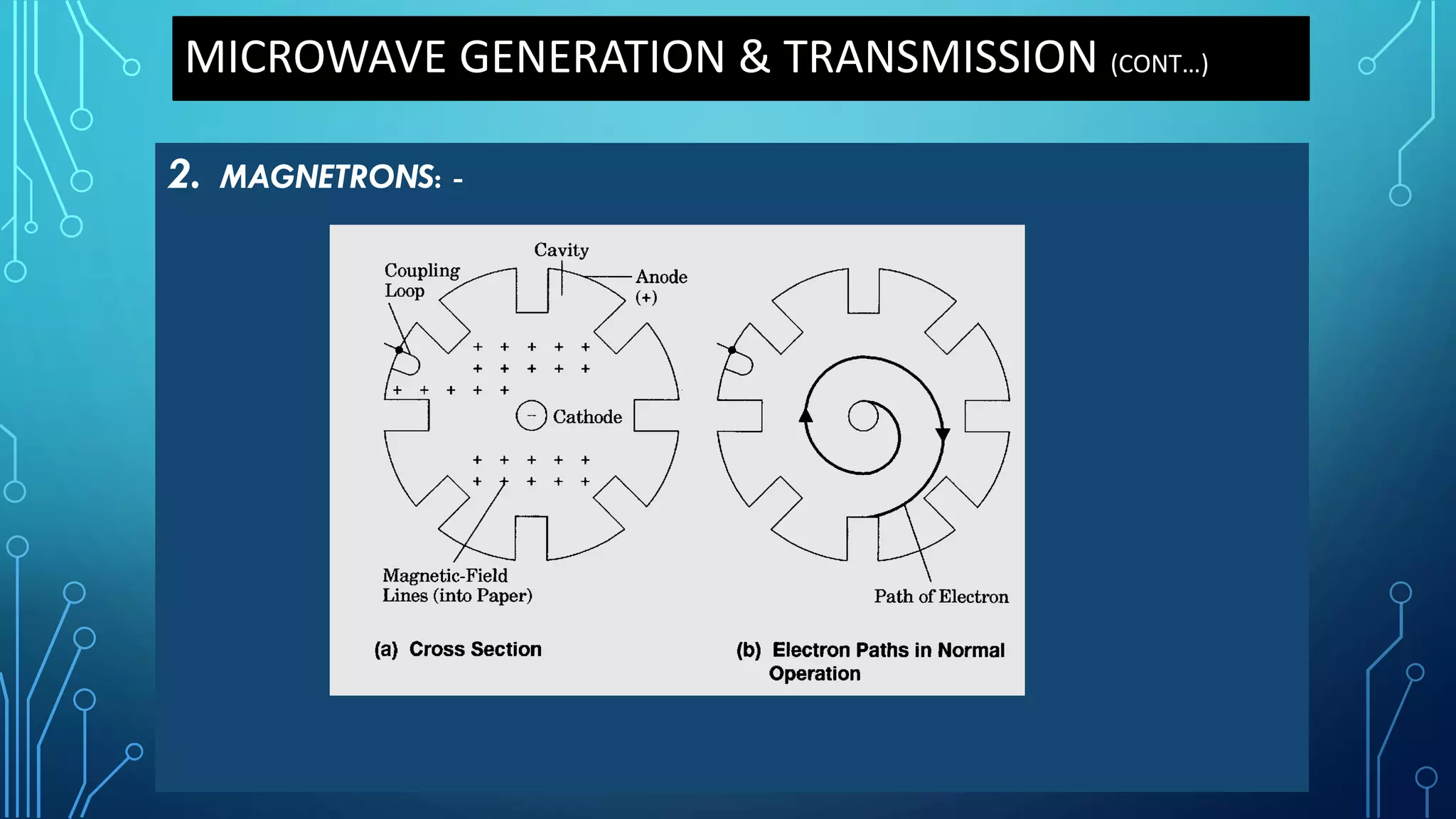
• Cathode in center, anode around outside
• Strong dc magnetic field around tube causes electrons from cathode to
spiral as they move toward anode
• Current of electrons generates microwaves in cavities around outside.
MICROWAVE GENERATION & TRANSMISSION (CONT…)
2. MAGNETRONS: -
MICROWAVE GENERATION & TRANSMISSION (CONT…)
2. MAGNETRONS: -
MICROWAVE GENERATION & TRANSMISSION (CONT…)
MICROWAVE TUBES
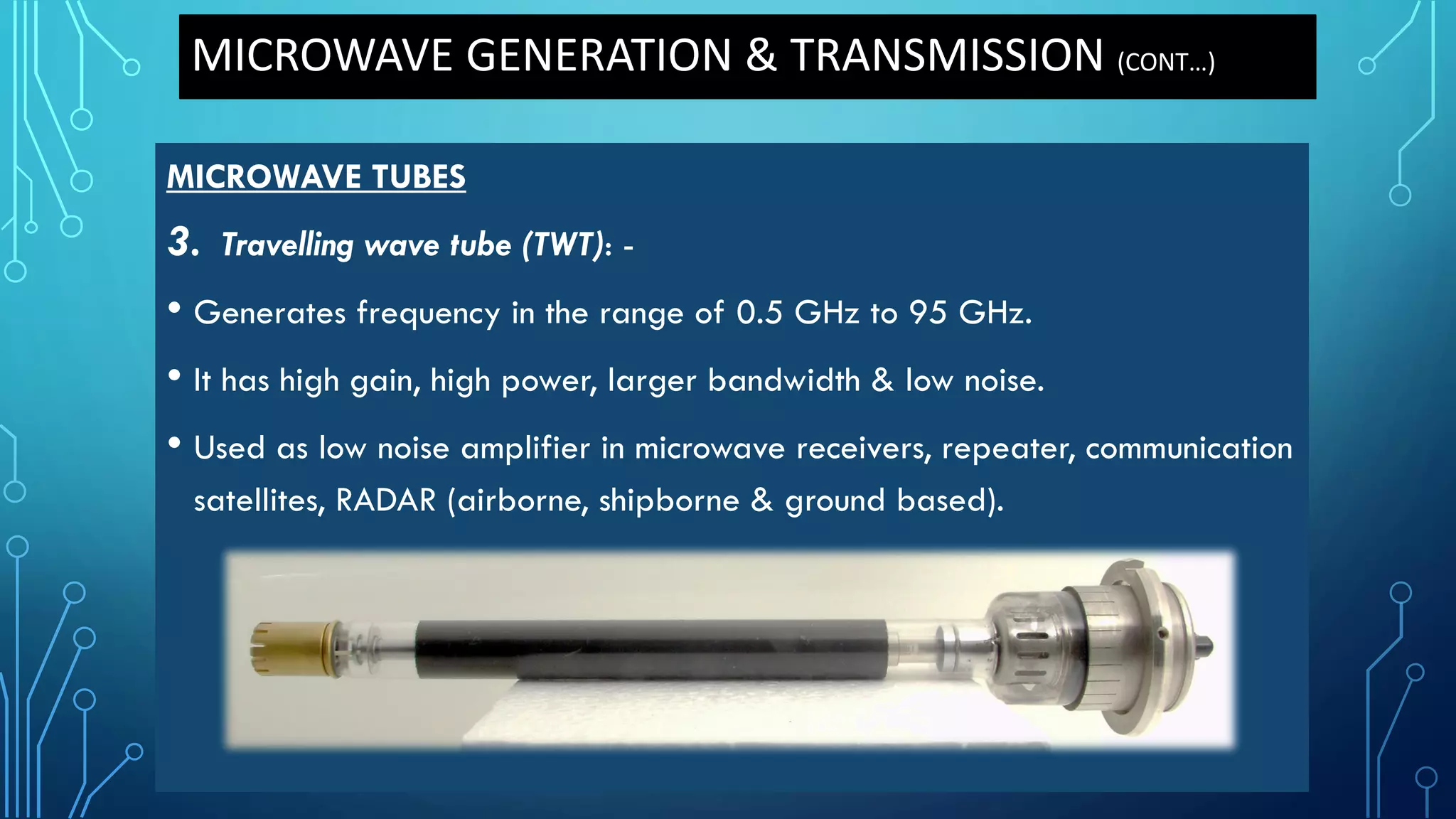
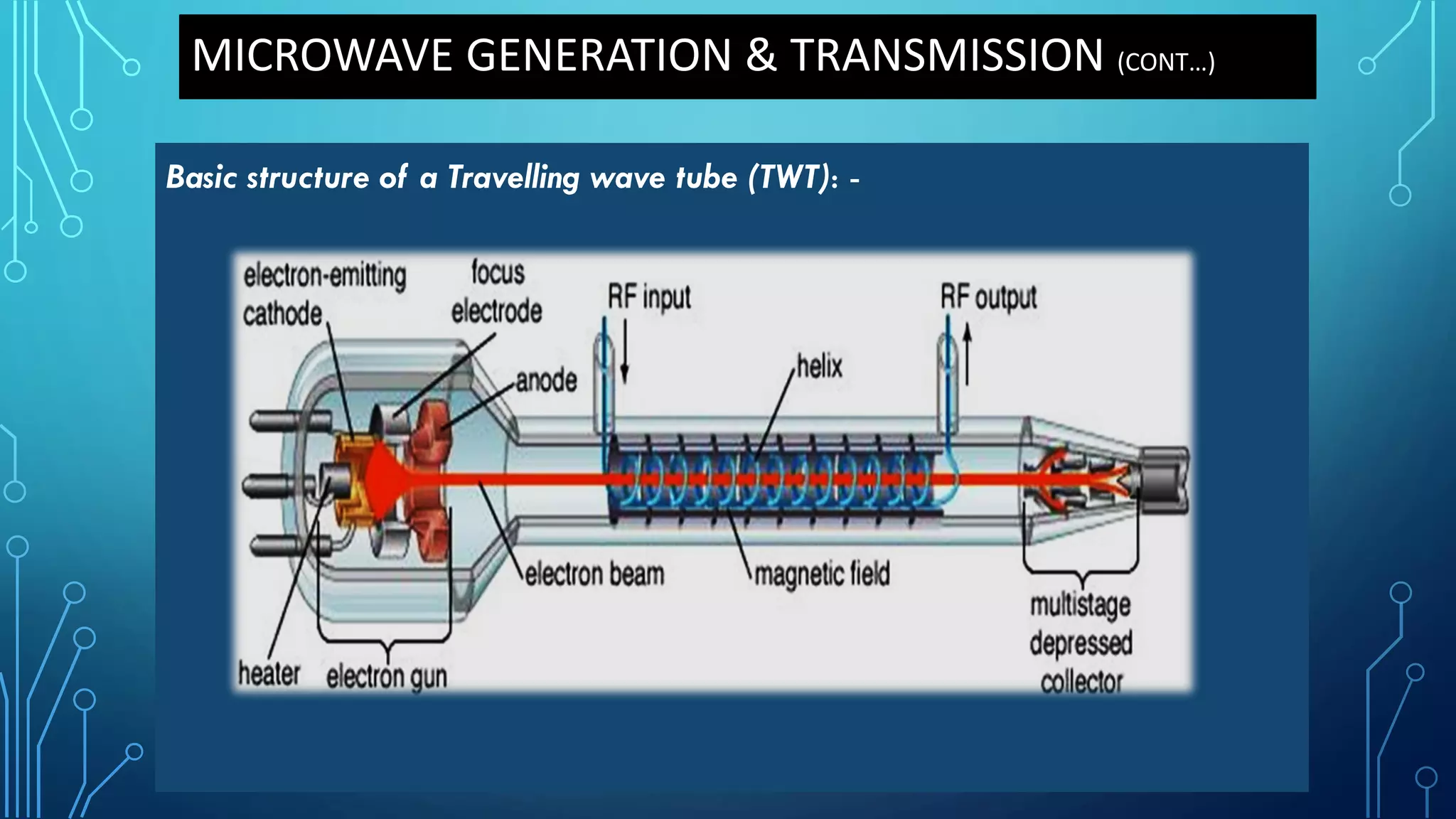
3. Travelling wave tube (TWT): -
• Generates frequency in the range of 0.5 GHz to 95 GHz.
• It has high gain, high power, larger bandwidth & low noise.
• Used as low noise amplifier in microwave receivers, repeater, communication
satellites, RADAR (airborne, shipborne & ground based).
MICROWAVE GENERATION & TRANSMISSION (CONT…)
3. Travelling wave tube (TWT): -
• Working:
• Uses a helix as a slow-wave structure.
• Because of the helix, electrons interact longer with the electric field. Hence,
it produces high continuous power of 2-5 KW and large bandwidth.
• Microwaves input at cathode end of helix, output at anode end
• Energy is transferred from electron beam to microwaves.
MICROWAVE GENERATION & TRANSMISSION (CONT…)
Basic structure of a Travelling wave tube (TWT): -
MICROWAVE GENERATION & TRANSMISSION (CONT…)
MICROWAVE TRANSMISSION -
• Two wire transmission line used in conventional circuits is inefficient at
microwave frequencies.
• The most common transmission lines are coaxial cable, micro strip lines,
waveguides.
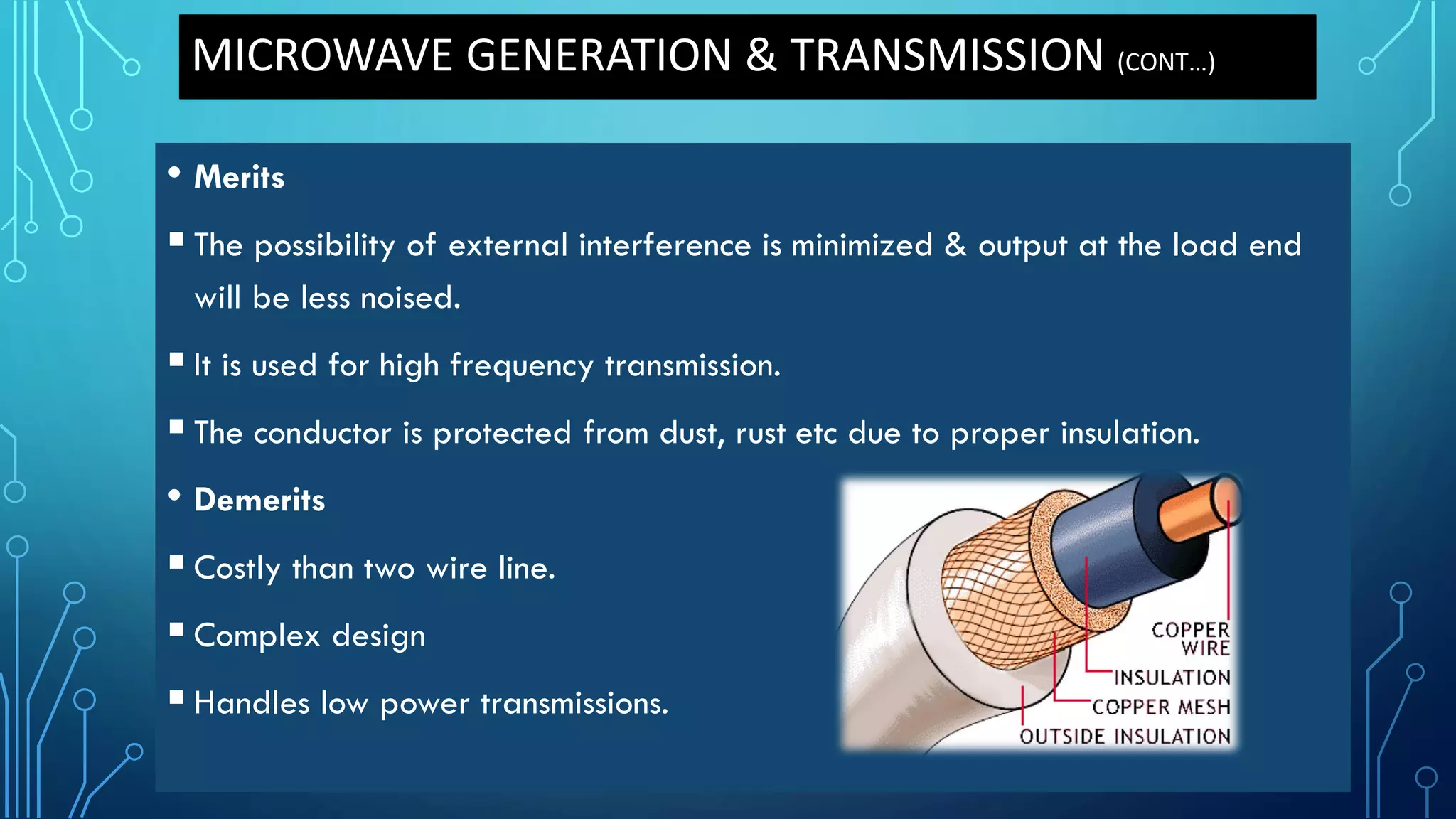
1.Co-axial cable:
• Consists of inner conducting wire made of copper, over this conducting wire
the coating of polyethylene or Teflon material is carried out.
• Then it is enclosed in the braded wire in the shape of mesh. The outer
surface of this wire is enclosed in a plastic jacket.
MICROWAVE GENERATION & TRANSMISSION (CONT…)
• Merits
The possibility of external interference is minimized & output at the load end
will be less noised.
It is used for high frequency transmission.
The conductor is protected from dust, rust etc due to proper insulation.
• Demerits
Costly than two wire line.
Complex design
Handles low power transmissions.
MICROWAVE GENERATION & TRANSMISSION (CONT…)
MICROWAVE TRANSMISSION -
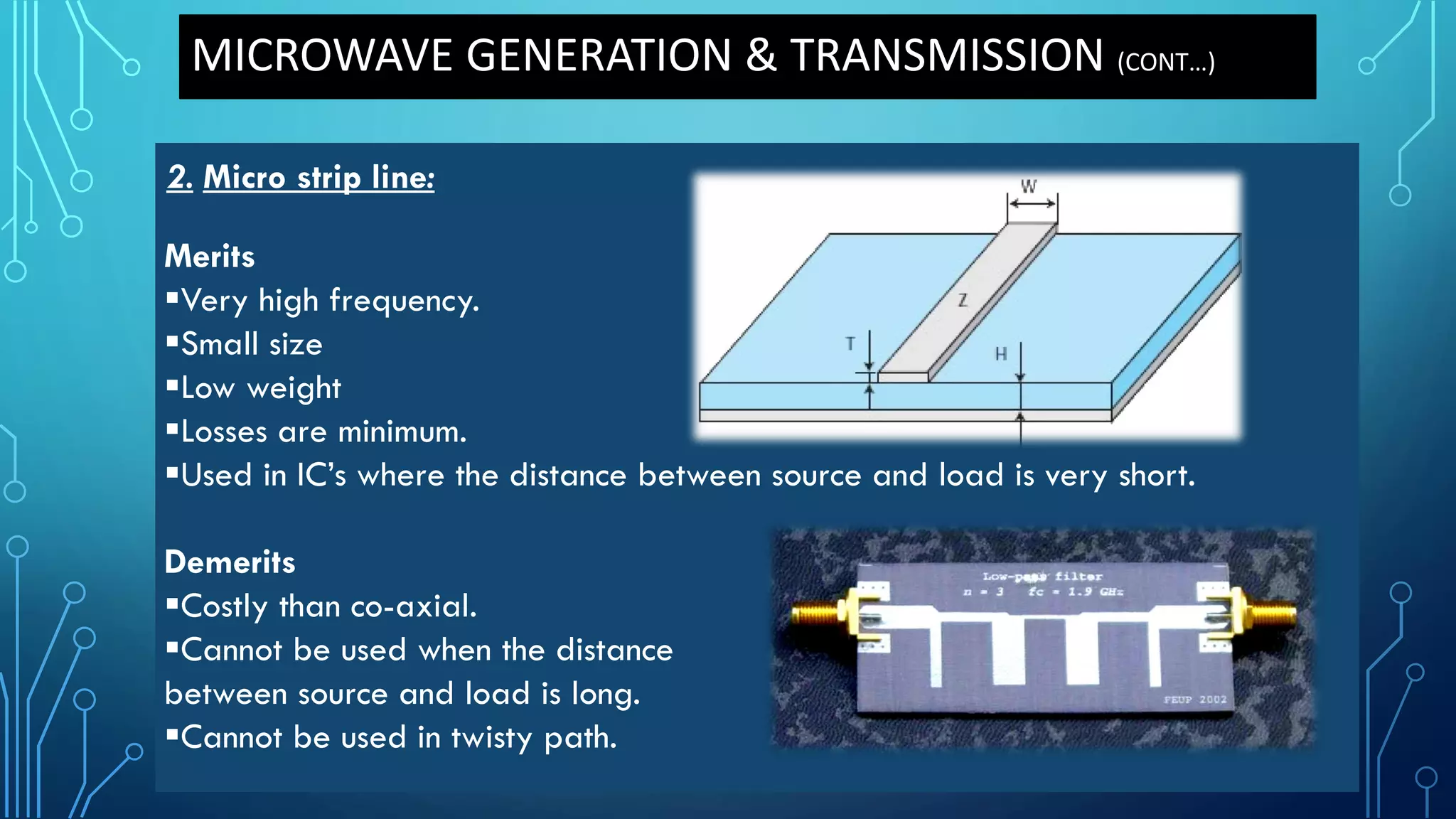
2. Micro strip line:
• A micro strip line is simply a copper track running on a side of the PCB while
the other side is the ground plane.
• There is thick coat of insulating material over the copper plate which is made of
fiber glass or polystyrene. This insulator works as a dielectric in micro strip line.
• At the top of the insulated plate one or more than one strip of the best
conducting material are plated which is made of gold, aluminium etc.
2. Micro strip line:
Merits
Very high frequency.
Small size
Low weight
Losses are minimum.
Used in IC’s where the distance between source and load is very short.
Demerits
Costly than co-axial.
Cannot be used when the distance
between source and load is long.
Cannot be used in twisty path.
MICROWAVE GENERATION & TRANSMISSION (CONT…)
3. Waveguides:
• A Hollow metallic tube of uniform cross section for transmitting electromagnetic
waves by successive reflections from the inner conducting layered walls of the
tube is called waveguide.
• At microwave frequencies (above 1GHz to 100 GHz) the losses in the two line
transmission system will be very high and hence it cannot be used at those
frequencies. Hence microwave signals are propagated through the waveguides
in order to minimize the losses.
MICROWAVE GENERATION & TRANSMISSION (CONT…)
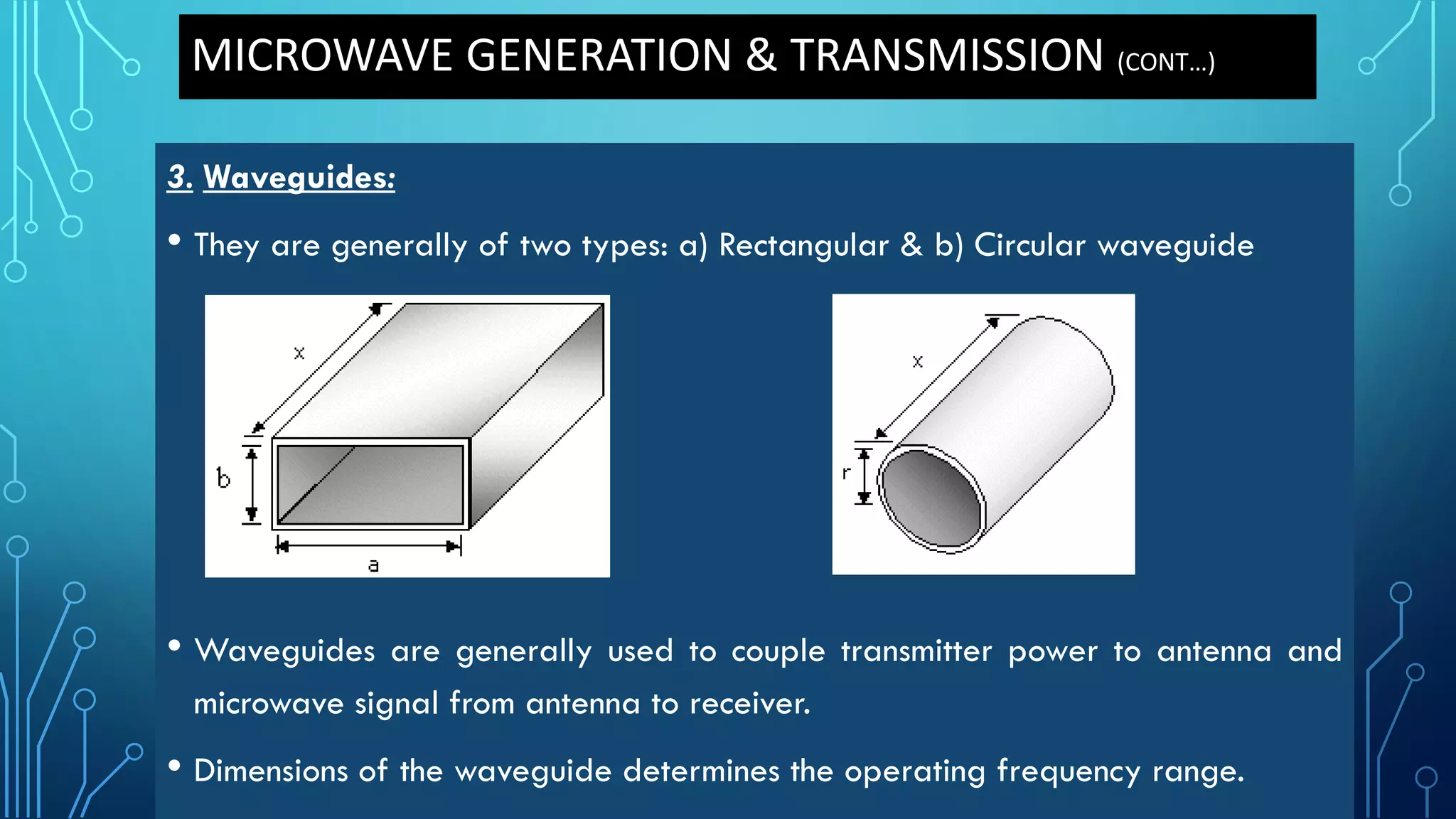
3. Waveguides:
• They are generally of two types: a) Rectangular & b) Circular waveguide
• Waveguides are generally used to couple transmitter power to antenna and
microwave signal from antenna to receiver.
• Dimensions of the waveguide determines the operating frequency range.
MICROWAVE GENERATION & TRANSMISSION (CONT…)
Merits
• Large surface area
• Low losses
• Better power handling capability
Demerits
• Size
• Difficult to install because of its rigid structure.
• costly
MICROWAVE ANTENNA & PROPAGATION
• MICROWAVE ANTENNA:
• The antenna is a passive device that radiate or receive the modulated signal. It
is fed by direct connect of the RF unit, coaxial cable, or waveguides at higher
frequencies.
• In two-way communication, the same antenna can be used for transmission and
reception.
• Types:
1. Horn Antenna 2.Parabolic Dish Antenna 3. Slot Antenna
4. Micro-strip patch or Printed Antenna
MICROWAVE ANTENNA & PROPAGATION
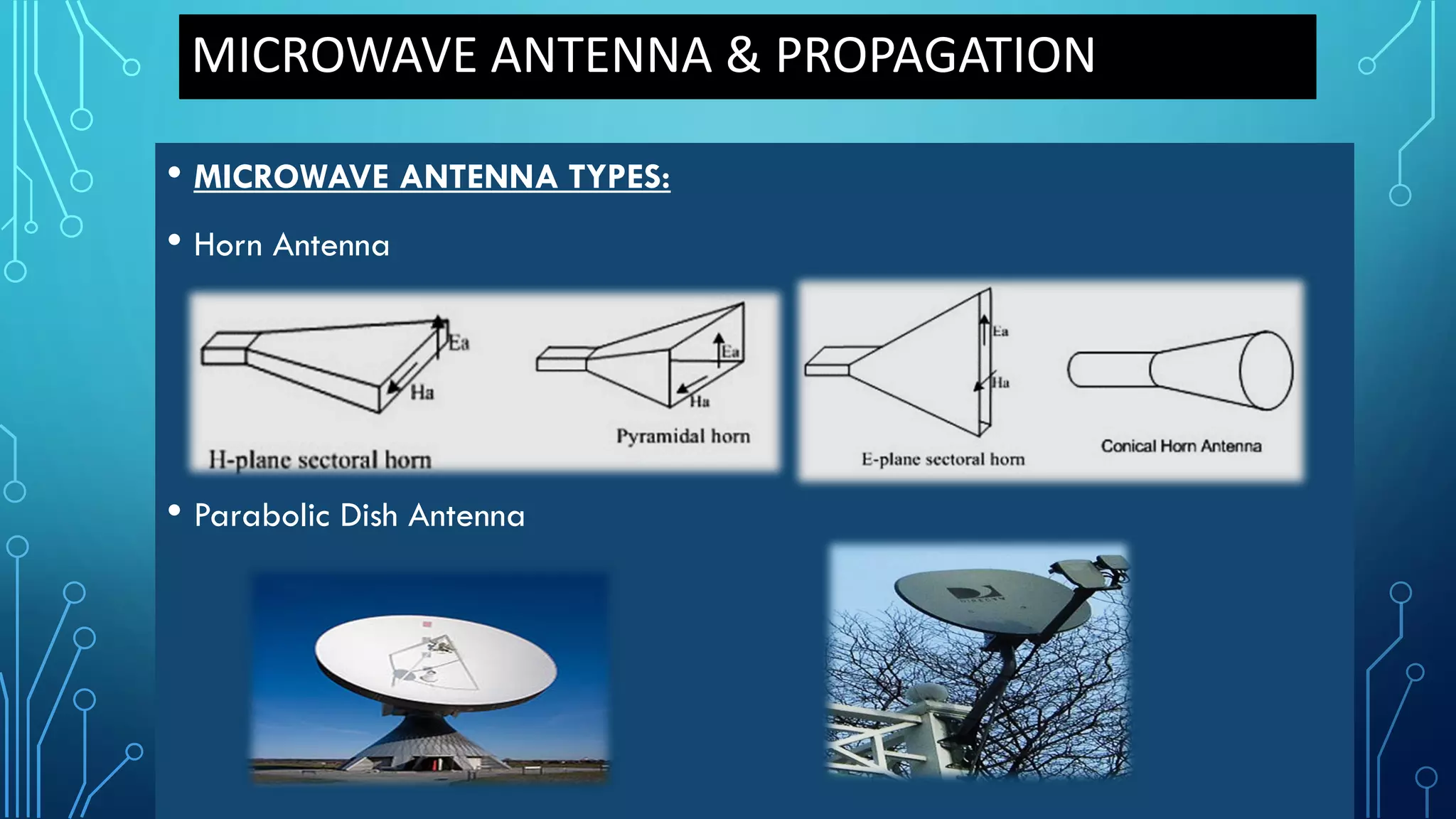
• MICROWAVE ANTENNA TYPES:
• Horn Antenna
• Parabolic Dish Antenna
MICROWAVE ANTENNA & PROPAGATION
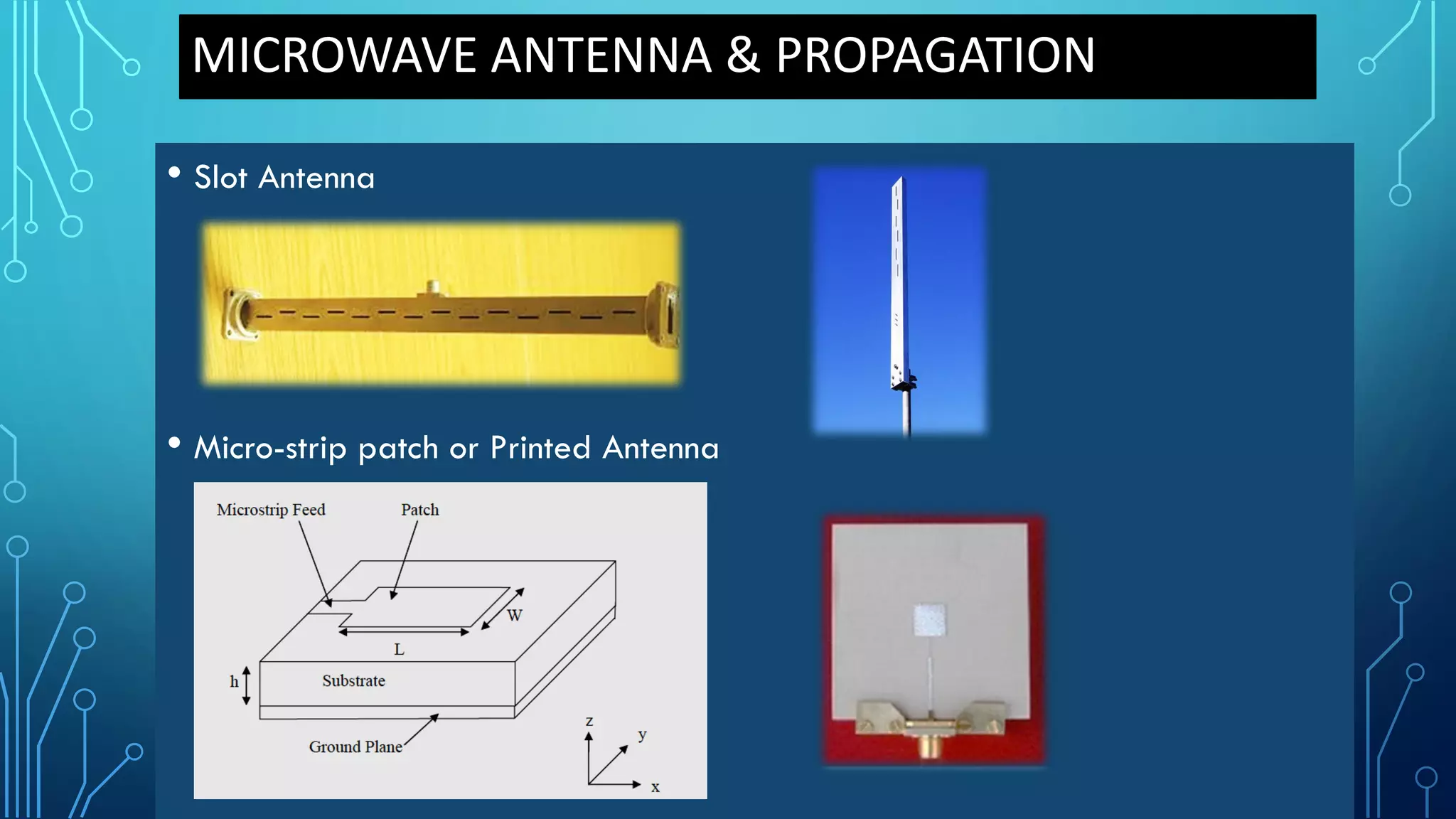
• Slot Antenna
• Micro-strip patch or Printed Antenna
MICROWAVE ANTENNA & PROPAGATION
• MICROWAVE PROPAGATION:
• Since microwave is used for point-to-point communication, it follows Line-of-
Sight (LOS) propagation.
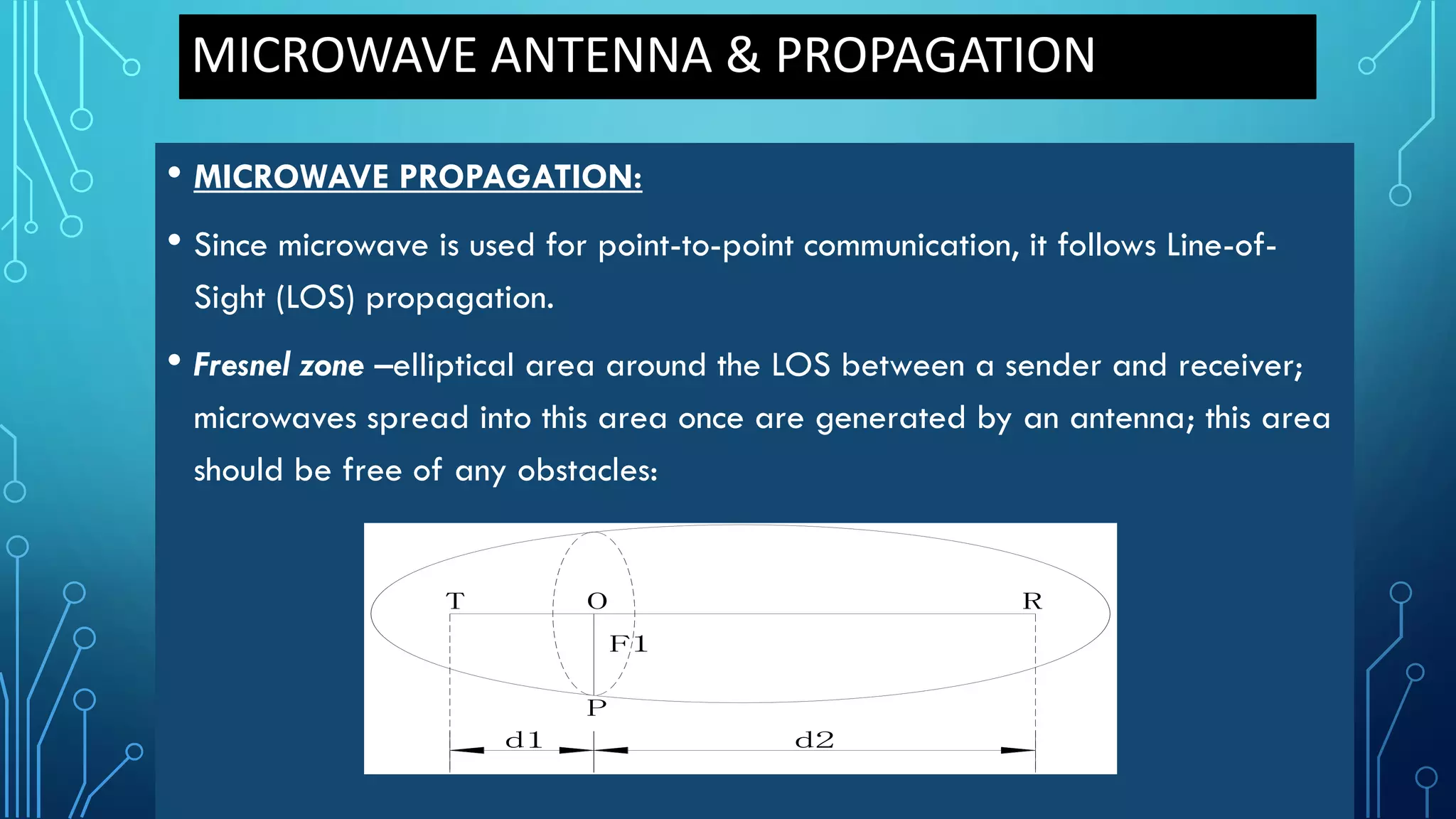
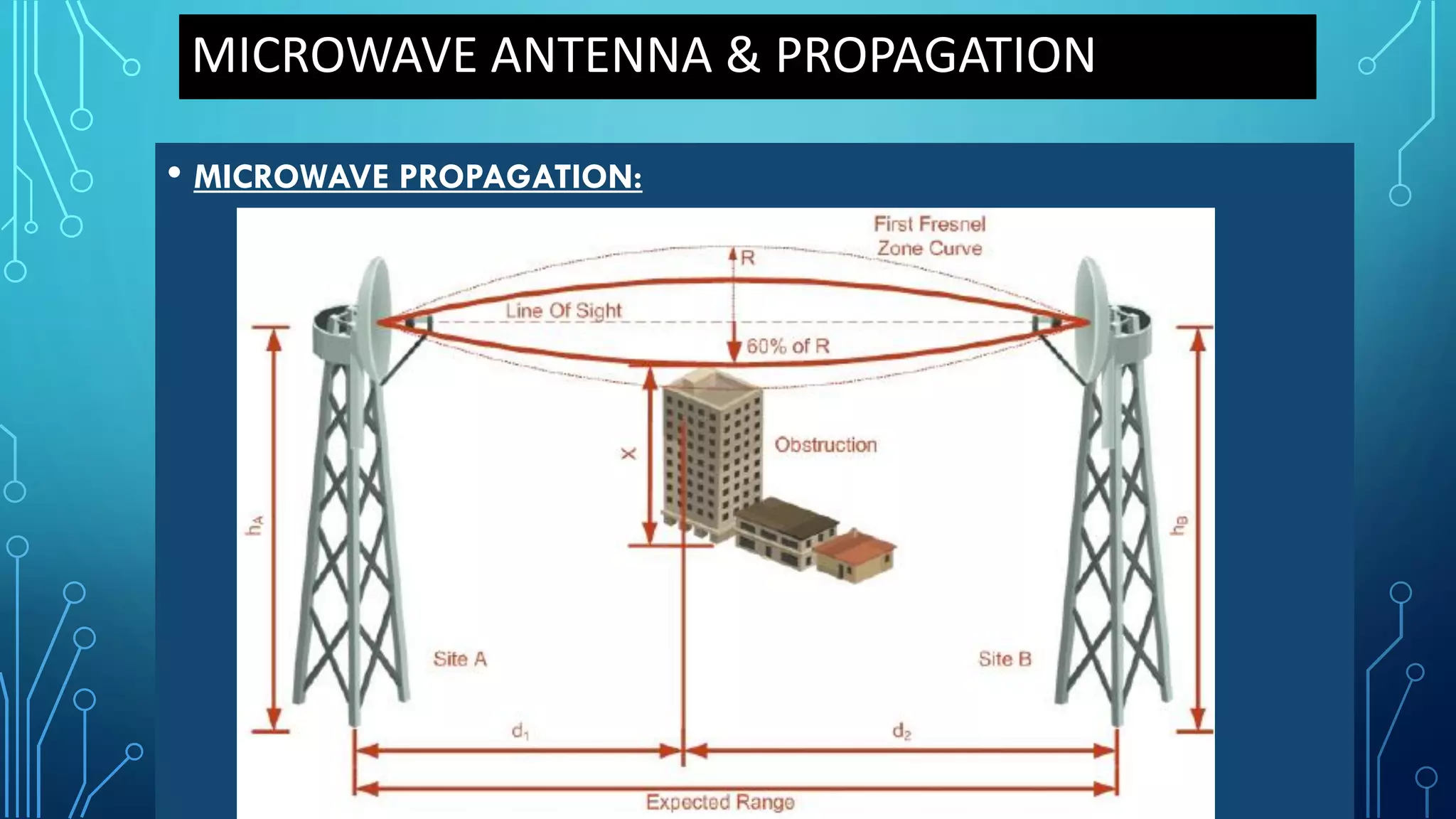
• Fresnel zone –elliptical area around the LOS between a sender and receiver;
microwaves spread into this area once are generated by an antenna; this area
should be free of any obstacles:
ROT
P
F1
d2d1
MICROWAVE ANTENNA & PROPAGATION
• MICROWAVE PROPAGATION:
• The first Fresnel zone is the region where the microwave transmission energy is
the most concentrated.
• With the increase of the Fresnel zone serial numbers, the field strength of the
receiving point reduces as per arithmetic series.
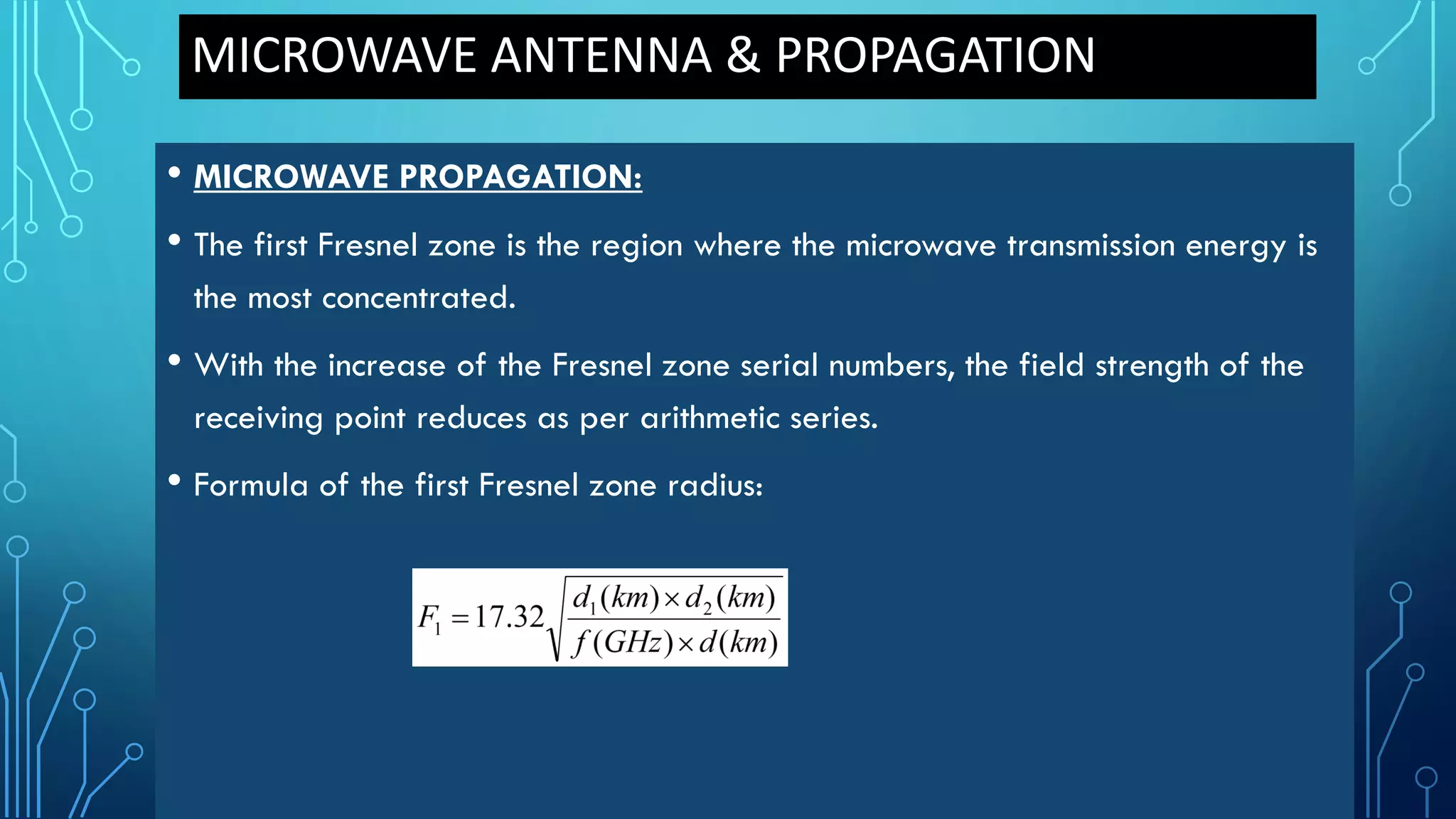
• Formula of the first Fresnel zone radius:
MICROWAVE ANTENNA & PROPAGATION
• MICROWAVE PROPAGATION:
MICROWAVE ANTENNA & PROPAGATION
• MICROWAVE PROPAGATION:
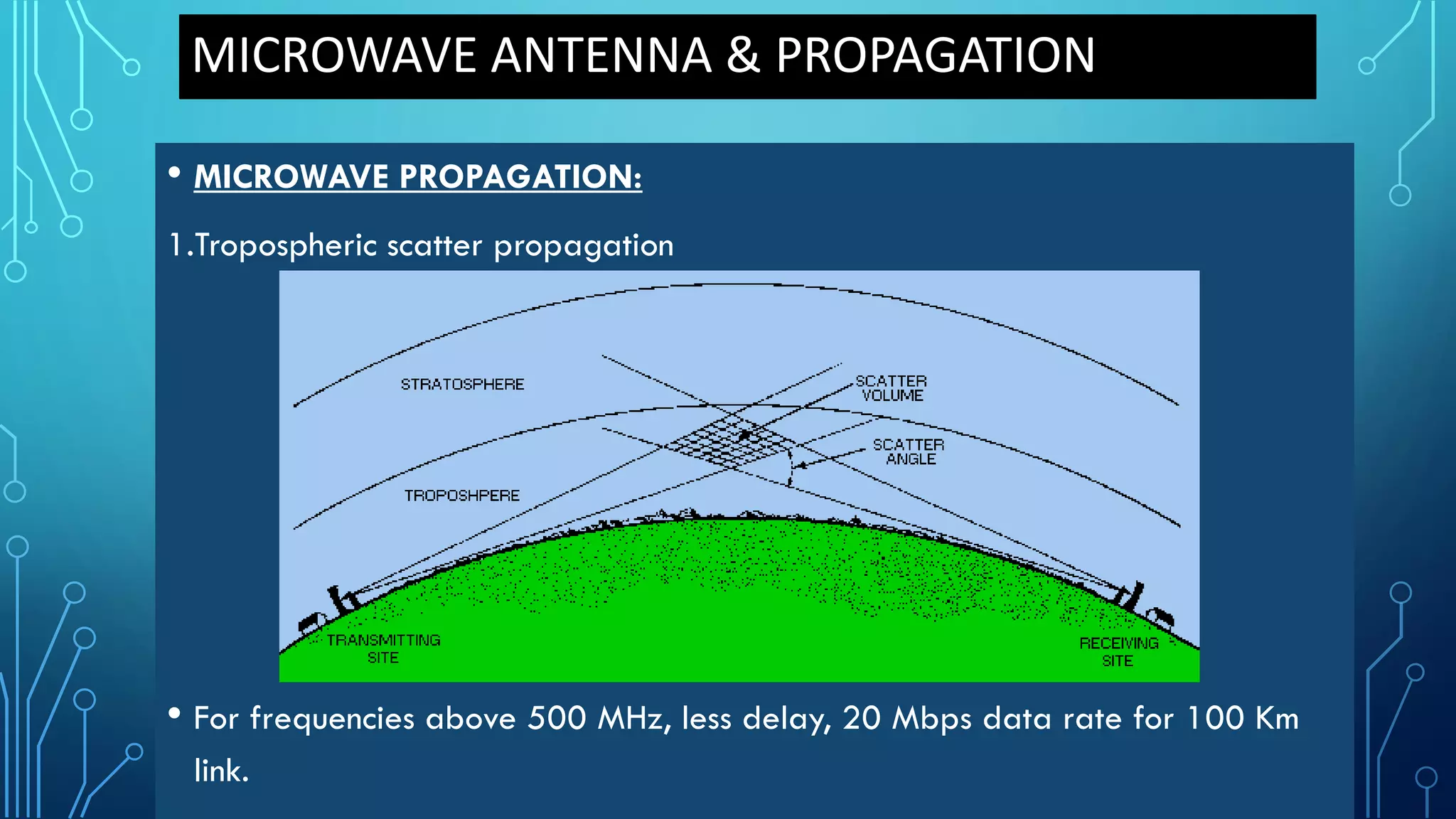
1.Tropospheric scatter propagation
• For frequencies above 500 MHz, less delay, 20 Mbps data rate for 100 Km
link.
MICROWAVE ANTENNA & PROPAGATION
• MICROWAVE PROPAGATION:
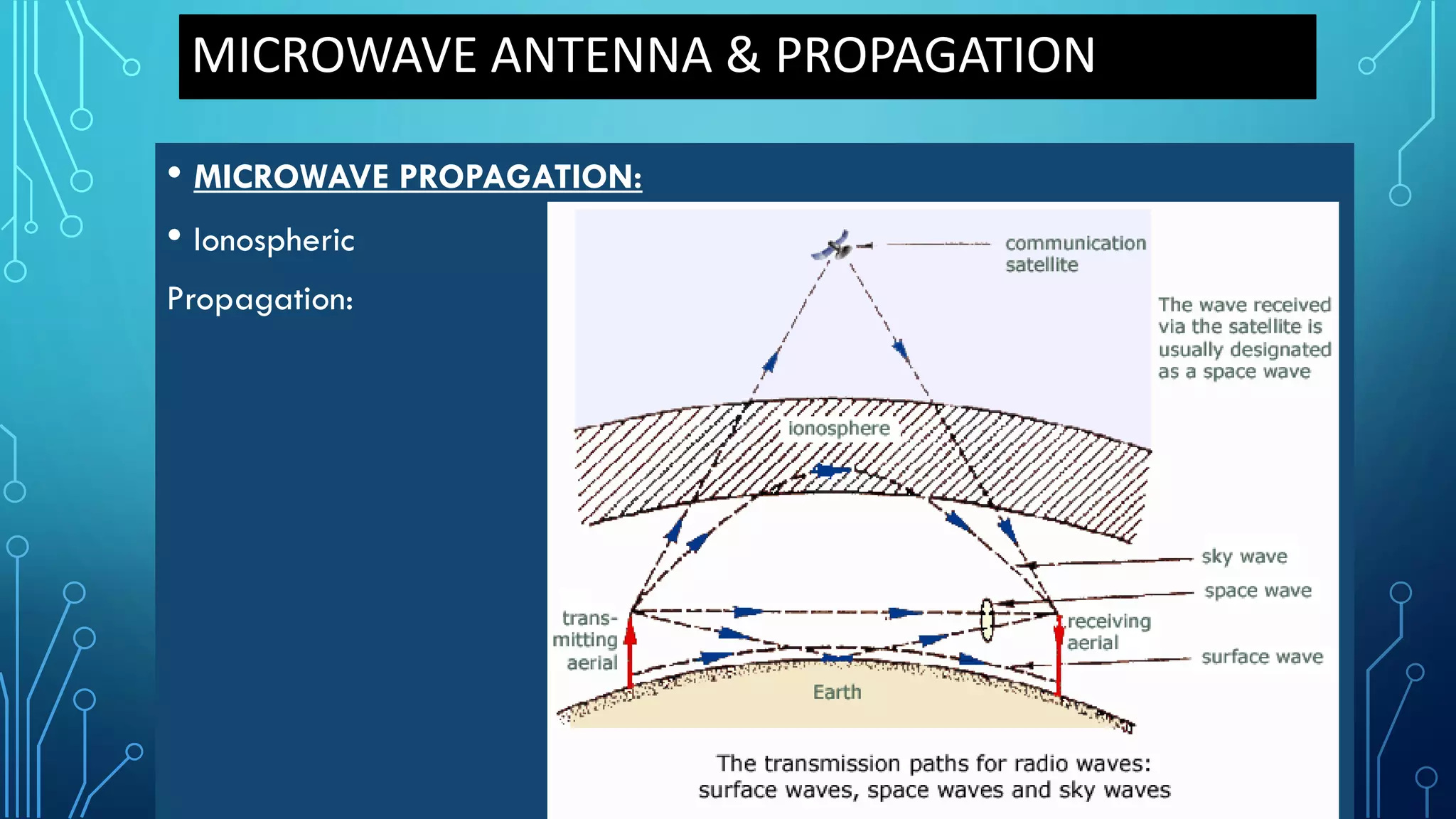
• Ionospheric
Propagation:
MICROWAVE ANTENNA & PROPAGATION
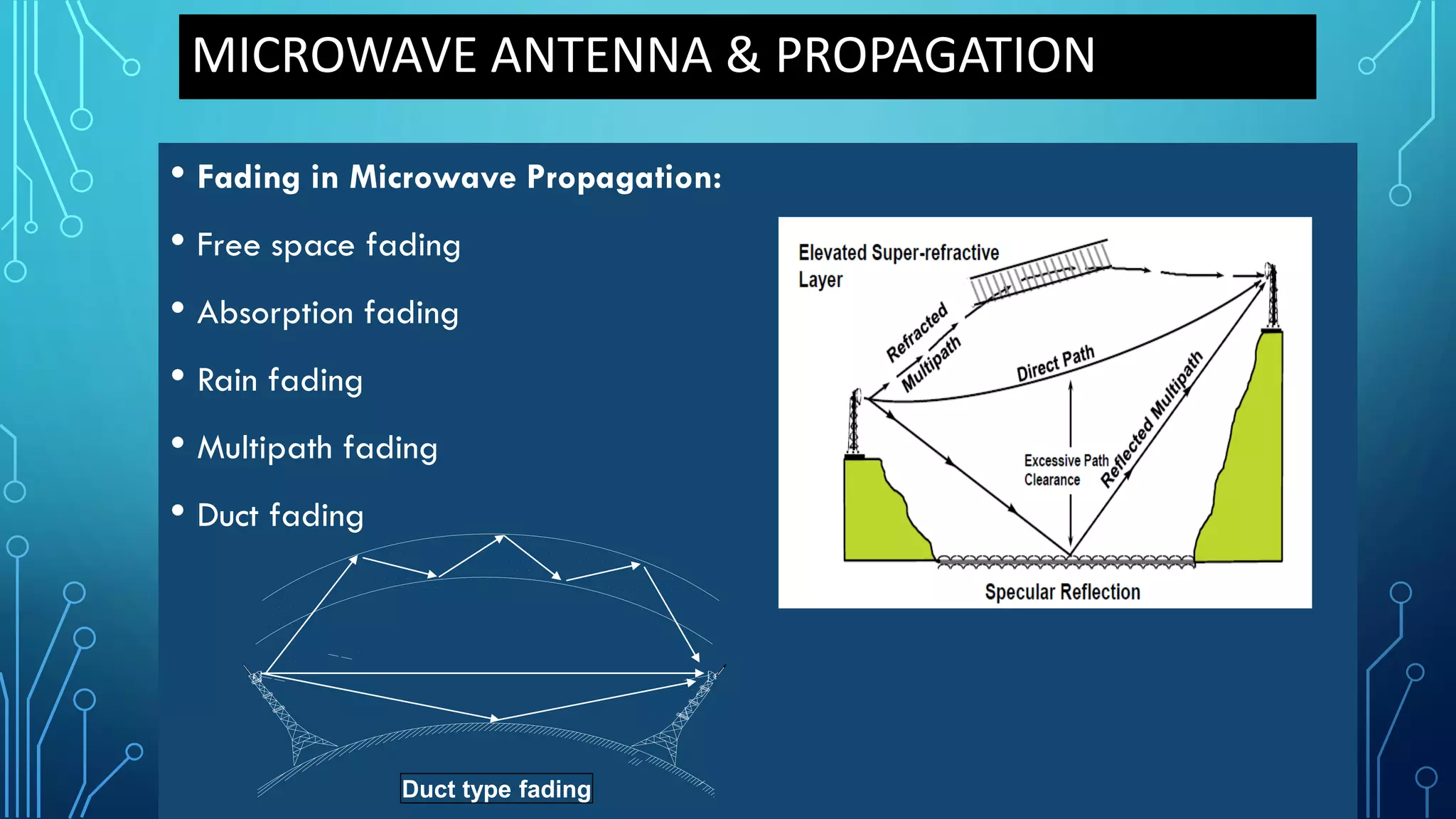
• Fading in Microwave Propagation:
• Free space fading
• Absorption fading
• Rain fading
• Multipath fading
• Duct fading
Duct type fading
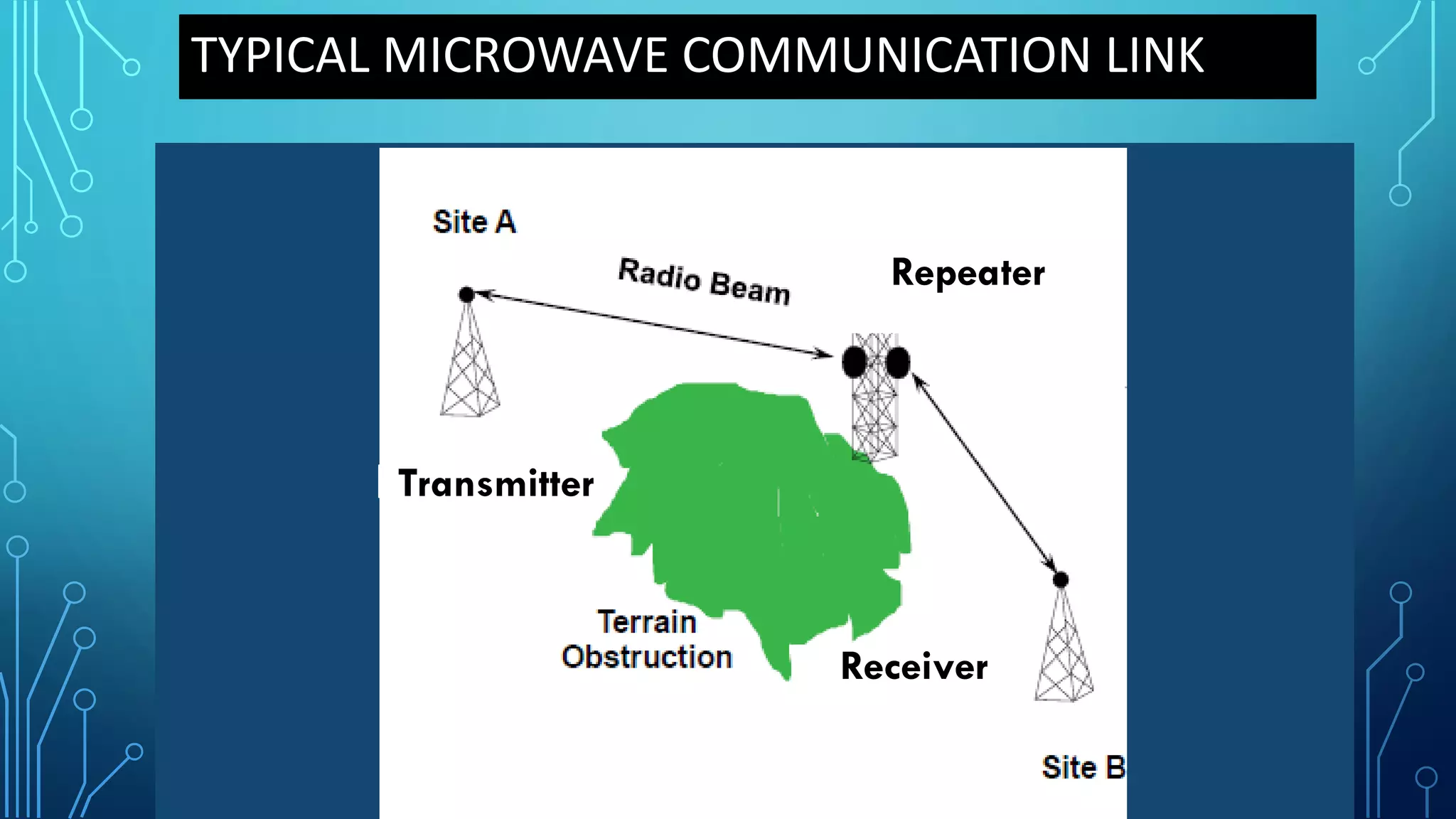
TYPICAL MICROWAVE COMMUNICATION LINK
RepeaterRepeater
Transmitter
Receiver
ADVANTAGES & DISADVANTAGES OF MICROWAVE
Advantages:
• Increased bandwidth availability
• Improved directive properties
• Fading effect and reliability
• Low power requirements
• Transparency property of microwaves.
• Less interference from nearby applications.
• Fast speed for digital system signal processing and data transmission.
• Difficulty in jamming (military applications).
•
• Disadvantages:
• More expensive components.
• Reliance on GaAs instead of Si technology.
• Higher component losses and lower output power from active devices.
• Less accurate design tools and less matured technology.
• Line-of-sight will be disrupted if any obstacle, such as new buildings, are in the
way
• Signal absorption by the atmosphere. Microwaves suffer from attenuation due
to atmospheric conditions.
ADVANTAGES & DISADVANTAGES OF MICROWAVE
MICROWAVE APPLICATIONS
1. Telecommunication: Intercontinental telephone and T.V. space communication
(earth to space and space t earth) telemetry communication link for railways
etc.
2. Radars: Detect aircraft, track/guide supersonic missiles, observe, and track
weather patterns, Air Traffic Control (ATC) etc
3. Commercial & Industrial Application use heat property of Microwave
a)Microwave oven(2.45 GHz, 600 W)
b) Drying machines
c) Food processing industry
d) Mining/public works
e) Biomedical Application
4. Electronic warfare.
INTRODUCTION TO RADAR
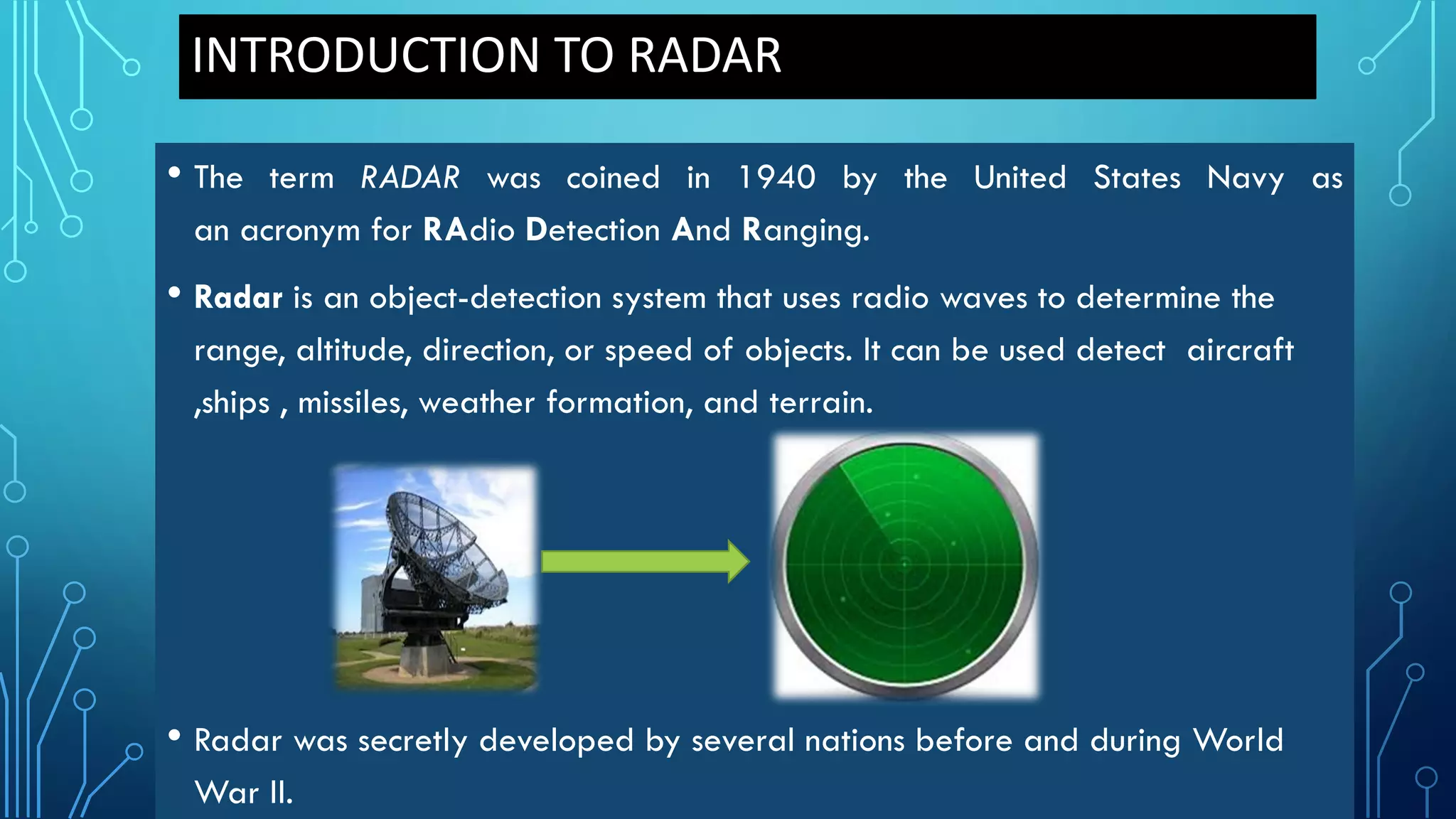
• The term RADAR was coined in 1940 by the United States Navy as
an acronym for RAdio Detection And Ranging.
• Radar is an object-detection system that uses radio waves to determine the
range, altitude, direction, or speed of objects. It can be used detect aircraft
,ships , missiles, weather formation, and terrain.
• Radar was secretly developed by several nations before and during World
War II.
BASIC PRINCIPLE AND OPERATION OF RADAR
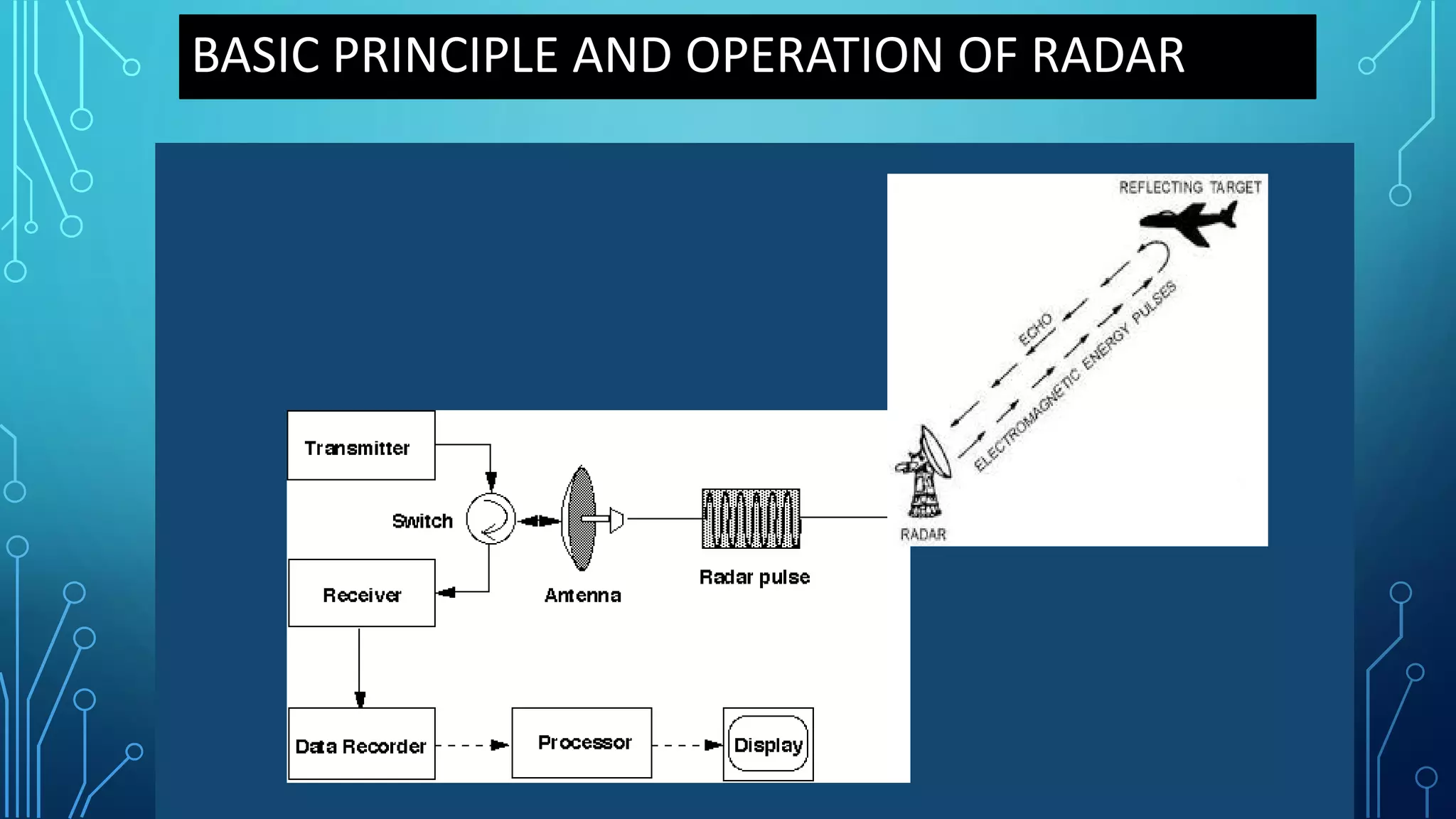
• A radar system has a transmitter that emits radio waves called radar signals in
predetermined directions.
• When these come into contact with an object they are usually reflected or
scattered in many directions.
• Radar signals are reflected especially well by materials of
considerable electrical conductivity
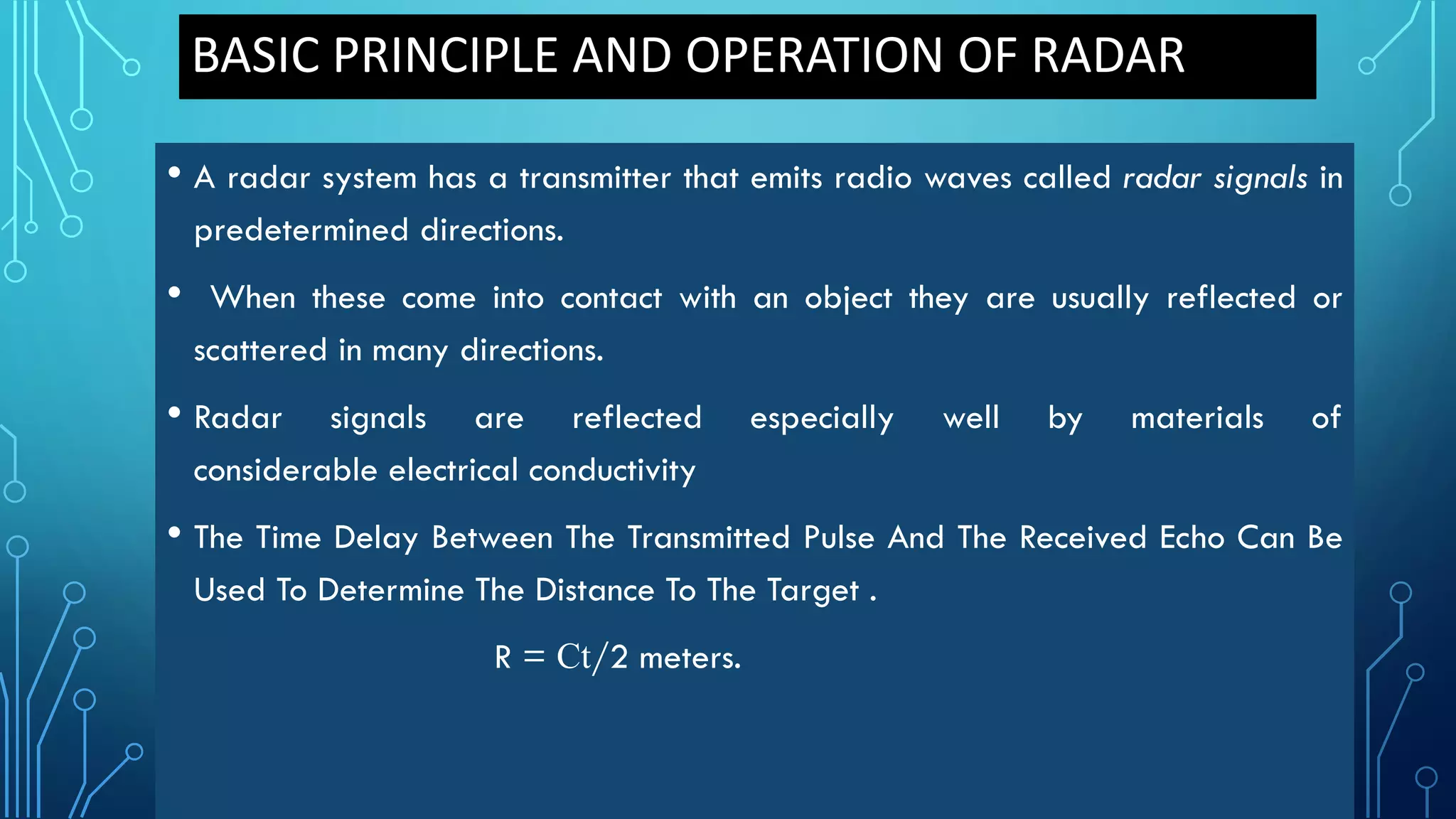
• The Time Delay Between The Transmitted Pulse And The Received Echo Can Be
Used To Determine The Distance To The Target .
R = Ct/2 meters.
BASIC PRINCIPLE AND OPERATION OF RADAR
TYPES OF RADAR
There are two main types of radar:
1)Primary Radar (Imaging)
• Continuous wave Radar
• Pulse Radar
2)Secondary Radar (Non-Imaging)
TYPES OF RADAR
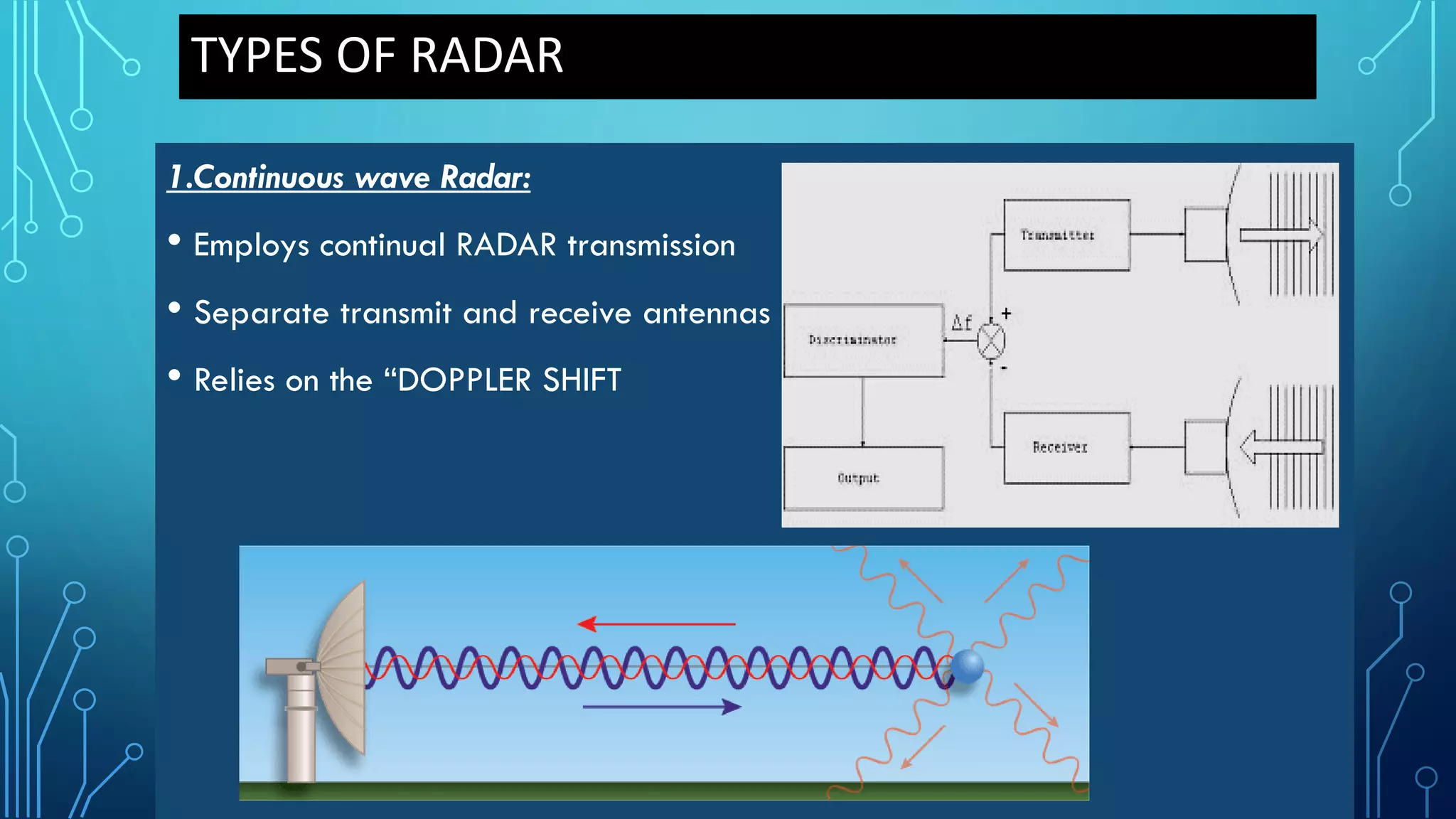
1.Continuous wave Radar:
• Employs continual RADAR transmission
• Separate transmit and receive antennas
• Relies on the “DOPPLER SHIFT
TYPES OF RADAR
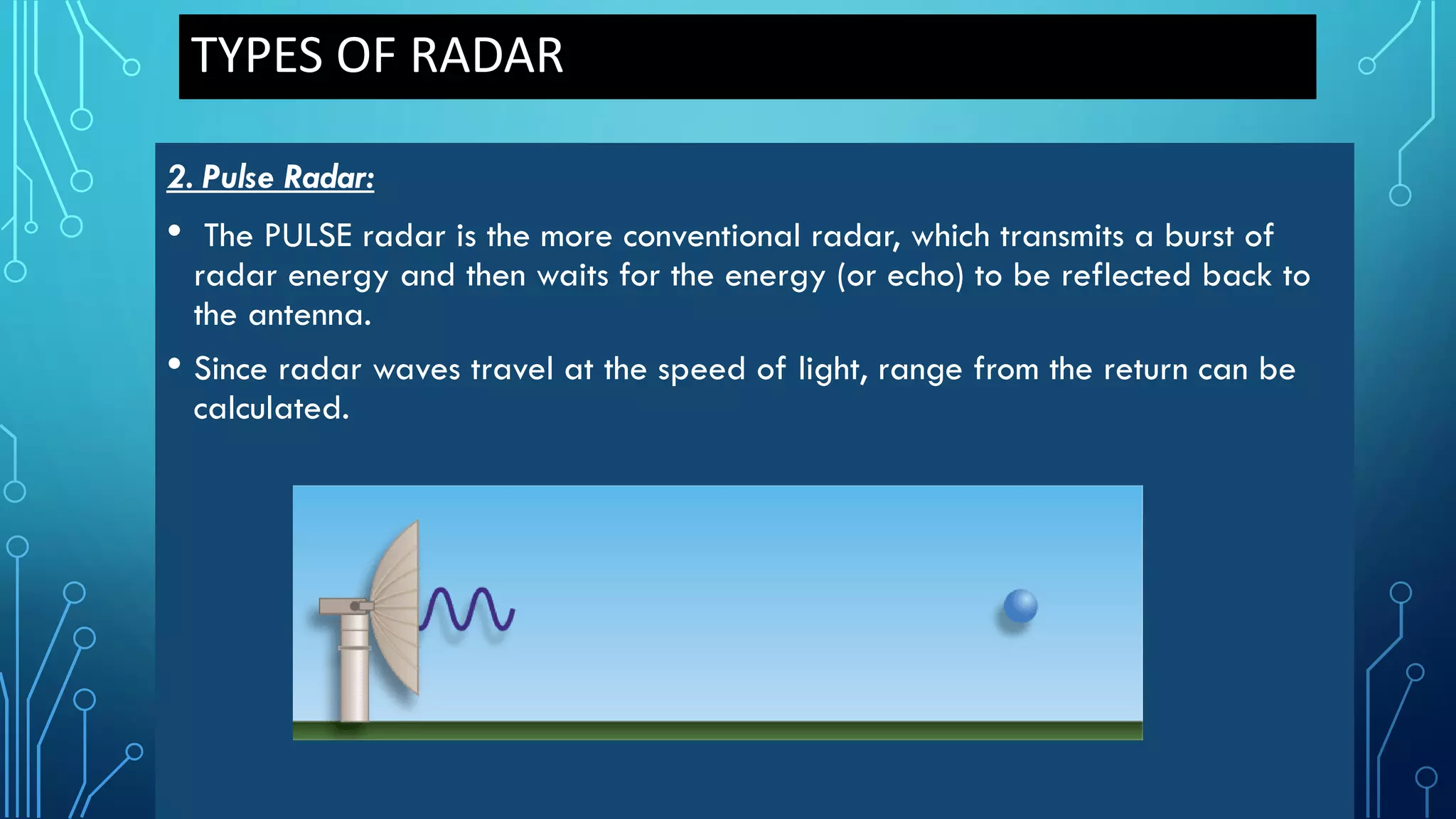
2. Pulse Radar:
• The PULSE radar is the more conventional radar, which transmits a burst of
radar energy and then waits for the energy (or echo) to be reflected back to
the antenna.
• Since radar waves travel at the speed of light, range from the return can be
calculated.
TYPES OF RADAR
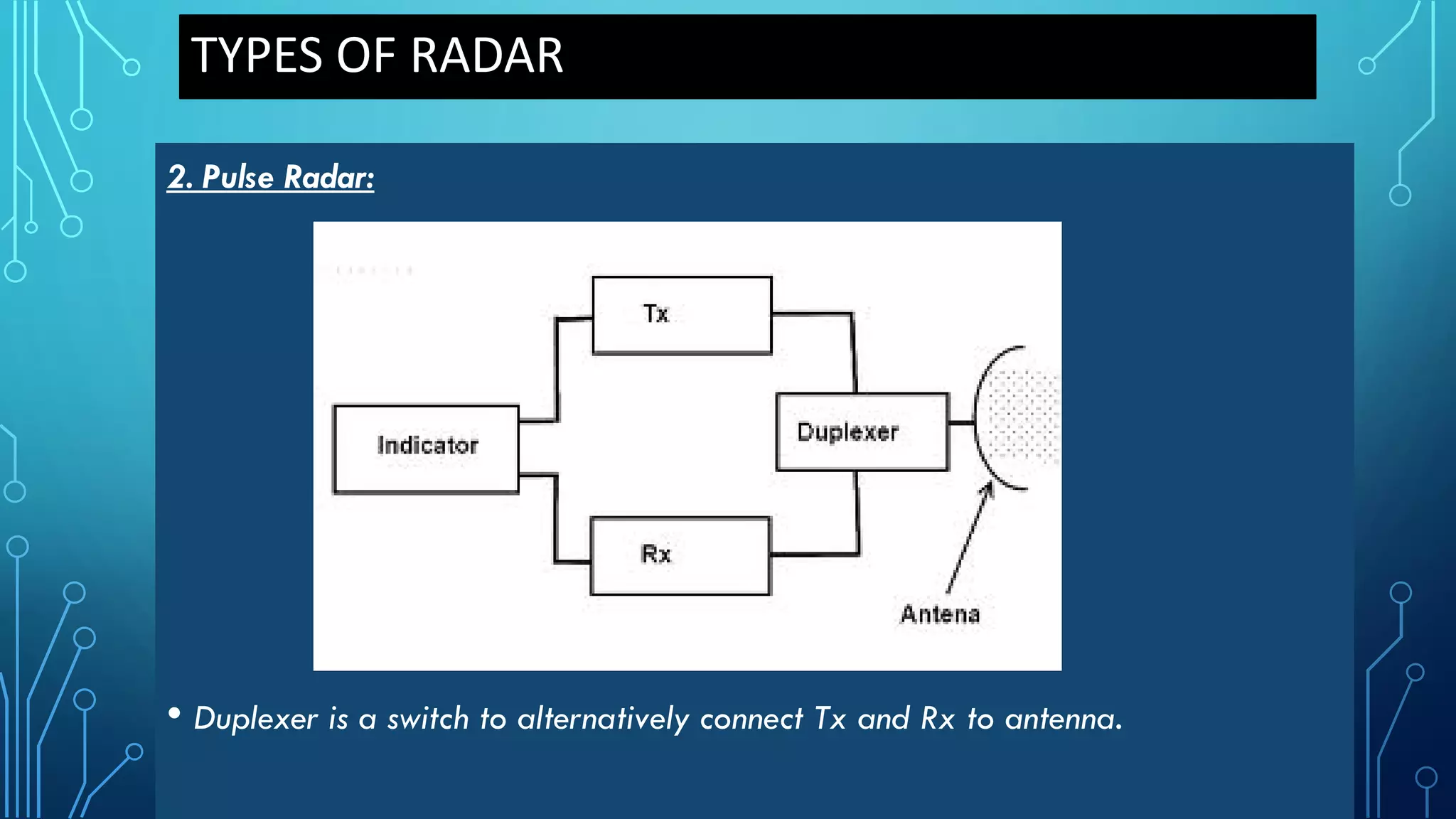
2. Pulse Radar:
• Duplexer is a switch to alternatively connect Tx and Rx to antenna.
TYPES OF RADAR
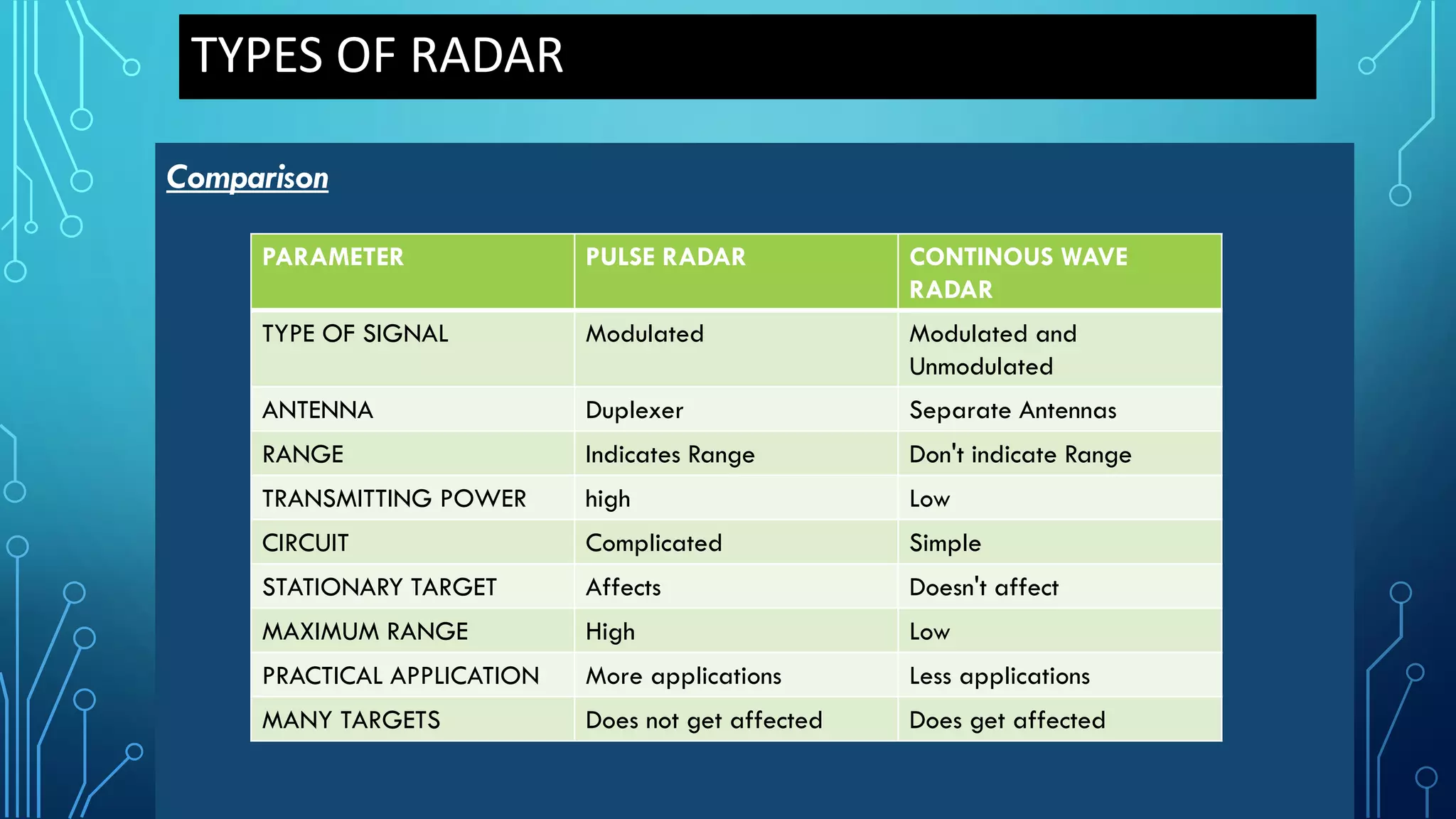
Comparison
PARAMETER PULSE RADAR CONTINOUS WAVE
RADAR
TYPE OF SIGNAL Modulated Modulated and
Unmodulated
ANTENNA Duplexer Separate Antennas
RANGE Indicates Range Don't indicate Range
TRANSMITTING POWER high Low
CIRCUIT Complicated Simple
STATIONARY TARGET Affects Doesn't affect
MAXIMUM RANGE High Low
PRACTICAL APPLICATION More applications Less applications
MANY TARGETS Does not get affected Does get affected
BASIC REQUIREMENTS OF RADAR
• Automatically operating duplexer
• Tx should remain silent during echo period
• Tx pulse should be very powerful
• Rx should be highly sensitive to echo signals and should be highly immune to
noise
• Antenna should be highly directive with large gain
• Pulse repetition frequency (PRF) should be high compared to the scanning
period
PRF = duty cycle/pulse width
Pav = Pt X duty cycle = Pt X Pulse width X PRF
APPLICATIONS OF RADR
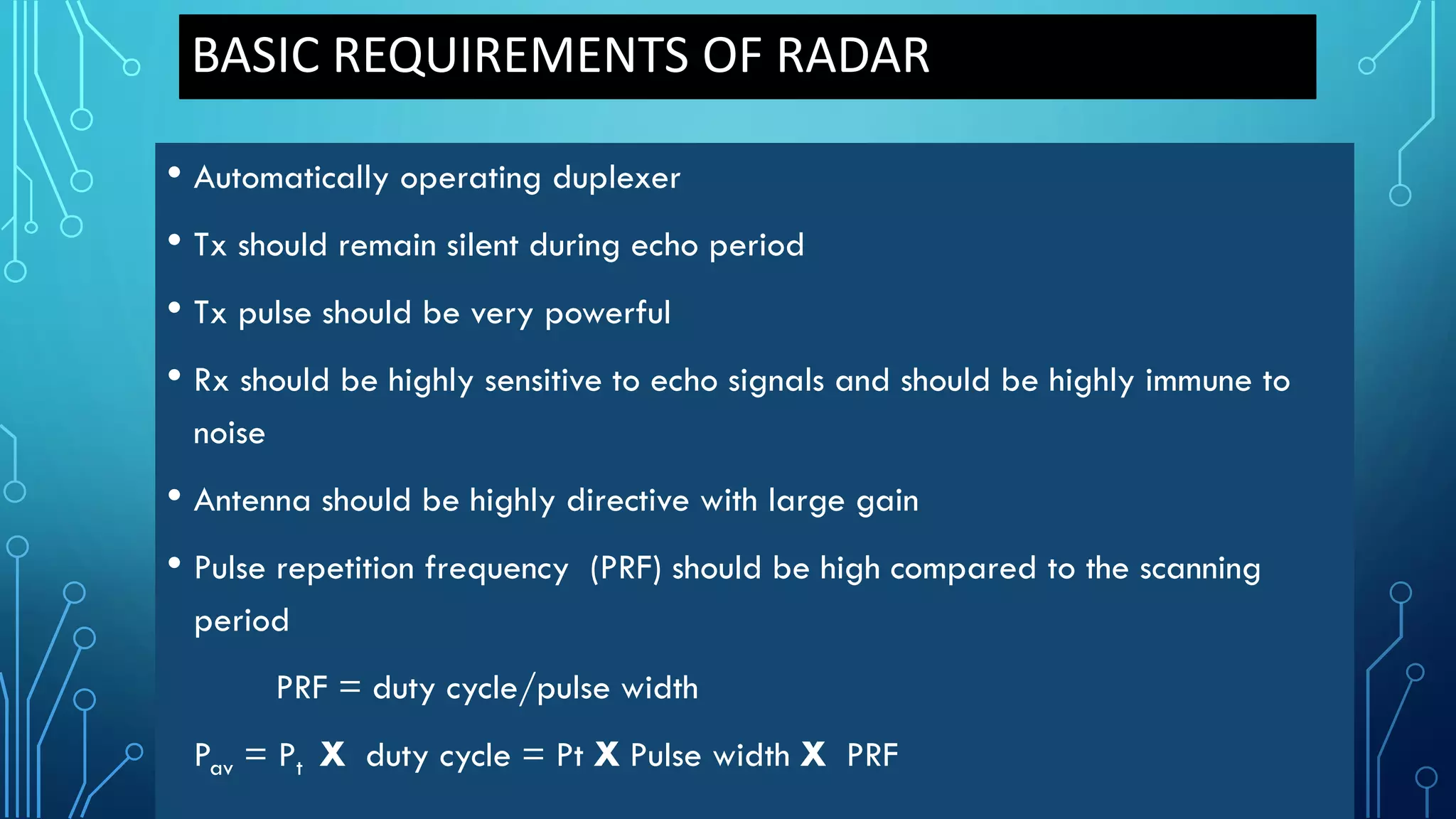
• Navigational aid on ground and sea
• Radar altimeters (height measurement)
• Radar blind lander (aircraft landing during poor visibility)
• Airborne radar for satellite surveillance
• Space applications like planetary observations
• Police radars (Law enforcement and Highway safety)
APPLICATIONS OF RADR
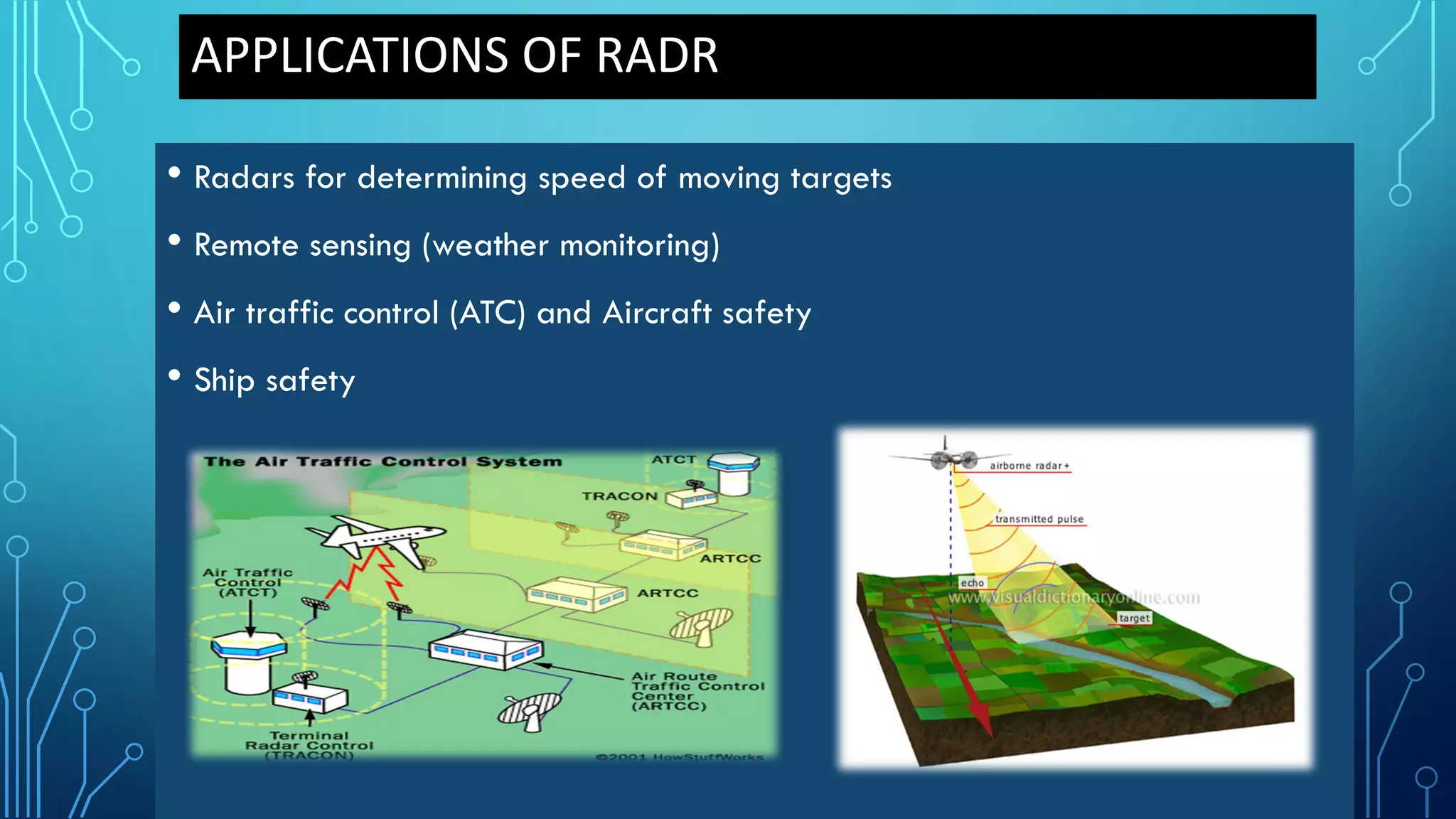
• Radars for determining speed of moving targets
• Remote sensing (weather monitoring)
• Air traffic control (ATC) and Aircraft safety
• Ship safety
APPLICATIONS OF RADR
• Non-contact method of speed and distance in industry
Military Applications:
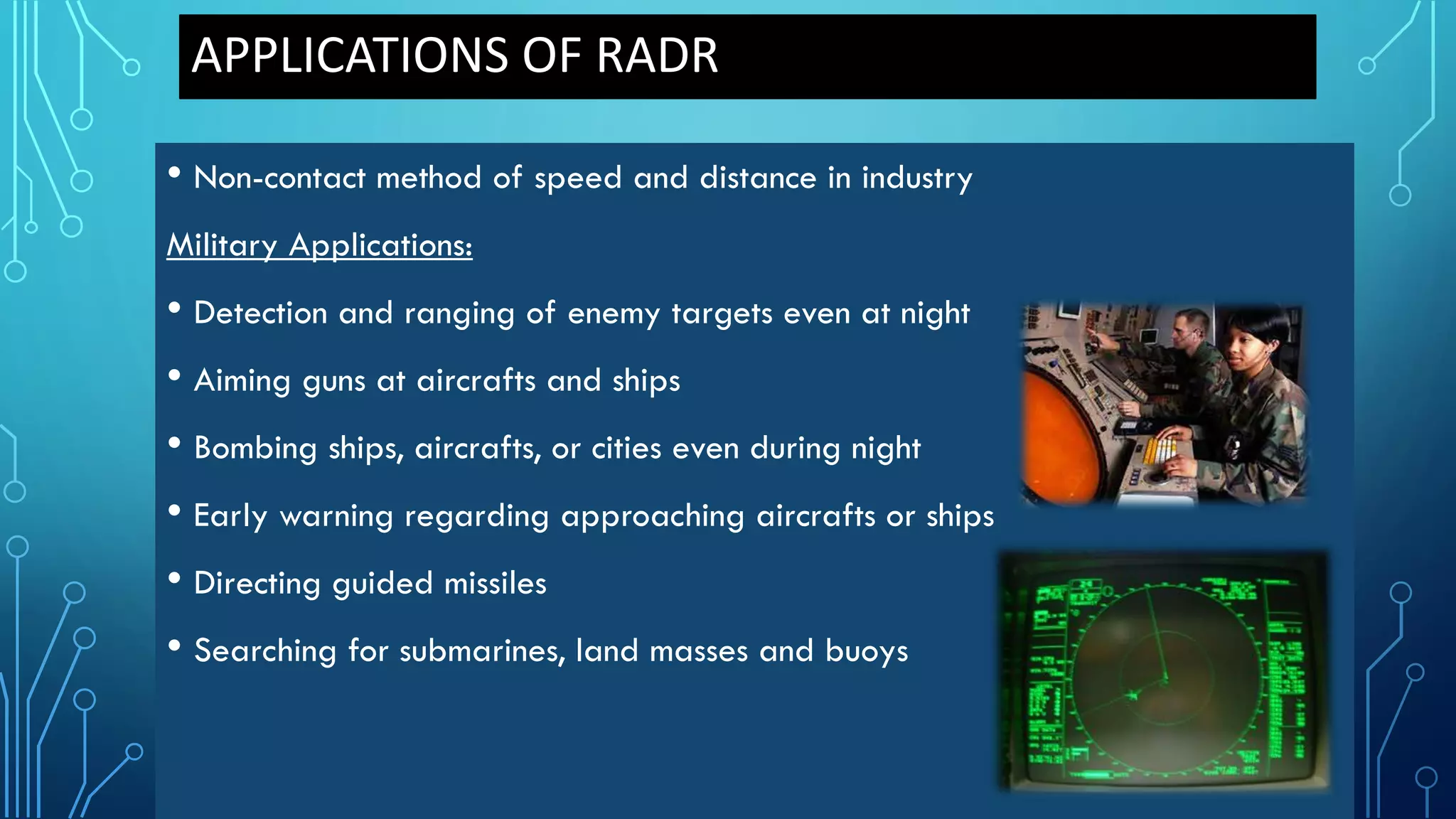
• Detection and ranging of enemy targets even at night
• Aiming guns at aircrafts and ships
• Bombing ships, aircrafts, or cities even during night
• Early warning regarding approaching aircrafts or ships
• Directing guided missiles
• Searching for submarines, land masses and buoys
REFERENCES
• http://www.srh.noaa.gov/jetstream/doppler/how.html
• www.Wikipedia.com
• Microwave Engineering by David. M. Pozar 4th edition Wiley 2012.
• Ahmad Shahid Khan-Microwave Engineering_ Concepts and Fundamentals-CRC Press (2014)
• http://www.slideshare.net/umerbreaker/microwaves-applications
• http://www.slideshare.net/universalhunk/radar-basics-5050311?qid=4f6e29d9-6224-4a33-
8098-59b220878802&v=&b=&from_search=11
• Fundamentals of Microwave communications, 6th edition, U.S. Army Signal School Fort Gordon,
Georgia.
• http://www.slideshare.net/ram_ari/radar-1493911?qid=4f6e29d9-62244a33-8098
59b220878802&v=&b=&from_search=10
THANK YOU FOR YOUR
ATTENTION!!!

Fundamentals of microwave communication system and radar systems

  • 1.
    FUNDAMENTALS OF MICROWAVE COMMUNICATIONSYSTEM AND RADAR SYSTEMS PREPARED BY: ER. SARBESH CHAUDHARY H.O.D DEPARTMENT OF ELECTRONICS MANMOHAN MEMORIAL POLYTECHNIC, BUDHIGANGA-4, NEPAL PRESENTATION ON
  • 2.
    CONTENTS • What ismicrowave? • Microwave generation & transmission • Microwave antenna & propagation • Typical Microwave communication link • Advantages & disadvantages of microwave • Microwave applications • Introduction to RADAR • Basic Principle and Operation Of RADAR • Types of RADAR • Basic requirements of RADAR • Applications of RADAR
  • 3.
    WHAT IS MICROWAVE? •Electromagnetic waves with frequencies ranging from 3 GHz to 300 GHz. • Wavelength is in the order of 10 cm to 1mm – something in between light waves and radio waves. So, it is also known as millimeter waves. • Term “micro” refers to the tinyness of the wavelength. • • Because of high frequency and short wavelength phase changes continuously w.r.t time.
  • 4.
    WHAT IS MICROWAVE?(CONTINUE) •Microwaves up to 300 GHz occupy a region in the electromagnetic spectrum between radio waves and infrared waves, • Microwaves behaves more like rays of light than ordinary radio waves. Due to this unique behaviour, microwaves frequencies are classified separately from radio waves.
  • 5.
    WHAT IS MICROWAVE?(CONTINUE) •Microwave frequency bands
  • 6.
    MICROWAVE GENERATION &TRANSMISSION MICROWAVE GENERATION • The operation of conventional vacuum tubes and solid state devices is limited by transit time , Inter-electrode capacitance and lead inductance effects. • Thus, the development of new devices was essential to exploit the microwave frequency region. • Fortunately, numbers of new principle of operations, such as , velocity modulation, interaction of electrons with electromagnetic fields, transferred electron techniques etc have enabled the generation of microwaves.
  • 7.
    MICROWAVE GENERATION &TRANSMISSION (CONT…) MICROWAVE GENERATION (cont..) Microwave Tubes Microwave Generation Klystron Magnetrons Travelling Wave Tube (TWT)
  • 8.
    MICROWAVE GENERATION &TRANSMISSION (CONT…) MICROWAVE TUBES • Tubes generate and amplify high levels of microwave power more cheaply than solid state devices. 1. KLYSTRON TUBE : - • Types a) Reflex Klystron b) 2-cavity c)Multi-cavity
  • 9.
    • Schematic diagramof 2-cavity Klystron Amplifier. MICROWAVE GENERATION & TRANSMISSION (CONT…)
  • 10.
    MICROWAVE GENERATION &TRANSMISSION (CONT…) Working : • Used as an oscillator or high-power amplifiers. • It makes use of velocity modulation and electron transit time. • Electron beam moves down tube past several cavities. • Input cavity is the buncher, output cavity is the catcher. • Buncher modulates the velocity of the electron beam. • Electric field from microwaves at buncher alternately speeds and slows electron beam • This causes electrons to bunch up • Electron bunches at catcher induce microwaves with more energy.
  • 11.
    1. KLYSTRON TUBE: - MICROWAVE GENERATION & TRANSMISSION (CONT…)
  • 12.
    MICROWAVE TUBES 2. MAGNETRONS:- • High-power oscillator • Common in radar and microwave ovens. • Working : • Cathode in center, anode around outside • Strong dc magnetic field around tube causes electrons from cathode to spiral as they move toward anode • Current of electrons generates microwaves in cavities around outside. MICROWAVE GENERATION & TRANSMISSION (CONT…)
  • 13.
    2. MAGNETRONS: - MICROWAVEGENERATION & TRANSMISSION (CONT…)
  • 14.
    MICROWAVE GENERATION &TRANSMISSION (CONT…) 2. MAGNETRONS: -
  • 15.
    MICROWAVE GENERATION &TRANSMISSION (CONT…) MICROWAVE TUBES 3. Travelling wave tube (TWT): - • Generates frequency in the range of 0.5 GHz to 95 GHz. • It has high gain, high power, larger bandwidth & low noise. • Used as low noise amplifier in microwave receivers, repeater, communication satellites, RADAR (airborne, shipborne & ground based).
  • 16.
    MICROWAVE GENERATION &TRANSMISSION (CONT…) 3. Travelling wave tube (TWT): - • Working: • Uses a helix as a slow-wave structure. • Because of the helix, electrons interact longer with the electric field. Hence, it produces high continuous power of 2-5 KW and large bandwidth. • Microwaves input at cathode end of helix, output at anode end • Energy is transferred from electron beam to microwaves.
  • 17.
    MICROWAVE GENERATION &TRANSMISSION (CONT…) Basic structure of a Travelling wave tube (TWT): -
  • 18.
    MICROWAVE GENERATION &TRANSMISSION (CONT…) MICROWAVE TRANSMISSION - • Two wire transmission line used in conventional circuits is inefficient at microwave frequencies. • The most common transmission lines are coaxial cable, micro strip lines, waveguides. 1.Co-axial cable: • Consists of inner conducting wire made of copper, over this conducting wire the coating of polyethylene or Teflon material is carried out. • Then it is enclosed in the braded wire in the shape of mesh. The outer surface of this wire is enclosed in a plastic jacket.
  • 19.
    MICROWAVE GENERATION &TRANSMISSION (CONT…) • Merits The possibility of external interference is minimized & output at the load end will be less noised. It is used for high frequency transmission. The conductor is protected from dust, rust etc due to proper insulation. • Demerits Costly than two wire line. Complex design Handles low power transmissions.
  • 20.
    MICROWAVE GENERATION &TRANSMISSION (CONT…) MICROWAVE TRANSMISSION - 2. Micro strip line: • A micro strip line is simply a copper track running on a side of the PCB while the other side is the ground plane. • There is thick coat of insulating material over the copper plate which is made of fiber glass or polystyrene. This insulator works as a dielectric in micro strip line. • At the top of the insulated plate one or more than one strip of the best conducting material are plated which is made of gold, aluminium etc.
  • 21.
    2. Micro stripline: Merits Very high frequency. Small size Low weight Losses are minimum. Used in IC’s where the distance between source and load is very short. Demerits Costly than co-axial. Cannot be used when the distance between source and load is long. Cannot be used in twisty path. MICROWAVE GENERATION & TRANSMISSION (CONT…)
  • 22.
    3. Waveguides: • AHollow metallic tube of uniform cross section for transmitting electromagnetic waves by successive reflections from the inner conducting layered walls of the tube is called waveguide. • At microwave frequencies (above 1GHz to 100 GHz) the losses in the two line transmission system will be very high and hence it cannot be used at those frequencies. Hence microwave signals are propagated through the waveguides in order to minimize the losses. MICROWAVE GENERATION & TRANSMISSION (CONT…)
  • 23.
    MICROWAVE GENERATION &TRANSMISSION (CONT…) 3. Waveguides: • They are generally of two types: a) Rectangular & b) Circular waveguide • Waveguides are generally used to couple transmitter power to antenna and microwave signal from antenna to receiver. • Dimensions of the waveguide determines the operating frequency range.
  • 24.
    MICROWAVE GENERATION &TRANSMISSION (CONT…) Merits • Large surface area • Low losses • Better power handling capability Demerits • Size • Difficult to install because of its rigid structure. • costly
  • 25.
    MICROWAVE ANTENNA &PROPAGATION • MICROWAVE ANTENNA: • The antenna is a passive device that radiate or receive the modulated signal. It is fed by direct connect of the RF unit, coaxial cable, or waveguides at higher frequencies. • In two-way communication, the same antenna can be used for transmission and reception. • Types: 1. Horn Antenna 2.Parabolic Dish Antenna 3. Slot Antenna 4. Micro-strip patch or Printed Antenna
  • 26.
    MICROWAVE ANTENNA &PROPAGATION • MICROWAVE ANTENNA TYPES: • Horn Antenna • Parabolic Dish Antenna
  • 27.
    MICROWAVE ANTENNA &PROPAGATION • Slot Antenna • Micro-strip patch or Printed Antenna
  • 28.
    MICROWAVE ANTENNA &PROPAGATION • MICROWAVE PROPAGATION: • Since microwave is used for point-to-point communication, it follows Line-of- Sight (LOS) propagation. • Fresnel zone –elliptical area around the LOS between a sender and receiver; microwaves spread into this area once are generated by an antenna; this area should be free of any obstacles: ROT P F1 d2d1
  • 29.
    MICROWAVE ANTENNA &PROPAGATION • MICROWAVE PROPAGATION: • The first Fresnel zone is the region where the microwave transmission energy is the most concentrated. • With the increase of the Fresnel zone serial numbers, the field strength of the receiving point reduces as per arithmetic series. • Formula of the first Fresnel zone radius:
  • 30.
    MICROWAVE ANTENNA &PROPAGATION • MICROWAVE PROPAGATION:
  • 31.
    MICROWAVE ANTENNA &PROPAGATION • MICROWAVE PROPAGATION: 1.Tropospheric scatter propagation • For frequencies above 500 MHz, less delay, 20 Mbps data rate for 100 Km link.
  • 32.
    MICROWAVE ANTENNA &PROPAGATION • MICROWAVE PROPAGATION: • Ionospheric Propagation:
  • 33.
    MICROWAVE ANTENNA &PROPAGATION • Fading in Microwave Propagation: • Free space fading • Absorption fading • Rain fading • Multipath fading • Duct fading Duct type fading
  • 34.
    TYPICAL MICROWAVE COMMUNICATIONLINK RepeaterRepeater Transmitter Receiver
  • 35.
    ADVANTAGES & DISADVANTAGESOF MICROWAVE Advantages: • Increased bandwidth availability • Improved directive properties • Fading effect and reliability • Low power requirements • Transparency property of microwaves. • Less interference from nearby applications. • Fast speed for digital system signal processing and data transmission. • Difficulty in jamming (military applications). •
  • 36.
    • Disadvantages: • Moreexpensive components. • Reliance on GaAs instead of Si technology. • Higher component losses and lower output power from active devices. • Less accurate design tools and less matured technology. • Line-of-sight will be disrupted if any obstacle, such as new buildings, are in the way • Signal absorption by the atmosphere. Microwaves suffer from attenuation due to atmospheric conditions. ADVANTAGES & DISADVANTAGES OF MICROWAVE
  • 37.
    MICROWAVE APPLICATIONS 1. Telecommunication:Intercontinental telephone and T.V. space communication (earth to space and space t earth) telemetry communication link for railways etc. 2. Radars: Detect aircraft, track/guide supersonic missiles, observe, and track weather patterns, Air Traffic Control (ATC) etc 3. Commercial & Industrial Application use heat property of Microwave a)Microwave oven(2.45 GHz, 600 W) b) Drying machines c) Food processing industry d) Mining/public works e) Biomedical Application 4. Electronic warfare.
  • 38.
    INTRODUCTION TO RADAR •The term RADAR was coined in 1940 by the United States Navy as an acronym for RAdio Detection And Ranging. • Radar is an object-detection system that uses radio waves to determine the range, altitude, direction, or speed of objects. It can be used detect aircraft ,ships , missiles, weather formation, and terrain. • Radar was secretly developed by several nations before and during World War II.
  • 39.
    BASIC PRINCIPLE ANDOPERATION OF RADAR • A radar system has a transmitter that emits radio waves called radar signals in predetermined directions. • When these come into contact with an object they are usually reflected or scattered in many directions. • Radar signals are reflected especially well by materials of considerable electrical conductivity • The Time Delay Between The Transmitted Pulse And The Received Echo Can Be Used To Determine The Distance To The Target . R = Ct/2 meters.
  • 40.
    BASIC PRINCIPLE ANDOPERATION OF RADAR
  • 41.
    TYPES OF RADAR Thereare two main types of radar: 1)Primary Radar (Imaging) • Continuous wave Radar • Pulse Radar 2)Secondary Radar (Non-Imaging)
  • 42.
    TYPES OF RADAR 1.Continuouswave Radar: • Employs continual RADAR transmission • Separate transmit and receive antennas • Relies on the “DOPPLER SHIFT
  • 43.
    TYPES OF RADAR 2.Pulse Radar: • The PULSE radar is the more conventional radar, which transmits a burst of radar energy and then waits for the energy (or echo) to be reflected back to the antenna. • Since radar waves travel at the speed of light, range from the return can be calculated.
  • 44.
    TYPES OF RADAR 2.Pulse Radar: • Duplexer is a switch to alternatively connect Tx and Rx to antenna.
  • 45.
    TYPES OF RADAR Comparison PARAMETERPULSE RADAR CONTINOUS WAVE RADAR TYPE OF SIGNAL Modulated Modulated and Unmodulated ANTENNA Duplexer Separate Antennas RANGE Indicates Range Don't indicate Range TRANSMITTING POWER high Low CIRCUIT Complicated Simple STATIONARY TARGET Affects Doesn't affect MAXIMUM RANGE High Low PRACTICAL APPLICATION More applications Less applications MANY TARGETS Does not get affected Does get affected
  • 46.
    BASIC REQUIREMENTS OFRADAR • Automatically operating duplexer • Tx should remain silent during echo period • Tx pulse should be very powerful • Rx should be highly sensitive to echo signals and should be highly immune to noise • Antenna should be highly directive with large gain • Pulse repetition frequency (PRF) should be high compared to the scanning period PRF = duty cycle/pulse width Pav = Pt X duty cycle = Pt X Pulse width X PRF
  • 47.
    APPLICATIONS OF RADR •Navigational aid on ground and sea • Radar altimeters (height measurement) • Radar blind lander (aircraft landing during poor visibility) • Airborne radar for satellite surveillance • Space applications like planetary observations • Police radars (Law enforcement and Highway safety)
  • 48.
    APPLICATIONS OF RADR •Radars for determining speed of moving targets • Remote sensing (weather monitoring) • Air traffic control (ATC) and Aircraft safety • Ship safety
  • 49.
    APPLICATIONS OF RADR •Non-contact method of speed and distance in industry Military Applications: • Detection and ranging of enemy targets even at night • Aiming guns at aircrafts and ships • Bombing ships, aircrafts, or cities even during night • Early warning regarding approaching aircrafts or ships • Directing guided missiles • Searching for submarines, land masses and buoys
  • 50.
    REFERENCES • http://www.srh.noaa.gov/jetstream/doppler/how.html • www.Wikipedia.com •Microwave Engineering by David. M. Pozar 4th edition Wiley 2012. • Ahmad Shahid Khan-Microwave Engineering_ Concepts and Fundamentals-CRC Press (2014) • http://www.slideshare.net/umerbreaker/microwaves-applications • http://www.slideshare.net/universalhunk/radar-basics-5050311?qid=4f6e29d9-6224-4a33- 8098-59b220878802&v=&b=&from_search=11 • Fundamentals of Microwave communications, 6th edition, U.S. Army Signal School Fort Gordon, Georgia. • http://www.slideshare.net/ram_ari/radar-1493911?qid=4f6e29d9-62244a33-8098 59b220878802&v=&b=&from_search=10
  • 51.
    THANK YOU FORYOUR ATTENTION!!!