LASER COMMUNICATION
NAME: GAURAV SINGH
CONTENT
• Introduction
• Implementation
• Working
• Working model
• Applications
• Advantages
• References
Introduction
• Laser communication is one of the key
area in wireless Communications. Due to
its low noise ratio makes its one of the
well suited communication medium for
exchange of information.
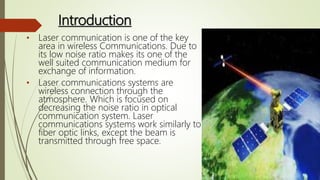
• Laser communications systems are
wireless connection through the
atmosphere. Which is focused on
decreasing the noise ratio in optical
communication system. Laser
communications systems work similarly to
fiber optic links, except the beam is
transmitted through free space.
Working of system
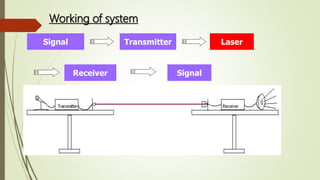
Signal Transmitter Laser
Receiver Signal
Working of system
 Laser Communication System mainly comprise of 2 sections such as
Transmitter section and Receiver section.
 Transmitter section is used to transmit the data and sound signals, which
comprised by microphone, Conditioning ckt, analog to digital converter and
laser diode to generate medium for transmission of signals.
 Transmitter converts the signal into laser beam and transmit it in a straight line.
 The receiver section is used to receive the laser beam, using photo transmitter,
which incorporated with the data or sound signals from the transmitter
comprised of Conditioning, MCR and Digital to Analog converter to extract the
data signals from the received laser beam and given as a input to the speaker.
What is the Transmitter?
The transmitter involves:
Signal processing electronics (analog/digital)
Laser modulator
Laser (visible, near visible wavelengths)
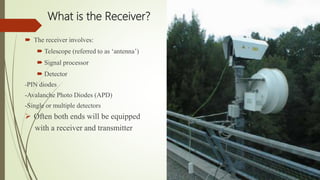
What is the Receiver?
 The receiver involves:
 Telescope (referred to as ‘antenna’)
 Signal processor
 Detector
-PIN diodes
-Avalanche Photo Diodes (APD)
-Single or multiple detectors
 Often both ends will be equipped
with a receiver and transmitter
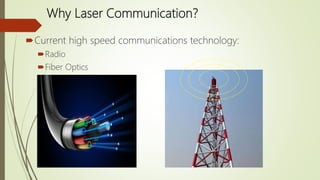
Why Laser Communication?
Current high speed communications technology:
Radio
Fiber Optics
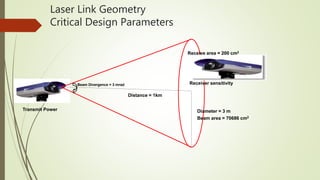
Laser Link Geometry
Critical Design Parameters
Transmit Power
Receive area = 200 cm2
Receiver sensitivity
Beam Divergence = 3 mrad
Distance = 1km
Diameter = 3 m
Beam area = 70686 cm2
Uplink/Downlink Data Processing
Sequence
Bits Bit Encoder
to Symbol LASER
Transfer
Optics
Channel
(Atmos.)
Error
Correction
Symbol
Recovery
Amplifier
Receiving
Optics
Bits
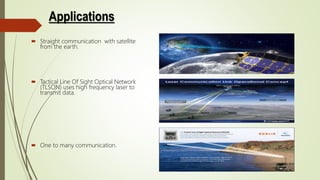
Applications
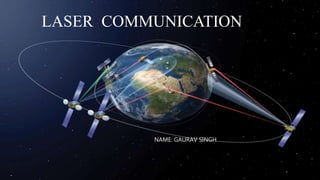
 Straight communication with satellite
from the earth.
 Tactical Line Of Sight Optical Network
(TLSON) uses high frequency laser to
transmit data.
 One to many communication.
Disadvantages!!
Laser link can be affected by-
 Atmospheric absorption
 Fog, Rain, Pollution (smoke)
 Physical obstructions
 Solar radiations
 These can be reduced by using Laser tuning, multiple number of transmitters,
filters etc.
Future Scope
It is more secure and provides high bandwidth
requirements. The low power consumption is
also a great advantage.
It can be the mostly used technique
worldwide in near future.

lassercobbbbbnmmunication-170320093403.pdf

  • 1.
  • 2.
    CONTENT • Introduction • Implementation •Working • Working model • Applications • Advantages • References
  • 3.
    Introduction • Laser communicationis one of the key area in wireless Communications. Due to its low noise ratio makes its one of the well suited communication medium for exchange of information. • Laser communications systems are wireless connection through the atmosphere. Which is focused on decreasing the noise ratio in optical communication system. Laser communications systems work similarly to fiber optic links, except the beam is transmitted through free space.
  • 4.
    Working of system SignalTransmitter Laser Receiver Signal
  • 5.
    Working of system Laser Communication System mainly comprise of 2 sections such as Transmitter section and Receiver section.  Transmitter section is used to transmit the data and sound signals, which comprised by microphone, Conditioning ckt, analog to digital converter and laser diode to generate medium for transmission of signals.  Transmitter converts the signal into laser beam and transmit it in a straight line.  The receiver section is used to receive the laser beam, using photo transmitter, which incorporated with the data or sound signals from the transmitter comprised of Conditioning, MCR and Digital to Analog converter to extract the data signals from the received laser beam and given as a input to the speaker.
  • 6.
    What is theTransmitter? The transmitter involves: Signal processing electronics (analog/digital) Laser modulator Laser (visible, near visible wavelengths)
  • 7.
    What is theReceiver?  The receiver involves:  Telescope (referred to as ‘antenna’)  Signal processor  Detector -PIN diodes -Avalanche Photo Diodes (APD) -Single or multiple detectors  Often both ends will be equipped with a receiver and transmitter
  • 8.
    Why Laser Communication? Currenthigh speed communications technology: Radio Fiber Optics
  • 9.
    Laser Link Geometry CriticalDesign Parameters Transmit Power Receive area = 200 cm2 Receiver sensitivity Beam Divergence = 3 mrad Distance = 1km Diameter = 3 m Beam area = 70686 cm2
  • 10.
    Uplink/Downlink Data Processing Sequence BitsBit Encoder to Symbol LASER Transfer Optics Channel (Atmos.) Error Correction Symbol Recovery Amplifier Receiving Optics Bits
  • 11.
    Applications  Straight communicationwith satellite from the earth.  Tactical Line Of Sight Optical Network (TLSON) uses high frequency laser to transmit data.  One to many communication.
  • 12.
    Disadvantages!! Laser link canbe affected by-  Atmospheric absorption  Fog, Rain, Pollution (smoke)  Physical obstructions  Solar radiations  These can be reduced by using Laser tuning, multiple number of transmitters, filters etc.
  • 13.
    Future Scope It ismore secure and provides high bandwidth requirements. The low power consumption is also a great advantage. It can be the mostly used technique worldwide in near future.