Laser Communication
Laser Communication
What Is Laser Communication?
Laser communications systems are wireless
connections through the atmosphere. They
work similarly to fiber optic links, except the
fact that, in lasers, beam is transmitted
through free space.
through free space.
L
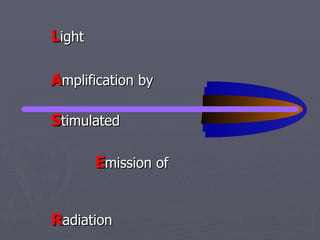
Light
ight
A
Amplification by
mplification by
S
Stimulated
timulated
E
Emission of
mission of
R
Radiation
adiation
Free Space Laser Communication
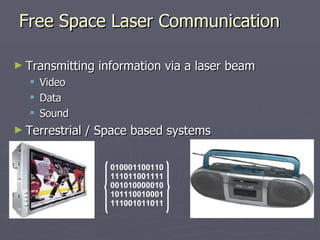
► Transmitting information via a laser beam
Transmitting information via a laser beam
 Video
Video
 Data
Data
 Sound
Sound
► Terrestrial / Space based systems
Terrestrial / Space based systems
010001100110
111011001111
001010000010
101110010001
111001011011
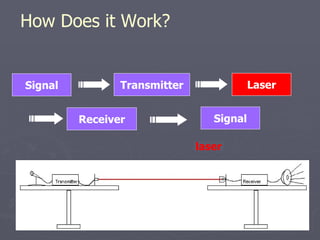
How Does it Work?
Signal Transmitter
Receiver Signal
Laser
laser
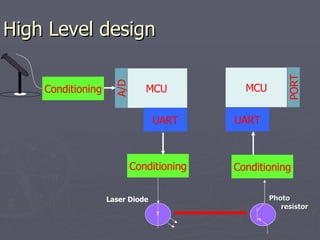
Photo
Photo
resistor
resistor
High Level design
High Level design
Conditioning MCU MCU
Conditioning
Conditioning
UART UART
A/D
PORT
Laser Diode
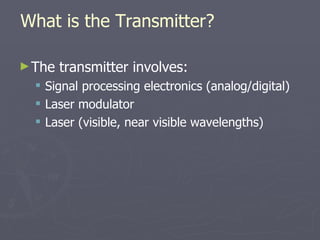
What is the Transmitter?
►The transmitter involves:
 Signal processing electronics (analog/digital)
 Laser modulator
 Laser (visible, near visible wavelengths)
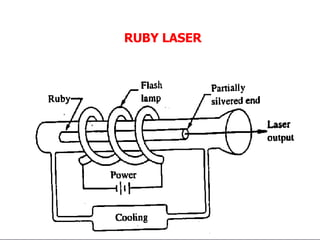
RUBY LASER
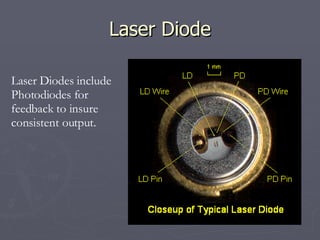
Laser Diode
Laser Diode
Laser Diodes include
Photodiodes for
feedback to insure
consistent output.
Modulation
Modulation
►AM
AM
 Easy with gas lasers, hard with diodes
Easy with gas lasers, hard with diodes
►PWM (Pulse Width Modulation)
PWM (Pulse Width Modulation)
►PFM (Pulsed FM)
PFM (Pulsed FM)
 Potentially the highest bandwidth (>100kHz)
Potentially the highest bandwidth (>100kHz)
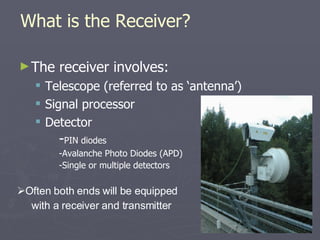
What is the Receiver?
►The receiver involves:
 Telescope (referred to as ‘antenna’)
 Signal processor
 Detector
Often both ends will be equipped
with a receiver and transmitter
-PIN diodes
-Avalanche Photo Diodes (APD)
-Single or multiple detectors
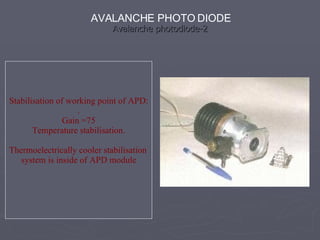
Avalanche photodiode-2
Stabilisation of working point of APD:
.
Gain =75
Temperature stabilisation.
Thermoelectrically cooler stabilisation
system is inside of APD module
AVALANCHE PHOTO DIODE
System Comparison
System Comparison
(OC3 1km products)
(OC3 1km products)
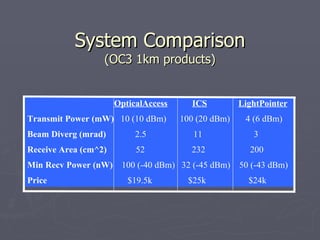
OpticalAccess ICS LightPointer
Transmit Power (mW) 10 (10 dBm) 100 (20 dBm) 4 (6 dBm)
Beam Diverg (mrad) 2.5 11 3
Receive Area (cm^2) 52 232 200
Min Recv Power (nW) 100 (-40 dBm) 32 (-45 dBm) 50 (-43 dBm)
Price $19.5k $25k $24k
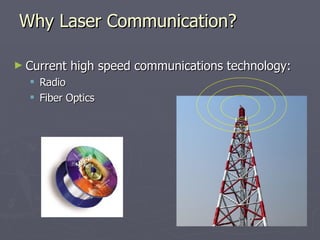
Why Laser Communication?
► Current high speed communications technology:
Current high speed communications technology:
 Radio
Radio
 Fiber Optics
Fiber Optics
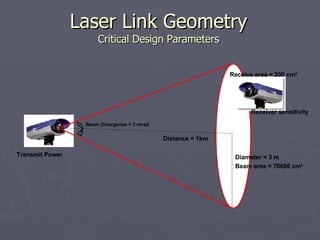
Laser Link Geometry
Laser Link Geometry
Critical Design Parameters
Beam Divergence = 3 mrad
Diameter = 3 m
Beam area = 70686 cm2
Distance = 1km
Receive area = 200 cm2
Transmit Power
Receiver sensitivity
►Not always possible to lay fiber lines
Not always possible to lay fiber lines
 Satellites
Satellites
 Combat zones
Combat zones
 Physically / Economically not practical
Physically / Economically not practical
 Emergencies
Emergencies
 LC being incorporated into fiber optic
LC being incorporated into fiber optic
networks when fiber is not practical.
Why not Fiber Optics?
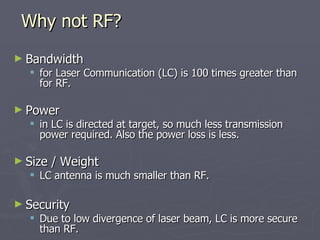
► Bandwidth
Bandwidth
 for Laser Communication (LC) is 100 times greater than
for Laser Communication (LC) is 100 times greater than
for RF.
for RF.
► Power
Power
 in LC is directed at target, so much less transmission
in LC is directed at target, so much less transmission
power required. Also the power loss is less.
► Size / Weight
Size / Weight
 LC antenna is much smaller than RF.
LC antenna is much smaller than RF.
► Security
Security
 Due to low divergence of laser beam, LC is more secure
Due to low divergence of laser beam, LC is more secure
than RF.
than RF.
Why not RF?
Why not RF?
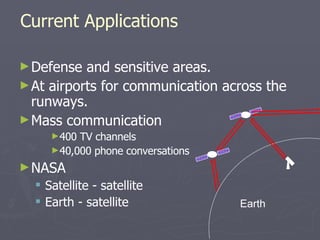
Current Applications
►Defense and sensitive areas.
►At airports for communication across the
runways.
►Mass communication
►400 TV channels
►40,000 phone conversations
►NASA
 Satellite - satellite
 Earth - satellite Earth
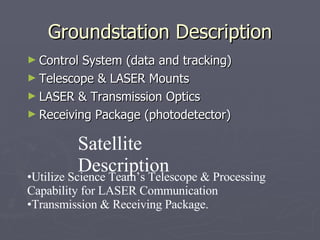
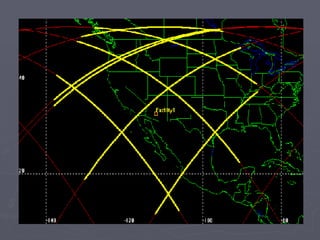
Groundstation Description
► Control System (data and tracking)
Control System (data and tracking)
► Telescope & LASER Mounts
Telescope & LASER Mounts
► LASER & Transmission Optics
LASER & Transmission Optics
► Receiving Package (photodetector)
Receiving Package (photodetector)
•Utilize Science Team’s Telescope & Processing
Capability for LASER Communication
•Transmission & Receiving Package.
Satellite
Description
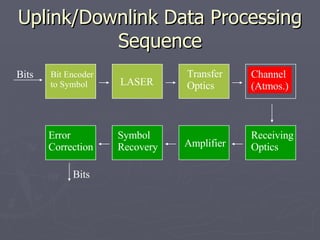
Uplink/Downlink Data Processing
Sequence
Sequence
Bits Bit Encoder
to Symbol LASER
Transfer
Optics
Channel
(Atmos.)
Receiving
Optics
Amplifier
Symbol
Recovery
Error
Correction
Bits
Opportunities For Student Involvement
•LASER Research
•LASER Modulation Circuitry
•Encoding/Decoding Circuitry
Contact Information
Contact Information
•Matthew Johnson (mjohnson@u.arizona.edu)
• Freddy Valenzuela (acv@bigdog.engr.arizona.edu)
• Http://www.physics.arizona.edu/ssp/sti
For more information regarding
laser communication:

laser-communication-1222866681398711-9.pdf

  • 1.
  • 2.
    What Is LaserCommunication? What Is Laser Communication? Laser communications systems are wireless Laser communications systems are wireless connections through the atmosphere. They connections through the atmosphere. They work similarly to fiber optic links, except the work similarly to fiber optic links, except the fact that, in lasers, beam is transmitted fact that, in lasers, beam is transmitted through free space. through free space.
  • 3.
  • 4.
    Free Space LaserCommunication Free Space Laser Communication ► Transmitting information via a laser beam Transmitting information via a laser beam  Video Video  Data Data  Sound Sound ► Terrestrial / Space based systems Terrestrial / Space based systems 010001100110 111011001111 001010000010 101110010001 111001011011
  • 5.
    How Does itWork? Signal Transmitter Receiver Signal Laser laser
  • 6.
    Photo Photo resistor resistor High Level design HighLevel design Conditioning MCU MCU Conditioning Conditioning UART UART A/D PORT Laser Diode
  • 7.
    What is theTransmitter? ►The transmitter involves:  Signal processing electronics (analog/digital)  Laser modulator  Laser (visible, near visible wavelengths)
  • 8.
  • 9.
    Laser Diode Laser Diode LaserDiodes include Photodiodes for feedback to insure consistent output.
  • 10.
    Modulation Modulation ►AM AM  Easy withgas lasers, hard with diodes Easy with gas lasers, hard with diodes ►PWM (Pulse Width Modulation) PWM (Pulse Width Modulation) ►PFM (Pulsed FM) PFM (Pulsed FM)  Potentially the highest bandwidth (>100kHz) Potentially the highest bandwidth (>100kHz)
  • 11.
    What is theReceiver? ►The receiver involves:  Telescope (referred to as ‘antenna’)  Signal processor  Detector Often both ends will be equipped with a receiver and transmitter -PIN diodes -Avalanche Photo Diodes (APD) -Single or multiple detectors
  • 12.
    Avalanche photodiode-2 Avalanche photodiode-2 Stabilisationof working point of APD: . Gain =75 Temperature stabilisation. Thermoelectrically cooler stabilisation system is inside of APD module AVALANCHE PHOTO DIODE
  • 13.
    System Comparison System Comparison (OC31km products) (OC3 1km products) OpticalAccess ICS LightPointer Transmit Power (mW) 10 (10 dBm) 100 (20 dBm) 4 (6 dBm) Beam Diverg (mrad) 2.5 11 3 Receive Area (cm^2) 52 232 200 Min Recv Power (nW) 100 (-40 dBm) 32 (-45 dBm) 50 (-43 dBm) Price $19.5k $25k $24k
  • 14.
    Why Laser Communication? WhyLaser Communication? ► Current high speed communications technology: Current high speed communications technology:  Radio Radio  Fiber Optics Fiber Optics
  • 15.
    Laser Link Geometry LaserLink Geometry Critical Design Parameters Critical Design Parameters Beam Divergence = 3 mrad Diameter = 3 m Beam area = 70686 cm2 Distance = 1km Receive area = 200 cm2 Transmit Power Receiver sensitivity
  • 16.
    ►Not always possibleto lay fiber lines Not always possible to lay fiber lines  Satellites Satellites  Combat zones Combat zones  Physically / Economically not practical Physically / Economically not practical  Emergencies Emergencies  LC being incorporated into fiber optic LC being incorporated into fiber optic networks when fiber is not practical. networks when fiber is not practical. Why not Fiber Optics? Why not Fiber Optics?
  • 17.
    ► Bandwidth Bandwidth  forLaser Communication (LC) is 100 times greater than for Laser Communication (LC) is 100 times greater than for RF. for RF. ► Power Power  in LC is directed at target, so much less transmission in LC is directed at target, so much less transmission power required. Also the power loss is less. power required. Also the power loss is less. ► Size / Weight Size / Weight  LC antenna is much smaller than RF. LC antenna is much smaller than RF. ► Security Security  Due to low divergence of laser beam, LC is more secure Due to low divergence of laser beam, LC is more secure than RF. than RF. Why not RF? Why not RF?
  • 18.
    Current Applications ►Defense andsensitive areas. ►At airports for communication across the runways. ►Mass communication ►400 TV channels ►40,000 phone conversations ►NASA  Satellite - satellite  Earth - satellite Earth
  • 19.
    Groundstation Description Groundstation Description ►Control System (data and tracking) Control System (data and tracking) ► Telescope & LASER Mounts Telescope & LASER Mounts ► LASER & Transmission Optics LASER & Transmission Optics ► Receiving Package (photodetector) Receiving Package (photodetector) •Utilize Science Team’s Telescope & Processing Capability for LASER Communication •Transmission & Receiving Package. Satellite Description
  • 20.
    Uplink/Downlink Data Processing Uplink/DownlinkData Processing Sequence Sequence Bits Bit Encoder to Symbol LASER Transfer Optics Channel (Atmos.) Receiving Optics Amplifier Symbol Recovery Error Correction Bits
  • 22.
    Opportunities For StudentInvolvement •LASER Research •LASER Modulation Circuitry •Encoding/Decoding Circuitry
  • 23.
    Contact Information Contact Information •MatthewJohnson (mjohnson@u.arizona.edu) • Freddy Valenzuela (acv@bigdog.engr.arizona.edu) • Http://www.physics.arizona.edu/ssp/sti For more information regarding laser communication: