Name of the course: Mechanical Engineering
Name of the subject
Modern Machining Processes
Group-C: Chapter 6
Laser Beam Machining
Name of the topic: Laser beam machining
Name of faculty: SK Hikmat
Asst. Prof. in Mechanical Engineering
Global Institute of Management and Technology
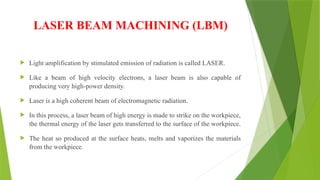
LASER BEAM MACHINING (LBM)
 Light amplification by stimulated emission of radiation is called LASER.
 Like a beam of high velocity electrons, a laser beam is also capable of
producing very high-power density.
 Laser is a high coherent beam of electromagnetic radiation.
 In this process, a laser beam of high energy is made to strike on the workpiece,
the thermal energy of the laser gets transferred to the surface of the workpiece.
 The heat so produced at the surface heats, melts and vaporizes the materials
from the workpiece.
Fundamental principle of LBM
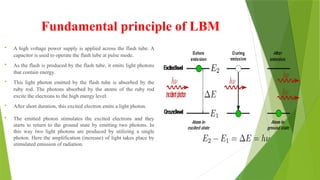
 A high voltage power supply is applied across the flash tube. A
capacitor is used to operate the flash tube at pulse mode.
 As the flash is produced by the flash tube, it emits light photons
that contain energy.
 This light photon emitted by the flash tube is absorbed by the
ruby rod. The photons absorbed by the atoms of the ruby rod
excite the electrons to the high energy level.
 After short duration, this excited electron emits a light photon.
 The emitted photon stimulates the excited electrons and they
starts to return to the ground state by emitting two photons. In
this way two light photons are produced by utilizing a single
photon. Here the amplification (increase) of light takes place by
stimulated emission of radiation.
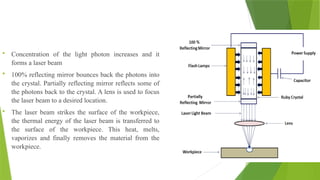
 Concentration of the light photon increases and it
forms a laser beam
 100% reflecting mirror bounces back the photons into
the crystal. Partially reflecting mirror reflects some of
the photons back to the crystal. A lens is used to focus
the laser beam to a desired location.
 The laser beam strikes the surface of the workpiece,
the thermal energy of the laser beam is transferred to
the surface of the workpiece. This heat, melts,
vaporizes and finally removes the material from the
workpiece.
Types of Laser
 On the basis of the media used for the production of the laser, it is classified
as:
 Gas lasers:
In these types of laser, gases are used as the medium to produce lasers. The
commonly used gases are He-Ne, argon (Ar) and CO2.
 Solid state lasers:
Ruby laser is an example of solid-state laser in which ruby crystal is used as
medium for the generation of laser beam.
Advantages of LBM
1) Any material can be easily machined
2) In can be focused to a very small diameter
3) It produces a very high amount of energy
4) There is no contact between the tool and workpiece
5) Tool wear is not existent
6) Small heat affected zone around the machined surface
7) High degree of accuracy can be achieved
8) Very small holes can be cut
Disadvantages of LBM
1) High initial cost
2) Highly skilled operators are needed
3) Low production rate
4) Its application is limited to only thin sections
5) Low metal removal rate
6) It is not easy to cut the workpiece that has high melting temperature
7) High maintenance cost
Applications of LBM
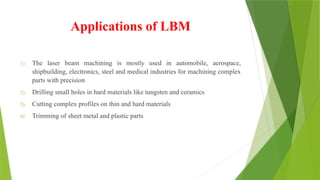
1) The laser beam machining is mostly used in automobile, aerospace,
shipbuilding, electronics, steel and medical industries for machining complex
parts with precision
2) Drilling small holes in hard materials like tungsten and ceramics
3) Cutting complex profiles on thin and hard materials
4) Trimming of sheet metal and plastic parts
Summary of LBM characteristics
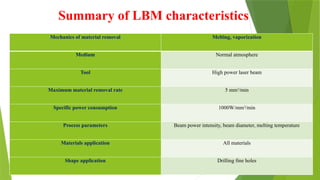
Mechanics of material removal Melting, vaporization
Medium Normal atmosphere
Tool High power laser beam
Maximum material removal rate 5 mm3
/min
Specific power consumption 1000W/mm3
/min
Process parameters Beam power intensity, beam diameter, melting temperature
Materials application All materials
Shape application Drilling fine holes

Laser beam machining APPLICATION AND WORKING(LBM).pptx

  • 1.
    Name of thecourse: Mechanical Engineering Name of the subject Modern Machining Processes Group-C: Chapter 6 Laser Beam Machining Name of the topic: Laser beam machining Name of faculty: SK Hikmat Asst. Prof. in Mechanical Engineering Global Institute of Management and Technology
  • 2.
    LASER BEAM MACHINING(LBM)  Light amplification by stimulated emission of radiation is called LASER.  Like a beam of high velocity electrons, a laser beam is also capable of producing very high-power density.  Laser is a high coherent beam of electromagnetic radiation.  In this process, a laser beam of high energy is made to strike on the workpiece, the thermal energy of the laser gets transferred to the surface of the workpiece.  The heat so produced at the surface heats, melts and vaporizes the materials from the workpiece.
  • 3.
    Fundamental principle ofLBM  A high voltage power supply is applied across the flash tube. A capacitor is used to operate the flash tube at pulse mode.  As the flash is produced by the flash tube, it emits light photons that contain energy.  This light photon emitted by the flash tube is absorbed by the ruby rod. The photons absorbed by the atoms of the ruby rod excite the electrons to the high energy level.  After short duration, this excited electron emits a light photon.  The emitted photon stimulates the excited electrons and they starts to return to the ground state by emitting two photons. In this way two light photons are produced by utilizing a single photon. Here the amplification (increase) of light takes place by stimulated emission of radiation.
  • 4.
     Concentration ofthe light photon increases and it forms a laser beam  100% reflecting mirror bounces back the photons into the crystal. Partially reflecting mirror reflects some of the photons back to the crystal. A lens is used to focus the laser beam to a desired location.  The laser beam strikes the surface of the workpiece, the thermal energy of the laser beam is transferred to the surface of the workpiece. This heat, melts, vaporizes and finally removes the material from the workpiece.
  • 6.
    Types of Laser On the basis of the media used for the production of the laser, it is classified as:  Gas lasers: In these types of laser, gases are used as the medium to produce lasers. The commonly used gases are He-Ne, argon (Ar) and CO2.  Solid state lasers: Ruby laser is an example of solid-state laser in which ruby crystal is used as medium for the generation of laser beam.
  • 7.
    Advantages of LBM 1)Any material can be easily machined 2) In can be focused to a very small diameter 3) It produces a very high amount of energy 4) There is no contact between the tool and workpiece 5) Tool wear is not existent 6) Small heat affected zone around the machined surface 7) High degree of accuracy can be achieved 8) Very small holes can be cut
  • 8.
    Disadvantages of LBM 1)High initial cost 2) Highly skilled operators are needed 3) Low production rate 4) Its application is limited to only thin sections 5) Low metal removal rate 6) It is not easy to cut the workpiece that has high melting temperature 7) High maintenance cost
  • 9.
    Applications of LBM 1)The laser beam machining is mostly used in automobile, aerospace, shipbuilding, electronics, steel and medical industries for machining complex parts with precision 2) Drilling small holes in hard materials like tungsten and ceramics 3) Cutting complex profiles on thin and hard materials 4) Trimming of sheet metal and plastic parts
  • 10.
    Summary of LBMcharacteristics Mechanics of material removal Melting, vaporization Medium Normal atmosphere Tool High power laser beam Maximum material removal rate 5 mm3 /min Specific power consumption 1000W/mm3 /min Process parameters Beam power intensity, beam diameter, melting temperature Materials application All materials Shape application Drilling fine holes