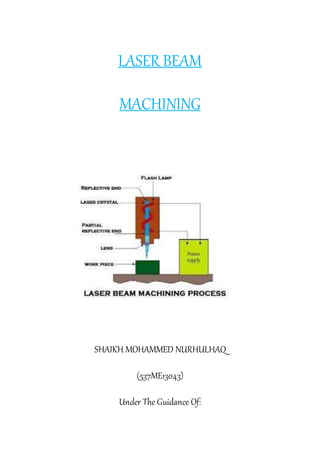
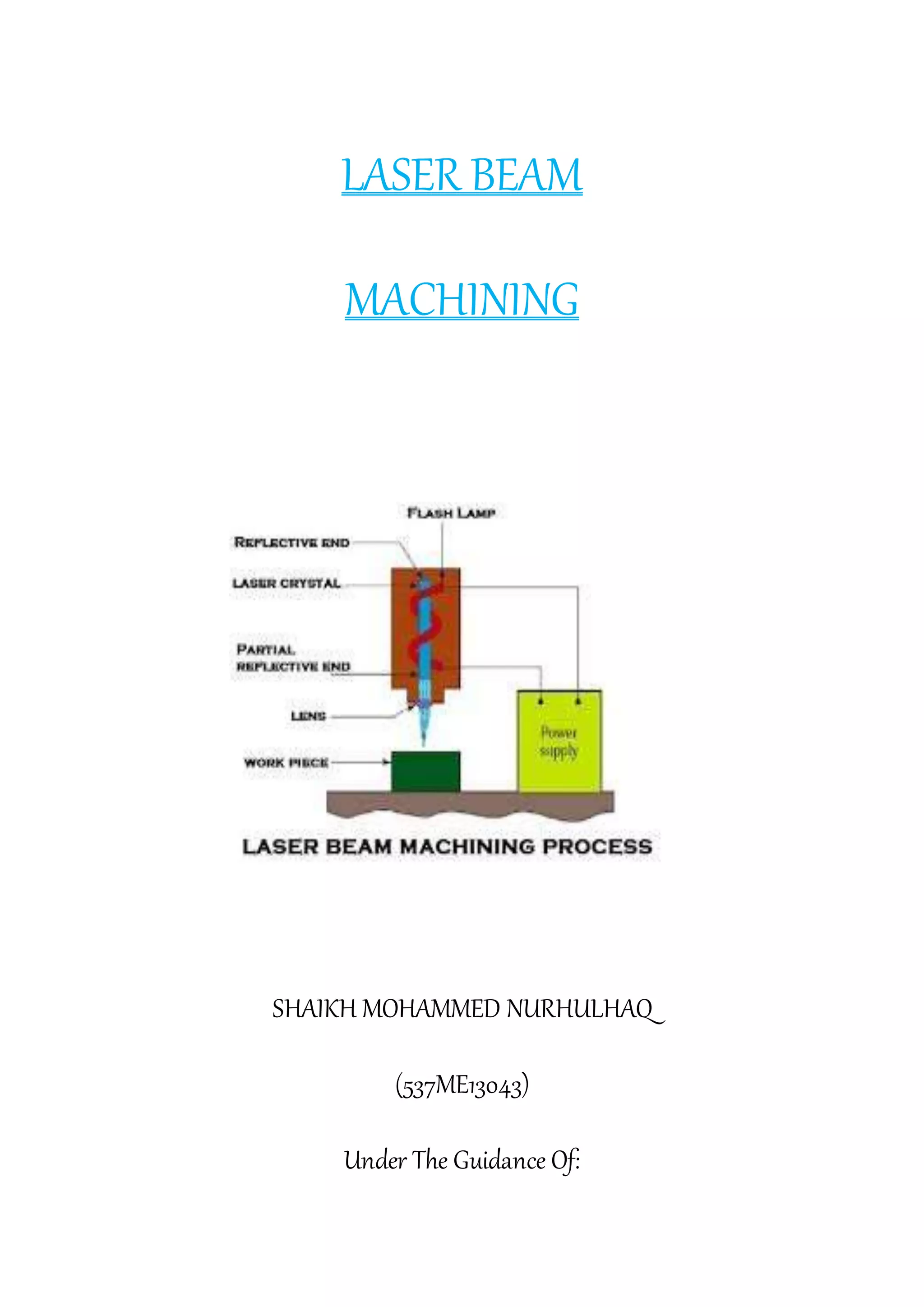
LASER BEAM
MACHINING
SHAIKH MOHAMMED NURHULHAQ
(537ME13043)
Under The Guidance Of:
Shri. CHANNABASAVA Sir
CONTENTS
 Abstract
 Laser Beam Machining
 Laser
 Types of Laser
 Laser Application
 Parameters Affecting LBM
 Advantages
 Dis-Advantages
 Conclusion
 Reference
Abstract
An overview is given of the state of the art of laser beam machining in general
with special emphasis on application of short and ultra short laser. In Laser
welding the trend is to apply optical sensor for process control
Laser surface treatment is mostly used to apply corrosion and wear resistant
layers, but also for repair of engine and machine parts.
In micro-machining, shorter pulse reduce heat affected damage of material
and opens new ways for nanometer accuracy.
Even 40years after the development of the development of the laser there is a
lot of effort in developing new and better performing lasers.
What is Laser
 LASER is the acronym for Light Amplified Stimulated Emission of Radiation
 Laser is a device which generates or amplifies light
 Stimulated emission of electromagnetic radiation
 Coherent, monochromatic, directional and high power laser beam is used
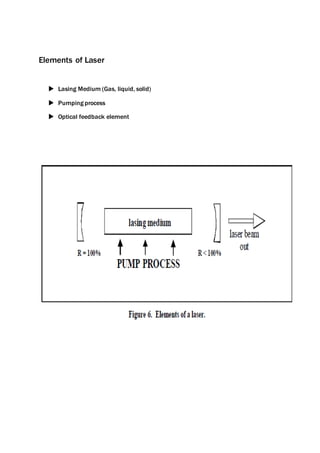
Elements of Laser
 Lasing Medium (Gas, liquid, solid)
 Pumping process
 Optical feedback element
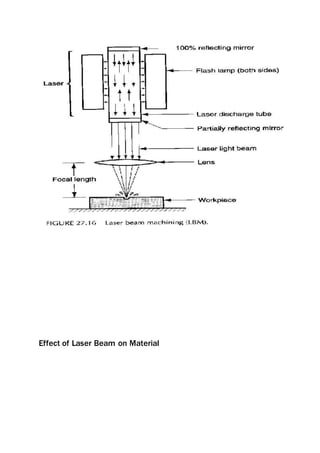
Laser Beam Machining
 Used light energy from a laser to remove material by vaporization and ablation
 Energy is concentrated optically
 Laser emits either continuous or pulsed light beam
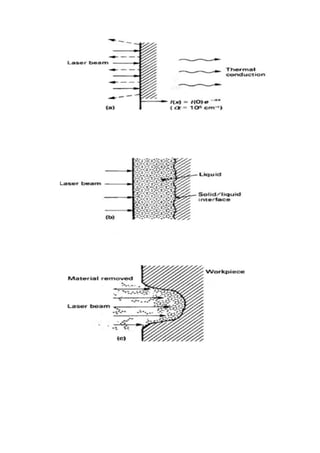
Effect of Laser Beam on Material
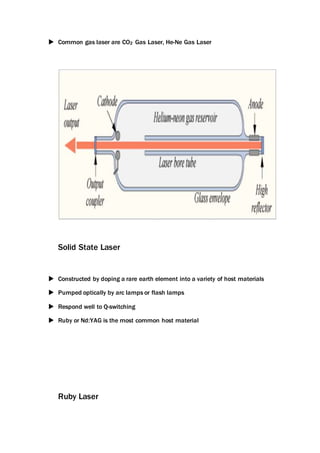
Gas Laser
 Electric current is discharged through a gas to produce a coherent light
 Operate on the principle of converting electric energy into laser light output
 Gas acts as pumping medium to attain the necessary population inversion
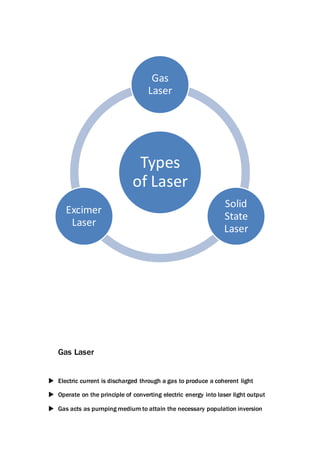
Types
of Laser
Gas
Laser
Solid
State
Laser
Excimer
Laser
 Common gas laser are CO2 Gas Laser, He-Ne Gas Laser
Solid State Laser
 Constructed by doping a rare earth element into a variety of host materials
 Pumped optically by arc lamps or flash lamps
 Respond well to Q-switching
 Ruby or Nd:YAG is the most common host material
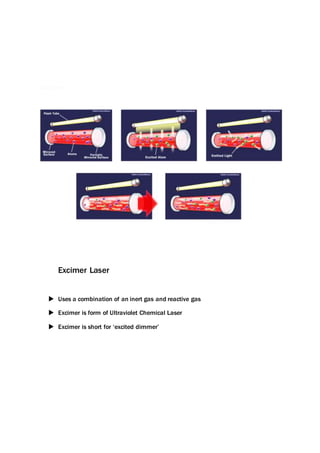
Ruby Laser
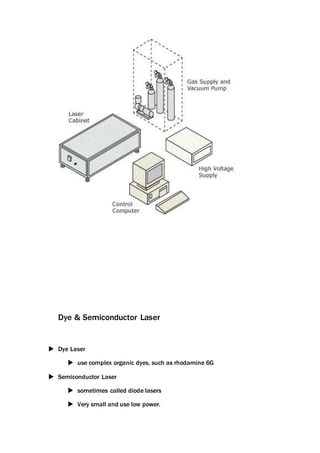
Excimer Laser
 Uses a combination of an inert gas and reactive gas
 Excimer is form of Ultraviolet Chemical Laser
 Excimer is short for ‘excited dimmer’
Dye & Semiconductor Laser
 Dye Laser
 use complex organic dyes, such as rhodamine 6G
 Semiconductor Laser
 sometimes called diode lasers
 Very small and use low power.
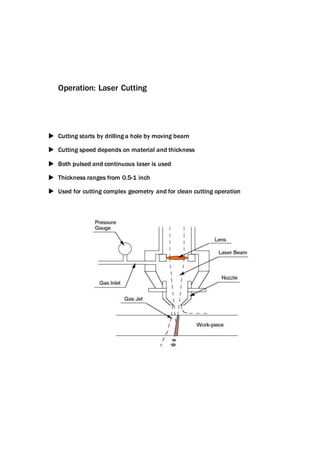
Operation: Laser Cutting
 Cutting starts by drilling a hole by moving beam
 Cutting speed depends on material and thickness
 Both pulsed and continuous laser is used
 Thickness ranges from 0.5-1 inch
 Used for cutting complex geometry and for clean cutting operation
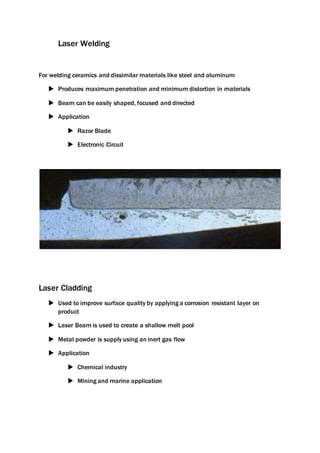
Laser Welding
For welding ceramics and dissimilar materials like steel and aluminum
 Produces maximum penetration and minimum distortion in materials
 Beam can be easily shaped, focused and directed
 Application
 Razor Blade
 Electronic Circuit
Laser Cladding
 Used to improve surface quality by applying a corrosion resistant layer on
product
 Laser Beam is used to create a shallow melt pool
 Metal powder is supply using an inert gas flow
 Application
 Chemical industry
 Mining and marine application
Laser Application
Heavy
Manufacturing
Seam & spot
welding
Cladding &
drilling
Light
Manufacturing
Engraving
Drilling
Electronics
Skiving of
circuits
Wire
stripping
Medical
Cosmetic
Surgery
Hair removal
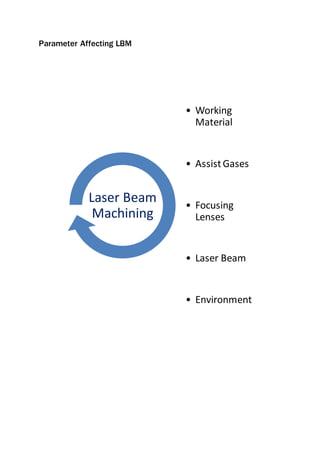
Parameter Affecting LBM
• Working
Material
• AssistGases
• Focusing
Lenses
• Laser Beam
• Environment
Laser Beam
Machining
Advantages
 Non Contact
 No solvent chemical
 Selective material removal
 Flexibility
 Fully automated
Disadvantages
 Requires specially trained operators
 Not for mass metal removal processes
 Requires greater control of joint tolerances
 Expensive equipment
 Consumes much energy
Conclusion
 When optimal focus positioning is centred in the work piece, there is
an optimal interaction between the number of required scans, the
diameteron the LASER beam input as well as on the output side,
and the associatedflank angle. The further off-centredthe focus
positionis, the more scans are required for a full cut. The diameter
on the LASER beam output side wanes, the deeper the focus is
positionedin the work piece
 The optimal feed rate obtained after conducting various experiment, amount to
8mm/s. This results in a pulse overlap of 97.7%. Even if higher pulse overlap
values reduce the required number of scans, they are not usable.
 By analyzing the influence of the pulse overlap to the diameter on the LASER
beam output as well as on the input side, there was no dependency discovered.
 The investigating of the track overlap found that the best values for the track
overlap amount to 14.3%.
 To enlarge the kerf width the number of tracks need to be increased. The more
nested circles into each other, the less number of scans required. However, it is
essential here to take into account the increasing required manufacturing time.
The optimal value of concentric circles is two. More than two circles are not an
efficient operation.
 If a closed configuration on the LASER beam output side is required only low
wobbing frequencies are usable
References
 http://www.google.com
 http://www.sciencedirect.com
 http://en.wikipedia.org/wiki/laser_cutting
 http://www.gobookee.org/powerpoint-of-laser-beam-machining/
 Laser beam machining (LBM), state of the art and new opportunities/Johan
Meijer
 http://science.howstuffworks.com/laser.htm
THANK YOU

Laser beam machining

  • 1.
    LASER BEAM MACHINING SHAIKH MOHAMMEDNURHULHAQ (537ME13043) Under The Guidance Of:
  • 2.
    Shri. CHANNABASAVA Sir CONTENTS Abstract  Laser Beam Machining  Laser  Types of Laser  Laser Application  Parameters Affecting LBM  Advantages  Dis-Advantages  Conclusion  Reference
  • 3.
    Abstract An overview isgiven of the state of the art of laser beam machining in general with special emphasis on application of short and ultra short laser. In Laser welding the trend is to apply optical sensor for process control Laser surface treatment is mostly used to apply corrosion and wear resistant layers, but also for repair of engine and machine parts. In micro-machining, shorter pulse reduce heat affected damage of material and opens new ways for nanometer accuracy. Even 40years after the development of the development of the laser there is a lot of effort in developing new and better performing lasers. What is Laser  LASER is the acronym for Light Amplified Stimulated Emission of Radiation  Laser is a device which generates or amplifies light  Stimulated emission of electromagnetic radiation  Coherent, monochromatic, directional and high power laser beam is used
  • 4.
    Elements of Laser Lasing Medium (Gas, liquid, solid)  Pumping process  Optical feedback element
  • 5.
    Laser Beam Machining Used light energy from a laser to remove material by vaporization and ablation  Energy is concentrated optically  Laser emits either continuous or pulsed light beam
  • 6.
    Effect of LaserBeam on Material
  • 8.
    Gas Laser  Electriccurrent is discharged through a gas to produce a coherent light  Operate on the principle of converting electric energy into laser light output  Gas acts as pumping medium to attain the necessary population inversion Types of Laser Gas Laser Solid State Laser Excimer Laser
  • 9.
     Common gaslaser are CO2 Gas Laser, He-Ne Gas Laser Solid State Laser  Constructed by doping a rare earth element into a variety of host materials  Pumped optically by arc lamps or flash lamps  Respond well to Q-switching  Ruby or Nd:YAG is the most common host material Ruby Laser
  • 10.
    Excimer Laser  Usesa combination of an inert gas and reactive gas  Excimer is form of Ultraviolet Chemical Laser  Excimer is short for ‘excited dimmer’
  • 11.
    Dye & SemiconductorLaser  Dye Laser  use complex organic dyes, such as rhodamine 6G  Semiconductor Laser  sometimes called diode lasers  Very small and use low power.
  • 12.
    Operation: Laser Cutting Cutting starts by drilling a hole by moving beam  Cutting speed depends on material and thickness  Both pulsed and continuous laser is used  Thickness ranges from 0.5-1 inch  Used for cutting complex geometry and for clean cutting operation
  • 13.
    Laser Welding For weldingceramics and dissimilar materials like steel and aluminum  Produces maximum penetration and minimum distortion in materials  Beam can be easily shaped, focused and directed  Application  Razor Blade  Electronic Circuit Laser Cladding  Used to improve surface quality by applying a corrosion resistant layer on product  Laser Beam is used to create a shallow melt pool  Metal powder is supply using an inert gas flow  Application  Chemical industry  Mining and marine application
  • 14.
    Laser Application Heavy Manufacturing Seam &spot welding Cladding & drilling Light Manufacturing Engraving Drilling Electronics Skiving of circuits Wire stripping Medical Cosmetic Surgery Hair removal
  • 15.
    Parameter Affecting LBM •Working Material • AssistGases • Focusing Lenses • Laser Beam • Environment Laser Beam Machining
  • 16.
    Advantages  Non Contact No solvent chemical  Selective material removal  Flexibility  Fully automated Disadvantages  Requires specially trained operators  Not for mass metal removal processes  Requires greater control of joint tolerances  Expensive equipment  Consumes much energy
  • 17.
    Conclusion  When optimalfocus positioning is centred in the work piece, there is an optimal interaction between the number of required scans, the diameteron the LASER beam input as well as on the output side, and the associatedflank angle. The further off-centredthe focus positionis, the more scans are required for a full cut. The diameter on the LASER beam output side wanes, the deeper the focus is positionedin the work piece  The optimal feed rate obtained after conducting various experiment, amount to 8mm/s. This results in a pulse overlap of 97.7%. Even if higher pulse overlap values reduce the required number of scans, they are not usable.  By analyzing the influence of the pulse overlap to the diameter on the LASER beam output as well as on the input side, there was no dependency discovered.  The investigating of the track overlap found that the best values for the track overlap amount to 14.3%.  To enlarge the kerf width the number of tracks need to be increased. The more nested circles into each other, the less number of scans required. However, it is essential here to take into account the increasing required manufacturing time. The optimal value of concentric circles is two. More than two circles are not an efficient operation.  If a closed configuration on the LASER beam output side is required only low wobbing frequencies are usable
  • 18.
    References  http://www.google.com  http://www.sciencedirect.com http://en.wikipedia.org/wiki/laser_cutting  http://www.gobookee.org/powerpoint-of-laser-beam-machining/  Laser beam machining (LBM), state of the art and new opportunities/Johan Meijer  http://science.howstuffworks.com/laser.htm
  • 19.