Department of Mechanical Engineering
Unit: 02
By A Nirala
Wire Drawing Process
Akhileshwar Nirala, GCET, Greater Noida
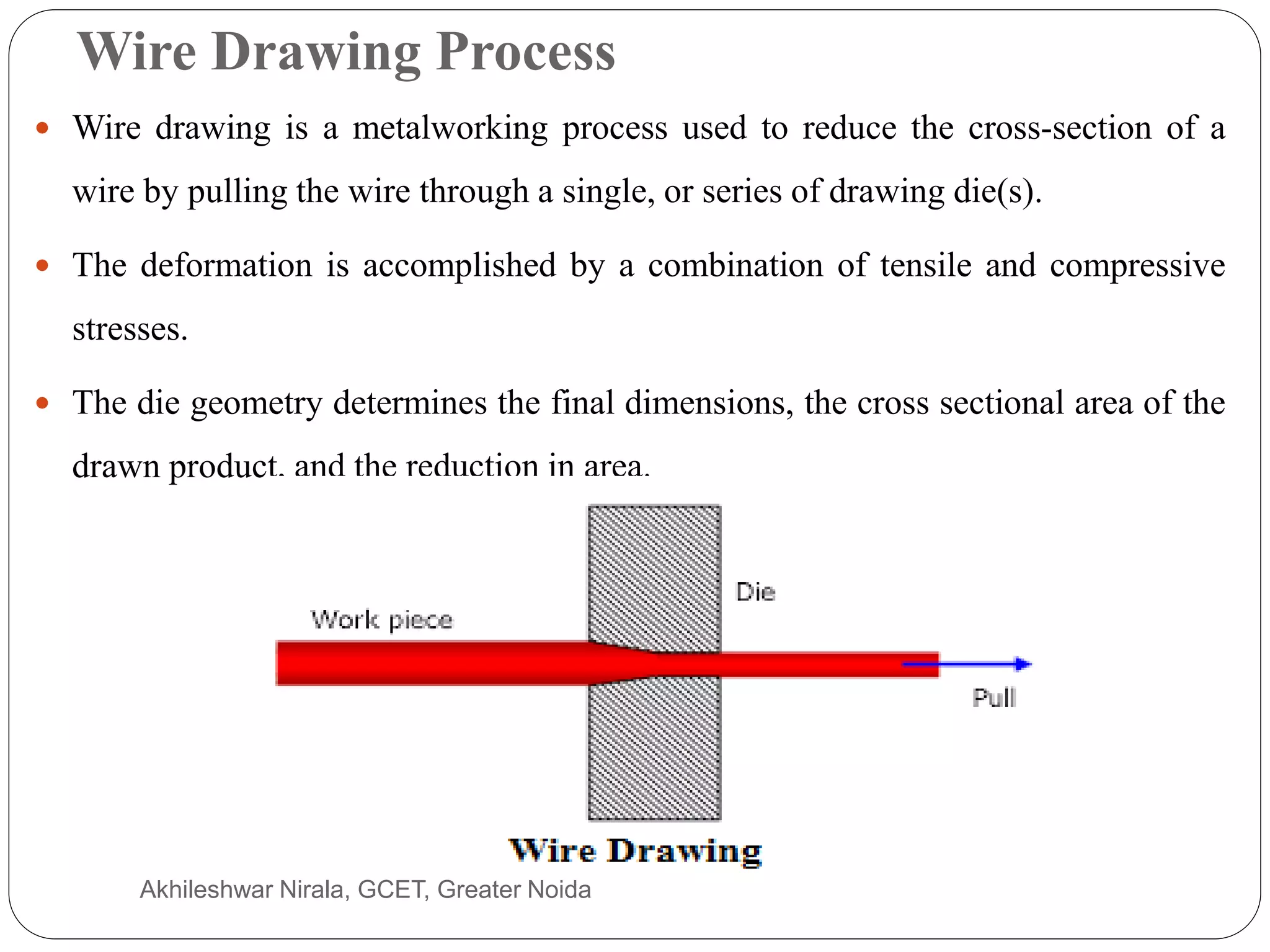
 Wire drawing is a metalworking process used to reduce the cross-section of a
wire by pulling the wire through a single, or series of drawing die(s).
 The deformation is accomplished by a combination of tensile and compressive
stresses.
 The die geometry determines the final dimensions, the cross sectional area of the
drawn product, and the reduction in area.
Deformation in Wire Drawing
Akhileshwar Nirala, GCET, Greater Noida
 The deformation is accomplished by a combination of tensile and compressive
stresses.
 The tensile force is created by the pulling at the exit end and compressive force
is arises from the reaction of the metal with the die in deformation zone.
Forces acting in wire drawing
Akhileshwar Nirala, GCET, Greater Noida
 Drawing force, F, represents the total force that must be applied at the die exit to
overcome friction at the die-work interface and resistance of the deforming
material.
Process Parameters
Akhileshwar Nirala, GCET, Greater Noida
The major processing variables in drawing are
 Reduction in cross-sectional area
 Die angle
 Friction between the die-work-piece interface
 drawing speed.
 Temperature
Analysis of wire drawing
Akhileshwar Nirala, GCET, Greater Noida
Assumptions:-
 A uniform state of stress is assumed to exist at all points in a plane normal to the
die axis
 A cylindrical state of stress is assumed to exist within the contact zone. The
principle stresses are σx and –p
 Coulomb`s law of friction is assumed to exists within the contact zone
 The coefficient of friction µ is assumed to be constant for the die and wire,
Material, and also for the given surface conditions.
Calculation of Drawing
stress
acting on an element in
Akhileshwar Nirala, GCET, Greater Noida
[1] Strip Drawing
[2] Wire Drawing
[3] Tube Drawing
[1] Strip Drawing
Akhileshwar Nirala, GCET, Greater Noida
 Strip drawing is a process of drawing in which, metal of large thickness gets
reduced in thickness and increase in length through a converging die.
[2] wire drawing
Akhileshwar Nirala, GCET, Greater Noida
continue…….
Akhileshwar Nirala, GCET, Greater Noida
+
continue…….
Akhileshwar Nirala, GCET, Greater Noida
σx
continue…….
Akhileshwar Nirala, GCET, Greater Noida
(3)
continue…….
Akhileshwar Nirala, GCET, Greater Noida
Extrusion Process
Akhileshwar Nirala, GCET, Greater Noida
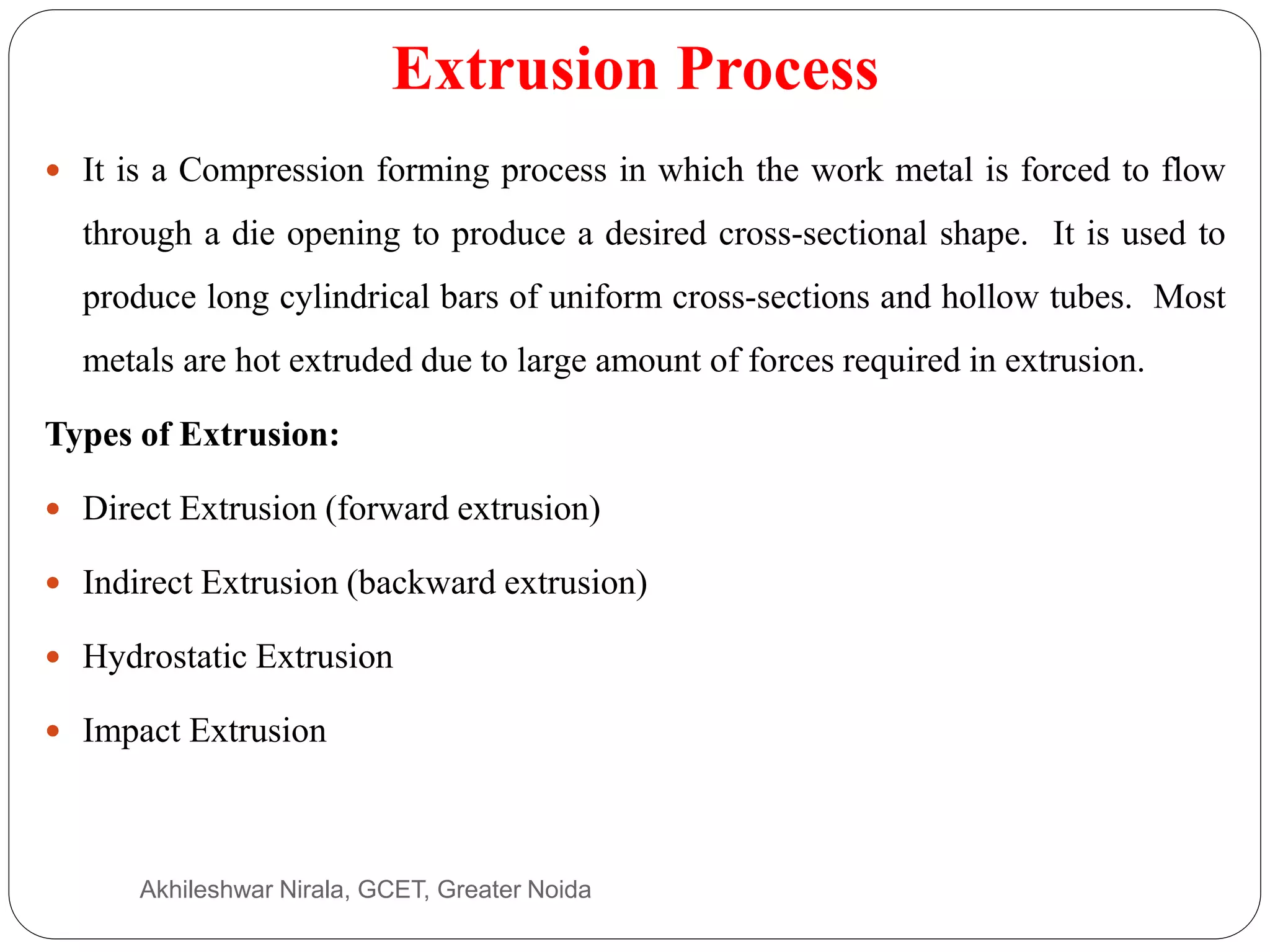
 It is a Compression forming process in which the work metal is forced to flow
through a die opening to produce a desired cross-sectional shape. It is used to
produce long cylindrical bars of uniform cross-sections and hollow tubes. Most
metals are hot extruded due to large amount of forces required in extrusion.
Types of Extrusion:
 Direct Extrusion (forward extrusion)
 Indirect Extrusion (backward extrusion)
 Hydrostatic Extrusion
 Impact Extrusion
Akhileshwar Nirala, GCET, Greater Noida
 Direct Extrusion: Direct extrusion, also called forward extrusion, is a
process in which is the billet moves along the same direction as the ram and
punch do. Because of sliding of billet against the container wall, friction
between the container and billet is high. As a result, greater forces are required.
 Direct extrusion can be used for extruding solid circular or non-circular sections,
hollow sections such as tubes or cups by providing mandrel with ram.
Akhileshwar Nirala, GCET, Greater Noida
 Indirect Extrusion: Indirect extrusion (backward extrusion) is a
process in which punch moves opposite to that of the billet. Here there is no
relative motion between container and billet. Hence, there is less friction and
hence reduced forces are required for indirect extrusion.
Akhileshwar Nirala, GCET, Greater Noida
 Hydrostatic Extrusion: In hydrostatic extrusion the container is filled with
a fluid. Extrusion pressure is transmitted through the fluid to the billet. Friction is
eliminated in this process because of there is no contact between billet and
container wall.
 Greater reductions are possible by this method.
 Pressure involved in the process may be as high as 1700 MPa.
 Pressure is limited by the strength of the container, punch and die materials.
 Vegetable oils such as castor oil are used.
Akhileshwar Nirala, GCET, Greater Noida
 Impact Extrusion: Impact extrusion is a discrete manufacturing process, in
which a metal part is extruded through the impact of a die with the work stock.
The part is formed at a high speed and over a relatively short stroke.
 In standard metal extrusions, the force to extrude the work is commonly
delivered by way of a hydraulic press.
Extrusion Calculation
Akhileshwar Nirala, GCET, Greater Noida
[1] Wire Extrusion
[2] Strip Extrusion
Analysis of wire extrusion
Akhileshwar Nirala, GCET, Greater Noida
Assumptions:-
 A uniform state of stress is assumed to exist at all points in a plane normal to
the die axis
 A cylindrical state of stress is assumed to exist within the contact zone. The
principle stresses are σx and –p
 Coulomb`s law of friction is assumed to exists within the contact zone
 The coefficient of friction M is assumed to be constant for the die and wire,
Material, and also for the given surface conditions.
[1] Wire Extrusion
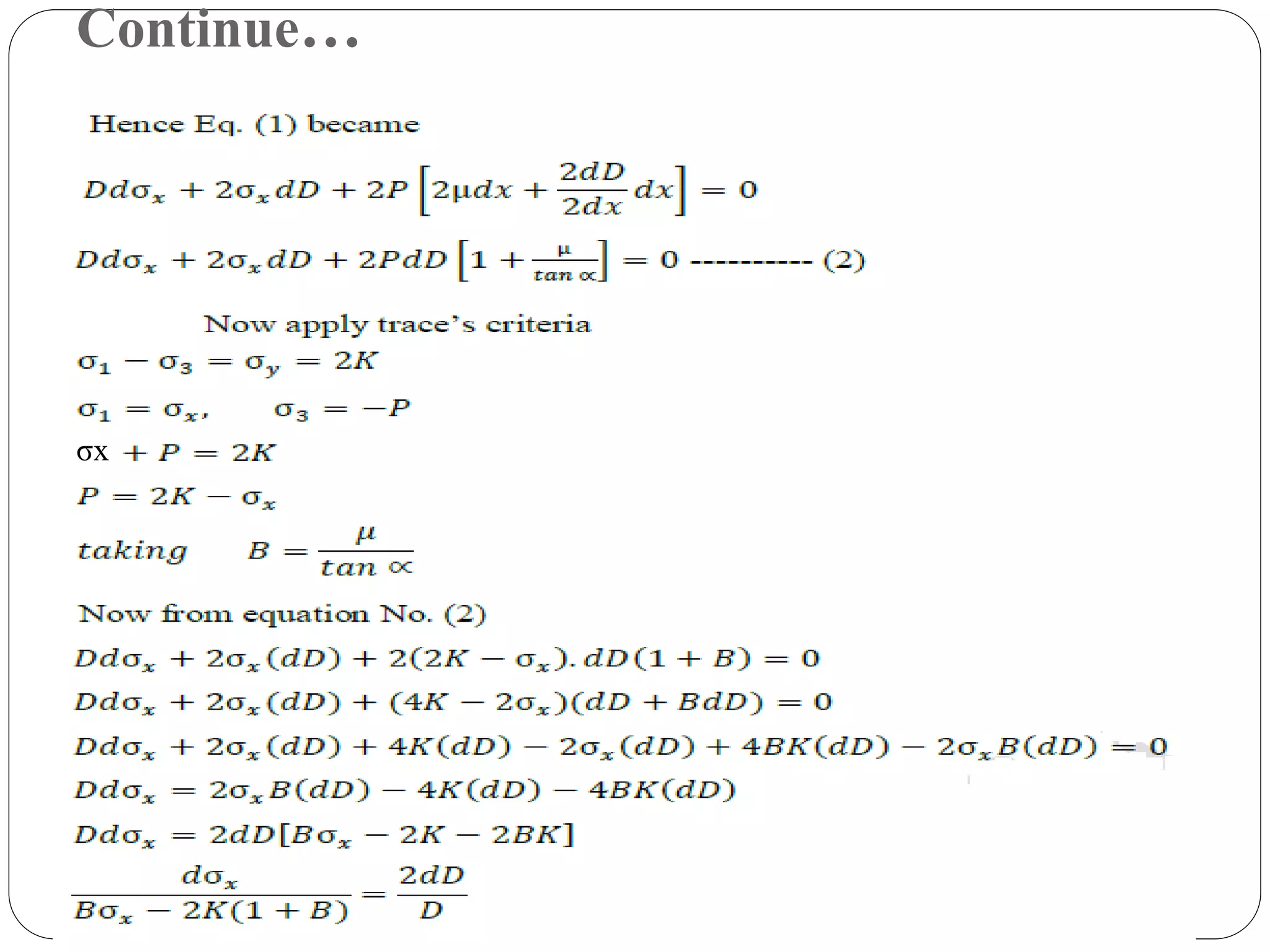
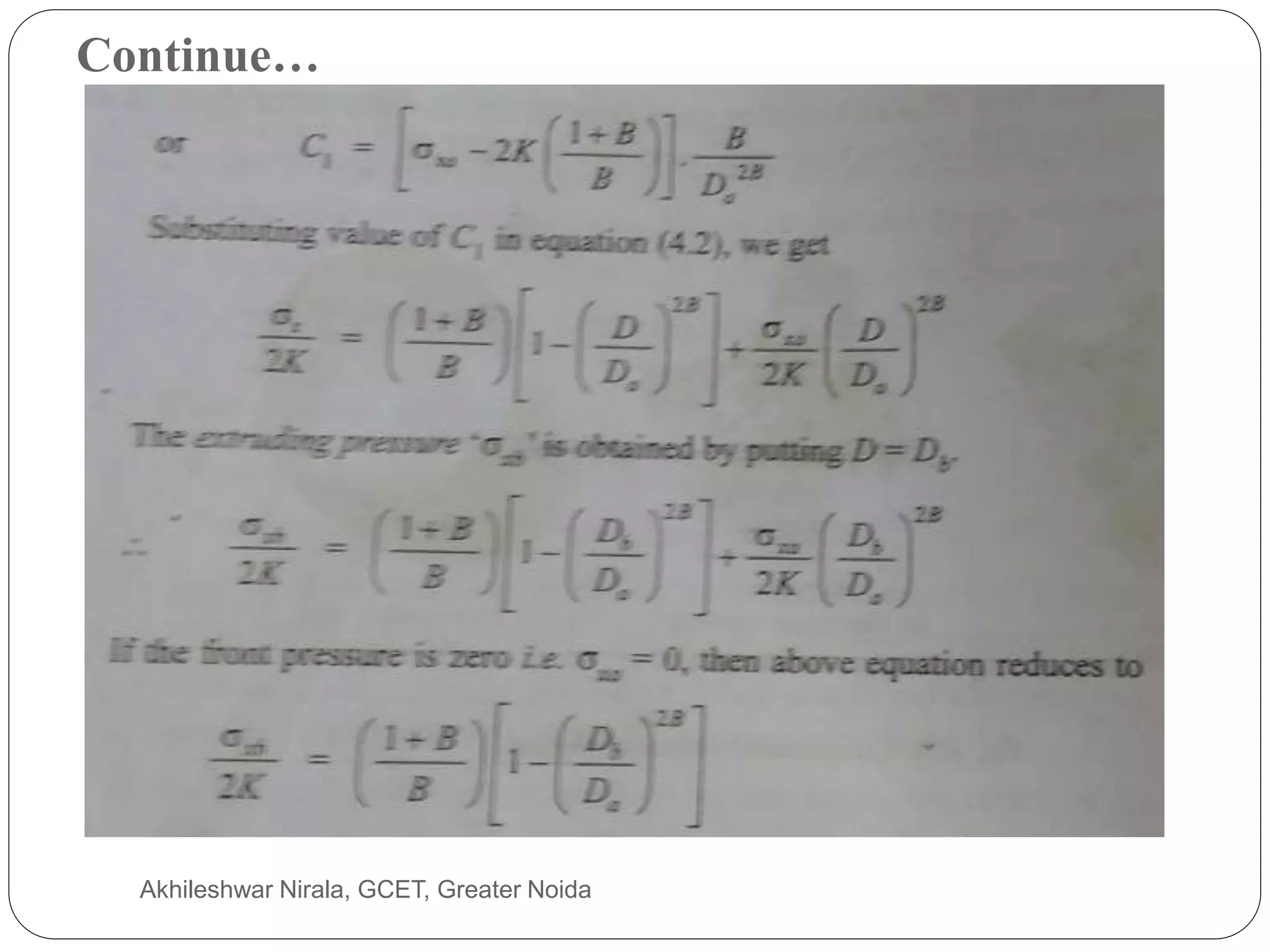
Continue…
Akhileshwar Nirala, GCET, Greater Noida
Continue….
Akhileshwar Nirala, GCET, Greater Noida
Continue…
Akhileshwar Nirala, GCET, Greater Noida
σx
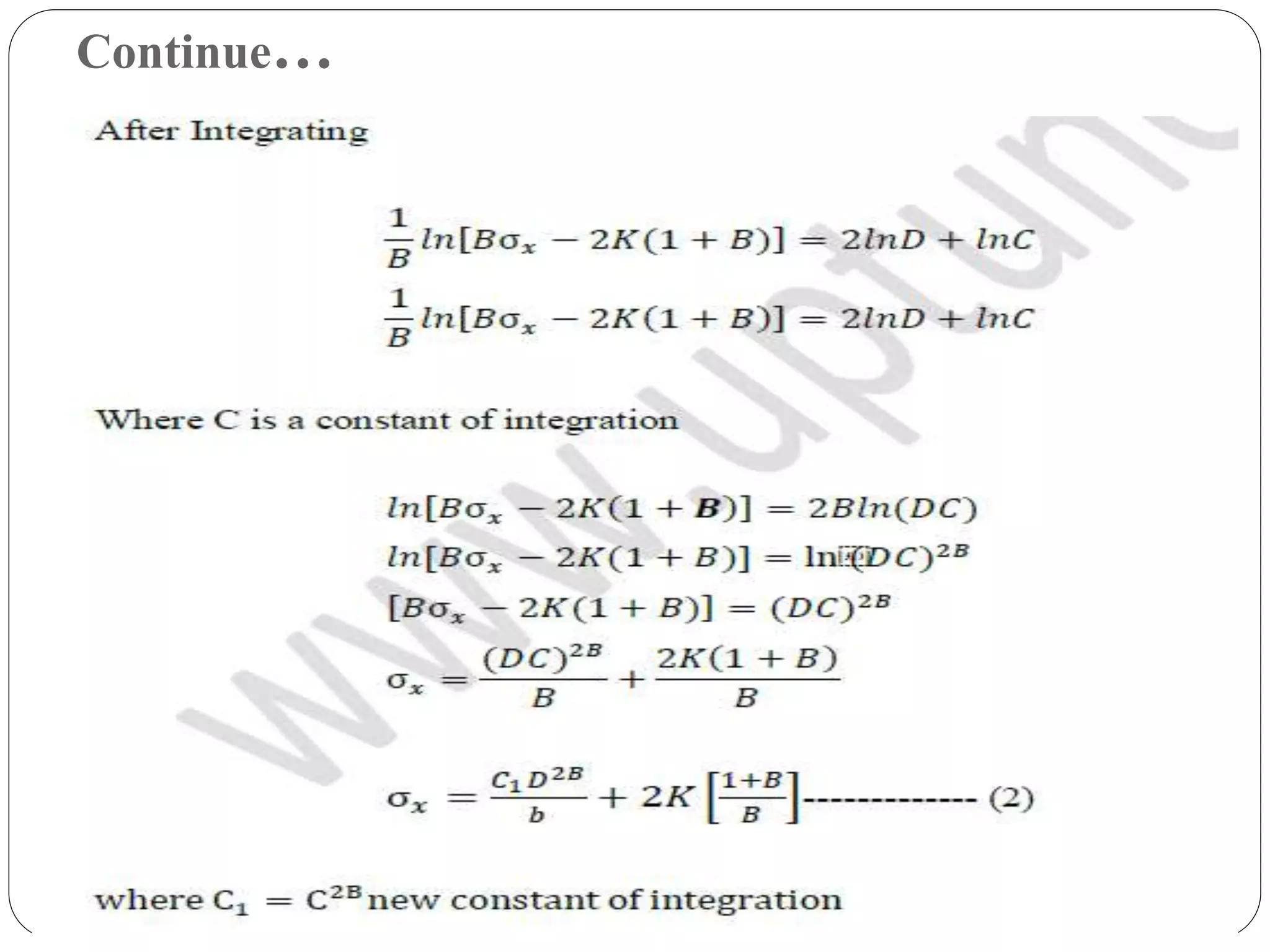
Continue…
Akhileshwar Nirala, GCET, Greater Noida
Continue…
Akhileshwar Nirala, GCET, Greater Noida
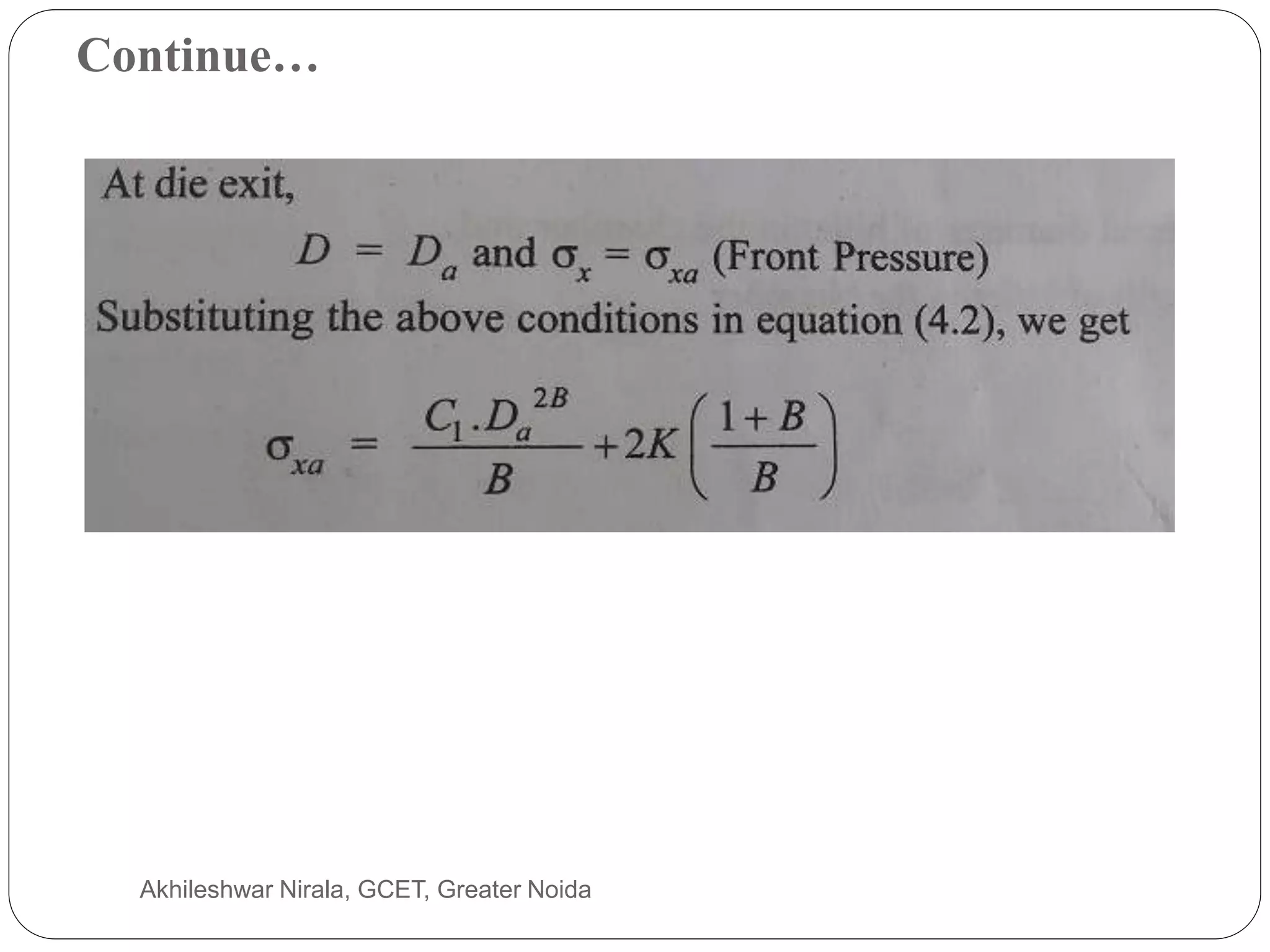
Continue…
Akhileshwar Nirala, GCET, Greater Noida
[2] Strip Extrusion
Akhileshwar Nirala, GCET, Greater Noida
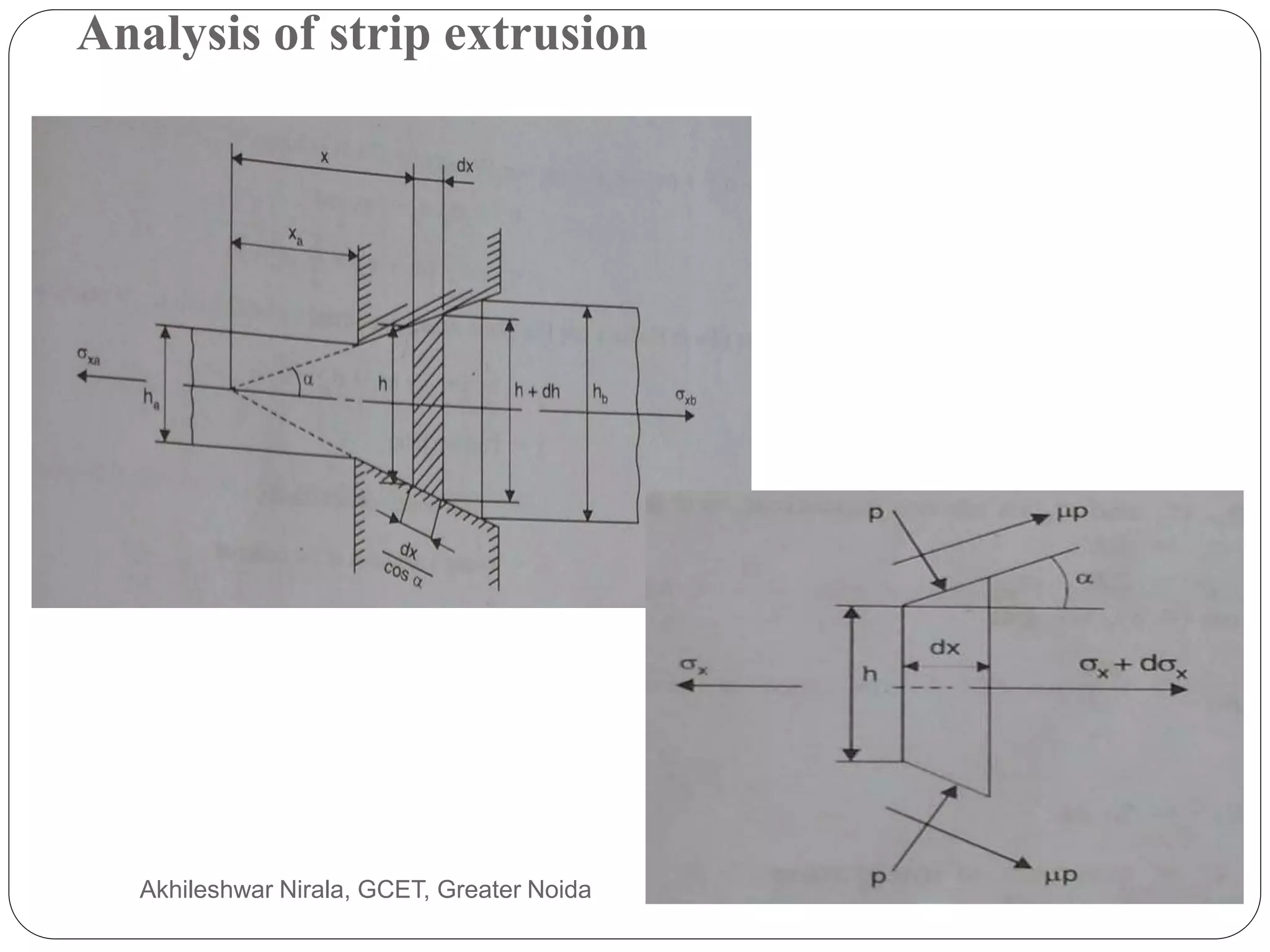
 Strip extrusion is a process in which, metal of large thickness gets reduced
in thickness and increase in length through a converging die.
Analysis of strip extrusion
Akhileshwar Nirala, GCET, Greater Noida
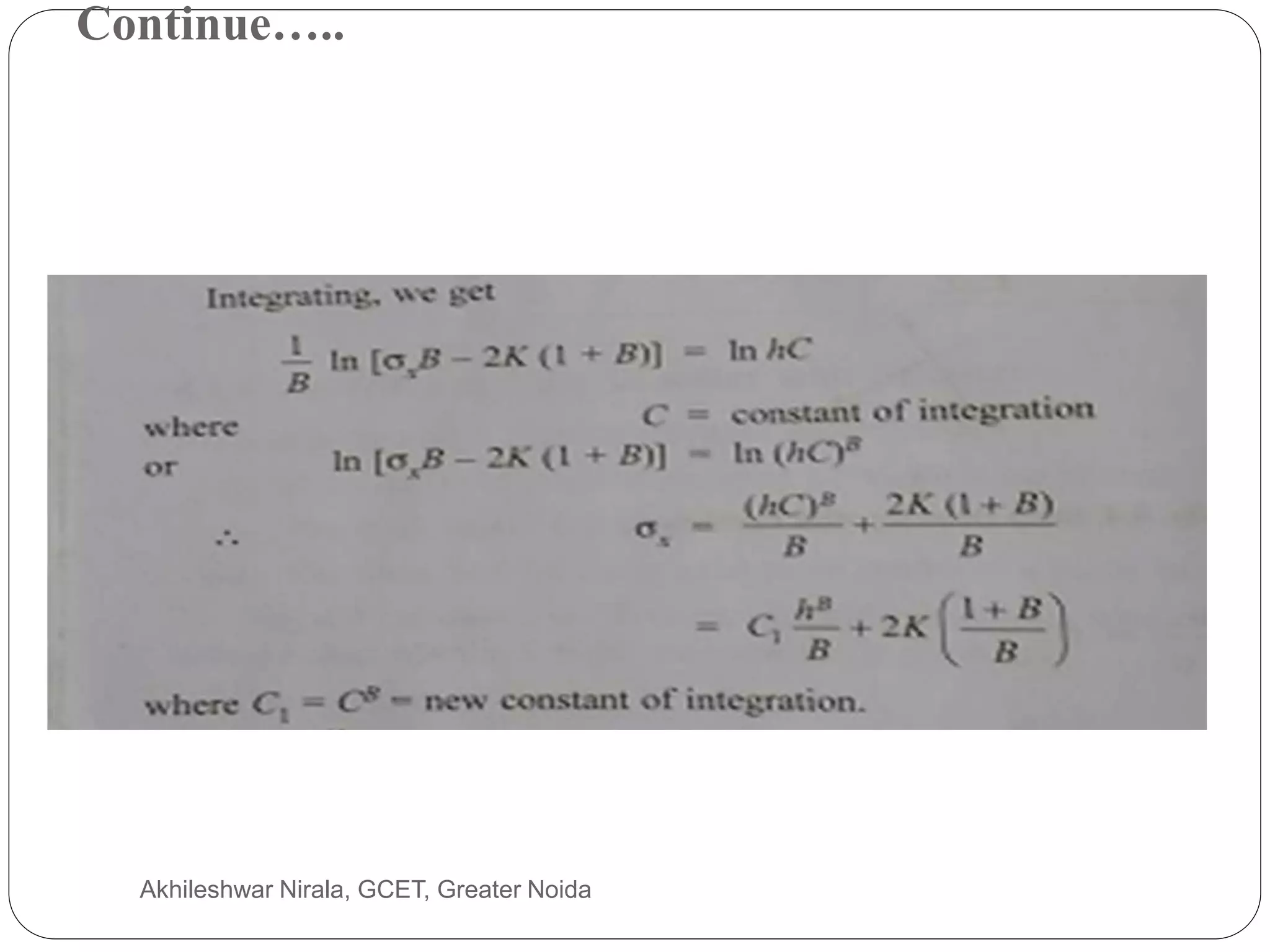
Continue…..
Akhileshwar Nirala, GCET, Greater Noida
 The stresses acting on volume element of unit width are shown in figure.
Continue…..
Akhileshwar Nirala, GCET, Greater Noida
Continue…..
Akhileshwar Nirala, GCET, Greater Noida
Continue…..
Akhileshwar Nirala, GCET, Greater Noida
Continue…..
Akhileshwar Nirala, GCET, Greater Noida
Forming
Akhileshwar Nirala, GCET, Greater Noida
Metal forming processes are characteristic of high pressures
between two contacting surfaces. In hot forming operations, these
high pressures are accompanied by extreme temperatures. Friction
and die wear are a serious consideration in metal forming
manufacturing. A certain amount of friction will be necessary for
some metal forming processes, but excessive friction is always
undesirable. Friction increases the amount of force required to
perform an operation, causes wear on tooling, and can affect metal
flow, creating defects in the work.
Where friction is involved, lubricants can usually help. For some
metal forming processes and materials no lubrication is used, but for
many lubrication is applied to contacting surfaces to reduce friction
forces. Lubricants used in industry are different depending upon the
type of metal forming process, the temperature at which the
operation occurs, and the type of material formed. Lubricants should
be effective and not produce any toxic fumes. Lubricants used in
manufacturing industry for metal forming processes include,
vegetable and mineral oils, soaps, graphite dispensed in grease,

Drawing and Extrusion

  • 1.
    Department of MechanicalEngineering Unit: 02 By A Nirala
  • 2.
    Wire Drawing Process AkhileshwarNirala, GCET, Greater Noida  Wire drawing is a metalworking process used to reduce the cross-section of a wire by pulling the wire through a single, or series of drawing die(s).  The deformation is accomplished by a combination of tensile and compressive stresses.  The die geometry determines the final dimensions, the cross sectional area of the drawn product, and the reduction in area.
  • 3.
    Deformation in WireDrawing Akhileshwar Nirala, GCET, Greater Noida  The deformation is accomplished by a combination of tensile and compressive stresses.  The tensile force is created by the pulling at the exit end and compressive force is arises from the reaction of the metal with the die in deformation zone.
  • 4.
    Forces acting inwire drawing Akhileshwar Nirala, GCET, Greater Noida  Drawing force, F, represents the total force that must be applied at the die exit to overcome friction at the die-work interface and resistance of the deforming material.
  • 5.
    Process Parameters Akhileshwar Nirala,GCET, Greater Noida The major processing variables in drawing are  Reduction in cross-sectional area  Die angle  Friction between the die-work-piece interface  drawing speed.  Temperature
  • 6.
    Analysis of wiredrawing Akhileshwar Nirala, GCET, Greater Noida Assumptions:-  A uniform state of stress is assumed to exist at all points in a plane normal to the die axis  A cylindrical state of stress is assumed to exist within the contact zone. The principle stresses are σx and –p  Coulomb`s law of friction is assumed to exists within the contact zone  The coefficient of friction µ is assumed to be constant for the die and wire, Material, and also for the given surface conditions.
  • 7.
    Calculation of Drawing stress actingon an element in Akhileshwar Nirala, GCET, Greater Noida [1] Strip Drawing [2] Wire Drawing [3] Tube Drawing
  • 8.
    [1] Strip Drawing AkhileshwarNirala, GCET, Greater Noida  Strip drawing is a process of drawing in which, metal of large thickness gets reduced in thickness and increase in length through a converging die.
  • 9.
    [2] wire drawing AkhileshwarNirala, GCET, Greater Noida
  • 10.
  • 11.
  • 12.
  • 13.
  • 14.
    Extrusion Process Akhileshwar Nirala,GCET, Greater Noida  It is a Compression forming process in which the work metal is forced to flow through a die opening to produce a desired cross-sectional shape. It is used to produce long cylindrical bars of uniform cross-sections and hollow tubes. Most metals are hot extruded due to large amount of forces required in extrusion. Types of Extrusion:  Direct Extrusion (forward extrusion)  Indirect Extrusion (backward extrusion)  Hydrostatic Extrusion  Impact Extrusion
  • 15.
    Akhileshwar Nirala, GCET,Greater Noida  Direct Extrusion: Direct extrusion, also called forward extrusion, is a process in which is the billet moves along the same direction as the ram and punch do. Because of sliding of billet against the container wall, friction between the container and billet is high. As a result, greater forces are required.  Direct extrusion can be used for extruding solid circular or non-circular sections, hollow sections such as tubes or cups by providing mandrel with ram.
  • 16.
    Akhileshwar Nirala, GCET,Greater Noida  Indirect Extrusion: Indirect extrusion (backward extrusion) is a process in which punch moves opposite to that of the billet. Here there is no relative motion between container and billet. Hence, there is less friction and hence reduced forces are required for indirect extrusion.
  • 17.
    Akhileshwar Nirala, GCET,Greater Noida  Hydrostatic Extrusion: In hydrostatic extrusion the container is filled with a fluid. Extrusion pressure is transmitted through the fluid to the billet. Friction is eliminated in this process because of there is no contact between billet and container wall.  Greater reductions are possible by this method.  Pressure involved in the process may be as high as 1700 MPa.  Pressure is limited by the strength of the container, punch and die materials.  Vegetable oils such as castor oil are used.
  • 18.
    Akhileshwar Nirala, GCET,Greater Noida  Impact Extrusion: Impact extrusion is a discrete manufacturing process, in which a metal part is extruded through the impact of a die with the work stock. The part is formed at a high speed and over a relatively short stroke.  In standard metal extrusions, the force to extrude the work is commonly delivered by way of a hydraulic press.
  • 19.
    Extrusion Calculation Akhileshwar Nirala,GCET, Greater Noida [1] Wire Extrusion [2] Strip Extrusion
  • 20.
    Analysis of wireextrusion Akhileshwar Nirala, GCET, Greater Noida Assumptions:-  A uniform state of stress is assumed to exist at all points in a plane normal to the die axis  A cylindrical state of stress is assumed to exist within the contact zone. The principle stresses are σx and –p  Coulomb`s law of friction is assumed to exists within the contact zone  The coefficient of friction M is assumed to be constant for the die and wire, Material, and also for the given surface conditions. [1] Wire Extrusion
  • 21.
  • 22.
  • 23.
  • 24.
  • 25.
  • 26.
  • 27.
    [2] Strip Extrusion AkhileshwarNirala, GCET, Greater Noida  Strip extrusion is a process in which, metal of large thickness gets reduced in thickness and increase in length through a converging die.
  • 28.
    Analysis of stripextrusion Akhileshwar Nirala, GCET, Greater Noida
  • 29.
    Continue….. Akhileshwar Nirala, GCET,Greater Noida  The stresses acting on volume element of unit width are shown in figure.
  • 30.
  • 31.
  • 32.
  • 33.
  • 34.
    Forming Akhileshwar Nirala, GCET,Greater Noida Metal forming processes are characteristic of high pressures between two contacting surfaces. In hot forming operations, these high pressures are accompanied by extreme temperatures. Friction and die wear are a serious consideration in metal forming manufacturing. A certain amount of friction will be necessary for some metal forming processes, but excessive friction is always undesirable. Friction increases the amount of force required to perform an operation, causes wear on tooling, and can affect metal flow, creating defects in the work. Where friction is involved, lubricants can usually help. For some metal forming processes and materials no lubrication is used, but for many lubrication is applied to contacting surfaces to reduce friction forces. Lubricants used in industry are different depending upon the type of metal forming process, the temperature at which the operation occurs, and the type of material formed. Lubricants should be effective and not produce any toxic fumes. Lubricants used in manufacturing industry for metal forming processes include, vegetable and mineral oils, soaps, graphite dispensed in grease,