By
Amit Sonchhatra (11BM081)
Athar Kothawala (11BM082)
Karan C. Prajapati (11BM083)
Yudhishthir Ramnani (11BM084)
Samiraj Anupam (11BM085)
1
Heat in Metal Cutting
School of Technology
Knowledge Corridor, Raisan, Gandhinagar-
382007,Gujarat
Introduction
2
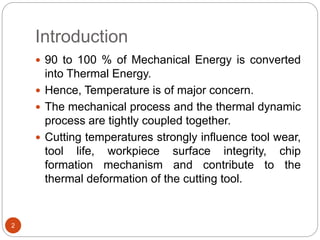
 90 to 100 % of Mechanical Energy is converted
into Thermal Energy.
 Hence, Temperature is of major concern.
 The mechanical process and the thermal dynamic
process are tightly coupled together.
 Cutting temperatures strongly influence tool wear,
tool life, workpiece surface integrity, chip
formation mechanism and contribute to the
thermal deformation of the cutting tool.
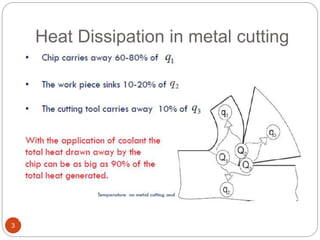
Heat Dissipation in metal cutting
3
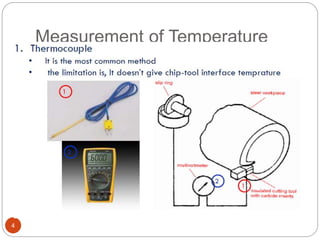
Measurement of Temperature
4
5
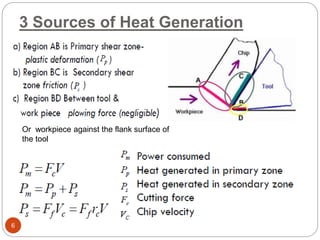
Or workpiece against the flank surface of
the tool
3 Sources of Heat Generation
6
7
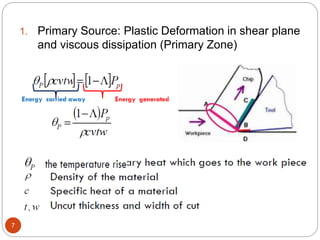
1. Primary Source: Plastic Deformation in shear plane
and viscous dissipation (Primary Zone)
8
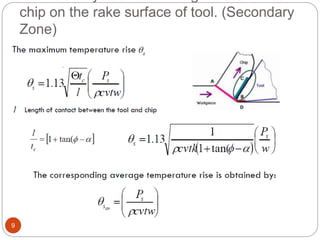
chip on the rake surface of tool. (Secondary
Zone)
9
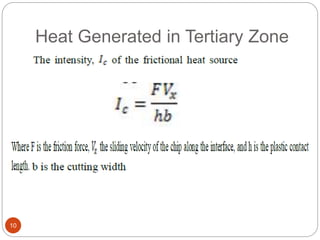
Heat Generated in Tertiary Zone
10
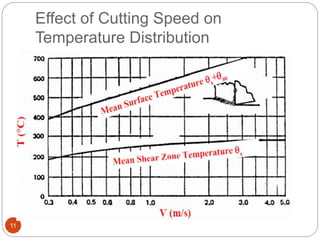
Effect of Cutting Speed on
Temperature Distribution
11
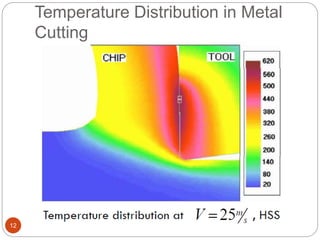
Temperature Distribution in Metal
Cutting
12
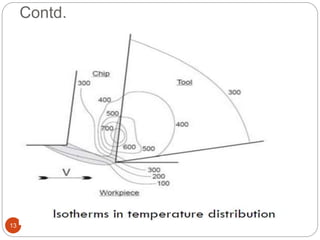
Contd.
13
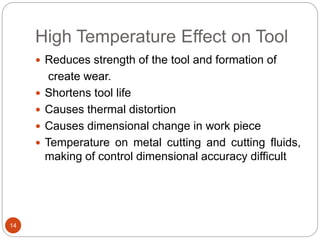
High Temperature Effect on Tool
14
 Reduces strength of the tool and formation of
create wear.
 Shortens tool life
 Causes thermal distortion
 Causes dimensional change in work piece
 Temperature on metal cutting and cutting fluids,
making of control dimensional accuracy difficult
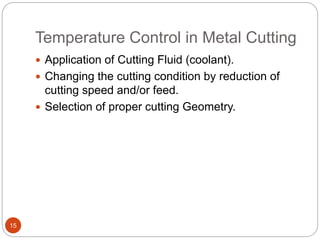
Temperature Control in Metal Cutting
15
 Application of Cutting Fluid (coolant).
 Changing the cutting condition by reduction of
cutting speed and/or feed.
 Selection of proper cutting Geometry.
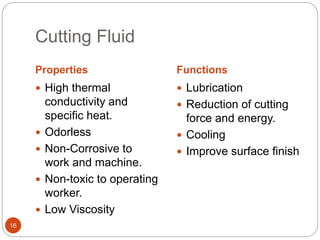
Cutting Fluid
Properties Functions
16
 High thermal
conductivity and
specific heat.
 Odorless
 Non-Corrosive to
work and machine.
 Non-toxic to operating
worker.
 Low Viscosity
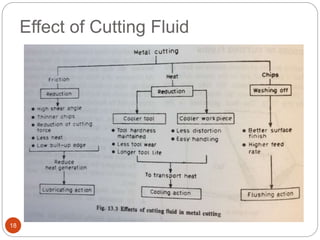
 Lubrication
 Reduction of cutting
force and energy.
 Cooling
 Improve surface finish
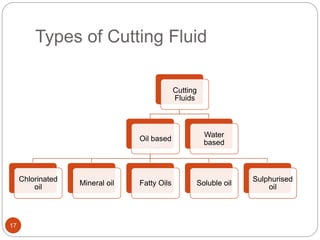
Types of Cutting Fluid
17
Cutting
Fluids
Oil based
Chlorinated
oil
Mineral oil Fatty Oils Soluble oil
Sulphurised
oil
Water
based
Effect of Cutting Fluid
18
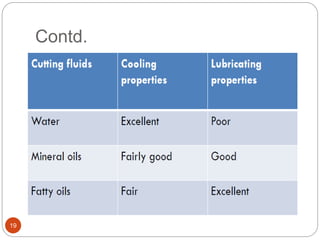
Contd.
19
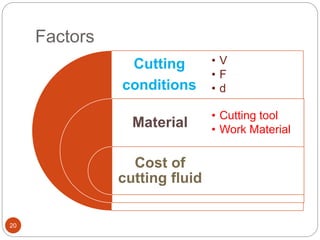
Factors
20
Cutting
conditions
Material
Cost of
cutting fluid
• V
• F
• d
• Cutting tool
• Work Material
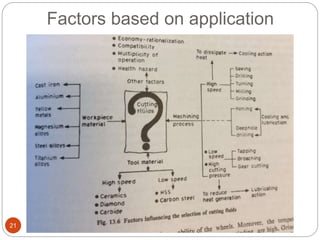
Factors based on application
21
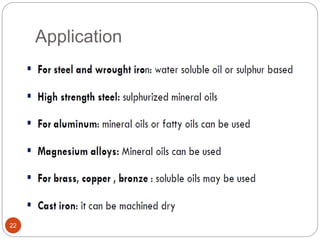
Application
22
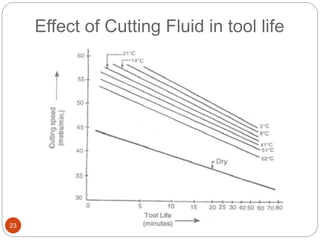
Effect of Cutting Fluid in tool life
23
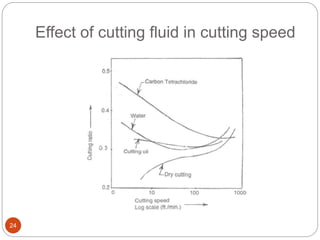
Effect of cutting fluid in cutting speed
24
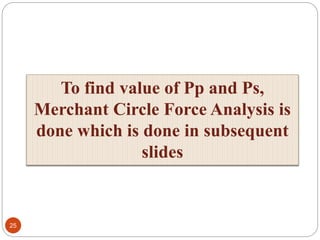
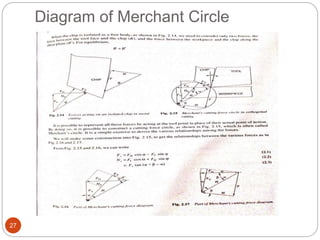
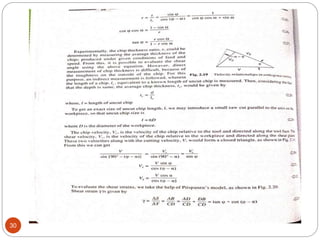
To find value of Pp and Ps,
Merchant Circle Force Analysis is
done which is done in subsequent
slides
25
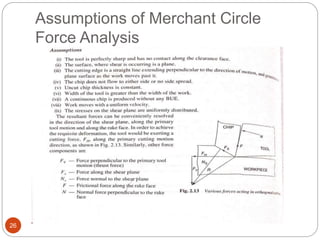
Assumptions of Merchant Circle
Force Analysis
26
Diagram of Merchant Circle
27
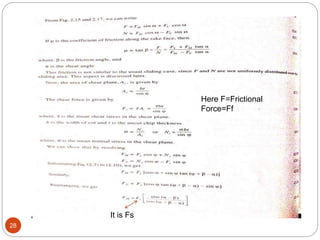
28
It is Fs
Here F=Frictional
Force=Ff
29
30
31
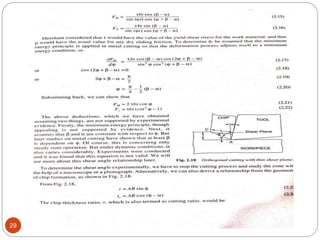
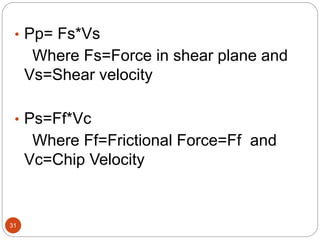
• Pp= Fs*Vs
Where Fs=Force in shear plane and
Vs=Shear velocity
• Ps=Ff*Vc
Where Ff=Frictional Force=Ff and
Vc=Chip Velocity
Reference
32
 http://www.mfg.mtu.edu/marc/primers/heat/heat.h
tml
 http://me.emu.edu.tr/me364/ME364_cutting_temp
eratures.pdf
 http://nathbeke.files.wordpress.com/2013/01/l4-
temprature-and-cooling.pdf
 Investigation of heat partition in high speed
turning of high strength alloy steel
 Production Technology by Hindustan Machine
Tool
 Metal Cutting and Machine Tools by P N Rao
Thank
You
33

Heat in metal cutting