LASER
Contents
 Laser and it’s properties
 Main parts of a laser
 Different types of a laser
 Applications of laser
INTRODUCTION
 The word laser is actually an acronym for “Light Amplification by
Stimulated Emission of Radiation.
 Laser light is the brightest monochromatic (single color) light.
 A laser is an electro optical device that emits organized light
(rather than the random pattern light emitted from a light bulb) in
a very narrow, intense beam by a process of optical feedback and
amplification. Because the explanation for this organization
involves stimulated emission.
 in 1917 by Albert Einstein. No one realized the incredible potential
of this concept until the 1950's, when practical research was first
performed on applying the theory of stimulated emission to
making lasers.
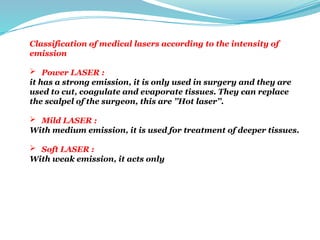
 1960 that the first true laser was made by Theodore Maimam, out
of synthetic ruby. Many ideas for laser applications quickly
followed.
Properties of laser
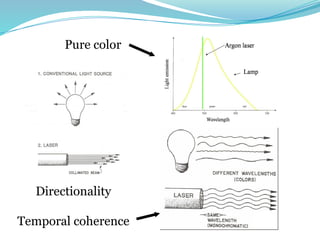
 Monochromatic The radiant energy emitted from the optical
cavity is of the same wavelength. is extremely intense and
unidirectional (collimated), and is coherent both temporally
and spatially. Temporal coherence refers to the waves of
light oscillating in phaseover a given time interval, deltat.
Whereas spatial coherence means that the photons are
equaland parallel across the wave front.
 collimation, and coherence distinguish the organized radiant
energy of a laser light source from the disorganized
radiant energy of a light bulb or other light source.
 Comparing to the conventional light, a laser is differentiated
by three characteristics. They are:
• Directionality.
• pure color.
• temporal coherence.
Directionality
Temporal coherence
Pure color
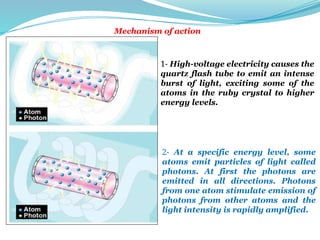
1- High-voltage electricity causes the
quartz flash tube to emit an intense
burst of light, exciting some of the
atoms in the ruby crystal to higher
energy levels.
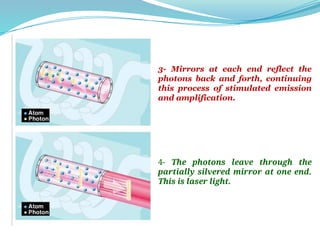
2- At a specific energy level, some
atoms emit particles of light called
photons. At first the photons are
emitted in all directions. Photons
from one atom stimulate emission of
photons from other atoms and the
light intensity is rapidly amplified.
Mechanism of action
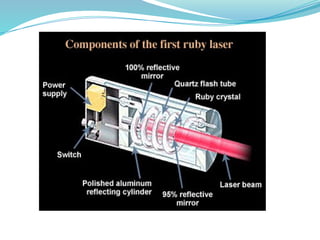
3- Mirrors at each end reflect the
photons back and forth, continuing
this process of stimulated emission
and amplification.
4- The photons leave through the
partially silvered mirror at one end.
This is laser light.
Types of lasers
There are many ways to define the type of laser.
Based on its pumping scheme a laser can be classified as:
 Optically pumped laser
 Electrically pumped laser
On the basis of the operation mode, laser fall into classes of
 Continuous Wave Lasers
 Pulsed Lasers.
According to the materials used to produce laser light, lasers
can be divided into three categories :
 Gas Lasers
 Solid State Lasers
 Semiconductor Lasers
 Other Laser Devices
Classification of medical lasers according to the intensity of
emission
 Power LASER :
it has a strong emission, it is only used in surgery and they are
used to cut, coagulate and evaporate tissues. They can replace
the scalpel of the surgeon, this are ’’Hot laser’’.
 Mild LASER :
With medium emission, it is used for treatment of deeper tissues.
 Soft LASER :
With weak emission, it acts only at the surface (dermatology).
Classification
Class I Inherently safe; no possibility of eye damage. This can be
either because of a low output power (in which case eye damage is
impossible even after hours of exposure), or due to an enclosure
preventing user access to the laser beam during normal operation,
such as in laser printers.
Class II The blink reflex of the human eye (aversion response) will
prevent eye damage, unless the person deliberately stares into the
beam for an extended period. Output power may be up to 1 mW.
Class III A Lasers in this class are mostly dangerous in combination
with optical instruments which change the beam diameter or power
density, though even without optical instrument enhancement direct
contact with the eye for over two minutes may cause serious damage
to the retina. Output power does not exceed 5 mW.
Class III B Lasers in this class may cause damage if the beam enters
the eye directly. This generally applies to lasers powered from 5–500
mW. Lasers in this category can cause permanent eye damage with
exposures of 1/100th of a second or more depending on the strength of
the laser. A diffuse reflection is generally not hazardous but specular
reflections can be just as dangerous as direct exposures.
LASER THERAPY
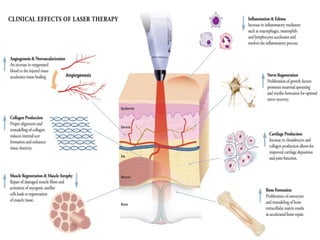
 Laser therapy treatment helps reduce pain and inflammation and
enhances tissue healing – both in hard and soft tissues , including
muscles , ligaments , and even bones.
 It increases oxygenation of tissues and allows injured or damaged
cells to absorb photons of light , which speeds healing .
 Laser therapy can be helpful for acute injuries, such as strains ,
sprains , shoulder injuries.
 Low-level laser therapy (LLLT) is a pain-free, non-invasive,
affordable tool used by physical therapists throughout the healing
process that is becoming more prevalent in PT practices
nationwide.
 Low-level cold lasers are absorbed into the skin to increase
cellular activity in tissues, which can bring healing to injured
areas.
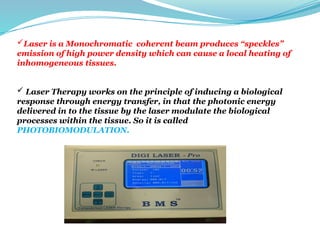
Laser is a Monochromatic coherent beam produces “speckles”
emission of high power density which can cause a local heating of
inhomogeneous tissues.
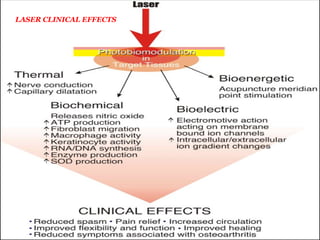
 Laser Therapy works on the principle of inducing a biological
response through energy transfer, in that the photonic energy
delivered in to the tissue by the laser modulate the biological
processes within the tissue. So it is called
PHOTOBIOMODULATION.
Advantages
 Dry surgical field and better visualization.
 Tissue surface sterilization and reduction in bacteria.
 Decreased swelling, edema and scarring.
 Decreased pain.
 Faster healing response.
 Increased patient acceptance.
 Minimal mechanical trauma.
 Negotiates folds in tissues.
Disadvantages
 Expensive.
 Require specialized training.
 No single wavelength will optimally treat all dental
disease.
 There is inability to remove metallic and cast-porcelain
defective restorations.
 Harmful to eyes and skin.
LASER CLINICAL EFFECTS
Wound healing ,
Pain Management
Cosmetic regeneration,
Soft tissue injury treatment
Skin Treatment
Diabetic wound healing
Dental,
Hair fall control
Acute and chronic pain
Non union,
Burns,
Plantar fasciitis,
Frozen shoulder,,
Osteoarthritis ,
Rheumatoid
ARTHRITIS,
Ligament and
TENDON Injuries,
Haematomas
Chrondomalacial
patella
Post Herpetic
Neuralgia
Brachial Neuralgia
Ulcers
Dermatitis
Acute Epididymitis
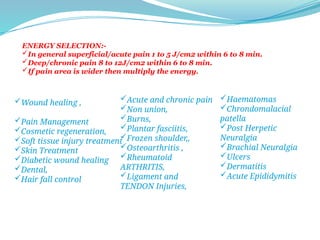
ENERGY SELECTION:-
In general superficial/acute pain 1 to 5 J/cm2 within 6 to 8 min.
Deep/chronic pain 8 to 12J/cm2 within 6 to 8 min.
If pain area is wider then multiply the energy.
The Influence of Low-Intensity Laser Therapy on Bone Healing
 low-intensity laser therapy (LILT) is to supply direct biostimulative light
energy to body cells.
 Absorbed laser energy causes stimulation of molecules and atoms of cells.
Using low-intensity laser radia-tion on the tissues does not cause rapid and
significant increase in tissue temperature.
 LILT have been reported on wound healing and collagen synthesis via in vitro
and in vivo studies . With respect to the bone, LILT has been shown to modulate
inflammation, accelerate cell proliferation and enhance healing.
 LILT has stimulating effects on stem cells of the bone and accelerates the re-
pair process of the bone
 LILT could stimulate the collagen fibers to arrange in a lamellar structure
stimulate the mineralization in the process of new bone formation in surgically
created bony defects
application of a deep-penetrating therapeutic laser actually
accomplish
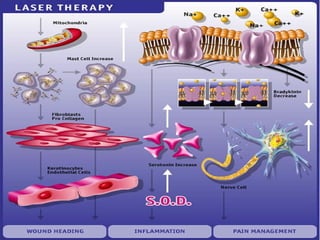
Through a stimulated photobiochemical the cellular level, we achieve
relief of pain, a reduction in inflammation and an increase in
microcirculation. These result in an accelerated restoration of function
or healing within the tissues.
 Increased nitric oxide production
 Increase in the release of beta endorphins
 Decreased bradykinin levels within the surrounding tissues
 Ion channel normalization within the individual cells
 Stabilization of the action potentials within the individual nerve cells
 An increase in the localized and systemic serotonin levels
 Increased release of acetylcholine
 Blocked depolarization of C-fiber afferent nerves
 Reduction in the inflammatory process is accomplished by a similar
cascade of events. These are:
• An inhibition in the synthesis and secretion of inflammatory
prostaglandins yet a stimulation of those prostaglandins that have a
vasodilatory and anti-inflammatory action.
• Stabilization of the cellular membrane in regard to Ca++, Na+ and
K+ concentrations
• Enhancement of ATP production and synthesis
stimulating the metabolic activity and the production of fibroblasts
• Reduction in interleukin 1 production Microcirculation is primarily
stimulated by the release of nitric oxide and increased levels of
serotonin. This increase in circulation and subsequent vasodilatation
allows for an increase in leukocytic and macrophage activities.

articulating mirrors laser application 1610922286.pptx

  • 1.
  • 2.
    Contents  Laser andit’s properties  Main parts of a laser  Different types of a laser  Applications of laser
  • 3.
    INTRODUCTION  The wordlaser is actually an acronym for “Light Amplification by Stimulated Emission of Radiation.  Laser light is the brightest monochromatic (single color) light.  A laser is an electro optical device that emits organized light (rather than the random pattern light emitted from a light bulb) in a very narrow, intense beam by a process of optical feedback and amplification. Because the explanation for this organization involves stimulated emission.  in 1917 by Albert Einstein. No one realized the incredible potential of this concept until the 1950's, when practical research was first performed on applying the theory of stimulated emission to making lasers.  1960 that the first true laser was made by Theodore Maimam, out of synthetic ruby. Many ideas for laser applications quickly followed.
  • 4.
    Properties of laser Monochromatic The radiant energy emitted from the optical cavity is of the same wavelength. is extremely intense and unidirectional (collimated), and is coherent both temporally and spatially. Temporal coherence refers to the waves of light oscillating in phaseover a given time interval, deltat. Whereas spatial coherence means that the photons are equaland parallel across the wave front.  collimation, and coherence distinguish the organized radiant energy of a laser light source from the disorganized radiant energy of a light bulb or other light source.  Comparing to the conventional light, a laser is differentiated by three characteristics. They are: • Directionality. • pure color. • temporal coherence.
  • 5.
  • 6.
    1- High-voltage electricitycauses the quartz flash tube to emit an intense burst of light, exciting some of the atoms in the ruby crystal to higher energy levels. 2- At a specific energy level, some atoms emit particles of light called photons. At first the photons are emitted in all directions. Photons from one atom stimulate emission of photons from other atoms and the light intensity is rapidly amplified. Mechanism of action
  • 7.
    3- Mirrors ateach end reflect the photons back and forth, continuing this process of stimulated emission and amplification. 4- The photons leave through the partially silvered mirror at one end. This is laser light.
  • 9.
    Types of lasers Thereare many ways to define the type of laser. Based on its pumping scheme a laser can be classified as:  Optically pumped laser  Electrically pumped laser On the basis of the operation mode, laser fall into classes of  Continuous Wave Lasers  Pulsed Lasers. According to the materials used to produce laser light, lasers can be divided into three categories :  Gas Lasers  Solid State Lasers  Semiconductor Lasers  Other Laser Devices
  • 10.
    Classification of medicallasers according to the intensity of emission  Power LASER : it has a strong emission, it is only used in surgery and they are used to cut, coagulate and evaporate tissues. They can replace the scalpel of the surgeon, this are ’’Hot laser’’.  Mild LASER : With medium emission, it is used for treatment of deeper tissues.  Soft LASER : With weak emission, it acts only at the surface (dermatology).
  • 11.
    Classification Class I Inherentlysafe; no possibility of eye damage. This can be either because of a low output power (in which case eye damage is impossible even after hours of exposure), or due to an enclosure preventing user access to the laser beam during normal operation, such as in laser printers. Class II The blink reflex of the human eye (aversion response) will prevent eye damage, unless the person deliberately stares into the beam for an extended period. Output power may be up to 1 mW. Class III A Lasers in this class are mostly dangerous in combination with optical instruments which change the beam diameter or power density, though even without optical instrument enhancement direct contact with the eye for over two minutes may cause serious damage to the retina. Output power does not exceed 5 mW. Class III B Lasers in this class may cause damage if the beam enters the eye directly. This generally applies to lasers powered from 5–500 mW. Lasers in this category can cause permanent eye damage with exposures of 1/100th of a second or more depending on the strength of the laser. A diffuse reflection is generally not hazardous but specular reflections can be just as dangerous as direct exposures.
  • 12.
    LASER THERAPY  Lasertherapy treatment helps reduce pain and inflammation and enhances tissue healing – both in hard and soft tissues , including muscles , ligaments , and even bones.  It increases oxygenation of tissues and allows injured or damaged cells to absorb photons of light , which speeds healing .  Laser therapy can be helpful for acute injuries, such as strains , sprains , shoulder injuries.  Low-level laser therapy (LLLT) is a pain-free, non-invasive, affordable tool used by physical therapists throughout the healing process that is becoming more prevalent in PT practices nationwide.  Low-level cold lasers are absorbed into the skin to increase cellular activity in tissues, which can bring healing to injured areas.
  • 13.
    Laser is aMonochromatic coherent beam produces “speckles” emission of high power density which can cause a local heating of inhomogeneous tissues.  Laser Therapy works on the principle of inducing a biological response through energy transfer, in that the photonic energy delivered in to the tissue by the laser modulate the biological processes within the tissue. So it is called PHOTOBIOMODULATION.
  • 14.
    Advantages  Dry surgicalfield and better visualization.  Tissue surface sterilization and reduction in bacteria.  Decreased swelling, edema and scarring.  Decreased pain.  Faster healing response.  Increased patient acceptance.  Minimal mechanical trauma.  Negotiates folds in tissues. Disadvantages  Expensive.  Require specialized training.  No single wavelength will optimally treat all dental disease.  There is inability to remove metallic and cast-porcelain defective restorations.  Harmful to eyes and skin.
  • 15.
  • 18.
    Wound healing , PainManagement Cosmetic regeneration, Soft tissue injury treatment Skin Treatment Diabetic wound healing Dental, Hair fall control Acute and chronic pain Non union, Burns, Plantar fasciitis, Frozen shoulder,, Osteoarthritis , Rheumatoid ARTHRITIS, Ligament and TENDON Injuries, Haematomas Chrondomalacial patella Post Herpetic Neuralgia Brachial Neuralgia Ulcers Dermatitis Acute Epididymitis ENERGY SELECTION:- In general superficial/acute pain 1 to 5 J/cm2 within 6 to 8 min. Deep/chronic pain 8 to 12J/cm2 within 6 to 8 min. If pain area is wider then multiply the energy.
  • 19.
    The Influence ofLow-Intensity Laser Therapy on Bone Healing  low-intensity laser therapy (LILT) is to supply direct biostimulative light energy to body cells.  Absorbed laser energy causes stimulation of molecules and atoms of cells. Using low-intensity laser radia-tion on the tissues does not cause rapid and significant increase in tissue temperature.  LILT have been reported on wound healing and collagen synthesis via in vitro and in vivo studies . With respect to the bone, LILT has been shown to modulate inflammation, accelerate cell proliferation and enhance healing.  LILT has stimulating effects on stem cells of the bone and accelerates the re- pair process of the bone  LILT could stimulate the collagen fibers to arrange in a lamellar structure stimulate the mineralization in the process of new bone formation in surgically created bony defects
  • 20.
    application of adeep-penetrating therapeutic laser actually accomplish Through a stimulated photobiochemical the cellular level, we achieve relief of pain, a reduction in inflammation and an increase in microcirculation. These result in an accelerated restoration of function or healing within the tissues.  Increased nitric oxide production  Increase in the release of beta endorphins  Decreased bradykinin levels within the surrounding tissues  Ion channel normalization within the individual cells  Stabilization of the action potentials within the individual nerve cells  An increase in the localized and systemic serotonin levels  Increased release of acetylcholine  Blocked depolarization of C-fiber afferent nerves
  • 21.
     Reduction inthe inflammatory process is accomplished by a similar cascade of events. These are: • An inhibition in the synthesis and secretion of inflammatory prostaglandins yet a stimulation of those prostaglandins that have a vasodilatory and anti-inflammatory action. • Stabilization of the cellular membrane in regard to Ca++, Na+ and K+ concentrations • Enhancement of ATP production and synthesis stimulating the metabolic activity and the production of fibroblasts • Reduction in interleukin 1 production Microcirculation is primarily stimulated by the release of nitric oxide and increased levels of serotonin. This increase in circulation and subsequent vasodilatation allows for an increase in leukocytic and macrophage activities.