Cholesterol synthesis and breakdown
Dr.Amer Gul
1
22
To compare and contrast the different mechanisms by which
cholesterol biosynthesis are regulated.
To predict whether intracellular cholesterol synthesis will be
up- or down-regulated in response to energy availability as
influenced by diet, hormones and exercise.
To distinguish the different mechanisms by which plasma
cholesterol levels are controlled by clinically adminstrered
pharmacological agents.
OBJECTIVES
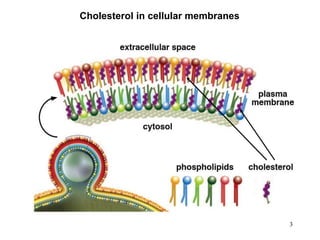
Cholesterol in cellular membranes
3
4
5
6
26
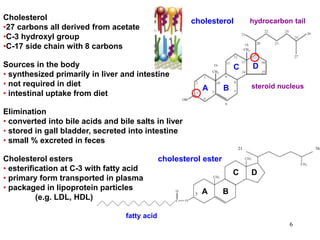
hydrocarbon tail
steroid nucleusA
C D
B
cholesterolCholesterol
•27 carbons all derived from acetate
•C-3 hydroxyl group
•C-17 side chain with 8 carbons
Sources in the body
• synthesized primarily in liver and intestine
• not required in diet
• intestinal uptake from diet
Elimination
• converted into bile acids and bile salts in liver
• stored in gall bladder, secreted into intestine
• small % excreted in feces
21
3
cholesterol ester
fatty acid
A
C D
B
Cholesterol esters
• esterification at C-3 with fatty acid
• primary form transported in plasma
• packaged in lipoprotein particles
(e.g. LDL, HDL)
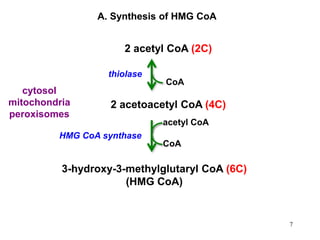
cytosol
mitochondria
peroxisomes
A. Synthesis of HMG CoA
7
2 acetyl CoA (2C)
2 acetoacetyl CoA (4C)
3-hydroxy-3-methylglutaryl CoA (6C)
(HMG CoA)
thiolase
HMG CoA synthase
CoA
CoA
acetyl CoA
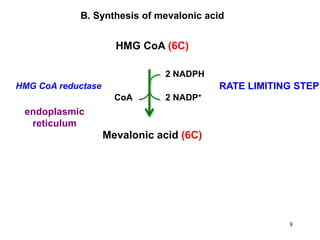
endoplasmic
reticulum
B. Synthesis of mevalonic acid
HMG CoA (6C)
HMG CoA reductase
2 NADPH
2 NADP+CoA
Mevalonic acid (6C)
RATE LIMITING STEP
8
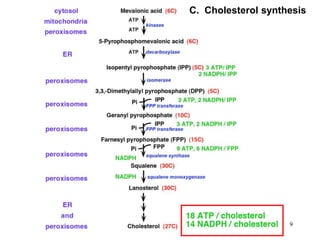
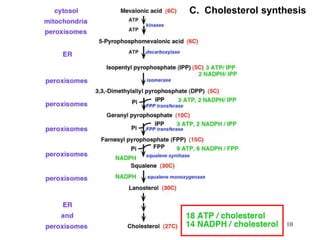
C. Cholesterol synthesis
9
C. Cholesterol synthesis
10
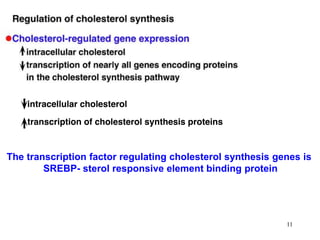
The transcription factor regulating cholesterol synthesis genes is
SREBP- sterol responsive element binding protein
11
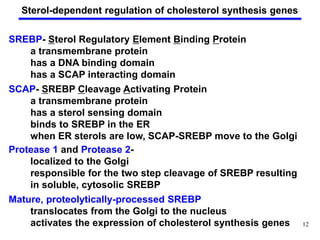
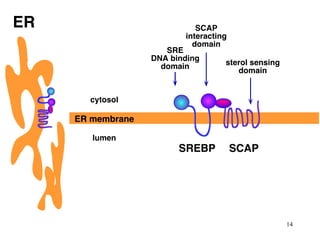
SCAP- SREBP Cleavage Activating Protein
a transmembrane protein
has a sterol sensing domain
binds to SREBP in the ER
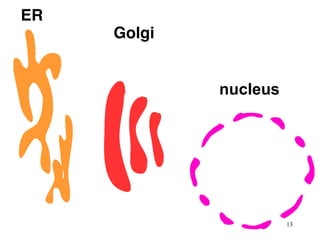
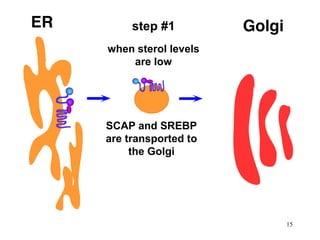
when ER sterols are low, SCAP-SREBP move to the Golgi
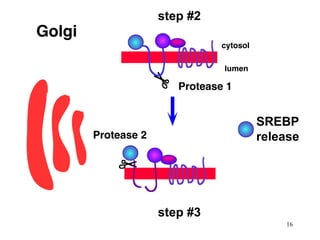
Protease 1 and Protease 2-
localized to the Golgi
responsible for the two step cleavage of SREBP resulting
in soluble, cytosolic SREBP
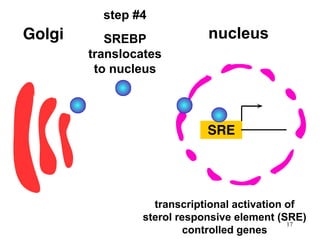
Mature, proteolytically-processed SREBP
translocates from the Golgi to the nucleus
activates the expression of cholesterol synthesis genes
SREBP- Sterol Regulatory Element Binding Protein
a transmembrane protein
has a DNA binding domain
has a SCAP interacting domain
Sterol-dependent regulation of cholesterol synthesis genes
12
nucleus
13
14
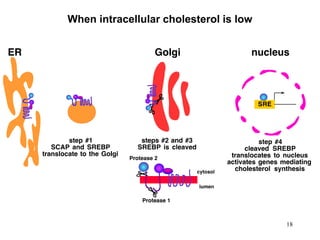
SCAP and SREBP
are transported to
the Golgi
when sterol levels
are low
step #1
15
step #2
step #3
SREBP
release
16
SREBP
translocates
to nucleus
step #4
transcriptional activation of
sterol responsive element (SRE)
controlled genes
nucleus
17
When intracellular cholesterol is low
18
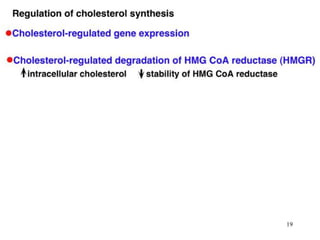
19
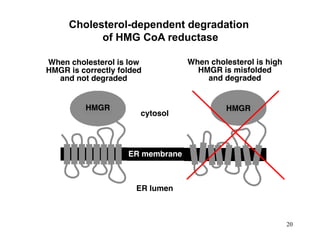
Cholesterol-dependent degradation
of HMG CoA reductase
20
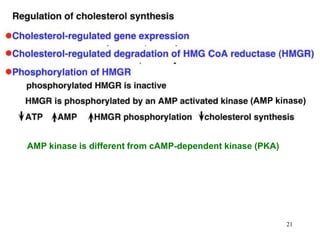
(AMP kinase)
AMP kinase is different from cAMP-dependent kinase (PKA)
21
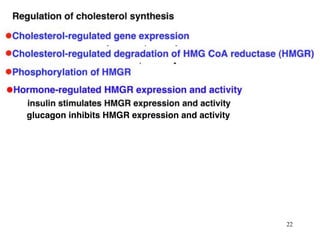
22
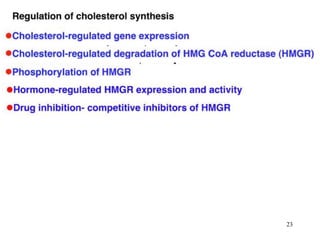
23
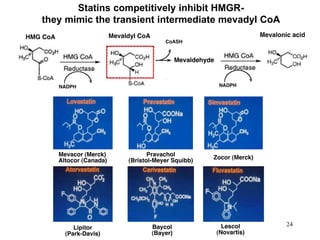
Statins competitively inhibit HMGR-
they mimic the transient intermediate mevadyl CoA
24
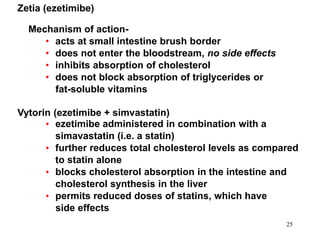
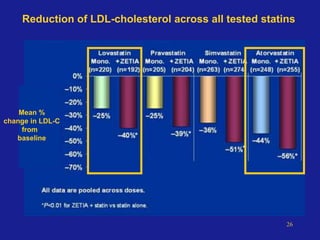
Vytorin (ezetimibe + simvastatin)
• ezetimibe administered in combination with a
simavastatin (i.e. a statin)
• further reduces total cholesterol levels as compared
to statin alone
• blocks cholesterol absorption in the intestine and
cholesterol synthesis in the liver
• permits reduced doses of statins, which have
side effects
Zetia (ezetimibe)
Mechanism of action-
• acts at small intestine brush border
• does not enter the bloodstream, no side effects
• inhibits absorption of cholesterol
• does not block absorption of triglycerides or
fat-soluble vitamins
25
Reduction of LDL-cholesterol across all tested statins
Mean %
change in LDL-C
from
baseline
26
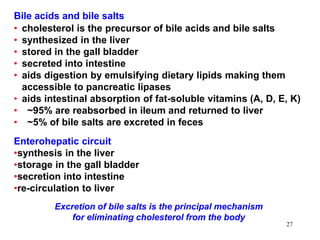
• cholesterol is the precursor of bile acids and bile salts
• synthesized in the liver
• stored in the gall bladder
• secreted into intestine
• aids digestion by emulsifying dietary lipids making them
accessible to pancreatic lipases
• aids intestinal absorption of fat-soluble vitamins (A, D, E, K)
• ~95% are reabsorbed in ileum and returned to liver
• ~5% of bile salts are excreted in feces
Bile acids and bile salts
Excretion of bile salts is the principal mechanism
for eliminating cholesterol from the body
Enterohepatic circuit
•synthesis in the liver
•storage in the gall bladder
•secretion into intestine
•re-circulation to liver
27
28
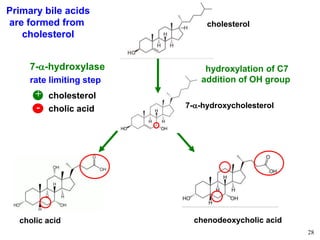
cholic acid-
+ cholesterol
rate limiting step
Primary bile acids
are formed from
cholesterol
cholesterol
cholic acid chenodeoxycholic acid
7-a-hydroxylase hydroxylation of C7
addition of OH group
7-a-hydroxycholesterol
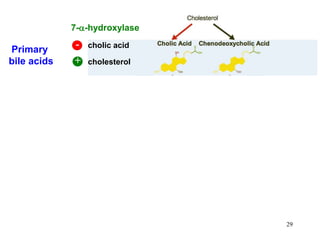
Primary
bile acids
7-a-hydroxylase
cholic acid-
+ cholesterol
29
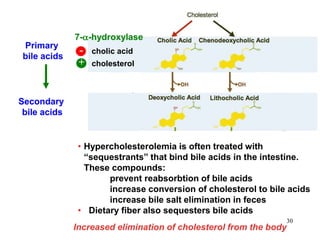
• Hypercholesterolemia is often treated with
“sequestrants” that bind bile acids in the intestine.
These compounds:
prevent reabsorbtion of bile acids
increase conversion of cholesterol to bile acids
increase bile salt elimination in feces
• Dietary fiber also sequesters bile acids
Secondary
bile acids
Secondary
bile acids
Primary
bile acids
7-a-hydroxylase
cholic acid-
+ cholesterol
30
Increased elimination of cholesterol from the body
Secondary
bile acids
Primary
bile acids
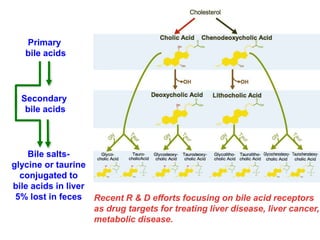
Bile salts-
glycine or taurine
conjugated to
bile acids in liver
5% lost in feces Recent R & D efforts focusing on bile acid receptors
as drug targets for treating liver disease, liver cancer,
metabolic disease.
Review- you tell me !!!!
•How many carbons are there in cholesterol?
•Which carbons are the business ends of the
cholesterol molecule?
•When cholesterol levels are high, HMG CoA reductase is
regulated by which of the following mechanisms?
•When cholesterol levels are high, HMG CoA reductase is
regulated by which of the following mechanisms?
•What organ STORES bile acids and bile salts?
Cholesterol synthesis and breakdown

  • 1.
    Cholesterol synthesis andbreakdown Dr.Amer Gul 1
  • 2.
    22 To compare andcontrast the different mechanisms by which cholesterol biosynthesis are regulated. To predict whether intracellular cholesterol synthesis will be up- or down-regulated in response to energy availability as influenced by diet, hormones and exercise. To distinguish the different mechanisms by which plasma cholesterol levels are controlled by clinically adminstrered pharmacological agents. OBJECTIVES
  • 3.
  • 4.
  • 5.
  • 6.
    6 26 hydrocarbon tail steroid nucleusA CD B cholesterolCholesterol •27 carbons all derived from acetate •C-3 hydroxyl group •C-17 side chain with 8 carbons Sources in the body • synthesized primarily in liver and intestine • not required in diet • intestinal uptake from diet Elimination • converted into bile acids and bile salts in liver • stored in gall bladder, secreted into intestine • small % excreted in feces 21 3 cholesterol ester fatty acid A C D B Cholesterol esters • esterification at C-3 with fatty acid • primary form transported in plasma • packaged in lipoprotein particles (e.g. LDL, HDL)
  • 7.
    cytosol mitochondria peroxisomes A. Synthesis ofHMG CoA 7 2 acetyl CoA (2C) 2 acetoacetyl CoA (4C) 3-hydroxy-3-methylglutaryl CoA (6C) (HMG CoA) thiolase HMG CoA synthase CoA CoA acetyl CoA
  • 8.
    endoplasmic reticulum B. Synthesis ofmevalonic acid HMG CoA (6C) HMG CoA reductase 2 NADPH 2 NADP+CoA Mevalonic acid (6C) RATE LIMITING STEP 8
  • 9.
  • 10.
  • 11.
    The transcription factorregulating cholesterol synthesis genes is SREBP- sterol responsive element binding protein 11
  • 12.
    SCAP- SREBP CleavageActivating Protein a transmembrane protein has a sterol sensing domain binds to SREBP in the ER when ER sterols are low, SCAP-SREBP move to the Golgi Protease 1 and Protease 2- localized to the Golgi responsible for the two step cleavage of SREBP resulting in soluble, cytosolic SREBP Mature, proteolytically-processed SREBP translocates from the Golgi to the nucleus activates the expression of cholesterol synthesis genes SREBP- Sterol Regulatory Element Binding Protein a transmembrane protein has a DNA binding domain has a SCAP interacting domain Sterol-dependent regulation of cholesterol synthesis genes 12
  • 13.
  • 14.
  • 15.
    SCAP and SREBP aretransported to the Golgi when sterol levels are low step #1 15
  • 16.
  • 17.
    SREBP translocates to nucleus step #4 transcriptionalactivation of sterol responsive element (SRE) controlled genes nucleus 17
  • 18.
  • 19.
  • 20.
  • 21.
    (AMP kinase) AMP kinaseis different from cAMP-dependent kinase (PKA) 21
  • 22.
  • 23.
  • 24.
    Statins competitively inhibitHMGR- they mimic the transient intermediate mevadyl CoA 24
  • 25.
    Vytorin (ezetimibe +simvastatin) • ezetimibe administered in combination with a simavastatin (i.e. a statin) • further reduces total cholesterol levels as compared to statin alone • blocks cholesterol absorption in the intestine and cholesterol synthesis in the liver • permits reduced doses of statins, which have side effects Zetia (ezetimibe) Mechanism of action- • acts at small intestine brush border • does not enter the bloodstream, no side effects • inhibits absorption of cholesterol • does not block absorption of triglycerides or fat-soluble vitamins 25
  • 26.
    Reduction of LDL-cholesterolacross all tested statins Mean % change in LDL-C from baseline 26
  • 27.
    • cholesterol isthe precursor of bile acids and bile salts • synthesized in the liver • stored in the gall bladder • secreted into intestine • aids digestion by emulsifying dietary lipids making them accessible to pancreatic lipases • aids intestinal absorption of fat-soluble vitamins (A, D, E, K) • ~95% are reabsorbed in ileum and returned to liver • ~5% of bile salts are excreted in feces Bile acids and bile salts Excretion of bile salts is the principal mechanism for eliminating cholesterol from the body Enterohepatic circuit •synthesis in the liver •storage in the gall bladder •secretion into intestine •re-circulation to liver 27
  • 28.
    28 cholic acid- + cholesterol ratelimiting step Primary bile acids are formed from cholesterol cholesterol cholic acid chenodeoxycholic acid 7-a-hydroxylase hydroxylation of C7 addition of OH group 7-a-hydroxycholesterol
  • 29.
  • 30.
    • Hypercholesterolemia isoften treated with “sequestrants” that bind bile acids in the intestine. These compounds: prevent reabsorbtion of bile acids increase conversion of cholesterol to bile acids increase bile salt elimination in feces • Dietary fiber also sequesters bile acids Secondary bile acids Secondary bile acids Primary bile acids 7-a-hydroxylase cholic acid- + cholesterol 30 Increased elimination of cholesterol from the body
  • 31.
    Secondary bile acids Primary bile acids Bilesalts- glycine or taurine conjugated to bile acids in liver 5% lost in feces Recent R & D efforts focusing on bile acid receptors as drug targets for treating liver disease, liver cancer, metabolic disease.
  • 32.
    Review- you tellme !!!! •How many carbons are there in cholesterol? •Which carbons are the business ends of the cholesterol molecule? •When cholesterol levels are high, HMG CoA reductase is regulated by which of the following mechanisms? •When cholesterol levels are high, HMG CoA reductase is regulated by which of the following mechanisms? •What organ STORES bile acids and bile salts?