Learning Outcomes
• Describe advantages of networking
• Describe the characteristic of two types of networks
• Describe the various classification of networks
• List the elements common to all client/server networks
• Describe the various computer network topologies
• Compare the characteristics of the different network
topologies
• State the organizations that set standards for
networking
What is Network?
• A combination of computer hardware, cabling,
network devices and computer software that
allows computers to communicate with each
other.
• The goal of any network is to allow computers
to communicate.
• Communication examples: web browser, AIM,
text messaging, email
Advantages of Comp. Network
• Data Exchange
• Hardware Resource Sharing
• Software Resource Sharing
• Data Security
• Increased Communication Capabilities
• Entertainment
• Backup - Avoid File Duplication and Corruption
Types of Networks
• Peer-to-Peer (P2P)
• Client Server
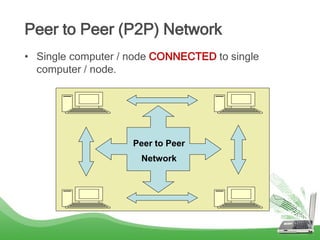
• Single computer / node CONNECTED to single
computer / node.
Peer to Peer
Network
Peer to Peer (P2P) Network
Peer to Peer (P2P) Network (cont…)
• P2P members usually perform similar tasks, sharing
of resources. Support 10 computers. Users of P2P is
located in the same geographical area
Advantages of a peer-to-peer network:
• Less initial expense - No need for a dedicated server.
• Setup - An operating system (such as Windows XP)
already in place may only need to be reconfigured for
peer-to-peer operations.
Peer to Peer (P2P) Network (cont…)
Disadvantages of a peer-to-peer network:
• Decentralized - No Centralized server.
• Security - Does not provide the security available on a
peer-to-peer network.
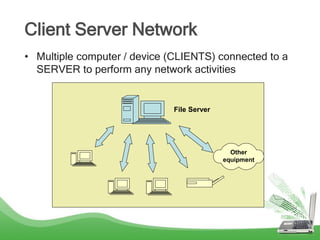
Client Server Network
• Multiple computer / device (CLIENTS) connected to a
SERVER to perform any network activities
File Server
Other
equipment
Client Server Network (cont…)
Advantages of a client/server network
• Centralized - Resources and data security are
controlled through the server.
• Security - More security then Peer-to-peer network.
• Flexibility - New technology can be easily integrated
into system.
• Interoperability - All components (client /server) work
together.
• Accessibility - Server can be accessed remotely and
across multiple platforms.
Client Server Network (cont…)
Disadvantages of a client/server network
• Expense - Requires initial investment in dedicated
server.
• Maintenance - Large networks will require a staff to
ensure efficient operation.
• Dependence - When server goes down, operations
will cease (stop) across the network.
RECAP!!
Can you explain differences
between Peer to Peer and
Client Server Network?
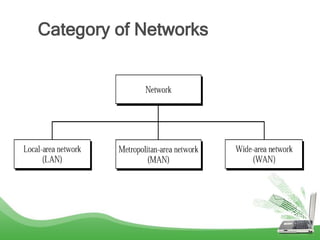
Category of Networks
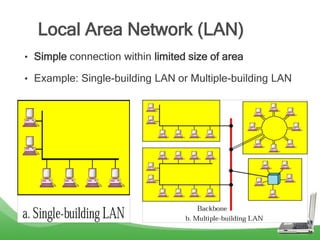
Local Area Network (LAN)
• Simple connection within limited size of area
• Example: Single-building LAN or Multiple-building LAN
Metropolitan Area Network (MAN)
• Connection over the city
• Example: JB networks to Melaka networks
Wide Area Network (WAN)
• Large-size of area connection which connects all
over the world
• Example: Malaysia networks to Japan networks
RECAP!!
Can you explain your
understand on category of
networks?
• CLIENT
– Clients are the computers that can access the shared network resources
provided by a server
• SERVER
– Servers are the computers that provide the shared resources to network
users
• NIC (Network Interface Card)
– Device inside a computer that connects a computer to the network (network
adapter)
• NETWORK OPERATING SYSTEM (NOS)
– The software that runs on servers that enables the servers to manage data,
users, groups, security, applications, and other network functions.
Example: Windows Server 2008 R2, Mac OSX, UNIX, Linux
Elements of Client Server Networks
Elements of Client Server Networks (cont…)
• BACKBONE
– The devices that connect all of the clients and servers across the
network. Example Switches, routers, access points
• SEGMENT
– A segment is a specially-configured subset of a larger network. The
ways of increasing available bandwidth on the LAN
• TOPOLOGY
– A topology is a arrangement of a network, including its nodes and
connecting lines. Network geometry: 1) Physical topology 2) Logical
(or signal) topology.
• TRANSMISSION MEDIA
– The physical or nonphysical means through which data is
transmitted and received across the network. Example: Wire and
cables, radio waves
Network Topologies
Two categories of network topology
are:
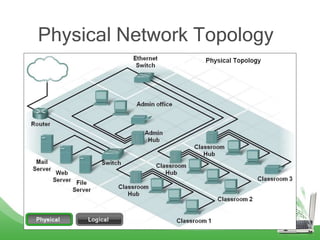
• Physical – topology map recorded each host is
located, wiring is installed and the locations of the
networking devices that connect the hosts.
• Logical – host names, addresses, group
information and applications can be recorded on
the logical topology map. Describes the logical
pathway a signal follows as it passes among the
network nodes
Physical Network Topology
Logical Network Topology
Network Topologies
TOPOLOGY
BUS RING STAR HYBRID
TREE MESH
Bus Topology
• It is a multipoint topology.
• One long cable acts as a backbone to link all
the devices in the network.
Ring Topology
• Each device has a dedicated point-to-point line
configuration.
• Message will be passed to each device until it
reach the destination
Star Topology
 Each device has a dedicated point-to-point link only
to a central controller.
 It does not allow direct traffic between devices.
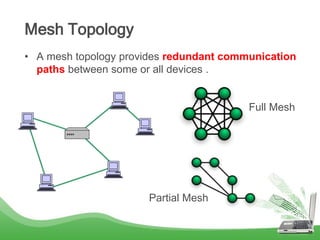
Mesh Topology
• A mesh topology provides redundant communication
paths between some or all devices .
Full Mesh
Partial Mesh
Tree Topology
 A tree topology integrates the star and bus
topologies in a hybrid approach to improve network
scalability.
Hybrid Topology
• The combination of two or more topologies.
Consideration to Choose Topology
• Money. A linear bus network may be the least
expensive way to install a network; you do not have
to purchase concentrators.
• Length of cable needed. The linear bus network uses
shorter lengths of cable.
• Future growth. With a star topology, expanding a
network is easily done by adding another
concentrator.
• Cable type. The most common cable is unshielded
twisted pair, which is most often used with star
topologies.
• Stability
Advantages & Disadvantages
TOPOLOGY ADVANTAGES DISADVANTAGES
Bus • Use of cable is economical.
• Media is inexpensive and
easy to work with.
• System is simple and
reliable.
• Bus is easy to extend.
• Network can slow down in heavy
traffic.
• Problems are difficult to isolate.
• Cable break can affect many users.
• Entire network shuts down if there
is a break in the main cable.
• Terminators are required at both
ends of the backbone cable.
Ring • System provides equal
access for all computers.
• Performance is even
despite many users.
• Failure of one computer can
impact the rest of the network.
• Problems are hard to isolate.
• Unmanageable in a large network
Star • Modifying system and
adding new computers is
easy.
• Centralized monitoring and
management are possible.
• Failure of one computer
does not affect the rest of
the network.
• If the centralized point fails, the
network fails.
• Costs are usually higher than with
bus or ring networks
Advantages & Disadvantages (cont…)
TOPOLOGY ADVANTAGES DISADVANTAGES
Mesh • System provides increased
redundancy and reliability
as well as ease of
troubleshooting.
• System is expensive to install
because it uses a lot of cabling.
Tree • Point-to-point wiring for
individual segments.
• Supported by several
hardware and software
venders.
• Overall length of each segment is
limited by the type of cabling
used.
• If the backbone line breaks, the
entire segment goes down.
• More difficult to configure and wire
than other topologies.
Type of Cable, Speed & Protocol
Topology Cable Speed Protocol
Bus, Star, Tree
Twisted Pair,
Coaxial, Fiber
10 Mbps Ethernet
Star
Twisted Pair,
Fiber
100 Mbps Fast Ethernet
Linear or Star Twisted Pair .23 Mbps LocalTalk
Star-Wired Ring Twisted Pair 4 Mbps - 16 Mbps Token Ring
Dual ring Fiber 100 Mbps FDDI
Bus, Star, Tree
Twisted Pair,
Fiber
155-2488 Mbps ATM
RECAP!!
What is differences between
all the various computer
network topologies??
Networking Standard Organization
• International Standard Organization (ISO)
• American National Standard Institute (ANSI)
• Institute of Electrical and Electronic Engineer (IEEE)
• Electronics Industries Association (EIA)
• International Telecommunication Union (ITU)
• Internet Architecture Board (IAB)
• Internet Engineering Task Force (IETF)
• Internet Society (ISOC)
• Internet Assigned Numbers Authority (IANA)
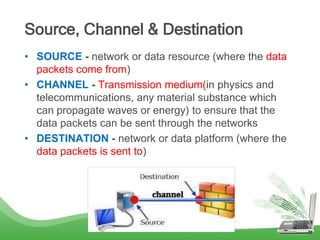
Source, Channel & Destination
• SOURCE - network or data resource (where the data
packets come from)
• CHANNEL - Transmission medium(in physics and
telecommunications, any material substance which
can propagate waves or energy) to ensure that the
data packets can be sent through the networks
• DESTINATION - network or data platform (where the
data packets is sent to)
Function of Hardware
• REPEATER - increasing the signals energy
• HUB / SWITCH
– Centralizing connection for all network devices (LAN only)
– Sending packets using MAC address
HUB
SWITCH
REPEATER
Function of Hardware (cont…)
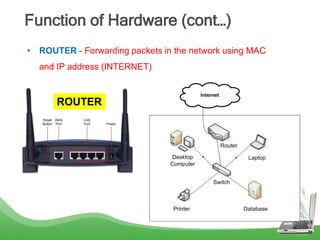
• ROUTER - Forwarding packets in the network using MAC
and IP address (INTERNET)
ROUTER
• BRIDGE - Connecting two or
more different networks for
communication
Function of Hardware (cont…)
BRIDGE
GATEWAYS
• GATEWAYS - a device that acts
as a ‘MAIN PATH’ for all network
traffics.
• “Gate” to the Internet.
INDIVIDUALEXERCISE1
1. Describe the history and function of organizations the set
standards of networking?
2. Search and study all network topology , and from the
result draw your own network topology by using
physical network topology view.
• Individual Exercise. Submit on 29/06/2015
• Try to write and explain using your own words.
No Organization Description
I don’t stop when I’m tired.
I only stop when I’m done…

Topic 1.1 basic concepts of computer network

  • 2.
    Learning Outcomes • Describeadvantages of networking • Describe the characteristic of two types of networks • Describe the various classification of networks • List the elements common to all client/server networks • Describe the various computer network topologies • Compare the characteristics of the different network topologies • State the organizations that set standards for networking
  • 3.
    What is Network? •A combination of computer hardware, cabling, network devices and computer software that allows computers to communicate with each other. • The goal of any network is to allow computers to communicate. • Communication examples: web browser, AIM, text messaging, email
  • 4.
    Advantages of Comp.Network • Data Exchange • Hardware Resource Sharing • Software Resource Sharing • Data Security • Increased Communication Capabilities • Entertainment • Backup - Avoid File Duplication and Corruption
  • 5.
    Types of Networks •Peer-to-Peer (P2P) • Client Server
  • 6.
    • Single computer/ node CONNECTED to single computer / node. Peer to Peer Network Peer to Peer (P2P) Network
  • 7.
    Peer to Peer(P2P) Network (cont…) • P2P members usually perform similar tasks, sharing of resources. Support 10 computers. Users of P2P is located in the same geographical area Advantages of a peer-to-peer network: • Less initial expense - No need for a dedicated server. • Setup - An operating system (such as Windows XP) already in place may only need to be reconfigured for peer-to-peer operations.
  • 8.
    Peer to Peer(P2P) Network (cont…) Disadvantages of a peer-to-peer network: • Decentralized - No Centralized server. • Security - Does not provide the security available on a peer-to-peer network.
  • 9.
    Client Server Network •Multiple computer / device (CLIENTS) connected to a SERVER to perform any network activities File Server Other equipment
  • 10.
    Client Server Network(cont…) Advantages of a client/server network • Centralized - Resources and data security are controlled through the server. • Security - More security then Peer-to-peer network. • Flexibility - New technology can be easily integrated into system. • Interoperability - All components (client /server) work together. • Accessibility - Server can be accessed remotely and across multiple platforms.
  • 11.
    Client Server Network(cont…) Disadvantages of a client/server network • Expense - Requires initial investment in dedicated server. • Maintenance - Large networks will require a staff to ensure efficient operation. • Dependence - When server goes down, operations will cease (stop) across the network.
  • 12.
    RECAP!! Can you explaindifferences between Peer to Peer and Client Server Network?
  • 13.
  • 14.
    Local Area Network(LAN) • Simple connection within limited size of area • Example: Single-building LAN or Multiple-building LAN
  • 15.
    Metropolitan Area Network(MAN) • Connection over the city • Example: JB networks to Melaka networks
  • 16.
    Wide Area Network(WAN) • Large-size of area connection which connects all over the world • Example: Malaysia networks to Japan networks
  • 17.
    RECAP!! Can you explainyour understand on category of networks?
  • 18.
    • CLIENT – Clientsare the computers that can access the shared network resources provided by a server • SERVER – Servers are the computers that provide the shared resources to network users • NIC (Network Interface Card) – Device inside a computer that connects a computer to the network (network adapter) • NETWORK OPERATING SYSTEM (NOS) – The software that runs on servers that enables the servers to manage data, users, groups, security, applications, and other network functions. Example: Windows Server 2008 R2, Mac OSX, UNIX, Linux Elements of Client Server Networks
  • 19.
    Elements of ClientServer Networks (cont…) • BACKBONE – The devices that connect all of the clients and servers across the network. Example Switches, routers, access points • SEGMENT – A segment is a specially-configured subset of a larger network. The ways of increasing available bandwidth on the LAN • TOPOLOGY – A topology is a arrangement of a network, including its nodes and connecting lines. Network geometry: 1) Physical topology 2) Logical (or signal) topology. • TRANSMISSION MEDIA – The physical or nonphysical means through which data is transmitted and received across the network. Example: Wire and cables, radio waves
  • 20.
    Network Topologies Two categoriesof network topology are: • Physical – topology map recorded each host is located, wiring is installed and the locations of the networking devices that connect the hosts. • Logical – host names, addresses, group information and applications can be recorded on the logical topology map. Describes the logical pathway a signal follows as it passes among the network nodes
  • 21.
  • 22.
  • 23.
  • 24.
    Bus Topology • Itis a multipoint topology. • One long cable acts as a backbone to link all the devices in the network.
  • 25.
    Ring Topology • Eachdevice has a dedicated point-to-point line configuration. • Message will be passed to each device until it reach the destination
  • 26.
    Star Topology  Eachdevice has a dedicated point-to-point link only to a central controller.  It does not allow direct traffic between devices.
  • 27.
    Mesh Topology • Amesh topology provides redundant communication paths between some or all devices . Full Mesh Partial Mesh
  • 28.
    Tree Topology  Atree topology integrates the star and bus topologies in a hybrid approach to improve network scalability.
  • 29.
    Hybrid Topology • Thecombination of two or more topologies.
  • 30.
    Consideration to ChooseTopology • Money. A linear bus network may be the least expensive way to install a network; you do not have to purchase concentrators. • Length of cable needed. The linear bus network uses shorter lengths of cable. • Future growth. With a star topology, expanding a network is easily done by adding another concentrator. • Cable type. The most common cable is unshielded twisted pair, which is most often used with star topologies. • Stability
  • 31.
    Advantages & Disadvantages TOPOLOGYADVANTAGES DISADVANTAGES Bus • Use of cable is economical. • Media is inexpensive and easy to work with. • System is simple and reliable. • Bus is easy to extend. • Network can slow down in heavy traffic. • Problems are difficult to isolate. • Cable break can affect many users. • Entire network shuts down if there is a break in the main cable. • Terminators are required at both ends of the backbone cable. Ring • System provides equal access for all computers. • Performance is even despite many users. • Failure of one computer can impact the rest of the network. • Problems are hard to isolate. • Unmanageable in a large network Star • Modifying system and adding new computers is easy. • Centralized monitoring and management are possible. • Failure of one computer does not affect the rest of the network. • If the centralized point fails, the network fails. • Costs are usually higher than with bus or ring networks
  • 32.
    Advantages & Disadvantages(cont…) TOPOLOGY ADVANTAGES DISADVANTAGES Mesh • System provides increased redundancy and reliability as well as ease of troubleshooting. • System is expensive to install because it uses a lot of cabling. Tree • Point-to-point wiring for individual segments. • Supported by several hardware and software venders. • Overall length of each segment is limited by the type of cabling used. • If the backbone line breaks, the entire segment goes down. • More difficult to configure and wire than other topologies.
  • 33.
    Type of Cable,Speed & Protocol Topology Cable Speed Protocol Bus, Star, Tree Twisted Pair, Coaxial, Fiber 10 Mbps Ethernet Star Twisted Pair, Fiber 100 Mbps Fast Ethernet Linear or Star Twisted Pair .23 Mbps LocalTalk Star-Wired Ring Twisted Pair 4 Mbps - 16 Mbps Token Ring Dual ring Fiber 100 Mbps FDDI Bus, Star, Tree Twisted Pair, Fiber 155-2488 Mbps ATM
  • 34.
    RECAP!! What is differencesbetween all the various computer network topologies??
  • 35.
    Networking Standard Organization •International Standard Organization (ISO) • American National Standard Institute (ANSI) • Institute of Electrical and Electronic Engineer (IEEE) • Electronics Industries Association (EIA) • International Telecommunication Union (ITU) • Internet Architecture Board (IAB) • Internet Engineering Task Force (IETF) • Internet Society (ISOC) • Internet Assigned Numbers Authority (IANA)
  • 36.
    Source, Channel &Destination • SOURCE - network or data resource (where the data packets come from) • CHANNEL - Transmission medium(in physics and telecommunications, any material substance which can propagate waves or energy) to ensure that the data packets can be sent through the networks • DESTINATION - network or data platform (where the data packets is sent to)
  • 37.
    Function of Hardware •REPEATER - increasing the signals energy • HUB / SWITCH – Centralizing connection for all network devices (LAN only) – Sending packets using MAC address HUB SWITCH REPEATER
  • 38.
    Function of Hardware(cont…) • ROUTER - Forwarding packets in the network using MAC and IP address (INTERNET) ROUTER
  • 39.
    • BRIDGE -Connecting two or more different networks for communication Function of Hardware (cont…) BRIDGE GATEWAYS • GATEWAYS - a device that acts as a ‘MAIN PATH’ for all network traffics. • “Gate” to the Internet.
  • 40.
    INDIVIDUALEXERCISE1 1. Describe thehistory and function of organizations the set standards of networking? 2. Search and study all network topology , and from the result draw your own network topology by using physical network topology view. • Individual Exercise. Submit on 29/06/2015 • Try to write and explain using your own words. No Organization Description
  • 41.
    I don’t stopwhen I’m tired. I only stop when I’m done…