

Laminar Flow Rodney Bajnath, Beverly Beasley, Mike Cavanaugh AOE 4124 March 29, 2004
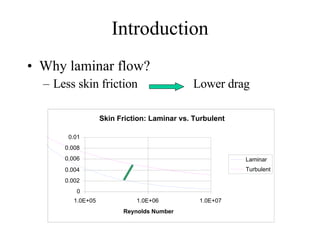
Introduction Why laminar flow? Less skin friction    Lower drag
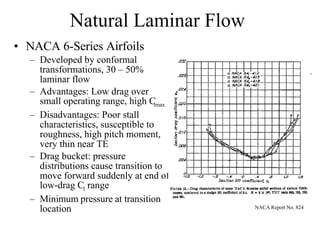
Natural Laminar Flow NACA 6-Series Airfoils Developed by conformal transformations, 30 – 50% laminar flow Advantages: Low drag over small operating range, high C lmax Disadvantages: Poor stall characteristics, susceptible to roughness, high pitch moment, very thin near TE Drag bucket: pressure distributions cause transition to move forward suddenly at end of low-drag C l  range Minimum pressure at transition location NACA Report No. 824
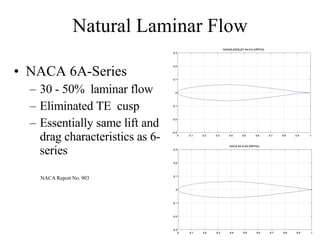
Natural Laminar Flow NACA 6A-Series 30 - 50%  laminar flow Eliminated TE  cusp Essentially same lift and drag characteristics as 6-series NACA Report No. 903
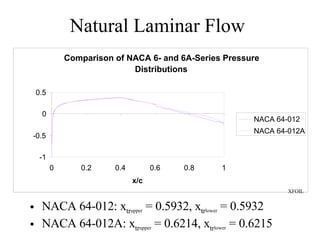
Natural Laminar Flow NACA 64-012: x tr upper  = 0.5932, x tr lower  = 0.5932 NACA 64-012A: x tr upper  = 0.6214, x tr lower  = 0.6215 XFOIL
Natural Laminar Flow NLF Airfoils Aft-loaded airfoils with cusp at TE (Wortmann or Eppler sailplane airfoils) Front-loaded airfoil sections with low pitching moments (Roncz-developed used on Rutan designs or canards) Also NASA NLF- and HSNLF-series, DU-, FX-, and HQ- airfoils Inverse airfoil design based on desired pressure distribution, capitalize on availability of composites Low speed and high speed applications Codes used for design include Eppler/Somers and PROFOIL Up to 65% laminar flow Drag as low as 30 counts 1. NASA Contractor Report No. 201686, 1997. 2. Lutz, “Airfoil Design and Optimization,” 2000. 3. Garrison, “Shape of Wings to Come,”  Flying  1984. 4. NASA Technical Memorandum 85788, 1984.
Natural Laminar Flow: Case Study SHM-1 Airfoil for the Honda Jet Lightweight business jet, airfoil inversely designed, tested in low-speed and transonic wind tunnels, and flight tested Designed to exactly match HJ requirements  High drag-divergence Mach number Small nose-down pitching moment Low drag for high cruise efficiency High C lmax Docile stall characteristics Insensitivity to LE contamination Fujino et al, “Natural-Laminar-Flow Airfoil Development for the Honda Jet.”
Natural Laminar Flow: Case Study (Continued) Requirements C lmax  = 1.6 for Re = 4.8x10 6 , M = 0.134 Loss of C l  less than 7% due to contamination C m  > -0.04 at C l  = 0.38, Re = 7.93x10 6 , M = 0.7 Airfoil thickness = 15% M DD  > 0.70 at C l  = 0.38 Low drag at cruise Fujino et al, “Natural-Laminar-Flow Airfoil Development for the Honda Jet.”
Natural Laminar Flow: Case Study (Continued) Design Method Eppler Airfoil Design and Analysis Code Conformal mapping, each section designed independently for different conditions MCARF and MSES Codes Analyzed and modified airfoil Improved C l max  and high speed characteristics Transition-location study Shock formation Drag divergence Fujino et al, “Natural-Laminar-Flow Airfoil Development for the Honda Jet.”
Natural Laminar Flow: Case Study (Continued) Resulting SHM-1 airfoil Favorable pressure gradient to 42%c upper surface, 63%c lower surface Concave pressure recovery (compromise between C lmax , C m , and M DD ) LE such that at high  α, transition near LE (roughness sensitivity) Short, shallow separation near TE for  C m Fujino et al, “Natural-Laminar-Flow Airfoil Development for the Honda Jet.”
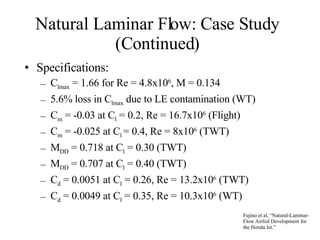
Natural Laminar Flow: Case Study (Continued) Specifications: C lmax  = 1.66 for Re = 4.8x10 6 , M = 0.134 5.6% loss in C lmax  due to LE contamination (WT) C m  = -0.03 at C l  = 0.2, Re = 16.7x10 6  (Flight) C m  = -0.025 at C l  = 0.4, Re = 8x10 6  (TWT) M DD  = 0.718 at C l  = 0.30 (TWT) M DD  = 0.707 at C l  = 0.40 (TWT) C d  = 0.0051 at C l  = 0.26, Re = 13.2x10 6  (TWT) C d  = 0.0049 at C l  = 0.35, Re = 10.3x10 6  (WT) Fujino et al, “Natural-Laminar-Flow Airfoil Development for the Honda Jet.”
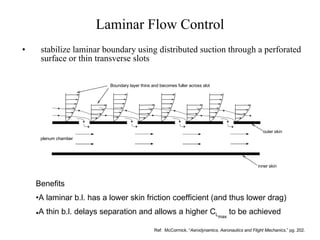
Laminar Flow Control stabilize laminar boundary using distributed suction through a perforated surface or thin transverse slots Benefits A laminar b.l. has a lower skin friction coefficient (and thus lower drag) A thin b.l. delays separation and allows a higher C L max  to be achieved Ref:  McCormick, “ Aerodynamics, Aeronautics and Flight Mechanics ,” pg. 202. plenum chamber outer skin inner skin Boundary layer thins and becomes fuller across slot
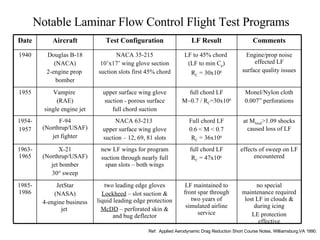
Notable Laminar Flow Control Flight Test Programs Ref:  Applied Aerodynamic Drag Reduction Short Course Notes, Williamsburg,VA 1990. effects of sweep on LF encountered full chord LF R C  = 47x10 6 new LF wings for program suction through nearly full span slots – both wings X-21 (Northrup/USAF) jet bomber 30 ° sweep 1963-1965 no special maintenance required lost LF in clouds & during icing LE protection effective LF maintained to front spar through two years of simulated airline service two leading edge gloves Lockheed  – slot suction & liquid leading edge protection McDD  – perforated skin & and bug deflector JetStar (NASA) 4-engine business jet  1985-1986 at M local >1.09 shocks caused loss of LF Full chord LF 0.6 < M < 0.7 R C  = 36x10 6 NACA 63-213  upper surface wing glove suction – 12, 69, 81 slots F-94 (Northrup/USAF) jet fighter 1954- 1957 Monel/Nylon cloth 0.007” perforations full chord LF M~0.7 / R C =30x10 6 upper surface wing glove suction - porous surface full chord suction Vampire  (RAE) single engine jet 1955 Engine/prop noise effected LF surface quality issues LF to 45% chord  (LF to min C p ) R C  = 30x10 6 NACA 35-215 10’x17’ wing glove section suction slots first 45% chord Douglas B-18 (NACA) 2-engine prop  bomber 1940 Comments LF Result Test Configuration Aircraft Date
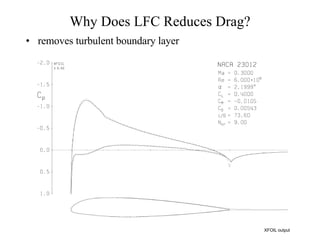
Why Does LFC Reduces Drag? removes turbulent boundary layer XFOIL output
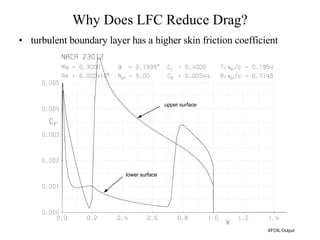
Why Does LFC Reduce Drag? turbulent boundary layer has a higher skin friction coefficient XFOIL Output upper surface lower surface
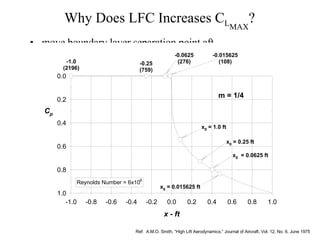
Why Does LFC Increases C L MAX ? move boundary layer separation point aft Ref:  A.M.O. Smith, “High Lift Aerodynamics,” Journal of Aircraft, Vol. 12, No. 6, June 1975
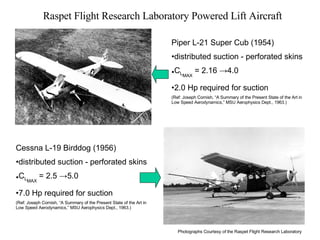
Raspet Flight Research Laboratory Powered Lift Aircraft Piper L-21 Super Cub (1954) distributed suction - perforated skins C L MAX  = 2.16  ->4.0 2.0 Hp required for suction (Ref: Joseph Cornish, “A Summary of the Present State of the Art in Low Speed Aerodynamics,” MSU Aerophysics Dept., 1963.) Cessna L-19 Birddog (1956) distributed suction - perforated skins C L MAX  = 2.5  ->5.0 7.0 Hp required for suction (Ref: Joseph Cornish, “A Summary of the Present State of the Art in Low Speed Aerodynamics,” MSU Aerophysics Dept., 1963.) Photographs Courtesy of the Raspet Flight Research Laboratory
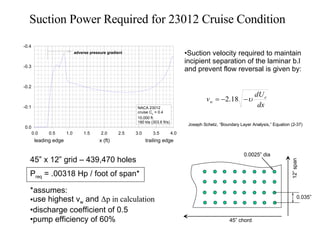
Suction Power Required for 23012 Cruise Condition Suction velocity required to maintain incipient separation of the laminar b.l  and prevent flow reversal is given by: Joseph Schetz, “Boundary Layer Analysis,” Equation (2-37) 0.035” 0.0025” dia 45” chord 12” span 45” x 12” grid – 439,470 holes P req  = .00318 Hp / foot of span* *assumes: use highest v w  and  Δ p in calculation discharge coefficient of 0.5 pump efficiency of 60%
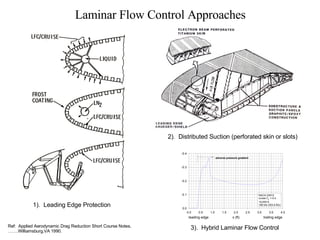
Laminar Flow Control Approaches 1).  Leading Edge Protection 2).  Distributed Suction (perforated skin or slots) 3).  Hybrid Laminar Flow Control Ref:  Applied Aerodynamic Drag Reduction Short Course Notes,  …….Williamsburg,VA 1990.
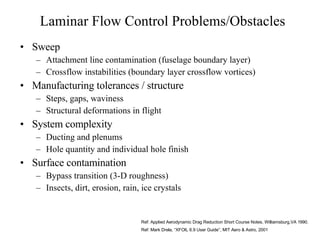
Laminar Flow Control Problems/Obstacles Sweep Attachment line contamination (fuselage boundary layer) Crossflow instabilities (boundary layer crossflow vortices) Manufacturing tolerances / structure Steps, gaps, waviness Structural deformations in flight System complexity Ducting and plenums Hole quantity and individual hole finish Surface contamination Bypass transition (3-D roughness) Insects, dirt, erosion, rain, ice crystals Ref: Applied Aerodynamic Drag Reduction Short Course Notes, Williamsburg,VA 1990. Ref: Mark Drela, “XFOIL 6.9 User Guide”, MIT Aero & Astro, 2001
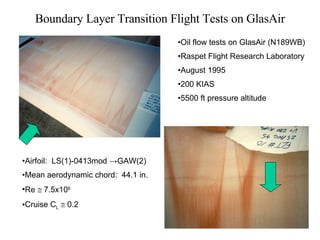
Boundary Layer Transition Flight Tests on GlasAir Oil flow tests on GlasAir (N189WB) Raspet Flight Research Laboratory  August 1995 200 KIAS 5500 ft pressure altitude Airfoil:  LS(1)-0413mod  ->GAW(2) Mean aerodynamic chord:  44.1 in. Re    7.5x10 6 Cruise C L     0.2
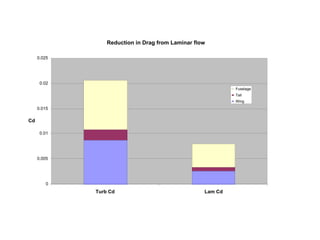
Drag Benefit of Laminar Flow
CENTURIA 4 Passenger Single Jet Engine GA Aircraft Competition Cirrus SR22 Cessna 182 Targets existing General Aviation pilots Cost ~ $750,000 International Senior Design Project Virginia Tech and Loughborough University
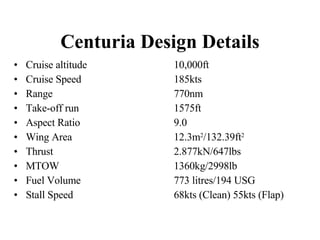
Centuria Design Details Cruise altitude 10,000ft Cruise Speed 185kts Range 770nm Take-off run   1575ft Aspect Ratio 9.0 Wing Area 12.3m 2 /132.39ft 2 Thrust 2.877kN/647lbs MTOW 1360kg/2998lb Fuel Volume 773 litres/194 USG Stall Speed 68kts (Clean) 55kts (Flap)
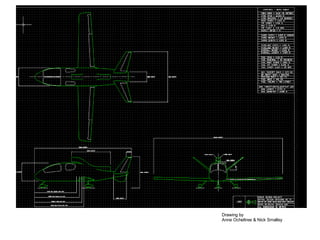
Drawing by  Anne Ocheltree & Nick Smalley
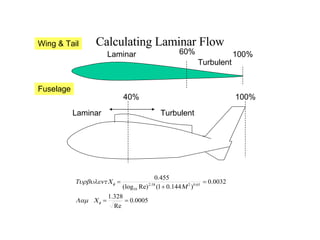
Calculating Laminar Flow 60% 100% Laminar Turbulent Laminar Turbulent Wing & Tail Fuselage 40% 100%
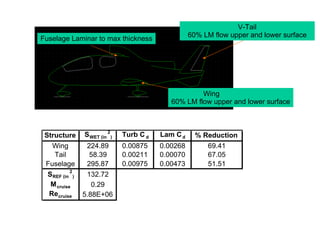
Fuselage Laminar to max thickness Wing 60% LM flow upper and lower surface V-Tail 60% LM flow upper and lower surface
 
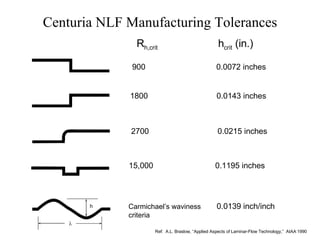
Centuria NLF Manufacturing Tolerances R h,crit   h crit  (in.) 900   0.0072 inches 1800   0.0143 inches 2700   0.0215 inches 15,000   0.1195 inches Carmichael’s waviness  0.0139 inch/inch criteria Ref:  A.L. Braslow, “Applied Aspects of Laminar-Flow Technology,”  AIAA 1990  h
Conclusions Natural Laminar Flow Improvement of materials and computational methods allows inverse airfoil design for desired characteristics or specific configurations Laminar Flow Control LFC is a mature technology that has yet to become commercially viable Drag Benefit on Centuria 61% reduction in skin friction drag due use of laminar flow on wings, tail and fuselage
References Abbott, I.,H., Von Doenhoff, A.,E., Stivers, L.,S., “Summary of Airfoil Data,” NACA Report 824, 1945. Loftin, L., K., “Theoretical and Experimental Data for a Number of NACA 6A-Series Airfoil Sections,” NACA Report 903, 1948. Drela, M., “XFOIL 6.9 User Guide,” MIT Aero & Astro, 2001. Green, Bradford, “An Approach to the Constrained Design of Natural Laminar Flow Airfoils,” NASA Contractor Report No. 201686, 1997. Lutz, Th.,”Airfoil Design and Optimization”, Institute of Aerodynamics and Gas Dynamics, University of Stuttgart, 2000. Garrison, P., “The Shape of Wings to Come,” Flying Magazine, November 1984. McGhee,R.,J., Viken, J.,K., Pfenninger, W., Beasley, W.,D., Harvey, W.,D., “Experimental Results for a Flapped Natural-Laminar-Flow Airfoil with High Lift/Drag Ratio,” NASA TM 85788, 1984. Fujino, M., Yoshizaki, Y., Kawamura, Y., “Natural-Laminar-Flow Airfoil Development for the Honda Jet,” AIAA 2003-2530, 2003. McCormick, B.,W.,  Aerodynamics, Aeronautics and Flight Mechanics , 2 nd  Edition, John Wiley & Sons, New York, 1995. “ Applied Aerodynamic Drag Reduction Short Course,” University of Kansas Division of Continuing Education, Williamsburg, VA 1990.  Smith, A.,M.,O., “High-Lift Aerodynamics,” Journal of Aircraft, Volume 12, Number 6, June 1975. Schetz, J.,A.,  Boundary Layer Analysis,  Prentice Hall, Upper Saddle River, New Jersey, 1993. Cornish, J.,J., “A Summary of the Present State of the Art in Low Speed Aerodynamics,” Mississippi State University Aerophysics Department Internal Memorandum, 1963. Raymer, D.,P.,  Aircraft Design: A Conceptual Approach , AIAA Education Series, 1989. Braslow, A.,L., Maddalon, D.,V., Bartlett, D.,W., Wagner, R.,D., Collier, F.,S., “Applied Aspects of Laminar-Flow Technology,” Appears in  Viscous Drag Reduction in Boundary Layers,  AIAA Progress in Astronautics and Aeronautics, Volume 123, 1990.

Laminarflow

  • 1.
    Laminar Flow RodneyBajnath, Beverly Beasley, Mike Cavanaugh AOE 4124 March 29, 2004
  • 2.
    Introduction Why laminarflow? Less skin friction Lower drag
  • 3.
    Natural Laminar FlowNACA 6-Series Airfoils Developed by conformal transformations, 30 – 50% laminar flow Advantages: Low drag over small operating range, high C lmax Disadvantages: Poor stall characteristics, susceptible to roughness, high pitch moment, very thin near TE Drag bucket: pressure distributions cause transition to move forward suddenly at end of low-drag C l range Minimum pressure at transition location NACA Report No. 824
  • 4.
    Natural Laminar FlowNACA 6A-Series 30 - 50% laminar flow Eliminated TE cusp Essentially same lift and drag characteristics as 6-series NACA Report No. 903
  • 5.
    Natural Laminar FlowNACA 64-012: x tr upper = 0.5932, x tr lower = 0.5932 NACA 64-012A: x tr upper = 0.6214, x tr lower = 0.6215 XFOIL
  • 6.
    Natural Laminar FlowNLF Airfoils Aft-loaded airfoils with cusp at TE (Wortmann or Eppler sailplane airfoils) Front-loaded airfoil sections with low pitching moments (Roncz-developed used on Rutan designs or canards) Also NASA NLF- and HSNLF-series, DU-, FX-, and HQ- airfoils Inverse airfoil design based on desired pressure distribution, capitalize on availability of composites Low speed and high speed applications Codes used for design include Eppler/Somers and PROFOIL Up to 65% laminar flow Drag as low as 30 counts 1. NASA Contractor Report No. 201686, 1997. 2. Lutz, “Airfoil Design and Optimization,” 2000. 3. Garrison, “Shape of Wings to Come,” Flying 1984. 4. NASA Technical Memorandum 85788, 1984.
  • 7.
    Natural Laminar Flow:Case Study SHM-1 Airfoil for the Honda Jet Lightweight business jet, airfoil inversely designed, tested in low-speed and transonic wind tunnels, and flight tested Designed to exactly match HJ requirements High drag-divergence Mach number Small nose-down pitching moment Low drag for high cruise efficiency High C lmax Docile stall characteristics Insensitivity to LE contamination Fujino et al, “Natural-Laminar-Flow Airfoil Development for the Honda Jet.”
  • 8.
    Natural Laminar Flow:Case Study (Continued) Requirements C lmax = 1.6 for Re = 4.8x10 6 , M = 0.134 Loss of C l less than 7% due to contamination C m > -0.04 at C l = 0.38, Re = 7.93x10 6 , M = 0.7 Airfoil thickness = 15% M DD > 0.70 at C l = 0.38 Low drag at cruise Fujino et al, “Natural-Laminar-Flow Airfoil Development for the Honda Jet.”
  • 9.
    Natural Laminar Flow:Case Study (Continued) Design Method Eppler Airfoil Design and Analysis Code Conformal mapping, each section designed independently for different conditions MCARF and MSES Codes Analyzed and modified airfoil Improved C l max and high speed characteristics Transition-location study Shock formation Drag divergence Fujino et al, “Natural-Laminar-Flow Airfoil Development for the Honda Jet.”
  • 10.
    Natural Laminar Flow:Case Study (Continued) Resulting SHM-1 airfoil Favorable pressure gradient to 42%c upper surface, 63%c lower surface Concave pressure recovery (compromise between C lmax , C m , and M DD ) LE such that at high α, transition near LE (roughness sensitivity) Short, shallow separation near TE for C m Fujino et al, “Natural-Laminar-Flow Airfoil Development for the Honda Jet.”
  • 11.
    Natural Laminar Flow:Case Study (Continued) Specifications: C lmax = 1.66 for Re = 4.8x10 6 , M = 0.134 5.6% loss in C lmax due to LE contamination (WT) C m = -0.03 at C l = 0.2, Re = 16.7x10 6 (Flight) C m = -0.025 at C l = 0.4, Re = 8x10 6 (TWT) M DD = 0.718 at C l = 0.30 (TWT) M DD = 0.707 at C l = 0.40 (TWT) C d = 0.0051 at C l = 0.26, Re = 13.2x10 6 (TWT) C d = 0.0049 at C l = 0.35, Re = 10.3x10 6 (WT) Fujino et al, “Natural-Laminar-Flow Airfoil Development for the Honda Jet.”
  • 12.
    Laminar Flow Controlstabilize laminar boundary using distributed suction through a perforated surface or thin transverse slots Benefits A laminar b.l. has a lower skin friction coefficient (and thus lower drag) A thin b.l. delays separation and allows a higher C L max to be achieved Ref: McCormick, “ Aerodynamics, Aeronautics and Flight Mechanics ,” pg. 202. plenum chamber outer skin inner skin Boundary layer thins and becomes fuller across slot
  • 13.
    Notable Laminar FlowControl Flight Test Programs Ref: Applied Aerodynamic Drag Reduction Short Course Notes, Williamsburg,VA 1990. effects of sweep on LF encountered full chord LF R C = 47x10 6 new LF wings for program suction through nearly full span slots – both wings X-21 (Northrup/USAF) jet bomber 30 ° sweep 1963-1965 no special maintenance required lost LF in clouds & during icing LE protection effective LF maintained to front spar through two years of simulated airline service two leading edge gloves Lockheed – slot suction & liquid leading edge protection McDD – perforated skin & and bug deflector JetStar (NASA) 4-engine business jet 1985-1986 at M local >1.09 shocks caused loss of LF Full chord LF 0.6 < M < 0.7 R C = 36x10 6 NACA 63-213 upper surface wing glove suction – 12, 69, 81 slots F-94 (Northrup/USAF) jet fighter 1954- 1957 Monel/Nylon cloth 0.007” perforations full chord LF M~0.7 / R C =30x10 6 upper surface wing glove suction - porous surface full chord suction Vampire (RAE) single engine jet 1955 Engine/prop noise effected LF surface quality issues LF to 45% chord (LF to min C p ) R C = 30x10 6 NACA 35-215 10’x17’ wing glove section suction slots first 45% chord Douglas B-18 (NACA) 2-engine prop bomber 1940 Comments LF Result Test Configuration Aircraft Date
  • 14.
    Why Does LFCReduces Drag? removes turbulent boundary layer XFOIL output
  • 15.
    Why Does LFCReduce Drag? turbulent boundary layer has a higher skin friction coefficient XFOIL Output upper surface lower surface
  • 16.
    Why Does LFCIncreases C L MAX ? move boundary layer separation point aft Ref: A.M.O. Smith, “High Lift Aerodynamics,” Journal of Aircraft, Vol. 12, No. 6, June 1975
  • 17.
    Raspet Flight ResearchLaboratory Powered Lift Aircraft Piper L-21 Super Cub (1954) distributed suction - perforated skins C L MAX = 2.16 ->4.0 2.0 Hp required for suction (Ref: Joseph Cornish, “A Summary of the Present State of the Art in Low Speed Aerodynamics,” MSU Aerophysics Dept., 1963.) Cessna L-19 Birddog (1956) distributed suction - perforated skins C L MAX = 2.5 ->5.0 7.0 Hp required for suction (Ref: Joseph Cornish, “A Summary of the Present State of the Art in Low Speed Aerodynamics,” MSU Aerophysics Dept., 1963.) Photographs Courtesy of the Raspet Flight Research Laboratory
  • 18.
    Suction Power Requiredfor 23012 Cruise Condition Suction velocity required to maintain incipient separation of the laminar b.l and prevent flow reversal is given by: Joseph Schetz, “Boundary Layer Analysis,” Equation (2-37) 0.035” 0.0025” dia 45” chord 12” span 45” x 12” grid – 439,470 holes P req = .00318 Hp / foot of span* *assumes: use highest v w and Δ p in calculation discharge coefficient of 0.5 pump efficiency of 60%
  • 19.
    Laminar Flow ControlApproaches 1). Leading Edge Protection 2). Distributed Suction (perforated skin or slots) 3). Hybrid Laminar Flow Control Ref: Applied Aerodynamic Drag Reduction Short Course Notes, …….Williamsburg,VA 1990.
  • 20.
    Laminar Flow ControlProblems/Obstacles Sweep Attachment line contamination (fuselage boundary layer) Crossflow instabilities (boundary layer crossflow vortices) Manufacturing tolerances / structure Steps, gaps, waviness Structural deformations in flight System complexity Ducting and plenums Hole quantity and individual hole finish Surface contamination Bypass transition (3-D roughness) Insects, dirt, erosion, rain, ice crystals Ref: Applied Aerodynamic Drag Reduction Short Course Notes, Williamsburg,VA 1990. Ref: Mark Drela, “XFOIL 6.9 User Guide”, MIT Aero & Astro, 2001
  • 21.
    Boundary Layer TransitionFlight Tests on GlasAir Oil flow tests on GlasAir (N189WB) Raspet Flight Research Laboratory August 1995 200 KIAS 5500 ft pressure altitude Airfoil: LS(1)-0413mod ->GAW(2) Mean aerodynamic chord: 44.1 in. Re  7.5x10 6 Cruise C L  0.2
  • 22.
    Drag Benefit ofLaminar Flow
  • 23.
    CENTURIA 4 PassengerSingle Jet Engine GA Aircraft Competition Cirrus SR22 Cessna 182 Targets existing General Aviation pilots Cost ~ $750,000 International Senior Design Project Virginia Tech and Loughborough University
  • 24.
    Centuria Design DetailsCruise altitude 10,000ft Cruise Speed 185kts Range 770nm Take-off run 1575ft Aspect Ratio 9.0 Wing Area 12.3m 2 /132.39ft 2 Thrust 2.877kN/647lbs MTOW 1360kg/2998lb Fuel Volume 773 litres/194 USG Stall Speed 68kts (Clean) 55kts (Flap)
  • 25.
    Drawing by Anne Ocheltree & Nick Smalley
  • 26.
    Calculating Laminar Flow60% 100% Laminar Turbulent Laminar Turbulent Wing & Tail Fuselage 40% 100%
  • 27.
    Fuselage Laminar tomax thickness Wing 60% LM flow upper and lower surface V-Tail 60% LM flow upper and lower surface
  • 28.
  • 29.
    Centuria NLF ManufacturingTolerances R h,crit h crit (in.) 900 0.0072 inches 1800 0.0143 inches 2700 0.0215 inches 15,000 0.1195 inches Carmichael’s waviness 0.0139 inch/inch criteria Ref: A.L. Braslow, “Applied Aspects of Laminar-Flow Technology,” AIAA 1990  h
  • 30.
    Conclusions Natural LaminarFlow Improvement of materials and computational methods allows inverse airfoil design for desired characteristics or specific configurations Laminar Flow Control LFC is a mature technology that has yet to become commercially viable Drag Benefit on Centuria 61% reduction in skin friction drag due use of laminar flow on wings, tail and fuselage
  • 31.
    References Abbott, I.,H.,Von Doenhoff, A.,E., Stivers, L.,S., “Summary of Airfoil Data,” NACA Report 824, 1945. Loftin, L., K., “Theoretical and Experimental Data for a Number of NACA 6A-Series Airfoil Sections,” NACA Report 903, 1948. Drela, M., “XFOIL 6.9 User Guide,” MIT Aero & Astro, 2001. Green, Bradford, “An Approach to the Constrained Design of Natural Laminar Flow Airfoils,” NASA Contractor Report No. 201686, 1997. Lutz, Th.,”Airfoil Design and Optimization”, Institute of Aerodynamics and Gas Dynamics, University of Stuttgart, 2000. Garrison, P., “The Shape of Wings to Come,” Flying Magazine, November 1984. McGhee,R.,J., Viken, J.,K., Pfenninger, W., Beasley, W.,D., Harvey, W.,D., “Experimental Results for a Flapped Natural-Laminar-Flow Airfoil with High Lift/Drag Ratio,” NASA TM 85788, 1984. Fujino, M., Yoshizaki, Y., Kawamura, Y., “Natural-Laminar-Flow Airfoil Development for the Honda Jet,” AIAA 2003-2530, 2003. McCormick, B.,W., Aerodynamics, Aeronautics and Flight Mechanics , 2 nd Edition, John Wiley & Sons, New York, 1995. “ Applied Aerodynamic Drag Reduction Short Course,” University of Kansas Division of Continuing Education, Williamsburg, VA 1990. Smith, A.,M.,O., “High-Lift Aerodynamics,” Journal of Aircraft, Volume 12, Number 6, June 1975. Schetz, J.,A., Boundary Layer Analysis, Prentice Hall, Upper Saddle River, New Jersey, 1993. Cornish, J.,J., “A Summary of the Present State of the Art in Low Speed Aerodynamics,” Mississippi State University Aerophysics Department Internal Memorandum, 1963. Raymer, D.,P., Aircraft Design: A Conceptual Approach , AIAA Education Series, 1989. Braslow, A.,L., Maddalon, D.,V., Bartlett, D.,W., Wagner, R.,D., Collier, F.,S., “Applied Aspects of Laminar-Flow Technology,” Appears in Viscous Drag Reduction in Boundary Layers, AIAA Progress in Astronautics and Aeronautics, Volume 123, 1990.