Introduction Of Lac Operon Model
lac operon (lactose operon) is an operon required for the transport and metabolism of lactose in
Escherichia coli and many other enteric bacteria. Although glucose is the preferred carbon source
for most bacteria, the lac operon allows for the effective digestion of lactose when glucose is not
available. Gene regulation of the lac operon was the first genetic regulatory mechanism to be
understood clearly, so it has become a foremost example of prokaryotic gene regulation. It is
often discussed in introductory molecular and cellular biology classes at universities for this
reason.
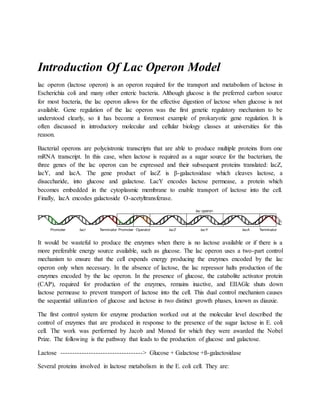
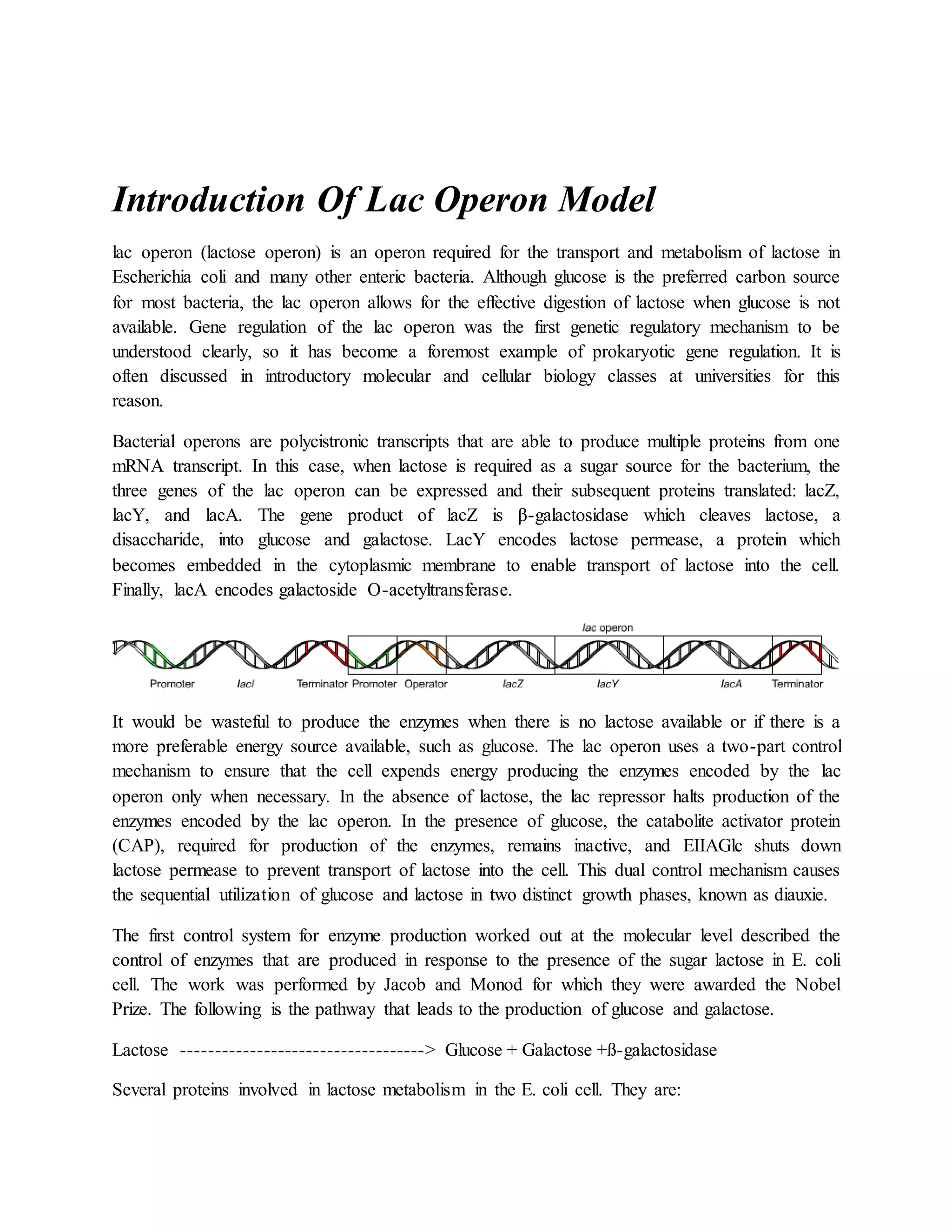
Bacterial operons are polycistronic transcripts that are able to produce multiple proteins from one
mRNA transcript. In this case, when lactose is required as a sugar source for the bacterium, the
three genes of the lac operon can be expressed and their subsequent proteins translated: lacZ,
lacY, and lacA. The gene product of lacZ is β-galactosidase which cleaves lactose, a
disaccharide, into glucose and galactose. LacY encodes lactose permease, a protein which
becomes embedded in the cytoplasmic membrane to enable transport of lactose into the cell.
Finally, lacA encodes galactoside O-acetyltransferase.
It would be wasteful to produce the enzymes when there is no lactose available or if there is a
more preferable energy source available, such as glucose. The lac operon uses a two-part control
mechanism to ensure that the cell expends energy producing the enzymes encoded by the lac
operon only when necessary. In the absence of lactose, the lac repressor halts production of the
enzymes encoded by the lac operon. In the presence of glucose, the catabolite activator protein
(CAP), required for production of the enzymes, remains inactive, and EIIAGlc shuts down
lactose permease to prevent transport of lactose into the cell. This dual control mechanism causes
the sequential utilization of glucose and lactose in two distinct growth phases, known as diauxie.
The first control system for enzyme production worked out at the molecular level described the
control of enzymes that are produced in response to the presence of the sugar lactose in E. coli
cell. The work was performed by Jacob and Monod for which they were awarded the Nobel
Prize. The following is the pathway that leads to the production of glucose and galactose.
Lactose -----------------------------------> Glucose + Galactose +ß-galactosidase
Several proteins involved in lactose metabolism in the E. coli cell. They are:
ß-galactosidase - converts lactose into glucose and galactose
ß-galactosidepermease - transports lactose into the cell
ß-galactosidetransacetylase - function unknown
Research with this system was greatly added by the availability of constitutive mutants. A
constitutive mutant is one in which the gene product is produced continually, that is there is no
control over its expression. In these mutants, the above proteins were produced all the time in
comparison to the wild type where the proteins only appeared in the presence of lactose. So in
these mutants, the mutation must be a gene other than those responsible for the structural genes.
All of the genes involved in controlling this pathway are located next to each other on the E. coli
chromosome. Together they form an operon. The following is the genetic structure of the operon.
Operon - a cluster of structural genes that are expressed as a group and their associated promoter
and operator
How does the system work? Without lactose in the cell, the repressor protein binds to the
operator and prevents the read through of RNA polymerase into the three structural genes. With
lactose in the cell, lactose binds to the repressor. This causes a structural change in the repressor
and it loses its affinity for the operator. Thus RNA polymerase can then bind to the promoter and
transcribe the structural genes. In this system lactose acts as an effector molecule. Effector
molecule - a molecule that interacts with the repressor and affects the affinity of the repressor for
the operatorWith the above information, we can now predict the effect that various mutants will
have on lac operon gene expression.
Catabolite Repression of the lac Operon
Lactose is not the preferred carbohydrate source for E. coli. If lactose and glucose are present,
the cell will use all of the glucose before the lac operon is turned on. This type of control is
termed catabolite repression. To prevent lactose metabolism, a second level of control of gene
expression exists. The promoter of the lac operon has two binding sites. One site is the location
where RNA polymerase binds. The second location is the binding site for a complex between the
catabolite activator protein (CAP) and cyclic AMP (cAMP). The binding of the CAP-cAMP
complex to the promoter site is required for transcription of the lac operon. The presence of this
complex is closely associated with the presence of glucose in the cell. As the concentration of
glucose increases the amount of cAMP decreases. As the cAMP decreases, the amount of
complex decreases. This decrease in the complex inactivates the promoter, and the lac operon is
turned off. Because the CAP-cAMP complex is needed for transcription, the complex exerts a
positive control over the expression of the lac operon.
Genetic nomenclature
Three-letter abbreviations are used to describe phenotypes in bacteria including E. coli.
Examples include:
Lac (the ability to use lactose),
His (the ability to synthesize the amino acid histidine)
Mot (swimming motility)
SmR (resistance to the antibiotic streptomycin)
In the case of Lac, wild type cells are Lac+ and are able to use lactose as a carbon and energy
source, while Lac− mutant derivatives cannot use lactose. The same three letters are typically
used (lower-case, italicized) to label the genes involved in a particular phenotype, where each
different gene is additionally distinguished by an extra letter. The lac genes encoding enzymes
are lacZ, lacY, and lacA. The fourth lac gene is lacI, encoding the lactose repressor—"I" stands
for inducibility.
One may distinguish between structural genes encoding enzymes, and regulatory genes encoding
proteins that affect gene expression. Current usage expands the phenotypic nomenclature to
apply to proteins: thus, LacZ is the protein product of the lacZ gene, β-galactosidase. Various
short sequences that are not genes also affect gene expression, including the lac promoter, lac p,
and the lac operator, lac o. Although it is not strictly standard usage, mutations affecting lac o are
referred to as lac oc, for historical reasons.
GENE REGULATION
Prokaryotic as well as eukaryotic organisms possess differentmechanisms to
control the regulation of their genes. Cells need to be efficient and avoid wasting
energy in the production of unnecessary proteins. Mostof these mechanims take
place at the transcriptionallevel. Gene regulation can be negative or positive.
In negative regulation, a repressor moleculebinds to the operator of an operon
and terminates transcription.
In positiveregulation, an activator interacts with the RNA polymerasein the
promoter region to initiate transcription.
The lac operon is an example of negative regulation.
Regulation can occur at all levels:
1. multiple genes
2. promoter efficiency
3. mRNA stability
4. Translation
5. posttranslational modification
6. protein stability
Regulation of transcription
Regulation of transcription is especially effective because mRNA typically has a
shorthalf life (1.8 minutes in E. coli) so stopping mRNA synthesis leads to rapid
changes in protein synthesis.
Ittakes lots of energy to make mRNAs (and proteins).
The Lac Operon has to do with the ability of E. coli to utilize the sugar lactose.
Lactose is a 12 Carbon sugar made of 2 simpler 6 carbon sugars, glucoseand
galactose. Glucoseis a very efficient carbon source; it can enter directly into the
metabolic paths that provideboth energy and substrates for making more
complex compounds. If lactoseis provided as the carbon source,itmust firstbe
broken down into the two componentsugars beforeit can be used. The enzyme
for breaking down lactose in E. coli is called β-galactosidase.
Lac-Operon components
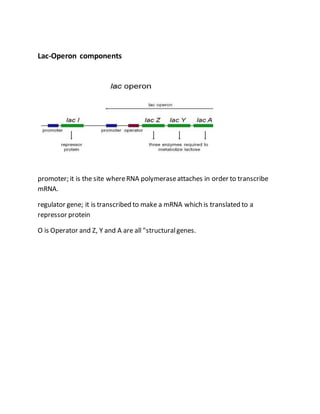
promoter; it is the site whereRNA polymeraseattaches in order to transcribe
mRNA.
regulator gene; it is transcribed to make a mRNA which is translated to a
repressor protein
O is Operator and Z, Y and A are all "structuralgenes.

Lac operon model

  • 1.
    Introduction Of LacOperon Model lac operon (lactose operon) is an operon required for the transport and metabolism of lactose in Escherichia coli and many other enteric bacteria. Although glucose is the preferred carbon source for most bacteria, the lac operon allows for the effective digestion of lactose when glucose is not available. Gene regulation of the lac operon was the first genetic regulatory mechanism to be understood clearly, so it has become a foremost example of prokaryotic gene regulation. It is often discussed in introductory molecular and cellular biology classes at universities for this reason. Bacterial operons are polycistronic transcripts that are able to produce multiple proteins from one mRNA transcript. In this case, when lactose is required as a sugar source for the bacterium, the three genes of the lac operon can be expressed and their subsequent proteins translated: lacZ, lacY, and lacA. The gene product of lacZ is β-galactosidase which cleaves lactose, a disaccharide, into glucose and galactose. LacY encodes lactose permease, a protein which becomes embedded in the cytoplasmic membrane to enable transport of lactose into the cell. Finally, lacA encodes galactoside O-acetyltransferase. It would be wasteful to produce the enzymes when there is no lactose available or if there is a more preferable energy source available, such as glucose. The lac operon uses a two-part control mechanism to ensure that the cell expends energy producing the enzymes encoded by the lac operon only when necessary. In the absence of lactose, the lac repressor halts production of the enzymes encoded by the lac operon. In the presence of glucose, the catabolite activator protein (CAP), required for production of the enzymes, remains inactive, and EIIAGlc shuts down lactose permease to prevent transport of lactose into the cell. This dual control mechanism causes the sequential utilization of glucose and lactose in two distinct growth phases, known as diauxie. The first control system for enzyme production worked out at the molecular level described the control of enzymes that are produced in response to the presence of the sugar lactose in E. coli cell. The work was performed by Jacob and Monod for which they were awarded the Nobel Prize. The following is the pathway that leads to the production of glucose and galactose. Lactose -----------------------------------> Glucose + Galactose +ß-galactosidase Several proteins involved in lactose metabolism in the E. coli cell. They are:
  • 2.
    ß-galactosidase - convertslactose into glucose and galactose ß-galactosidepermease - transports lactose into the cell ß-galactosidetransacetylase - function unknown Research with this system was greatly added by the availability of constitutive mutants. A constitutive mutant is one in which the gene product is produced continually, that is there is no control over its expression. In these mutants, the above proteins were produced all the time in comparison to the wild type where the proteins only appeared in the presence of lactose. So in these mutants, the mutation must be a gene other than those responsible for the structural genes. All of the genes involved in controlling this pathway are located next to each other on the E. coli chromosome. Together they form an operon. The following is the genetic structure of the operon. Operon - a cluster of structural genes that are expressed as a group and their associated promoter and operator How does the system work? Without lactose in the cell, the repressor protein binds to the operator and prevents the read through of RNA polymerase into the three structural genes. With lactose in the cell, lactose binds to the repressor. This causes a structural change in the repressor and it loses its affinity for the operator. Thus RNA polymerase can then bind to the promoter and transcribe the structural genes. In this system lactose acts as an effector molecule. Effector molecule - a molecule that interacts with the repressor and affects the affinity of the repressor for the operatorWith the above information, we can now predict the effect that various mutants will have on lac operon gene expression. Catabolite Repression of the lac Operon Lactose is not the preferred carbohydrate source for E. coli. If lactose and glucose are present, the cell will use all of the glucose before the lac operon is turned on. This type of control is termed catabolite repression. To prevent lactose metabolism, a second level of control of gene expression exists. The promoter of the lac operon has two binding sites. One site is the location where RNA polymerase binds. The second location is the binding site for a complex between the catabolite activator protein (CAP) and cyclic AMP (cAMP). The binding of the CAP-cAMP complex to the promoter site is required for transcription of the lac operon. The presence of this complex is closely associated with the presence of glucose in the cell. As the concentration of glucose increases the amount of cAMP decreases. As the cAMP decreases, the amount of complex decreases. This decrease in the complex inactivates the promoter, and the lac operon is turned off. Because the CAP-cAMP complex is needed for transcription, the complex exerts a positive control over the expression of the lac operon.
  • 3.
    Genetic nomenclature Three-letter abbreviationsare used to describe phenotypes in bacteria including E. coli. Examples include: Lac (the ability to use lactose), His (the ability to synthesize the amino acid histidine) Mot (swimming motility) SmR (resistance to the antibiotic streptomycin) In the case of Lac, wild type cells are Lac+ and are able to use lactose as a carbon and energy source, while Lac− mutant derivatives cannot use lactose. The same three letters are typically used (lower-case, italicized) to label the genes involved in a particular phenotype, where each different gene is additionally distinguished by an extra letter. The lac genes encoding enzymes are lacZ, lacY, and lacA. The fourth lac gene is lacI, encoding the lactose repressor—"I" stands for inducibility. One may distinguish between structural genes encoding enzymes, and regulatory genes encoding proteins that affect gene expression. Current usage expands the phenotypic nomenclature to apply to proteins: thus, LacZ is the protein product of the lacZ gene, β-galactosidase. Various short sequences that are not genes also affect gene expression, including the lac promoter, lac p, and the lac operator, lac o. Although it is not strictly standard usage, mutations affecting lac o are referred to as lac oc, for historical reasons. GENE REGULATION Prokaryotic as well as eukaryotic organisms possess differentmechanisms to control the regulation of their genes. Cells need to be efficient and avoid wasting energy in the production of unnecessary proteins. Mostof these mechanims take place at the transcriptionallevel. Gene regulation can be negative or positive. In negative regulation, a repressor moleculebinds to the operator of an operon and terminates transcription.
  • 4.
    In positiveregulation, anactivator interacts with the RNA polymerasein the promoter region to initiate transcription. The lac operon is an example of negative regulation. Regulation can occur at all levels: 1. multiple genes 2. promoter efficiency 3. mRNA stability 4. Translation 5. posttranslational modification 6. protein stability Regulation of transcription Regulation of transcription is especially effective because mRNA typically has a shorthalf life (1.8 minutes in E. coli) so stopping mRNA synthesis leads to rapid changes in protein synthesis. Ittakes lots of energy to make mRNAs (and proteins). The Lac Operon has to do with the ability of E. coli to utilize the sugar lactose. Lactose is a 12 Carbon sugar made of 2 simpler 6 carbon sugars, glucoseand galactose. Glucoseis a very efficient carbon source; it can enter directly into the metabolic paths that provideboth energy and substrates for making more complex compounds. If lactoseis provided as the carbon source,itmust firstbe broken down into the two componentsugars beforeit can be used. The enzyme for breaking down lactose in E. coli is called β-galactosidase.
  • 5.
    Lac-Operon components promoter; itis the site whereRNA polymeraseattaches in order to transcribe mRNA. regulator gene; it is transcribed to make a mRNA which is translated to a repressor protein O is Operator and Z, Y and A are all "structuralgenes.