SLSMLS:LABMANAGER
1
Lab Manager
Do you ever feel you were unprepared for a career as Laboratory Manager?
You chose the scientific profession
because you were fascinated with the
world around you and wanted to
discover on a molecular level the
ways in which life exists. Additionally,
you wanted the freedom to choose
your own field of research and study
what interests you most.
You long to be at the heart of the lab
— directing experiments, analyzing
data and writing papers — but you
find yourself caught up in other tasks
— ordering reagents, dealing with a
troubled graduate student, attending
yet another committee meeting,
anything but bench research.
You have found that being the head of the lab is more than just making big discoveries; it is
about managing a small business. Lab-management skills, while used every day by
scientists, are not directly taught to young scientists. Rather, they are learned secondhand.
While much is to be learned from this follow-by-example approach, it has its limits. We have
all heard horror stories of principal investigators with poor leadership and organization
skills, but how can we keep from becoming a character in one of these stories?
Top 10 lab-management tips
1. You can learn management skills.
2. Have a five-year plan for your lab.
3. Set clear standards and expectations.
4. Optimize your management style for each lab member.
5. Listen to your lab members.
6. Walk around the lab daily.
7. Learn when to say no.
8. Be prepared when small amounts of free time become available.
9. Get to know the people at your institution who can help you.
10. Celebrate successes with your lab.
Lab management can and should be learned in a more directed manner
SLSMLS:LABMANAGER
2
“Laboratory managers are often promoted from the ranks of the technical staff,” says
Rodney Forsman, the immediate past president of the Clinical Laboratory Management
Association and an assistant professor emeritus at the Mayo Clinic College of Medicine in
Rochester, Minn. “If an individual has the capacity to learn the science of laboratory
medicine, they can learn the necessary management skills, given the desire and aptitude to
do so.”
Management skills are important for science careers of all types. Whether you work at the
bench or away, the ability to organize your work and supervise those under you is critical.
Management can be divided into four main categories:
1. Planning allows a lab manager to know where the lab is going.
2. Organizing is also an important job for a lab manager as he or she determines who does
which project and technique, manages the timelines and budgets for multiple projects,
and keeps current with research in the fields.
3. Leadership is extremely important for a lab manager, as it often sets the environment
and pace of the lab. Good leadership can inspire lab members toward productivity and
creativity and help members work together.
4. Controlling a lab involves the evaluation of lab members’ and projects’ progress and the
ability to correct problems as they arise.
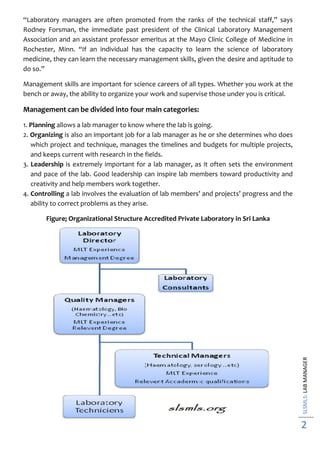
Figure; Organizational Structure Accredited Private Laboratory in Sri Lanka
SLSMLS:LABMANAGER
3
Planning: considering the big picture
With all the responsibilities that lab management entails, it is easy to make sure the T’s get
crossed but to lose sight of the bigger goal.
“Self-awareness is vital in time management! It is so easy to believe that you are being
productive when you are merely being busy,” says Kathy Barker, author of “At the Helm: A
Laboratory Navigator,” a book that instructs new investigators in lab management. “Being
able to stand back and truly assess your effectiveness is hard, but it is the only way to make
every day count.”
A common suggestion from the experts interviewed was to have a five-year strategy. In a
study by McKinsey & Company, all successful, thriving labs utilized three- to five-year plans.
While lab members need technical skills to complete individual experiments, it is the lab
manager’s job to ensure that all experiments are aimed toward a common goal. The ability
to see the bigger picture allows lab members to evaluate a project’s progress and
determine future projects, manuscripts and grants. A five-year plan allows you to gauge the
progress of your research and keep it goal-oriented.
Once you know where you want your research to be, you can plan experiments much more
efficiently. This becomes especially important when a lab is managing multiple grants of
varying lengths. Having a long-term plan also is helpful for tenure-track faculty so they can
stay on schedule and achieve the requirements needed for tenure in the appropriate time.
“Perhaps scientists don’t create five-year plans because they don’t think they need to: They
are overwhelmed with detail and trust that, as they take care of the day-to-day details, the
path will emerge. It usually doesn’t. It just becomes more obscured with endless tasks,”
Barker says.
Similarly, a mission statement can guide a lab and keep it on track. “A mission statement
helps to remind the PI of what her priorities are,” Barker says. “It is hard to keep your eyes
on the prize with all the personnel, funding and administrative decisions that have to be
made daily. Reminding yourself that your mission is, say, children’s health or the mentoring
of young scientists helps you to recognize what tasks will help you fulfill your plans and so
be more productive.”
Write a mission statement that will help you and your lab members remember, when things
get tough, why you are in science and why your project is important.
Also, scientists love to ask questions, but sometimes that can lead researchers down rabbit
holes. A mission statement can guide you in experiment planning so that time is not wasted
pursuing trivial or tangential research.
SLSMLS:LABMANAGER
4
Organization: more than a clean desk
Organization takes a number of forms in lab management. Time, people and your physical
lab space must be organized and orderly for research to run smoothly. There never will be
enough time in the day to complete all the tasks you hope to accomplish, so it is important
to know when to say no.
While an open relationship with lab members is encouraged, sometimes you need to close
your office door. “With time and experience, you should develop the ability to better know
what requests will help you in your research and career and which ones will impede you,”
Barker says. “You get better at looking into the future to see that you might get no
immediate benefit to agreeing to be on a certain committee but that in six months you
might gain a chance at more graduate students or a better relationship with an
administrator.”
Lab meetings are a great way to help keep a group of people organized and focused on
their goals. Meetings with the whole group allow lab members and the PI to remain
informed of events within the lab. They also can be a good forum for brainstorming and
troubleshooting.
The McKinsey & Company study of successful labs also found that top labs have regular lab
meetings, both formal and informal. One-on-one meetings also are important for both the
lab member and the PI, as experiments and issues can be discussed in greater detail.
However, lab meetings can become an inefficient use of time if they are not organized.
Having a meeting agenda can keep conversations on track and avoid the need for multiple
meetings about a single issue. Records of lab meetings also can be used to measure
research progress.
Leading by design
Many of the scientists and managers interviewed noted that not all successful leaders are
the same. The first step toward reaching your leadership potential is to recognize your
leadership style.
Multiple resources exist online that allow you to recognize and analyze the way you lead.
Then you can focus on the strengths and weaknesses of that leadership style and work to
improve it.
Additionally, you can compare the type of leader you actually are to the kind you would like
to be. “It is advantageous to identify a successful mentor who can not only be a model for
your behavior but a sounding board for issues you may not have dealt with previously,”
Forsman says. ”The mentor should have experience beyond the laboratory, especially in
dealing with organizational protocol and key individuals outside the laboratory.”
SLSMLS:LABMANAGER
5
On a related note, many people emphasized that lab managers should walk the talk. In
other words, do what you say. This action builds trust and respect from colleagues and
fellow scientists. If you desire students to be in the lab from 8 to 5, they are far more likely
to do so if you are also there from 8 to 5. Lorsch gives an example: “I give a practice talk for
my group for every new lecture I make and ask them for (and take) their feedback. That
way, when I make them give practice talks and get feedback, they know I am not asking
them to do something that I don’t do.”
Most of the experts emphasized the importance of listening. A good leader not only directs
lab members and tells them what to do, but he or she also listens to his or her employees.
“Make sure you are not the person doing most of the talking at lab meeting,” Lorsch says.
“If you are, there is a problem.” Instead, he suggests that you empower senior members of
the staff to teach and mentor junior members.
Taking time to listen is also important because a lot can be gained from your lab members.
One way to do this is to organize brainstorming sessions. “This gets creativity flowing,
empowers people to think about new research directions for themselves and the rest of
the group, and often generates good ideas,” Lorsch says. Not only does this make lab
members feel appreciated, but it also provides them with a learning experience. Most
importantly, it gives you a different perspective on your research than you would have if
you worked in isolation.
Lastly, know when to relax and have fun. Taking time to celebrate as a lab is great for
morale and can act as an incentive to reach lab goals. Science is full of disappointments,
and perseverance is essential for survival. Taking time to relax and enjoy your
accomplishments will give lab members and you the energy to continue. “Have a sense of
humor,” Lorsch says. “This is probably the most important advice I can give.”
Controlling: making sure your employees succeed
Managing a lab means that there are times when things go wrong and you are expected to
fix it.
“Managers often lament that ‘all problems come in on two feet,’ which highlights the
importance of honing your people skills,” says Forsman.
One of the best ways to prevent issues with employees is to be clear about standards and
expectations from the start. Every lab member comes from a different background. Most
of the issues rise from a lack of communication about expectations. Without clear
expectations, you cannot expect lab members to do something just how you like it. It is
equally important for lab standards to be maintained, or they will not be followed.
SLSMLS:LABMANAGER
6
DeFrank and Lorsch both suggest motivating lab members through rewards rather than
fear. “When people are doing well, make sure you tell them so,” Lorsch says. “When things
are going slowly, make sure you give encouragement along with advice.” People are more
likely to be productive and create high-quality work when they are happy and working
toward a goal rather than fearing punishment. As Barker puts it, “share interests, not
issues.” These rewards do not need to be significant or monetary; what matters is that they
are sincere.
Lastly, try to give lab members a sense of control over their work. Many grad students want
to have labs of their own one day, and experiment planning is a skill they need to learn
now. Additionally, a sense of pride and ownership can go a long way to motivate
employees while freeing you to spend time on other issues.
If you don’t have your own lab yet, begin learning about lab management now. While you
may not run a whole lab, your boss will give you smaller tasks to manage. The ability to
manage a little will bring opportunities to lead larger future projects.
Many of the techniques for managing a lab also can be used on a personal level for career
development. “Because the graduate school-postdoc-assistant-professor-etc. pathway is so
apparently scripted, it may appear that the path ahead is solid and paved and doesn’t need
so much personal input,” Barker notes. “The system and the busyness can lull one into
complacency, but the job has grown so much bigger than the training prepares the PI for.”
Figure; Organizational Structure State Sector Laboratory Service in Sri Lanaka
SLSMLS:LABMANAGER
7
Laboratory Manager Job Description
Laboratory Manager Skills and Qualifications:
Managing Processes, Presenting Technical Information, Management Proficiency,
Equipment Maintenance, Training , Analyzing Information , Informing Others, Quality
Focus, Clinical Lab Testing, Lab Environment, Technical Understanding
Laboratory Manager Job Responsibilities:
Serves patients by providing medical laboratory diagnostic and therapeutic information,
products, and services
Figure; Academic plan for Laboratory Managers in Sri Lanka
Laboratory Manager Job Duties:
• Provides medical laboratory diagnostic and therapeutic information, products, and
services by establishing specimen preparation procedures; developing and
implementing analytical procedures; evaluating laboratory information; consulting
with pathologists; reporting results according to protocols mandated by the hospital
and public health department.
• Maintains medical laboratory equipment performance by establishing quality
standards; developing operations, quality, and troubleshooting procedures; ensuring
staff compliance; certifying instrument performance; arranging equipment
replacement, service, and repair.
SLSMLS:LABMANAGER
8
• Maintains medical laboratory supplies inventory by checking stock to determine
inventory level; anticipating needed supplies; placing and expediting orders for
supplies; verifying receipt of supplies.
• Maintains medical laboratory productivity by monitoring workload of functional
areas; identifying peak and slack periods; making operational or staffing adjustment.
• Maintains quality results by participating in the hospital quality assurance program;
consulting with pathologists; performing proficiency surveys; reviewing quality
control and quality assurance programs; making adjustments in policy and
procedures; generating reports; maintaining records.
• Maintains medical laboratory information system by identifying information needs
and problems; recommending improvements; establishing priorities; testing; writing
user manuals; training employees; maintaining security and confidentiality.
• Implements new programs, tests, methods, instrumentation, and procedures by
investigating alternatives; preparing proposals; developing and performing parallel
testing; monitoring progress.
• Maintains medical laboratory staff by recruiting, selecting, orienting, and training
employees.
• Completes operational requirements by scheduling and assigning employees;
following up on work results.
• Maintains medical laboratory staff results by counseling and disciplining employees;
planning, monitoring, and appraising job results.
• Maintains professional and technical knowledge by attending educational
workshops; reviewing professional publications; establishing personal networks;
participating in professional societies.
• Prepares physicians, nurses, patients, and students by teaching analytical theory,
testing methodology, and the role of tested components in human physiology and
medical practice.
• Complies with state and professional continuing education licensure requirements by
providing in-service programs; monitoring outcomes.
• Resolves problems by consulting with pathologists, other laboratory managers,
technical coordinators, laboratory directors, physicians, nurses, and other health
care professionals; attending committee meetings.
• Bills for services by completing requests for service; monitoring billed units;
providing the billing office with service codes.
• Provides administrative support for the hospital by acting as manager on call.
• Contributes to team effort by accomplishing related results as needed.
SLSMLS:LABMANAGER
9
The key to returning to the work you love, science, is to
manage your lab well through planning, organization, leading and controlling.
It may take some work, but the payoff will be rewarding to
you and your lab members.
Remember: If you can learn science, you can learn lab management.
Sri Lanka Society for Medical Laboratory Science
slsmls.com / medicallaboratoryscience.sl@gmail.com

Lab Manager

  • 1.
    SLSMLS:LABMANAGER 1 Lab Manager Do youever feel you were unprepared for a career as Laboratory Manager? You chose the scientific profession because you were fascinated with the world around you and wanted to discover on a molecular level the ways in which life exists. Additionally, you wanted the freedom to choose your own field of research and study what interests you most. You long to be at the heart of the lab — directing experiments, analyzing data and writing papers — but you find yourself caught up in other tasks — ordering reagents, dealing with a troubled graduate student, attending yet another committee meeting, anything but bench research. You have found that being the head of the lab is more than just making big discoveries; it is about managing a small business. Lab-management skills, while used every day by scientists, are not directly taught to young scientists. Rather, they are learned secondhand. While much is to be learned from this follow-by-example approach, it has its limits. We have all heard horror stories of principal investigators with poor leadership and organization skills, but how can we keep from becoming a character in one of these stories? Top 10 lab-management tips 1. You can learn management skills. 2. Have a five-year plan for your lab. 3. Set clear standards and expectations. 4. Optimize your management style for each lab member. 5. Listen to your lab members. 6. Walk around the lab daily. 7. Learn when to say no. 8. Be prepared when small amounts of free time become available. 9. Get to know the people at your institution who can help you. 10. Celebrate successes with your lab. Lab management can and should be learned in a more directed manner
  • 2.
    SLSMLS:LABMANAGER 2 “Laboratory managers areoften promoted from the ranks of the technical staff,” says Rodney Forsman, the immediate past president of the Clinical Laboratory Management Association and an assistant professor emeritus at the Mayo Clinic College of Medicine in Rochester, Minn. “If an individual has the capacity to learn the science of laboratory medicine, they can learn the necessary management skills, given the desire and aptitude to do so.” Management skills are important for science careers of all types. Whether you work at the bench or away, the ability to organize your work and supervise those under you is critical. Management can be divided into four main categories: 1. Planning allows a lab manager to know where the lab is going. 2. Organizing is also an important job for a lab manager as he or she determines who does which project and technique, manages the timelines and budgets for multiple projects, and keeps current with research in the fields. 3. Leadership is extremely important for a lab manager, as it often sets the environment and pace of the lab. Good leadership can inspire lab members toward productivity and creativity and help members work together. 4. Controlling a lab involves the evaluation of lab members’ and projects’ progress and the ability to correct problems as they arise. Figure; Organizational Structure Accredited Private Laboratory in Sri Lanka
  • 3.
    SLSMLS:LABMANAGER 3 Planning: considering thebig picture With all the responsibilities that lab management entails, it is easy to make sure the T’s get crossed but to lose sight of the bigger goal. “Self-awareness is vital in time management! It is so easy to believe that you are being productive when you are merely being busy,” says Kathy Barker, author of “At the Helm: A Laboratory Navigator,” a book that instructs new investigators in lab management. “Being able to stand back and truly assess your effectiveness is hard, but it is the only way to make every day count.” A common suggestion from the experts interviewed was to have a five-year strategy. In a study by McKinsey & Company, all successful, thriving labs utilized three- to five-year plans. While lab members need technical skills to complete individual experiments, it is the lab manager’s job to ensure that all experiments are aimed toward a common goal. The ability to see the bigger picture allows lab members to evaluate a project’s progress and determine future projects, manuscripts and grants. A five-year plan allows you to gauge the progress of your research and keep it goal-oriented. Once you know where you want your research to be, you can plan experiments much more efficiently. This becomes especially important when a lab is managing multiple grants of varying lengths. Having a long-term plan also is helpful for tenure-track faculty so they can stay on schedule and achieve the requirements needed for tenure in the appropriate time. “Perhaps scientists don’t create five-year plans because they don’t think they need to: They are overwhelmed with detail and trust that, as they take care of the day-to-day details, the path will emerge. It usually doesn’t. It just becomes more obscured with endless tasks,” Barker says. Similarly, a mission statement can guide a lab and keep it on track. “A mission statement helps to remind the PI of what her priorities are,” Barker says. “It is hard to keep your eyes on the prize with all the personnel, funding and administrative decisions that have to be made daily. Reminding yourself that your mission is, say, children’s health or the mentoring of young scientists helps you to recognize what tasks will help you fulfill your plans and so be more productive.” Write a mission statement that will help you and your lab members remember, when things get tough, why you are in science and why your project is important. Also, scientists love to ask questions, but sometimes that can lead researchers down rabbit holes. A mission statement can guide you in experiment planning so that time is not wasted pursuing trivial or tangential research.
  • 4.
    SLSMLS:LABMANAGER 4 Organization: more thana clean desk Organization takes a number of forms in lab management. Time, people and your physical lab space must be organized and orderly for research to run smoothly. There never will be enough time in the day to complete all the tasks you hope to accomplish, so it is important to know when to say no. While an open relationship with lab members is encouraged, sometimes you need to close your office door. “With time and experience, you should develop the ability to better know what requests will help you in your research and career and which ones will impede you,” Barker says. “You get better at looking into the future to see that you might get no immediate benefit to agreeing to be on a certain committee but that in six months you might gain a chance at more graduate students or a better relationship with an administrator.” Lab meetings are a great way to help keep a group of people organized and focused on their goals. Meetings with the whole group allow lab members and the PI to remain informed of events within the lab. They also can be a good forum for brainstorming and troubleshooting. The McKinsey & Company study of successful labs also found that top labs have regular lab meetings, both formal and informal. One-on-one meetings also are important for both the lab member and the PI, as experiments and issues can be discussed in greater detail. However, lab meetings can become an inefficient use of time if they are not organized. Having a meeting agenda can keep conversations on track and avoid the need for multiple meetings about a single issue. Records of lab meetings also can be used to measure research progress. Leading by design Many of the scientists and managers interviewed noted that not all successful leaders are the same. The first step toward reaching your leadership potential is to recognize your leadership style. Multiple resources exist online that allow you to recognize and analyze the way you lead. Then you can focus on the strengths and weaknesses of that leadership style and work to improve it. Additionally, you can compare the type of leader you actually are to the kind you would like to be. “It is advantageous to identify a successful mentor who can not only be a model for your behavior but a sounding board for issues you may not have dealt with previously,” Forsman says. ”The mentor should have experience beyond the laboratory, especially in dealing with organizational protocol and key individuals outside the laboratory.”
  • 5.
    SLSMLS:LABMANAGER 5 On a relatednote, many people emphasized that lab managers should walk the talk. In other words, do what you say. This action builds trust and respect from colleagues and fellow scientists. If you desire students to be in the lab from 8 to 5, they are far more likely to do so if you are also there from 8 to 5. Lorsch gives an example: “I give a practice talk for my group for every new lecture I make and ask them for (and take) their feedback. That way, when I make them give practice talks and get feedback, they know I am not asking them to do something that I don’t do.” Most of the experts emphasized the importance of listening. A good leader not only directs lab members and tells them what to do, but he or she also listens to his or her employees. “Make sure you are not the person doing most of the talking at lab meeting,” Lorsch says. “If you are, there is a problem.” Instead, he suggests that you empower senior members of the staff to teach and mentor junior members. Taking time to listen is also important because a lot can be gained from your lab members. One way to do this is to organize brainstorming sessions. “This gets creativity flowing, empowers people to think about new research directions for themselves and the rest of the group, and often generates good ideas,” Lorsch says. Not only does this make lab members feel appreciated, but it also provides them with a learning experience. Most importantly, it gives you a different perspective on your research than you would have if you worked in isolation. Lastly, know when to relax and have fun. Taking time to celebrate as a lab is great for morale and can act as an incentive to reach lab goals. Science is full of disappointments, and perseverance is essential for survival. Taking time to relax and enjoy your accomplishments will give lab members and you the energy to continue. “Have a sense of humor,” Lorsch says. “This is probably the most important advice I can give.” Controlling: making sure your employees succeed Managing a lab means that there are times when things go wrong and you are expected to fix it. “Managers often lament that ‘all problems come in on two feet,’ which highlights the importance of honing your people skills,” says Forsman. One of the best ways to prevent issues with employees is to be clear about standards and expectations from the start. Every lab member comes from a different background. Most of the issues rise from a lack of communication about expectations. Without clear expectations, you cannot expect lab members to do something just how you like it. It is equally important for lab standards to be maintained, or they will not be followed.
  • 6.
    SLSMLS:LABMANAGER 6 DeFrank and Lorschboth suggest motivating lab members through rewards rather than fear. “When people are doing well, make sure you tell them so,” Lorsch says. “When things are going slowly, make sure you give encouragement along with advice.” People are more likely to be productive and create high-quality work when they are happy and working toward a goal rather than fearing punishment. As Barker puts it, “share interests, not issues.” These rewards do not need to be significant or monetary; what matters is that they are sincere. Lastly, try to give lab members a sense of control over their work. Many grad students want to have labs of their own one day, and experiment planning is a skill they need to learn now. Additionally, a sense of pride and ownership can go a long way to motivate employees while freeing you to spend time on other issues. If you don’t have your own lab yet, begin learning about lab management now. While you may not run a whole lab, your boss will give you smaller tasks to manage. The ability to manage a little will bring opportunities to lead larger future projects. Many of the techniques for managing a lab also can be used on a personal level for career development. “Because the graduate school-postdoc-assistant-professor-etc. pathway is so apparently scripted, it may appear that the path ahead is solid and paved and doesn’t need so much personal input,” Barker notes. “The system and the busyness can lull one into complacency, but the job has grown so much bigger than the training prepares the PI for.” Figure; Organizational Structure State Sector Laboratory Service in Sri Lanaka
  • 7.
    SLSMLS:LABMANAGER 7 Laboratory Manager JobDescription Laboratory Manager Skills and Qualifications: Managing Processes, Presenting Technical Information, Management Proficiency, Equipment Maintenance, Training , Analyzing Information , Informing Others, Quality Focus, Clinical Lab Testing, Lab Environment, Technical Understanding Laboratory Manager Job Responsibilities: Serves patients by providing medical laboratory diagnostic and therapeutic information, products, and services Figure; Academic plan for Laboratory Managers in Sri Lanka Laboratory Manager Job Duties: • Provides medical laboratory diagnostic and therapeutic information, products, and services by establishing specimen preparation procedures; developing and implementing analytical procedures; evaluating laboratory information; consulting with pathologists; reporting results according to protocols mandated by the hospital and public health department. • Maintains medical laboratory equipment performance by establishing quality standards; developing operations, quality, and troubleshooting procedures; ensuring staff compliance; certifying instrument performance; arranging equipment replacement, service, and repair.
  • 8.
    SLSMLS:LABMANAGER 8 • Maintains medicallaboratory supplies inventory by checking stock to determine inventory level; anticipating needed supplies; placing and expediting orders for supplies; verifying receipt of supplies. • Maintains medical laboratory productivity by monitoring workload of functional areas; identifying peak and slack periods; making operational or staffing adjustment. • Maintains quality results by participating in the hospital quality assurance program; consulting with pathologists; performing proficiency surveys; reviewing quality control and quality assurance programs; making adjustments in policy and procedures; generating reports; maintaining records. • Maintains medical laboratory information system by identifying information needs and problems; recommending improvements; establishing priorities; testing; writing user manuals; training employees; maintaining security and confidentiality. • Implements new programs, tests, methods, instrumentation, and procedures by investigating alternatives; preparing proposals; developing and performing parallel testing; monitoring progress. • Maintains medical laboratory staff by recruiting, selecting, orienting, and training employees. • Completes operational requirements by scheduling and assigning employees; following up on work results. • Maintains medical laboratory staff results by counseling and disciplining employees; planning, monitoring, and appraising job results. • Maintains professional and technical knowledge by attending educational workshops; reviewing professional publications; establishing personal networks; participating in professional societies. • Prepares physicians, nurses, patients, and students by teaching analytical theory, testing methodology, and the role of tested components in human physiology and medical practice. • Complies with state and professional continuing education licensure requirements by providing in-service programs; monitoring outcomes. • Resolves problems by consulting with pathologists, other laboratory managers, technical coordinators, laboratory directors, physicians, nurses, and other health care professionals; attending committee meetings. • Bills for services by completing requests for service; monitoring billed units; providing the billing office with service codes. • Provides administrative support for the hospital by acting as manager on call. • Contributes to team effort by accomplishing related results as needed.
  • 9.
    SLSMLS:LABMANAGER 9 The key toreturning to the work you love, science, is to manage your lab well through planning, organization, leading and controlling. It may take some work, but the payoff will be rewarding to you and your lab members. Remember: If you can learn science, you can learn lab management. Sri Lanka Society for Medical Laboratory Science slsmls.com / medicallaboratoryscience.sl@gmail.com