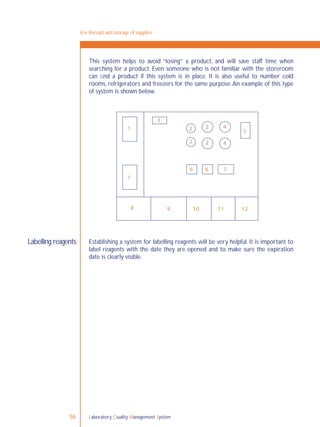
Laboratory
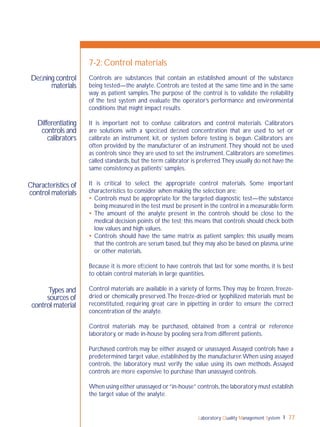
Quality
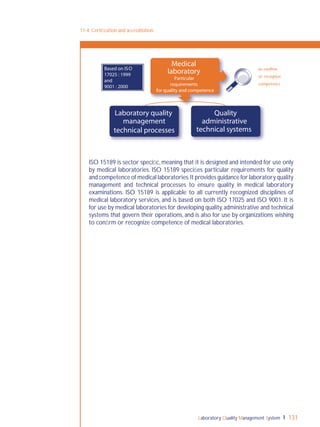
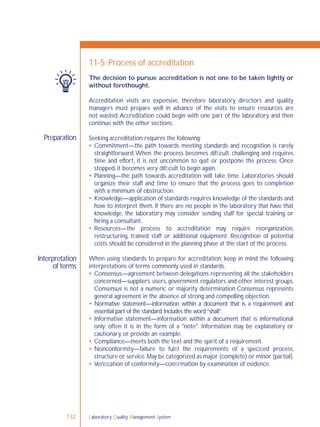
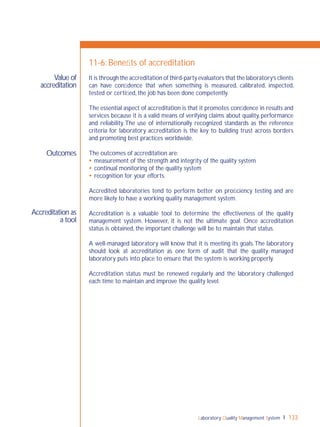
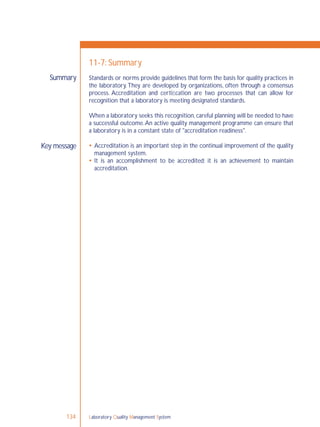
Management
System
Handbook
Laboratory Quality Management System
Contacts
WHO Lyon Office – International Health Regulations Coordination
58 avenue Debourg – 69007 Lyon – France
ihrinfo@who.int
CDC – National Center for Preparedness,Detection and Control of Infectious
Diseases (NCPDCID)
1600 Clifton Road – Atlanta, GA – USA
QMS_toolkit@CDC.gov
Clinical and Laboratory Standards Institute
940 WestValley Road, Suite 1400
Wayne, PA 19087 – USA
customerservice@clsi.org
WHO Library Cataloguing-in-Publication Data
Laboratory quality management system: handbook.
1.Laboratories — organization and administration. 2. Laboratories — handbooks.
3.Laboratories techniques and procedures — standards. 4.Quality control. 5.Manuals.
I.World Health Organization.
ISBN 978 92 4 154827 4 (NLM classification: QY 25)
© World Health Organization 2011
All rights reserved. Publications of the World Health Organization are available on the
WHO web site (www.who.int) or can be purchased from WHO Press, World Health
Organization, 20 Avenue Appia, 1211 Geneva 27, Switzerland (tel.: +41 22 791 3264; fax:
+41 22 791 4857; e-mail: bookorders@who.int).
Requests for permission to reproduce or translate WHO publications – whether for sale
or for noncommercial distribution – should be addressed to WHO Press through the
WHO web site (http://www.who.int/about/licensing/copyright_form/en/index.html).
The designations employed and the presentation of the material in this publication do
not imply the expression of any opinion whatsoever on the part of the World Health
Organization concerning the legal status of any country, territory, city or area or of its
authorities, or concerning the delimitation of its frontiers or boundaries. Dotted lines on
maps represent approximate border lines for which there may not yet be full agreement.
The mention of specific companies or of certain manufacturers’ products does not imply
that they are endorsed or recommended by theWorld Health Organization in preference
to others of a similar nature that are not mentioned. Errors and omissions excepted, the
names of proprietary products are distinguished by initial capital letters.
All reasonable precautions have been taken by the World Health Organization to verify
the information contained in this publication. However, the published material is being
distributed without warranty of any kind, either expressed or implied. The responsibility
for the interpretation and use of the material lies with the reader. In no event shall the
World Health Organization be liable for damages arising from its use.
Printed in France
Laboratory Quality Management System 1
Table of contents
Acknowledgements ........................................................................................................p 4
Foreword ...........................................................................................................................p 5
Key words..........................................................................................................................p 6
1. Introduction to quality................................................................................................p 7
1-1:The importance of laboratory quality...............................................................................................p 8
1-2: Overview of the quality management system ...............................................................................p 9
1-3:The quality management system model .........................................................................................p 11
1-4: History of laboratory quality management ..................................................................................p 14
1-5: International laboratory standards..................................................................................................p 15
1-6: Summary ...............................................................................................................................................p 16
2. Facilities and safety ................................................................................................... p 17
2-1: Overview ..............................................................................................................................................p 18
2-2: Laboratory design ..............................................................................................................................p 20
2-3: Geographic or spatial organization ................................................................................................p 21
2-4: Physical aspects of premises and rooms........................................................................................p 22
2-5: Safety management programme .....................................................................................................p 23
2-6: Identification of risks .........................................................................................................................p 25
2-7: Personal protective equipment........................................................................................................p 29
2-8: Emergency management and first aid.............................................................................................p 30
2-9: Summary ...............................................................................................................................................p 32
3. Equipment................................................................................................................... p 33
3-1: Overview .............................................................................................................................................p 34
3-2: Selecting and acquiring equipment .................................................................................................p 36
3-3: Getting equipment ready for service ............................................................................................p 38
3-4: Implementing an equipment maintenance programme ..............................................................p 40
3-5:Troubleshooting, service, repair and retiring equipment ...........................................................p 42
3-6: Equipment maintenance documentation ......................................................................................p 44
3-7: Summary ...............................................................................................................................................p 46
4. Purchasing and inventory.................................................................................. p 47
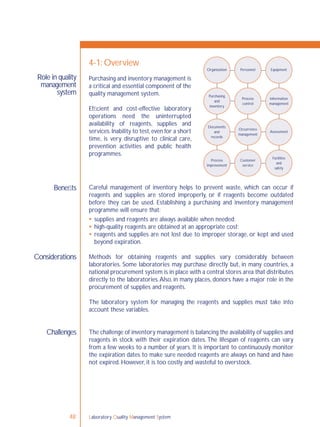
4-1: Overview .............................................................................................................................................p 48
4-2: Purchasing ............................................................................................................................................p 50
4-3: Implementing an inventory management programme ...............................................................p 51
4-4: Quantification ......................................................................................................................................p 52
4-5: Forms and logs ...................................................................................................................................p 54
4-6: Receipt and storage of supplies.......................................................................................................p 55
4-7: Monitoring inventory ........................................................................................................................p 57
4-8: Summary ...............................................................................................................................................p 58
5. Process control—sample management .............................................................. p 59
5-1: Overview ..............................................................................................................................................p 60
5-2:The laboratory handbook..................................................................................................................p 61
5-3: Collection and preservation ............................................................................................................p 62
5-4: Sample processing...............................................................................................................................p 64
5-5: Sample storage, retention and disposal .........................................................................................p 66
5-6: Sample transport ................................................................................................................................p 67
5-7: Summary ...............................................................................................................................................p 70
Laboratory Quality Management System2
6. Process control—introduction to quality control............................................. p 71
6-1: Introduction ........................................................................................................................................p 72
7. Process control—quality control for quantitative tests................................... p 75
7-1: Overview .............................................................................................................................................p 76
7-2: Control materials ...............................................................................................................................p 77
7-3: Establishing the value range for the control material .................................................................p 79
7-4: Graphically representing control ranges........................................................................................p 84
7-5: Interpreting quality control data ....................................................................................................p 85
7-6: Using quality control information ..................................................................................................p 87
7-7: Summary ...............................................................................................................................................p 88
8. Process control—quality control for qualitative and
semiquantitative procedures .................................................................................. p 89
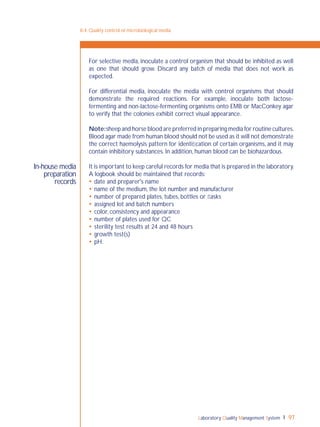
8-1: Overview ..............................................................................................................................................p 90
8-2: Quality control materials .................................................................................................................p 92
8-3: Quality control of stains....................................................................................................................p 94
8-4: Quality control of microbiological media......................................................................................p 96
8-5: Summary ...............................................................................................................................................p 98
9.Assessment—audits.................................................................................................. p 99
9-1: Overview ..........................................................................................................................................p 100
9-2: External audit....................................................................................................................................p 103
9-3: Internal audit.....................................................................................................................................p 105
9-4: Internal audit programme ..............................................................................................................p 106
9-5:Actions as result of audit ...............................................................................................................p 108
9-6: Summary ...........................................................................................................................................p 109
10.Assessment—external quality assessment .....................................................p 111
10-1: Overview.........................................................................................................................................p 112
10-2: Proficiency testing..........................................................................................................................p 115
10-3: Other external quality assessment methods .........................................................................p 117
10-4: Comparison of external quality assessment methods...........................................................p 119
10-5: Managing external quality assessment in the laboratory.....................................................p 120
10-6: Summary..........................................................................................................................................p 122
11.Assessment—norms and accreditation ...........................................................p 123
11-1: Overview.........................................................................................................................................p 124
11-2: International standards and standardization bodies .............................................................p 125
11-3: National standards and technical guidelines ...........................................................................p 127
11-4: Certification and accreditation...................................................................................................p 129
11-5: Process of accreditation...............................................................................................................p 132
11-6: Benefits of accreditation .............................................................................................................p 133
11-7: Summary..........................................................................................................................................p 134
12. Personnel ...............................................................................................................p 135
12-1: Overview ........................................................................................................................................p 136
12-2: Recruitment and orientation .....................................................................................................p 138
12-3: Competency and competency assessment .............................................................................p 140
12-4:Training and continuing education..............................................................................................p 143
12-5: Employee performance appraisal ..............................................................................................p 145
12-6: Personnel records..........................................................................................................................p 147
12-7: Summary..........................................................................................................................................p 148
Laboratory Quality Management System 3
13. Customer service.................................................................................................p 149
13-1: Overview ........................................................................................................................................p 150
13-2:The laboratory clients—the customers ...................................................................................p 152
13-3:Assessing and monitoring customer satisfaction ...................................................................p 155
13-4: Customer satisfaction surveys....................................................................................................p 156
13-5: Summary..........................................................................................................................................p 158
14. Occurrence management ..................................................................................p 159
14-1: Overview.........................................................................................................................................p 160
14-2: Sources and consequences of laboratory error.....................................................................p 161
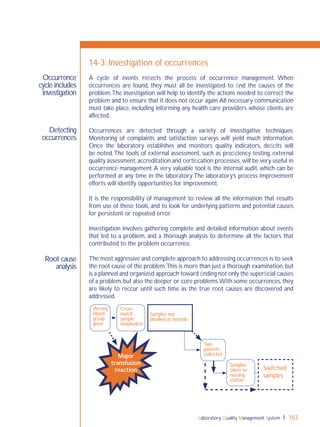
14-3: Investigation of occurrences........................................................................................................p 163
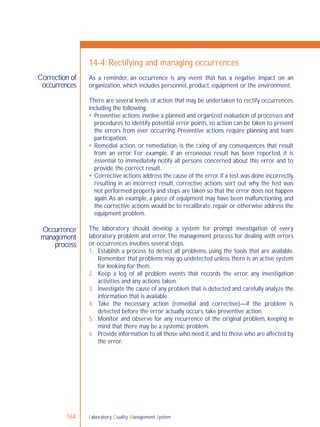
14-4: Rectifying and managing occurrences........................................................................................p 164
14-5: Summary..........................................................................................................................................p 166
15. Process improvement .........................................................................................p 167
15-1: Continual improvement concept ...............................................................................................p 168
15-2:Tools for process improvement..................................................................................................p 170
15-3: Quality indicators ..........................................................................................................................p 172
15-4: Selecting quality indicators ..........................................................................................................p 173
15-5: Implementing process improvement.........................................................................................p 176
15-6: Summary .........................................................................................................................................p 178
16. Documents and records .....................................................................................p 179
16-1: Introduction ....................................................................................................................................p 180
16-2: Overview of documents...............................................................................................................p 181
16-3:The quality manual.........................................................................................................................p 184
16-4: Standard operating procedures (SOPs).................................................................................... p 185
16-5: Document control.........................................................................................................................p 188
16-6: Overview of records.....................................................................................................................p 191
16-7: Storing documents and records.................................................................................................p 193
16-8: Summary..........................................................................................................................................p 194
17. Information management....................................................................................p 195
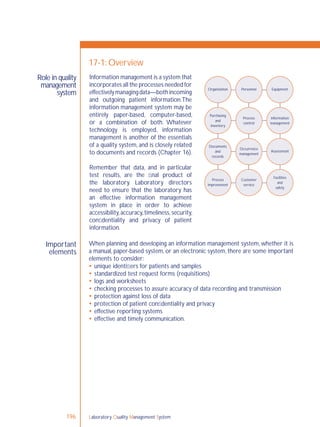
17-1: Overview.........................................................................................................................................p 196
17-2: Elements of information management ...................................................................................... p 197
17-3: Manual paper-based systems .......................................................................................................p 200
17-4: Computerized laboratory information systems .....................................................................p 202
17-5: Summary..........................................................................................................................................p 205
18. Organization ..........................................................................................................p 207
18-1: Organizational requirements for a quality management system.........................................p 208
18-2: Management role ...........................................................................................................................p 210
18-3: Organizational structure..............................................................................................................p 212
18-4: Organizational functions: planning..............................................................................................p 214
18-5: Organizational functions: implementation................................................................................ p 216
18-6:The laboratory quality manual ....................................................................................................p 218
18-7: Summary..........................................................................................................................................p 220
Glossary .......................................................................................................................p 221
Acronyms...................................................................................................................... p 233
References and resources by chapter ....................................................................p 235
Notes.............................................................................................................................p 243
Laboratory Quality Management System4
This handbook was developed through collaboration between the WHO Lyon
Office for National Epidemic Preparedness and Response, the United States
of America Centers for Disease Control and Prevention (CDC) Division of
Laboratory Systems, and the Clinical and Laboratory Standards Institute (CLSI).
It is based on training sessions and modules provided by the CDC and WHO in
more than 25 countries, and on guidelines for implementation of ISO 15189 in
diagnostic laboratories, developed by CLSI.
WHO, the CDC and the CLSI would like to acknowledge with thanks all those
who contributed to the development and review of this training package, more
specifically:
Adilya Albetkova
Robin Barteluk
Anouk Berger
Sébastien Cognat
Carlyn Collins
Philippe Dubois
Christelle Estran
Glen Fine
Sharon Granade
Stacy Howard
Devery Howerton
Kazunobu Kojima
Xin Liu
Jennifer McGeary
Robert Martin
Sylvio Menna
Michael Noble
Antoine Pierson
Anne Pollock
Mark Rayfield
John Ridderhof
Eunice Rosner
Joanna Zwetyenga
Acknowledgements
Laboratory Quality Management System 5
Foreword
Achieving, maintaining and improving accuracy, timeliness and reliability are major
challenges for health laboratories. Countries worldwide committed themselves
to build national capacities for the detection of, and response to, public health
events of international concern when they decided to engage in the International
Health Regulations implementation process.
Only sound management of quality in health laboratories will enable countries
to produce test results that the international community will trust in cases of
international emergency.
This handbook is intended to provide a comprehensive reference on Laboratory
Quality Management System for all stakeholders in health laboratory processes,
from management, to administration, to bench-work laboratorians.
This handbook covers topics that are essential for quality management of a public
health or clinical laboratory. They are based on both ISO 15189 and CLSI
GP26-A3 documents.
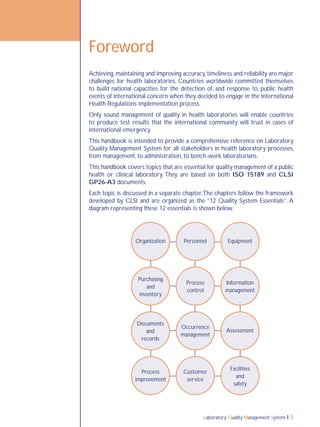
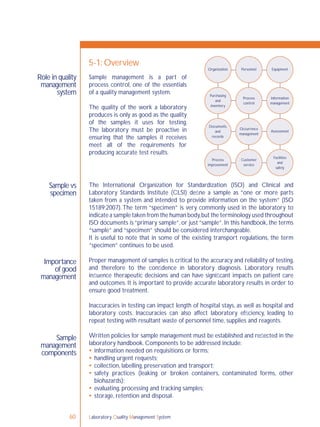
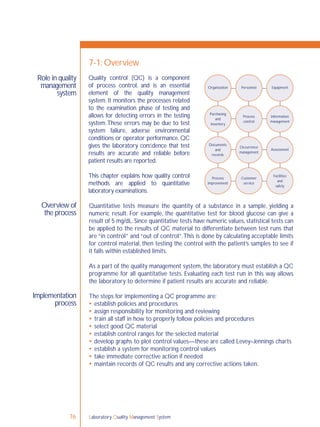
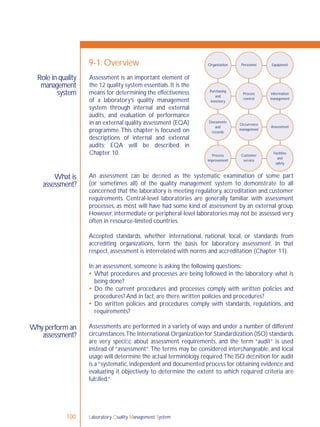
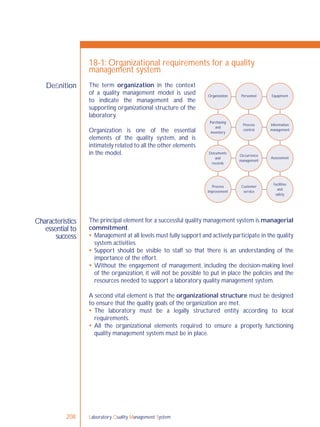
Each topic is discussed in a separate chapter.The chapters follow the framework
developed by CLSI and are organized as the “12 Quality System Essentials”. A
diagram representing these 12 essentials is shown below.
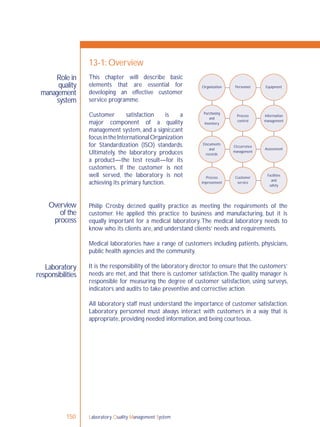
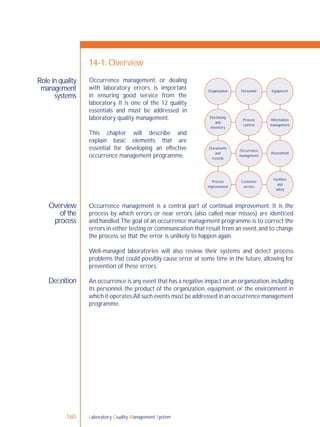
Organization Personnel Equipment
Purchasing
and
inventory
Process
control
Information
management
Occurrence
management
Assessment
Facilities
and
safety
Customer
service
Process
improvement
Documents
and
records
Laboratory Quality Management System6
Laboratory quality management system, laboratory quality, laboratory quality
systems, laboratory information management, laboratory information system,
laboratory documents and records, laboratory quality manual, quality control,
laboratory facilities and safety, laboratory equipment, laboratory sample
management, laboratory sample transport, laboratory purchasing and inventory,
laboratory assessment, laboratory customer service, occurrence management,
process improvement, quality essentials, laboratory process control, clinical
laboratory, ISO 15189.
Key words
Note:
Health laboratories, in this handbook, is a term that is meant to be inclusive
of clinical laboratories, diagnostic laboratories, medical laboratories, public
health laboratories, animal and environmental health laboratories or any other
laboratories performing testing for the purpose of disease diagnosis, screening,
prevention, medical treatment decisions, surveillance or public health. Because all
these terms for laboratories are frequently used interchangeably, the terms may
likewise be used interchangeably in this handbook.
1.Introduction to
quality
Laboratory Quality Management System8
1-1:The importance of laboratory quality
Laboratory quality can be defined as accuracy,reliability and timeliness of reported
test results.The laboratory results must be as accurate as possible, all aspects of
the laboratory operations must be reliable,and reporting must be timely in order
to be useful in a clinical or public health setting.
When making measurements, there is always some level of inaccuracy. The
challenge is to reduce the level of inaccuracy as much as possible, given the
limitations of our testing systems. An accuracy level of 99% may at first glance
appear acceptable, but the resulting 1% error can become quite large in a system
where many events occur, such as laboratory testing.
Laboratories produce test results that are widely used in clinical and public
health settings, and health outcomes depend on the accuracy of the testing
and reporting. If inaccurate results are provided, the consequences can be very
significant, including:
 unnecessary treatment
 treatment complications
 failure to provide the proper treatment
 delay in correct diagnosis
 additional and unnecessary diagnostic testing.
These consequences result in increased cost in time and personnel effort, and
often in poor patient outcomes.
In order to achieve the highest level of accuracy and reliability, it is essential
to perform all processes and procedures in the laboratory in the best possible
way. The laboratory is a complex system, involving many steps of activity and
many people. The complexity of the system requires that many processes and
procedures be performed properly. Therefore, the quality management system
model, which looks at the entire system, is very important for achieving good
laboratory performance.
Definition of
quality
Level of accuracy
required
Negative
consequences of
laboratory error
Minimizing
laboratory error
Laboratory Quality Management System 9
A quality management system can be defined as “coordinated activities to direct
and control an organization with regard to quality”. This definition is used by
the International Organization for Standardization (ISO) and by the Clinical and
Laboratory Standards Institute (CLSI). Both groups are internationally recognized
laboratory standards organizations, and will be discussed later in this handbook.
In a quality management system, all aspects of the laboratory operation, including
the organizational structure, processes and procedures, need to be addressed to
assure quality.
1-2: Overview of the quality management system
Definition of
quality
management
system
Complexity
of laboratory
processes
Examination
Post-examination
Pre-exam
i
nation
HIGH
LOW
Sample receipt and
accessioning
Reporting
Patient client prep
Sample collection
Personnel competency
test evaluations
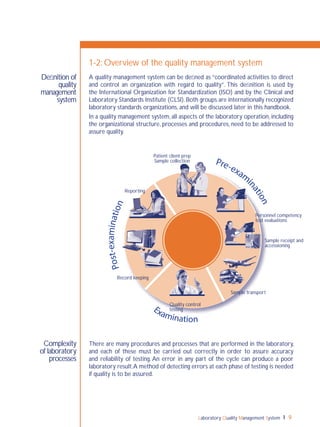
There are many procedures and processes that are performed in the laboratory,
and each of these must be carried out correctly in order to assure accuracy
and reliability of testing. An error in any part of the cycle can produce a poor
laboratory result.A method of detecting errors at each phase of testing is needed
if quality is to be assured.
Quality control
testing
Sample transport
Record keeping
Laboratory Quality Management System10
Path of workflow
1-2: Overview of the quality management system
The complexity of the laboratory system requires that many factors must be
addressed to assure quality in the laboratory. Some of these factors include:
 the laboratory environment
 quality control procedures
 communications
 record keeping
 competent and knowledgeable staff
 good-quality reagents and equipment.
Quality
management
system addresses
all processes
ISO standards group laboratory processes into pre-examination, examination
and post-examination categories. Comparable terms in current laboratory use
include: pre-analytic, analytic and post-analytic processes; or pre-test, test and
post-test processes.
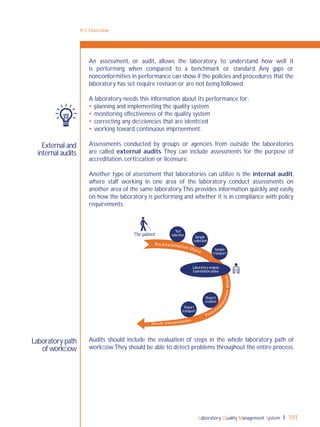
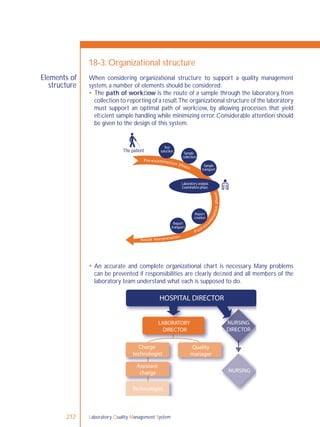
The entire set of operations that occur in testing is called the path of workflow.
The path of workflow begins with the patient and ends in reporting and results
interpretation, as shown in the figure below.
The concept of the path of workflow is a key to the quality model or the quality
management system, and must be considered when developing quality practices.
For example, a sample that is damaged or altered as a result of improper
collection or transport cannot provide a reliable result. A medical report that
is delayed or lost, or poorly written, can negate all the effort of performing the
test well.
Pre examination hase
Result nterpretation
Post ex
am
inationhase
i
p
p
The patient
Sample
transport
Sample
collection
Test
selection
Laboratory analysis
Examination phase
Report
creation
Report
transport
Laboratory Quality Management System 11
Assuring accuracy and reliability throughout the path of workflow depends on
good management of all of the quality essentials.
In order to have a functioning quality management system, the structure and
management of the laboratory must be organized so that quality policies can be
established and implemented.There must be a strong supporting organizational
structure—management commitment is crucial—and there must be a mechanism
for implementation and monitoring.
The most important laboratory resource is competent,motivated staff.The quality
management system addresses many elements of personnel management and
oversight, and reminds us of the importance of encouragement and motivation.
Many kinds of equipment are used in the laboratory,and each piece of equipment
must be functioning properly. Choosing the right equipment, installing it
correctly, ensuring that new equipment works properly, and having a system for
maintenance are all part of the equipment management programme in a quality
management system.
1-3:The quality management system model
Overview of
the quality
management
system model
Organization
When all of the laboratory procedures
and processes are organized into
an understandable and workable
structure, the opportunity to ensure
that all are appropriately managed
is increased. The quality model used
here organizes all of the laboratory
activities into 12 quality system
essentials. These quality system
essentials are a set of coordinated
activities that serve as building blocks
for quality management. Each must be
addressed if overall laboratory quality
improvement is to be achieved. This
quality management system model
was developed by CLSI,1
and is fully
compatible with ISO standards.2,3
Equipment
Personnel
1 CLSI/NCCLS. A quality management system model for health care; approved guideline—second edition, CLSI/NCCLS document HS1-A2.
Wayne, PA, NCCLS, 2004.
2 ISO 15189:2007. Medical laboratories–particular requirements for quality and competence. Geneva: International Organization for
Standardization, 2007.
3 ISO 9001:2000. Quality management systems–requirements. Geneva: International Organization for Standardization, 2000.
Organization Personnel Equipment
Purchasing
and
inventory
Process
control
Information
management
Occurrence
management
Assessment
Facilities
and
safety
Customer
service
Process
improvement
Documents
and
records
Path of workflow
Laboratory Quality Management System12
1-3:The quality management system model
Purchasing and
inventory
The management of reagents and supplies in the laboratory is often a challenging
task.However,proper management of purchasing and inventory can produce cost
savings in addition to ensuring supplies and reagents are available when needed.
The procedures that are a part of management of purchasing and inventory are
designed to ensure that all reagents and supplies are of good quality,and that they
are used and stored in a manner that preserves integrity and reliability.
Process control is comprised of several factors that are important in ensuring the
quality of the laboratory testing processes.These factors include quality control
for testing, appropriate management of the sample, including collection and
handling, and method verification and validation.
The elements of process control are very familiar to laboratorians;quality control
was one of the first quality practices to be used in the laboratory and continues
to play a vital role in ensuring accuracy of testing.
The product of the laboratory is information, primarily in the form of test
reporting. Information (data) needs to be carefully managed to ensure accuracy
and confidentiality, as well as accessibility to the laboratory staff and to the health
care providers. Information may be managed and conveyed with either paper
systems or with computers; both will be discussed in the section on information
management.
Many of the 12 quality system essentials overlap. A good example is the close
relationship between "Documents and records" and "Information management".
Documents are needed in the laboratory to inform how to do things, and
laboratories always have many documents. Records must be meticulously
maintained so as to be accurate and accessible.
An “occurrence” is an error or an event that should not have happened.A system
is needed to detect these problems or occurrences, to handle them properly, and
to learn from mistakes and take action so that they do not happen again.
The process of assessment is a tool for examining laboratory performance and
comparing it to standards, benchmarks or the performance of other laboratories.
Assessment may be internal (performed within the laboratory using its own staff)
or it may be external (conducted by a group or agency outside the laboratory).
Laboratory quality standards are an important part of the assessment process,
serving as benchmarks for the laboratory.
Process control
Information
management
Documents and
records
Occurrence
management
Assessment
Laboratory Quality Management System 13
1-3:The quality management system model
Process
improvement
The primary goal in a quality management system is continuous improvement of
the laboratory processes,and this must be done in a systematic manner.There are
a number of tools that are useful for process improvement.
The concept of customer service has often been overlooked in laboratory practice.
However, it is important to note that the laboratory is a service organization;
therefore, it is essential that clients of the laboratory receive what they need.The
laboratory should understand who the customers are, and should assess their
needs and use customer feedback for making improvements.
Many factors must be a part of the quality management of facilities and safety.
These include:
 Security—which is the process of preventing unwanted risks and hazards
from entering the laboratory space.
 Containment—which seeks to minimize risks and prevent hazards from
leaving the laboratory space and causing harm to the community.
 Safety—which includes policies and procedures to prevent harm to workers,
visitors and the community.
 Ergonomics—which addresses facility and equipment adaptation to allow safe
and healthy working conditions at the laboratory site.
In the quality management system model, all 12 quality system essentials must
be addressed to ensure accurate, reliable and timely laboratory results, and to
have quality throughout the laboratory operations. It is important to note that
the 12 quality system essentials may be implemented in the order that best suits
the laboratory.Approaches to implementation will vary with the local situation.
Laboratories not implementing a good quality management system are
guaranteed that there will be many errors and problems occurring that may
go undetected. Implementing a quality management system may not guarantee
an error-free laboratory, but it does yield a high-quality laboratory that detects
errors and prevents them from recurring.
Customer
service
Facilities and
safety
Quality
management
system model
Laboratory Quality Management System14
Principal
innovators
and their
contributions
ISO 9000 defines quality management as “coordinated activities to direct and
control an organization with regard to quality”.This is intimately related to the
definition of a quality system—“organizational structure, resources, processes
and procedures needed to implement quality management”. Quality management
concepts in use today had their onset in the 20th century, and are primarily an
outgrowth of manufacturing and shop processes.
One of the earliest concepts of the quality management movement was that
of quality control of the product. Shewhart developed a method for statistical
process control in the 1920s, forming the basis for quality control procedures in
the laboratory. Quality control methods were not applied in the laboratory until
the 1940s. Other critical thinkers and innovators, including Arman Feigenbaum,
Kaoru Ishikawa and Genichi Taguchi, added to the concepts. The most recent
method that is of importance to the laboratory is Galvin’s work on micro-scale
error reduction.
Quality management is not new.
Definition
of quality
management
1-4: History of laboratory quality management
Laboratory Quality Management System 15
1-5: International laboratory standards
A part of quality management is assessment, measuring performance against
a standard or benchmark. The concept of quality management requires that
standards be set, and again industry has been in the lead.
Using a set of standards established by the United States of America military for
the manufacture and production of equipment, the ISO established standards for
industrial manufacturing; we know these standards as ISO standards.
The ISO 9000 documents provide guidance for quality in manufacturing and
service industries,and can be broadly applied to many other kinds of organizations.
ISO 9001:2000 addresses general quality management system requirements
and applies to laboratories. There are two ISO standards that are specific to
laboratories:
 ISO 15189:2007. Medical laboratories—particular requirements for quality and
competence. Geneva: International Organization for Standardization, 2007.
 ISO/IEC 17025:2005. General requirements for the competence of testing and
calibration laboratories. Geneva: International Organization for Standardization,
2005.
Another important international standards organization for laboratories is the
Clinical and Laboratory Standards Institute, or CLSI, formerly known as the
National Committee for Clinical Laboratory Standards (NCCLS). CLSI uses a
consensus process involving many stakeholders for developing standards. CLSI
developed the quality management system model used in this handbook. This
model is based on 12 quality system essentials, and is fully compatible with ISO
laboratory standards.
CLSI has two documents that are very important in the clinical laboratory:
 A quality management system model for health care; approved guideline—second
edition. CLSI/NCCLS document HS1-A2.Wayne, PA, NCCLS, 2004.
 Application of a quality management system model for laboratory services; approved
guideline—third edition. CLSI/NCCLS document GP26-A3.Wayne, PA, NCCLS,
2004.
The information in this handbook is based on the CLSI quality
management system model and the ISO 15189 standard.
There are many other standards organizations, and many examples of laboratory
standards. Some countries have established national laboratory quality standards
that apply specifically to laboratories within the country. Some laboratory
standards apply only to specific areas in the laboratory or only to specific tests.
The World Health Organization has established standards for some specific
programmes and areas.
Need for international
laboratory standards
Important laboratory
standards organizations
Other
standards
CLSI
ISO
Laboratory Quality Management System16
Quality management is not new;it grew from the work of innovators who defined
quality over a span of 80 years.Quality management is as applicable for the medical
laboratory as it is for manufacturing and industry.
 A laboratory is a complex system and all aspects must function properly to
achieve quality.
 Approaches to implementation will vary with the local situation.
 Start with changes that can be easily accomplished and have the biggest impact.
 Implement in a stepwise process but ultimately, all quality essentials must
be addressed.
Quality
management
Key messages
1-6: Summary
2. Facilities and
safety
Laboratory Quality Management System18
Responsibilities
Importance of
safety
Role in quality
management
system
2-1: Overview
substances.As a general rule, all diagnostic laboratories should be designed and
organized for biosafety level 2 or above.
A laboratory safety programme is important in order to protect the lives of
employees and patients, to protect laboratory equipment and facilities, and to
protect the environment.
Neglecting laboratory safety is very costly. Secondary effects of a laboratory
accident are:
 loss of reputation
 loss of customers / loss of income
 negative effect on staff retention
 increased costs—litigation, insurance.
Ensuring quality and safety during laboratory processes is a major concern
for laboratory managers. Often, the laboratories they manage are designed by
architects and/or administrators who have little knowledge of specific laboratory
needs, making the job of the manager more difficult.
As a laboratory director, it is important to:
 actively participate in the design and planning stages of new laboratory facilities;
 assess all potential risks and apply basic concepts of organization in order to
provide a proper and safe environment for conducting laboratory activities,
including services to patients;
 consider the organization of the laboratory when developing new activities or
new diagnostic techniques in the laboratory.
The laboratory work space and facilities
must be such that the workload can
be performed without compromising
the quality of work and the safety of
the laboratory staff, other health care
personnel,patients and the community.
This chapter will describe essential
elements for laboratory design and
safety that prevent and control
exposure to physical, chemical and
biological hazards.
This chapter addresses pathogens
and chemicals of moderate or low-
level risk, rather than highly dangerous
Organization Personnel Equipment
Purchasing
and
inventory
Process
control
Information
management
Occurrence
management
Assessment
Facilities
and
safety
Customer
service
Process
improvement
Documents
and
records
Laboratory Quality Management System 19
2-1: Overview
As a quality manager (or designated safety officer), it is necessary to:
 develop a complete and thorough description of basic safety rules and
organization,and ensure that personnel are trained in their specific duties when
new activities or techniques are introduced into the laboratory;
 know the basics of safety and biosafety management issues when working with
chemicals and pathogens of moderate or low level of risk;
 know how to perform an extensive risk assessment when developing new
activities in the laboratory;
 conduct laboratory safety audits.
As a laboratorian, it is important to:
 be aware of basic safety rules and processes;
 understand the basics of safety and biosafety management issues when working
with toxic chemicals, biological samples and physical hazards, and when
interacting with patients.
Everyone in the laboratory is responsible for quality and safety.
Laboratory Quality Management System20
When designing a laboratory or organizing workflow, ensure that patients and
patient samples do not have common pathways. Circulation paths should be
designed in such a way that contact between the public and biological materials
can occur only in the rooms where patient samples are collected.The reception
desk where incoming patients register should be located as close as possible to
the entry door.
Access to rooms where manipulation or analysis of samples takes place, or
where hazardous chemicals or other materials are stored, must be restricted
to authorized persons, usually laboratory technical staff and maintenance staff.
Restriction of access may be accomplished using signs on doors, locks when
appropriate and staff identification badges.
To identify where improvements in laboratory design may be needed in order
to prevent or reduce risks of cross-contamination, follow the path of the sample
as it moves through the laboratory during the pre-examination, examination and
post-examination phases of testing. Pathways to assess include:
 Sample collection areas—a laboratory layout with both the reception and the
sample collection room located at the entrance saves time and energy.
 Sample processing areas—here, samples are centrifuged as needed, allocated
for different examinations and dispersed to the appropriate sections of the
laboratory for analysis. If possible, the sample processing area should be
separated from, but nearby, the testing areas.
 Start with changes that can be easily accomplished and have the biggest impact.
 Circulation pathways of biological samples between different sections of the
laboratory—These pathways should be assessed for the purpose of minimizing
contamination risks.If possible,circulation pathways of clean and dirty laboratory
materials should never cross, and circulation pathways of contaminated waste
should be isolated.
 Post-examination pathways—After the analysis of the samples, the results
must be accurately recorded, properly filed, and delivered on time to the right
person. Communication systems appropriate to the size and complexity of the
laboratory, including the efficient and reliable transferring of messages, should
be part of the laboratory design.
For the most efficient design, all related services should be located in
close proximity.
Access
2-2: Laboratory design
Circulation
pathways
Laboratory Quality Management System 21
2-3: Geographic or spatial organization
When organizing laboratory work space, divide the laboratory into areas with
different access control in order to separate patients from biological samples.
Where samples are actually processed, plan for spatial organization that ensures
the best service.
For optimal organization of the laboratory, consider:
 Delineation of laboratory activities—Care should be taken to either group
related activities in a single room,or to clearly delineate bench space for specific
activities. Measures must be taken to prevent cross-contamination of samples.
 Location of service rooms—Service rooms to accommodate autoclaves, sinks
for cleaning glassware, preparation and sterilization of culture media, and so on,
should be located in a central area to minimize distances and facilitate circulation
paths of materials, samples and goods. A responsible staff member should be
designated to oversee cleaning and maintenance of the service rooms.
 Location of activities with specific requirements, such as:
- molecular biology—needs to be located in a separate space,with at least two
rooms, so that preparation of DNA extracts is not performed in the same
room as where the subsequent steps (preparation of reagent mixes and DNA
amplification) are performed;
- fluorescence microscopy—requires a dark room with proper ventilation
which must not be used for storage of stock materials and other chemicals;
- ultraviolet illumination systems for DNA gel photography—requires a dark
room and appropriate eye protection equipment.
The laboratory director and safety officer must consider special needs for equipment
when designing laboratory space.Some things to consider are:
 Access to equipment for entry and maintenance—Make sure that there are no
physical restrictions for access, such as door and elevator size, that could pose
a problem for the delivery and maintenance of new machines and equipment.
 Power supply—Consider the need for a stable power supply for sensitive
equipment and a backup power supply or emergency generator for times when
the laboratory’s primary power source is down.
 Managing disposal of liquids from equipment—Disposal of liquid reagents, by-
products and wastes from laboratory equipment and procedures is a major
concern for laboratories. When placing equipment in the laboratory, be sure
to consider how liquid wastes will be handled. It is important to be aware of,
and comply with, local and national requirements for liquid waste disposal, in
order to prevent contamination of community sewage systems with pathogens
or toxic chemicals.
Distribution of
activities
Spatial
provision for
equipment
Laboratory Quality Management System22
The laboratory must be designed to ensure proper ventilation throughout, with an
active ventilation system and adequate space for circulation of people, laboratory
carts and trolleys.
Rooms should have a high ceiling to ensure proper ventilation,and walls and ceilings
should be painted with washable,glossy paint or coated with a material suitable for
cleaning and disinfection.The floor must also be easy to clean and disinfect,and have
no edges between the walls and floor.
Laboratory work benches should be constructed of materials that are durable and
easy to disinfect. If the laboratory’s budget allows, ceramic tiles are good materials
to use for benchtops, as they are easy to clean and are resistant to deterioration
from harsh disinfectants and aggressive cleaning products. However, be aware that
the grout between them can sometimes harbour contaminating microorganisms,so
must be disinfected regularly.
Wood should not be used,as it is not easy to clean or disinfect,and will deteriorate
over time when repeatedly exposed to disinfectants and detergents. Wood also
support the growth of contaminants when wet or damaged.
The disadvantage of using steel for benchtops is that steel will rust when washed
with chlorine.
It is advisable to organize work benches according to the type of analysis that
is performed, with adequate space for benchtop equipment and enough space to
place a standard operating procedure while in use and display job aids. In areas
where microbiology procedures are performed,work benches should be separated
according to the different types of samples or pathogens that are analyzed,in order
to minimize risks of cross-contamination.
It is very important that all areas of the laboratory are cleaned and maintained on a
regular basis. Examples of areas that need daily attention are:
 Benchtops—clean and disinfect benchtops after completing examinations, and
after any spills of samples or reagents.This responsibility is generally assigned to
the technical staff performing the tests.
 Floors—these are usually cleaned by cleaning staff, unless restricted access
allows only technical staff to disinfect the floors at the end of the day.
Other areas of the laboratory should be scheduled for cleaning on a weekly or
monthly basis, depending on laboratory conditions. For example, ceilings and walls
may require cleaning weekly, whereas items such as refrigerators and storage areas
might be scheduled for a monthly cleaning.
Cleaning and disinfection of laboratory areas should be recorded,including the date
and name of the person performing the maintenance.
Facilities
2-4: Physical aspects of premises and rooms
Work benches
Cleaning
Laboratory Quality Management System 23
2-5: Safety management programme
Often, the responsibility for developing a safety programme and organizing
appropriate safety measures for the laboratory is assigned to a laboratory safety
officer. In smaller laboratories, the responsibility for laboratory safety may fall to
the laboratory manager or even to the quality officer.The steps for designing a
safety management programme include:
 developing a manual to provide written procedures for safety and biosafety in
the laboratory;
 organizing safety training and exercises that teach staff to be aware of potential
hazards and how to apply safety practices and techniques—training should
include information about universal precautions, infection control, chemical
and radiation safety, how to use personal protective equipment (PPE), how to
dispose of hazardous waste, and what to do in case of emergencies;
 setting up a process to conduct risk assessments—this process should include
initial risk assessments, as well as ongoing laboratory safety audits to look for
potential safety problems.
The safety officer should be assigned responsibility for ensuring that there is an
adequate supply of appropriate equipment for safety and biosafety, such as:
 PPE
 fire extinguishers and fire blankets
 appropriate storage and cabinets for flammable and toxic chemicals
 eye washers and emergency shower
 waste disposal supplies and equipment
 first aid equipment.
Policies should be put in place that outline the safety practices to be followed in
the laboratory. Standard laboratory safety practices include:
 limiting or restricting access to the laboratory;
 washing hands after handling infectious or hazardous materials and animals,
after removing gloves, and before leaving the laboratory;
 prohibiting eating, drinking, smoking, handling contact lenses, and applying
cosmetics in work areas;
 prohibiting mouth pipetting;
 using techniques that minimize aerosol or splash production when performing
procedures—biosafety cabinets should be used whenever there is a potential
for aerosol or splash creation,or when high concentrations or large volumes of
infectious agents are used;
Developing a
laboratory safety
programme
Standard safety
practices
General safety
equipment
Laboratory Quality Management System24
 preventing inhalation exposure by using chemical fume hoods or other
containment devices for vapours, gases, aerosols, fumes, dusts or powders;
 properly storing chemicals according to recognized compatibilities—chemicals
posing special hazards or risks should be limited to the minimum quantities
required to meet short-term needs and stored under appropriately safe
conditions (i.e. flammables in flammable storage cabinets)—chemicals should
not be stored on the floor or in chemical fume hoods;
 securing compressed gas cylinders at all times;
 decontaminating work surfaces daily;
 decontaminating all cultures, stocks and other regulated wastes before disposal
via autoclave, chemical disinfection, incinerator or other approved method;
 implementing and maintaining an insect and rodent control programme;
 using PPE such as gloves, masks, goggles, face shields and laboratory coats when
working in the laboratory;
 prohibiting sandals and open-toed shoes to be worn while working in the
laboratory;
 disposing of chemical, biological and other wastes according to laboratory
policies.
Monthly and yearly exercises must be organized for fire drills and laboratory
evacuation procedures. This is an occasion for the safety officer to emphasize
risks to laboratory staff and to review with them the specific procedures for
evacuation, handling of incidents and basic security precautions.
Laboratory waste management is a critical issue. All potentially harmful and
dangerous materials (including liquids and radioactive materials) must be
treated in a specific way before disposing. Separate waste containers should be
used depending on the nature of the waste, and must be clearly identified by a
colour code. Specific attention should be given to the management of potentially
harmful contaminated waste such as sharps, needles or broken glassware. Sharps
containers must be available on work benches so they are conveniently accessible
to staff.
Many labels that give warnings and instructions for safety precautions are
internationally recognized. A list of websites that provide these labels can be
found in the references and resources section.
Procedures and
exercises
Waste
management
Internationally
recognized labels
2-5: Safety management programme
Laboratory Quality Management System 25
2-6: Identification of risks
Laboratory workers encounter a significant number of risks, which vary with the
types of activities and analyses that are performed.
Risk assessment is compulsory in order for the laboratory director to manage and
reduce risks to laboratory employees.Assistance from a safety officer is needed
to appreciate potential risks and incorporate appropriate preventive measures.
It is important to develop safety procedures that describe what to do in case of
accidents, injuries or contamination. In addition, it is important to keep a record
of staff exposures to hazards, actions taken when this occurs, and procedures put
into place to prevent future occurrences.
The outcome of a
study of physical
risks encountered by
laboratory staff that
was conducted by
the Howard Hughes
Medical Institute
Office of Laboratory
Safety is shown in the
chart.This study only
addressed physical
risks, but personnel
contamination and
infection have been
reported in many
instances, and recent reports on laboratory-acquired infection leading to severe
acute respiratory syndrome (SARS) show that the risks are never reduced to zero,
even in high-confinement facilities.
Laboratory equipment is a significant source of potential injury to laboratory
staff, thus making training in specific safety procedures imperative. Examples
of equipment in which safety training and precautions are important include
autoclaves,centrifuges,compressed gas cylinders and fume hoods.Many laboratory
instruments pose a danger of electrical shock, and some equipment can emit
dangerous microwaves or radiation if not properly used or maintained.
Storage of compressed gases in the laboratory requires precautions unique to
the unusual containers in which these materials are kept, and the high pressures
they are subject to. Cylinders are kept chained to the wall so that they cannot fall
over.The safety cap must be secured over the valve of the cylinder whenever it is
moved or taken out of service.
Laboratories
are hazardous
environments
Physical
hazards
Repetitive stress 8%
Eye injury 10%
Chemical exposure 11%
Bruise, sprain, strain, fracture 21%
Laceration 32%
Allergy 1%
Burn 3%
Other 3%
Animal bite, scratch 4%
Needle puncture 7%
Laboratory Quality Management System26
2-6: Identification of risks
Needles, broken glass and other sharps need to be handled and disposed of
appropriately to prevent risks of infection to laboratory and housekeeping
(custodial) staff. Instructions for proper disposal of sharps are:
 Avoid needle recapping. If recapping is crucial, the correct procedure is for the
person doing the recapping to keep one hand behind the back of the needle,
and use the other hand to scoop the cover onto the needle.
 Put sharps in a puncture-resistant, leak-proof sharps container. Label the
container "Sharps". If the sharps are not biohazardous, deface any biohazard
markings or symbols. Seal the container tightly.
Laboratory glassware and plasticware are not considered to be sharps for disposal
purposes. Laboratory glassware and plasticware include any item that could
puncture regular waste bags and therefore endanger waste handlers. Laboratory
glass must be placed in cardboard boxes for safety during transport through the
building.Any cardboard box may be used,provided it is sturdy and of a size that will
not weigh more than 40 pounds when full.
Contaminated laboratory glass must be appropriately decontaminated prior to
disposal.
Never use boxes for the disposal of:
 sharps
 biohazardous materials that have not been autoclaved
 liquid wastes
 chemically contaminated laboratory glassware or plasticware
 chemical containers that cannot be disposed of as regular solid waste.
Exposure to toxic chemicals poses a real threat to the health and safety of laboratory
staff.There are three main routes by which chemicals enter the body.
 Inhalation—this is the major route of entry when working with solvents; there
is great rapidity of absorption when fumes are inhaled.
 Absorption through skin—this may produce systemic poisoning; the condition
of the skin determines the rate of absorption. Examples of chemicals with
these risks are organic lead, solvents such as xylene and methylene chloride,
organophosphate, pesticides and cyanides.
 Ingestion—accidental ingestion is generally due to poor hygiene practices, such
as eating or smoking in the laboratory.
To prevent or reduce incidents caused by exposure to toxic chemicals,all chemicals,
including solutions and chemicals transferred from their original containers, should
be labelled with their common names, concentrations and hazards. Additional
information, such as the date received, date opened and date of expiration, should
also be recorded.
It is crucial that chemicals are stored properly. Store corrosive, toxic and highly
reactive chemicals in a well-ventilated area, and store chemicals that can ignite at
room temperature in a flammables cabinet.
Chemical hazards
Needles and
sharps
Laboratory Quality Management System 27
Radiochemicals require special precautions, and dedicated benches with specific
bench covers for manipulation of radiolabelled elements are needed. Specific
storage areas for radioactive materials are needed.These must provide appropriate
protection (Plexiglas™, lead) and specific waste containers, depending on the
chemical nature of waste and radioactive elements.
The material safety data sheet (MSDS) is a technical bulletin providing detailed
hazard and precautionary information.1
Businesses are required to provide to
their customers the MSDS for all chemicals they manufacture or distribute.
Laboratories need to heed precautions listed in the MSDS in order to ensure the
chemicals they use are handled and stored safely.
The MSDS provides:
 product information;
 fire and explosion precautions;
 toxicology;
 health effects;
 recommended PPE;
 storage recommendations;
 leaks and spills—recommended
actions;
 waste disposal recommendations;
 first aid.
The MSDS should be:
 available to all employees prior to use of hazardous materials;
 kept close to where the hazardous material is used and located.
Laboratory-acquired infections are not infrequent in medical laboratories.
The following tables show the most frequently reported infections acquired in
laboratories in the United States of America from 1979 to 1999.2
Material safety
data sheet
2-6: Identification of risks
1 ISO 15190:2003. Medical laboratories—requirements for safety. Geneva: International Organization for Standardization, 2003.
2 Harding AL, Brandt Byers K. Epidemiology of laboratory-associated infections. In: Fleming, DO, Hunt DL, eds. Biological safety: principles
and practices.Washington, DC,ASM Press, 2000, 35–54.
Biological hazards
0 0
0
FLAMMABILITY
PROTECTIVE
EQUIPEMENT
HEALTH REACTIVITY
0
Laboratory Quality Management System28
Aerosols are the main sources of contamination within diagnostic laboratories;
contamination can occur over very long distances.This is why the major target
of containment systems is the blockage of aerosol diffusion inside and outside
the laboratory. Diagnostic laboratories of physical containment level 2, where
activities concern only pathogens of moderate risks, must have appropriate
ventilation. Higher containment level laboratories or working cabinets must
ensure a continuous inward airflow, as well as absolute filtration of exhausted air,
to avoid aerosol dissemination outside the working area or the whole laboratory.1
2-6: Identification of risks
Disease or agent No. of cases
Mycobacterium tuberculosis 223
Q fever 176
Hantavirus 169
Hepatitis B 84
Brucella sp. 81
Salmonella sp. 66
Shigella sp. 56
Hepatitis non-A, non-B 28
Cryptosporidium sp. 27
Total 910
Disease Probable source
Maximum distance
from source
No.
infected
Brucellosis Centrifugation Basement to 3rd
floor
94
Coccidioidomycosis Culture transfer, solid media 2 building floors 13
Coxsackie
virus infection
Spilled tube of infected
mouse tissue on floor
5 feet estimated 2
Murine typhus Intranasal inoculation of mice 6 feet estimated 6
Tularemia 20 petri plates dropped 70 feet 5
Venezuelan
encephalitis
9 lyophilized
ampoules dropped
4th floor stairs to
3rd or 5th floor
24
1 Reitman M,Wedum AG. Microbiological safety. Public Health Reports, 1956, 71(7):659–665.
Laboratory Quality Management System 29
2-7: Personal protective equipment
The major routes by which laboratory staff acquire work-related infections are:
 percutaneous inoculation
 contact between mucous membranes and contaminated material
 accidental ingestion.
To reduce the risk of these occurrences, it is imperative that staff have access to PPE,
be trained in how to properly use it, and habitually use the PPE while working in the
laboratory.Approved goggles, face shields, splatter guards, masks, or other eye and face
protection should be worn when handling infectious or other hazardous materials outside
the biosafety cabinet.
Gloves should be worn in all instances, and should be available to laboratory staff on a
routine basis.Effective use of gloves relies on two simple practices.
1.Remove gloves when leaving the working area to prevent contamination of other areas
such as the telephone,door handles and pens.
2. Never reuse gloves. Do not attempt to wash or decontaminate gloves—they will
develop microcracks,become more porous and lose their protective properties.After
use,gloves must be disposed of in the contaminated waste.
Goggles—The projection of droplets is a frequent occurrence when opening patient
sample containers.Protection of eyes with goggles is strongly recommended as a routine
procedure to prevent contact with these droplets.
Another way to protect eyes and other mucous membranes from projection is to
manipulate the specimen tubes behind a screen (glass or Plexiglas™) or face shield.This
equipment should be compulsory when manipulating dangerous liquids, such as liquid
nitrogen or some solvents.
Contact lenses do not offer protection from splashes.Additional eye protection must be
worn with contact lenses.
Masks—Masksserveasabarrierwhensplashesorspraysoccur.Furthermore,inorderto
reduce laboratory workers' respiratory exposure to airborne highly dangerous pathogens,
it is recommended to use fit-tested particulate respirators with adequate filtering (e.g.EU
FFP2,US NIOSH-certified N95) during specimen collection or handling.
Laboratory coats are compulsory in all instances in the physical containment level 2
laboratory.Be aware of the composition of fabrics,as some might be highly flammable.
A disposable laboratory coat is compulsory in physical containment level 3 laboratories
or in specific instances such as sample collection when highly dangerous pathogens can be
involved,such as suspected cases of H5N1 avian influenza or SARS.
Basic
information
Face
protection
Body protection
Hand
protection
Laboratory Quality Management System30
Laboratories need to have procedures in place for how staff should deal with
accidents and emergencies. General written procedures for first aid should be
developed and made available to all staff so they know the first things to do, and
who to call or notify in case of minor cuts and bruises, major wounds or skin
contamination.
A chemical spill is considered to be minor only if the person who spilled it is
familiar with the chemical, knows the associated hazards and knows how to clean
up the spill safely.The recommended steps for dealing with a minor spill include:
 alert coworkers, then clean up spill;
 follow procedures for disposal of materials used to clean up spill;
 absorb free liquids with an appropriate absorbent, as follows
- caustic liquids—use polypropylene pads or diatomaceous earth
- oxidizing acids—use diatomaceous earth
- mineral acids—use baking soda or polypropylene pads
- flammable liquids—use polypropylene pads;
 neutralize residues and decontaminate the area.
Anything beyond a minor spill and that requires help from outside of the
laboratory group constitutes a major spill. Steps to deal with major spills include
alerting coworkers, moving to a safe location and calling authorities to report the
situation.
When surfaces are contaminated by biological spills, the appropriate actions
to take are:
1. Define/isolate the contaminated area.
2. Alert coworkers.
3. Put on appropriate PPE.
4. Remove glass/lumps with forceps or scoop.
5. Apply absorbent towel(s) to the spill;remove bulk and reapply if needed.
6. Apply disinfectant to towel surface.
7. Allow adequate contact time (20 minutes).
8. Remove towel,mop up,and clean the surface with alcohol or soap and water.
9. Properly dispose of materials.
10. Notify the supervisor,safety officer,and other appropriate authorities.
Disinfectant: For most spills, use a 1:50 solution (1 g/l chlorine) of household
bleach (sodium hypochlorite solution containing 50 g/l chlorine).
Emergencies
2-8: Emergency management and first aid
Chemical spills
Biological spills
Laboratory Quality Management System 31
2-8: Emergency management and first aid
For spills containing large amounts of organic material, use a 1:10 solution
(5 g/l chlorine) of household bleach, or an approved mycobactericidal.1
Suggested
sources of mycobactericidals are registered with the United States of America
Environmental Protection Agency (http://www.epa.gov/oppad001/chemregindex.
htm).
Alcohols are not recommended as surface decontaminating agents because they
evaporate quickly, thus decreasing contact time.
If laboratory personnel become contaminated with biological hazards due
to splashes or spills, immediate steps to take include:
1. Clean exposed skin or body surface with soap and water, eyewash (for eye
exposures) or saline (for mouth exposures).
2. Apply first aid and treat as an emergency.
3. Notify supervisor, safety officer, or security desk (after hours).
4. Follow appropriate reporting procedures.
5. Report to physician for treatment or counselling.
Laboratory personnel need to be alert for conditions that might pose a risk for
fires. Keep in mind that liquids with low flash points may ignite if they are near
heat sources such as hotplates, steam lines or equipment that might produce a
spark or heat.
A small laboratory fire is considered to be one that is extinguishable within
1–2 minutes.The appropriate action to take is to cover the fire with an inverted
beaker or wet paper towels. If this fails, use a fire extinguisher. For large fires,
call the appropriate local authorities, usually the fire department and the police
department.
Laboratories should have the appropriate class of extinguisher for the fire hazards
in the laboratory. In general, a class BC or class ABC extinguisher is appropriate.
Fire extinguishers must be inspected annually and replaced as needed.Laboratory
personnel should be trained in the various classes of fires and basic fire extinguisher
use in annual laboratory safety and hazardous waste management training.
All laboratory personnel must learn how to operate a portable fire
extinguisher.
Laboratory fires
1 See World Health Organization. Laboratory biosafety manual, 3rd ed. Geneva,WHO, 2004
Laboratory Quality Management System32
When designing a laboratory or organizing workflow, ensure that patients and
patient samples do not have common pathways.To identify where improvements
in laboratory design may be needed in order to prevent or reduce risks of cross-
contamination, follow the path of the sample as it moves through the laboratory
during the pre-examination, examination and post-examination phases of testing.
The design of laboratory work areas should ensure proper ventilation and
surfaces that can be cleaned and disinfected.
In establishing a safety management programme, it is important to appoint a
responsible supervisor.The laboratory should have a safety manual that establishes
policy and describes standard procedures for handling safety and emergency issues.
Personnel need to be trained in how to apply safety practices and techniques,and
to be aware of potential hazards.
Neglecting laboratory safety is costly. It jeopardizes the lives and health of
employees and patients, laboratory reputation, equipment and facilities.
Summary
2-9: Summary
Key message
3. Equipment
Laboratory Quality Management System34
Role in
quality
management
system
3-1: Overview
Program
considerations
 lengthens instrument life;
 reduces interruption of services due to breakdowns and failures;
 increases safety for workers;
 produces greater customer satisfaction.
A great deal of thought and planning should go into equipment management. As
the laboratory puts an equipment management programme in place,the following
elements should be considered.
 Selection and purchasing—When obtaining new equipment, what criteria
should be used to select equipment? Should equipment be purchased or would
it be better to lease?
 Installation—For new equipment, what are the installation requirements and
who will install the new instrument?
 Calibration and performance evaluation—What is needed to calibrate the
equipment and validate that it is operating correctly? How will these important
procedures be conducted for both old and new instruments?
 Maintenance—What maintenance schedule is recommended by the
manufacturer? Will the laboratory need additional preventive maintenance
procedures? Are current maintenance procedures being conducted properly?
 Troubleshooting—Is there a clear procedure for troubleshooting for each
instrument?
 Service and repair—What is the cost? Can the laboratory obtain the necessary
service and repair in its geographical area?
 Retiring and disposing of equipment—What must be done to dispose of old
equipment when it needs to be replaced?
Equipment management is one of
the essential elements of a quality
management system. Proper
management of the equipment in the
laboratory is necessary to ensure
accurate, reliable and timely testing.
The benefits of a good equipment
management programme are many:
 helps to maintain a high level of
boratory performance;
 reduces variation in test results,
nd improves the technologist’s
confidence in the accuracy of testing
results;
 lowers repair costs, as fewer repairs
will be needed for a well-maintained
instrument;
Organization Personnel Equipment
Purchasing
and
inventory
Process
control
Information
management
Occurrence
management
Assessment
Facilities
and
safety
Customer
service
Process
improvement
Documents
and
records
Laboratory Quality Management System 35
It is the responsibility of the laboratory director to:
 oversee all the equipment management systems in the laboratory;
 ensure that all persons who will be using the instruments have been appropriately
trained and understand how to both properly operate the instrument and
perform all necessary routine maintenance procedures.
Equipment management responsibility may be specifically assigned to a technologist
in the laboratory. In many laboratories, there is a person who has good skills
with equipment maintenance and troubleshooting. Giving this person the role of
oversight of all equipment is recommended.
Oversight of an equipment management programme includes:
 assigning responsibilities for all activities
 ensuring that all personnel are trained in operation and maintenance
 monitoring the equipment management activities, including
- reviewing all equipment records routinely
- updating maintenance procedures as necessary
- ensuring that all procedures are followed.
Note: day-to-day maintenance should be the responsibility of the technical
operator. Everyone who uses the equipment should be trained in calibration and
daily maintenance.
Oversight
3-1: Overview
Laboratory Quality Management System36
Selecting
equipment
3-2: Selecting and acquiring equipment
Acquiring
equipment
Selecting the best instrument for the laboratory is a very important part of
equipment management. Some criteria to consider when selecting laboratory
equipment are listed below.
 Why and how will the equipment be used? The instrument should be matched
against the service the laboratory provides.
 What are the performance characteristics of the instrument? Is it sufficiently
accurate and reproducible to suit the needs of the testing to be done?
 What are the facility requirements, including the requirements for physical
space?
 Will the cost of the equipment be within the laboratory’s budget?
 Will reagents be readily available?
 Will reagents be provided free of charge for a limited period of time? If so, for
how long?
 How easy will it be for staff to operate?
 Will instructions be available in a language that is understood?
 Is there a retailer for the equipment in the country, with available services?
 Does the equipment have a warranty?
 Are there any safety issues to consider?
If the decisions about purchasing are made outside the laboratory (e.g.by a central
purchasing body), the laboratory manager should provide information that will
support selecting equipment that will best serve the needs of the laboratory. In
areas where there are national programmes for purchasing standard equipment,
the laboratories of the country should have some input to decisions. In addition,
in areas where donors are likely to provide some of the equipment that is
used, laboratory management should have input into the choice of equipment.
If this is not possible, management should consider declining equipment if it is
inappropriate for laboratory needs.
Is it better to purchase or lease equipment? When making this decision, it is a
good idea to factor in repair costs.The manufacturer should provide all of the
necessary information to operate and maintain equipment.The initial cost of an
instrument may seem reasonable, but it may be expensive to repair.Also consider
savings that could be negotiated if the laboratory needs more than one piece of
equipment.
Before purchasing ask if:
 wiring diagrams, computer software information, a list of parts needed, and an
operator’s manual are provided;
 the manufacturer will install the equipment and train staff (covering travel
expenses as necessary) as part of the purchase price;
Laboratory Quality Management System 37
 the warranty includes a trial period to verify that the instrument performs as
expected;
 the manufacturer’s maintenance can be included in the contract and, if so,
whether maintenance is provided on a regular basis.
Determine if the laboratory can provide all the necessary physical requirements,
such as electricity, water, and space.There must be adequate room to move the
equipment into the laboratory; consider door openings and elevator access.
Before equipment is installed, verify that all physical requirements (electrical,
space, doors, ventilation and water supply) have been met.
Other things to consider are:
 The vendor’s responsibilities for installation should be confirmed in writing
prior to beginning the installation process.
 A checklist of the expected performance specifications should be developed,so
that performance can be quickly verified as soon as the equipment is installed.
Whenever possible, it is best to have the manufacturer install laboratory
equipment; this will likely improve the conditions of the warranty, and also may
ensure that the installation is done properly and quickly.
If equipment is installed by the laboratory:
 check that the package contents contain all of the parts;
 make a copy of any software that is part of the system;
 do not allow the equipment to be used before it is completely installed,
performance is verified and testing personnel are trained.
3-2: Selecting and acquiring equipment
Installing
equipment
38 Laboratory Quality Management System
After installation
Equipment
calibration
3-3: Getting equipment ready for service
After equipment has been installed, the following details need to be addressed
before putting the equipment into service.
 Assignresponsibilityforperformingthemaintenanceandoperationprogrammes.
 Develop a system for recording the use of parts and supplies (see Chapter 4).
 Implement a written plan for calibration, performance verification, and proper
operation of the equipment.
 Establish a scheduled maintenance programme that includes daily, weekly and
monthly maintenance tasks.
 Provide training for all operators; only personnel who have been trained
specifically to properly use the equipment should be authorized as operators.
Designate those authorized to use the equipment and when it is to be
used.
Follow the manufacturer’s directions carefully when performing the initial
calibration of the instrument.It is a good idea to calibrate the instrument with each
test run, when first putting it into service. Determine how often the instrument
will need to be recalibrated, based on its stability and the manufacturer’s
recommendation. It may be advantageous to use calibrators provided by or
purchased from the manufacturer.
Inventory record
Calibration Verification
Operating
procedures
Maintenance program
Train all operators
Laboratory Quality Management System 39
Function
checks
Prior to testing patient specimens, it is important to evaluate the performance
of new equipment to ensure it is working correctly with respect to accuracy and
precision.
In addition, test methods using kits or laboratory instruments need to be
evaluated for the ability to detect disease (sensitivity, specificity, positive and
negative predictive value) and to determine normal and reportable ranges.
Verification of manufacturers’ performance claims—Manufacturers
provide performance evaluations for testing methods using their kits or
instruments, and include the information in the package inserts or operator's
manuals. However, laboratories need to verify the manufacturer's performance
claims,and demonstrate they can get the same results using the kits or equipment
in their laboratory, with their personnel.
Some of the steps that should be followed to verify performance include:
 testing samples with known values and comparing the results to the expected
or certified value;
 if equipment is temperature controlled, establishing the stability and uniformity
of the temperature.
Validation of new equipment and associated techniques—If the
equipment and associated techniques are new, validation processes will be
important.Validation can be carried out by running samples in parallel using both
old and new equipment and methods for a period of time to determine that
the expected results can be obtained. These validation procedures should be
completely recorded.
In order to verify that equipment is working according to the manufacturer’s
specifications, it is necessary to monitor instrument parameters by performing
periodic function checks.This should be done before using the instrument initially,
then with the frequency recommended by the manufacturer. These function
checks should also be done following any instrument repairs. Some examples of
function checks are daily monitoring of temperatures and checking the accuracy
of wavelength calibration.
3-3: Getting equipment ready for service
Performance
evaluation
Laboratory Quality Management System40
Preventive
maintenance
Maintenance plan
Equipment
inventory
3-4: Implementing an equipment maintenance programme
Preventive maintenance includes measures such as systematic and routine
cleaning, adjustment and replacement of equipment parts at scheduled intervals.
Manufacturers generally recommend a set of equipment maintenance tasks
that should be performed at regular intervals: daily, weekly, monthly or yearly.
Following these recommendations will ensure that the equipment performs at
maximum efficiency and will increase the lifespan of the equipment.This will also
help to prevent:
 inaccurate test results due to equipment failure
 delays in reporting results
 low productivity
 large repair costs.
A maintenance plan will include preventive maintenance procedures as well
as provision for inventory, troubleshooting and repair of equipment. When
implementing an equipment maintenance program, some of the initial steps will
include:
 assigning responsibility for providing oversight;
 developing written policies and procedures for maintaining equipment,including
routine maintenance plans for each piece of equipment that specify the
frequency with which all maintenance tasks should be performed;
 developing the format for records, creating logs and forms, and establishing the
processes to maintain records;
 training staff on the use and maintenance of the equipment, and ensuring that
all staff understand their specific responsibilities.
It is recommended that a label is attached to the instrument indicating when the
next maintenance or service should be performed.
The laboratory should keep an inventory log of all equipment in the laboratory.
The log should be updated with information on new equipment and include
documentation of when old equipment is retired. For each piece of equipment,
the equipment inventory log should have a record of:
 instrument type, make and model number, and serial number so that any
problems can be discussed with the manufacturer;
 date the equipment was purchased, and whether it was purchased new, used or
reconditioned;
 manufacturer/vendor contact information;
 presence or absence of documentation, spare parts and maintenance contract;
 warranty’s expiration date;
 specific inventory number indicating the year of acquisition (this is especially
useful for larger laboratories); for example, use the style “YY-number” (04-
001, 04-002, etc.) where “YY-number” equals the last two numbers of the year
followed by a number attributed in the year.
Laboratory Quality Management System 41
Inventory of
spare parts
An inventory process must be conducted if the laboratory does not have an
existing inventory system for equipment. This could be conveniently organized
following a model grid, room by room; for example, conduct an inventory of
equipment in the reception area, then the sample collection area, the serology
testing area, and the parasitology testing area. During the inventory, the condition
of the equipment should be documented as functional, partially functional or
nonfunctional. Equipment that is not functioning needs to be evaluated as to
whether or not it can be repaired. Nonrepairable equipment should be retired,
and work should be scheduled for equipment needing repair.
To ensure that the laboratory does not run out of spare parts, an inventory
record of those used most frequently should be kept for each piece of equipment.
The record should include:
 part name and number;
 average use of the part, and the minimum to keep on hand;
 cost;
 date when the part is placed into storage and when it is used (in and out stock
log);
 quantity of each part remaining in inventory.
3-4: Implementing an equipment maintenance programme
Laboratory Quality Management System42
What is the
source of the
problem?
Troubleshooting
When problems
cannot be
corrected
3-5: Troubleshooting,service repair and retiring equipment
Problems with equipment may present in many ways.The operator may notice
subtle changes such as drift in quality control or calibrator values,or obvious flaws
in equipment function. Sometimes, the equipment fails to operate. It is important
to teach operators to troubleshoot equipment problems in order to quickly get
the equipment functioning and resume testing as rapidly as possible.
When an operator observes instrument drift, it is important to repeat the
preventive maintenance procedures as a first step to resolve the problem. If this
does not work, proceed with troubleshooting processes.
Manufacturers frequently provide a flowchart that can help determine the source
of problems. Some of the questions to consider are listed below.
 Is the problem related to a poor sample? Has the sample been collected
and stored properly? Are factors such as turbidity or coagulation affecting
instrument performance?
 Is there a problem with the reagents? Have they been stored properly, and are
they still in date? Have new lot numbers been introduced without updating
instrument calibration?
 Is there a problem with the water or electrical supply?
 Is there a problem with the equipment?
Make one change at a time based on symptoms. If the equipment is the problem,
review the manufacturer’s instructions to verify that all procedures are being
followed correctly.
If problems cannot be identified and corrected in-house, attempt to find a way to
continue testing until the equipment can be repaired. Some ways to achieve this
are as follows.
 Arrange to have access to backup instruments. It is often too costly for the
laboratory to have its own backup instruments, but sometimes a central stores
agency can maintain backup instruments to be shared throughout the local area
or country.
 Ask the manufacturer to provide a replacement instrument during repairs.
 Send the samples to a nearby laboratory for testing.
Be sure to notify the appropriate providers that there are problems and that
there will probably be delays in completing the testing.
Laboratory Quality Management System 43
3-5:Troubleshooting, service, repair and retiring equipment
Service and
repair
Retiring and
disposing of
equipment
Do not use faulty equipment! Seek help from the manufacturer or other technical
expert. Place a note on the equipment so all staff are aware that it is not in use.
Manufacturers may provide service and repair of equipment that is purchased
from them. Be sure to set up a procedure for scheduling service that must be
periodically performed by the manufacturer. When instruments need repair,
remember that some warranties require that repairs be handled only by the
manufacturer. Large facilities sometimes have biomedical service technicians in-
house who perform equipment maintenance and repair.
Routine service should be scheduled so as not to interrupt the flow of work.
It is very important to have a policy and procedure for retiring older laboratory
equipment. This will usually occur when it is clear that the instrument is not
functioning and is not repairable, or when it is outmoded and should be replaced
with new equipment.
Once a piece of equipment is fully retired and it has been determined that it has
no further use, it should be disposed of in an appropriate manner.This last step is
often neglected in laboratories and old equipment accumulates,taking up valuable
space and sometimes creating a hazard.
When disposing of equipment, salvage any usable parts, particularly if the
equipment is being replaced with another similar one.Then consider any potential
biohazards and follow all safety disposal procedures.
Laboratory Quality Management System44
Developing
documents
and policies for
recordkeeping
Recording
maintenance
information
3-6: Equipment maintenance documentation
Equipment documents and records are an essential part of the quality system.
The policies and procedures for maintenance should be defined in appropriate
documents, and keeping good equipment records will allow for thorough
evaluation of any problems that arise (see Chapter 16).
Each major piece of equipment will have its own equipment maintenance
document. Smaller, commonly used equipment such as centrifuges and pipettes
may be managed with an equipment maintenance document or manual that deals
with all such equipment in the laboratory.An equipment maintenance document
should include:
 step-by-step instructions for routine maintenance, including frequency of
performance and how to keep records of maintenance;
 instructions for carrying out function checks, frequency of performance, and
how to record the results;
 directions for calibrating the instrument;
 guide for troubleshooting;
 any required manufacturer’s service and repair;
 list of any specific items needed for use and maintenance, such as spare parts.
For major equipment,include identification of the specific instrument and perhaps
information on its performance.
Each piece of equipment should have a dedicated logbook documenting all
characteristics and maintenance elements, including:
 preventive maintenance activities and schedule;
 recording of function checks and calibration;
 any maintenance performed by the manufacturer;
 full information on any problem that the instrument develops, the subsequent
troubleshooting activity and follow-up information regarding resolution of the
problem. In recording problems, be sure to record
- date problem occurred and when equipment was removed from service;
- reason for breakdown or failure;
- corrective action taken, including a note about any service provided by the
manufacturer;
- date returned to use;
- any changes to procedure for maintenance or function checks as a result of
the problem.
Laboratory Quality Management System 45
3-6: Equipment maintenance documentation
Some of the tools that are helpful for keeping records of equipment management
are:
 charts
 logs
 checklists
 graphs
 service reports.
The logbook should be available for review during the entire life of the equipment.
Laboratory Quality Management System46
Summary
Key messages
3-7: Summary
All laboratories should have a well-organized equipment management programme.
The programme should address equipment selection, preventive maintenance,
and procedures for troubleshooting and repair.
It is essential that good documents and records be maintained.These will include
a complete and accurate inventory of all laboratory equipment, documents
provided by the manufacturer on operation, maintenance and troubleshooting,
and records of all preventive maintenance and repair activities.
 A good equipment maintenance programme results in a high level of performance
and greater confidence in the reliability of results.
 A significant benefit to the laboratory will be fewer interruptions in test
performance, lower repair costs and elimination of premature replacement of
equipment.
 Increased safety for laboratory workers will result from well-maintained
equipment.
4.Purchasing and
inventory
Laboratory Quality Management System48
Role in quality
management
system
Benefits
Challenges
Considerations
4-1: Overview
Purchasing and inventory management is
a critical and essential component of the
quality management system.
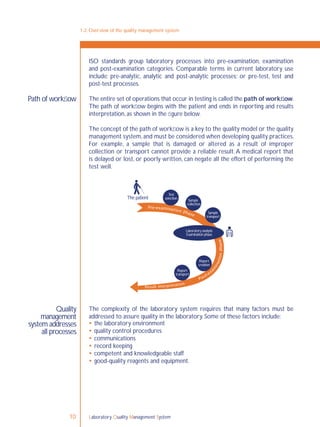
Efficient and cost-effective laboratory
operations need the uninterrupted
availability of reagents, supplies and
services.Inability to test,even for a short
time, is very disruptive to clinical care,
prevention activities and public health
programmes.
Careful management of inventory helps to prevent waste, which can occur if
reagents and supplies are stored improperly, or if reagents become outdated
before they can be used. Establishing a purchasing and inventory management
programme will ensure that:
 supplies and reagents are always available when needed;
 high-quality reagents are obtained at an appropriate cost;
 reagents and supplies are not lost due to improper storage, or kept and used
beyond expiration.
Methods for obtaining reagents and supplies vary considerably between
laboratories. Some laboratories may purchase directly but, in many countries, a
national procurement system is in place with a central stores area that distributes
directly to the laboratories.Also, in many places, donors have a major role in the
procurement of supplies and reagents.
The laboratory system for managing the reagents and supplies must take into
account these variables.
The challenge of inventory management is balancing the availability of supplies and
reagents in stock with their expiration dates.The lifespan of reagents can vary
from a few weeks to a number of years. It is important to continuously monitor
the expiration dates to make sure needed reagents are always on hand and have
not expired. However, it is too costly and wasteful to overstock.
Organization Personnel Equipment
Purchasing
and
inventory
Process
control
Information
management
Occurrence
management
Assessment
Facilities
and
safety
Customer
service
Process
improvement
Documents
and
records
Laboratory Quality Management System 49
4-1: Overview
Key components
Equipment and supplies received or accepted from donors must meet the clients’
needs and the operational needs of the laboratory. Managers may sometimes
need to refuse donations, but this should be done in a diplomatic way to ensure
future offers are not discouraged.
Successful purchasing and inventory management requires that policies and
procedures be established for managing all critical materials and services.Some of
the key components to address are:
 vendor/manufacturer qualifications;
 purchase agreements;
 receiving, inspecting, testing, storing, and handling of materials—all purchased
material should be inspected and appropriately tested to ensure that
specifications are met, and policies should be established for storing and
handling materials as they are delivered to the laboratory;
 tracking materials to individual patients—the management system must allow
for tracking materials to individual patients; that is, the laboratory should be
able to identify specific test materials used for performing tests on any given
day, so that if there is a problem with a patient result, the laboratory will know
what reagents were used;
 assessing and maintaining inventory;
 controlling expiration periods;
 dispatching supplies to satellite laboratories.
Laboratory Quality Management System50
Selecting vendors
Considerations
4-2: Purchasing
It is very important to set expectations and build and maintain relationships with
providers of materials and services. Laboratories that purchase directly should
look very carefully at vendors’ and manufacturers’ qualifications, examining such
things as specifications and methods of transport. Laboratories that receive
reagents and supplies from a central stores area managed by their government
should interact with those managing the central stores area to accomplish these
same objectives.
At the outset, the laboratory should:
 define criteria for supplies or materials to be purchased;
 look for the best price, taking into account the qualifications and credibility of
the supplier;
 consider the advantages and disadvantages of purchasing “brand name”
compared to “generic” products (e.g. is it better to purchase specific
pipette tips for a specific pipette, or is it just as effective to use generic pipette
tips that cost less?).
It may be useful to seek information from other laboratories when considering
quality, reliability of supply, and cost.
It is equally important to evaluate vendors after purchase. Consider such factors
as whether the vendor delivered the specified goods, or whether the central
procurement body assured that user specifications were met.
When setting up procedures for purchasing,there are a number of considerations.
 Understand any local or national government requirements that need to be
accommodated in the contracts.
 Negotiate for the best price without undermining quality.
 Carefully review all contracts to make sure the laboratory’s requirements
are being met. Contracts should clearly address payment mechanisms and
provisions to assure reliable availability and delivery of reagents and supplies.
Ask if there are penalties for ending a contract.
 Determine how payments will be made,and how the vendor will assure reliable
availability and delivery of supplies and reagents.
Laboratory Quality Management System 51
Implementation
steps
Analyze
needs
4-3: Implementing an inventory management programme
In establishing an inventory control programme there are a number of factors to
consider.A system should be designed so that the laboratory can closely monitor
the condition of all supplies and reagents, know what quantities are available and
be alerted when there is a need to reorder.
The following are important steps for implementation.
 Assign responsibility—without this, nothing may get done.
 Analyze the needs of the laboratory.
 Establish the minimum stock needed for an appropriate time period.
 Develop needed forms and logs.
 Establish a system for receiving, inspecting and storing supplies.
 Maintain an inventory system in all storage areas, and for all reagents and
supplies used in the laboratory.
A laboratory needs a process for analyzing its needs for materials and for
determining how many kits for a particular test should be on hand.
The laboratory should make a list of all the tests it performs and identify all the
supplies and reagents that are needed for each test. It is wise to use all available
information to help estimate the usage of supplies and reagents for the period
of time between ordering new materials.The information necessary for analyzing
needs includes:
 a complete description of each item used;
 the package count or number of units in which the item is supplied (e.g. a kit
can include 12 tests or 100 tests, and pipette tips can be packaged as 100 per
box or 1000 per box);
 approximate usage per month (quantification, e.g. 6 boxes used per month);
 the priority or importance level the item has in doing the work of the laboratory
(e.g. used every day or only once a month?);
 length of time required to receive a delivery (will the order take a day, week or
month to arrive?);
 storage space and conditions (will a bulk order use too much storage space?
Does the item require storage in a refrigerator?).
Laboratory Quality Management System52
Why?
When?
How?
4-4: Quantification
How can a laboratory determine how much of any particular item to order?
Quantification is a very important process that can help calculate how much is
required of any particular item for a given period of time,and it is an essential part
of a successful inventory management programme.Accurate quantification will:
 ensure essential supplies will be available when needed
 prevent overstocking, which can lead to wastage of expensive materials.
Quantification provides information for:
 estimating annual budget requirements;
 allowing for better planning;
 making decisions and monitoring performance of the inventory management
system.
Quantification is performed when making annual plans for the laboratory and this
planning will take into account the usual usage of supplies and reagents.
There are times when it is important to consider how new demands on the
laboratory will create a need for greater testing volume.This often occurs when
new health programmes are being implemented,and in preparation for epidemics,
either identified or potential.
The two frequently used methods are consumption-based quantification and
morbidity-based quantification.
Consumption-based quantification
Laboratories most frequently use the consumption-based method, drawing on
their experience over time.This method is based on actual consumption,so there
are a number of factors to consider. For example, to determine the actual usage,
it is important to also estimate how much wastage has occurred and how many
expired or spoiled reagents and supplies have been discarded.An example of this
type of monitoring is shown below.
Immersion oil
Collection containers
Slide
0
20
40
60
80
100
4th3rd2nd1st
s
Quarter
Laboratory Quality Management System 53
4-4: Quantification
For planning, it is a good idea to consider whether any supplies or reagents have
been out of stock for more than 15 days during any time of the year.This may
mean that supplies are not ordered in sufficient quantities, or that the wastage or
expiry is higher than predicted.
Morbidity-based quantification
In using the morbidity-based quantification method (shown below),the laboratory
must take into account the actual number of episodes, illnesses and health
problems that require laboratory testing. In other words, the laboratory needs
to estimate an expected frequency of the disease in question—how many cases
will occur per unit of population (per 1000, per 10 000, etc.)? Then, considering
how many people the laboratory serves,it can estimate the total number of cases
the community might reasonably expect to observe. Using standard guidelines
for diagnosis and treatment, and considering how well health care providers
adhere to these guidelines, can help to estimate how many laboratory tests will
be performed.
A good morbidity-based quantification method is more accurate than the
quantification by consumption method, but it depends on accurate data.
Diarrhoea
Tuberculosis
Influenza
0
40
20
80
60
120
100
160
180
140
4th3rd2nd1st
Quarter
Laboratory Quality Management System54
Developing forms
and logs
Logbook
4-5: Forms and logs
Developing an appropriate record-keeping system is an important step for
inventory management. Good tools for managing the stock include:
 standardized forms
 card systems
 log books.
For any system that is used, the following information should be recorded:
 date reagent or set of supplies are received;
 lot numbers for all supplies, reagents and kits;
 pass or fail acceptance criteria;
 date the lot number or box of supplies was put into service or,if not usable,the
date and method of disposition.
The stock logbook or card system will provide a way to keep track of all supplies
and reagents that are on hand at any given time. In addition to information
mentioned above, it is a good idea to record:
 name and signature of the person receiving the materials
 date of receipt
 expiration date
 quantity of the material received
 minimum stock that should be on hand
 current stock balance.
Additional information to record could include:
 shelf number or name
 destination (e.g. to –20 o
C freezer to media room).
It is a good idea to keep the stock logbook in the storage area.
Laboratory Quality Management System 55
Receiving and
inspecting
supplies
Storage
Organization
of shelves
4-6: Receipt and storage of supplies
A system should be established so when supplies are received, personnel know
what is expected.All supplies and reagents should be inspected as they arrive in
the laboratory to be sure that they are in good condition and to verify that what
is received is what was ordered.
In addition, the person receiving supplies should:
 sign their name verifying receipt of goods
 date each item received
 note expiration date
 store new shipment behind existing shipment
 create or update logbook records.
Storage of reagents and supplies is a very important part of inventory control.
Good practices to keep in mind are:
 Keep the storeroom clean, organized and locked to protect the inventory.
 Make sure storage areas are well ventilated and protected from direct sunlight.
 Ensure storage conditions are in accordance with the manufacturer’s
instructions, paying particular attention to any temperature requirements or
other specifications, such as safety requirements.
 Use good shelving strong enough to support items,and organize items carefully
on the shelves to prevent movement shifts or falls. Shelves should be attached
firmly to support walls to prevent tipping.
 Ensure items are accessible to staff. Sturdy step stools should be available for
reaching higher shelves and heavier items should be stored on lower shelves;
laboratory staff should not be required to lift heavy items.
 When storing,put the new shipment behind existing materials that are already in
the laboratory. Organize the reagents and materials so that the older materials
get used first (i.e. items with the first expiry dates are the first used).
Labelling shelves is a useful tool for storing inventory and will help to systemize
and organize storage space.
 Assign a number (or name) to different areas of the shelves.
 Record in the logbook what shelves are used for which reagents and supplies.
Laboratory Quality Management System56
4-6: Receipt and storage of supplies
Labelling reagents
This system helps to avoid “losing” a product, and will save staff time when
searching for a product. Even someone who is not familiar with the storeroom
can find a product if this system is in place. It is also useful to number cold
rooms, refrigerators and freezers for the same purpose.An example of this type
of system is shown below.
Establishing a system for labelling reagents will be very helpful. It is important to
label reagents with the date they are opened and to make sure the expiration
date is clearly visible.
1
1
3
2 2 4
4
5
2
6 6 7
8 9 10 11 12
2
Laboratory Quality Management System 57
Continuous
monitoring of
inventory
Computerized
inventory
management
advantages and
drawbacks
4-7: Monitoring inventory
Procedures should be developed and put in place for continuous monitoring of
the inventory.To ensure this is done effectively:
 assign the responsibility for this task to an appropriate person or persons—
someone must be in charge;
 be sure that all supplies and reagents in the laboratory are covered by the sys-
tem and maintain inventory management in all of the storage areas;
 conduct weekly physical counts of reagents and supplies in order to check the
system, and as a part of the monitoring process;
 make sure that all records relevant to inventory management are updated and
maintained.
In many laboratories,a simple computerized system can be set up for management
of inventory.There are many advantages to using a computer.A computer will:
 keep track of the exact number of supplies and reagents on hand, as it can be
updated daily;
 allow for good management of expiration dates—the system can be set up
to alert when lot numbers are near the expiration date, and therefore use of
resources can be optimized;
 generate statistics that will help when planning and making purchases;
 help manage the process for distributing reagents to satellite laboratories;
 ease the burden of inventory management.
Some drawbacks to setting up a computerized system are:
 an on-site computer is needed and it could be expensive to purchase
 staff using the system will need to be trained.
Laboratory Quality Management System58
Summary
Key messages
4-8: Summary
A well-managed laboratory will have a system for inventory maintenance and
purchasing. The system will require planning and monitoring to ensure that
appropriate quantities of supplies and reagents are always available,and to prevent
wastage.
In implementing an inventory management system, the laboratory must assign
responsibility for the programme, analyze the needs of the laboratory and
establish the minimum stock needed for an appropriate time period.Appropriate
logs and forms will be needed, as well as a procedure for receiving, inspecting and
storing supplies.
The laboratory will need to maintain an inventory system for all reagents and
supplies used in the laboratory; this system must include all areas where reagents
and supplies are stored.
Properly managing inventory will:
 increase the efficiency and effectiveness of the laboratory, because it will
provide an uninterrupted flow of needed materials;
 ensure products are available when they are needed;
 ensure that patient and clinical needs are met.
5. Process control—
sample management
Laboratory Quality Management System60
Role in quality
management
system
Sample vs
specimen
Sample
management
components
Importance
of good
management
The International Organization for Standardization (ISO) and Clinical and
Laboratory Standards Institute (CLSI) define a sample as “one or more parts
taken from a system and intended to provide information on the system” (ISO
15189:2007).The term “specimen” is very commonly used in the laboratory to
indicate a sample taken from the human body,but the terminology used throughout
ISO documents is “primary sample”, or just “sample”. In this handbook, the terms
“sample” and “specimen” should be considered interchangeable.
It is useful to note that in some of the existing transport regulations, the term
“specimen” continues to be used.
Proper management of samples is critical to the accuracy and reliability of testing,
and therefore to the confidence in laboratory diagnosis. Laboratory results
influence therapeutic decisions and can have significant impacts on patient care
and outcomes. It is important to provide accurate laboratory results in order to
ensure good treatment.
Inaccuracies in testing can impact length of hospital stays, as well as hospital and
laboratory costs. Inaccuracies can also affect laboratory efficiency, leading to
repeat testing with resultant waste of personnel time, supplies and reagents.
Written policies for sample management must be established and reflected in the
laboratory handbook. Components to be addressed include:
 information needed on requisitions or forms;
 handling urgent requests;
 collection, labelling, preservation and transport;
 safety practices (leaking or broken containers, contaminated forms, other
biohazards);
 evaluating, processing and tracking samples;
 storage, retention and disposal.
5-1: Overview
Sample management is a part of
process control, one of the essentials
of a quality management system.
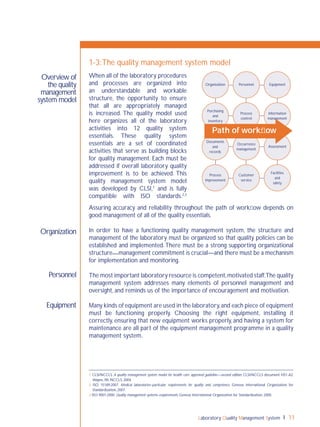
The quality of the work a laboratory
produces is only as good as the quality
of the samples it uses for testing.
The laboratory must be proactive in
ensuring that the samples it receives
meet all of the requirements for
producing accurate test results.
Organization Personnel Equipment
Purchasing
and
inventory
Process
control
Information
management
Occurrence
management
Assessment
Facilities
and
safety
Customer
service
Process
improvement
Documents
and
records
Laboratory Quality Management System 61
Purpose and
distribution
Content
5-2:The laboratory handbook
To ensure that all samples are managed properly and that persons collecting
samples have the needed information,the laboratory should develop a laboratory
handbook.This handbook should be made available at all sample collection areas,
including those that are distant from the laboratory.
All laboratory staff should also be familiar with the information in the handbook,
and should be able to answer questions about the information included. The
laboratory handbook is an important laboratory document. It must be kept up to
date and be referenced in the laboratory’s quality manual.
Important information that should be included in the laboratory handbook:
 contact names and telephone numbers of key personnel;
 name and address of the laboratory;
 hours of operation of the laboratory;
 list of tests that can be ordered;
 detailed information on sample collection requirements;
 sample transport requirements, if any;
 expected turnaround times;
 description of how urgent requests are handled—this should include a list
of what kinds of tests are done on an urgent basis, what are the expected
turnaround times, and how to order these tests.
The laboratory should periodically provide training sessions to health care and
laboratory personnel who are responsible for the collection of samples.
Laboratory Quality Management System62
The laboratory’s
responsibilites
Test
requisition
Sample collection
requirements
5-3: Collection and preservation
The collection of appropriate and optimum samples is the responsibility of the
laboratory, even though the actual collection process is often carried out by persons
who are not part of the laboratory staff.The sample may be collected at the bedside
by a nurse if the patient is being managed in a hospital.The health care provider may
collect a sample in a clinic setting.
The laboratory can help to ensure good samples by providing collection information
to health care personnel at the collection site,making sure that appropriate containers
and collection supplies are available, defining a good labelling system and checking all
samples carefully when they arrive in the laboratory.
The first step in the process
of obtaining the sample is the
request for testing.The laboratory
must make available a test
request form that specifies all
the information that will be
needed for proper handling and
reporting.
Essential information for the test
request form includes:
 patient identification;
 tests requested;
 time and date of the sample
collection;
 source of the sample, when
appropriate;
 clinical data, when indicated;
 contact information for the health care provider requesting the test.
Collection of samples in the field for epidemiological studies should be
accompanied by a form that includes the patient’s name, a unique identification
number, demographic information and the patient’s health status.The additional
information is necessary to assist in identifying the source of an infection and
finding potential contacts.
Sample collection and preservation will vary, depending on the test and the
type of sample to be collected. The laboratory must carefully define a sample
collection process for all tests it performs.The following should be considered
when preparing instructions.
 Patient preparation—Some tests require that the patient be fasting.There
may also be special timing issues for tests such as blood glucose,drug levels and
hormone tests.
Laboratory Quality Management System 63
5-3: Collection and preservation
Sample
labelling
Outcomes of
collection errors
 Patient identification—The person collecting the sample must accurately
identify the patient.This might be done by questioning the patient,by questioning
an accompanying family member, or by the use of an identifying wrist band or
other device.
 Type of sample required—Blood tests might require serum,plasma or whole
blood.Other tests might require urine or saliva.Microbiology testing deals with
a variety of sample types, so specific information as to what is required for the
test is needed.
 Type of container—The container for the sample is often very important,
as it will affect volume and any needed additives such as anticoagulants and
preservatives. If the container does not control volume, for example as with
Vacutainer® tubes, this will need to be clearly specified. Some microbiology
samples will require specific transport media to preserve microorganisms.
 Sample labelling—All requirements for labelling of the sample at the time of
collection will need to be explained in detail in the instructions for collection.
 Special handling—Some samples may require special handling, such as
immediate refrigeration, protection from light or prompt delivery to the
laboratory.Any important safety precautions should be explained.
Patient samples are sometimes collected by the patient themselves; for example,
faecal parasitological samples. It is important that the laboratories have set
protocols to ensure that appropriate collection kits with instructions for
collection, safety precautions and labelling are available for their patients. It is
suggested that instructions for the patients be in the languages for the community
the laboratory is serving, or presented as simple, easy-to-understand graphics.
Each sample should be clearly labelled with:
 the patient’s first and last name;
 a unique identification number—this might be a hospital number or a number
assigned by the laboratory;
 the test that has been requested;
 the time and date of collection;
 the initials of the person collecting the sample.
Proper sample collection is an important element for good laboratory practice.
Improper collection of samples can lead to poor outcomes,such as:
 delays in reporting test results
 unnecessary redraws/retests
 decreased customer satisfaction
 increased costs
 incorrect diagnosis or treatment
 injury
 death.
Laboratory Quality Management System64
Verification of
quality
Rejection of
samples
5-4: Sample processing
Once a sample enters the laboratory, there are a number of steps needed prior
to testing.
 Verify the sample is properly labelled, adequate in quantity, in good condition
and appropriate for the test requested.The test request must be complete and
include all necessary information.
 Record sample information into a register or log.
 Enforce procedures for handling suboptimum samples, including sample
rejection when necessary.
The laboratory should establish rejection criteria and follow them closely. It is
sometimes difficult to reject a sample, but remember that a poor sample will not
allow for accurate results. It is the responsibility of the laboratory to enforce its
policies on sample rejection so that patient care is not compromised.
Management should regularly review the number of rejected samples and
reasons for rejections, conduct training on sample collection, and revise written
procedures for sample management as needed.
The following are examples of samples that should be rejected:
 unlabelled sample;
 broken or leaking tube/container;
 insufficient patient information;
 sample label and patient name on the test request form do not match;
 haemolysed sample (depending on test requested);
 nonfasting samples, for tests that require fasting;
 sample collected in wrong tube/container (e.g. using the wrong preservative or
a nonsterile container);
 inadequate volume for the quantity of preservative;
 insufficient quantity for the test requested;
 prolonged transport time or other poor handling during transport.
Record the reason for rejection in the logbook and include all pertinent
information.
When rejecting a sample, it is important to:
 promptly inform the authorized person that the sample is unsuitable for testing;
 request another sample to be collected following procedures outlined in the
laboratory handbook;
 retain the rejected sample pending a final decision regarding disposition.
In some circumstances, and after consultation with the requester, it may be
necessary to proceed with the testing of a sample that is not optimal.
Laboratory Quality Management System 65
5-4: Sample processing
Register
or log
Tracking
system
Sample
handling
The laboratory should keep a register (log) of all incoming samples. A master
register may be kept, or each specialty laboratory may keep its own sample
register.
Assign the sample a laboratory identification number—write the number on the
sample and the requisition form. If computers are used for reports, enter the
information into the computer.
The register should include:
 date and time of collection
 date and time the sample was received in the laboratory
 sample type
 patient name and demographics, as required
 laboratory assigned identification (e.g. number 276_01_06_2009)
 tests to be performed.
The laboratory needs a system to allow for tracking a sample throughout the
laboratory from the time it is received until results are reported.
This can be done manually by careful keeping of records as follows.
 Confirm receipt of samples and include date and time.
 Label samples appropriately and keep with the test requisition until laboratory
identification is assigned.
 Track aliquots—they should be traceable to the original sample.
If computers are available, maintain a database for tracking. The following
information about each sample should be entered into the database:
 identification number
 patient information
 collection date and time
 type of sample (e.g. urine, throat, cerebrospinal fluid for culture)
 tests to be performed
 name of ordering physician (or other health care provider)
 location of patient (e.g. ward, clinic, outpatient)
 diagnostic test results
 time and date results are reported.
Handle all samples as if they are infectious.
Laboratory Quality Management System66
Sample
storage
Sample
retention
Sample
disposal
Sample
referral
5-5: Sample storage, retention and disposal
Written policies should be developed that include:
 description of what samples should be stored;
 retention time;
 location (consider ease of access);
 conditions for storage, such as atmospheric and temperature requirements;
 system for storage organization—one method is to store samples by day of
receipt or accession number.
Set a laboratory policy for retention of each type of sample.Some samples can be
quickly discarded and others may need to be retained for longer periods.Monitor
stored samples and do not keep for longer than necessary, as refrigerator and
freezer space may be limited. Sample freeze/thaw cycles must be monitored, as
samples may deteriorate under these conditions.
Planning is required for samples that may need long-term storage.An organized,
accessible system using computer tracking would be useful for these samples.
The inventory of stored samples should be reviewed at specified intervals to
determine when they should be discarded.
When referring samples to other laboratories for testing:
 Obtain a laboratory handbook with detailed procedures from each laboratory.
 Ensure the sample is labelled correctly, in the correct container, accompanied
by a requisition form that specifies the required test(s) and includes the sending
laboratory’s contact information.
 Carefully monitor samples that are referred:
- keep a record of all tests and samples referred, date of referral and name of
person referring the test;
- record and report results received for each referred sample;
- monitor turnaround times and record any problems encountered.
The laboratory is responsible for ensuring that disposal of all laboratory waste is
handled in a safe manner.To ensure proper disposal of patient samples:
 Develop a policy for sample disposal; apply local as well as country regulations
for disposal of medical waste.
 Establish and follow procedures to disinfect samples prior to disposal.
Laboratory Quality Management System 67
Need for
transport
Safety
requirements
Regulations
Classification
5-6: Sample transport
Frequently,samples are collected outside the laboratory and must be transported
for subsequent processing and testing. Transport may be for a short distance,
but sometimes a distant clinic or collection site requires the use of vehicles or
aeroplanes. In addition, it may be necessary for the laboratory to ship samples to
referral laboratories. In all cases, transport must be managed carefully in order
to maintain integrity of the sample, giving attention to temperature, preservation
needs, special transport containers and time limitations. It is also important to
ensure the safety of those handling the material before,during and after transport.
Laboratories that mail or transport samples by air, sea, rail or road between local,
regional and reference laboratories, or between laboratories in other countries,
must adhere to a number of regulations.These regulations are designed to deal
with transportation accidents and spills, reduce biohazards and keep samples
intact for testing.
Regulations for transporting samples come from several sources, including:
 national transport regulations;
 International Civil Aviation Organization (ICAO), as conveyed by the
International Air Transport Association;
 rail and road traffic agencies;
 postal services.
Private courier companies may have their own requirements.
Compliance with industry standards and regulations is mandatory. Heavy fines
may be imposed on personnel who violate these regulations.At risk are the safety
of courier, carrier and laboratory personnel, as well as passengers.
The United Nations committee of experts, consisting of voting representatives
from over 30 countries and nonvoting advisers from various organizations, makes
recommendations for the transport of dangerous goods.Many countries adopt the
United Nations regulations in their entirety to stand as their national dangerous
goods regulations. Some countries apply variations. National authorities should
provide details of their own national requirements.
Sample transport requirements are based on the category of samples being
transported. Infectious substances are classified as Category A or Category B.
There is no direct relationship between Risk Groups and Categories A and B.
Category A: Infectious substances capable of causing permanent disability or
life-threatening or fatal disease to humans or animals.
Laboratory Quality Management System68
5-6: Sample transport
Packaging
requirements
These are assigned the following proper shipping name and UN number:
 Infectious substance affecting humans, UN 2814.
 Infectious substance affecting animals only, UN 2900.
Category B: Infectious substances that do not meet the criteria for inclusion
in Category A.They are assigned the proper shipping name Biological substance,
Category B, and UN number UN 3373.
Medical or clinical wastes that contain infectious substances also need to be
classified as Category A or B, depending on the infectious material and whether
it is present in the culture.
Exemptions: The United Nations Model Regulations for the Transport of
Infectious Substances includes a list of exemptions, which are samples that have
a minimal likelihood that pathogens are present. They do not have the same
requirements for packaging and shipping as Categories A and B.
All three categories of samples have specific packaging instructions and labelling
requirements depending on their classification.All potentially hazardous material
requires triple packaging.
 The primary container is a tube or vial containing the sample; it is made
of glass, metal or plastic. It must have a leak-proof seal; if necessary it can
be wrapped with waterproof tape. The tube or vial must be labelled with a
permanent marker.
 The secondary container is a watertight polyethylene box intended to
protect the primary container. It is supplied with cardboard or bubble-wrap,
or a vial holder in which several primary containers can be placed in order to
protect them.Absorbent material (gauze, absorbent paper) must be added in a
sufficient quantity to absorb the fluid completely in case of breakage.
 The outer container is a strengthened cardboard box used to protect the
secondary container. Both the secondary and outer containers are reusable as
long as they are intact, but old labels must be removed.
There is specific packaging for samples requiring shipment on dry ice.
Laboratory Quality Management System 69
Ensure that all regulations and requirements are met when transporting samples;
be aware of any national requirements that apply to samples transported by
hospital or laboratory vehicles.
All personnel who package samples or who drive transport vehicles should be
trained in the proper procedures for safety and good maintenance of samples. If
ICAO regulations must be met, staff must have specific training in packaging of
dangerous goods.
When transporting locally, whether by ambulance, or by clinic or laboratory
staff, it is important to maintain sample integrity. Ensure that temperatures are
controlled, using ice boxes or air-conditioning, set an acceptable transport time
and monitor compliance.
Managing sample
transport
5-6: Sample transport
Laboratory Quality Management System70
5-7: Summary
A laboratory handbook describing sample collection and providing testing
information must be available to everyone who needs this information.
It is important to have a system for tracking samples as they move through the
laboratory.
Establish and implement a policy for sample storage and sample disposal.
Maintain sample integrity and assure that all regulations and requirements are
met.
It may be useful to appoint someone with oversight responsibilities for sample
management.
 The laboratory must have good samples in order to ensure accuracy and
reliability of testing and confidence in results.
 Sample management directly affects patient care and outcome.
Summary
Key messages
6. Process control—
introduction to
quality control
Laboratory Quality Management System72
Role in quality
management
system
What is QC?
6-1: Introduction
QC is the part of quality management focused on fulfilling quality requirements
(ISO 9000:2000 [3.2.10]). Simply put, it is examining “control” materials of known
substances along with patient samples to monitor the accuracy and precision of the
complete analytic process. QC is required for accreditation purposes.
In 1981, the World Health Organization (WHO) used the term "internal quality
control" (IQC), which it defined as “a set of procedures for continuously assessing
laboratory work and the emergent results”.The terms QC and IQC are sometimes
used interchangeably; cultural setting and country may influence preferences for
these terms.
In the past few years, "internal quality control' has become confusing
in some settings because of the different meanings that have been
associated with the term. Some manufacturers of test kits for qualitative tests have
integrated "built-in" controls in the design of their kits,which they sometimes refer
to as internal controls. Other manufacturers include their own control materials
with the kits they sell and they refer to these as "internal controls", meaning that
the materials are meant specifically for that manufacturer’s kit. Finally, some people
refer to any quality control materials that are used in conjunction with test runs as
IQC, as in the 1981 WHO definition.
72
Organization Personnel Equipment
Purchasing
and
inventory
Process
control
Information
management
Occurrence
management
Assessment
Facilities
and
safety
Customer
service
Process
improvement
Documents
and
records
Process control is an essential element
of the quality management system,
and refers to control of the activities
employed in the handling of samples
and examination processes in order
to ensure accurate and reliable testing.
Sample management, discussed in
Chapter 5, and all quality control
(QC) processes are a part of process
control.
QC monitors activities related to the
examination (analytic) phase of testing.
The goal of QC is to detect, evaluate,
nd correct errors due to test system
failure, environmental conditions or
operator performance, before patient
results are reported.
Laboratory Quality Management System 73
6-1: Introduction
QC for varying
methods
To avoid confusion, the term "quality control" will be used here to mean use
of control materials to monitor the accuracy and precision of all the processes
associated with the examination (analytic) phase of testing.
Quality control processes vary,depending on whether the laboratory examinations
use methods that produce quantitative, qualitative or semiquantitative results.
These examinations differ in the following ways.
Quantitative examinations measure the quantity of an analyte present in the
sample, and measurements need to be accurate and precise.The measurement
produces a numeric value as an end-point, expressed in a particular unit of
measurement. For example, the result of a blood glucose test might be reported
as 5 mg/dL.
Qualitative examinations are those that measure the presence or absence of
a substance, or evaluate cellular characteristics such as morphology.The results
are not expressed in numerical terms, but in qualitative terms such as “positive”
or “negative”;“reactive” or “nonreactive”;“normal” or “abnormal”; and “growth”
or “no growth”. Examples of qualitative examinations include microscopic
examinations, serologic procedures for presence or absence of antigens and
antibodies, and many microbiological procedures.
Semiquantitative examinations are similar to qualitative examinations,in that
the results are not expressed in quantitative terms.The difference is that results
of these tests are expressed as an estimate of how much of the measured
substance is present.Results might be expressed in terms such as“trace amount”,
“moderate amount”, or “1+, 2+, or 3+”. Examples are urine dipsticks, tablet tests
for ketones and some serologic agglutination procedures. In the case of other
serologic testing,the result is often expressed as a titre—again involving a number
but providing an estimate, rather than an exact amount of the quantity present.
Some microscopic examinations are considered semiquantitative because results
are reported as estimates of the number of cells seen per low-power field or
high-power field. For example, a urine microscopic examination might report
0–5 red blood cells seen per high-power field.
Because QC processes differ for these various types of examinations, the
presentations for QC will be divided into two chapters. Chapter 7 will address
QC for quantitative examinations, and Chapter 8 will address QC for qualitative
and semiquantitative examinations.
Laboratory Quality Management System74
6-1: Introduction
Summary
Regardless of the type of examination that is performed, steps for implementing
and maintaining a QC programme include:
 establishing written policies and procedures, including corrective actions
 training all laboratory staff
 ensuring complete documentation
 reviewing quality control data.
These responsibilities will be described in more detail in Chapters 7 and 8.
 QC is part of the quality management system and is used to monitor the
examination (analytic) phase of testing.
 The goal of QC is to detect, evaluate and correct errors due to test system
failure, environmental conditions, or operator performance, before patient
results are reported.
 Different QC processes are applied to monitor quantitative, qualitative and
semiquantitative tests.
Elements of a
QC programme
7. Process control—
quality control for
quantitative tests
Laboratory Quality Management System76
Role in quality
management
system
Overview of
the process
Implementation
process
7-1: Overview
Quantitative tests measure the quantity of a substance in a sample, yielding a
numeric result. For example, the quantitative test for blood glucose can give a
result of 5 mg/dL. Since quantitative tests have numeric values, statistical tests can
be applied to the results of QC material to differentiate between test runs that
are “in control” and “out of control”.This is done by calculating acceptable limits
for control material, then testing the control with the patient’s samples to see if
it falls within established limits.
As a part of the quality management system, the laboratory must establish a QC
programme for all quantitative tests. Evaluating each test run in this way allows
the laboratory to determine if patient results are accurate and reliable.
The steps for implementing a QC programme are:
 establish policies and procedures
 assign responsibility for monitoring and reviewing
 train all staff in how to properly follow policies and procedures
 select good QC material
 establish control ranges for the selected material
 develop graphs to plot control values—these are called Levey–Jennings charts
 establish a system for monitoring control values
 take immediate corrective action if needed
 maintain records of QC results and any corrective actions taken.
Organization Personnel Equipment
Purchasing
and
inventory
Process
control
Information
management
Occurrence
management
Assessment
Facilities
and
safety
Customer
service
Process
improvement
Documents
and
records
Quality control (QC) is a component
of process control, and is an essential
element of the quality management
system. It monitors the processes related
to the examination phase of testing and
allows for detecting errors in the testing
system.These errors may be due to test
system failure, adverse environmental
conditions or operator performance. QC
gives the laboratory confidence that test
results are accurate and reliable before
patient results are reported.
This chapter explains how quality control
methods are applied to quantitative
laboratory examinations.
Laboratory Quality Management System 77
Differentiating
controls and
calibrators
Characteristics of
control materials
Types and
sources of
control material
Defining control
materials
7-2: Control materials
Controls are substances that contain an established amount of the substance
being tested—the analyte. Controls are tested at the same time and in the same
way as patient samples.The purpose of the control is to validate the reliability
of the test system and evaluate the operator’s performance and environmental
conditions that might impact results.
It is important not to confuse calibrators and control materials. Calibrators
are solutions with a specified defined concentration that are used to set or
calibrate an instrument, kit, or system before testing is begun. Calibrators are
often provided by the manufacturer of an instrument.They should not be used
as controls since they are used to set the instrument. Calibrators are sometimes
called standards,but the term calibrator is preferred.They usually do not have the
same consistency as patients’ samples.
It is critical to select the appropriate control materials. Some important
characteristics to consider when making the selection are:
 Controls must be appropriate for the targeted diagnostic test—the substance
being measured in the test must be present in the control in a measurable form.
 The amount of the analyte present in the controls should be close to the
medical decision points of the test; this means that controls should check both
low values and high values.
 Controls should have the same matrix as patient samples; this usually means
that the controls are serum based, but they may also be based on plasma, urine
or other materials.
Because it is more efficient to have controls that last for some months, it is best
to obtain control materials in large quantities.
Control materials are available in a variety of forms.They may be frozen, freeze-
dried or chemically preserved.The freeze-dried or lyophilized materials must be
reconstituted, requiring great care in pipetting in order to ensure the correct
concentration of the analyte.
Control materials may be purchased, obtained from a central or reference
laboratory, or made in-house by pooling sera from different patients.
Purchased controls may be either assayed or unassayed.Assayed controls have a
predetermined target value, established by the manufacturer.When using assayed
controls, the laboratory must verify the value using its own methods. Assayed
controls are more expensive to purchase than unassayed controls.
When using either unassayed or“in-house” controls,the laboratory must establish
the target value of the analyte.
Laboratory Quality Management System78
7-2: Control materials
Choosing
controls
Preparing and
storing control
material
The use of in-house controls requires resources to perform validation and testing
steps.An advantage is that the laboratory can produce very large volumes with
exact specifications.
Remember that QC materials are usually serum based. Universal
precautions should be used when handling.
When choosing controls for a particular method,select values that cover medical
decision points, such as one with a normal value, and one that is either high or
low, but in the medically significant range.
Controls are usually available in "high", "normal" and "low" ranges. Shown in the
graphic are normal, abnormal high and low, and critical high and low ranges. For
some assays, it may be important to include controls with values near the low
end of detection.
When preparing and storing QC materials, it is important to carefully adhere to
the manufacturer’s instructions for reconstituting and storage. If in-house control
material is used, freeze aliquots and place in the freezer so that a small amount
can be thawed and used daily.Do not thaw and refreeze control material.Monitor
and maintain freezer temperatures to avoid degradation of the analyte in any
frozen control material.
Use a pipette to deliver the exact amount of required diluent to lyophilized
controls that must be reconstituted.
??
PATIENT CONTROLS
Critical
Critical
Abnormal
Critical high
and low range
Abnormal high
and low ranges
Normal range
Abnormal
Normal
CONTROL
CONTROL
CONTROL
Laboratory Quality Management System 79
Characteristics
of repeated
measures
Assaying control
over time
7-3: Establishing the value range for the control material
Once the appropriate control materials are purchased or prepared, the next step
is to determine the range of acceptable values for the control material.This will
be used to let the laboratory know if the test run is “in control” or if the control
values are not reading properly—“out of control”.This is done by assaying the
control material repeatedly over time.At least 20 data points must be collected
over a 20–30-day period. When collecting this data, be sure to include any
procedural variation that occurs in the daily runs; for example, if different testing
personnel normally do the analysis, all of them should collect part of the data.
Once the data is collected, the laboratory will need to calculate the mean and
standard deviation of the results. A characteristic of repeated measurements is
that there is a degree of variation.Variation may be due to operator technique,
environmental conditions or the performance characteristics of an instrument.
Some variation is normal, even when all of the factors listed above are controlled.
The standard deviation gives a measure of the variation.This process is illustrated
below.
One of the goals of a QC programme is to differentiate between
normal variation and errors.
A few theoretical concepts are important because they are used to
establish the normal variability of the test system. QC materials are
run to quantify the variability and establish a normal range, and to
decrease the risk of error.
The variability of repeated measurements will be distributed around a central
point or location. This characteristic of repeated measurements is known as
central tendency.
Obtain control material
Run each control
20 times over 30 days
Calculate mean and
+ 1, 2, 3 standard deviations
3 SD
2 SD
1 SD
Mean
1 SD
2 SD
3 SD
Laboratory Quality Management System80
7-3: Establishing the value range for the control material
Statistical
notations
Mean
Before calculating
QC ranges
Normal
distribution
The three measures of central tendency are:
 Mode—the number that occurs most frequently.
 Median—the central point of the values when they are arranged in numerical
sequence.
 Mean—the arithmetic average of results.The mean is the most commonly used
measure of central tendency used in laboratory QC.
Statistical notations are symbols used in mathematical formulas to calculate
statistical measures. For this chapter, the symbols that are important to know are:
 the sum of
 number of data points (results or observations)
X1
individual result
X1
– Xn
data point 1–n where n is the last result
X the symbol for the mean
 the square root of the data.
The formula for the mean is:
X =
X1
+ X2
+ X 3
... Xn
N
As an example of how to calculate a mean,consider enzyme-linked immunosorbent
assay (ELISA) testing.The method is to gather data as ratios, add the values and
divide by the number of measurements.
The purpose of obtaining 20 data points by running the QC sample is to quantify
normal variation and establish ranges for QC samples. Use the results of these
measurements to establish QC ranges for testing.
If one or two data points appear to be too high or low for the set of data, they
should not be included when calculating QC ranges.They are called “outliers”.
 If there are more than 2 outliers in the 20 data points, there is a problem with
the data and it should not be used.
 Identify and resolve the problem and repeat the data collection.
If many measurements are taken,and the results are plotted on a graph,the values
form a bell-shaped curve as the results vary around the mean. This is called a
normal distribution (also termed Gaussian distribution).
Laboratory Quality Management System 81
7-3: Establishing the value range for the control material
Accuracy and
precision
Target illustration
The distribution can be seen if data points are plotted on the x-axis and the
frequency with which they occur on the y-axis.
The normal curve shown (right) is really
a theoretical curve obtained when a large
number of measurements are plotted.It is
assumed that the types of measurements
used for quantitative QC are normally
distributed based on this theory.
If a measurement is repeated many times,
the result is a mean that is very close to the true mean.
Accuracy is the closeness of a measurement to its true value.
Precision is the amount of variation in the measurements.
 The less variation a set of measurements has, the more precise it is.
 In more precise measurements, the width of the curve is smaller because the
measurements are all closer to the mean.
Bias is the difference between the expectation of a test result and an accepted
reference method.
The reliability of a method is judged in terms of accuracy and precision.
A simple way to portray precision and accuracy is to think of a target with a
bull’s eye.The bull’s eye represents the accepted reference value which is the true,
unbiased value.If a set of data is clustered around the bull’s eye,it is accurate.
The closer together the hits
are, the more precise they
are. If most of the hits are
in the the bull’s eye, as in the
figure on the left,they are both
precise and accurate.
The values in the middle
figure are precise but not
accurate because they are
clustered together but not at the bull’s eye.The figure on the right shows a set of hits
that are imprecise.
Measurementscanbeprecisebutnotaccurateifthevaluesareclosetogetherbutdonot
hit the bull’s eye.These values are said to be biased.The middle figure demonstrates
a set of precise but biased measurements.
mean
Frequency
Accurate and
precise
Precise but
biased
Imprecise
Accurate = precise but not biased
Laboratory Quality Management System82
7-3: Establishing the value range for the control material
Measures of
variability
Standard
deviation
Calculating
acceptable
limits for
the control
The purpose of quality control is to monitor the accuracy and precision
of laboratory assays before releasing patient results.
The methods used in clinical laboratories may show different variations about the
mean; hence, some are more precise than others.To determine the acceptable
variation, the laboratory must compute the standard deviation (SD) of the 20
control values.This is important because a characteristic of the normal distribution
is that, when measurements are normally distributed:
 68.3% of the values will fall within –1 SD and +1 SD of the mean
 95.5% fall within –2 SD and +2 SD
 99.7% fall between –3 SD and +3 SD of the mean.
Knowing this is true for all normally shaped distributions allows the laboratory to
establish ranges for QC material.
Once the mean and SD are computed for a set of measurements, a QC material
that is examined along with patients' samples should fall within these ranges.
SD is a measurement of variation in a set of results. It is very useful to the
laboratory in analyzing QC results.
The formula for calculating standard deviation is:
The number of independent data points (values) in a data set are represented
by “n”. Calculating the mean reduces the number of independent data points to
n – 1. Dividing by n –1 reduces bias.
The values of the mean, as well as the values of + 1, 2 and 3 SDs are needed to
develop the chart used to plot the daily control values.
 To calculate 2 SDs,multiply the SD by 2 then add and subtract each result from
the mean.
 To calculate 3 SDs,multiply the SD by 3,then add and subtract each result from
the mean.
For any given data point, 68.3% of values will fall between + 1 SD, 95.5% between
(X1
– X)2
n–1
SD =
Laboratory Quality Management System 83
7-3: Establishing the value range for the control material
Coefficient of
variation
+ 2 SD and 99.7% between + 3 SD of the mean.
When only one control is used,we consider an examination run to be“in control”
if a value is within 2 SD of the mean.
The coefficient of variation (CV) is the SD expressed as a percentage of the mean.
CV (%) = SD x 100
Mean
The CV is used to monitor precision. When a laboratory changes from one
method of analysis to another, the CV is one of the elements that can be used
to compare the precision of the methods. Ideally, the value of the CV should be
less than 5%.
Laboratory Quality Management System84
Using graphs
for analysis and
monitoring
Developing
data for Levey–
Jennings charts
Levey–Jennings
chart
7-4: Graphically representing control ranges
Once the appropriate range of control values has been established,the laboratory
will find it very useful to represent the range graphically for the purpose of daily
monitoring.The common method for this graphing is the use of Levey–Jennings
charts.
In order to develop Levey–Jennings charts for daily use in the laboratory, the
first step is the calculation of the mean and SD of a set of 20 control values as
explained in 7-3.
A Levey–Jennings chart can then be drawn, showing the mean value as well as
+ 1, 2, and 3 SD.The mean is shown by drawing a line horizontally in the middle
of the graph and the SD are marked off at appropriate intervals and lines drawn
horizontally on the graph, as shown below.
This Levey–Jennings chart was developed using 20 repeated measurements of the
control value. In order to use the Levey–Jennings chart to record and monitor
daily control values, label the x-axis with days, runs,or other intervals used to run
QC. Label the chart with the name of the test and the lot number of the control
being used.
196.5
194.5
192.5
190.5
188.5
186.5
184.5
Draw lines for mean and SD
(calculated from 20 controls)
Chart name: Lot number:
Days
+3 SD
+2 SD
+1 SD
–1 SD
–2 SD
–3 SD
MEAN
Laboratory Quality Management System 85
Number of
controls used
Plotting control
values
7-5: Interpreting quality control data
A QC sample tested along with patient’s samples can now be used to determine if
daily runs are “in control”.A control sample must be run with each set of patient
samples.
Run the control and plot it on the Levey–Jennings chart. If the value is within
+2 SD, the run can be accepted as “in-control”.
The values on the chart are those run on days 1,2 and 3 after the chart was made.
In this case, the second value is “out of control” because it falls outside of 2 SD.
When using only one QC sample,if the value is outside 2 SD,that run is considered
“out of control” and the run must be rejected.
If it is possible to use only one control, choose one with a value that lies within
the normal range of the analyte being tested.When evaluating results, accept all
runs where the control lies within +2 SD. Using this system, the correct value will
be rejected 4.5% of the time.
In order to improve efficiency and accuracy, a system using two or three controls
for each run can be employed.Then another set of rules can be used to avoid
rejecting runs that may be acceptable. These rules were applied to laboratory
QC by a clinical chemist named James Westgard. This Westgard multirule
system requires running two controls of different target values for each set of
examinations, developing a Levey–Jennings chart for each, and applying the rules.
The use of three controls with each run gives even higher assurance of accuracy
of the test run. When using three controls, choose a low, a normal and a high
range value.There are also Westgard rules for a system with three controls.
196.5
194.5
192.5
190.5
188.5
186.5
184.5
Draw lines for mean and SD
(calculated from 20 controls)
Chart name: Lot number:
Days
+3 SD
+2 SD
+1 SD
–1 SD
–2 SD
–3 SD
MEAN
Laboratory Quality Management System86
7-5: Interpreting quality control data
Detecting
error
Shifts and
trends
Measurement
uncertainty
Errors that occur in the testing process may be either random or systematic.
With random error, there will be a variation in QC results that show no pattern.
This type of error generally does not reflect a failure in some part of the testing
system, and is therefore not like to reccur. Random error is only a cause for
rejection of the test run if it exceeds +2 SD.
Systematic error is not acceptable, as it indicates some failure in the system that
can and should be corrected. Examples of evidence of systematic error include:
 shift—when the control is on the same side of the mean for five consecutive
runs;
 trend—when the control is moving in one direction, and appears to be heading
toward an out-of-control value.
Even when a control value falls within 2 SD, it can be a cause for concern. Levey–
Jennings charts can help distinguish between normal variation and systematic
error.
Shifts in the mean occur when an abrupt change is followed by six or more
consecutive QC results that fall on one side of the mean, but typically within
95% range as if clustered around a new mean. On the sixth occasion this is called
a shift and results are rejected.
Trends occur when values gradually, but continually, move in one direction over
six or more analytical runs.Trends may display values across the mean, or they
may occur only on one side of the mean.On the sixth occasion,this is determined
to be a trend and results are rejected.
The source of the problem must be investigated and corrected before patients’
samples are reported.
As variation occurs in measurements, uncertainty exists as to the true value.
Uncertainty represents a range of values in which the true value is reasonably
expected to lie. In most situations, measurement uncertainty is estimated at
“95% coverage”.For most instances,a range of +2 SD is accepted as measurement
uncertainty that is explained by random variation.
But the degree of variation also depends on the method used. Methods that are
more precise have less uncertainty because the amount of variation included in
the 95% limits is smaller.
Laboratories should strive to use methods that have a high degree of precision,
and always follow standard operating procedures.
Laboratory Quality Management System 87
Problem
solving
When QC is out
of range
7-6: Using quality control information
When the QC sample that is used in a test run is out of the acceptable range,
the run is considered to be“out of control”.When this happens,there are several
steps that the laboratory must follow.
 The testing process should be stopped and the technologist must immediately
try to identify and correct problems.
 Once possible sources of error have been identified and corrections have been
made, the control material should be rechecked. If they read correctly, then
patient samples, along with another QC specimen, should be repeated. Do
not simply repeat the testing without looking for sources of error and taking
corrective action.
 Patient results must not be reported until the problem is resolved and the
controls indicate proper performance.
When attempting to solve QC problems, it is useful to have established policies
and procedures for remedial action. Often, manufacturers of either equipment
or reagents will provide guidelines that can be helpful. Use any troubleshooting
guides that are available.
Possible problems to consider include:
 degradation of reagents or kits
 control material degradation
 operator error
 failure to follow manufacturer’s instructions
 an outdated procedure manual
 equipment failure
 calibration error.
Laboratory Quality Management System88
Summary
Key messages
7-7: Summary
A QC programme for quantitative tests is essential to ensuring accuracy and
reliability of laboratory testing.The laboratory must establish a QC programme
that monitors all quantitative tests.The programme will have written policies and
procedures that are followed by all laboratory staff.
The overall responsibility of managing the QC programme is usually assigned to
the quality manager,who monitors and reviews all QC data on a regular basis.The
recording of the QC data must be complete and easy to access.
For quantitative testing,statistical analysis can be used for the monitoring process,
and the use of Levey–Jennings charts provides a very useful visual tool for this
monitoring.
When controls are out of range, corrective action and troubleshooting must be
undertaken;the problem must be fixed before reporting patient results.Therefore,
good protocols for troubleshooting and corrective action are an important part
of the QC process.
 A QC programme allows the laboratory to differentiate between normal
variation and error.
 The QC programme monitors the accuracy and precision of laboratory assays.
 The results of patient testing should never be released if the QC results for the
test run do not meet the laboratory target values.
8.Process control—
quality control
for qualitative and
semiquantitative
procedures
Laboratory Quality Management System90
Qualitative and
semiquantitative
examinations
Role in quality
management
system
8-1: Overview
Quality control (QC) is a component
of process control, which is a
major element of the quality
management system. It monitors the
processes related to the examination
phase of testing and allows for detecting
errors in the testing system. These
errors may be due to test system failure,
adverse environmental conditions or
operator performance. QC gives the
laboratory confidence that test results
are accurate and reliable before patient
results are reported.
This chapter explains how QC
methods are applied to qualitative
and semiquantitative laboratory
examinations.
Qualitative examinations are those
that measure the presence or absence
of a substance, or evaluate cellular
characteristics such as morphology.
The results are not expressed in
numerical terms, but in descriptive
or qualitative terms such as “positive”,
“negative”, “reactive”, “nonreactive”,
“normal” or “abnormal”.
Examples of qualitative
examinations include microscopic
examinations for cell morphology
or presence of parasitic organisms,
serologic procedures for presence or
absence of antigens and antibodies,
some microbiological procedures and
some molecular techniques.
Semiquantitative examinations are
similar to qualitative examinations;
testing does not measure the precise
Organization Personnel Equipment
Purchasing
and
inventory
Process
control
Information
management
Occurrence
management
Assessment
Facilities
and
safety
Customer
service
Process
improvement
Documents
and
records
Laboratory Quality Management System 91
8-1: Overview
Important
concepts
quantity of a substance.The difference is that results of these tests are expressed
as an estimate of how much of a measured substance is present.This estimate
is sometimes reported as a number.Therefore, test results for semiquantitative
tests may be shown as “trace amount”,“1+, 2+ or 3+”, or positive at 1:160 (titre
or dilution). Examples of semiquantitative examinations are urine dipsticks, tablet
tests for ketones and serological agglutination procedures.
Some microscopic examinations are considered semiquantitative because results
are reported as estimates of the number of cells seen per low-power field or high-
power field. For example, a urine microscopic examination might report 0–5 red
blood cells seen per high-power field.
As with quantitative procedures,it is important to verify that results of qualitative
and semiquantitative examinations are correct prior to reporting them to the
requesting health care provider.
Conducting QC for many of these tests is not as easily accomplished as with
quantitative tests.Therefore, it becomes essential that other processes within the
quality system are carefully conducted, in addition to traditional QC methods.
Following are some important overarching concepts for quality that apply to
qualitative and semiquantitative tests.
 Sample management is important in all laboratory testing. Examinations that are
dependent on a viable organism in the sample may need closer monitoring and
better communication with nonlaboratory staff (see Chapter 5).
 Dedicated, professional staff who understand the principles of QC are key to
quality.
 Incubators,refrigerators,microscopes,autoclaves and other equipment must be
maintained and monitored carefully (see Chapter 3).
 Positive and negative controls must be used to monitor the effectiveness of test
procedures that use special stains or reagents and tests with end-points such as
agglutination, colour change or other non-numeric results.
 Reagents should be stored according to the manufacturer’s instructions,labelled
with the date they are opened and put into use, and discarded at the expiration
date (see Chapter 4).
 Keeping records of all QC processes and corrective actions is necessary for
continual improvement of the laboratory quality system (see Chapter 16).
 When problems occur, investigate, correct, and repeat patient testing (see
Chapter 14).
If QC results are not what are expected, do not report patient
results.
Laboratory Quality Management System92
Control
types
Built-in
controls
Traditional
controls
8-2: Quality control materials
Qualitative and semiquantitative examinations include tests that utilize a variety of
control materials.These controls may be built-in (on-board or procedural) controls,
traditional controls that mimic patient samples, or stock cultures for use with
microbiological examinations.
Built-in controls are those that are integrated into the
designofatestsystemsuchasatestkitdevice.Usually,the
device is marked with designated areas where coloured
lines, bars or dots should appear to indicate success
or failure of positive and negative controls, and these
controlsareperformedautomaticallywitheachtest.The
manufacturer’s product instructions may also refer to
these as procedural controls, on-board controls or
internal controls.
Most built-in controls monitor only a portion of the
examination phase, and they vary from one test to another as to what is being
monitored. For example, built-in controls for some kits may indicate that all the
reagents impregnated into the device are active and working properly, whereas
built-in controls for other kits may only indicate that a sample was added and
solutions flowed through the device correctly. It is important to carefully read the
instructions provided by the manufacturer to understand what the built-in controls
monitor, and to determine whether additional controls may be needed.
Examples of test kits with built-in controls are rapid tests that detect the
presence of antigens or antibodies, such as those for infectious disease (human
immunodeficiency virus [HIV], influenza, lyme disease, streptococcal infection,
infectious mononucleosis), drugs of abuse, pregnancy or faecal occult blood.
Even though these built-in controls give some degree of confidence, they do not
monitor for all conditions that could affect test results.It is advisable to periodically
test traditional control materials that mimic patient samples, for added confidence
in the accuracy and reliability of test results.
In some settings, these built-in controls are referred to as internal
controls.
Traditional control materials are made to mimic patient samples and they are tested
with the patient samples to evaluate the examination component. Positive controls
have known reactivity and negative controls are nonreactive for the analyte being
tested. The controls should have the same composition, or matrix, as patient
samples, including viscosity, turbidity and colour, in order to properly evaluate the
test performance. Control materials are often lyophilized when received, and
need to be carefully reconstituted before use. Some manufacturers may provide
Laboratory Quality Management System 93
8-2: Quality control materials
Stock
cultures
these controls with their test kits but, more frequently, they need to be purchased
separately.
Traditional controls evaluate the testing process more broadly than built-in controls.
They assess the integrity of the entire test system, the suitability of the physical
testing environment (temperature, humidity, level workspace), and whether the
person conducting the test performs it correctly.
Positive and negative controls are recommended for many qualitative and
semiquantitative tests,including some procedures that use special stains or reagents,
and tests with end-points such as agglutination or colour change.These controls
should generally be used with each test run.Use of controls will also help to validate
a new lot number of test kits or reagents,to check on temperatures of storage and
testing areas, and to evaluate the process when new testing personnel are carrying
out the testing.
Things to keep in mind when using traditional controls for qualitative or
semiquantitative tests are:
 test control materials in the same manner as testing patient samples;
 use a positive and negative control,preferably once each day of testing,or at least
as often as recommended by the manufacturer;
 choose positive controls that are close to the cut-off value of the test,to be sure
the test can detect weak positive reactions;
 for agglutination procedures,include a weak positive control as well as a negative
control and a stronger positive control;
 for tests with an extraction phase,such as some rapid groupA Streptococcus tests,
choose controls that are capable of detecting errors in the extraction process.
QC in microbiology requires use of live control organisms with predictable
reactions to verify that stains, reagents and media are working correctly.
They must be kept on hand and carefully maintained in the form of
stock and working cultures. For each reaction, organisms with both
positive and negative results should be tested.
The following organizations offer reference strains, which are available from local
distributors:
 AmericanType Culture Collection (ATCC)
 NationalType Culture Collection (NTCC, United Kingdom)
 Pasteur Institute Collection (CIP, France).
Purchased reference strains are usually lyophilized and kept in the refrigerator.
Once they are reconstituted, plated and checked for purity, they can be used to
make working cultures for quality control.
Some laboratories may choose to use isolates from their own laboratories for QC.
If so, they should be monitored closely to verify that reactions tested are sustained
over time.
Laboratory Quality Management System94
Procedures
using stains
Stain
management
8-3: Quality control of stains
In performing many qualitative and semiquantitative procedures,stains are needed
for evaluating microscopic morphology of cells, parasites or microbes, or to
determine their presence or absence.Stains are used for microscopic procedures
that provide information for either preliminary or definitive diagnosis.These are
frequent in haematology, urinalysis, cytology, histology, microbiology, parasitology
and other laboratory areas.
In microbiology, permanent stains such as acridine orange, trichrome and iron-
haematoxylin for faecal parasites, and Giemsa stain for malaria, are frequently
used. Gram stains are used for identification of bacteria and yeast from colonies
and samples.Acid-fast stains are particularly important for preliminary diagnosis,
since growth of mycobacteria takes several weeks. In many sites, Mycobacterium
tuberculosis (TB) cultures are not available and acid-fast smears will provide the
final diagnosis for patients. For wet mounts, iodine solutions are used to detect
cysts and eggs in faecal samples, and potassium hydroxide preparations are used
to detect fungal elements.
Examination of blood smears requires a stain that
allows for clear visualization of red blood cells,white
blood cells, platelets and inclusions within cells.
Differentiation of cells in blood most frequently
employs a Wright stain, and some haematology
procedures use special stains to help differentiate
infection from leukaemia.
Cytology and histology tests require a wide
variety of stains that provide valuable information for diagnosis.Many other stains
are available to laboratory staff for special uses.
The common elements for QC are the same: the stains should be prepared and
stored properly, and checked to be sure they perform as expected. Remember
that many of the microscopic examinations that rely on stains are critical in
diagnosis of many diseases.
Some stains can be purchased commercially, but others must be prepared by
the laboratory, following an established procedure. Once stains are made, their
bottles should be labelled with the following information:
 name of the stain
 concentration
 date prepared
 date placed in service
 expiration date/shelf life
 preparer’s initials.
Laboratory Quality Management System 95
8-3: Quality control of stains
Quality
control
It may be useful to keep a logbook for recording information on each stain in use,
including the lot number and date received.The expiration date must be noted
on the label. Some stains deteriorate and lose their ability to produce the correct
reactions.
Stains should be stored at the correct temperature at all times and in an appropriate
staining bottle. Some stains must be protected from light. In some cases, working
solutions can be made from stock solutions. If so, storage of working solutions
should be carefully monitored.
Because of their importance, stains should be checked each day of use with
positive and negative QC materials, to make sure their reagents are active and
they provide the intended results. In most cases, positive and negative controls
should be stained with each batch of patients’ slides. All QC results must be
recorded each time they are run.
Stains should also be examined to look for precipitation or crystal formation, and
to check for bacterial contamination. Careful maintenance and care of the stock
and working solutions of stains is an essential component in a system to provide
good quality in microscopic examinations.
Be aware that many stains are toxic, therefore, take appropriate safety
precautions when working with them.
Laboratory Quality Management System96
QC is essential
for media
Verifying
performance
Use of control
organisms for
verification
8-4: Quality control of microbiological media
The quality of media used in the microbiology laboratory is crucial to achieving
optimal and reliable results. Some media are essential to isolation of microbes,
so it is imperative that they function as expected. QC procedures provide the
confidence that media has not been contaminated prior to use, and that it
supports the growth of the organism with which it was inoculated.
The performance characteristics of all media used in the laboratory must be
verified by the appropriate QC methods. For media that is prepared in-house,
this evaluation must be conducted for each batch prepared; for all commercially
prepared media, the performance verification will be performed for each new lot
number.
In all cases, in-house and purchased media should be carefully checked for:
 sterility—incubate overnight before use
 appearance—check for turbidity, dryness, evenness of layer, abnormal colour
 pH
 ability to support growth—using stock organisms
 ability to yield the appropriate biochemical results—using stock organisms.
The laboratory must maintain sufficient stock organisms to check all its media
and test systems. Some examples of important stock organisms, and the media
checked, include:
 Escherichia coli (ATCC 25922): MacConkey or eosin methylene blue (EMB),
some antimicrobial susceptibility testing;
 Staphylococcus aureus (ATCC 25923): blood agar, mannitol salt and some
antimicrobial susceptibility tests;
 Neisseria gonorrhoeae (ATCC 49226): chocolate agar and Thayer–Martin agar.
Laboratory Quality Management System 97
In-house media
preparation
records
8-4: Quality control of microbiological media
For selective media, inoculate a control organism that should be inhibited as well
as one that should grow. Discard any batch of media that does not work as
expected.
For differential media, inoculate the media with control organisms that should
demonstrate the required reactions. For example, inoculate both lactose-
fermenting and non-lactose-fermenting organisms onto EMB or MacConkey agar
to verify that the colonies exhibit correct visual appearance.
Note:sheep and horse blood are preferred in preparing media for routine cultures.
Blood agar made from human blood should not be used as it will not demonstrate
the correct haemolysis pattern for identification of certain organisms, and it may
contain inhibitory substances. In addition, human blood can be biohazardous.
It is important to keep careful records for media that is prepared in the laboratory.
A logbook should be maintained that records:
 date and preparer's name
 name of the medium, the lot number and manufacturer
 number of prepared plates, tubes, bottles or flasks
 assigned lot and batch numbers
 color, consistency and appearance
 number of plates used for QC
 sterility test results at 24 and 48 hours
 growth test(s)
 pH.
Laboratory Quality Management System98
Examinations
with non-
numerical results
Key messages
8-5: Summary
Qualitative and semiquantitative examinations are those that give non-numerical
results.Qualitative examinations measure the presence or absence of a substance,
or evaluate cellular characteristics such as morphology. Semiquantitative
examinations provide an estimate of how much of the measured substance is
present.
Qualitative and semiquantitative testing must be monitored by QC processes.
These processes should use controls that mimic patient samples as much as
possible. Quality controls that check kits, reagents, stains and microbiological
media and ensure that they work as expected must be used whenever they are
available.
The laboratory must establish a QC programme for all of its qualitative and
semiquantitative tests. In establishing this programme, set policies, train staff and
assign responsibilities, and ensure that all resources needed are available. Make
sure that recording of all QC data is complete, and that appropriate review of
the information is carried out by the quality manager and the laboratory director.
 All staff must follow the QC practices and procedures.
 Always record QC results and any corrective actions that are taken.
 If QC results are not acceptable, do not report patient results.
9.Assessment—audits
Laboratory Quality Management System100
Role in quality
management
system
What is
assessment?
9-1: Overview
An assessment can be defined as the systematic examination of some part
(or sometimes all) of the quality management system to demonstrate to all
concerned that the laboratory is meeting regulatory, accreditation and customer
requirements. Central-level laboratories are generally familiar with assessment
processes, as most will have had some kind of assessment by an external group.
However, intermediate or peripheral-level laboratories may not be assessed very
often in resource-limited countries.
Accepted standards, whether international, national, local, or standards from
accrediting organizations, form the basis for laboratory assessment. In that
respect, assessment is interrelated with norms and accreditation (Chapter 11).
In an assessment, someone is asking the following questions:
 What procedures and processes are being followed in the laboratory; what is
being done?
 Do the current procedures and processes comply with written policies and
procedures? And in fact, are there written policies and procedures?
 Do written policies and procedures comply with standards, regulations, and
requirements?
Assessments are performed in a variety of ways and under a number of different
circumstances.The International Organization for Standardization (ISO) standards
are very specific about assessment requirements, and the term “audit” is used
instead of “assessment”.The terms may be considered interchangeable, and local
usage will determine the actual terminology required.The ISO definition for audit
is a“systematic,independent and documented process for obtaining evidence and
evaluating it objectively to determine the extent to which required criteria are
fulfilled.”
Organization Personnel Equipment
Purchasing
and
inventory
Process
control
Information
management
Occurrence
management
Assessment
Facilities
and
safety
Customer
service
Process
improvement
Documents
and
records
Assessment is an important element of
the 12 quality system essentials. It is the
means for determining the effectiveness
of a laboratory’s quality management
system through internal and external
audits, and evaluation of performance
in an external quality assessment (EQA)
programme.This chapter is focused on
descriptions of internal and external
audits; EQA will be described in
Chapter 10.
Why perform an
assessment?
Laboratory Quality Management System 101
9-1: Overview
External and
internal audits
Laboratory path
of workflow
An assessment, or audit, allows the laboratory to understand how well it
is performing when compared to a benchmark or standard. Any gaps or
nonconformities in performance can show if the policies and procedures that the
laboratory has set require revision or are not being followed.
A laboratory needs this information about its performance for:
 planning and implementing the quality system
 monitoring effectiveness of the quality system
 correcting any deficiencies that are identified
 working toward continuous improvement.
Assessments conducted by groups or agencies from outside the laboratories
are called external audits. They can include assessments for the purpose of
accreditation, certification or licensure.
Another type of assessment that laboratories can utilize is the internal audit,
where staff working in one area of the laboratory conduct assessments on
another area of the same laboratory.This provides information quickly and easily
on how the laboratory is performing and whether it is in compliance with policy
requirements.
Audits should include the evaluation of steps in the whole laboratory path of
workflow.They should be able to detect problems throughout the entire process.
Pre examination hase
Result nterpretation
Post ex
am
inationhase
i
p
p
The patient
Sample
transport
Sample
collection
Test
selection
Laboratory analysis
Examination phase
Report
creation
Report
transport
Laboratory Quality Management System102
9-1: Overview
The value of a well-designed audit is that it will reveal weaknesses in the pre-
examination,examination and post-examination phases.During audits,information
is gathered about:
 processes and operating procedures
 staff competence and training
 equipment
 environment
 handling of samples
 quality control and verification of results
 recording and reporting practices.
The findings are compared with the laboratory’s internal policies and to a
standard or external benchmark.Any breakdown in the system or departure from
procedures will be identified.
Auditing
Laboratory Quality Management System 103
External
audits
Standards
Preparation
9-2: External audit
Assessments conducted by groups or agencies from outside the laboratory are
called external audits. Some examples of external auditors are described below.
 Health authorities may assess laboratories to evaluate the quality of performance,
or compliance with licensing requirements and national regulations.They may
also assess as part of a capacity strengthening plan of action,or for public health
programme needs.
 Accreditation bodies are organizations that provide accreditation or
certification. When a laboratory seeks accreditation, an initial audit will be
required to evaluate compliance with standards.In order to maintain accredited
status, the accreditation bodies will require periodic audits (see Chapter 11).
 An audit may be requested by major public health programmes, or by agencies
that provide funding for programmes.These groups want to ensure that quality
standards are being met and that quality practices are in place. International
programmes such as the World Health Organization (WHO) Polio Initiative
regularly assess disease-specific laboratories according to their own standards
with their own checklists; for example, WHO polio laboratory accreditation
standard and WHO measles accreditation standard.
In conducting external audits, the assessors will verify that laboratory policies,
processes and procedures are documented and comply with designated standards.
Different standards can be used for the assessment processes, ranging from
international standards to a locally developed checklist.
Laboratory management must demonstrate to the assessment team that all
requirements as laid down in the standard are being followed.
When a laboratory undergoes an external audit, the laboratory needs to be fully
prepared so that the assessment experience is as easy as possible for both the
assessors and the laboratory staff, and so the assessment yields the maximum
amount of information.
To be ready for the external audit, it is necessary to:
 plan thoroughly and carefully;
 organize everything ahead of time, including documents and records, to save
valuable time during the audit;
 make all staff aware of the audit, and arrange schedules so that all staff needed
for the audit will be available.
On occasion, some external audits might occur without prior notification. In
this case, the laboratory would not be able to make special preparation, so the
laboratory should always be sure its system is operating properly.
Laboratory Quality Management System104
9-2: External audit
Audit report and
plan of action
After the audit, the recommendations of the assessors are often presented as a
verbal summary to the laboratory management and staff,which are then followed
by a thorough written report. After the external audit has been completed the
laboratory should:
 review the recommendations of the assessors;
 identify gaps or nonconformities, learning where benchmarks or standards
were not fully met;
 plan to correct the nonconformities—this will result in a plan for all needed
corrective actions to be taken by the laboratory,which should include a timeline,
as well as indicate who is responsible for doing the work;
 record all results and actions taken so that the laboratory has a permanent
record of the event—often a written report is useful for preserving all
information.
Laboratory Quality Management System 105
Value of an
internal audit
Internal audit and
ISO
Purpose
9-3: Internal audit
Most technologists in central-level laboratories are relatively familiar with
external audits; however, the idea of conducting internal audits might be new to
some people.
An internal audit allows the laboratory to look at its own processes. In
contrast to external audits, the advantages of internal audits are that
laboratories can perform them as frequently as needed, and at very little
or no cost. Internal audits should be a part of every laboratory quality
system, and are a requirement of ISO standards.1
The audits should be conducted regularly and when problems that need to be
studied have been identified. For example, internal audits should be performed
after receiving a poor performance on a proficiency testing survey, after an
increased number of unexpected abnormal results for a particular test, or after
an increase in expected turnaround time.
The internal audit is a valuable tool in a quality management system.An internal
audit can help the laboratory to:
 prepare for an external audit;
 increase staff awareness of quality system requirements;
 identify the gaps or nonconformities that need to be corrected—the
opportunities for improvement;
 understand where preventive or corrective action is needed;
 identify areas where education or training needs to occur;
 determine if the laboratory is meeting its own quality standards.
ISO standards put much emphasis on internal audits, and for those seeking
accreditation under ISO,internal audits are required.ISO requirements state that:
 the laboratory must have an audit programme;
 the auditors should be independent of the activity;
 audits must be documented and reports retained;
 results must be reported to management for review;
 problems identified in the audits must be promptly addressed and appropriate
actions taken.
1 ISO 19011:2002.Guidelines for quality and/or environmental systems auditing.Geneva,International Organization for Standardization,2002.
Laboratory Quality Management System106
Responsibilities
Process
Select areas
for audits
Establish a
schedule
9-4: Internal audit programme
The laboratory director is responsible for setting overall policies for the
internal audit programme. Responsibilities will include assigning authority
for the programme (usually to the quality manager) and supporting the
corrective action measures that are indicated. It is essential that the
laboratory director be fully informed about the results of all internal audits.
The quality manager is responsible for organizing and managing the laboratory
internal audit programme. This includes setting a timeframe for the audits,
choosing and training the auditors, and coordinating the process.The follow-up
activities will also usually be the responsibility of the quality manager, and these
include managing all corrective action efforts.The quality manager must be sure
that laboratory management and the laboratory staff are fully informed about
outcomes of the audit.
The commitment of laboratory management and the quality manager
will be key to successfully establishing a process for internal audits.
The quality manager or other designated qualified personnel should organize the
internal audit following these steps:
 develop a formal plan
 prepare a checklist based on selected guidelines or standards
 meet with all staff and explain the audit process
 select staff to serve as auditors
 collect and analyze information
 share results with staff
 prepare a report
 present the report to management
 retain the report as a permanent laboratory record.
In order to facilitate the internal audit process, it is useful to keep it simple. Focus
on defined areas of the laboratory activities, identified by issues such as customer
complaints or quality control problems. Narrowing the audit to the specific
corresponding process will save time and energy.Perform short and frequent audits
rather than initiating an annual comprehensive and overwhelming effort.
ISO 15189:2007 [4.14.2] states: “The main elements of the quality management
system should normally be subject to internal audit once every twelve months”.
This requirement does not mean that a complete audit needs to be done annually.
Rather, it means that over a period of a year, every part of the laboratory should
have at least one inspection. Doing a number of small, bench-specific or section-
specific audits is much easier than trying to do them all at the same time.
Establish a policy that, at specified intervals, some section of the laboratory or a
specific process will have an internal audit. In general, audit regularly and consider
three to six-month intervals between audits. If audits reveal specific problems, it
may be necessary to include more frequent audits.
Laboratory Quality Management System 107
9-4: Internal audit programme
When developing checklists for internal audits:
 Take into account any established national policies and standards. For example,
most countries have standards for human immunodeficiency virus (HIV)
and tuberculosis testing; laboratories conducting this testing need to ensure
checklists reflect these standards.
 Ensure checklists are easy to use and include areas for recording information.
 Focus on specific tests or processes; whatever the area of focus, address all
areas of the quality system. If auditing enzyme-linked immunosorbent assay
(ELISA) tests, consider personnel competency or equipment maintenance,
sample handling, and quality control associated with these tests.
Forms will be needed for recording corrective actions and for making reports.
When the laboratory initializes an internal audit programme,selection of auditors
is one of the first steps to address. It is very important, and required by ISO
standards, that the auditors are independent of the area audited. Some things to
consider are:
 The availability of staffing and level of technical expertise—depending on
the area for auditing, there might be many kinds of personnel who would be
appropriate for conducting the audit; for example, if the laboratory is looking
at safety issues, a hospital safety expert, or even a housekeeping expert
might be appropriate.
 Whether to hire a consultant—this could still be conducted as an internal audit:
the audit is planned by the laboratory itself, without any external constraints,
but consultants or peers recruited by the laboratory for this specific audit will
help the laboratory staff to conduct it.
Any knowledgeable person in the laboratory can perform internal
audits, not just the manager or supervisor.
When deciding the personnel to choose for the audit process, take into account
the skills that will be needed for a good result.A good auditor will:
 pay attention to details—for example, check expiry dates, open and inspect
refrigerators and storage areas;
 be able to communicate effectively, but also diplomatically—diplomacy is an
important skill, since it is easy to imply criticism during an audit process.
The auditors chosen must have the technical skills needed to evaluate the area
being audited, and must have a good understanding of the laboratory’s quality
management system. Some staff may have specialized expertise in a limited area,
such as sample transport or housekeeping, but could serve as auditors in these
areas. Some in-house training on how to conduct an audit should be provided to
those who will serve as auditors.
If auditors are poorly chosen, the audits will be much less effective.
Select auditors
Important skills
for auditors
Checklists and
forms used
Laboratory Quality Management System108
Audits should
lead to actions
Problem
solving
Continuous
monitoring
9-5:Actions as a result of audit
Audits should lead to actions—this is why laboratories conduct them, to further
the process of continual improvement in the laboratory.
Audits identify opportunities for improvement (OFIs). Both preventive and
corrective actions are steps taken to improve a process or to correct a problem.
A record of OFIs should be kept,along with actions that are taken.Preventive and
corrective actions should be carried out within an agreed-upon time. Normally
the quality manager is responsible for initiating actions.
Sometimes the cause of the problem is not obvious or easily found; in such cases
a problem-solving team may be necessary to:
 look for root causes;
 recommend the appropriate
corrective action;
 implement the actions decided
upon;
 check to see if the corrective actions
are effective;
 monitor the procedures over time.
All actions and findings from the
monitoring should be recorded so the
laboratory can learn from its activities.
Continuous monitoring is the key
element to success in the quality
system. It is through this process that
we are able to achieve the continual
improvement that is our overall goal.
Continuous
quality
improvement
Monitoring
and evaluation
customer satisfaction
quality control
proficiency
testing
audit
Quality
improvement
plan
Corrective
action
Laboratory Quality Management System 109
Key
messages
Summary
9-6: Summary
Assessment is important in monitoring the effectiveness of the laboratory quality
management system. Both external and internal audits yield useful information.
Audits are used to identify problems in the laboratory, in order to improve
processes and procedures. An outcome of assessment is finding root causes of
problems and taking corrective actions.
 All laboratories should establish an internal audit programme. Conducted on a
regular basis, it will provide information for continual improvement.
 Problems become opportunities for improvement.
10. Assessment—
external quality
assessment
Laboratory Quality Management System112
Role in quality
management
system
Definition of
EQA
Types of EQA
10-1: Overview
The term EQA is used to describe a method that allows for comparison of
a laboratory’s testing to a source outside the laboratory. This comparison
can be made to the performance of a peer group of laboratories or to the
performance of a reference laboratory. The term EQA is sometimes used
interchangeably with proficiency testing; however, EQA can also be carried
out using other processes.
EQA is here defined as a system for objectively checking the
laboratory’s performance using an external agency or facility.
Several EQA methods or processes are commonly used.These include:
1. Proficiency testing—external provider sends unknown samples for testing
to a set of laboratories, and the results of all laboratories are analyzed,
compared and reported to the laboratories.
2. Rechecking or retesting—slides that have been read are rechecked by
a reference laboratory; samples that have been analyzed are retested,
allowing for interlaboratory comparison.
3. On-site evaluation—usually done when it is difficult to conduct traditional
proficiency testing or to use the rechecking/retesting method.
Another method of interlaboratory comparison is the exchange of samples
among a set of laboratories, usually reserved for specialized tests for which
no proficiency testing is available.This method is used by very specialized or
sophisticated laboratories and therefore will not be further discussed in this
chapter.
Organization Personnel Equipment
Purchasing
and
inventory
Process
control
Information
management
Occurrence
management
Assessment
Facilities
and
safety
Customer
service
Process
improvement
Documents
and
records
Assessment is a critical aspect of
laboratory quality management, and
it can be conducted in several ways.
One of the commonly employed
assessment methods is that of external
quality assessment (EQA).
Laboratory Quality Management System 113
10-1: Overview
Principal
characteristics
of an EQA
scheme
EQA
benefits
Participation in an EQA programme provides valuable data and information,which:
 allows comparison of performance and results among different test sites;
 provides early warning for systematic problems associated with kits or
operations;
 provides objective evidence of testing quality;
 indicates areas that need improvement;
 identifies training needs.
EQA helps to ensure customers,such as physicians,patients and health authorities,
that the laboratory can produce reliable results.
Individual laboratories can use EQA to identify problems in laboratory practices,
allowing for appropriate corrective action.EQA participation will help to evaluate
reliability of methods, materials and equipment, and to evaluate and monitor
training impact.
For laboratories performing public health–related testing, EQA can help to ensure
that results from different laboratories during surveillance activities are comparable.
EQA participation is usually required for accreditation. Also, EQA participation
creates a network for communication, and can be a good tool for enhancing a
national laboratory network. Samples received for EQA testing, as well as the
information shared by the EQA provider, are useful for conducting continuing
education activities.
EQA programmes vary, but principal characteristics include the following:
 EQA programmes can either be free of charge or require a fee. Free EQA
programmes include those offered by a manufacturer to ensure equipment is
working correctly,and those organized by a regional or national programme for
quality improvement.
 Some EQA programmes are obligatory, either required by an accrediting
body or by law. Others are voluntary, and the quality manager may choose to
voluntarily participate in an EQA programme in order to achieve improvement
in the quality of the laboratory’s performance.
 The EQA programme can be organized at different levels: regional, national or
international.
 Individual laboratory results are kept confidential,and generally are only known
by the participating laboratory and the EQA provider.A summary is generally
provided and allows comparison to the overall group.
Laboratory Quality Management System114
10-1: Overview
 Some EQA schemes may address a single disease; for example, the EQA
programme for tuberculosis. Others may address many kinds of laboratory
tests, looking at the overall testing performance for microbiology.An example
of this multidisease or test programme is the national microbiology EQA in
France, which is obligatory.
Successful performance in an EQA programme reflects the effectiveness of the
laboratory’s quality management, and allows for recognition of laboratory quality
by external groups.
EQA is important for improvement of the laboratory quality
management system, as it is a measure of laboratory performance.
Laboratory Quality Management System 115
Proficiency
testing process
Role of the
laboratory
Definitions
10-2: Proficiency testing
Proficiency testing, or PT, has been in use by laboratories for many years. It is the
most commonly employed type of EQA, as it is able to address many laboratory
methods. PT is available for most of the commonly performed laboratory tests,
and covers a range of chemistry, haematology, microbiology and immunology
testing.Most laboratorians are familiar with the PT process,and many laboratories
employ some kind of PT.
Standards organizations recognize the importance of this tool, and the following
are examples of formal definitions that are in use.
• ISO/IEC Guide 43-1:1997:“Proficiency testing schemes (PTS) are interlaboratory
comparisons that are organized regularly to assess the performance of analytical
laboratories and the competence of the analytical personnel”.
• Clinical and Laboratory Standards Institute: “A program in which multiple
samples are periodically sent to members of a group of laboratories for analysis
and/or identification; whereby each laboratory’s results are compared with those
of other laboratories in the group and/or with an assigned value, and reported to
the participating laboratories and others”.
In the PT process, laboratories receive samples from a PT provider.This provider
may be an organization (non-profit or for-profit) formed specifically to provide PT.
Other providers of PT include central reference laboratories, government health
agencies, and manufacturers of kits or instruments.
In a typical PT programme, challenge samples are provided at regular intervals.
An optimal frequency will be 3–4 times yearly. If the programme cannot provide
challenges with this frequency, the laboratory may be able to seek additional
sources.
The laboratories participating in the programme analyze the samples and return
their results to the central organization. Results are evaluated and analyzed, and
the laboratories are provided with information about their performance and
how they compared with other participants. The participating laboratories use
the information regarding their performance to make appropriate changes and
improvements.
To be successful, PT instructions must be followed carefully, all paper work
completed accurately and results submission deadlines met. All PT results, as
well as corrective actions, should be recorded and the records maintained for an
appropriate period of time.
Laboratory Quality Management System116
Limitations
PT is a tool to measure laboratory performance. Therefore, there must be no
difference in the treatment of PT samples and the patient’s sample. PT providers
make every effort to produce samples that exactly mimic, or closely resemble,
usual samples received from patients. PT samples must be processed by normal
testing method(s) and involve personnel who routinely perform the testing.
When PT is used for any purpose other than internal quality improvement, the
provider or central organization generally prohibits the discussion of results with
other laboratories.Some PT organizers send different samples to different groups
of laboratories to avoid interlaboratory discussion.
PT participation is valuable only if the information received is directed
to improvement in the laboratory.
It is important to remember that PT does have some limitations and it is not
appropriate to use PT as the only means for evaluating the quality of a laboratory.
PT results are affected by variables not related to patient samples, including
preparation of the sample, matrix effects, clerical functions, selection of statistical
methods of evaluation, and peer group definition. PT will not detect all problems
in the laboratory, particularly those that address the pre-examination and post-
examination procedures.
A single unacceptable result does not necessarily indicate that a problem exists
in the laboratory.
10-2: Proficiency testing
Laboratory Quality Management System 117
Retesting process
Using other EQA
methods
10-3: Other external quality assessment methods
In situations where it is difficult to provide appropriate external samples, or
sometimes when normal laboratory quality control methods cannot be applied,
other procedures have been developed and used for EQA.The primary examples
and their uses are as follows:
 Rechecking/retesting has been used traditionally for EQA for microscopic slides
for acid-fast bacilli (AFB), and for human immunodeficiency virus (HIV) rapid
testing. It can also be used in other situations, but is not usually employed if
traditional PT is feasible.
 On-site evaluation has proven a useful technique for the same situations—AFB
examination and HIV rapid testing.It allows for an external evaluation of quality
on-site, and can be conducted in conjunction with PT or rechecking/retesting.
These procedures can be time-consuming and costly, and so are used only when
there are not good alternatives. It is essential to have a reference laboratory
with the capacity to do the repeat testing; the use of a reference laboratory
gives assurance that the re-examination process will give a dependable result.The
turnaround for the retesting must be accomplished in a timely manner, allowing
for immediate corrective actions. In some settings, transport of samples or slides
to the reference laboratory will present problems.
This EQA method is used for HIV rapid testing. HIV rapid testing presents some
special challenges, because it is often performed outside a traditional laboratory,
and by persons who are not trained in laboratory medicine.Additionally, the kits
are single use, and cannot be subjected to the usual quality control methods that
laboratories employ.Therefore, retesting of some of the samples using a different
process such as enzyme immunoassay (EIA) or enzyme-linked immunosorbent
assay (ELISA) helps to assess the quality of the original testing.
Characteristically, the retesting is:
 done by a reference laboratory to ensure quality;
 performed on dried blood spots or serum collected at the time of the rapid
test performance;
 not performed as a blinded process, as this is unnecessary.
The number of samples retested must provide statistically significant data in
order to detect error.This becomes difficult in settings where small numbers of
rapid tests are performed. A full discussion of the statistical issues in retesting
is found in the Centres for Disease Control and Prevention and World Health
Organization Guidelines for assuring the accuracy and reliability of HIV rapid testing:
applying a quality system approach.
Laboratory Quality Management System118
Rechecking
process
Advantage of
performing blind
recheck
On-site
evaluation
This method is most commonly used for acid-fast smears;the slides that were read
in the original laboratory are “rechecked” in a central or reference laboratory.
This allows for the accuracy of the original report to be evaluated,and also allows
assessment of the quality of the slide preparation and staining.
The following principles are important when performing recheck procedures:
 The slides for re-examination must be collected randomly. Every effort should
be made to avoid systematic sampling bias.
 Rechecking must be based upon statistical considerations.A common method
is for the central laboratory to recheck 10% of negative and 100% of positive
slides.
 When discrepancies occur,there should be procedures in place to resolve them.
 The outcome of rechecking must be analyzed for effective and timely feedback.
It is usually recommended that rechecking be done in a blinded fashion, so that
the laboratorian performing the retest does not know the original results. In
the study carried out by Martinez et al.1
, random blinded rechecking provided
more accurate estimates of AFB microscopy results than on the nonrandomly
selected, nonblinded smears.This resulted in improved diagnosis and monitoring
of treatment response.
A periodic visit by evaluators for on-site laboratory assessment is a type of EQA
that has been used when other methods of EQA are not feasible or effective.
Again, this method has most frequently been employed for assessment of sites
performing AFB smears and those performing HIV rapid testing.
On-site evaluation can be a valuable tool to:
• obtain a realistic picture of laboratory practices by observing the laboratory
under routine conditions in order to check that it is meeting quality requirements;
• provide information for internal process improvement;
• measure gaps or deficiencies—learn “where we are”;
• assist the laboratory in collecting information for planning and implementation
of training, monitoring and corrective actions.
On-site evaluation for the purpose of EQA may be conducted by a central
reference laboratory or other health authorities. On-site evaluation can be used
together with retesting and rechecking schemes to provide more information
about performance.
10-3: Other external quality assessment methods
1 Martinez A et al. Evaluation of new external quality assessment guidelines involving random blinded rechecking of acid-fast bacilli
smears in a pilot project setting in Mexico. International Journal ofTuberculosis and Lung Diseases, 2005,9(3):301–305.
Laboratory Quality Management System 119
Summary of
comparison
Comparison
of some
characteristics
10-4: Comparison of external quality assessment methods
Some of the characteristics of PT and rechecking are compared in the table below.
Comparison of proficiency testing (PT) and rechecking/retesting (RC)
Proficiency testing:
 gives a good, objective measure of the laboratory performance
 can be organized to address most kinds of laboratory testing
 is cost-effective and can therefore be used frequently.
Retesting/rechecking:
 is useful when it is difficult or impossible to prepare samples to test all of the
testing process;
 is expensive and uses considerable staff time.
On-site evaluation:
 can give a true picture of a laboratory’s overall performance, and offer real-time
guidance for improvements that are needed;
 is probably the most costly,requiring staff time,travel time and expenses of those
performing the evaluation.
Method/characteristics PT RC
Interlaboratory comparison Yes Yes
Simulated samples Yes No
Real samples Yes/No Yes
Time and resources needed Less More
Analytes evaluated Many Few
Laboratory Quality Management System120
Participation in
EQA
Management
process
10-5: Managing external quality assessment in the
laboratory
All laboratories should participate in EQA challenges,and this should include EQA
for all testing procedures performed in the laboratory, if possible.The benefits of
this participation are considerable, and EQA provides the only means available
to a laboratory to ensure that its performance is comparable to that of other
laboratories.
For laboratories that are accredited, or that plan to seek accreditation, EQA
participation is essential.ISO 15189 addresses EQA requirements for laboratories
as follows.
 There is a requirement that the laboratory participate in interlaboratory
comparisons.
 Where an established EQA scheme is not available,an alternate EQA mechanism
will have to be considered for interlaboratory comparison, such as exchange of
samples with other laboratories.
 The laboratory management shall monitor the results of EQA and participate
in the implementation of corrective actions.
When participating in EQA programmes, the laboratory needs to develop a
process for the management of the process. A primary objective is to assure
that all EQA samples are treated in the same manner as other samples tested.
Procedures should be developed that address:
 Handling of samples—These will need to be logged, processed properly and
stored as needed for future use.
 Analyses of samples—Consider whether EQA samples can be tested so that
staff do not recognize them as different from patient samples (blinded testing).
 Appropriate record keeping—Records of all EQA testing reporting should be
maintained over a period of time, so that performance improvement can be
measured.
 Investigation of any deficiencies—For any challenges where performance is not
acceptable.
 Taking corrective action when performance is not acceptable—The purpose of
EQA is to allow for detection of problems in the laboratory, and to therefore
provide an opportunity for improvement.
 Communication of outcomes to all laboratory staff and to management.
Laboratory Quality Management System 121
EQA
performance
problems
If the laboratory performs poorly on EQA, the problems may lie anywhere along
the path of workflow.All aspects of the process will need to be checked. Some
examples of problems that may be identified include the following.
Pre-examination:
 The sample may have been compromised during preparation, shipping, or after
receipt in the laboratory by improper storage or handling.
 The sample may have been processed or labelled improperly in the laboratory.
Examination:
 The EQA challenge materials may exhibit a matrix effect in the examination
system used by the participating laboratory.
 Possible sources of analytical problems include reagents, instruments, test
methods,calibrations and calculations.Analytical problems should be investigated
to determine whether error is random or systemic.
 Competency of staff will need to be considered and evaluated.
Post-examination:
 The report format can be confusing.
 Interpretation of results can be incorrect.
 Clerical or transcription errors can be sources of error.
Incorrect data captured by the EQA provider is another possible source of error.
10-5: Managing external quality assessment in the laboratory
Laboratory Quality Management System122
Summary
Key messages
10-6: Summary
EQA is a system for objectively checking the laboratory’s performance using an
external agency or facility.All laboratories should participate in an EQA process
for all tests performed, whenever possible.Accredited laboratories are required
to participate in EQA.
There are several methods for conducting EQA.Traditional PT is available for many
tests,is cost-effective and provides useful information.When PT is not practical or
does not provide enough information, other methods should be employed.
There must be no difference in the treatment of a PT sample and a patient sample.
The normal testing methods must be followed and the procedure must involve
personnel who routinely perform the testing.
 As EQA uses valuable resources, the laboratory should make the best use
possible of its participation in EQA.
 EQA should not be punitive. It should be viewed as educational and used as a
tool to help direct improvement efforts in the laboratory.
 EQA is one of the critical elements of a laboratory quality management system.
11. Assessment—
norms and
accreditation
Laboratory Quality Management System124
Role in
quality
management
system
Overview of
the process
Responsibilities
11-1: Overview
An important way for a laboratory to be recognized as delivering accurate
and reproducible results is to go through evaluation or assessment processes
conducted by a credible, qualified organization. Successful completion of this
process gives the laboratory recognition that it is in compliance with the quality
standards and norms used for the assessment.
Laboratory directors need to be aware of the importance of gaining
accreditation,certification and licensure,by implementing international or national
standards, in line with the scope of laboratory activities and in accordance with
national legislation. A major duty of laboratory managers should be to seek
information about appropriate norms and standards, and about accreditation and
certification processes, so that these can be used to provide better service.
Quality managers must convey to the laboratory staff the need for compliance
with standards, whether international or national.The quality officer will explain
the process for meeting standards, and will organize and prepare the laboratory
for assessments.
Laboratorians must be aware of requirements of the chosen standards,
contribute to the development of tasks for meeting standards, be aware of
assessment processes and help to assure readiness for assessment processes.
Organization Personnel Equipment
Purchasing
and
inventory
Process
control
Information
management
Occurrence
management
Assessment
Facilities
and
safety
Customer
service
Process
improvement
Documents
and
records
Assessment is the means of determining
the effectiveness of a laboratory’s
quality management system. Standards,

as well as other normative documents
that provide guidelines, form the basis
for assessment.They may be developed
at international, national or local levels.
Organizations that establish norms
or standards, and that provide for
accreditation or certification of
laboratories, play a vital role in the
assessment process.
Laboratory Quality Management System 125
Standardization
bodies
Definitions
11-2: International standards and standardization bodies
Normative document—a document that provides rules, guidelines or
characteristics for activities or their results.It covers such documents as standards,
technical specifications, codes of practice and regulations.1
Standard document—a document established by consensus and approved by
a recognized body, that provides for common and repeated use, guidelines or
characteristics for activities or their results, aimed at the achievement of the
optimum degree of order in a given context.1
Regulation—any standard that is mandated by a governmental agency or
authoritative body.
Standards may be developed internationally, nationally or locally. Compliance to a
standard may be required by government or another authoritative body, or may
be voluntary.
Standards developed internationally may have the broadest consensus or
agreement, but may be less specific. Standards developed locally may have the
highest degree of applicability, but may not be useful for comparison with other
regions or countries.
Examples of international organizations are given below.
ISO (International Organization for Standardization)
ISO is the world's largest developer and publisher of international standards, and
ISO standards are applicable to many kinds of organizations, including clinical and
public health laboratories.
ISO is a network of the national standard institutes of 157 countries, one member
per country, with a Central Secretariat in Geneva, Switzerland, that coordinates
the system. It is a nongovernmental organization and it forms a bridge between
the public and private sectors. On the one hand, many of its member institutes are
part of the governmental structure of their countries or have been mandated by
government. However, many members have roots uniquely in the private sector,
having been set up by national partnerships of industry associations.Therefore, ISO
enables a consensus to be reached on solutions that meet both the requirements
of business and the broader needs of society.
The work of preparing standards is conducted by ISO technical committees. Each
member body has the right to be represented on the committees. International
organizations, both governmental and nongovernmental, also take part in the
committee activities. Draft international standards adopted by the technical
1 ISO/IEC Guide 2:1996 (EN 45020:1998) Standardization and related activities—general vocabulary. Geneva, International Organization
for Standardization, 1996.
Laboratory Quality Management System126
committees are circulated to the member bodies for voting. Publication as an
International Standard requires approval by at least 75% of the member bodies
casting a vote.
CLSI (Clinical and Laboratory Standards Institute)
CLSI is a global, non-profit, standards-developing organization that promotes the
development and use of voluntary consensus standards and guidelines within the
health care community. CLSI documents are developed by experts working on
subcommittees or working groups under the direction and supervision of an area
committee. Development of CLSI standards is a dynamic process. Each CLSI area
committee is committed to producing consensus documents related to a specific
discipline, as described in its mission statement.
CEN (European Committee for Standardization)
CEN was founded in 1961 by the national standards bodies in the European
Economic Community and associated countries. The general terms include
openness, transparency, consensus and integration.
Formal adoption of European Standards is decided by a weighted majority vote of
the CEN national members and is binding on all of them.The responsibilities are
shared between 30 national members from each country, 7 associate members
and 2 counsellors, as well as the CEN Management Centre in Brussels.
WHO (World Health Organization)
WHO has developed several standards for disease-specific diagnostic laboratories.
One example is polio, where accreditation is required in order for a laboratory
to participate in the Polio Network for Eradication of Poliomyelitis. Seven criteria
have been selected,including a minimum activity of 150 samples annually,successful
participation in proficiency testing,and accuracy and timeliness of reports of cases
to the network.
11-2: International standards and standardization bodies
Laboratory Quality Management System 127
Guidelines
Examples
Country-specific
standards
11-3: National standards and technical guidelines
Standards may be developed within a country to apply only to national use.These
may be created by governmental organizations, or may also be developed by a
recognized body with a specific area or domain for application.
In some instances, national standards have been developed based on an
international standard such as ISO, and adapted to the culture and general
condition of the country.
Guidelines are developed in a variety of situations. Usually ISO standards need
more technical guidance for actual implementation in laboratories and in countries.
Several national and international organizations have developed those guidelines.
Another use for guidelines is to address a specific kind of testing or to provide
guidance for certain parts of the laboratory. For example, there may be guidelines
for performance of human immunodeficiency virus (HIV) rapid testing, or
guidelines for obtaining the appropriate biological safety cabinet for the testing
being conducted.
Many national guidelines and standards have been developed. Some examples
include the following.
GBEA (Guideline for Good Analysis Performance), France
French legislation created these guidelines to assure the quality of the services
offered by French laboratories in 1994.It was revised in 1999 and 2002.All clinical
laboratories in France are required by law to comply with GBEA.
BLQS (Bureau of Laboratory Quality Standards),Thailand
The BLQS of the Department of the Medical Sciences has developed national
quality standards for health laboratories based on ISO 17025 and ISO 15189.A
checklist with 110 items was developed and a stepwise approach was devised.
Depending on the score obtained when compared to the checklist, laboratories
will be accredited against country-wide national standards, or can apply for the
ISO accreditation process.
Laboratory Quality Management System128
CLIA (Clinical Laboratory Improvement Amendments of 1988), United
States ofAmerica
CLIA was mandated by legislation in 1988,and brings all medical laboratory testing
in the United States under federal regulation.Quality standards are defined based
on the complexity of testing performed.The objective of the CLIA programme
is to ensure quality laboratory testing, regardless of where it is performed (e.g.
physician’s office, hospital laboratory, health clinic, nursing home).
11-3: National standards and technical guidelines
Laboratory Quality Management System 129
Elements of
accreditation
Applying
standards
11-4: Certification and accreditation
Standards are used when a laboratory seeks recognition of its ability to use quality
practices in carrying out its work. Remember that meeting the standards may be a
legal requirement,or may be voluntary.There are three processes that may be used to
indicate that the laboratory is complying with defined standards.
 Certification—the procedure by which an independent body gives written
assurance that a product,process or service conforms to specific requirements.1
In the certification process, a laboratory is visited by representatives from a
certification body. These representatives are looking for evidence of compliance
with standards, policies, procedures, requirements, and regulations. Primarily, the
inspection team checks for physical presence of texts,procedures and documents.
 Accreditation—the procedure by which an authoritative body gives formal
recognition that a body or person is competent to carry out specific tasks.2
A
laboratory is visited by representatives from an accreditation body who are looking
for evidence of compliance with standards, policies, procedures, requirements and
regulations,and also observe laboratory staff to ensure that they perform functions
and duties correctly and competently.
Accreditation provides a higher level of assurance to those using the
laboratory that its testing is reliable and accurate because it includes an
evaluation of competency.
 Licensure—the granting of ability to practise, usually provided by a local
governmental agency. Licensure is usually based on demonstrated knowledge,
training and skills.3
Generally, when laboratory licensure is used, it is a legal
requirement for operation.
The accreditation process requires:
 an accreditation body that oversees the assessments and grants accreditation—this
body may also set the standards used in the accreditation process;
 standards with which a laboratory must comply in order to gain accreditation;
 knowledgeable assessors or inspectors who seek to establish compliance with the
standards by conducting the assessment;
 a user laboratory which is required to, or voluntarily seeks to, comply with the
standards by being assessed.
1 ISO/IEC 17000:2004. Conformity assessment—vocabulary and general principles. Geneva, International Organization for Standardization,
2004.
2 ISO 15189:2007. Medical laboratories—particular requirements for quality and competence. Geneva, International Organization for
Standardization, 2007.
3 Wikipedia 2007.
Laboratory Quality Management System130
Certification and
accreditation
bodies
Commonly used
standards for
accreditation or
certification
A certification or accreditation body is an organization or agency with the
authorized right and authority to inspect a facility, and provide written evidence
of its compliance (certification) and competence (accreditation) with a standard.
Certification and accreditation bodies have the following common characteristics:
 Approved—accreditation and certification bodies usually require their own
accreditation status. This accreditation is commonly performed under the
authority of national or international bodies,such as national standards agencies.
International accreditation bodies often are accredited to ISO 17011.1
 Knowledgeable—these bodies must be knowledgeable and skilled in the
content and interpretation of the standards against which they accredit, as well
as in the discipline they accredit. An accreditation body team includes both
discipline content experts and accreditation requirement experts.
 Standards-based—assessments are always based on established standards.
 Objective—interpretation of competence and skill is based on evidence rather
than impression.The inspection teams do not write their own rules, but rather
measure compliance with given rules or standards.
 Competent—these organizations ensure that all staff are trained and skilled,
and that auditing teams involve members knowledgeable in both technical and
quality management information. The bodies maintain competency because
of professionalism, and because of the importance of sustaining their own
accredited status.
Standards may be applicable to accreditation or to certification, or they may be
regulatory. Some important examples of accreditation standards include ISO
17025 and IS0 15189, both international standards in wide use. ISO 15189 is
a preferred standard for medical laboratories because it applies to the total
laboratory, regardless which tests it performs, as opposed to ISO 17025, which
is designed and intended to be implemented on an individual, test-by-test basis.
ISO 17025 specifies general requirements for competence to carry out tests
and/or calibrations, including sampling. It is applicable to testing and calibration
laboratories, and can be used for developing quality, administrative, and
technical systems that govern operations. It can be used by laboratory clients,
regulatory authorities, and accreditation bodies wishing to confirm or recognize
competence of laboratories. It does not cover compliance with regulatory and
safety requirements.
11-4: Certification and accreditation
1 ISO/IEC 17011:2004. Conformity assessment—general requirements for accreditation bodies accrediting conformity
assessment bodies. Geneva, International Organization for Standardization, 2004.
Laboratory Quality Management System 131
ISO 15189 is sector specific,meaning that it is designed and intended for use only
by medical laboratories. ISO 15189 specifies particular requirements for quality
and competence of medical laboratories.It provides guidance for laboratory quality
management and technical processes to ensure quality in medical laboratory
examinations. ISO 15189 is applicable to all currently recognized disciplines of
medical laboratory services, and is based on both ISO 17025 and ISO 9001. It is
for use by medical laboratories for developing quality,administrative and technical
systems that govern their operations, and is also for use by organizations wishing
to confirm or recognize competence of medical laboratories.
11-4: Certification and accreditation
Medical
laboratory
Laboratory quality
management
technical processes
Quality
administrative
technical systems
Particular
requirements
for quality and competence
Based on ISO
17025 : 1999
and
9001 : 2000
or recognize
competence
Laboratory Quality Management System132
Preparation
Interpretation
of terms
11-5: Process of accreditation
The decision to pursue accreditation is not one to be taken lightly or
without forethought.
Accreditation visits are expensive, therefore laboratory directors and quality
managers must prepare well in advance of the visits to ensure resources are
not wasted.Accreditation could begin with one part of the laboratory and then
continue with the other sections.
Seeking accreditation requires the following:
 Commitment—the path towards meeting standards and recognition is rarely
straightforward.When the process becomes difficult, challenging and requires
time and effort, it is not uncommon to quit or postpone the process. Once
stopped, it becomes very difficult to begin again.
 Planning—the path towards accreditation will take time. Laboratories should
organize their staff and time to ensure that the process goes to completion
with a minimum of obstruction.
 Knowledge—application of standards requires knowledge of the standards and
how to interpret them. If there are no people in the laboratory that have that
knowledge, the laboratory may consider sending staff for special training or
hiring a consultant.
 Resources—the process to accreditation may require reorganization,
restructuring, trained staff or additional equipment. Recognition of potential
costs should be considered in the planning phase at the start of the process.
When using standards to prepare for accreditation, keep in mind the following
interpretations of terms commonly used in standards.
 Consensus—agreement between delegations representing all the stakeholders
concerned—suppliers, users, government regulators and other interest groups.
Consensus is not a numeric or majority determination.Consensus represents
general agreement in the absence of strong and compelling objection.
 Normative statement—information within a document that is a requirement and
essential part of the standard.Includes the word“shall”.
 Informative statement—information within a document that is informational
only; often it is in the form of a "note". Information may be explanatory or
cautionary, or provide an example.
 Compliance—meets both the text and the spirit of a requirement.
 Nonconformity—failure to fulfil the requirements of a specified process,
structure or service.May be categorized as major (complete) or minor (partial).
 Verification of conformity—confirmation by examination of evidence.
Laboratory Quality Management System 133
Outcomes
Accreditation as
a tool
Value of
accreditation
11-6: Benefits of accreditation
It is through the accreditation of third-party evaluators that the laboratory’s clients
can have confidence that when something is measured, calibrated, inspected,
tested or certified, the job has been done competently.
The essential aspect of accreditation is that it promotes confidence in results and
services because it is a valid means of verifying claims about quality, performance
and reliability. The use of internationally recognized standards as the reference
criteria for laboratory accreditation is the key to building trust across borders
and promoting best practices worldwide.
The outcomes of accreditation are:
 measurement of the strength and integrity of the quality system
 continual monitoring of the quality system
 recognition for your efforts.
Accredited laboratories tend to perform better on proficiency testing and are
more likely to have a working quality management system.
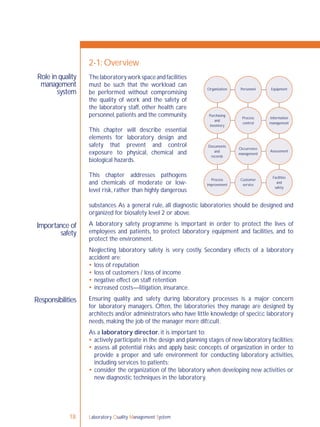
Accreditation is a valuable tool to determine the effectiveness of the quality
management system. However, it is not the ultimate goal. Once accreditation
status is obtained, the important challenge will be to maintain that status.
A well-managed laboratory will know that it is meeting its goals.The laboratory
should look at accreditation as one form of audit that the quality managed
laboratory puts into place to ensure that the system is working properly.
Accreditation status must be renewed regularly and the laboratory challenged
each time to maintain and improve the quality level.
Laboratory Quality Management System134
Summary
Key message
11-7: Summary
Standards or norms provide guidelines that form the basis for quality practices in
the laboratory.They are developed by organizations, often through a consensus
process. Accreditation and certification are two processes that can allow for
recognition that a laboratory is meeting designated standards.
When a laboratory seeks this recognition, careful planning will be needed to have
a successful outcome.An active quality management programme can ensure that
a laboratory is in a constant state of "accreditation readiness".
 Accreditation is an important step in the continual improvement of the quality
management system.
 It is an accomplishment to be accredited; it is an achievement to maintain
accreditation.
12. Personnel
Laboratory Quality Management System136
Role in quality
management
system
Overview of
the process
12-1: Overview
Recruiting and retaining qualified staff is essential to laboratory quality. Failure
to check the education qualifications and references for a new hire can lead to
problems in the future.
As a laboratory director it is important to:
 Hire an appropriate number of staff to cover workload.
 Verify that items on the job application are correct.
 Develop complete and thorough job descriptions for each employee.
 Train each employee in their specific duties.
 Provide orientation for new employees. Even with a credible background,
differences between laboratories are common, so a manager needs to ensure
new employees have adequate orientation and training.
 Conduct and record competency assessments on all personnel. It is
management’s responsibility to verify that trained employees are sufficiently
competent to do their work.
 Provide opportunities for continuing education; new techniques or updates for
existing methods can be introduced using continuing education courses.
 Conduct annual employee performance appraisals.
As a quality manager it is necessary to:
 Provide employees with orientation and training.
 Keep track of employee records and make sure they are confidential.
 Include policies relevant to personnel in the quality manual.
Organization Personnel Equipment
Purchasing
and
inventory
Process
control
Information
management
Occurrence
management
Assessment
Facilities
and
safety
Customer
service
Process
improvement
Documents
and
records
Personnel are the most important
laboratory resource. Critical to
the implementation of the quality
management system are people
who possess integrity, recognize
the importance of their work and
participate in continuous improvement.
Laboratorians are important partners
in health care.
Laboratory Quality Management System 137
Retention
of staff
Importance of
motivation
As a laboratorian it is important to:
 Participate in training and continuing education opportunities.
 Request training that may be needed as job responsibilities increase.
 Maintain records of personal professional development.
Success or failure depends on the knowledge and skills of the people in the
laboratory, and their commitment and motivation to perform tasks as described
in the job description. Motivated employees are more likely to be committed to
their work.
Elements of motivation vary for different people.
 Some people respond to concrete rewards such as bonuses and praise.
 Somepeoplerespondbesttoflexibleworkschedulesthatfittheirresponsibilities
to home and children.
 Most people respond to recognition and feeling that they are an integral part
of the health care team.
The manager can motivate the team by emphasizing that everyone’s job is
important; whether it is performing testing, collecting specimens, making reagents
or managing the laboratory.
Migration and turnover of staff have been described as major challenges in many
countries.Apart from economic factors, the lack of a good working environment
and improper management practices can contribute to loss of staff. A good
personnel management programne can contribute to the retention of staff.
12-1: Overview
Laboratory Quality Management System138
Personnel
qualifications and
job description
Orientation
12-2: Recruitment and orientation
Management must establish appropriate personnel qualifications for all positions
in the laboratory. These should include requirements for education, skills,
knowledge and experience.When defining qualifications, keep in mind any special
skills and knowledge that are needed, such as language, information technology
and biosafety.
Job descriptions give a clear and accurate picture of responsibilities and authorities
for each staff position. Job descriptions should:
 lay out all activities and tasks that should be performed;
 specify responsibilities for conducting testing and implementing the quality
system (policies and activities);
 reflect the employee’s background and training;
 be kept current and be available for all people working in the laboratory.
Job descriptions should be competency based and reflect any skills needed.
The requirements for each staff position may vary depending on the size of
the laboratory and complexity of testing services offered. For example, in small
laboratories with limited personnel, staff may have many responsibilities and
perform many tasks, whereas in larger laboratories with more personnel, staff
may be more specialized.
Remember,not only are clear job descriptions a guideline,but they can
be used to formally assess personnel competency.
Orientation is the process of introducing a new staff member to the new work
environment and to their specific tasks or duties. Nothing is more frustrating to
an employee than not knowing where to find the necessary resources.
Orientation is different from training.
Orientation of laboratory personnel should include the following aspects.
 General orientation—a tour of the workplace and introduction to all
management and staff. Information about
- how the organization fits into the medical community and/or the public
health system;
- key personnel and lines of authority;
- the laboratory interaction with both users and customers of the laboratory;
- the policies and procedures regarding facilities and safety.
Laboratory Quality Management System 139
 Personnel policies
- ethics
- confidentiality
- employee benefits
- work schedules.
 An employee handbook that outlines the policies of the organization and
information about the laboratory quality system.
 A copy of the employee’s job description and a detailed review of its contents.
 An overview of standard operating procedures (SOPs).
A checklist that addresses each aspect of the orientation is important. Ask
employees to initial and date the checklist to document discussion of each topic.
12-2: Recruitment and orientation
Laboratory Quality Management System140
Definitions
Overview
Competency
assessment
methods
12-3: Competency and competency assessment
Competency is defined as the application of knowledge, skills and behaviours
used in performing specific job tasks.1
Accurate laboratory test results depend on
staff being competent in performing a range of procedures that occur throughout
the entire examination process.
Competency assessment is defined as any system for measuring and
documenting personnel competency. The goal of competency assessment is to
identify problems with employee performance and to correct these issues before
they affect patient care.
An initial competency assessment may reveal the need for specific training of
the employee. Competency assessment should be conducted at regular intervals
during the employee’s tenure.
Competency assessments conducted either initially or periodically help to identify
or prevent performance problems that may be solved through task-specific
training.
Competency assessment methods include the following.
 Direct observation helps identify and prevent any performance problems:
- The employee’s techniques are watched during the examination process,
which allows the observer to see if the employee is following the SOP.
- To avoid subjectivity during a competency assessment, the observer uses
a custom-designed checklist; checklists are used when there are specific,
observable items, actions or attributes to be observed.
Observation is the most time-consuming way to assess employee competence,
but this method is advised when assessing the areas that may have a higher impact
on patient care.
 Monitor records (e.g. review worksheets and logs prepared by the employee).
 Review and analyze quality control records and results of proficiency tests
performed by the employee being evaluated.
 Retest or recheck results to compare results among personnel; discrepancies
should be resolved.
 Assess knowledge or problem-solving skills using case studies. Employees are
asked to respond orally or in writing to simulated technical problems.
1 ISO 10015:1999. Quality management—guidelines for training. Geneva, International Organization for Standardization, 1999.
Laboratory Quality Management System 141
Policies
and
processes
Methods for determining personnel competency may need to be
adapted to local customs and concerns.
Policy writing for competency assessment is a critical quality systems issue and is
the responsibility of the management.Each policy should be shared with everyone
in the laboratory and assessments of all personnel should be documented.
An example of policy for competency assessment is“Every employee shall regularly
be assessed for competency for the tasks defined in their job description”.
Processes describe how the policy will be enacted. For example, the following
questions should be addressed.
 Who will conduct assessments? Responsibility for conducting the assessment
should be assigned to someone who has previously demonstrated competency
in the area to be assessed.The responsible person must document and evaluate
the results of the assessment.
 What will be assessed? Which job task or tasks and procedure performed in
the pre-examination, examination and post-examination testing process will be
assessed? Critical competencies for each task should be identified. First-line
supervisors should be involved in this step. Examples of critical competencies
include
- patient identification
- sample collection
- evaluation of adequacy of samples
- use of equipment
- application of quality control procedures
- interpretation of results.
 When will assessments occur (annually or biannually)? It is important to develop
a timeline for periodic assessment of each employee.A period of training and
then assessment should be implemented for everyone as new procedures and
equipment are introduced into the laboratory.
Policies and processes should be reviewed annually and modified when
necessary.
12-3: Competency and competency assessment
Laboratory Quality Management System142
Competency
assessment
documentation
Procedures describe specifically how each element of the processes will be
performed.An employee competency assessment would follow these procedures,
1. The assessor contacts the employee in advance to inform them that the
assessment will be done at a prearranged time.
2. The assessment is done while the employee is performing tasks using routine
samples.
3. The assessment is done by a specified method previously described and is
recorded in a logbook.
4. The results of the assessment are shared with the employee.
5. A remedial action plan is developed defining required retraining. The plan
should be written and the manager must ensure that the plan is understood
by the employee.The plan should outline specific steps to be taken to resolve
or correct the problem with related deadlines. Needed resources should be
clearly outlined in the plan. For example, the employee may need an updated
version of the SOP.
6. The employee is asked to acknowledge the assessment, related action plan,
and reassessment.
If more than one person makes the same error even after training
has occurred, consider the root cause of the error, such as equipment
malfunction and operating procedure ambiguity.
Standard forms should be generated in advance and used so all employees
are assessed the same way. This will prevent employees from thinking that the
assessments are biased.
All competency assessments must be recorded, showing date and results, and
should be kept in a place where they remain confidential.These records are part
of a laboratory’s quality documents,and should be periodically reviewed and used
for continuous improvement.
12-3: Competency and competency assessment
Procedures
Laboratory Quality Management System 143
Rationale
Methods
Definitions
12-4:Training and continuing education
Training is a process to provide and develop knowledge, skills, and behaviours
to meet requirements. In this context, training is linked to the job description
and competency assessment, and addresses identified gaps in specific tasks to be
performed by the employee. Competency should be reassessed after any job-
specific training.
Retraining is required when competency assessment reveals the need for
improving an employee’s knowledge and skills.
Cross-training provides an opportunity for staff to acquire skills outside their
own discipline. This allows for flexibility in shifting or reassigning personnel
whenever needed; this may occur in crisis situations or with absences of staff due
to illness or vacation.
Continuing education is an educational programme that brings employees up-
to-date in a particular area of knowledge or skills. Since laboratory medicine is
constantly changing, keeping current takes effort on the part of both employee
and management.
Reasons for training and continuing education are to:
 achieve quality practices in the laboratory and produce accurate, reliable and
timely test results;
 help staff achieve personal career goals;
 improve the organization’s capabilities and achievement of quality objectives.
In laboratory medicine, new testing methodologies and instruments are
continuously introduced to the marketplace that could have implications for
laboratory testing and improved patient care.
When planning a training or continuing education activity, consider:
 identification of training needs
 design of training
 provision of training
 evaluation of training results.
Activities can often be organized at low cost, for example:
 starting a journal club;
 starting case study discussion groups;
 watching videotapes and DVDs;
 researching a topic and presenting findings to colleagues;
 using interactive self-study programmes, including e-learning freeware or
printed courses;
 collecting and maintaining a set of teaching slides (e.g. haematology and
parasitology).
Laboratory Quality Management System144
Resources Local resources—When organizing internal continuing education programmes,
local resources available from the health care community should be considered.
Some of these resources include:
 quality assurance committee
 clinicians
 nurses
 pathologists
 infection control personnel
 epidemiologists or surveillance officers
 external assessors.
Each of these groups may offer specialized knowledge and experience they can
share with laboratory staff.They can be invited to give lectures, lead discussions
and exchange information.
External resources—External continuing education programmes can also be
presented by topic experts, such as those associated with:
 proficiency testing services
 manufacturers
 scientific societies
 World Health Organization
 United States Centers for Disease Control and Prevention
 nongovernmental organizations.
12-4:Training and continuing education
Laboratory Quality Management System 145
Feedback
Cause
of poor
performance
Periodic appraisal
12-5: Employee performance appraisal
Employees should have a periodic formal appraisal of their overall performance.
This is broader than competency assessment and includes the following elements:
 technical competency
 efficiency
 adherence to policies
 observance of safety rules
 communication skills
 customer service
 punctuality
 professional behaviour.
Appraisal can affect an employee’s morale,motivation and self-esteem,and should
be conducted equitably for all employees. People respond to criticism differently,
even if delivered tactfully; therefore, consider unique approaches that match
personality when counselling employees. Positive feedback, as well as suggestions
for improvement, should be provided.
All identified problems should be addressed with the employee when they
occur, so that they can correct any issue before the formal evaluation.A periodic
appraisal that is part of the employee’s record should not have items that were
not previously discussed with the employee.
Poor performance may not always be due to technical incompetence.Performance
may be affected by:
 distractions—especially personal issues such as a sick child or parent, or
financial problems, which can make the employee’s concentration difficult;
 excessive workloads that pressure or hurry the employee, which may cause
them to inadvertently make errors;
 insufficient initial orientation or training;
 resistance to change—some people may not want to use new procedures
(“We’ve always done it this way, why change?”).
Laboratory Quality Management System146
The following factors could also contribute to poor results performance.
 Compromised sample—the laboratorian may or may not know that the sample
arrived in the wrong preservative or was improperly stored.
 Absence of SOPs or failure to update them—test kits may come with modified
manufacturer’s instructions,and these modifications need to be reflected in the
SOPs.
 Poorly written procedures—including omitting certain steps, the wrong
sequence of steps, or incorrect sample or reagent quantities—can cause very
serious errors and should always be suspected when several employees obtain
erroneous results.
 Job descriptions that are not clear may be a source of error—for example,
confusion about who has responsibility for calibrating an instrument could
result in the calibration not being done, causing erroneous results.
12-5: Employee performance appraisal
Laboratory Quality Management System 147
What
Where
Policy
12-6: Personnel records
Medical laboratories should maintain employee records that contain information
integral to their laboratory-related work. Keep records of positions held and
dates for each of these positions. This information is important for calculating
employee benefits.All terms and conditions of employment should be a part of
the personnel record.
Personnel information that the laboratory maintains may differ in different regions
and settings.While a complete list of information may include the following, some
parts may not be required in all regions and all settings:
 employment details;
 original application and resume;
 tests the employee is authorized to perform;
 conditions of continued employment;
 job description;
 both original and subsequent competency assessments;
 continuing education programmes attended;
 personnel actions—corrective, disciplinary;
 leave records;
 health information,including records of work injury or exposure to occupational
hazards, vaccine status, skin tests (if any);
 performance appraisals;
 emergency contact information.
The personnel files should be kept in a secure site to protect confidentiality.
Not all information needs to be maintained within the laboratory offices. Some
institutions maintain a human resources or personnel department that may be
responsible for employee records. Consider what is essential to be maintained in
the laboratory itself, such as emergency contact information or job descriptions.
Laboratory Quality Management System148
Important
principles of
personnel
management
Key messages
12-7: Summary
Management of personnel is critical to the success of a quality management
programme. Several elements are important in this management process. Job
descriptions should reflect all skills needed and accurately describe tasks, roles,
and authorities.The competency of personnel will need to be evaluated at the
time of hiring and on a regular, recurring basis. A very important part of the
management process is to seek ways to attract qualified personnel,and to provide
motivation and appropriate benefits and working conditions so as to retain staff.
 Personnel are the most important resource in the laboratory.
 Managers must create an environment that will fully support all laboratory
personnel in order to maintain a high quality of laboratory performance.
 Continuing education is vital to personnel competency, but does not need
to be expensive. New testing methodologies and instruments are constantly
introduced to the marketplace, and employees need to update their knowledge
and skills.
13. Customer
service
Laboratory Quality Management System150
Role in
quality
management
system
Overview
of the
process
Laboratory
responsibilities
13-1: Overview
Philip Crosby defined quality practice as meeting the requirements of the
customer. He applied this practice to business and manufacturing, but it is
equally important for a medical laboratory. The medical laboratory needs to
know who its clients are, and understand clients’ needs and requirements.
Medical laboratories have a range of customers including patients, physicians,
public health agencies and the community.
It is the responsibility of the laboratory director to ensure that the customers’
needs are met, and that there is customer satisfaction.The quality manager is
responsible for measuring the degree of customer satisfaction, using surveys,
indicators and audits to take preventive and corrective action.
All laboratory staff must understand the importance of customer satisfaction.
Laboratory personnel must always interact with customers in a way that is
appropriate, providing needed information, and being courteous.
Organization Personnel Equipment
Purchasing
and
inventory
Process
control
Information
management
Occurrence
management
Assessment
Facilities
and
safety
Customer
service
Process
improvement
Documents
and
records
This chapter will describe basic
elements that are essential for
developing an effective customer
service programme.
Customer satisfaction is a
major component of a quality
management system, and a significant
focusintheInternationalOrganization
for Standardization (ISO) standards.
Ultimately, the laboratory produces
a product—the test result—for its
customers. If the customer is not
well served, the laboratory is not
achieving its primary function.
Laboratory Quality Management System 151
Seeking customer satisfaction requires the following:
1. Commitment—customer satisfaction is a requirement of several international
standards for laboratory quality, but some laboratory staff might consider it
secondary to technical competency. Because of the importance of customer
satisfaction in a quality system, all staff must be strongly committed to the
process.
2. Planning—monitoring takes time and planning to be done properly.Appropriate
monitoring tools need to be developed prior to gathering information. Poor
planning results in inadequate information and often leads to uninterpretable
information.
3. Knowledge—creation of useful monitoring tools requires specific knowledge.
If there are not people in the laboratory that have that knowledge, the
laboratory may consider sending staff for special training or hiring a consultant.
4. Resources—the process to monitoring does not have to be heavily resourced,
but it does take time. Some of that time can be saved by having access to
calculators, computers and the internet.
13-1: Overview
Establishing a
programme to
address customer
satisfaction
Laboratory Quality Management System152
The laboratory
and its clients
Legal
identity
13-2:The laboratory clients—the customers
The laboratory has many clients and the needs of all must be carefully addressed.
A central figure in the client list is the physician or health care provider.The
initial request for service originates with this person, and the laboratory staff
generally identifies the ordering physician as the primary client.Remember that in
a hospital setting, the health care provider will be assisted by many other people,
including nurses, medical assistants, phlebotomists, and secretaries or
clerks. These vital hospital personnel should also be considered clients of the
laboratory, and their needs must be considered.
Another important client for the laboratory is the patient,usually including their
family. Family members may play a very important role in patient management,
and may help with sample collection and transport.
When laboratory testing is being performed to meet a public health need,public
health officials or workers become clients of the laboratory.The laboratory is a
critical partner in surveillance, disease detection and prevention, and other public
health programmes. Laboratories need to meet the needs of the public health
workers in addressing problems. They sometimes need to share information
without compromising the confidentiality of the patient. Specialized laboratories
such as food safety or water testing laboratories would have other customers
to consider, such as food producers, manufacturers, or water systems
managers.
The community in which a laboratory works also has expectations. The
community needs to be assured that the laboratory will not create a risk for
workers, visitors or the public.
In many countries, laboratory tests can only be ordered by a licensed
health care provider—a physician, nurse or dentist. In some countries,
laboratory tests can be ordered by the patient directly without referral from a
physician or nurse. Some patients do not have the knowledge or expertise to
order the right test or to interpret results. Laboratory personnel may have to
provide assistance in test selection and interpretation.
International standards usually require that any laboratory clearly identifies itself
to the public,giving assurance that an identified person is in charge and accessible.
At a minimum,every laboratory must make public a laboratory name and address,
and the name of the director, including relevant contact information.
Laboratory Quality Management System 153
Patient
requirements
Public health
requirements
Physician or
health care
provider
requirements
The health care provider expects to have access to accurate, clinically relevant
information that can be understood and used in a timely manner. Health care
professionals need assurance of laboratory responsibility throughout the testing
process, including pre-examination steps, the testing process itself and the post-
examination process.
In the re-examination phase, physicians will be particularly interested in the test
menu.They benefit from an accurate collection manual, requisition forms that are
complete but user friendly, and a timely delivery system.
For the testing or examination phase, physicians would like to be sure of working
with competent personnel.They need to know that the test methods being used
have been validated, and that testing is done with good process control and
with quality control procedures in place.Appropriate management of all adverse
occurrences or errors will significantly affect physician laboratory use.
The physician looks to the laboratory to do an excellent job in managing the
post-examination steps, as these are critical to receiving the results of testing.
A solid laboratory information system, a method for results verification, and for
delivering timely and interpretable results to the right place, are all important.
The patient expects to receive personal care,keeping in mind comfort and privacy.
He or she also expects to be assured that the testing has been done correctly and
properly, and provided to the health care provider in a timely manner.
The laboratory actions needed to meet the patient requirements include:
 providing adequate information, both for collection of a specimen, and also
information about the laboratory;
 providing good collection facilities;
 having available trained and knowledgeable personnel—personnel should know
how to collect a sample properly, and should be trained to be courteous to all
patients;
 giving assurance that the laboratory records are maintained properly so that
they can be easily retrieved, and also giving assurance of protection of the
confidentiality of the records.
Public health professionals have the same needs as health care providers,requiring
that all parts of the pre-examination,examination and post-examination processes
are carried out properly.They may need special kinds of information in dealing
with an outbreak or epidemic, such as specific collection processes or forms
designed for the particular project or investigation. Public health officials will
also be particularly concerned with safety issues and containment of infectious
material.
Food manufacturers and producers, and water plant managers will need
information from the laboratory to help them comply with their specific quality
requirements.
13-2:The laboratory clients—the customers
Laboratory Quality Management System154
Community
requirements
Serving all
clients well
The community in which a laboratory does its work expects that dangerous
materials will be kept within the confines of the facility, and that the laboratory
will protect their own workers from risk. The community should be aware of
communicable disease alerts, and surveillance and response activities.
The laboratory is responsible for assuring safety and security, for containment of
any infectious materials,for dealing appropriately with waste management,and for
following all regulations for the transport of dangerous goods.
All clients benefit when a laboratory chooses to put in place a quality system and
to seek recognition that it is accredited to the highest standards.This provides
assurance that the laboratory is following quality practices, and that the results it
produces are accurate and reliable.
Good customer service provides:
 valuable information for best patient care
 valuable information to improve surveillance and other public health actions
 a professional image for the laboratory.
Customer service is an integral part of a quality management system.
13-2:The laboratory clients—the customers
Laboratory Quality Management System 155
Using
assessment
methods
Methods for
assessment
13-3:Assessing and monitoring customer satisfaction
In order to understand whether client needs are being met, the laboratory will
need to employ tools for gaining information.The laboratory needs to actively
seek information from customers, rather than just waiting for customers to
contact the laboratory with a complaint.
Important information on customer satisfaction may be obtained using:
 complaint monitoring
 quality indicators
 internal audit
 management review
 satisfaction surveys
 interviews and focus groups.
The monitoring of customer service and customer satisfaction is part of the
continual improvement performed by the laboratory.
When the laboratory is contacted about a problem, this can provide important
and helpful information. All such complaints should be thoroughly investigated,
and remedial and corrective action taken. However, remember that received
complaints may reflect only the “tip of the iceberg”, because many people do
not complain.The laboratory cannot use received complaints as the only means
of assessing customer satisfaction.
Quality indicators are an objective measure of laboratory practices.Indicators
can be developed that look at complaints, timeliness, patient refusals, and lost
or delayed laboratory reports as examples. When these indicators are being
monitored, information about customer needs and satisfaction will be acquired.
When the laboratory conducts internal audits, some aspects of laboratory
practice that affect patient satisfaction can be examined. Examples might include
turnaround times—always of great concern to physicians or health care providers.
All findings from these investigations should be very carefully reviewed by
management and followed up with appropriate action.
Laboratory Quality Management System156
Customer
surveys
13-4: Customer satisfaction surveys
In order to actively seek information about how clients view the laboratory’s
service, it will be necessary to conduct surveys (paper-based or electronic) or to
use interviews and focus groups. In this way the laboratory can address specific
questions to areas of concern, and can look at areas not commonly covered by
complaints or internal processes.
ISO standards put a heavy emphasis on the importance of customer satisfaction;
customer surveys are required in ISO 9001 standards for quality management
systems.Any laboratory that implements a quality management system, whether
accredited or not, needs to use some method for surveying clients in order to
understand whether needs are being met.
To be successful, surveys should be carefully planned and organized.Deciding
which clients to ask to participate in a survey is important. Surveying health care
practitioners is often easier than surveying patients. Laboratory staff can also be
asked to participate in surveys and may offer good suggestions for streamlining
operations to improve customer service.
Any survey questionnaire should be pretested for clarity. When developing
material, avoid leading and biased questions. Be sure to analyze the results in a
timely manner and, when possible, provide some feedback to the group that has
been surveyed.
If the survey is to be conducted using interviews, the following tips can be
helpful.
 Write out all questions in advance,so that everyone is asked the same questions.
 After asking some specific questions about their satisfaction with the laboratory,
ask an open-ended question that allows customers to provide honest feedback.
For example, ask how the laboratory could improve its service.
Employing focus groups can be a very useful technique for gathering information
on customer satisfaction. The process of a group discussion will often elicit
comments and ideas from all the participants that might not otherwise surface.
When conducting focus group discussions, consider the following:
 assemble small groups of 8–10 people
 include people with diverse backgrounds and laboratory needs
 start by asking questions that build trust
 develop a focus group guide for consistency between groups
 ask open-ended questions—not “yes or no” questions.
Summarize verbal responses in a written report that can be used by the laboratory
as a tool to improve customer service.
Laboratory Quality Management System 157
Successful
surveys identify
opportunities for
improvement
When measuring customer satisfaction, whether by survey, indicators or audits,
much will be learned when the method is successful. This information and the
insights on customer service that it provides can be used to help the laboratory
identify opportunities for improvement (OFI).The OFI will lead to preventive and
corrective actions.
Information gathering must lead to change in a continual improvement
process.
13-4: Customer satisfaction surveys
Laboratory Quality Management System158
Summary
Key messages
13-5: Summary
Seeking customer satisfaction requires commitment from the laboratory
management and staff. It is important to remember that technical competency is
not the only goal for the laboratory.
A programme for addressing customer satisfaction requires good planning, the
development of appropriate monitoring tools, and the knowledge to apply the
tools to gain usable information.
Customers or clients of the laboratory include physicians and other health care
providers, hospital and clinic staff, patients and their families, public health officials
and the general community.
Monitoring customer satisfaction requires some resources, primarily involving
staff time. Managers need to ensure that these resources are available.
 Meeting customer needs is a primary goal of the laboratory.
 Everyone in the laboratory is responsible for quality and,therefore,for customer
service.
 An active quality management system ensures laboratories meet all client
requirements.
14. Occurrence
management
Laboratory Quality Management System160
Role in quality
management
systems
Overview
of the
process
Definition
14-1: Overview
Occurrence management is a central part of continual improvement. It is the
process by which errors or near errors (also called near misses) are identified
and handled.The goal of an occurrence management programme is to correct the
errors in either testing or communication that result from an event,and to change
the process so that the error is unlikely to happen again.
Well-managed laboratories will also review their systems and detect process
problems that could possibly cause error at some time in the future, allowing for
prevention of these errors.
An occurrence is any event that has a negative impact on an organization,including
its personnel, the product of the organization, equipment, or the environment in
which it operates.All such events must be addressed in an occurrence management
programme.
Organization Personnel Equipment
Purchasing
and
inventory
Process
control
Information
management
Occurrence
management
Assessment
Facilities
and
safety
Customer
service
Process
improvement
Documents
and
records
Occurrence management, or dealing
with laboratory errors, is important
in ensuring good service from the
laboratory. It is one of the 12 quality
essentials and must be addressed in
laboratory quality management.
This chapter will describe and
explain basic elements that are
essential for developing an effective
occurrence management programme.
Laboratory Quality Management System 161
Pre-examination
errors
Causes of
laboratory error
14-2: Sources and consequences of laboratory error
Some of the common causes of error in the laboratory are easily identifiable, and
are also readily correctable.
For example, some errors may occur because staff are unclear about who is
responsible for carrying out a particular task,so it may remain undone.To prevent
these types of errors, individual responsibilities must be clearly defined and
communicated.
Other errors occur when procedures are not written or followed, and staff are
not adequately trained.Written procedures serve as a guide for all staff, and help
to ensure that everyone knows what to do. It is essential to ensure that these
written procedures are followed correctly. Staff need to be trained in how to
conduct the procedures and, if this training is neglected, errors can result.
There are many other sources of error in addition to these, which are
frequently observed. While they often occur during pre-examination
and post-examination processes, errors can occur throughout the
testing process.
Useful studies for understanding sources of laboratory errors include a
retrospective data collection that found Australian pathology laboratories had a
transcription error rate of up to 39%,and an error rate of up to 26% for analytical
results.1
A report from the College ofAmerican Pathologists in collaboration with
the Centres for Disease Control and Prevention Outcomes Working Group
describes error stratification in the working process for clinical laboratories. In
more than 88 000 defects, 41% were observed in the pre-examination phase of
testing,55% in the post-examination phase and only 4% in the examination phase.2
Some examples of pre-examination errors that are frequently seen include:
 collecting the wrong sample;
 mislabelling or failing to label the sample;
 storing the sample incorrectly prior to testing, so that the sample deteriorates;
 transporting the sample under conditions that damage the sample or that
endanger staff and public safety;
 damaging the reagents or test kits by storing them improperly.
1 Khoury M et al. Error rates in Australian chemical pathology laboratories. Medical Journal of Australia, 1996, 165:128–130 (http://www.
mja.com.au/public/issues/aug5/khoury/khoury.html).
2 Bonini P et al. Errors in laboratory medicine. Clinical Chemistry, 2002, 48:691–698 (http://www.clinchem.org/cgi/content/full/48/5/691).
Laboratory Quality Management System162
A list of common errors that occur during the testing process include:
 failing to follow an established algorithm (e.g. for HIV testing);
 reporting of results when the quality control material tests out of range;
 incorrect measuring of the sample or reagents (usually these are dilution or
pipetting errors);
 using reagents that have been improperly stored, or after their expiration date.
Many of the common laboratory errors occur following the testing of the sample,
and some of these may be more difficult to detect. Common examples of these
kinds of errors include:
 making a transcription error when preparing the report;
 producing a report that is illegible, usually caused by poor handwriting, but
sometimes by damage to the report form;
 sending the report to the wrong location, which often results in complete loss
of the report;
 failing to send the report.
The laboratory is a critical partner in all health systems, and it must perform its
functions well in order to help ensure good outcomes of health programmes
and interventions. A failure in the laboratory role can have s significant effect,
producing:
 inadequate or inappropriate patient care
 inappropriate public health action
 undetected communicable disease outbreaks
 wasting of resources
 death of an individual.
14-2: Sources and consequences of laboratory error
Examination
errors
Post-examination
errors
Consequences of
laboratory error
Laboratory Quality Management System 163
Detecting
occurrences
Root cause
analysis
Occurrence
cycle includes
investigation
14-3: Investigation of occurrences
A cycle of events reflects the process of occurrence management. When
occurrences are found, they must all be investigated to find the causes of the
problem.The investigation will help to identify the actions needed to correct the
problem and to ensure that it does not occur again.All necessary communication
must take place, including informing any health care providers whose clients are
affected.
Occurrences are detected through a variety of investigative techniques.
Monitoring of complaints and satisfaction surveys will yield much information.
Once the laboratory establishes and monitors quality indicators, deficits will
be noted.The tools of external assessment, such as proficiency testing, external
quality assessment, accreditation and certification processes, will be very useful in
occurrence management.A very valuable tool is the internal audit, which can be
performed at any time in the laboratory.The laboratory’s process improvement
efforts will identify opportunities for improvement.
It is the responsibility of management to review all the information that results
from use of these tools, and to look for underlying patterns and potential causes
for persistent or repeated error.
Investigation involves gathering complete and detailed information about events
that led to a problem, and a thorough analysis to determine all the factors that
contributed to the problem occurrence.
The most aggressive and complete approach to addressing occurrences is to seek
the root cause of the problem.This is more than just a thorough examination, but
is a planned and organized approach toward finding not only the superficial causes
of a problem,but also the deeper or core problems.With some occurrences,they
are likely to reccur until such time as the true root causes are discovered and
addressed.
Cross-
match
sample
mislabelled
Samples
taken to
nursing
station
Two
patients
collected
Samples not
labelled at bedside
Switched
samples
 Major
 transfusion
 reaction
Wrong
blood
group
given
Laboratory Quality Management System164
Correction of
occurrences
Occurrence
management
process
14-4: Rectifying and managing occurrences
As a reminder, an occurrence is any event that has a negative impact on an
organization, which includes personnel, product, equipment or the environment.
There are several levels of action that may be undertaken to rectify occurrences,
including the following.
 Preventive actions involve a planned and organized evaluation of processes and
procedures to identify potential error points, so action can be taken to prevent
the errors from ever occurring. Preventive actions require planning and team
participation.
 Remedial action, or remediation, is the fixing of any consequences that result
from an error. For example, if an erroneous result has been reported, it is
essential to immediately notify all persons concerned about this error and to
provide the correct result.
 Corrective actions address the cause of the error.If a test was done incorrectly,
resulting in an incorrect result, corrective actions sort out why the test was
not performed properly and steps are taken so that the error does not happen
again.As an example, a piece of equipment may have been malfunctioning, and
the corrective actions would be to recalibrate, repair or otherwise address the
equipment problem.
The laboratory should develop a system for prompt investigation of every
laboratory problem and error.The management process for dealing with errors
or occurrences involves several steps.
1. Establish a process to detect all problems, using the tools that are available.
Remember that problems may go undetected unless there is an active system
for looking for them.
2. Keep a log of all problem events that records the error, any investigation
activities and any actions taken.
3. Investigate the cause of any problem that is detected and carefully analyze the
information that is available.
4. Take the necessary action (remedial and corrective)—if the problem is
detected before the error actually occurs, take preventive action.
5. Monitor and observe for any recurrence of the original problem, keeping in
mind that there may be a systemic problem.
6. Provide information to all those who need it,and to those who are affected by
the error.
Laboratory Quality Management System 165
Responsibilities The responsibility for monitoring for occurrences belongs to everyone in the
laboratory. It is important, however, that someone be designated as the person
responsible for marshalling the energies and activities of all staff into an effective
management process.In many instances,this is the responsibility of the laboratory
director, laboratory manager or quality manager.
14-4: Rectifying and managing occurrences
Laboratory Quality Management System166
Summary
Key messages
14-5: Summary
Occurrence management is an integral component of laboratory quality
management. It establishes the methods for finding errors and preventing them
from occurring again,and also seeks to identify potential errors and prevent them
from happening.
The laboratory should employ an active process for occurrence management and
take a positive approach. Make an effort to detect problems as early as possible,
and then take immediate remedial and corrective action. Be proactive and see
opportunities to identify potential error, thus preventing an occurrence. Finally,
keep good records of all problems, investigations and actions taken.
The difference between a quality-managed laboratory and laboratories with no
system in place is that the quality laboratory detects the problem,investigates and
takes actions.
15. Process
improvement
Laboratory Quality Management System168
Role in quality
management
system
Historical
basis
Deming’s
PDCA
cycle
15-1: Continual improvement concept
W. Edwards Deming is one of the originators of the concept of continual
improvement, the primary goal of a quality management system. Beginning in the

1940s, he worked with manufacturing and industrial processes, and introduced
many of the tools used in quality improvement efforts; his ideas and concepts
are used today to produce reliable, quality laboratory results. Deming outlined
14 points for quality,many of which can easily be applied to the laboratory.For the
purposes of this discussion, two of his points are particularly important:
1. Create constancy of purpose for improvement. The message here is
that there is a need to be constantly working toward making the process
better.
2. Improve constantly and forever.This statement points out that continual
improvement will always be a goal. Perfection is never achieved, but we try to
get as close to it as possible. Process improvement is something that is never
finished, but rather continues on “forever”.
The Deming Plan-Do-Check-Act (PDCA) cycle shows how to achieve continual
improvement in any process.
 Plan—identify the problems and the potential sources of system weakness or
error. Decide on the steps to be used to gather information.Ask the question,
“How can you best assess the current situation and analyze root causes of problem
areas?” Using the information that is gathered through these techniques,develop
a plan for improvement.
 Do—implement whatever plans have been developed—put the plan into action.
Organization Personnel Equipment
Purchasing
and
inventory
Process
control
Information
management
Occurrence
management
Assessment
Facilities
and
safety
Customer
service
Process
improvement
Documents
and
records
Process improvement, one of the
12 quality system essentials, establishes
a programme for helping to ensure
continual improvement in laboratory
quality over time. This continual
improvement of the laboratory
processes is essential in a quality
management system.
Laboratory Quality Management System 169
ISO process
for continual
improvement
 Check—this refers to the monitoring process. It will be important to assess
the effectiveness of the action taken, using focused review and audit processes.
If the system weakness is complex, a pilot study may be needed in order to
understand all the complexities.After “checking”, revise the plan as required to
achieve the improvements needed.
 Act—Take any corrective action that is required, and then recheck to be sure
that the solution has worked.This cycle is a continuous process,so the laboratory
will begin again with a planning process to continue the improvements.
This is the continual improvement process and, in the laboratory, this process is
applied to all procedures and processes that are a part of the path of workflow.
ISO 15189 [4.12] describes a very similar set of activities for achieving continual
improvement in the laboratory.These are outlined as follows:
 identify potential sources of any system weakness or error;
 develop plans to implement improvement;
 implement the plan;
 review the effectiveness of the action through the process of focused review
and audit;
 adjust the action plan and modify the system in accordance with the review and
audit results.
15-1: Continual improvement concept
Plan
Act Do
Check
Laboratory Quality Management System170
What is process
improvement?
Conventional
tools for
improvement
15-2:Tools for process improvement
A process is a series of actions or operations contributing to an end. In every
case, inputs (patient samples) are turned into outputs (patient examination
results) because some kind of work, activity or function is carried out. Process
improvement is a systematic and periodic approach to improving laboratory
quality and the inputs and outputs that glue these processes together. It is a way
of solving problems. If there is a problem, however hard to describe, one or more
processes needs to be improved.
Many useful techniques have been developed to use in process improvement, and
some have been discussed in other chapters of this handbook. For example, both
internal and external audits will identify system weaknesses and problem
areas. Participation in an external quality assessment is another useful tool; it
allows for comparing laboratory performance to that of other laboratories.
Management review of all information gathered through these activities should
be conducted.In addition,there should be management reviews of the laboratory
records on a regular basis; for example, quality control, inventory management
and equipment maintenance.These reviews will provide useful information about
areas for improvement.
Using information from these reviews and from audits, and through the process
of monitoring the organization’s customer complaints, worker complaints, errors,
near errors or near misses, opportunities for improvement (OFIs) will be
identified.These OFIs will be the focus for corrective action.
Quality plan
Monitoring Monitoring Monitoring
Internal audit External audit
Quality
assessment
Quality control
Opportunities
for improvement
Quality goal
Laboratory Quality Management System 171
Newer tools
When conducting audits or evaluating laboratory records, it is important to have
a goal or standard of performance.Therefore, quality indicators will be needed
and will have an important role to play.
The plan leads to the goals; OFIs, which are the result of monitoring, lead to the
creation of a new plan, with the process leading to continual improvement.
New ideas for tools to use for continual improvement continue to come from the
manufacturing industry.Two of these new tools are now being used in laboratory
quality improvement.
1. Lean is the process of optimizing space, time and activity in order to
improve the physical paths of workflow.This tool of industry is applicable to
laboratories, and many laboratories are currently engaged in creating a lean
system. Lean analysis may lead to revised processes and changes in laboratory
floor plans.This should save time and financial resources, as well as help to
reduce errors in the path of workflow.
2. Six Sigma is also a concept that has come to us from the manufacturing
industry. This consists of a formal structure for project planning
in order to implement change and improvement. In Six Sigma, the
focus is to move toward reducing error to very low levels.The processes that
are described in Six Sigma are define, measure, analyze, improve and control.
These are similar ideas to those already discussed. The Six Sigma concept
applies a very structured method for achieving these processes. (This chapter
will not explore Six Sigma in depth; it is included here so that participants will
become familiar with the term. See Chapter 15 reference list for sources of
Six Sigma information.)
15-2:Tools for process improvement
Laboratory Quality Management System172
Reminder:
What is quality?
What is a quality
indicator?
Purpose of quality
indicators
15-3: Quality indicators
It is often useful to consider a number of definitions in order to make very clear
what is meant by a term such as quality. Philip Crosby, in his essays on quality
management from the 1960s, defined quality as “conformance to requirements,
not as ‘goodness’ or ‘elegance’”.
Established measures used to determine how well an organization meets needs
and operational and performance expectations is a good working explanation of
a quality indicator.
Quality indicators are addressed in ISO 9001 and ISO 15189 documents.
ISO 9001 [5.4.1] requires that quality objectives should be measurable.Thus, the
objectives or indicators must be quantifiable or otherwise capable of analysis,
allowing for an assessment of the success of the quality system.
ISO 9001 [8.4] more specifically requires collecting and analyzing specific
information or data upon which one can determine effectiveness and continual
improvement. Some of the indicators that are required to be considered include
customer satisfaction, conforming to customer requirements for products,
counting the number of preventive actions addressed, and ensuring that suppliers
are providing materials that will not adversely affect quality.
ISO 15189 [4.12.4] states that the laboratory shall implement quality indicators to
systematically monitor and evaluate the laboratory’s contribution to patient care.
When the programme identifies opportunities for improvement, the laboratory
management shall address them, regardless of where they occur.Also, it is stated
that laboratory management shall ensure that the medical laboratory participates
in quality improvement activities that deal with relevant areas and outcomes of
patient care.
Quality indicators are information that is measured.The indicators:
 give information about the performance of a process
 determine quality of services
 highlight potential quality concerns
 identify areas that need further study and investigation
 track changes over time.
Laboratory Quality Management System 173
Developing
successful
indicators
General
guidelines
15-4: Selecting quality indicators
In selecting quality indicators for measuring performance, Mark Graham Brown,
a leading expert on performance measurement, suggests the following useful
guidelines.1
 Fewer are better; that is, do not try to have too many quality indicators, as
tracking becomes difficult. Few laboratories can effectively address more than
five or six indicators at a single time.
 Link the indicators to the factors needed for success.Choose the quality indicators
that relate to areas that need correction in order to achieve good performance;
select those that will be most meaningful to the laboratory.
 Measures (indicators) should be based around customer and stakeholder needs.
 Measures should look at all levels of the laboratory;if possible,include indicators
that will evaluate function at the top management level, but also flow down to
all levels of employees.
 Measures should change as the environment and strategy changes. Do not stick
with the same indicators over long periods of time.
 Base the targets and goals for the measures on rational values, rather than
values of convenience. They should be established on the basis of research
rather than arbitrary estimates.
Quality indicators—also called metrics—are the specific targets that are regularly
examined using objective methods,in order to determine if the goals of compliance
are being met.When developing quality indicators an organization should ensure
the following.
 Objective—the indicators must be measurable, and not dependent on
subjective judgements. It must be possible to have concrete evidence that the
event (or indicator) either occurs or does not, or that the target is clearly met.
 Methodology available—be sure that the organization has the tools needed
to accomplish the necessary measurements. The laboratory must have the
ability to gather the information. If the data or information collection requires
special equipment, then make sure the special equipment is available before
starting.
 Limits—the laboratory will need to know the acceptable value, including the
upper and lower range, before starting measurements. Determine in advance
the limits of acceptability, and at what point a result causes concern. Also
consider what action will be required. For example, how many delayed reports
per month would be considered acceptable? How many would be considered
as requiring corrective actions? How many would require immediate revision
of the action plan?
1 Brown MG. Baldridge award winning quality: How to interpret the Baldridge criteria for performance excellence. Milwaukee,ASQ Quality
Press, 2006.
Laboratory Quality Management System174
Characteristics
of good quality
indicators
 Interpretation—decisions must be made as to how indicator information
will be interpreted before beginning measurements. Know in advance how
to interpret the information that has been collected. For example, if you are
monitoring completed requisitions to see if they are correct,you need to know
how many samples you have examined,if they have come from multiple sources
or all sources, and whether they are for only one type of sample or all sample
types.
 Limitation—the organization should understand exactly what information is
being provided by the indicator, and be clear on what is not being determined
by the measurement of a particular indicator. For example, if collecting the
number of accidents or errors, do you know if all are being reported?
 Presentation—the organization must decide how to present the information
in order to fully display its value. Some information is best presented in a table,
whereas other information might be best shown by a longitudinal graphic bar or
in text. Presentation of information is important when looking for trends that
predict future outcome.
 Action plan—before beginning the use of an indicator, the laboratory should
have some idea of what to do if the indicator shows that there is a problem.
Also decide how to collect the information, who will collect it, and how long it
will be collected.
 Exit plan—because making these measurements takes time and resources,
there should be a plan as to when to stop using a particular indicator and
replace it with another.Generally,this is done when the original indicator shows
that the operation is working and stable.
When developing quality indicators, be sure to engage the bench-level staff—
those who do the work have a clear understanding of the tasks and outcomes.
The planning process is best done in groups rather than by the quality manager
alone. By engaging the people who actually do the work, the opportunity for
success improves.
Good quality indicators (also called metrics) have the following characteristics:
 measurable—the evidence can be gathered and counted;
 achievable—the laboratory has the capability of gathering the evidence it needs;
 interpretable—once it is gathered, the laboratory can make a conclusion about
the information that is useful to the laboratory;
 actionable—if the indicator information reports a high or unacceptable level of
error, it is possible to do something about the problem identified;
 balanced—consider indicators that examine multiple aspects of the total testing
cycle in the pre-examination, examination, and post-examination phases;
 engaging—indicators should examine the work of all staff, not just one group;
 timed—consider indicators with both short-term and long-term implications.
15-4: Selecting quality indicators
Laboratory Quality Management System 175
Some examples
of quality
indicators
The laboratory produces much information,but all the things that can be measured
are not necessarily informative.As an example, a computer can analyze data in a
variety of ways, but this does not always mean that the information is useful for
continual improvement activities.
Mark Graham Brown warns, “Many organizations spend thousands of hours
collecting and interpreting data. However many of these hours are nothing more
than wasted time because they analyze the wrong measurements, leading to
inaccurate decision making”.1
All laboratories should consider implementing a process for using a set of
indicators which cover pre-examination, examination, and post-examination
issues, as well as patient care systems.
A 2005 study of medical laboratories carried out in the United States showed
the most commonly monitored indicators in use at that time were related to
proficiency testing,quality control,personnel competencies,turnaround time,and
patient identification and its accuracy.2
It is important to note that,ideally,quality indicators used in health care should be
linked to patient outcomes.However,this is very difficult with laboratory indicators
because patient outcome is dependent upon a complex set of circumstances,
including age and underlying illness, stage of illness, stage of diagnosis and stage
of therapy.Therefore, laboratories often use quality indicators other than health
outcomes of patients.
15-4: Selecting quality indicators
Proficiency
testing
Quality
control
Competency
of personnel
Result turnaround
time
Patient
identification
6040 80 100
Most common indicators tracked (%), 2005
1 Brown MG. Using the right metrics to drive world-class performance. NewYork,American Management Association, 1996.
2 Hilborne L. Developing a core set of laboratory based quality indicators. Presented at Institute for Quality in Laboratory Medicine
Conference, Centers for Disease Control and Prevention, Atlanta, GA United States, 29 April 2005 (http://cdc.confex.com/cdc/
qlm2005/techprogram/paper_9086.htm).
Laboratory Quality Management System176
Essentials for
implementation
Planning
for quality
improvement
Role of leadership
15-5: Implementing process improvement
Regardless of the technique used, continual improvement requires action from
the people within the organization. Some of the necessary steps are important
management roles, and others require the entire laboratory staff for success.
These essential factors and steps include:
 Commitment from all levels of the laboratory staff. Improvement requires
continual awareness and activity.This is a full-time task and requires dedicated
staff time .
 Careful planning so that goals can be achieved. Before action plans are
implemented,there is much to consider:root causes of error;risk management;
failures, potential failures and near misses; costs, benefits and priorities; and the
costs of inaction.
 An organizational structure that supports the improvement activities.
 Leadership—top management must be engaged and supportive.
 Participation and engagement of the people that normally perform the tasks
being addressed.These are the staff most likely to know and understand what is
done on a regular and daily basis, and without their participation, improvement
programmes have little opportunity for lasting success.
When undertaking and implementing action plans for quality improvement, there
are a number of factors to consider.
 What are the root causes of error? In order to correct errors, it is important
to identify the root causes, or underlying causes, of the problem.
 How will risk be managed in the laboratory? Risk management takes into
account the trade offs between the risk of a problem, and the costs and effort
involved in fixing it.
 Failures, potential failures and near misses are categories into which laboratory
problems fall. Failures are most commonly identified, as a failure in the system
will usually be immediately obvious. Failures need to be addressed as a part of
continual improvement.However,a good process improvement programme will
try to identify potential failures,which are not so obvious,as well as near misses
(those situations where a failure has almost occurred).
 Any process improvement programme must take into account the costs of
making changes,the benefits of making the changes and the priorities for action.
These decisions relate to the concept of risk management.
 Finally, it is important to consider the cost of inaction, or failure to take action.
What will be the cost, in money, time or adverse effects, of not correcting a
problem in the laboratory quality system?
Early on, Deming observed that quality managers working without the clear,
active,and open participation of top management cannot succeed in implementing
continual improvement. Sustained leadership must come from the top.
Laboratory Quality Management System 177
Quality
improvement
activities
Retiring a
quality
indicator
Participation in
the process
Good leadership fosters the culture for improvement, including:
 openness—theprocessmustbeunderstoodbyallandtheremustbearecognition
that all laboratory staff will have good ideas to help with improvements.
 commitment—it must be clearly communicated that there is support for the
process and that improvements will occur.
 opportunity—a good leader will ensure that all staff have the opportunity to
participate in the process.
Always remember that top management, quality managers and consultants do
not know everything that the bench-level staff know, and often are not aware
of all of the staff’s tasks. It is vital to engage all bench-level staff in the process
improvement programme, as their knowledge and support are also essential.
Furthermore, when staff know they can make a difference, they will benefit the
laboratory by pointing out potential problems that can be avoided.
Continual improvement requires both leadership and engaged team participation.
The following steps show how to plan quality improvement activities:
 use a timeline and do not take on more than can be accomplished within a
timeframe;
 use a team approach, involving bench-level staff;
 use appropriate quality improvement tools;
 implement corrective or preventive actions;
 report quality improvement activities,findings and corrective action progress to
management and also to laboratory staff.
If possible,design a study so that results can be statistically measured.Use available
information to select a topic for study, for example:
 customers' suggestions or complaints
 identified errors from occurrence management programme
 problems identified in internal audits.
Consider as a guideline to have no more than one project every six
months.
Use a quality indicator only as long as it provides useful information. Once it is
indicating a stable and error-free operation, select a new quality indicator.
15-5: Implementing process improvement
2008 2009
ID activity I II III IV I II III IV
1 Specimen collection—haematology
2 ELISA turnaround time
3 Physicians complaints—AFB smears
4 QC of chemistry instruments
Laboratory Quality Management System178
Key
messages
Continual
improvement
15-6: Summary
The process for continual improvement includes:
 identification of the problem;
 analysis of the data and the processes;
 determination of the root cause of the problem;
 generation of ideas for solutions.
Continual improvement is the core of quality management, but it requires
commitment, planning, structure, leadership, participation and engagement.
 Quality counts—it is a very important goal for any laboratory.
 Continual improvement is an outcome of an active laboratory quality
management system.
The quality cycle
Plan
Act Do
CHECK
Each step is
essential to keep
the quality cycle
cycling
16. Documents
and records
Laboratory Quality Management System180
Role in quality
management
system
Documents
and records—
what are the
differences?
16-1: Introduction
Documents provide written information about policies,processes and procedures.
Characteristics of documents are that they:
 communicate information to all persons who need it, including laboratory staff,
users and laboratory management personnel;
 need to be updated or maintained;
 must be changed when a policy, process or procedure changes;
 establish formats for recording and reporting information by the use of
standardized forms—once the forms are used to record information, they
become records.
Some examples of documents include a quality manual, standard operating
procedures and job aids.
Records are the collected information produced by the laboratory in the process
of performing and reporting a laboratory test. Characteristics of records are that
they:
 need to be easily retrieved or accessed;
 contain information that is permanent, and does not require updating.
Some examples of records include completed forms, charts, sample logs, patient
records, quality control information and patient reports.
Information is the major product of the laboratory, so manage it
carefully with a good system for the laboratory’s documents and
records.
Organization Personnel Equipment
Purchasing
and
inventory
Process
control
Information
management
Occurrence
management
Assessment
Facilities
and
safety
Customer
service
Process
improvement
Documents
and
records
The management of documents and
records is one of the 12 essential
elements of the quality system. The
management system addresses both
use and maintenance of documents
and records. A major goal of keeping
documents and records is to find
information whenever it is needed.
Laboratory Quality Management System 181
What is a
process?
What are
procedures?
What is a
policy?
16-2: Overview of documents
Documents include all the written policies, processes and procedures of
the laboratory. In order to develop laboratory documents, it is important to
understand each of these elements and how they relate to each other.
A policy is “a documented statement of overall intentions and direction defined
by those in the organization and endorsed by management”.1
Policies give broad
and general direction to the quality system.They:
 tell “what to do”, in a broad and general way;
 include a statement of the organizational mission, goals and purpose;
 serve as the framework for the quality system, and should always be specified
in the quality manual.
Although there are national policies that affect laboratory operations,
each laboratory will develop policies specific to its own operations.
Processes are the steps involved in carrying out quality policies. ISO 9000 [4.3.1]2
defines a process as a “set of interrelated or interacting activities that transform
inputs into outputs”.
Some examples of laboratory inputs include test requests,samples,and requests for
information. Examples of laboratory outputs include laboratory data and reports
of results. Using these examples, one process might be how to transform a test
request (input) into a test result (output).
Another way of thinking about a process is as “how it happens”. Processes can
generally be represented in a flow chart, with a series of steps to indicate how
events should occur over a period of time.
Procedures are the specific activities of a process (ISO 9000 [3.4]).Procedures are very
familiar to laboratorians—a procedure is easily described as the performance of a test.
A procedure tells “how to do it”, and shows the step-by-step instructions that
laboratory staff should meticulously follow for each activity. The term standard
operating procedure (SOP) is often used to indicate these detailed instructions
on how to do it.
Job aids,or work instructions, are shortened versions of SOPs that can be posted
at the bench for easy reference on performing a procedure. They are meant to
supplement,not replace,the SOPs.
1 CLSI/NCCLS. A quality management system model for health care; approved guideline—second edition. CLSI/NCCLS document HS1-A2.
Wayne, PA, NCCLS, 2004.
2 ISO 9000:2005. Quality management systems—fundamentals and vocabulary. Geneva, International Organization for Standardization,
2005.
Laboratory Quality Management System182
Why are
documents
important?
A good way to represent the relationship of policies, processes and procedures
is as a tree.The policies are represented by the roots, and they form the base
for all the other parts. The processes can be viewed as the trunk of the tree,
representing a series of steps or flow of actions through the laboratory.The leaves
of the tree can be thought of as the procedures;there will be many procedures in
the laboratory for accomplishing the activities or the work.
The quality manual is the overall guiding document that defines the quality system
through policies established by the laboratory.Next in the hierarchy of documents
are the processes, the sets of activities. Procedures either flow from processes,
or make up a part of a process; these will generally be described as SOPs.Work
instructions or job aids are shortened versions of SOPs. Finally, forms are used to
record results; when completed, they become records.
Documents are the essential guidelines for all of the laboratory operations.Some of
the important documents that every laboratory should have include:
 Quality manual—this is the overall guiding document for the quality system
and provides the framework for its design and implementation.A laboratory is
required to have a quality manual for ISO accreditation (the quality manual is
discussed further in sections 16-3 and 16-4).
 SOPs—SOPs contain step-by-step written instructions for each procedure
performed in the laboratory.These instructions are essential to ensure that all
procedures are performed consistently by everyone in the laboratory.
 Reference materials—good reference materials are needed in order to
find scientific and clinical information about diseases, laboratory methods,
and procedures. Sometimes, there are difficult interpretive issues, for which
references or textbooks will be needed. As an example, when examining
samples microscopically for parasites, photographs and descriptive information
can be very helpful.
Written documents are required by formal laboratory standards, including those
leading to accreditation. Standards generally require that policies and procedures
be written and available. Most inspection or assessment activities include an
examination of the laboratory’s documents. The documents are an important
element on which the laboratory is assessed.
16-2: Overview of documents
Document
hierarchy
Laboratory Quality Management System 183
Accessibility
What makes
a good
document?
Documents are the communicators of the quality system.All policies, processes
and procedures must be written, so that everyone will know the proper
procedures and can carry them out.Verbal instructions alone may not be heard,
may be misunderstood, are quickly forgotten and are difficult to follow. Everyone,
both inside and outside the laboratory,must know exactly what is being done and
what should be done at each step.Therefore, all of the guidelines must be written
so that they are available and accessible to all who need them.
Documents are a reflection of the laboratory’s organization and its quality
management. A well-managed laboratory will always have a strong set of
documents to guide its work.
A good rule to follow is “Do what you wrote and write what you are doing”.
Documents communicate what is done in the laboratory. Good documents are:
 written clearly and concisely—it is better to avoid wordy, unnecessary
explanations in the documents;
 written in a user-friendly style—it might be helpful to use a standard outline so
the general structure will be familiar to staff and easily used by new personnel;
 written so as to be explicit and accurate, reflecting all implemented measures,
responsibilities and programmes;
 maintained to ensure that it is always up to date.
The documents needed in the work process must be accessible to all staff.
Persons managing samples should have the procedures for sample management
directly available to them.Testing personnel will need the SOPs in a convenient
place,and perhaps a job aid posted in clear view of the workspace where testing is
performed.The testing personnel need immediate access to quality control charts
and troubleshooting instructions for equipment. All staff must have access to
safety manuals.
16-2: Overview of documents
Laboratory Quality Management System184
What is a quality
manual?
Writing a quality
manual
Key points
16-3:The quality manual
The quality manual is a document that describes the quality management system
of an organization (ISO 15189). Its purpose is to:
 clearly communicate information
 serve as a framework for meeting quality system requirements
 convey managerial commitment to the quality system.
As the quality manual is an important guide or roadmap, all persons in the
laboratory should be instructed on its use and application.The manual must be
kept up to date, and responsibility for the updating should be assigned.
Although ISO 15189 standards require that laboratories have a quality manual,
the style and structure are not specified.There is considerable flexibility in how
to prepare it, and a laboratory can construct the manual so that it is most useful
and suited to the needs of the laboratory and its customers.
When writing a quality manual, it is a good idea to use a steering committee.
Because the quality manual needs to be tailored to the specific needs of the
laboratory, each facility should carefully consider how to best involve those who
are needed. Involve the policy makers for the laboratory. It is also essential to
involve the bench technologists,to take advantage of their expertise and get their
buy-in.
The quality manual should state policies for each of the twelve essentials of the
quality system. Also describe how all the related quality processes occur, and
make note of all versions of procedures (SOPs) and where they are located. For
example, SOPs are a part of the overall quality system.Although there are usually
too many to include directly in the quality manual, the manual should specify that
SOPs be developed and indicate that they be compiled in the SOP manual.
The key points to remember about the quality manual are:
• there is only one official version
• the quality manual is never finished—it is always being improved
• it should be read, understood and accepted by everyone
• it should be written in clear, easily understood language
• the quality manual should be dated and signed by the management.
Developing a quality manual is a very big job,but it is also very rewarding
and useful for the laboratory.
Laboratory Quality Management System 185
Standardized
format
What is
an SOP?
16-4: Standard operating procedures (SOPs)
SOPs are also documents, and contain written step-by-step instructions that
laboratory staff should meticulously follow when performing a procedure.
A laboratory will have many SOPs, one for each procedure conducted in the
laboratory.
Written SOPs ensure the following.
 Consistency—everyone should perform the tests exactly the same way so that
the same result can be expected from all staff. Consistency enables people who
use laboratory results to observe changes in a particular patient’s results over
time. If different laboratories use the same SOPs, comparisons of their results
can be made; it should be emphasized that all laboratory staff must follow the
SOPs exactly.
 Accuracy—following written procedures helps laboratory staff produce more
accurate results than relying on memory alone because they will not forget
steps in the process.
 Quality—consistent (reliable) and accurate results are primary goals of the
laboratory,and could be considered as the definition of quality in the laboratory.
A good SOP should be:
 detailed, clear and concise, so that staff not normally performing the procedure
will be able to do so by following the SOP—all necessary details (e.g. ambient
temperature requirements and precise timing instructions) should be included;
 easily understood by new personnel or students in training;
 reviewed and approved by the laboratory management—approval is indicated
by a signature and a date (this is important to ensure that the procedures being
used for testing in the laboratory are those that are up to date and appropriate);
 updated on a regular basis.
It is a good idea to standardize the formats of SOPs so staff can easily recognize
the flow of the information.
Headers are a very important part of the format. Below are examples of two
different types of headers that could be used when writing an SOP.
 Complete standardized header—typically the standardized header would
appear on the first page of each SOP.The standardized form makes it easy for
staff to quickly note the pertinent information.
Laboratory Quality Management System186
Preparing
SOPs
 Reduced standardized header—this standardized form includes a smaller
version of the header that would appear on all pages other than the first.
There are a few things to keep in mind when preparing an SOP. Firstly, it is
important to assess the scientific validity of the procedure.Then,when writing the
procedure, include all steps and details explaining how to properly perform the
procedure.The SOP should refer to any relevant procedures that may be written
separately, such as instructions for sample collection or quality control. Finally, a
mechanism should be established for keeping SOPs updated.
SOPs should include the following information:
 title—name of test;
 purpose—include information about the test (why it is important,how it is used,
and whether it is intended for screening, to diagnose, or to follow treatment
and if it is to be used for public health surveillance);
 instructions—detailed information for the entire testing process, including pre-
examination, examination and post-examination phases;
 name of the person preparing the SOP;
 signatures of approving officials and dates of approval—it is necessary to follow
the laboratory’s quality policy and regulatory requirements.
Pre-examination instructions should address sample collection and transport to
the laboratory, and conditions needed for proper sample handling. For example,
instructions should indicate whether the sample needs a preservative,and whether
it should be refrigerated,frozen,or kept at room temperature.Instructions should
also reflect laboratory policies for sample labelling,such as requirements to verify
more than one type of patient identification, to write the collection date on the
sample label, and to make sure all information needed is included on the test
request form.
16-4: Standard operating procedures (SOPs)
TLM/MSH Microbiology Department
Policy & Procedure Manual
Policy # MI/RESP/11/v05 Page 1 of 5
Section: Respiratory Tract Culture Manual Subject Title: SPUTUM (Including Endotracheal
Tube andTracheostomy Specimens)
Issued by: LABORATORY MANAGER Original Date: September 25, 2000
Approved by: Laboratory Director Revision Date: September 14, 2006
Annual Review Date:August 13, 2007
TLM/MSH Microbiology Department
Policy & Procedure Manual
Policy # MI/RESP/11/v05 Page 2 of 5
RespiratoryTract Culture Manual
Laboratory Quality Management System 187
What is a
job aid?
Manufacturer’s
instructions
Examination instructions should address the actual step-by-step laboratory
procedures to follow and the quality control procedures needed to ensure
accuracy and reliability.
Post-examination instructions should provide information on reporting the results,
including the unit of measurement to be used, the normal (reference) range,
ranges that are life-threatening (sometimes called “panic values”) and instructions
for how to deal with an urgent report. They should also include references to
the published sources of the procedures, including published evidence that the
procedures are scientifically valid.
The instructions that manufacturers provide in their product inserts tell how
to perform the test, but do not include other important information that is
specific to laboratory policy, such as how to record results, algorithms outlining
the sequence of testing and safety practices. The manufacturer’s instructions
may describe recommended quality control procedures for the test, but the
recommendations may not be as comprehensive as protocols that a laboratory
has put into place. Do not rely solely on manufacturer product inserts for
SOPs. Use information from these inserts, but develop SOPs specific
to your laboratory.
A job aid is a shortened version of an SOP. It is designed for use directly at the
testing site. It should be placed in a visible location, and serves as a reminder of
the steps that need to be completed.The job aid and the SOP must include the
same instructions. If a job aid is distributed to sources outside the laboratory,
ensure that the information illustrated matches that which is instructed in the
SOP. External laboratory assessors often check to see if job aids and SOPs are in
accordance.
Job aids supplement—not replace—the SOP.They do not include all the details
that are provided in the SOP.
16-4: Standard operating procedures (SOPs)
Laboratory Quality Management System188
Purpose of
document
control
Elements of
document
control
Controlled
documents
Developing
the document
control system
16-5: Document control
Documents, by definition, require updating. A system must be established for
managing them so that current versions are always available.A document control
system provides procedures for formatting and maintaining documents and
should:
 ensure that the most current version of any document is the one that is in use;
 ensure availability and ease of use when a document is needed;
 provide for the appropriate archiving of documents when they need to be
replaced.
A document control system provides a method for formatting documents so that
they are easily managed, and sets up processes for maintaining the inventory of
documents. In this system the laboratory will need:
 a uniform format that includes a numbering system, to include a method for
identifying the version (date) of the document;
 a process for formal approval of each new document, a distribution plan or list,
and a procedure for updating and revising laboratory documents;
 a master log or inventory of all documents of the laboratory;
 a process to ensure that the documents are available to all who need them,
including users outside the laboratory;
 a method for archiving documents that become outdated but need to be kept
for future reference.
All documents that are produced by and/or used in the laboratory must be
included in the control system. Some important examples include:
 SOPs—these must be up to date, showing the procedures that are in current
use and, when work instructions or job aids are used, they must exactly match
the SOPs for the tasks described;
 texts, articles and books that are part of the documents referenced in a
laboratory;
 documents of external origin, such as instrument service manuals, regulations
and standards, and new references (that may change over time).
While establishing a document control programme, the following should be
considered.
 A system for standardizing the format and/or numbering—it is very useful
to have a numbering or coding system that applies to all documents created
within the organization. Because documents are “living” and require updating,
the numbering system should indicate the document version.
- One suggestion for a numbering system is to use a letter for the type of
document, then an incremented number for each of the documents of this
type.All pages of the documents would contain the appropriate number. For
example, B1, B2, B3, … for books ;T1,T2, ... for official texts.A location code
could be used, and would be useful for the master log or file. For example,
“Book number 2, pages 188–200, on bookshelf 1” B2, 188–200, BS1.
Laboratory Quality Management System 189
Implementing
document
control
- Establishing a document numbering system can be a difficult and time-
consuming process. If the laboratory already has an effective system in place,
there is no need to change it.
 Approval, distribution and revision process—control of documents requires
that they be reviewed on a regular basis, with revision as needed, followed by
approval and distribution to those who need them. The review and approval
process is generally performed by laboratory management, and approval
is indicated by signatures with appropriate dates. Policies for the approval,
distribution and revision of documents should be clearly established as a part
of the documents and records policy.
 Master log—this will allow the person responsible for document control to
know exactly what is in circulation and where copies can be found. The log
should be kept up to date at all times.
 Accessibility—the document control plan must provide a process for ensuring
that relevant versions of documents are available at the point of use.This may
include provision for having current sample collection information available
outside the laboratory if collection is performed in other places,such as hospital
wards or physician offices.
 System for archiving—remember that archiving old versions of documents
will be very important. It is frequently necessary to refer to older versions of
documents when researching a problem or when reviewing quality practices.As
a part of the distribution process, it will be necessary to collect all old versions
of the documents for archiving or destruction.
When implementing a new document control system, the following steps will be
needed.
 Collect, review and update all existing documents and records—usually a
laboratory without a document control system will find many outdated
documents that will need to be revised.
 Determine additional needs—once all documents have been collected,it should
be possible to determine needs for new process or procedure descriptions. If
the quality manual has not yet been developed, this should probably be done at
that time, as it serves as the framework for all the efforts.
 Develop or obtain examples of documents, including forms and worksheets,
if needed—remember that forms of all kinds are documents, but once they
have information added they become records. In order to help with formatting,
examples from other laboratories or from published materials can be used.
 Involve stakeholders—it is useful when creating documents to be used in the
laboratory to involve all staff who will be using them. For documents that will
be used outside the laboratory, such as reports, it is very helpful to seek input
from those who will use the reports.
16-5: Document control
Laboratory Quality Management System190
Common
problems
Some of the common problems found in laboratories that do not have document
control systems, or that do not manage their document control systems include:
 Outdated documents in circulation.
 Distribution problems—if multiple copies of documents are dispersed
throughout different areas of the laboratory,it will be cumbersome to gather all
copies when it is time to update them, and some could be overlooked. For this
reason,multiple copies should be avoided.Documents should not be distributed
more widely than needed and a record should be kept of where all documents
are located.
 Failure to account for documents of external origin—these documents may
be forgotten in the management process, but it is important to remember that
they may also become outdated and need to be updated.
16-5: Document control
Laboratory Quality Management System 191
Examples of
laboratory
records
Importance of
records
16-6: Overview of records
Remember that records are laboratory information, either written by hand or
computer-printed. They are permanent, and are not revised or modified. They
should be complete, legible and carefully maintained, as they are used for many
purposes, such as:
 Continuous monitoring—without access to all the data collected as a part of a
quality system process, continuous monitoring cannot be accomplished.
 Tracking of samples—well-kept records allow for tracking of samples throughout
the entire testing process; this is essential for troubleshooting, looking for
sources of error in testing and investigating identified errors.
 Evaluating problems—well-kept equipment records will allow for thorough
evaluation of any problems that arise.
 Management—good records serve as a very important management tool.
Never change a record. If new information needs to be added to a
record, it should be noted as an addition, with a date, and signature or
initials.
Many kinds of records are produced in a laboratory. Some examples include:
 sample logbook, registers;
 laboratory workbooks or worksheets;
 instrument printouts—maintenance records;
 quality control data;
 external quality assessent or proficiency testing records;
 patient test reports;
 personnel records;
 results of internal and external audits;
 continuous improvement projects;
 incident reports;
 user surveys and customer feedback;
 critical communications (e.g. letters from regulatory agencies, government or
administrative offices within the health care system).
A method to record any information that must be kept should be established.The
following type of records could be easily forgotten.
 Information on the management and handling of rejected samples.
 Data needed on any sample referred to another laboratory; to include when
the sample was transported,where it was sent and when the report was issued.
The sample should be able to be tracked throughout the referral process.
Laboratory Quality Management System192
Test report
contents
 Information about adverse occurrences or problems. Include all information
that is pertinent, such as the results of any investigation of the problem (see
Chapter 14).
 Inventory and storage records.These help keep track of reagents and supplies;
(see Chapter 4).
 Equipment records.
Test reports should be designed so that all information that is needed by the
laboratory,the laboratory users,and for any accreditation requirement,is included.
The following is a list of test report contents required by ISO 15189:
 identification of test;
 identification of laboratory;
 unique identification and location of patient, where possible, and destination of
the report;
 name and address of requestor;
 date and time of collection, and time of receipt in laboratory;
 date and time of release of report;
 primary sample type;
 results reported in SI units or units traceable to SI units, where applicable;
 biological reference intervals, where applicable;
 interpretation of results, where appropriate;
 applicable comments relating to quality or adequacy of sample, methodology
limitations or other issues that affect interpretation;
 identification and signature of the person authorizing release of the report;
 if relevant, notation of original and corrected results.
Many of the items listed above are used by laboratories for their report
forms. Some may be used less often, depending on the test and the
context. For some tests, the report form may also need to include the
patient’s gender, as well as the date of birth (or age).
16-6: Overview of records
Laboratory Quality Management System 193
Using a paper
system
Using an
electronic
system
Record
retention
Where to keep
documents and records
16-7: Storing documents and records
Storage must be given careful consideration, as the main goal of documentation is
finding the information when it is needed.
It is important to consider the following when using a paper system for records:
 Permanence—paper records must last for as long as needed.This should be ensured
by binding pages together, or using a bound book (log register). Pages should be
numbered for easy access,and permanent ink should be used.
 Accessibility—paper systems should be designed so that information can be
easily retrieved whenever needed.
 Security—documents and records must be kept in a secure place.Security
considerations include maintaining patient confidentiality. Care should be taken
to keep documents safe from any environmental hazards such as spills.Consider
how records can be protected in the event of fires,floods or other possibilities.
 Traceability—it should be possible to trace a sample throughout all processes
in the laboratory,and later to be able to see who collected the sample,who ran
the test, and what the quality control results were for the test run, including
issuing of the report. This is important in the event there are questions or
problems about any reported laboratory result. All records should be signed,
dated and reviewed to ensure that this traceability throughout the laboratory
has been maintained.
Electronic systems have essentially the same requirements as paper systems.
However, the methods for meeting these requirements will be different when
using computers.The following are factors to consider:
 Permanence—backup systems are essential in case the main system fails.
Additionally, regular maintenance of the computer system will help to reduce
system failures and loss of data.
 Security—it can be more difficult to assure confidentiality with a computer
system,as many people may have access to the data.However,computer access
codes can be established to protect the data.
 Traceability—electronic record systems should be designed in a way that allows for
tracing the specimen throughout the entire process in the laboratory. Six months
after performing an examination, it should be possible to look at the records and
determine who collected the specimen and who ran the test.
Retention times for records should be determined in each laboratory, based on
a number of factors:
 the length of time the laboratory will need to have access to its records;
 government requirements or standards that dictate record retention times;
 whether the laboratory is engaged in ongoing research requiring many years
of data;
 the time interval between the laboratory’s assessments or audits.
Laboratory Quality Management System194
Key messages
Summary
16-8: Summary
Documents include written policies, processes and procedures, and provide a
framework for the quality system.They need to be updated and maintained.
Records include information captured in the process of performing and reporting
a laboratory test.This information is permanent and does not require updating.
Having a good document control programme ensures that the most current
version of a document is used, and ensures availability and ease of access when a
document is needed.
 Information is our product.
 Documents are essential for assuring accuracy and consistency in the laboratory.
17. Information
management
Laboratory Quality Management System196
Role in quality
management
system
Important
elements
17-1: Overview
When planning and developing an information management system, whether it is
a manual, paper-based system, or an electronic system, there are some important
elements to consider:
 unique identifiers for patients and samples
 standardized test request forms (requisitions)
 logs and worksheets
 checking processes to assure accuracy of data recording and transmission
 protection against loss of data
 protection of patient confidentiality and privacy
 effective reporting systems
 effective and timely communication.
Organization Personnel Equipment
Purchasing
and
inventory
Process
control
Information
management
Occurrence
management
Assessment
Facilities
and
safety
Customer
service
Process
improvement
Documents
and
records
Information management is a system that
incorporates all the processes needed for
effectivelymanagingdata—bothincoming
and outgoing patient information.The
information management system may be
entirely paper-based, computer-based,
or a combination of both. Whatever
technology is employed, information
management is another of the essentials
of a quality system, and is closely related
to documents and records (Chapter 16).
Remember that data, and in particular
test results, are the final product of
the laboratory. Laboratory directors
need to ensure that the laboratory has
an effective information management
system in place in order to achieve
accessibility,accuracy,timeliness,security,
confidentiality and privacy of patient
information.
Laboratory Quality Management System 197
Unique
identifiers
17-2: Elements of information management
A unique identifier is an important tool for managing information, and careful
thought should be given to how best to assign identifiers to patients and samples
within the information management system.
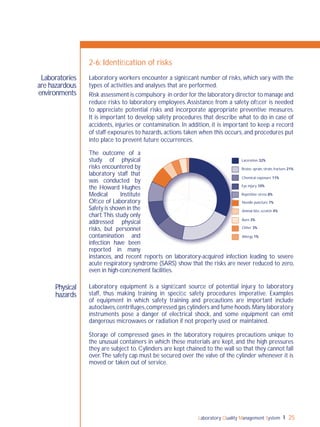
Patient identifiers—Sometimes hospitalized patients are assigned a unique
identifier upon admission,to be used for the duration of the hospital stay.A patient
may get a new number each time they are seen or admitted. In other settings, the
unique identifier may be assigned to the patient on a more permanent basis,to be
used each time the patient has any health care.
Sample identifiers—Laboratories need to assign unique identifiers
to patient samples so they can be tracked throughout the laboratory.
The method for generating and assigning unique identifiers within an
information management system will depend on many factors.Some commercially
available computer systems for laboratories have a numbering system built in to
the software. Laboratories using paper-based systems will need to establish their
own system.
An example of a simple system for generating unique identifiers is using a number
consisting of the year,the month,the day and a four digit number:YYMMDDXXXX.
At the beginning of each day, the last four digits will be 0001.
For example, the number 0905130047 can be read 09 05 13 0047, and it would
represent sample number 47, received on 13 May 2009.
To avoid confusion or mix-up of samples, use the sample’s full identifying number
throughout the laboratory.At a minimum, the unique number will need to be used
on all aliquots of the sample, on the request form, the laboratory register or log,
and the result sheet.
Whatever system a laboratory chooses, unique identifiers should be
used to eliminate confusion and mix-up of samples, and make samples
and information easier to find.
Laboratory Quality Management System198
Test request
forms,logs and
worksheets
Security
The test request form is where the entire testing process begins,and is important
for both paper and electronic systems.To optimize test requests:
 Standardize the test form—the form should indicate all information that needs
to be provided when ordering and submitting a test request, and sufficient
space for recording the information. ISO 15189 requirements for the request
form are addressed in Chapter 16.
 Ensure the request form is completed—when the request form is incomplete,
communicate with the requestor to try to secure the needed information. It
may become necessary to refuse nonurgent test examination until the form is
completed.
Logs that allow for recording data at the time of arrival of the sample in the
laboratory are very important, as are worksheets that document which patient
samples are being tested during a given procedure. In a paper-based system, this
will be a written record, usually in a bound book. For an electronic system, logs
and worksheets may be generated from the computer.Thought should be given
as to what information should be recorded.
There are certain points in data handling where it is easy for errors to occur,
such as during manual transfer of patient data from requisition forms to logs,
keyboard electronic entry of data into a computerized information system, or
transcription from worksheets to reports.The laboratory should put processes in
place to safeguard against errors at these points. Sometimes it may be necessary
to adopt formal checking processes to ensure the accuracy of data recording and
transmission of handwritten or keyed information.
One example of a simple checking process is to always have two people review
data transcription to verify its accuracy. Some computerized systems have
electronic checks built into the system that require duplicate entry of data. If
these duplicate entries do not match, an error alert is generated to the person
entering the data.
It is important to establish a means to protect against loss of data. For paper-
based systems, this will involve using safe materials for recording and storing
the records properly. For computerized systems, scheduled or regular backup
processes become very important.
It is of utmost importance to safeguard a patient’s privacy and, in this regard,
security measures must be taken to protect the confidentiality of laboratory data.
Laboratory directors are responsible for putting policies and procedures in place
to ensure confidentiality of patient information is protected.
The product of a laboratory is the test result or the report. Give sufficient
attention to the reporting mechanism to ensure that it is timely, accurate, legible
and easily understood.
17-2: Elements of information management
Reporting
systems
Laboratory Quality Management System 199
Communication
considerations
Common
problems
The report should provide all information needed by the health care provider
or the public health official using the data, and include any comments that are
appropriate,such as“sample haemolysed” or“repeat sample”.It should be verified
and signed by the appropriate laboratory staff.
Whether issuing paper-based or computer-based test reports, laboratories must
ensure reports arrive on time to the right person. Reports might be delivered by
laboratory staff to the hospital ward, by courier or by mail to an off-site facility,
or through electronic mechanisms using a sophisticated laboratory information
management system. A telephone is often used to give urgent results. A record
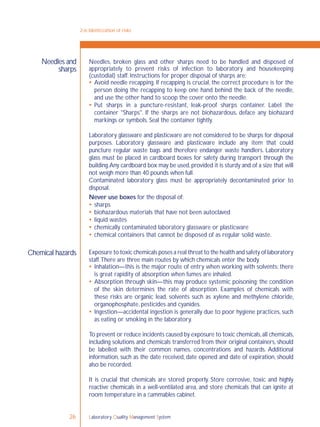
of the telephone call must be kept and should include the caller’s signature, date
and time, and whenever possible, the recipient’s name.Telephone results should
be followed by a written report.
The test result report reflects the laboratory’s image to the client, the
test requestor, and others who may use or need the report.
When planning for paper-based or computer-based information systems, be sure
to consider the need for a good system for communicating within and external
to the laboratory.This is especially important in larger organizations. It may be
necessary to devise a system for passing along information between staff covering
different shifts or areas of the laboratory, to make sure important details are not
overlooked.The laboratory might also need to develop a policy for communicating
with its customers, such as health care providers, central reference laboratories
and official agencies. The policy should describe what communication channels
need to be followed and when, and state who has authority to communicate with
the different levels of customers.
There are many points where problems can occur when managing laboratory
information.The laboratory should carefully consider potential problems and plan
on how to avoid them. Some of the most common problems are:
 incomplete data for test interpretation, or insufficient or illegible identification—
systems should be designed to minimize this occurrence; for example, when using
electronic systems,it is possible to design fields so that if information is missing,data
entry cannot be completed;
 forms that are inadequately designed to meet laboratory and client needs;
 standardized forms prepared by others that may not be suitable for all
laboratories;
 inability to retrieve data due to poor archiving processes or insufficient backup
of computerized information;
 poor data organization, which may hinder later data analysis efforts to meet
research or other needs;
 incompatibility between computerized information systems and equipment or
other electronic systems,resulting in problems with data transmission.
17-2: Elements of information management
Laboratory Quality Management System200
Developing a
manual system
Registers,logs
and worksheets
Data entry
17-3: Manual, paper-based systems
Financial constraints may require that a laboratory use a manual, paper-based
system for all its information management. Careful planning, attention to detail
nd awareness of problems can allow for the development of a good paper-based
system that will provide satisfactory service.
Manual registers, logs and worksheets are widely used, and most laboratorians
are very familiar with use of manual systems for managing samples through the
laboratory. Even laboratories with some computerization will often have partially
or totally handwritten worksheets.
Laboratory registers or sample logs take many forms, and almost all laboratories
will have one that has been in use. When reviewing information management
needs, consider whether an existing register is satisfactory, or whether it should
be redesigned.
Registers and logs with good design:
• are practical to use and easy to complete
• make it easy to find the data
• make summarizing data and writing reports easier.
The logbook or register can be supplemented by the use of daily logbooks.
For example, a separate logbook might be used to keep track of the numbers
of patients and samples, or a logbook could be developed that is organized by
the type of test. For some specialties such as microbiology or parasitology, a
laboratory might decide to keep a specific logbook showing the total number of
tests and the percentage of positive results.
Registers and logbooks are unique sources of information for preparing
statistics and reports, although they can be more cumbersome to use
and less complete than a computerized information system.
When using a paper system, it is important to emphasize to staff that all data entry
must be complete.A computerized system usually requires that all“essential fields”
contain data,but in handwritten records there is no check on this point. An example
of a handwritten record book with missing data is shown in the following image.
Laboratory Quality Management System 201
Handwritten
reports
Storing
paper-based
materials
Legibility Illegible writing may be a problem, but it must be addressed; emphasize to
employees the importance of legibility.
Carefully consider the ease of use and legibility of the final report of results—it
is the primary product of the laboratory, so make sure it is done properly and
professionally.
When handwritten reports are issued, the laboratory needs a copy for its files
or archives. Not having an exact copy of the report can lead to later problems, if
errors in transcription occur.
It is imperative that the records are kept in a safe place where they can be easily
retrieved.
When storing paper-based materials, keep in mind that the goals are to be able
to find a result, trace a sample throughout its pathway in the entire process, and
evaluate a problem or an occurrence to find its source.
Some useful rules to think about are:
 keep everything, but develop a system for when and how to discard (for
example, after the appropriate established retention time, shred records to
maintain patient confidentiality);
 ensure easy access to information by those who need it;
 use a logical system for filing;
 use numbers to help keep things in chronological order.
Paper is fragile and vulnerable to water, fire, humidity and vermin
(rodents and insects).Use a storage area that will protect against these
elements as much as possible.
17-3: Manual paper-based systems
Age not
recorded
Results recorded
in village column
Village name
not recorded
Laboratory Quality Management System202
Developing a
computerized
system
Choosing a
system
Advantages of
computerized
systems
17-4: Computerized laboratory information systems
A computerized system for laboratory data is often called a laboratory
information management system and is referred to by the acronym LIMS or LIS.
The use of a computerized system is becoming more common in laboratories
around the world.An appropriately designed and installed LIMS brings accuracy
and accessibility to the flow of samples and data in the clinical laboratory.
There are a number of options available to those interested in developing a LIMS.
Some laboratories may elect to develop an in-house computer network and use
locally developed systems based on commercially available database software, such
as Microsoft Access. Others may choose to purchase fully developed laboratory
systems, which usually include computers, software and training.
One source of information that may be helpful for planning and implementing a
LIMS is theAssociation for Public Health Laboratories' Guidebook for implementation
of laboratory information systems in resource poor settings.1
If the decisions about purchasing are made outside the laboratory (e.g. by
the information system department), the laboratory director should provide
information that will support selecting equipment that will best serve the needs
of the laboratory.The most up-to-date hardware or software may not add to the
functionality of the laboratory and can end up increasing overhead (e.g.more data
handling) in order to use LIMS that have been designed not for the laboratory,but
for the accounting or central supplies departments.
A LIMS with flexibility, adaptability, ease of evolution and support, and system
speed will most benefit the laboratory.The speed issue is critical, as laboratorians
will not use something that is slow or awkward, but if it saves time they will
quickly accept the project and aggressively move the process forward.
A complete computerized information system will be able to handle all the basic
information management needs.A computer system has the capacity to quickly
and easily manage, analyze and retrieve data. The computerized system offers
some definite advantages over paper-based systems. Some of these advantages
are listed below.
 Error reduction—a well-planned computer system, with check systems for
errors, will help to alert the user of inconsistencies and reduce the number of
errors. It will also provide information that is legible.
 Quality control management—it becomes easy to keep good quality control
records, perform analysis on quality control data and generate statistics
automatically.
1 Information about this guidebook is available at: http://www.aphl.org/aphlprograms/global/initiatives/Pages/lis.aspx
Laboratory Quality Management System 203
Disadvantages
 Provision of options for data searching—a variety of parameters can be used
for data retrieval; it is usually possible to access data by name, by laboratory or
patient number, and sometimes by test result or analysis performed.This kind
of data searching is almost impossible with paper-based systems.
 Access to patient information—most computer systems allow access to
all recent laboratory data for a patient. This is very useful in the process of
checking the most recent results against previous data to look for changes,
which is a good practice and helps to detect errors. Some computer systems
give enough information to determine the admitting diagnosis or access other
useful information related to the illness.
 Generate reports—it is easy to generate detailed, legible reports quickly. A
LIMS will provide standardized (or customized) reports.
 Ability to track reports—a computer system makes it much easier to track
reports, to know when work was finished, who performed the work, when the
data was reviewed and when the report was sent.
 Ability to track and analyze trends—the computer and its databases provide
very strong search capabilities and, with careful design, it will be possible to
retrieve and use large amounts of data effectively to track and analyze trends
of various kinds.
 Improved capability for maintaining patient confidentiality—it is often easier to
maintain confidentiality of laboratory data when using a computer than when dealing
with a handwritten report form, if computer user codes are established to control
access to the data.
 Financial management—some systems will allow for financial management; for
example, patient billing.
 Integration with sites outside the laboratory—a LIMS can be set up so that data
comes into the laboratory system directly from a patient or client registration
point. Data can be transmitted to many sites or interfaces as needed. Results
can be provided directly to computers accessible to the health care provider or
public health official.Computers can handle data entry into a national laboratory
database and almost any other data application that is needed.
 Manufacturer-provided training—purchased LIMS often include on-site training
for staff.To make the full use of the system, it is essential that either on-site
training of all staff, or training at the manufacturer’s headquarters, is provided.
It is important to remember that, in spite of all of the advantages, computers do
have disadvantages. Some of these are as follows:
 Training—personnel training is required and,because of the complexity of LIMS,
this training can be time-consuming and expensive.
 Time to adapt to a new system—when starting up a computer system, it may
seem inconvenient and unwieldy to laboratory staff. Personnel accustomed
to manual systems may be challenged by such tasks as correcting errors, and
uncertain of how to proceed when encountering situations where a field must
be filled in.
17-4: Computerized laboratory information systems
Laboratory Quality Management System204
 Cost—purchaseandmaintenancearethemostexpensivepartsofacomputerized
system, and the costs can be prohibitive in some settings. Additionally, some
settings will not have good maintenance that is locally available. Surprisingly,
computers use lots of paper, and the cost of materials must be planned for, as
this can add up.Also remember that technology changes rapidly, and the life of
a computer may not be more than a few years.This might require repurchase
of computer equipment periodically in order to remain current and compatible
with other systems.
 Physical restrictions—adequate space and dedicated electrical requirements
are necessary, as well as placement of the computer away from heat, humidity
and dust.
 Need for backup system—all computer information must be carefully backed
up.Loss of data due to a damaged disk or system crash cannot be tolerated,and
backup systems will be critical.
17-4: Computerized laboratory information systems
Laboratory Quality Management System 205
Key messages
Information
management
system
17-5: Summary
Information management is a system that incorporates all the processes
needed for effectively managing data—both incoming and outgoing
patient information.The system can be entirely paper-based, or it can be partly
paper-based with some computer support, or it may be entirely electronic.
For either paper-based or computer systems, unique identifiers for patient
samples will be needed. Standardized test request forms, logs and worksheets
are also important to both systems. In helping to prevent transcription errors, a
checking process is beneficial.
When considering adding a computer-based system to a laboratory, cost is a big
factor. In implementation, careful planning and training will help to ensure good
results.
A good information management system will:
 ensure that all data—the final product of the laboratory—is well managed;
 consider all the ways laboratory data will be used when planning a system;
 ensure the accessibility, accuracy, timeliness and security of data;
 ensure confidentiality and privacy of patient information.
18. Organization
Laboratory Quality Management System208
Characteristics
essential to
success
Definition
18-1: Organizational requirements for a quality
management system
The principal element for a successful quality management system is managerial
commitment.
 Management at all levels must fully support and actively participate in the quality
system activities.
 Support should be visible to staff so that there is an understanding of the
importance of the effort.
 Without the engagement of management, including the decision-making level
of the organization, it will not be possible to put in place the policies and the
resources needed to support a laboratory quality management system.
A second vital element is that the organizational structure must be designed
to ensure that the quality goals of the organization are met.
 The laboratory must be a legally structured entity according to local
requirements.
 All the organizational elements required to ensure a properly functioning
quality management system must be in place.
Organization Personnel Equipment
Purchasing
and
inventory
Process
control
Information
management
Occurrence
management
Assessment
Facilities
and
safety
Customer
service
Process
improvement
Documents
and
records
The term organization in the context
of a quality management model is used
to indicate the management and the
supporting organizational structure of the
laboratory.
Organization is one of the essential
elements of the quality system, and is
intimately related to all the other elements
in the model.
Laboratory Quality Management System 209
The important organizational requirements for achieving a successful quality
system include the following:
 Leadership—laboratory leaders must be fully committed to implementation
of the system, and these leaders will also need vision, team-building and
motivational skills, good communication techniques, and the ability to use
resources responsibly.
 Organizational structure—the structure of the organization should be
clearly defined, and this should be reflected by a functional organizational chart
with clear assignment of responsibility.
 Planning process—skills for planning are needed,and planning should address
a time frame, responsibility for conducting the activities, the availability and use
of human resources, management of workflow and financial resources.
 Implementation—implementation requires that a number of issues must be
addressed by the management staff.These include management of projects and
activities, directing resources to accomplish plans, and ensuring that timelines
are met and goals achieved.
 Monitoring—as components of the quality management system are put in
place, processes for monitoring will be needed to ensure that the system
is working, and that benchmarks and standards are being met. This element
is essential to the primary goal of a quality system, which is continuous
improvement.
18-1: Organizational requirements for a quality management system
Key
organizational
components
Laboratory Quality Management System210
Providing
leadership
Responsibilities of
managers
18-2: Management role
Leadership can be defined in many ways, but it is an important factor in the
success of any organization’s efforts for improvement.
A good leader will exercise responsible authority. Important roles for a leader
include:
 providing vision
 giving a direction for goal-setting
 motivating staff
 providing encouragement.
A strong leader will help staff understand the importance of the task at hand.
ISO 15189 [4.1.5] states that “Laboratory management shall have responsibility
for the design, implementation, maintenance, and improvement of the quality
management system”.
A quality management system outlines specific responsibilities of managers.
Management must be responsible for:
 establishing the policies and processes of the quality system;
 ensuring all policies, processes, procedures, and instructions are documented;
 making sure that all personnel understand documents, instructions, and their
duties and responsibilities;
 providing personnel with the appropriate authority and resources to carry out
their duties.
Management is charged with providing a quality manual which describes the
quality management system.The quality manual is the means by which the policies
are established and communicated to the staff and the users of the laboratory.
Laboratory directors have the principal responsibility for setting up an
organization that can support the quality system model. They are responsible
for developing policies, assigning authority and responsibility to the appropriate
persons, ensuring resources and reviewing the organizational aspects of the
system for optimal functioning of quality processes. Laboratory directors must
ensure that staff follow the quality policies established by the quality manual.
Quality managers assist in developing policies, planning and implementing
the quality management system. They are usually responsible for many of the
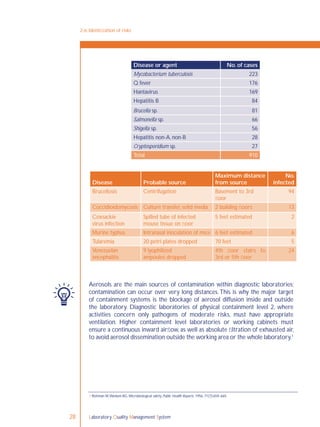
implementing and monitoring processes,and must communicate all aspects of the
quality management system processes to the laboratory director or head of the
laboratory.
Laboratory Quality Management System 211
Commitment of
management
Laboratory staff (laboratorians) are responsible for understanding the
organizational structure of the laboratory, including where authority and
responsibility are assigned.The laboratory staff will follow all of the quality policies
in their daily work routine.
Most critical in beginning any new programme is to seek approval from the top.
Management needs to be involved at a sufficiently high level to assure success
of the programme. When implementing a quality system, determine what the
“sufficiently high level” is; be sure to include those who make decisions as their
approval and support is vital. Finally, it is important that laboratory managers
communicate their commitment to the entire laboratory staff. Managers must
show the way, and encourage and foster the “spirit” of the organization.
18-2: Management role
Laboratory Quality Management System212
Elements of
structure
18-3: Organizational structure
When considering organizational structure to support a quality management
system, a number of elements should be considered:
 The path of workflow is the route of a sample through the laboratory, from
collection to reporting of a result.The organizational structure of the laboratory
must support an optimal path of workflow, by allowing processes that yield
efficient sample handling while minimizing error. Considerable attention should
be given to the design of this system.
 An accurate and complete organizational chart is necessary. Many problems
can be prevented if responsibilities are clearly defined and all members of the
laboratory team understand what each is supposed to do.
Pre examination hase
Result nterpretation
Post ex
am
inationhase
i
p
p
The patient
Sample
transport
Sample
collection
Test
selection
Laboratory analysis
Examination phase
Report
creation
Report
transport
HOSPITAL DIRECTOR
LABORATORY
DIRECTOR
NURSING
DIRECTOR
NURSING
Quality
manager
Charge
technologist
Assistant
charge
Technologist
Laboratory Quality Management System 213
Quality
manager
 A quality management system must have a quality manager.
 Resource allocation must be sufficient to ensure that personnel and
infrastructure needs are met.
ISO 15189 [4.1.5 i] states that a laboratory must have a quality manager. The
quality manager is the person most directly responsible for ensuring that the
quality policies and procedures are carried out.
The quality manager should sit high in the organizational structure; they must be
delegated the appropriate responsibility and authority to ensure compliance to
the quality system requirements.The quality manager should report directly to
the decision maker(s) in the organization.
A very large laboratory may need several quality managers, perhaps one for each
section. On the other hand, in a small laboratory this may be a part-time job for
a senior technologist, or even a job that is carried out by the laboratory manager.
The quality manager may be assigned many tasks. Some typical responsibilities of
the quality manager will include:
 monitoring all aspects of the quality system;
 ensuring staff are following quality policies and procedures;
 regularly reviewing all records; for example, quality control and external quality
assessment that are part of the quality system;
 organizing internal audits and coordinating external audits;
 investigating any deficiencies identified in the audit process;
 informing management on all aspects of the quality system monitoring.
18-3: Organizational structure
Laboratory Quality Management System214
Approaches to
planning
Establish a plan
18-4: Organizational functions: planning
Once management is committed to instituting a quality system in the laboratory,a
planning process is needed.Approaches used will vary,depending on many factors
in the local situation.
 What quality practices are already in use in the laboratory?
 What is the level of knowledge of current staff?
 What resources will be available?
All elements of the quality system should be included in the planning process. It is
not necessary (usually not possible) to implement all parts of the plan at once; a
stepwise approach will often be more practical.
In many laboratories, the implementation of a quality system may involve many
changes.It is therefore important to keep all staff involved,and to not proceed too
rapidly,as personnel may find it difficult to meet the goals and can get discouraged.
Communicate with staff frequently, clearly and positively; this will help to keep
morale high.
During planning,priority areas will emerge as the bigger problems are identified.It
will be important to keep objectives realistic and measurable. Inevitably, there will
be some factors that are beyond the control of the laboratory. Recognize these
and move on to other factors that can be addressed. If these factors are vital to
the ultimate success of the quality programme, then look for ways to influence
those who can control them.Always advocate for quality.
In planning for implementation of a quality system, the first step is to analyze and
understand the current practices.A useful way to accomplish this is the technique
of gap analysis.To conduct a gap analysis:
 use a good quality systems checklist to evaluate the practices in the individual
laboratory;
 identify gaps or areas where the laboratory is not using the good laboratory
practices required in the quality system.
Using the information provided by the gap analysis,develop a task list of everything
needing to be addressed, and then set priorities. In determining priorities,
consider first addressing problems that can be easily fixed; this will give some
early successes and boost staff morale.Also evaluate what would have the most
impact on laboratory quality and give these factors high priority.
Laboratory Quality Management System 215
The quality
system plan
Problems commonly identified in laboratories using a gap analysis include:
 test ordering
 sample management
 incompetent technical staff
 quality control
 analytical process
 recording and reporting results
 reagent and equipment management.
The implementation of a quality system in the laboratory requires a written plan.
A written plan makes clear to all staff and all users of the laboratory how the
process will proceed.The plan should contain the following components:
 objectives and tasks—what should be done;
 responsibilities—who will get the job done, who will be responsible;
 timeline—when will each task be worked on, when will it be completed;
 budget and resource needs—additional staff,training needs,facilities,equipment,
reagents and supplies, quality control materials;
 benchmarks—essential for monitoring progress in implementation.
The written plan should be made available to all laboratory staff,as everyone must
understand the plan and the process of implementation.
18-4: Organizational functions: planning
Laboratory Quality Management System216
Beginning
implementation
Following the
timeline
18-5: Organizational functions: implementation
Once a plan has been written and agreed upon, implementation will begin.These
suggestions will help the laboratory in this process:
 Commit from the beginning to complete the project and achieve the
established objectives. Go in with a positive attitude.
 Prepare to implement in stages.It is important to prevent staff from getting
discouraged, so choose manageable “bites” at the beginning. Staggering start
dates will also be helpful; use established priorities to determine start dates.
 Determine resource requirements early in the process, and secure the
necessary resources before starting tasks. If working in a highly resource-
limited environment, choose as initial activities those things that can be done
with available funds and staff—there are many such activities, such as improving
documents,records,or developing up-to-date and improved standard operating
procedures.
 Engage all staff by communicating effectively. If training is needed to have
personnel understand the quality system and its goals, this training should
probably be done before starting other tasks.
As a part of the planning process, the laboratory will have established a timeline
for tasks to be performed, including a projected completion date.This timeline
is a critical part of the process, as it allows everyone in the laboratory to
observe progress.A Gantt chart (shown below) is a very useful tool for visually
representing the proposed timeline; it shows tasks to be done, with times of
beginning and completion.
Laboratory Quality Management System 217
Monitoring
basics
Establishing
a monitoring
programme
Providing
resources
The timeline should be very carefully prepared, so as to allow
appropriate times for completion. Do not let the laboratory staff
become overwhelmed with the tasks that need to be accomplished.
During the planning process, all additional resources that are needed will have
been identified. As implementation begins, be sure that these resources are in
place and available. Several kinds of resources need to be considered:
 all financial requirements— establish a budget;
 personnel needs—are additional laboratory staff required, will training be
needed for any of the staff?
 facilities, equipment, supplies, and computer needs.
Establishing a system for monitoring quality management is essential in
implementing a quality system. It is the monitoring and maintenance part of the
effort that will produce the continuous improvement that is the overall goal of
a good quality system. Monitoring involves being able to check each part of the
system to be sure that the system is working properly.
There are several steps in setting up a programme to monitor compliance to the
quality system.
 Assign responsibility for the process. Usually the quality manager will be the
person who is primarily responsible for the monitoring programme.
 Develop indicators or benchmarks using the laboratory quality policy. These
indicators will be monitored over time.
 Develop a system for the monitoring process; establish time or frequency of
checks, decide how the monitoring will be managed.
 Conduct an audit, followed by a management review; these constitute two
important tools in monitoring compliance.
Internal audits should be conducted at regular intervals. They are valuable for
evaluation, and they are required by ISO 15189.
Management reviews are a particularly valuable component of the monitoring
process. It is the responsibility of management to review all appropriate quality
systems information, and to look for opportunities for improvement.
18-5: Organizational functions: implementation
Laboratory Quality Management System218
Definition
Writing a quality
manual
18-6:The laboratory quality manual
The quality manual is a document which fully describes the quality management
system of an organization.It is key to the process,serving as a guide for the entire
system.The manual will clearly lay out the quality policies, and will describe the
structure of the other laboratory documents.
In a laboratory that is implementing a quality management system, there must be
a quality manual. However, there is considerable flexibility in how to prepare it,
and a laboratory can construct the manual so that it is most useful and suited to
the local need (see Chapter 16 for additional information).
ISO 15189 [4.2.4] requires that laboratories have a quality manual, although style
and structure are not specified.
The purpose of a quality manual is to clearly communicate information, and to
serve as a framework or roadmap for meeting quality system requirements.
The manual is the responsibility of laboratory management, and thus conveys
managerial commitment to quality and to the quality management system.
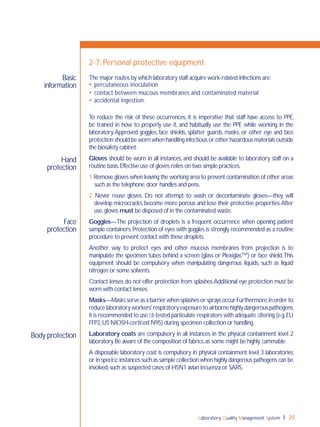
The manual should contain the following:
 All quality policies of the laboratory—these should address all 12 essential
elements of the quality system.
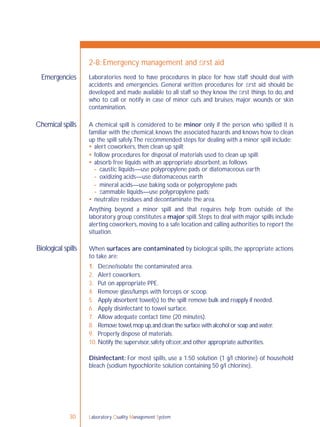
 A reference to all processes and procedures—for example, standard operating
procedures (SOPs) are a part of the overall quality system.There are usually
too many to include directly in the quality manual, but the manual should say
that all procedures must have an SOP and that these can be found in the SOP
manual.
 A table of contents—ISO 15189 provides a suggested table of contents, and
this includes a description of the laboratory,staff education and training policies,
and all the other elements of a quality management system (e.g.documents and
records).
Laboratory Quality Management System 219
The quality manual is the framework for the entire quality management system,
therefore it must always be correct and up to date. The laboratory will need
to establish a process to ensure this. The following steps offer suggestions for
developing, maintaining and using the quality manual.
 When the quality manual is written and prepared, it must be approved by the
head of the laboratory. In some laboratories, approval by another appropriate
person,such as the quality manager,might also be required.This approval should
be indicated by having official signatures and dates of signing recorded in the
manual itself.
 A process or system for updating needs to be established.This system should
specify the frequency for reviewing the manual,assign responsibility for updating
to someone (usually the quality manager), and define how changes in the
manual will be incorporated and documented. Changes to the quality manual
will need to be approved; approval should be indicated by having signatures
of the person(s) with authority to make changes, and the date of the change,
recorded in the manual.
 Instruction on use of the manual should be provided to all laboratory staff;
laboratory personnel must understand that the policies detailed in the quality
manual are always to be followed.
18-6:The laboratory quality manual
Maintaining and
using the quality
manual
Laboratory Quality Management System220
Steps for
organization
Key messages
18-7: Summary
As the laboratory moves from intent to action in the development of a quality
management system,the major organizational steps will be to assign responsibility
for implementation, allocate resources, develop and distribute a quality manual,
begin implementation, and monitor compliance with the quality policy and the
quality management system requirements.
Successful implementation of a quality management system requires planning,
management commitment, understanding the benefits, engaging staff at all levels,
setting realistic time frames and looking for ways to continually improve.
Remember:
 Quality is not a science; it is a way of thinking.
 Time invested today will help gain quality results, professional and personal
satisfaction, and peer recognition.
 Everyone in the laboratory is responsible for quality performance:
- Laboratory leaders and managers must commit to meeting quality needs.
- Laboratory personnel must follow all quality assurance procedures and
adhere to requirements and standards.
Laboratory Quality Management System 221
Glossary
 A
Accreditation Procedure by which an authoritative body gives formal
recognition that a body or person is competent to carry out specific tasks.
Reference: ISO 15189.
Accreditation (and certification) body An organization or agency with
the authorized right and authority to inspect a facility and provide written
evidence of its compliance (certification) and competence (accreditation) with
a standard.
Accident An undesirable or unfortunate event that occurs unintentionally.
Accuracy The closeness of a measurement to its true value.
Analytical phase See Examination.
Audit Systematic, independent and documented process for gathering
evidence and evaluating it objectively to determine the extent to which audit
criteria are fulfilled.
 B
Benchmark A point of reference or a criterion of quality. A benchmark is
intended to serve the user as a guide for measuring optimum performance or
to suggest solutions to problems or deficiencies. It implies the best practice.
Bias A numerical value used to measure accuracy.The difference between the
average value of all measurements and the reference value.
Biohazard An infectious agent, or part thereof, that presents a real or
potential risk to the well-being of humans, animals or plants. It can present a
hazard directly through infection or indirectly through the disruption of the
environment.
Biological safety cabinet An enclosure in which entry and exhaust air
is filtered through a high efficiency particulate air (HEPA) filter to remove
any particles from potential aerosols; used to contain a biological hazard,
protecting the operator and the environment. Depending on the class of
the safety cabinet, it may or may not protect the actual biohazard itself from
contamination.
Biological safety levels Also known as physical contaiment levels:
 Biological safety level 1 A laboratory that works with agents not known
to cause disease in healthy adults; standard microbiological practices apply;
no special safety equipment required; sinks required.
 Biological safety level 2 A laboratory that works with agents associated
with human disease; standard microbiological practices apply plus limited
access, biohazard signs, sharps precautions and biosafety manual required;
biological safety cabinet used for aerosol/splash-generating operations;
laboratory coats, gloves, face protection required; contaminated waste is
autoclaved.An appropriate ventilation system should be in place.
Laboratory Quality Management System222
 Biological safety level 3 A laboratory that works with agents that
may have serious or lethal consequences and with potential for aerosol
transmission; biological safety level 2 practices plus controlled access;
decontamination of all waste and laboratory clothing before laundering;
determination of baseline serums; biological safety cabinet used for all
sample manipulations; respiratory protection used as needed; physical
separation from access corridors; double-door access; negative airflow into
laboratory.The ventilation system must ensure removal of particulates by
filtering entry and exhaust air through HEPA filters.
 Biological safety level 4A laboratory that works with dangerous or exotic
agents of life-threatening nature or unknown risk of transmission; biological
safety level 3 practices plus clothing change before entering laboratory;shower
required for exit;all materials are decontaminated on exit;positive pressure
personnel suit required for entry; separated or isolated building; dedicated
air supply and exhaust with HEPA filters; and decontamination systems.
Biosafety The active, assertive, evidence-based process that laboratorians
use to prevent microbial contamination, infection or toxic reaction as they
actively manipulate live microorganisms or their products, thus protecting
themselves, other laboratory staff, the public and the environment.
 C
Calibrators Solutions with specified defined concentrations that are used to
set or calibrate an instrument,kit or system before testing is begun.Calibrators
are often provided by the manufacturer of an instrument.
Certification Procedure by which a third party gives written assurance that
a product, process or service conforms to specific requirements. Reference:
ISO/IEC 17000:2004.
Certification arrangements Certification requirements for a particular
category of people who will go through the same certification procedure and
standard application. Reference: ISO 17024:2003.
Certification (and accreditation) body An organization or agency with
the authorized right and authority to inspect a facility and provide written
evidence of its compliance (certification) and competence (accreditation) with
a standard.
ChecklistA list used to ensure all important steps or actions in an operation
have been taken. Checklists contain items important or relevant to an issue
or situation.
CLIA In the United States, the Centers for Medicare & Medicaid Services
(CMS) regulates all medical laboratory testing (except research) performed on
humans through the Clinical Laboratory Improvement Amendments of 1988
(CLIA).The CLIA regulations provide standards to assure consistent, accurate
and reliable laboratory test results. The CMS issues Certificates of Waiver
and Certificates of Compliance. Certificates of Accreditation are issued to
laboratories by accrediting organizations with deemed status under CLIA.
Glossary
Laboratory Quality Management System 223
Glossary
Coefficient of variation (CV) The standard deviation (SD) expressed as a
percentage of the mean.
Competence Demonstrated ability to apply knowledge or skills.
Compliance An affirmative indication or judgement that the supplier of a
product or service has met the requirements of the relevant specifications,
contract or regulation;also the state of meeting the requirements.Meets both
the text and the spirit of a requirement.
Confidentiality Pertains to the disclosure of personal information in a
relationship of trust,with the expectation that it will not be divulged to others
in ways that are inconsistent with the original disclosure.
ConsensusAgreement between delegations representing all the stakeholders
concerned—suppliers,users,government regulators and other interest groups.
Consensus is not a numeric or majority determination. Consensus represents
general agreement in the absence of strong and compelling objection.
Continual/continous improvement The cornerstone of quality
management systems; allows the laboratory to gain insights from setting
objectives, monitoring through audit and management review, addressing
complaints and nonconformities, and performing client satisfaction surveys.
A recurring activity to increase the ability to fulfill requirements. Includes the
steps Plan, Do, Check,Act.
Continuous quality improvement A philosophy and attitude for analyzing
capabilities and processes and improving them repeatedly to achieve the
objective of customer satisfaction.
Controls Substances that contain an established amount of the substance
being tested—the analyte. Controls are tested at the same time and in the
same way as patient samples.
Controlled documentation A system for maintaining and ensuring the
proper use of time-sensitive or version-sensitive documents.
Correction Action to eliminate a detected nonconformity.
Customer Organization or person that receives a product or service from
a supplier organization.
Customer satisfaction Customer's perception of the degree to which the
customer's requirements have been fulfilled. It can vary from high satisfaction
to low satisfaction. If customers believe that you have met their requirements,
they experience high satisfaction. If they believe that you have not met their
requirements, they experience low satisfaction.
Laboratory Quality Management System224
 D
Deming cycle for continuous improvement A visualization of the
continuous quality improvement process usually consisting of four points—
Plan, Do, Check,Act—linked by quarter circles.The cycle was first developed
by Dr Walter A Shewhart, but was popularized in Japan in the 1950s by
Dr W Edwards Deming.
Deming's 14 principles The foundation of Deming's philosophy.The points
are a blend of leadership, management theory and statistical concepts that
highlight the responsibilities of management while enhancing the capacities of
employees.
Document Information and its supporting medium; digital or physical. The
International Organization for Standardization (ISO) identifies five types of
documents:specifications,quality manuals,quality plans,records and procedure
documents. See Normative document and Standard document.
Documentation Written material defining the process to be followed.
 E
Error A deviation from truth, accuracy or correctness; a mistake; a failure of
a planned action to be completed as intended, or the use of a wrong plan to
achieve an aim.
EventAn occurrence of some importance and frequently having an antecedent
cause.
Examination 1. Activities and steps related to performing laboratory
examinations.2.A set of operations having the object of determining the value
or characteristics of a property to describe these processes. 3. One phase of
the three-phase framework for the total testing process to describe issues
related to the quality of laboratory testing. Also referred to as an analytical
phase. See Pre-examination and Post-examination.
External quality assessment (EQA) A system for objectively checking the
laboratory’s performance using an external agency or facility.
 F
False negative In the case of a clinical microbiology test, a negative test
result for a person who is actually infected.
False positive In the case of a clinical microbiology test,a positive test result
for a person who is actually not infected.
Flowchart A graphical representation of the flow of a process.A useful way
to examine how various steps in a process relate to each other, to define the
boundaries of the process, to identify customer and supplier relationships
in a process, to verify or form the appropriate team, to create common
understanding of the process flow, to determine the current best method of
performing the process, and to identify redundancy, unnecessary complexity
and inefficiency in a process.
Glossary
Laboratory Quality Management System 225
Form A paper or electronic document on which information or results are
captured; once completed, it becomes a record.
 G
Gantt chart A very useful tool for visually representing the proposed time
line: it shows tasks to be done, with times of beginning and completion.
Gap analysis Planning tool used to compare the present/current state with
the future desired state. Basis for development of action plans to address
high-priority gaps.
 I
Incident An individual occurrence of brief duration or secondary importance.
Incident reporting The barometer of risk in an organization and all health
service quality initiatives stress its importance.
Indicators Established measures used to determine how well an organization
is meeting its customers' needs, as well as other operational and financial
performance expectations.
Infrastructure Buildings,workspaces,equipment,hardware,software,utilities
and support services such as transportation and communication.
Informative statement Information with a document that is informational
only; often it is in the form of a note. Information may be explanatory or
cautionary, or provide an example.
Inspection Activities such as measuring, examining, testing or gauging one
or more characteristics of a product or service, and comparing these with
specified requirements to determine conformity.
Internal audit An audit carried out by the laboratory personnel who examine
the elements of a quality management system in their laboratory in order to
evaluate how well these elements comply with quality system requirements.
ISO standards A set of international standards providing guidance for quality
in the manufacturing and service industries; developed by the International
Organization for Standardization (ISO) to help companies effectively document
the quality system elements to be implemented to maintain an efficient quality
system. The standards, initially published in 1987, are not specific to any
particular industry, product or service; they are broadly applicable to many
kinds of organizations.
ISO 9001:2000 The most important and internationally well-recognized
series of standards for quality management are referred to as the ISO 9000
series.The most recent iteration was written in 2000, and thus is referred to
as ISO 9000:2000. It includes a series of policy statements.
ISO 15189:2007 Standard for medical laboratories; a series of policy
statements.
Glossary
Laboratory Quality Management System226
 L
Laboratory director Person(s) with responsibility for, and authority over, a
laboratory.
Laboratory manager Person(s) who manage the activities of a laboratory
headed by a laboratory director.
Laboratorian Person who works in a laboratory and is trained to perform
laboratory procedures.
Lean A system of methods that emphasize identifying and eliminating all
non-value-adding activities. Tools include S5—sort, set, shine, standardize,
sustain—and CANDO—clearing up, arranging, neatness, discipline, ongoing
improvement.An English phrase coined to summarize Japanese manufacturing
techniques (specifically, the Toyota production system).
Licensure Granting of ability to practise provided most often by a local
governmental agency, usually based on demonstrated knowledge, training and
skills (Wikipedia 2007). Generally, when laboratory licensure is used, it is a
legal requirement for operation.
 M
Management Coordinated activities to direct and control an organization.
Management review Evaluation of the overall performance of an
organization's quality management system and identification of improvement
opportunities. These reviews are carried out by the organization's top
managers and are done on a regular basis.
Material safety data sheet (MSDS) Form containing data regarding the
properties of a particular (chemical) substance intended to provide workers
and emergency personnel with procedures for handling or working with that
substance in a safe manner, and includes information such as physical data,
storage, disposal, protective equipment, and spill handling procedures. The
exact format of an MSDS can vary from source to source within a country
depending on how specific is the national requirement (Wikipedia 2007).
Metric A measurement for standard of quality for comparing different items
or time periods—you can't improve what you can't measure.Decision makers
examine the outcomes of various measured processes and strategies and
track the results to guide the company and provide feedback.
 N
Nonconformity Failure to fulfil the requirements of a specified process,
structure or service. May be categorized as major (complete) or minor
(partial).
Normative document A document that provides rules, guidelines or
characteristics for activities or their results. It covers such documents as
standards, technical specifications, codes of practice and regulations.
Glossary
Laboratory Quality Management System 227
Normative statement Information within a document that is a required
and essential part of the standard. Includes the word “shall”.
 O
Occurrence An event, accident or circumstance that happened without
intent, volition or plan.
Occurrence management A central part of continual improvement; the
process by which errors or near errors (also called near misses) are identified
and handled.
Organization Group of people and facilities with an arrangement of
responsibilities, authorities and relationships.
Organizational chart Defines the working structure for the organization;
organizes jobs along lines of authority; defines reporting structure and span
of control; defines authority to make decisions and accountability for results;
works together with job descriptions to define the working structure of the
organization.
Organizational structure The pattern of responsibilities, authorities and
relationships that control how people perform their functions and govern
how they interact with one another.
 P
Path of workflow (clinical laboratory) Sequential processes in pre-
examination, examination and post-examination clinical laboratory activities
that transform a physician's order into laboratory information.
PDCA Plan,Do,Check,Act (quality improvement tool).A checklist of the four
stages which you must go through to get from "problem faced" to "problem
solved". See Deming cycle for continuous improvement.
Policy An overarching plan (direction) for achieving an organization's goals.
Post-examination (also post-analytical phase) Processes following the
examination including systematic review, formatting and interpretation,
authorization for release, reporting and transmission of the results, and
storage of samples after the examinations. One phase of the three-phase
framework for the total testing process to describe issues related to the
quality of laboratory testing.
Precision The amount of variation in a series of repeated measurements.
The less variation a set of measurements has, the more precise it is. See
Quantitative examination.
Pre-examination (also pre-analytical phase) Steps, in chronological order
from the clinician’s request, including the examination requisition, preparation
of the patient, collection of the primary sample, and transportation to and
Glossary
Laboratory Quality Management System228
within the laboratory, and ending when the examination phase begins. One
phase of the three-phase framework for the total testing process to describe
issues related to the quality of laboratory testing.
Preventive action Plan steps that are taken to remove the causes of potential
nonconformities or to make quality improvements.Preventive actions address
potential problems,ones that have not yet occurred.In general,the preventive
action process can be thought of as a risk analysis process.
Problem solving The act of defining a problem;determining the cause of the
problem; identifying, prioritizing and selecting alternatives for a solution; and
implementing a solution.
ProcessThe use of resources to transform inputs into outputs. In every case,
inputs are turned into outputs because some kind of work,activity,or function
is carried out.
Process control Concerns monitoring all operations of the laboratory.
Process improvement A systematic and periodic approach to improving
laboratory quality, and the inputs and outputs that glue these processes
together. Managing by focusing on processes.
Product Result of a process;may be services,software,hardware or processed
materials, or a combination thereof.
Proficiency testing ISO Guide: 43 (EA-2/03) [1]. Proficiency testing
schemes are interlaboratory comparisons that are organized regularly to
assess the performance of analytical laboratories and the competence of the
analytical personnel. CLSI definition: “A program in which multiple samples
are periodically sent to members of a group of laboratories for analysis and/
or identification; whereby each laboratory’s results are compared with those
of other laboratories in the group and/or with an assigned value,and reported
to the participating laboratories and others”. See External quality assessment.
Project Unique process, consisting of a set of coordinated and controlled
activities with start and finish dates, undertaken to achieve an objective
conforming to specific requirements, including the constraints of time, cost
and resources.
 Q
Qualitative examination Measurement of the presence or absence of a
substance, or evaluation of cellular characteristics such as morphology. The
results are not expressed in numerical terms, but in qualitative terms such as
“positive” or “negative”;“reactive” or “nonreactive”;“normal” or “abnormal”;
and “growth” or “no growth”.
Quality Degree to which a set of inherent characteristics fulfils requirements.
Quality assurance A planned and systematic set of quality activities focused
on providing confidence that quality requirements will be fulfilled.
Glossary
Laboratory Quality Management System 229
Quality audit (also quality assessment or conformity assessment) A
systematic and independent examination and evaluation to determine whether
quality activities and results comply with planned arrangements, and whether
these arrangements are implemented effectively and are suitable to achieve
objectives.
Quality control A set of activities or techniques whose purpose is to ensure
that all quality requirements are being met.Simply put,it is examining“control”
materials of known substances along with patient samples to monitor the
accuracy and precision of the complete examination process.
Quality improvement Part of quality management focused on increasing
the ability to fulfil quality requirements.
Quality indicator Established measure used to determine how well an
organization meets needs and operational and performance expectations.
Quality management Coordinated activities that managers carry out in an
effort to implement their quality policy.These activities include quality planning,
quality control,quality assurance and quality improvement.See Quality system
essentials.
Quality management standards (such as ISO 9001:2000 and ISO
15189:2007) A series of policy statements. Required statements include
the term “shall”. Full compliance with the standard requires that all “shall”
statements are implemented.Were the laboratory to be inspected to ensure
compliance with the standard, the auditor or inspector would expect to see
evidence that each required policy was being met. “Shall” statements are
often supplemented by notes or comments that often contain examples or
statements using the term “should”. These statements are intended to give
guidance on what would be considered as reasonable activities, content
or structure to demonstrate that the “shall” statement is being followed.
The organization is not required to meet all the comments, suggestions or
recommendations included within these notes or commentary.
Quality management system Management system to direct and control
an organization with regard to quality.
Quality manual Document specifying the quality management system of an
organization.
Quality plan Document specifying which procedures and associated
resources shall be applied, by whom, and when, to a specific project, product,
process or contract.
Quality policy Overall intentions and direction of an organization related to
quality as formally expressed by top management.
Quality record Objective evidence which shows how well a quality
requirement is being met or how well a quality process is performing.It always
documents what has happened in the past.
Glossary
Laboratory Quality Management System230
Quality system The defined organizational structure, responsibilities,
processes, procedures and resources for implementing and coordinating the
quality assurance and quality system audit.A documented activity performed
to verify, by examination and evaluation of objective evidence, that applicable
elements of the quality system are suitable and have been developed,
documented and effectively implemented in accordance with specified
requirements.
Quality system essentials The necessary infrastructure or foundational
building blocks in any organization that need to be in place and functioning
effectively in order to support the organization’s work operations so that they
proceed smoothly. See Quality management.
Quality system review A formal evaluation by management of the status
and adequacy of the quality system in relation to quality policy and/or new
objectives resulting from changing circumstances.
Quality tools The diagrams, charts, techniques and methods that, step by
step, accomplish the work of quality improvement.
Quantification A process for calculating how much is required of any
particular item for a given period of time.
Quantitative examination Measures the quantity of an analyte present in
the sample;measurements need to be accurate and precise.The measurement
produces a numeric value as an end-point, expressed in a particular unit of
measurement.
 R
Record Document stating results achieved or providing evidence of activities
performed. Information captured on worksheets, forms and charts.
Referral laboratory External laboratory to which a sample is submitted for
a supplementary or confirmatory examination procedure, or for testing not
performed in the originating laboratory.
Regulation Any standard that is mandated by a governmental agency or
authoritative body.
Requirement A need, expectation or obligation. It can be stated or implied
by an organization, its customers or other interested parties.There are many
types of requirements; some of these include quality requirements, customer
requirements, management requirements and product requirements.
Risk The combination of severity of harm and probability of occurrence of
that harm.
Risk analysis The systematic use of available information to identify hazards
and estimate the risk.
Risk assessment Identifying potential failure modes, determining
severity of consequences,identifying existing controls,determining probabilities
of occurrence and detection, and evaluating risks to identify essential control
points.
Glossary
Laboratory Quality Management System 231
Risk management The identification, analysis and economic control of
those risks which can threaten the assets or earnings of an enterprise.
Root cause That which has the most impact on the problem being tackled.
Root cause analysis A tool designed to help identify not only what and how
an event occurred, but also why it happened.
 S
SafetyThose processes implemented to protect laboratory workers,visitors,
the public and environment.
Sample (also specimen) One or more parts taken from a system and intended
to provide information on the system,often to serve as a basis for decision on
the system or its production.
Semiquantitative examination Test whose results are expressed as an
estimate of how much of the measured substance is present.
SI units Modernized metric system,called SI from the French name,le Systeme
International d'Unités.
Six Sigma A quality process that measures defects in parts per million;stands
for six standard deviations (sigma is the Greek letter “s” used to represent
standard deviation in statistics) from the mean. Six Sigma methodology
provides the techniques and tools to improve the capability and reduce the
defects in any process by constantly reviewing and retuning the process.
Specimen See Sample.
Standard document A document established by consensus and approved
by a recognized body that provides, for common and repeated use, guidelines
or characteristics for activities or their results, aimed at the achievement of
the optimum degree of order in a given context.
Statistical tools Methods and techniques used to generate,analyze,interpret
and present data.
Supplier Organization or person that provides a product or service.
SurveyThe act of examining a process or of questioning a selected sample of
individuals to obtain data about a process, product or service.
 T
Team A group of individuals organized to work together to accomplish a
specific objective.
Test Determination of one or more characteristics according to a procedure.
Traceability Ability to trace the history,application or location of that which
is under consideration.
Task A specific, definable activity to perform an assigned piece of work, often
finished within a certain time.
Turnaround time Length of time that a sample’s final result may be issued
to the ordering physician.
Glossary
Laboratory Quality Management System232
 U
Universal precautions An approach to infection control in which all human
blood and certain human body fluids are treated as if known to be infectious.
 V
Validation Confirmation, through the provision of objective evidence, that
the requirements for a specific intended use or application have been fulfilled.
Verification Confirmation, through the provision of objective evidence, that
specified requirements have been fulfilled.
Verification of conformity Confirmation by examination of evidence.
Vision An overarching statement of the way an organization wants to be; an
ideal state of being at a future point.
 W
Waste Any activity that consumes resources and produces no added value to
the product or service a customer receives.
Work environment All the factors that influence work; these include
social, cultural, psychological, physical and environmental conditions. The
term work environment includes lighting, temperature, and noise factors, as
well as the whole range of ergonomic influences. It also includes things like
supervisory practices, as well as reward and recognition programmes. All of
these things influence how work is performed.
Glossary
Laboratory Quality Management System 233
Acronyms
 A
AFB acid-fast bacilli
ANSI American National Standards Institute
ASQ American Society for Quality
 C
CDC Centers for Disease Control and Prevention (United States ofAmerica)
CLSI Clinical and Laboratory Standards Institute (Wayne, Pennsylvania,
United States of America), uses a consensus process to develop standards
CLSI GP26-A3 Application of a quality management system model
for laboratory services (quality document)
CLSI HS1 A quality management system model for health care (quality document)
 D
DNA deoxyribonucleic acid
 E
ELISA enzyme-linked immunosorbent assay
EQA external quality assessment
 H
HIV human immunodeficiency virus
 I
IEC International Engineering Consortium.A partnership between academia
and industry providing quality continuing education, research, publications and
service programmes for the international information industry
Laboratory Quality Management System234
ISO International Organization for Standardization
 L
LIMS laboratory information management system
 M
MSDS material safety data sheet
 N
NCCLS National Committee for Clinical Laboratory Standards (former
name of Clinical and Laboratory Standards Institute)
 P
PDCA Plan, Do, Check,Act (quality improvement tool)
PT proficiency testing
 Q
QC quality control
 S
SD standard deviation
 W
WHO World Health Organization
Acronyms
Laboratory Quality Management System 235
References and resources by
chapter
There are two International Organization for Standardization (ISO) standards that are
specific to laboratories and the Clinical and Laboratory Standards Insitute (CLSI) has two
documents that are very important in the clinical laboratory.These four documents are
referred to throughout each of the 18 chapters and are therefore not cited in the individual
chapters listed below.
• ISO 15189:2007. Medical laboratories—particular requirements for quality and competence.
Geneva, International Organization for Standardization, 2007.
• ISO/IEC 17025:2005. General requirements for the competence of testing and calibration
laboratories. Geneva, International Organization for Standardization, 2005.
• CLSI/NCCLS. Application of a quality management system model for laboratory services;
approved guideline—3rd ed. GP26-A3.Wayne, PA, NCCLS, 2004.
• CLSI/NCCLS.A quality management system model for health care; approved guideline—2nd
ed. HS1-A2.Wayne, PA, NCCLS, 2004.
Chapter 1 Introduction to quality
Crosby PB. Quality without tears: the art of hassle-free management. NewYork, McGraw-Hill,
1995.
Deming WE. Out of the crisis. Cambridge, MIT Press, 1982.
ISO 9000:2005. Quality management systems–fundamentals and vocabulary. Geneva,
International Organization for Standardization, 2005.
ISO 9001:2000. Quality management systems–requirements. Geneva, International
Organization for Standardization, 2000.
ShewartWE. Economic control of quality of manufactured product. NewYork, D.Van Nostrand
Company, 1931.
Shewart WE. Statistical methods from the viewpoint of quality control,WE Deming, ed.,
Washington, DC, Graduate School, Department of Agriculture, 1939. Reprinted NewYork,
Dover Publications Inc, 1986.
Walton M. The Deming management method. NewYork, Perigee Books, 1986.
WHO. Fifty-eighth World Health Assembly. Resolutions and decisions annex. Geneva,
World Health Organization, 2005 (http://www.who.int/gb/ebwha/pdf_files/WHA58-REC1/
english/A58_2005_REC1-en.pdf, accessed 11 April 2011).
Chapter 2 Facilities and safety
CDC and NIH. Biosafety in microbiological and biomedical laboratories, 4th ed. United States
Government Printing Office, United States Department of Health and Human Services,
Public Health Service,Centers for Disease Control and Prevention,and National Institutes
of Health, 1999.
Collins CH, Kennedy DA. Laboratory-acquired infections. In: Laboratory-acquired infections:
history, incidence, causes and preventions, 4th ed. Oxford, United Kingdom, Butterworth-
Heinemann, 1999:1–37.
Laboratory Quality Management System236
Harding AL, Brandt Byers K. Epidemiology of laboratory-associated infections. In: Fleming
DO, Hunt DL, eds. Biological safety: principles and practices. Washington, DC, ASM Press,
2000:35–54.
Howard Hughes Medical Institute, Office of Laboratory Safety. Laboratory safety study
1993–1997 (http://www.hhmi.org/).
ISO 15190:2003. Medical laboratories–requirements for safety. Geneva, International
Organization for Standardization, 2003.
ISO 3864-1:2002. Graphical symbols—Safety colours and safety signs—Part 1: Design principles
for safety signs in workplaces and public areas. Geneva, International Organization for
Standardization, 2002.
ISO 3864-3:2006. Graphical symbols—Safety colours and safety signs—Part 3: Design
principles for graphical symbols for use in safety signs. Geneva, International Organization for
Standardization, 2006.
Internationally recognized labels:
 http://www.ehs.cornell.edu/lrs/lab_dot_labels/lab_dot_labels.cfm (accessed 11 April
2011)
 http://ehs.unc.edu/labels/bio.shtml (accessed 11 April 2011)
 http://www.safetylabel.com/safetylabelstandards/iso-ansi-symbols.php (accessed 11 April
2011).
PHAC. Chapter 9: Biological safety cabinets. In: The laboratory biosafety guidelines, 3rd ed.
Ottawa, Public Health Agency of Canada, 2004 (http://www.phac-aspc.gc.ca/publicat/lbg-
ldmbl-04/ch9-eng.php, accessed 11 April 2011).
Reitman M,Wedum AG. Microbiological safety. Public Health Report, 1956,71(7):659–665.
Rutala WA,Weber DJ. Disinfection and sterilization in health care facilities: what clinicians
need to know. Clinical Infectious Diseases, 2004, 39:702–709 (http://www.hpci.ch/files/
documents/guidelines/hh_gl_disinf-sterili-cid.pdf, accessed 11 April 2011).
Sewell DL. Laboratory-associated infections and biosafety. Clinical Microbiology Reviews,
1995, 8:389–405.
WHO. Laboratory safety manual, 3rd ed. Geneva,World Health Organization, 2003.
WHO. Guidance on regulation for the transport of infectious substances 2007–2008. Geneva,
World Health Organization, 2007.
Chapter 3 Equipment
WHO.Guidelinesforhealthcareequipmentdonations.Geneva,WorldHealthOrganization,2000
(http://www.who.int/hac/techguidance/pht/en/1_equipment%20donationbuletin82WHO.
pdf, accessed 11 April 2011).
King B.NIOSH Health Hazard Evaluation Report No.2004-0081-3002.NewYork University
School of Medicine, NewYork, 2006:11 (http://www.cdc.gov/niosh/hhe/reports/pdfs/2004-
0081-3002.pdf, accessed 11 April 2011).
Richmond JY, McKinney RW, eds. Primary containment for biohazards: selection, installation and
use of biological safety cabinets, 2nd ed. United States Government Printing Office, United
States Department of Health and Human Services Public Health Service, Centers for
Disease Control and Prevention, and National Institutes of Health, 2000.
References and resources by chapter
Laboratory Quality Management System 237
References and resources by chapter
Chapter 4 Purchasing and inventory
WHO.Guidelinesforhealthcareequipmentdonations.Geneva,WorldHealthOrganization,2000
(http://www.who.int/hac/techguidance/pht/en/1_equipment%20donationbuletin82WHO.
pdf, accessed 11 April 2011).
Chapter 5 Process control—sample management
ICAO.Technical instructions for the safe transport of dangerous goods by air, 2007–2008
ed. (Doc 9284). Montreal, Canada, International Civil Aviation Organization, 2006.
ISO 15394:2000. Packaging—bar code and two-dimensional symbols for shipping, transport and
receiving labels. Geneva, International Organization for Standardization, 2000.
ISO 21067:2007. Packaging—vocabulary. Geneva, International Organization for
Standardization, 2007.
UN. Recommendations on the transport of dangerous goods: model regulations,15th revised ed.
NewYork, Geneva, United Nations, 2007.These recommendations include:
• UN 2900 Infectious substances affecting humans—infectious substances included
in Category A in any form unless otherwise indicated;
• UN 2900 Infectious substances affecting animals only—"Exempt" human or animal
samples;
• Shipper’s Declaration for Dangerous Goods Form;
• Flowchart for Classification of Infectious Agents for Transport;
• Packaging and Labeling of Category A Infectious Substances;
• Packaging and Labeling of Category B Infectious Substances;
• Packaging and Labeling of Exempt Substances;
• Thermal Control Shipping Unit;
• Dry Ice Shipping Label.
Wagar EA et al. Patient safety in the clinical laboratory: a longitudinal analysis of specimen
identification errors.Archives of Pathology and Laboratory Medicine,2006,130(11):1662–1668
(http://arpa.allenpress.com/pdfserv/10.1043%2F15432165(2006)130%5B1662:PSITCL%5D
2.0.CO%3B2).
WHO. Guidance on regulation for the transport of infectious substances 2007–2008. Geneva,
World Health Organization, 2007.
Chapter 6 Process control—introduction to quality
control
ISO 9000:2005. Quality management systems–fundamentals and vocabulary. Geneva,
International Organization for Standardization, 2005.
WHO. External quality assessment of health laboratories: report on a WHO Working Group.
Geneva,World Health Organization, 1981.
Laboratory Quality Management System238
Chapter 7 Process control—quality control for
quantitative tests
CLSI. C24-A3—Statistical quality control for quantitative measurement procedures: principles
and definitions, approved guideline—3rd ed.Wayne, PA, Clinical and Laboratory Standards
Institute, 2006.
Chapter 8 Process control—quality control for
qualitative and semiquantitative procedures
CLSI. User protocol for evaluation of qualitative test performance, approved guideline—2nd ed.
EP12-A2 (electronic document). Wayne, PA, Clinical and Laboratory Standards Institute,
2008.
CLSI. Abbreviated identification of bacteria and yeast, approved guideline—2nd ed. M35-A2.
Wayne, PA, Clinical and Laboratory Standards Institute, 2008.
CLSI. Performance standards for antimicrobial disk susceptibility tests, approved standards—
18th informational supplement. M100-S18.Wayne, PA, Clinical and Laboratory Standards
Institute, 2008.
Jorgensen JH,Turnidge JD. Susceptibility test methods: dilution and disk diffusion methods.
In:Murray PR et al.(eds).Manual of Clinical Microbiology,9th ed. Washington,DC,ASM Press,
2007:1152–1172.
Turnidge JD, Ferraro MJ, Jorgensen JH. Susceptibility test methods: general considerations.
In:Murray PR et al.(eds).Manual of Clinical Microbiology,9th ed.Washington,DC,ASM Press,
2007:1146–1151.
Westgard Multirule System. (http://www.westgard.com, accessed 11 April 2011).
Chapter 9 Assessment—audits
Cochran C.The five keys to a successful internal audit program.The Auditor 2:1. Chico,
CA,Paton Press,2007 (http://www.dnvcert.com/DNV/Certification1/Resources1/Articles/
NewsletterInfo/FiveKeystoaSuccessfulI/).
ISO 9000:2005. Quality management systems–fundamentals and vocabulary. Geneva,
International Organization for Standardization, 2005.
ISO 19011:2002. Guidelines for quality and/or environmental systems auditing. Geneva,
International Organization for Standardization, 2002.
Kusum M, Silva P. Quality standards in health laboratories implementation in Thailand: a novel
approach. World Health Organization Regional Office for South-East Asia, 2005 (http://
www.searo.who.int/LinkFiles/Publications_SEA-HLM-386__a4___2_.pdf, accessed 11
April 2011).
Chapter 10 Assessment—external quality assessment
WHO. Accreditation of health laboratories in the countries of the SEA region: report of a regional
consultation, Bangkok, Thailand, 6–10 October, 2003. WHO Project: ICP BCT 001, World
Health Organization Regional Office for South-East Asia, 2004.
CDC/WHO. HIV rapid test training package. Atlanta, Centers for Disease Control and
Prevention/Geneva, World Health Organization, 2005 (http:// www.cdc.gov/dls/ila/
hivtraining, accessed 11 April 2011).
References and resources by chapter
Laboratory Quality Management System 239
References and resources by chapter
Chaitram JM et al. The World Health Organization's external quality assurance system
proficiency testing program has improved the accuracy of antimicrobial susceptibility
testing and reporting among participating laboratories using NCCLS methods. Journal of
Clinical Microbiology, 2003, 41:2372–2377.
CLSI. Using proficiency testing to improve the clinical laboratory, approved guideline—2nd ed.
GP27-A2.Wayne, PA, Clinical and Laboratory Standards Institute, 2007.
CLSI. Assessment of laboratory tests when proficiency testing is not available, approved
guideline—2nd ed, GP29-A2.Wayne, PA, Clinical and Laboratory Standards Institute, 2008.
ISO 15189:2007 (5.6.4). Medical laboratories—requirements for quality and competence.
Geneva, International Organization for Standardization, 2007.
APHL.External quality assessment forAFB smear microscopy.Silver Spring,MD,Association
of Public Health Laboratories, 2002 (http://wwwn.cdc.gov/mlp/pdf/GAP/Ridderhof.pdf,
accessed 11 April 2011).
WHO. Policy and procedures of the WHO/NICD microbiology external quality assessment
programme in Africa, years 1 to 4, 2002–2006. Geneva, World Health Organization, 2007
(http://www.who.int/csr/ihr/lyon/Policy_procedures_eqa_en.pdf, accessed 11 April 2011).
WHO,CDC. Guidelines for assuring the accuracy and reliability of HIV rapid testing: applying a
quality system approach. Geneva,World Health Organization/Atlanta, Centers for Disease
Control and Prevention, 2005 (http://www.phppo.cdc.gov/dls/ila/default.aspx and http://
www.who.int/hiv/topics/vct/toolkit/components/supply/en/index8.html).
Chapter 11 Assessment—norms and accreditation
Dawson D, Kim SJ and the Stop Tuberculosis (TB) Unit at the Western Pacific Regional
Office (WPRO). Quality assurance of sputum microscopy in DOTS programmes.World Health
Organization Regional Office for theWestern Pacific,2003.DeutscherAkkreditierungs Rat
(DAR).Acronyms, links, and e-mail addresses (http://www.dar.bam.de/indexe.html).
ISO/IEC 17011:2004. Conformity assessment—general requirements for accreditation
bodies accrediting conformity assessment bodies. Geneva, International Organization for
Standardization, 2004.
Kusum M, Silva P. Quality standards in health laboratories, implementation in Thailand: a novel
approach. World Health Organization Regional Office for South-East Asia, 2005, SEA-
HLM-386 (http://www.searo.who.int/LinkFiles/Publications_SEA-HLM-386__a4___2_.pdf,
accessed 11 April 2011).
Kumari S, Bhatia R. Guidelines for peripheral and intermediate laboratories in quality assurance
in bacteriology and immunology.World Health Organization Regional Office for South-East
Asia, Series No. 28, 2003.
Silva P. Guidelines on establishment of accreditation of health laboratories. World Health
Organization Regional Office for South-East Asia, 2007.
WHO. Accreditation of health laboratories in the countries of the SEA region: report of a regional
consultation, Bangkok, Thailand, 6–10 October 2003. WHO Project ICP BCT 001. World
Health Organization Regional Office for South-East Asia, 2004, SEA-HLM-379.
WHO. Handbook: Good laboratory practice—quality practices for regulated nonclinical research
and development. UNDP/World Bank/WHO Special Programme for Research and Training
in Tropical Diseases. Geneva, World Health Organization, 2001 (http://www.who.int/tdr/
svc/publications/training-guidelinepublications/good-laboratory-practice-handbook).
Laboratory Quality Management System240
References and resources by chapter
WHO. National Polio Laboratory check list for annual WHO accreditation. Geneva, World
Health Organization, 2003 (http://www.searo.who.int/LinkFiles/Laboratory_Network_
NPLchecklist.pdf).
Chapter 12 Personnel
ISO 10015:1999. Quality management—guidelines for training. Geneva, International
Organization for Standardization, 1999.
Bello M. Employee handbook. eScholarship Repository, University of California, 2008 (http://
repositories.cdlib.org/lbnl/LBNL-937E).
Chapter 13 Customer service
ISO 10001:2007.Quality management—customer satisfaction:guidelines for codes of conduct for
organizations. Geneva, International Organization for Standardization, 2007.
Chapter 14 Occurrence management
Bonini P et al. Errors in laboratory medicine. Clinical Chemistry, 2002, 48:691–698 (http://
www.clinchem.org/cgi/content/full/48/5/691).
ISO/TS 22367:2008. Medical laboratories—reduction of error through risk management and
continual improvement. Geneva, International Organization for Standardization, 2008.
Khoury M et al. Error rates in Australian chemical pathology laboratories. Medical Journal
of Australia, 1996, 165:128–130 (http://www.mja.com.au/public/issues/aug5/khoury/khoury.
html).
Chapter 15 Process improvement
Brown MG. Baldridge award winning quality, 15th ed.: How to interpret the Baldridge criteria for
performance excellence. Milwaukee, ASQ Quality Press, 2006.
Brown MG. Using the right metrics to drive world-class performance. New York, American
Management Association, 1996.
Crosby PB. Quality management: the real thing; on perfection (essays), 1962 (http://
www.wppl.org/wphistory/PhilipCrosby/OnPerfection.pdf and www.wppl.org/wphistory/
PhilipCrosby/QualityManagementTheRealThing.pdf).
Crosby PB. The myths of zero defects (essay), 1979 (http://www.wppl.org/wphistory/
PhilipCrosby/TheMythsOfZeroDefects.pdf).
Crosby PB. Quality is free: the art of making quality certain. NewYork, McGraw-Hill, 1979.
Deming WE. Out of the crisis. Cambridge, MIT Press, 1982.
Hilborne L. Developing a core set of laboratory based quality indicators. Presented at:
Institute for Quality in Laboratory Medicine Conference,29April 2005,Atlanta,GA,United
States of America (http://cdc.confex.com/cdc/qlm2005/techprogram/paper_9086.htm).
ISO 9001:2000. Quality management systems–requirements. Geneva, International
Organization for Standardization, 2000.
Laboratory Quality Management System 241
References and resources by chapter
Jacobson JM et al.Lean and Six Sigma:not for amateurs.Laboratory Medicine,2006,37:78–83.
Pande P, Holpp L. What is Six Sigma? Milwaukee, ASQ Quality Press, 2001.
Spanyi A. Six Sigma for the rest of us. Quality Digest, 2003, 23(7):22–26.
Chapter 16 Documents and records
Microbiology Laboratory Manual Online. Department of Microbiology, Mount Sinai Hospital
Joseph and Wolf Lebovic Health Complex, Toronto, Ontario, Canada (http://www.
mountsinai.on.ca/education/staff-professionals/microbiology).
Chapter 17 Information management
APHL. Guidebook for implementation of laboratory information systems in resource poor settings.
Association for Public Health Laboratories, 2006 (http://www.aphl.org/aphlprograms/
global/initiatives/Pages/lis.aspx).
Bentley D. Analysis of a laboratory information management system (LIMS). University of
Missouri, St Louis, MO, 1999 (http://www.umsl.edu/~sauterv/ analysis/LIMS_example.
html#BM1_).
Chapter 18 Organization
ISO 9001:2000. Quality management systems–requirements. Geneva, International
Organization for Standardization, 2000.
Laboratory Quality Management System 243
NOTES
978 92 4 154827 4

Lqms en

  • 1.
  • 2.
    Laboratory Quality ManagementSystem Contacts WHO Lyon Office – International Health Regulations Coordination 58 avenue Debourg – 69007 Lyon – France ihrinfo@who.int CDC – National Center for Preparedness,Detection and Control of Infectious Diseases (NCPDCID) 1600 Clifton Road – Atlanta, GA – USA QMS_toolkit@CDC.gov Clinical and Laboratory Standards Institute 940 WestValley Road, Suite 1400 Wayne, PA 19087 – USA customerservice@clsi.org WHO Library Cataloguing-in-Publication Data Laboratory quality management system: handbook. 1.Laboratories — organization and administration. 2. Laboratories — handbooks. 3.Laboratories techniques and procedures — standards. 4.Quality control. 5.Manuals. I.World Health Organization. ISBN 978 92 4 154827 4 (NLM classification: QY 25) © World Health Organization 2011 All rights reserved. Publications of the World Health Organization are available on the WHO web site (www.who.int) or can be purchased from WHO Press, World Health Organization, 20 Avenue Appia, 1211 Geneva 27, Switzerland (tel.: +41 22 791 3264; fax: +41 22 791 4857; e-mail: bookorders@who.int). Requests for permission to reproduce or translate WHO publications – whether for sale or for noncommercial distribution – should be addressed to WHO Press through the WHO web site (http://www.who.int/about/licensing/copyright_form/en/index.html). The designations employed and the presentation of the material in this publication do not imply the expression of any opinion whatsoever on the part of the World Health Organization concerning the legal status of any country, territory, city or area or of its authorities, or concerning the delimitation of its frontiers or boundaries. Dotted lines on maps represent approximate border lines for which there may not yet be full agreement. The mention of specific companies or of certain manufacturers’ products does not imply that they are endorsed or recommended by theWorld Health Organization in preference to others of a similar nature that are not mentioned. Errors and omissions excepted, the names of proprietary products are distinguished by initial capital letters. All reasonable precautions have been taken by the World Health Organization to verify the information contained in this publication. However, the published material is being distributed without warranty of any kind, either expressed or implied. The responsibility for the interpretation and use of the material lies with the reader. In no event shall the World Health Organization be liable for damages arising from its use. Printed in France
  • 3.
    Laboratory Quality ManagementSystem 1 Table of contents Acknowledgements ........................................................................................................p 4 Foreword ...........................................................................................................................p 5 Key words..........................................................................................................................p 6 1. Introduction to quality................................................................................................p 7 1-1:The importance of laboratory quality...............................................................................................p 8 1-2: Overview of the quality management system ...............................................................................p 9 1-3:The quality management system model .........................................................................................p 11 1-4: History of laboratory quality management ..................................................................................p 14 1-5: International laboratory standards..................................................................................................p 15 1-6: Summary ...............................................................................................................................................p 16 2. Facilities and safety ................................................................................................... p 17 2-1: Overview ..............................................................................................................................................p 18 2-2: Laboratory design ..............................................................................................................................p 20 2-3: Geographic or spatial organization ................................................................................................p 21 2-4: Physical aspects of premises and rooms........................................................................................p 22 2-5: Safety management programme .....................................................................................................p 23 2-6: Identification of risks .........................................................................................................................p 25 2-7: Personal protective equipment........................................................................................................p 29 2-8: Emergency management and first aid.............................................................................................p 30 2-9: Summary ...............................................................................................................................................p 32 3. Equipment................................................................................................................... p 33 3-1: Overview .............................................................................................................................................p 34 3-2: Selecting and acquiring equipment .................................................................................................p 36 3-3: Getting equipment ready for service ............................................................................................p 38 3-4: Implementing an equipment maintenance programme ..............................................................p 40 3-5:Troubleshooting, service, repair and retiring equipment ...........................................................p 42 3-6: Equipment maintenance documentation ......................................................................................p 44 3-7: Summary ...............................................................................................................................................p 46 4. Purchasing and inventory.................................................................................. p 47 4-1: Overview .............................................................................................................................................p 48 4-2: Purchasing ............................................................................................................................................p 50 4-3: Implementing an inventory management programme ...............................................................p 51 4-4: Quantification ......................................................................................................................................p 52 4-5: Forms and logs ...................................................................................................................................p 54 4-6: Receipt and storage of supplies.......................................................................................................p 55 4-7: Monitoring inventory ........................................................................................................................p 57 4-8: Summary ...............................................................................................................................................p 58 5. Process control—sample management .............................................................. p 59 5-1: Overview ..............................................................................................................................................p 60 5-2:The laboratory handbook..................................................................................................................p 61 5-3: Collection and preservation ............................................................................................................p 62 5-4: Sample processing...............................................................................................................................p 64 5-5: Sample storage, retention and disposal .........................................................................................p 66 5-6: Sample transport ................................................................................................................................p 67 5-7: Summary ...............................................................................................................................................p 70
  • 4.
    Laboratory Quality ManagementSystem2 6. Process control—introduction to quality control............................................. p 71 6-1: Introduction ........................................................................................................................................p 72 7. Process control—quality control for quantitative tests................................... p 75 7-1: Overview .............................................................................................................................................p 76 7-2: Control materials ...............................................................................................................................p 77 7-3: Establishing the value range for the control material .................................................................p 79 7-4: Graphically representing control ranges........................................................................................p 84 7-5: Interpreting quality control data ....................................................................................................p 85 7-6: Using quality control information ..................................................................................................p 87 7-7: Summary ...............................................................................................................................................p 88 8. Process control—quality control for qualitative and semiquantitative procedures .................................................................................. p 89 8-1: Overview ..............................................................................................................................................p 90 8-2: Quality control materials .................................................................................................................p 92 8-3: Quality control of stains....................................................................................................................p 94 8-4: Quality control of microbiological media......................................................................................p 96 8-5: Summary ...............................................................................................................................................p 98 9.Assessment—audits.................................................................................................. p 99 9-1: Overview ..........................................................................................................................................p 100 9-2: External audit....................................................................................................................................p 103 9-3: Internal audit.....................................................................................................................................p 105 9-4: Internal audit programme ..............................................................................................................p 106 9-5:Actions as result of audit ...............................................................................................................p 108 9-6: Summary ...........................................................................................................................................p 109 10.Assessment—external quality assessment .....................................................p 111 10-1: Overview.........................................................................................................................................p 112 10-2: Proficiency testing..........................................................................................................................p 115 10-3: Other external quality assessment methods .........................................................................p 117 10-4: Comparison of external quality assessment methods...........................................................p 119 10-5: Managing external quality assessment in the laboratory.....................................................p 120 10-6: Summary..........................................................................................................................................p 122 11.Assessment—norms and accreditation ...........................................................p 123 11-1: Overview.........................................................................................................................................p 124 11-2: International standards and standardization bodies .............................................................p 125 11-3: National standards and technical guidelines ...........................................................................p 127 11-4: Certification and accreditation...................................................................................................p 129 11-5: Process of accreditation...............................................................................................................p 132 11-6: Benefits of accreditation .............................................................................................................p 133 11-7: Summary..........................................................................................................................................p 134 12. Personnel ...............................................................................................................p 135 12-1: Overview ........................................................................................................................................p 136 12-2: Recruitment and orientation .....................................................................................................p 138 12-3: Competency and competency assessment .............................................................................p 140 12-4:Training and continuing education..............................................................................................p 143 12-5: Employee performance appraisal ..............................................................................................p 145 12-6: Personnel records..........................................................................................................................p 147 12-7: Summary..........................................................................................................................................p 148
  • 5.
    Laboratory Quality ManagementSystem 3 13. Customer service.................................................................................................p 149 13-1: Overview ........................................................................................................................................p 150 13-2:The laboratory clients—the customers ...................................................................................p 152 13-3:Assessing and monitoring customer satisfaction ...................................................................p 155 13-4: Customer satisfaction surveys....................................................................................................p 156 13-5: Summary..........................................................................................................................................p 158 14. Occurrence management ..................................................................................p 159 14-1: Overview.........................................................................................................................................p 160 14-2: Sources and consequences of laboratory error.....................................................................p 161 14-3: Investigation of occurrences........................................................................................................p 163 14-4: Rectifying and managing occurrences........................................................................................p 164 14-5: Summary..........................................................................................................................................p 166 15. Process improvement .........................................................................................p 167 15-1: Continual improvement concept ...............................................................................................p 168 15-2:Tools for process improvement..................................................................................................p 170 15-3: Quality indicators ..........................................................................................................................p 172 15-4: Selecting quality indicators ..........................................................................................................p 173 15-5: Implementing process improvement.........................................................................................p 176 15-6: Summary .........................................................................................................................................p 178 16. Documents and records .....................................................................................p 179 16-1: Introduction ....................................................................................................................................p 180 16-2: Overview of documents...............................................................................................................p 181 16-3:The quality manual.........................................................................................................................p 184 16-4: Standard operating procedures (SOPs).................................................................................... p 185 16-5: Document control.........................................................................................................................p 188 16-6: Overview of records.....................................................................................................................p 191 16-7: Storing documents and records.................................................................................................p 193 16-8: Summary..........................................................................................................................................p 194 17. Information management....................................................................................p 195 17-1: Overview.........................................................................................................................................p 196 17-2: Elements of information management ...................................................................................... p 197 17-3: Manual paper-based systems .......................................................................................................p 200 17-4: Computerized laboratory information systems .....................................................................p 202 17-5: Summary..........................................................................................................................................p 205 18. Organization ..........................................................................................................p 207 18-1: Organizational requirements for a quality management system.........................................p 208 18-2: Management role ...........................................................................................................................p 210 18-3: Organizational structure..............................................................................................................p 212 18-4: Organizational functions: planning..............................................................................................p 214 18-5: Organizational functions: implementation................................................................................ p 216 18-6:The laboratory quality manual ....................................................................................................p 218 18-7: Summary..........................................................................................................................................p 220 Glossary .......................................................................................................................p 221 Acronyms...................................................................................................................... p 233 References and resources by chapter ....................................................................p 235 Notes.............................................................................................................................p 243
  • 6.
    Laboratory Quality ManagementSystem4 This handbook was developed through collaboration between the WHO Lyon Office for National Epidemic Preparedness and Response, the United States of America Centers for Disease Control and Prevention (CDC) Division of Laboratory Systems, and the Clinical and Laboratory Standards Institute (CLSI). It is based on training sessions and modules provided by the CDC and WHO in more than 25 countries, and on guidelines for implementation of ISO 15189 in diagnostic laboratories, developed by CLSI. WHO, the CDC and the CLSI would like to acknowledge with thanks all those who contributed to the development and review of this training package, more specifically: Adilya Albetkova Robin Barteluk Anouk Berger Sébastien Cognat Carlyn Collins Philippe Dubois Christelle Estran Glen Fine Sharon Granade Stacy Howard Devery Howerton Kazunobu Kojima Xin Liu Jennifer McGeary Robert Martin Sylvio Menna Michael Noble Antoine Pierson Anne Pollock Mark Rayfield John Ridderhof Eunice Rosner Joanna Zwetyenga Acknowledgements
  • 7.
    Laboratory Quality ManagementSystem 5 Foreword Achieving, maintaining and improving accuracy, timeliness and reliability are major challenges for health laboratories. Countries worldwide committed themselves to build national capacities for the detection of, and response to, public health events of international concern when they decided to engage in the International Health Regulations implementation process. Only sound management of quality in health laboratories will enable countries to produce test results that the international community will trust in cases of international emergency. This handbook is intended to provide a comprehensive reference on Laboratory Quality Management System for all stakeholders in health laboratory processes, from management, to administration, to bench-work laboratorians. This handbook covers topics that are essential for quality management of a public health or clinical laboratory. They are based on both ISO 15189 and CLSI GP26-A3 documents. Each topic is discussed in a separate chapter.The chapters follow the framework developed by CLSI and are organized as the “12 Quality System Essentials”. A diagram representing these 12 essentials is shown below. Organization Personnel Equipment Purchasing and inventory Process control Information management Occurrence management Assessment Facilities and safety Customer service Process improvement Documents and records
  • 8.
    Laboratory Quality ManagementSystem6 Laboratory quality management system, laboratory quality, laboratory quality systems, laboratory information management, laboratory information system, laboratory documents and records, laboratory quality manual, quality control, laboratory facilities and safety, laboratory equipment, laboratory sample management, laboratory sample transport, laboratory purchasing and inventory, laboratory assessment, laboratory customer service, occurrence management, process improvement, quality essentials, laboratory process control, clinical laboratory, ISO 15189. Key words Note: Health laboratories, in this handbook, is a term that is meant to be inclusive of clinical laboratories, diagnostic laboratories, medical laboratories, public health laboratories, animal and environmental health laboratories or any other laboratories performing testing for the purpose of disease diagnosis, screening, prevention, medical treatment decisions, surveillance or public health. Because all these terms for laboratories are frequently used interchangeably, the terms may likewise be used interchangeably in this handbook.
  • 9.
  • 10.
    Laboratory Quality ManagementSystem8 1-1:The importance of laboratory quality Laboratory quality can be defined as accuracy,reliability and timeliness of reported test results.The laboratory results must be as accurate as possible, all aspects of the laboratory operations must be reliable,and reporting must be timely in order to be useful in a clinical or public health setting. When making measurements, there is always some level of inaccuracy. The challenge is to reduce the level of inaccuracy as much as possible, given the limitations of our testing systems. An accuracy level of 99% may at first glance appear acceptable, but the resulting 1% error can become quite large in a system where many events occur, such as laboratory testing. Laboratories produce test results that are widely used in clinical and public health settings, and health outcomes depend on the accuracy of the testing and reporting. If inaccurate results are provided, the consequences can be very significant, including:  unnecessary treatment  treatment complications  failure to provide the proper treatment  delay in correct diagnosis  additional and unnecessary diagnostic testing. These consequences result in increased cost in time and personnel effort, and often in poor patient outcomes. In order to achieve the highest level of accuracy and reliability, it is essential to perform all processes and procedures in the laboratory in the best possible way. The laboratory is a complex system, involving many steps of activity and many people. The complexity of the system requires that many processes and procedures be performed properly. Therefore, the quality management system model, which looks at the entire system, is very important for achieving good laboratory performance. Definition of quality Level of accuracy required Negative consequences of laboratory error Minimizing laboratory error
  • 11.
    Laboratory Quality ManagementSystem 9 A quality management system can be defined as “coordinated activities to direct and control an organization with regard to quality”. This definition is used by the International Organization for Standardization (ISO) and by the Clinical and Laboratory Standards Institute (CLSI). Both groups are internationally recognized laboratory standards organizations, and will be discussed later in this handbook. In a quality management system, all aspects of the laboratory operation, including the organizational structure, processes and procedures, need to be addressed to assure quality. 1-2: Overview of the quality management system Definition of quality management system Complexity of laboratory processes Examination Post-examination Pre-exam i nation HIGH LOW Sample receipt and accessioning Reporting Patient client prep Sample collection Personnel competency test evaluations There are many procedures and processes that are performed in the laboratory, and each of these must be carried out correctly in order to assure accuracy and reliability of testing. An error in any part of the cycle can produce a poor laboratory result.A method of detecting errors at each phase of testing is needed if quality is to be assured. Quality control testing Sample transport Record keeping
  • 12.
    Laboratory Quality ManagementSystem10 Path of workflow 1-2: Overview of the quality management system The complexity of the laboratory system requires that many factors must be addressed to assure quality in the laboratory. Some of these factors include:  the laboratory environment  quality control procedures  communications  record keeping  competent and knowledgeable staff  good-quality reagents and equipment. Quality management system addresses all processes ISO standards group laboratory processes into pre-examination, examination and post-examination categories. Comparable terms in current laboratory use include: pre-analytic, analytic and post-analytic processes; or pre-test, test and post-test processes. The entire set of operations that occur in testing is called the path of workflow. The path of workflow begins with the patient and ends in reporting and results interpretation, as shown in the figure below. The concept of the path of workflow is a key to the quality model or the quality management system, and must be considered when developing quality practices. For example, a sample that is damaged or altered as a result of improper collection or transport cannot provide a reliable result. A medical report that is delayed or lost, or poorly written, can negate all the effort of performing the test well. Pre examination hase Result nterpretation Post ex am inationhase i p p The patient Sample transport Sample collection Test selection Laboratory analysis Examination phase Report creation Report transport
  • 13.
    Laboratory Quality ManagementSystem 11 Assuring accuracy and reliability throughout the path of workflow depends on good management of all of the quality essentials. In order to have a functioning quality management system, the structure and management of the laboratory must be organized so that quality policies can be established and implemented.There must be a strong supporting organizational structure—management commitment is crucial—and there must be a mechanism for implementation and monitoring. The most important laboratory resource is competent,motivated staff.The quality management system addresses many elements of personnel management and oversight, and reminds us of the importance of encouragement and motivation. Many kinds of equipment are used in the laboratory,and each piece of equipment must be functioning properly. Choosing the right equipment, installing it correctly, ensuring that new equipment works properly, and having a system for maintenance are all part of the equipment management programme in a quality management system. 1-3:The quality management system model Overview of the quality management system model Organization When all of the laboratory procedures and processes are organized into an understandable and workable structure, the opportunity to ensure that all are appropriately managed is increased. The quality model used here organizes all of the laboratory activities into 12 quality system essentials. These quality system essentials are a set of coordinated activities that serve as building blocks for quality management. Each must be addressed if overall laboratory quality improvement is to be achieved. This quality management system model was developed by CLSI,1 and is fully compatible with ISO standards.2,3 Equipment Personnel 1 CLSI/NCCLS. A quality management system model for health care; approved guideline—second edition, CLSI/NCCLS document HS1-A2. Wayne, PA, NCCLS, 2004. 2 ISO 15189:2007. Medical laboratories–particular requirements for quality and competence. Geneva: International Organization for Standardization, 2007. 3 ISO 9001:2000. Quality management systems–requirements. Geneva: International Organization for Standardization, 2000. Organization Personnel Equipment Purchasing and inventory Process control Information management Occurrence management Assessment Facilities and safety Customer service Process improvement Documents and records Path of workflow
  • 14.
    Laboratory Quality ManagementSystem12 1-3:The quality management system model Purchasing and inventory The management of reagents and supplies in the laboratory is often a challenging task.However,proper management of purchasing and inventory can produce cost savings in addition to ensuring supplies and reagents are available when needed. The procedures that are a part of management of purchasing and inventory are designed to ensure that all reagents and supplies are of good quality,and that they are used and stored in a manner that preserves integrity and reliability. Process control is comprised of several factors that are important in ensuring the quality of the laboratory testing processes.These factors include quality control for testing, appropriate management of the sample, including collection and handling, and method verification and validation. The elements of process control are very familiar to laboratorians;quality control was one of the first quality practices to be used in the laboratory and continues to play a vital role in ensuring accuracy of testing. The product of the laboratory is information, primarily in the form of test reporting. Information (data) needs to be carefully managed to ensure accuracy and confidentiality, as well as accessibility to the laboratory staff and to the health care providers. Information may be managed and conveyed with either paper systems or with computers; both will be discussed in the section on information management. Many of the 12 quality system essentials overlap. A good example is the close relationship between "Documents and records" and "Information management". Documents are needed in the laboratory to inform how to do things, and laboratories always have many documents. Records must be meticulously maintained so as to be accurate and accessible. An “occurrence” is an error or an event that should not have happened.A system is needed to detect these problems or occurrences, to handle them properly, and to learn from mistakes and take action so that they do not happen again. The process of assessment is a tool for examining laboratory performance and comparing it to standards, benchmarks or the performance of other laboratories. Assessment may be internal (performed within the laboratory using its own staff) or it may be external (conducted by a group or agency outside the laboratory). Laboratory quality standards are an important part of the assessment process, serving as benchmarks for the laboratory. Process control Information management Documents and records Occurrence management Assessment
  • 15.
    Laboratory Quality ManagementSystem 13 1-3:The quality management system model Process improvement The primary goal in a quality management system is continuous improvement of the laboratory processes,and this must be done in a systematic manner.There are a number of tools that are useful for process improvement. The concept of customer service has often been overlooked in laboratory practice. However, it is important to note that the laboratory is a service organization; therefore, it is essential that clients of the laboratory receive what they need.The laboratory should understand who the customers are, and should assess their needs and use customer feedback for making improvements. Many factors must be a part of the quality management of facilities and safety. These include:  Security—which is the process of preventing unwanted risks and hazards from entering the laboratory space.  Containment—which seeks to minimize risks and prevent hazards from leaving the laboratory space and causing harm to the community.  Safety—which includes policies and procedures to prevent harm to workers, visitors and the community.  Ergonomics—which addresses facility and equipment adaptation to allow safe and healthy working conditions at the laboratory site. In the quality management system model, all 12 quality system essentials must be addressed to ensure accurate, reliable and timely laboratory results, and to have quality throughout the laboratory operations. It is important to note that the 12 quality system essentials may be implemented in the order that best suits the laboratory.Approaches to implementation will vary with the local situation. Laboratories not implementing a good quality management system are guaranteed that there will be many errors and problems occurring that may go undetected. Implementing a quality management system may not guarantee an error-free laboratory, but it does yield a high-quality laboratory that detects errors and prevents them from recurring. Customer service Facilities and safety Quality management system model
  • 16.
    Laboratory Quality ManagementSystem14 Principal innovators and their contributions ISO 9000 defines quality management as “coordinated activities to direct and control an organization with regard to quality”.This is intimately related to the definition of a quality system—“organizational structure, resources, processes and procedures needed to implement quality management”. Quality management concepts in use today had their onset in the 20th century, and are primarily an outgrowth of manufacturing and shop processes. One of the earliest concepts of the quality management movement was that of quality control of the product. Shewhart developed a method for statistical process control in the 1920s, forming the basis for quality control procedures in the laboratory. Quality control methods were not applied in the laboratory until the 1940s. Other critical thinkers and innovators, including Arman Feigenbaum, Kaoru Ishikawa and Genichi Taguchi, added to the concepts. The most recent method that is of importance to the laboratory is Galvin’s work on micro-scale error reduction. Quality management is not new. Definition of quality management 1-4: History of laboratory quality management
  • 17.
    Laboratory Quality ManagementSystem 15 1-5: International laboratory standards A part of quality management is assessment, measuring performance against a standard or benchmark. The concept of quality management requires that standards be set, and again industry has been in the lead. Using a set of standards established by the United States of America military for the manufacture and production of equipment, the ISO established standards for industrial manufacturing; we know these standards as ISO standards. The ISO 9000 documents provide guidance for quality in manufacturing and service industries,and can be broadly applied to many other kinds of organizations. ISO 9001:2000 addresses general quality management system requirements and applies to laboratories. There are two ISO standards that are specific to laboratories:  ISO 15189:2007. Medical laboratories—particular requirements for quality and competence. Geneva: International Organization for Standardization, 2007.  ISO/IEC 17025:2005. General requirements for the competence of testing and calibration laboratories. Geneva: International Organization for Standardization, 2005. Another important international standards organization for laboratories is the Clinical and Laboratory Standards Institute, or CLSI, formerly known as the National Committee for Clinical Laboratory Standards (NCCLS). CLSI uses a consensus process involving many stakeholders for developing standards. CLSI developed the quality management system model used in this handbook. This model is based on 12 quality system essentials, and is fully compatible with ISO laboratory standards. CLSI has two documents that are very important in the clinical laboratory:  A quality management system model for health care; approved guideline—second edition. CLSI/NCCLS document HS1-A2.Wayne, PA, NCCLS, 2004.  Application of a quality management system model for laboratory services; approved guideline—third edition. CLSI/NCCLS document GP26-A3.Wayne, PA, NCCLS, 2004. The information in this handbook is based on the CLSI quality management system model and the ISO 15189 standard. There are many other standards organizations, and many examples of laboratory standards. Some countries have established national laboratory quality standards that apply specifically to laboratories within the country. Some laboratory standards apply only to specific areas in the laboratory or only to specific tests. The World Health Organization has established standards for some specific programmes and areas. Need for international laboratory standards Important laboratory standards organizations Other standards CLSI ISO
  • 18.
    Laboratory Quality ManagementSystem16 Quality management is not new;it grew from the work of innovators who defined quality over a span of 80 years.Quality management is as applicable for the medical laboratory as it is for manufacturing and industry.  A laboratory is a complex system and all aspects must function properly to achieve quality.  Approaches to implementation will vary with the local situation.  Start with changes that can be easily accomplished and have the biggest impact.  Implement in a stepwise process but ultimately, all quality essentials must be addressed. Quality management Key messages 1-6: Summary
  • 19.
  • 20.
    Laboratory Quality ManagementSystem18 Responsibilities Importance of safety Role in quality management system 2-1: Overview substances.As a general rule, all diagnostic laboratories should be designed and organized for biosafety level 2 or above. A laboratory safety programme is important in order to protect the lives of employees and patients, to protect laboratory equipment and facilities, and to protect the environment. Neglecting laboratory safety is very costly. Secondary effects of a laboratory accident are:  loss of reputation  loss of customers / loss of income  negative effect on staff retention  increased costs—litigation, insurance. Ensuring quality and safety during laboratory processes is a major concern for laboratory managers. Often, the laboratories they manage are designed by architects and/or administrators who have little knowledge of specific laboratory needs, making the job of the manager more difficult. As a laboratory director, it is important to:  actively participate in the design and planning stages of new laboratory facilities;  assess all potential risks and apply basic concepts of organization in order to provide a proper and safe environment for conducting laboratory activities, including services to patients;  consider the organization of the laboratory when developing new activities or new diagnostic techniques in the laboratory. The laboratory work space and facilities must be such that the workload can be performed without compromising the quality of work and the safety of the laboratory staff, other health care personnel,patients and the community. This chapter will describe essential elements for laboratory design and safety that prevent and control exposure to physical, chemical and biological hazards. This chapter addresses pathogens and chemicals of moderate or low- level risk, rather than highly dangerous Organization Personnel Equipment Purchasing and inventory Process control Information management Occurrence management Assessment Facilities and safety Customer service Process improvement Documents and records
  • 21.
    Laboratory Quality ManagementSystem 19 2-1: Overview As a quality manager (or designated safety officer), it is necessary to:  develop a complete and thorough description of basic safety rules and organization,and ensure that personnel are trained in their specific duties when new activities or techniques are introduced into the laboratory;  know the basics of safety and biosafety management issues when working with chemicals and pathogens of moderate or low level of risk;  know how to perform an extensive risk assessment when developing new activities in the laboratory;  conduct laboratory safety audits. As a laboratorian, it is important to:  be aware of basic safety rules and processes;  understand the basics of safety and biosafety management issues when working with toxic chemicals, biological samples and physical hazards, and when interacting with patients. Everyone in the laboratory is responsible for quality and safety.
  • 22.
    Laboratory Quality ManagementSystem20 When designing a laboratory or organizing workflow, ensure that patients and patient samples do not have common pathways. Circulation paths should be designed in such a way that contact between the public and biological materials can occur only in the rooms where patient samples are collected.The reception desk where incoming patients register should be located as close as possible to the entry door. Access to rooms where manipulation or analysis of samples takes place, or where hazardous chemicals or other materials are stored, must be restricted to authorized persons, usually laboratory technical staff and maintenance staff. Restriction of access may be accomplished using signs on doors, locks when appropriate and staff identification badges. To identify where improvements in laboratory design may be needed in order to prevent or reduce risks of cross-contamination, follow the path of the sample as it moves through the laboratory during the pre-examination, examination and post-examination phases of testing. Pathways to assess include:  Sample collection areas—a laboratory layout with both the reception and the sample collection room located at the entrance saves time and energy.  Sample processing areas—here, samples are centrifuged as needed, allocated for different examinations and dispersed to the appropriate sections of the laboratory for analysis. If possible, the sample processing area should be separated from, but nearby, the testing areas.  Start with changes that can be easily accomplished and have the biggest impact.  Circulation pathways of biological samples between different sections of the laboratory—These pathways should be assessed for the purpose of minimizing contamination risks.If possible,circulation pathways of clean and dirty laboratory materials should never cross, and circulation pathways of contaminated waste should be isolated.  Post-examination pathways—After the analysis of the samples, the results must be accurately recorded, properly filed, and delivered on time to the right person. Communication systems appropriate to the size and complexity of the laboratory, including the efficient and reliable transferring of messages, should be part of the laboratory design. For the most efficient design, all related services should be located in close proximity. Access 2-2: Laboratory design Circulation pathways
  • 23.
    Laboratory Quality ManagementSystem 21 2-3: Geographic or spatial organization When organizing laboratory work space, divide the laboratory into areas with different access control in order to separate patients from biological samples. Where samples are actually processed, plan for spatial organization that ensures the best service. For optimal organization of the laboratory, consider:  Delineation of laboratory activities—Care should be taken to either group related activities in a single room,or to clearly delineate bench space for specific activities. Measures must be taken to prevent cross-contamination of samples.  Location of service rooms—Service rooms to accommodate autoclaves, sinks for cleaning glassware, preparation and sterilization of culture media, and so on, should be located in a central area to minimize distances and facilitate circulation paths of materials, samples and goods. A responsible staff member should be designated to oversee cleaning and maintenance of the service rooms.  Location of activities with specific requirements, such as: - molecular biology—needs to be located in a separate space,with at least two rooms, so that preparation of DNA extracts is not performed in the same room as where the subsequent steps (preparation of reagent mixes and DNA amplification) are performed; - fluorescence microscopy—requires a dark room with proper ventilation which must not be used for storage of stock materials and other chemicals; - ultraviolet illumination systems for DNA gel photography—requires a dark room and appropriate eye protection equipment. The laboratory director and safety officer must consider special needs for equipment when designing laboratory space.Some things to consider are:  Access to equipment for entry and maintenance—Make sure that there are no physical restrictions for access, such as door and elevator size, that could pose a problem for the delivery and maintenance of new machines and equipment.  Power supply—Consider the need for a stable power supply for sensitive equipment and a backup power supply or emergency generator for times when the laboratory’s primary power source is down.  Managing disposal of liquids from equipment—Disposal of liquid reagents, by- products and wastes from laboratory equipment and procedures is a major concern for laboratories. When placing equipment in the laboratory, be sure to consider how liquid wastes will be handled. It is important to be aware of, and comply with, local and national requirements for liquid waste disposal, in order to prevent contamination of community sewage systems with pathogens or toxic chemicals. Distribution of activities Spatial provision for equipment
  • 24.
    Laboratory Quality ManagementSystem22 The laboratory must be designed to ensure proper ventilation throughout, with an active ventilation system and adequate space for circulation of people, laboratory carts and trolleys. Rooms should have a high ceiling to ensure proper ventilation,and walls and ceilings should be painted with washable,glossy paint or coated with a material suitable for cleaning and disinfection.The floor must also be easy to clean and disinfect,and have no edges between the walls and floor. Laboratory work benches should be constructed of materials that are durable and easy to disinfect. If the laboratory’s budget allows, ceramic tiles are good materials to use for benchtops, as they are easy to clean and are resistant to deterioration from harsh disinfectants and aggressive cleaning products. However, be aware that the grout between them can sometimes harbour contaminating microorganisms,so must be disinfected regularly. Wood should not be used,as it is not easy to clean or disinfect,and will deteriorate over time when repeatedly exposed to disinfectants and detergents. Wood also support the growth of contaminants when wet or damaged. The disadvantage of using steel for benchtops is that steel will rust when washed with chlorine. It is advisable to organize work benches according to the type of analysis that is performed, with adequate space for benchtop equipment and enough space to place a standard operating procedure while in use and display job aids. In areas where microbiology procedures are performed,work benches should be separated according to the different types of samples or pathogens that are analyzed,in order to minimize risks of cross-contamination. It is very important that all areas of the laboratory are cleaned and maintained on a regular basis. Examples of areas that need daily attention are:  Benchtops—clean and disinfect benchtops after completing examinations, and after any spills of samples or reagents.This responsibility is generally assigned to the technical staff performing the tests.  Floors—these are usually cleaned by cleaning staff, unless restricted access allows only technical staff to disinfect the floors at the end of the day. Other areas of the laboratory should be scheduled for cleaning on a weekly or monthly basis, depending on laboratory conditions. For example, ceilings and walls may require cleaning weekly, whereas items such as refrigerators and storage areas might be scheduled for a monthly cleaning. Cleaning and disinfection of laboratory areas should be recorded,including the date and name of the person performing the maintenance. Facilities 2-4: Physical aspects of premises and rooms Work benches Cleaning
  • 25.
    Laboratory Quality ManagementSystem 23 2-5: Safety management programme Often, the responsibility for developing a safety programme and organizing appropriate safety measures for the laboratory is assigned to a laboratory safety officer. In smaller laboratories, the responsibility for laboratory safety may fall to the laboratory manager or even to the quality officer.The steps for designing a safety management programme include:  developing a manual to provide written procedures for safety and biosafety in the laboratory;  organizing safety training and exercises that teach staff to be aware of potential hazards and how to apply safety practices and techniques—training should include information about universal precautions, infection control, chemical and radiation safety, how to use personal protective equipment (PPE), how to dispose of hazardous waste, and what to do in case of emergencies;  setting up a process to conduct risk assessments—this process should include initial risk assessments, as well as ongoing laboratory safety audits to look for potential safety problems. The safety officer should be assigned responsibility for ensuring that there is an adequate supply of appropriate equipment for safety and biosafety, such as:  PPE  fire extinguishers and fire blankets  appropriate storage and cabinets for flammable and toxic chemicals  eye washers and emergency shower  waste disposal supplies and equipment  first aid equipment. Policies should be put in place that outline the safety practices to be followed in the laboratory. Standard laboratory safety practices include:  limiting or restricting access to the laboratory;  washing hands after handling infectious or hazardous materials and animals, after removing gloves, and before leaving the laboratory;  prohibiting eating, drinking, smoking, handling contact lenses, and applying cosmetics in work areas;  prohibiting mouth pipetting;  using techniques that minimize aerosol or splash production when performing procedures—biosafety cabinets should be used whenever there is a potential for aerosol or splash creation,or when high concentrations or large volumes of infectious agents are used; Developing a laboratory safety programme Standard safety practices General safety equipment
  • 26.
    Laboratory Quality ManagementSystem24  preventing inhalation exposure by using chemical fume hoods or other containment devices for vapours, gases, aerosols, fumes, dusts or powders;  properly storing chemicals according to recognized compatibilities—chemicals posing special hazards or risks should be limited to the minimum quantities required to meet short-term needs and stored under appropriately safe conditions (i.e. flammables in flammable storage cabinets)—chemicals should not be stored on the floor or in chemical fume hoods;  securing compressed gas cylinders at all times;  decontaminating work surfaces daily;  decontaminating all cultures, stocks and other regulated wastes before disposal via autoclave, chemical disinfection, incinerator or other approved method;  implementing and maintaining an insect and rodent control programme;  using PPE such as gloves, masks, goggles, face shields and laboratory coats when working in the laboratory;  prohibiting sandals and open-toed shoes to be worn while working in the laboratory;  disposing of chemical, biological and other wastes according to laboratory policies. Monthly and yearly exercises must be organized for fire drills and laboratory evacuation procedures. This is an occasion for the safety officer to emphasize risks to laboratory staff and to review with them the specific procedures for evacuation, handling of incidents and basic security precautions. Laboratory waste management is a critical issue. All potentially harmful and dangerous materials (including liquids and radioactive materials) must be treated in a specific way before disposing. Separate waste containers should be used depending on the nature of the waste, and must be clearly identified by a colour code. Specific attention should be given to the management of potentially harmful contaminated waste such as sharps, needles or broken glassware. Sharps containers must be available on work benches so they are conveniently accessible to staff. Many labels that give warnings and instructions for safety precautions are internationally recognized. A list of websites that provide these labels can be found in the references and resources section. Procedures and exercises Waste management Internationally recognized labels 2-5: Safety management programme
  • 27.
    Laboratory Quality ManagementSystem 25 2-6: Identification of risks Laboratory workers encounter a significant number of risks, which vary with the types of activities and analyses that are performed. Risk assessment is compulsory in order for the laboratory director to manage and reduce risks to laboratory employees.Assistance from a safety officer is needed to appreciate potential risks and incorporate appropriate preventive measures. It is important to develop safety procedures that describe what to do in case of accidents, injuries or contamination. In addition, it is important to keep a record of staff exposures to hazards, actions taken when this occurs, and procedures put into place to prevent future occurrences. The outcome of a study of physical risks encountered by laboratory staff that was conducted by the Howard Hughes Medical Institute Office of Laboratory Safety is shown in the chart.This study only addressed physical risks, but personnel contamination and infection have been reported in many instances, and recent reports on laboratory-acquired infection leading to severe acute respiratory syndrome (SARS) show that the risks are never reduced to zero, even in high-confinement facilities. Laboratory equipment is a significant source of potential injury to laboratory staff, thus making training in specific safety procedures imperative. Examples of equipment in which safety training and precautions are important include autoclaves,centrifuges,compressed gas cylinders and fume hoods.Many laboratory instruments pose a danger of electrical shock, and some equipment can emit dangerous microwaves or radiation if not properly used or maintained. Storage of compressed gases in the laboratory requires precautions unique to the unusual containers in which these materials are kept, and the high pressures they are subject to. Cylinders are kept chained to the wall so that they cannot fall over.The safety cap must be secured over the valve of the cylinder whenever it is moved or taken out of service. Laboratories are hazardous environments Physical hazards Repetitive stress 8% Eye injury 10% Chemical exposure 11% Bruise, sprain, strain, fracture 21% Laceration 32% Allergy 1% Burn 3% Other 3% Animal bite, scratch 4% Needle puncture 7%
  • 28.
    Laboratory Quality ManagementSystem26 2-6: Identification of risks Needles, broken glass and other sharps need to be handled and disposed of appropriately to prevent risks of infection to laboratory and housekeeping (custodial) staff. Instructions for proper disposal of sharps are:  Avoid needle recapping. If recapping is crucial, the correct procedure is for the person doing the recapping to keep one hand behind the back of the needle, and use the other hand to scoop the cover onto the needle.  Put sharps in a puncture-resistant, leak-proof sharps container. Label the container "Sharps". If the sharps are not biohazardous, deface any biohazard markings or symbols. Seal the container tightly. Laboratory glassware and plasticware are not considered to be sharps for disposal purposes. Laboratory glassware and plasticware include any item that could puncture regular waste bags and therefore endanger waste handlers. Laboratory glass must be placed in cardboard boxes for safety during transport through the building.Any cardboard box may be used,provided it is sturdy and of a size that will not weigh more than 40 pounds when full. Contaminated laboratory glass must be appropriately decontaminated prior to disposal. Never use boxes for the disposal of:  sharps  biohazardous materials that have not been autoclaved  liquid wastes  chemically contaminated laboratory glassware or plasticware  chemical containers that cannot be disposed of as regular solid waste. Exposure to toxic chemicals poses a real threat to the health and safety of laboratory staff.There are three main routes by which chemicals enter the body.  Inhalation—this is the major route of entry when working with solvents; there is great rapidity of absorption when fumes are inhaled.  Absorption through skin—this may produce systemic poisoning; the condition of the skin determines the rate of absorption. Examples of chemicals with these risks are organic lead, solvents such as xylene and methylene chloride, organophosphate, pesticides and cyanides.  Ingestion—accidental ingestion is generally due to poor hygiene practices, such as eating or smoking in the laboratory. To prevent or reduce incidents caused by exposure to toxic chemicals,all chemicals, including solutions and chemicals transferred from their original containers, should be labelled with their common names, concentrations and hazards. Additional information, such as the date received, date opened and date of expiration, should also be recorded. It is crucial that chemicals are stored properly. Store corrosive, toxic and highly reactive chemicals in a well-ventilated area, and store chemicals that can ignite at room temperature in a flammables cabinet. Chemical hazards Needles and sharps
  • 29.
    Laboratory Quality ManagementSystem 27 Radiochemicals require special precautions, and dedicated benches with specific bench covers for manipulation of radiolabelled elements are needed. Specific storage areas for radioactive materials are needed.These must provide appropriate protection (Plexiglas™, lead) and specific waste containers, depending on the chemical nature of waste and radioactive elements. The material safety data sheet (MSDS) is a technical bulletin providing detailed hazard and precautionary information.1 Businesses are required to provide to their customers the MSDS for all chemicals they manufacture or distribute. Laboratories need to heed precautions listed in the MSDS in order to ensure the chemicals they use are handled and stored safely. The MSDS provides:  product information;  fire and explosion precautions;  toxicology;  health effects;  recommended PPE;  storage recommendations;  leaks and spills—recommended actions;  waste disposal recommendations;  first aid. The MSDS should be:  available to all employees prior to use of hazardous materials;  kept close to where the hazardous material is used and located. Laboratory-acquired infections are not infrequent in medical laboratories. The following tables show the most frequently reported infections acquired in laboratories in the United States of America from 1979 to 1999.2 Material safety data sheet 2-6: Identification of risks 1 ISO 15190:2003. Medical laboratories—requirements for safety. Geneva: International Organization for Standardization, 2003. 2 Harding AL, Brandt Byers K. Epidemiology of laboratory-associated infections. In: Fleming, DO, Hunt DL, eds. Biological safety: principles and practices.Washington, DC,ASM Press, 2000, 35–54. Biological hazards 0 0 0 FLAMMABILITY PROTECTIVE EQUIPEMENT HEALTH REACTIVITY 0
  • 30.
    Laboratory Quality ManagementSystem28 Aerosols are the main sources of contamination within diagnostic laboratories; contamination can occur over very long distances.This is why the major target of containment systems is the blockage of aerosol diffusion inside and outside the laboratory. Diagnostic laboratories of physical containment level 2, where activities concern only pathogens of moderate risks, must have appropriate ventilation. Higher containment level laboratories or working cabinets must ensure a continuous inward airflow, as well as absolute filtration of exhausted air, to avoid aerosol dissemination outside the working area or the whole laboratory.1 2-6: Identification of risks Disease or agent No. of cases Mycobacterium tuberculosis 223 Q fever 176 Hantavirus 169 Hepatitis B 84 Brucella sp. 81 Salmonella sp. 66 Shigella sp. 56 Hepatitis non-A, non-B 28 Cryptosporidium sp. 27 Total 910 Disease Probable source Maximum distance from source No. infected Brucellosis Centrifugation Basement to 3rd floor 94 Coccidioidomycosis Culture transfer, solid media 2 building floors 13 Coxsackie virus infection Spilled tube of infected mouse tissue on floor 5 feet estimated 2 Murine typhus Intranasal inoculation of mice 6 feet estimated 6 Tularemia 20 petri plates dropped 70 feet 5 Venezuelan encephalitis 9 lyophilized ampoules dropped 4th floor stairs to 3rd or 5th floor 24 1 Reitman M,Wedum AG. Microbiological safety. Public Health Reports, 1956, 71(7):659–665.
  • 31.
    Laboratory Quality ManagementSystem 29 2-7: Personal protective equipment The major routes by which laboratory staff acquire work-related infections are:  percutaneous inoculation  contact between mucous membranes and contaminated material  accidental ingestion. To reduce the risk of these occurrences, it is imperative that staff have access to PPE, be trained in how to properly use it, and habitually use the PPE while working in the laboratory.Approved goggles, face shields, splatter guards, masks, or other eye and face protection should be worn when handling infectious or other hazardous materials outside the biosafety cabinet. Gloves should be worn in all instances, and should be available to laboratory staff on a routine basis.Effective use of gloves relies on two simple practices. 1.Remove gloves when leaving the working area to prevent contamination of other areas such as the telephone,door handles and pens. 2. Never reuse gloves. Do not attempt to wash or decontaminate gloves—they will develop microcracks,become more porous and lose their protective properties.After use,gloves must be disposed of in the contaminated waste. Goggles—The projection of droplets is a frequent occurrence when opening patient sample containers.Protection of eyes with goggles is strongly recommended as a routine procedure to prevent contact with these droplets. Another way to protect eyes and other mucous membranes from projection is to manipulate the specimen tubes behind a screen (glass or Plexiglas™) or face shield.This equipment should be compulsory when manipulating dangerous liquids, such as liquid nitrogen or some solvents. Contact lenses do not offer protection from splashes.Additional eye protection must be worn with contact lenses. Masks—Masksserveasabarrierwhensplashesorspraysoccur.Furthermore,inorderto reduce laboratory workers' respiratory exposure to airborne highly dangerous pathogens, it is recommended to use fit-tested particulate respirators with adequate filtering (e.g.EU FFP2,US NIOSH-certified N95) during specimen collection or handling. Laboratory coats are compulsory in all instances in the physical containment level 2 laboratory.Be aware of the composition of fabrics,as some might be highly flammable. A disposable laboratory coat is compulsory in physical containment level 3 laboratories or in specific instances such as sample collection when highly dangerous pathogens can be involved,such as suspected cases of H5N1 avian influenza or SARS. Basic information Face protection Body protection Hand protection
  • 32.
    Laboratory Quality ManagementSystem30 Laboratories need to have procedures in place for how staff should deal with accidents and emergencies. General written procedures for first aid should be developed and made available to all staff so they know the first things to do, and who to call or notify in case of minor cuts and bruises, major wounds or skin contamination. A chemical spill is considered to be minor only if the person who spilled it is familiar with the chemical, knows the associated hazards and knows how to clean up the spill safely.The recommended steps for dealing with a minor spill include:  alert coworkers, then clean up spill;  follow procedures for disposal of materials used to clean up spill;  absorb free liquids with an appropriate absorbent, as follows - caustic liquids—use polypropylene pads or diatomaceous earth - oxidizing acids—use diatomaceous earth - mineral acids—use baking soda or polypropylene pads - flammable liquids—use polypropylene pads;  neutralize residues and decontaminate the area. Anything beyond a minor spill and that requires help from outside of the laboratory group constitutes a major spill. Steps to deal with major spills include alerting coworkers, moving to a safe location and calling authorities to report the situation. When surfaces are contaminated by biological spills, the appropriate actions to take are: 1. Define/isolate the contaminated area. 2. Alert coworkers. 3. Put on appropriate PPE. 4. Remove glass/lumps with forceps or scoop. 5. Apply absorbent towel(s) to the spill;remove bulk and reapply if needed. 6. Apply disinfectant to towel surface. 7. Allow adequate contact time (20 minutes). 8. Remove towel,mop up,and clean the surface with alcohol or soap and water. 9. Properly dispose of materials. 10. Notify the supervisor,safety officer,and other appropriate authorities. Disinfectant: For most spills, use a 1:50 solution (1 g/l chlorine) of household bleach (sodium hypochlorite solution containing 50 g/l chlorine). Emergencies 2-8: Emergency management and first aid Chemical spills Biological spills
  • 33.
    Laboratory Quality ManagementSystem 31 2-8: Emergency management and first aid For spills containing large amounts of organic material, use a 1:10 solution (5 g/l chlorine) of household bleach, or an approved mycobactericidal.1 Suggested sources of mycobactericidals are registered with the United States of America Environmental Protection Agency (http://www.epa.gov/oppad001/chemregindex. htm). Alcohols are not recommended as surface decontaminating agents because they evaporate quickly, thus decreasing contact time. If laboratory personnel become contaminated with biological hazards due to splashes or spills, immediate steps to take include: 1. Clean exposed skin or body surface with soap and water, eyewash (for eye exposures) or saline (for mouth exposures). 2. Apply first aid and treat as an emergency. 3. Notify supervisor, safety officer, or security desk (after hours). 4. Follow appropriate reporting procedures. 5. Report to physician for treatment or counselling. Laboratory personnel need to be alert for conditions that might pose a risk for fires. Keep in mind that liquids with low flash points may ignite if they are near heat sources such as hotplates, steam lines or equipment that might produce a spark or heat. A small laboratory fire is considered to be one that is extinguishable within 1–2 minutes.The appropriate action to take is to cover the fire with an inverted beaker or wet paper towels. If this fails, use a fire extinguisher. For large fires, call the appropriate local authorities, usually the fire department and the police department. Laboratories should have the appropriate class of extinguisher for the fire hazards in the laboratory. In general, a class BC or class ABC extinguisher is appropriate. Fire extinguishers must be inspected annually and replaced as needed.Laboratory personnel should be trained in the various classes of fires and basic fire extinguisher use in annual laboratory safety and hazardous waste management training. All laboratory personnel must learn how to operate a portable fire extinguisher. Laboratory fires 1 See World Health Organization. Laboratory biosafety manual, 3rd ed. Geneva,WHO, 2004
  • 34.
    Laboratory Quality ManagementSystem32 When designing a laboratory or organizing workflow, ensure that patients and patient samples do not have common pathways.To identify where improvements in laboratory design may be needed in order to prevent or reduce risks of cross- contamination, follow the path of the sample as it moves through the laboratory during the pre-examination, examination and post-examination phases of testing. The design of laboratory work areas should ensure proper ventilation and surfaces that can be cleaned and disinfected. In establishing a safety management programme, it is important to appoint a responsible supervisor.The laboratory should have a safety manual that establishes policy and describes standard procedures for handling safety and emergency issues. Personnel need to be trained in how to apply safety practices and techniques,and to be aware of potential hazards. Neglecting laboratory safety is costly. It jeopardizes the lives and health of employees and patients, laboratory reputation, equipment and facilities. Summary 2-9: Summary Key message
  • 35.
  • 36.
    Laboratory Quality ManagementSystem34 Role in quality management system 3-1: Overview Program considerations  lengthens instrument life;  reduces interruption of services due to breakdowns and failures;  increases safety for workers;  produces greater customer satisfaction. A great deal of thought and planning should go into equipment management. As the laboratory puts an equipment management programme in place,the following elements should be considered.  Selection and purchasing—When obtaining new equipment, what criteria should be used to select equipment? Should equipment be purchased or would it be better to lease?  Installation—For new equipment, what are the installation requirements and who will install the new instrument?  Calibration and performance evaluation—What is needed to calibrate the equipment and validate that it is operating correctly? How will these important procedures be conducted for both old and new instruments?  Maintenance—What maintenance schedule is recommended by the manufacturer? Will the laboratory need additional preventive maintenance procedures? Are current maintenance procedures being conducted properly?  Troubleshooting—Is there a clear procedure for troubleshooting for each instrument?  Service and repair—What is the cost? Can the laboratory obtain the necessary service and repair in its geographical area?  Retiring and disposing of equipment—What must be done to dispose of old equipment when it needs to be replaced? Equipment management is one of the essential elements of a quality management system. Proper management of the equipment in the laboratory is necessary to ensure accurate, reliable and timely testing. The benefits of a good equipment management programme are many:  helps to maintain a high level of boratory performance;  reduces variation in test results, nd improves the technologist’s confidence in the accuracy of testing results;  lowers repair costs, as fewer repairs will be needed for a well-maintained instrument; Organization Personnel Equipment Purchasing and inventory Process control Information management Occurrence management Assessment Facilities and safety Customer service Process improvement Documents and records
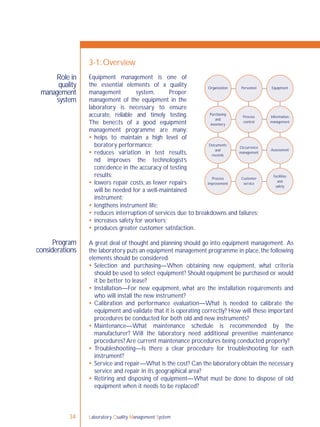
  • 37.
    Laboratory Quality ManagementSystem 35 It is the responsibility of the laboratory director to:  oversee all the equipment management systems in the laboratory;  ensure that all persons who will be using the instruments have been appropriately trained and understand how to both properly operate the instrument and perform all necessary routine maintenance procedures. Equipment management responsibility may be specifically assigned to a technologist in the laboratory. In many laboratories, there is a person who has good skills with equipment maintenance and troubleshooting. Giving this person the role of oversight of all equipment is recommended. Oversight of an equipment management programme includes:  assigning responsibilities for all activities  ensuring that all personnel are trained in operation and maintenance  monitoring the equipment management activities, including - reviewing all equipment records routinely - updating maintenance procedures as necessary - ensuring that all procedures are followed. Note: day-to-day maintenance should be the responsibility of the technical operator. Everyone who uses the equipment should be trained in calibration and daily maintenance. Oversight 3-1: Overview
  • 38.
    Laboratory Quality ManagementSystem36 Selecting equipment 3-2: Selecting and acquiring equipment Acquiring equipment Selecting the best instrument for the laboratory is a very important part of equipment management. Some criteria to consider when selecting laboratory equipment are listed below.  Why and how will the equipment be used? The instrument should be matched against the service the laboratory provides.  What are the performance characteristics of the instrument? Is it sufficiently accurate and reproducible to suit the needs of the testing to be done?  What are the facility requirements, including the requirements for physical space?  Will the cost of the equipment be within the laboratory’s budget?  Will reagents be readily available?  Will reagents be provided free of charge for a limited period of time? If so, for how long?  How easy will it be for staff to operate?  Will instructions be available in a language that is understood?  Is there a retailer for the equipment in the country, with available services?  Does the equipment have a warranty?  Are there any safety issues to consider? If the decisions about purchasing are made outside the laboratory (e.g.by a central purchasing body), the laboratory manager should provide information that will support selecting equipment that will best serve the needs of the laboratory. In areas where there are national programmes for purchasing standard equipment, the laboratories of the country should have some input to decisions. In addition, in areas where donors are likely to provide some of the equipment that is used, laboratory management should have input into the choice of equipment. If this is not possible, management should consider declining equipment if it is inappropriate for laboratory needs. Is it better to purchase or lease equipment? When making this decision, it is a good idea to factor in repair costs.The manufacturer should provide all of the necessary information to operate and maintain equipment.The initial cost of an instrument may seem reasonable, but it may be expensive to repair.Also consider savings that could be negotiated if the laboratory needs more than one piece of equipment. Before purchasing ask if:  wiring diagrams, computer software information, a list of parts needed, and an operator’s manual are provided;  the manufacturer will install the equipment and train staff (covering travel expenses as necessary) as part of the purchase price;
  • 39.
    Laboratory Quality ManagementSystem 37  the warranty includes a trial period to verify that the instrument performs as expected;  the manufacturer’s maintenance can be included in the contract and, if so, whether maintenance is provided on a regular basis. Determine if the laboratory can provide all the necessary physical requirements, such as electricity, water, and space.There must be adequate room to move the equipment into the laboratory; consider door openings and elevator access. Before equipment is installed, verify that all physical requirements (electrical, space, doors, ventilation and water supply) have been met. Other things to consider are:  The vendor’s responsibilities for installation should be confirmed in writing prior to beginning the installation process.  A checklist of the expected performance specifications should be developed,so that performance can be quickly verified as soon as the equipment is installed. Whenever possible, it is best to have the manufacturer install laboratory equipment; this will likely improve the conditions of the warranty, and also may ensure that the installation is done properly and quickly. If equipment is installed by the laboratory:  check that the package contents contain all of the parts;  make a copy of any software that is part of the system;  do not allow the equipment to be used before it is completely installed, performance is verified and testing personnel are trained. 3-2: Selecting and acquiring equipment Installing equipment
  • 40.
    38 Laboratory QualityManagement System After installation Equipment calibration 3-3: Getting equipment ready for service After equipment has been installed, the following details need to be addressed before putting the equipment into service.  Assignresponsibilityforperformingthemaintenanceandoperationprogrammes.  Develop a system for recording the use of parts and supplies (see Chapter 4).  Implement a written plan for calibration, performance verification, and proper operation of the equipment.  Establish a scheduled maintenance programme that includes daily, weekly and monthly maintenance tasks.  Provide training for all operators; only personnel who have been trained specifically to properly use the equipment should be authorized as operators. Designate those authorized to use the equipment and when it is to be used. Follow the manufacturer’s directions carefully when performing the initial calibration of the instrument.It is a good idea to calibrate the instrument with each test run, when first putting it into service. Determine how often the instrument will need to be recalibrated, based on its stability and the manufacturer’s recommendation. It may be advantageous to use calibrators provided by or purchased from the manufacturer. Inventory record Calibration Verification Operating procedures Maintenance program Train all operators
  • 41.
    Laboratory Quality ManagementSystem 39 Function checks Prior to testing patient specimens, it is important to evaluate the performance of new equipment to ensure it is working correctly with respect to accuracy and precision. In addition, test methods using kits or laboratory instruments need to be evaluated for the ability to detect disease (sensitivity, specificity, positive and negative predictive value) and to determine normal and reportable ranges. Verification of manufacturers’ performance claims—Manufacturers provide performance evaluations for testing methods using their kits or instruments, and include the information in the package inserts or operator's manuals. However, laboratories need to verify the manufacturer's performance claims,and demonstrate they can get the same results using the kits or equipment in their laboratory, with their personnel. Some of the steps that should be followed to verify performance include:  testing samples with known values and comparing the results to the expected or certified value;  if equipment is temperature controlled, establishing the stability and uniformity of the temperature. Validation of new equipment and associated techniques—If the equipment and associated techniques are new, validation processes will be important.Validation can be carried out by running samples in parallel using both old and new equipment and methods for a period of time to determine that the expected results can be obtained. These validation procedures should be completely recorded. In order to verify that equipment is working according to the manufacturer’s specifications, it is necessary to monitor instrument parameters by performing periodic function checks.This should be done before using the instrument initially, then with the frequency recommended by the manufacturer. These function checks should also be done following any instrument repairs. Some examples of function checks are daily monitoring of temperatures and checking the accuracy of wavelength calibration. 3-3: Getting equipment ready for service Performance evaluation
  • 42.
    Laboratory Quality ManagementSystem40 Preventive maintenance Maintenance plan Equipment inventory 3-4: Implementing an equipment maintenance programme Preventive maintenance includes measures such as systematic and routine cleaning, adjustment and replacement of equipment parts at scheduled intervals. Manufacturers generally recommend a set of equipment maintenance tasks that should be performed at regular intervals: daily, weekly, monthly or yearly. Following these recommendations will ensure that the equipment performs at maximum efficiency and will increase the lifespan of the equipment.This will also help to prevent:  inaccurate test results due to equipment failure  delays in reporting results  low productivity  large repair costs. A maintenance plan will include preventive maintenance procedures as well as provision for inventory, troubleshooting and repair of equipment. When implementing an equipment maintenance program, some of the initial steps will include:  assigning responsibility for providing oversight;  developing written policies and procedures for maintaining equipment,including routine maintenance plans for each piece of equipment that specify the frequency with which all maintenance tasks should be performed;  developing the format for records, creating logs and forms, and establishing the processes to maintain records;  training staff on the use and maintenance of the equipment, and ensuring that all staff understand their specific responsibilities. It is recommended that a label is attached to the instrument indicating when the next maintenance or service should be performed. The laboratory should keep an inventory log of all equipment in the laboratory. The log should be updated with information on new equipment and include documentation of when old equipment is retired. For each piece of equipment, the equipment inventory log should have a record of:  instrument type, make and model number, and serial number so that any problems can be discussed with the manufacturer;  date the equipment was purchased, and whether it was purchased new, used or reconditioned;  manufacturer/vendor contact information;  presence or absence of documentation, spare parts and maintenance contract;  warranty’s expiration date;  specific inventory number indicating the year of acquisition (this is especially useful for larger laboratories); for example, use the style “YY-number” (04- 001, 04-002, etc.) where “YY-number” equals the last two numbers of the year followed by a number attributed in the year.
  • 43.
    Laboratory Quality ManagementSystem 41 Inventory of spare parts An inventory process must be conducted if the laboratory does not have an existing inventory system for equipment. This could be conveniently organized following a model grid, room by room; for example, conduct an inventory of equipment in the reception area, then the sample collection area, the serology testing area, and the parasitology testing area. During the inventory, the condition of the equipment should be documented as functional, partially functional or nonfunctional. Equipment that is not functioning needs to be evaluated as to whether or not it can be repaired. Nonrepairable equipment should be retired, and work should be scheduled for equipment needing repair. To ensure that the laboratory does not run out of spare parts, an inventory record of those used most frequently should be kept for each piece of equipment. The record should include:  part name and number;  average use of the part, and the minimum to keep on hand;  cost;  date when the part is placed into storage and when it is used (in and out stock log);  quantity of each part remaining in inventory. 3-4: Implementing an equipment maintenance programme
  • 44.
    Laboratory Quality ManagementSystem42 What is the source of the problem? Troubleshooting When problems cannot be corrected 3-5: Troubleshooting,service repair and retiring equipment Problems with equipment may present in many ways.The operator may notice subtle changes such as drift in quality control or calibrator values,or obvious flaws in equipment function. Sometimes, the equipment fails to operate. It is important to teach operators to troubleshoot equipment problems in order to quickly get the equipment functioning and resume testing as rapidly as possible. When an operator observes instrument drift, it is important to repeat the preventive maintenance procedures as a first step to resolve the problem. If this does not work, proceed with troubleshooting processes. Manufacturers frequently provide a flowchart that can help determine the source of problems. Some of the questions to consider are listed below.  Is the problem related to a poor sample? Has the sample been collected and stored properly? Are factors such as turbidity or coagulation affecting instrument performance?  Is there a problem with the reagents? Have they been stored properly, and are they still in date? Have new lot numbers been introduced without updating instrument calibration?  Is there a problem with the water or electrical supply?  Is there a problem with the equipment? Make one change at a time based on symptoms. If the equipment is the problem, review the manufacturer’s instructions to verify that all procedures are being followed correctly. If problems cannot be identified and corrected in-house, attempt to find a way to continue testing until the equipment can be repaired. Some ways to achieve this are as follows.  Arrange to have access to backup instruments. It is often too costly for the laboratory to have its own backup instruments, but sometimes a central stores agency can maintain backup instruments to be shared throughout the local area or country.  Ask the manufacturer to provide a replacement instrument during repairs.  Send the samples to a nearby laboratory for testing. Be sure to notify the appropriate providers that there are problems and that there will probably be delays in completing the testing.
  • 45.
    Laboratory Quality ManagementSystem 43 3-5:Troubleshooting, service, repair and retiring equipment Service and repair Retiring and disposing of equipment Do not use faulty equipment! Seek help from the manufacturer or other technical expert. Place a note on the equipment so all staff are aware that it is not in use. Manufacturers may provide service and repair of equipment that is purchased from them. Be sure to set up a procedure for scheduling service that must be periodically performed by the manufacturer. When instruments need repair, remember that some warranties require that repairs be handled only by the manufacturer. Large facilities sometimes have biomedical service technicians in- house who perform equipment maintenance and repair. Routine service should be scheduled so as not to interrupt the flow of work. It is very important to have a policy and procedure for retiring older laboratory equipment. This will usually occur when it is clear that the instrument is not functioning and is not repairable, or when it is outmoded and should be replaced with new equipment. Once a piece of equipment is fully retired and it has been determined that it has no further use, it should be disposed of in an appropriate manner.This last step is often neglected in laboratories and old equipment accumulates,taking up valuable space and sometimes creating a hazard. When disposing of equipment, salvage any usable parts, particularly if the equipment is being replaced with another similar one.Then consider any potential biohazards and follow all safety disposal procedures.

  • 46.
    Laboratory Quality ManagementSystem44 Developing documents and policies for recordkeeping Recording maintenance information 3-6: Equipment maintenance documentation Equipment documents and records are an essential part of the quality system. The policies and procedures for maintenance should be defined in appropriate documents, and keeping good equipment records will allow for thorough evaluation of any problems that arise (see Chapter 16). Each major piece of equipment will have its own equipment maintenance document. Smaller, commonly used equipment such as centrifuges and pipettes may be managed with an equipment maintenance document or manual that deals with all such equipment in the laboratory.An equipment maintenance document should include:  step-by-step instructions for routine maintenance, including frequency of performance and how to keep records of maintenance;  instructions for carrying out function checks, frequency of performance, and how to record the results;  directions for calibrating the instrument;  guide for troubleshooting;  any required manufacturer’s service and repair;  list of any specific items needed for use and maintenance, such as spare parts. For major equipment,include identification of the specific instrument and perhaps information on its performance. Each piece of equipment should have a dedicated logbook documenting all characteristics and maintenance elements, including:  preventive maintenance activities and schedule;  recording of function checks and calibration;  any maintenance performed by the manufacturer;  full information on any problem that the instrument develops, the subsequent troubleshooting activity and follow-up information regarding resolution of the problem. In recording problems, be sure to record - date problem occurred and when equipment was removed from service; - reason for breakdown or failure; - corrective action taken, including a note about any service provided by the manufacturer; - date returned to use; - any changes to procedure for maintenance or function checks as a result of the problem.
  • 47.
    Laboratory Quality ManagementSystem 45 3-6: Equipment maintenance documentation Some of the tools that are helpful for keeping records of equipment management are:  charts  logs  checklists  graphs  service reports. The logbook should be available for review during the entire life of the equipment.
  • 48.
    Laboratory Quality ManagementSystem46 Summary Key messages 3-7: Summary All laboratories should have a well-organized equipment management programme. The programme should address equipment selection, preventive maintenance, and procedures for troubleshooting and repair. It is essential that good documents and records be maintained.These will include a complete and accurate inventory of all laboratory equipment, documents provided by the manufacturer on operation, maintenance and troubleshooting, and records of all preventive maintenance and repair activities.  A good equipment maintenance programme results in a high level of performance and greater confidence in the reliability of results.  A significant benefit to the laboratory will be fewer interruptions in test performance, lower repair costs and elimination of premature replacement of equipment.  Increased safety for laboratory workers will result from well-maintained equipment.
  • 49.
  • 50.
    Laboratory Quality ManagementSystem48 Role in quality management system Benefits Challenges Considerations 4-1: Overview Purchasing and inventory management is a critical and essential component of the quality management system. Efficient and cost-effective laboratory operations need the uninterrupted availability of reagents, supplies and services.Inability to test,even for a short time, is very disruptive to clinical care, prevention activities and public health programmes. Careful management of inventory helps to prevent waste, which can occur if reagents and supplies are stored improperly, or if reagents become outdated before they can be used. Establishing a purchasing and inventory management programme will ensure that:  supplies and reagents are always available when needed;  high-quality reagents are obtained at an appropriate cost;  reagents and supplies are not lost due to improper storage, or kept and used beyond expiration. Methods for obtaining reagents and supplies vary considerably between laboratories. Some laboratories may purchase directly but, in many countries, a national procurement system is in place with a central stores area that distributes directly to the laboratories.Also, in many places, donors have a major role in the procurement of supplies and reagents. The laboratory system for managing the reagents and supplies must take into account these variables. The challenge of inventory management is balancing the availability of supplies and reagents in stock with their expiration dates.The lifespan of reagents can vary from a few weeks to a number of years. It is important to continuously monitor the expiration dates to make sure needed reagents are always on hand and have not expired. However, it is too costly and wasteful to overstock. Organization Personnel Equipment Purchasing and inventory Process control Information management Occurrence management Assessment Facilities and safety Customer service Process improvement Documents and records
  • 51.
    Laboratory Quality ManagementSystem 49 4-1: Overview Key components Equipment and supplies received or accepted from donors must meet the clients’ needs and the operational needs of the laboratory. Managers may sometimes need to refuse donations, but this should be done in a diplomatic way to ensure future offers are not discouraged. Successful purchasing and inventory management requires that policies and procedures be established for managing all critical materials and services.Some of the key components to address are:  vendor/manufacturer qualifications;  purchase agreements;  receiving, inspecting, testing, storing, and handling of materials—all purchased material should be inspected and appropriately tested to ensure that specifications are met, and policies should be established for storing and handling materials as they are delivered to the laboratory;  tracking materials to individual patients—the management system must allow for tracking materials to individual patients; that is, the laboratory should be able to identify specific test materials used for performing tests on any given day, so that if there is a problem with a patient result, the laboratory will know what reagents were used;  assessing and maintaining inventory;  controlling expiration periods;  dispatching supplies to satellite laboratories.
  • 52.
    Laboratory Quality ManagementSystem50 Selecting vendors Considerations 4-2: Purchasing It is very important to set expectations and build and maintain relationships with providers of materials and services. Laboratories that purchase directly should look very carefully at vendors’ and manufacturers’ qualifications, examining such things as specifications and methods of transport. Laboratories that receive reagents and supplies from a central stores area managed by their government should interact with those managing the central stores area to accomplish these same objectives. At the outset, the laboratory should:  define criteria for supplies or materials to be purchased;  look for the best price, taking into account the qualifications and credibility of the supplier;  consider the advantages and disadvantages of purchasing “brand name” compared to “generic” products (e.g. is it better to purchase specific pipette tips for a specific pipette, or is it just as effective to use generic pipette tips that cost less?). It may be useful to seek information from other laboratories when considering quality, reliability of supply, and cost. It is equally important to evaluate vendors after purchase. Consider such factors as whether the vendor delivered the specified goods, or whether the central procurement body assured that user specifications were met. When setting up procedures for purchasing,there are a number of considerations.  Understand any local or national government requirements that need to be accommodated in the contracts.  Negotiate for the best price without undermining quality.  Carefully review all contracts to make sure the laboratory’s requirements are being met. Contracts should clearly address payment mechanisms and provisions to assure reliable availability and delivery of reagents and supplies. Ask if there are penalties for ending a contract.  Determine how payments will be made,and how the vendor will assure reliable availability and delivery of supplies and reagents.
  • 53.
    Laboratory Quality ManagementSystem 51 Implementation steps Analyze needs 4-3: Implementing an inventory management programme In establishing an inventory control programme there are a number of factors to consider.A system should be designed so that the laboratory can closely monitor the condition of all supplies and reagents, know what quantities are available and be alerted when there is a need to reorder. The following are important steps for implementation.  Assign responsibility—without this, nothing may get done.  Analyze the needs of the laboratory.  Establish the minimum stock needed for an appropriate time period.  Develop needed forms and logs.  Establish a system for receiving, inspecting and storing supplies.  Maintain an inventory system in all storage areas, and for all reagents and supplies used in the laboratory. A laboratory needs a process for analyzing its needs for materials and for determining how many kits for a particular test should be on hand. The laboratory should make a list of all the tests it performs and identify all the supplies and reagents that are needed for each test. It is wise to use all available information to help estimate the usage of supplies and reagents for the period of time between ordering new materials.The information necessary for analyzing needs includes:  a complete description of each item used;  the package count or number of units in which the item is supplied (e.g. a kit can include 12 tests or 100 tests, and pipette tips can be packaged as 100 per box or 1000 per box);  approximate usage per month (quantification, e.g. 6 boxes used per month);  the priority or importance level the item has in doing the work of the laboratory (e.g. used every day or only once a month?);  length of time required to receive a delivery (will the order take a day, week or month to arrive?);  storage space and conditions (will a bulk order use too much storage space? Does the item require storage in a refrigerator?).
  • 54.
    Laboratory Quality ManagementSystem52 Why? When? How? 4-4: Quantification How can a laboratory determine how much of any particular item to order? Quantification is a very important process that can help calculate how much is required of any particular item for a given period of time,and it is an essential part of a successful inventory management programme.Accurate quantification will:  ensure essential supplies will be available when needed  prevent overstocking, which can lead to wastage of expensive materials. Quantification provides information for:  estimating annual budget requirements;  allowing for better planning;  making decisions and monitoring performance of the inventory management system. Quantification is performed when making annual plans for the laboratory and this planning will take into account the usual usage of supplies and reagents. There are times when it is important to consider how new demands on the laboratory will create a need for greater testing volume.This often occurs when new health programmes are being implemented,and in preparation for epidemics, either identified or potential. The two frequently used methods are consumption-based quantification and morbidity-based quantification. Consumption-based quantification Laboratories most frequently use the consumption-based method, drawing on their experience over time.This method is based on actual consumption,so there are a number of factors to consider. For example, to determine the actual usage, it is important to also estimate how much wastage has occurred and how many expired or spoiled reagents and supplies have been discarded.An example of this type of monitoring is shown below. Immersion oil Collection containers Slide 0 20 40 60 80 100 4th3rd2nd1st s Quarter
  • 55.
    Laboratory Quality ManagementSystem 53 4-4: Quantification For planning, it is a good idea to consider whether any supplies or reagents have been out of stock for more than 15 days during any time of the year.This may mean that supplies are not ordered in sufficient quantities, or that the wastage or expiry is higher than predicted. Morbidity-based quantification In using the morbidity-based quantification method (shown below),the laboratory must take into account the actual number of episodes, illnesses and health problems that require laboratory testing. In other words, the laboratory needs to estimate an expected frequency of the disease in question—how many cases will occur per unit of population (per 1000, per 10 000, etc.)? Then, considering how many people the laboratory serves,it can estimate the total number of cases the community might reasonably expect to observe. Using standard guidelines for diagnosis and treatment, and considering how well health care providers adhere to these guidelines, can help to estimate how many laboratory tests will be performed. A good morbidity-based quantification method is more accurate than the quantification by consumption method, but it depends on accurate data. Diarrhoea Tuberculosis Influenza 0 40 20 80 60 120 100 160 180 140 4th3rd2nd1st Quarter
  • 56.
    Laboratory Quality ManagementSystem54 Developing forms and logs Logbook 4-5: Forms and logs Developing an appropriate record-keeping system is an important step for inventory management. Good tools for managing the stock include:  standardized forms  card systems  log books. For any system that is used, the following information should be recorded:  date reagent or set of supplies are received;  lot numbers for all supplies, reagents and kits;  pass or fail acceptance criteria;  date the lot number or box of supplies was put into service or,if not usable,the date and method of disposition. The stock logbook or card system will provide a way to keep track of all supplies and reagents that are on hand at any given time. In addition to information mentioned above, it is a good idea to record:  name and signature of the person receiving the materials  date of receipt  expiration date  quantity of the material received  minimum stock that should be on hand  current stock balance. Additional information to record could include:  shelf number or name  destination (e.g. to –20 o C freezer to media room). It is a good idea to keep the stock logbook in the storage area.
  • 57.
    Laboratory Quality ManagementSystem 55 Receiving and inspecting supplies Storage Organization of shelves 4-6: Receipt and storage of supplies A system should be established so when supplies are received, personnel know what is expected.All supplies and reagents should be inspected as they arrive in the laboratory to be sure that they are in good condition and to verify that what is received is what was ordered. In addition, the person receiving supplies should:  sign their name verifying receipt of goods  date each item received  note expiration date  store new shipment behind existing shipment  create or update logbook records. Storage of reagents and supplies is a very important part of inventory control. Good practices to keep in mind are:  Keep the storeroom clean, organized and locked to protect the inventory.  Make sure storage areas are well ventilated and protected from direct sunlight.  Ensure storage conditions are in accordance with the manufacturer’s instructions, paying particular attention to any temperature requirements or other specifications, such as safety requirements.  Use good shelving strong enough to support items,and organize items carefully on the shelves to prevent movement shifts or falls. Shelves should be attached firmly to support walls to prevent tipping.  Ensure items are accessible to staff. Sturdy step stools should be available for reaching higher shelves and heavier items should be stored on lower shelves; laboratory staff should not be required to lift heavy items.  When storing,put the new shipment behind existing materials that are already in the laboratory. Organize the reagents and materials so that the older materials get used first (i.e. items with the first expiry dates are the first used). Labelling shelves is a useful tool for storing inventory and will help to systemize and organize storage space.  Assign a number (or name) to different areas of the shelves.  Record in the logbook what shelves are used for which reagents and supplies.
  • 58.
    Laboratory Quality ManagementSystem56 4-6: Receipt and storage of supplies Labelling reagents This system helps to avoid “losing” a product, and will save staff time when searching for a product. Even someone who is not familiar with the storeroom can find a product if this system is in place. It is also useful to number cold rooms, refrigerators and freezers for the same purpose.An example of this type of system is shown below. Establishing a system for labelling reagents will be very helpful. It is important to label reagents with the date they are opened and to make sure the expiration date is clearly visible. 1 1 3 2 2 4 4 5 2 6 6 7 8 9 10 11 12 2
  • 59.
    Laboratory Quality ManagementSystem 57 Continuous monitoring of inventory Computerized inventory management advantages and drawbacks 4-7: Monitoring inventory Procedures should be developed and put in place for continuous monitoring of the inventory.To ensure this is done effectively:  assign the responsibility for this task to an appropriate person or persons— someone must be in charge;  be sure that all supplies and reagents in the laboratory are covered by the sys- tem and maintain inventory management in all of the storage areas;  conduct weekly physical counts of reagents and supplies in order to check the system, and as a part of the monitoring process;  make sure that all records relevant to inventory management are updated and maintained. In many laboratories,a simple computerized system can be set up for management of inventory.There are many advantages to using a computer.A computer will:  keep track of the exact number of supplies and reagents on hand, as it can be updated daily;  allow for good management of expiration dates—the system can be set up to alert when lot numbers are near the expiration date, and therefore use of resources can be optimized;  generate statistics that will help when planning and making purchases;  help manage the process for distributing reagents to satellite laboratories;  ease the burden of inventory management. Some drawbacks to setting up a computerized system are:  an on-site computer is needed and it could be expensive to purchase  staff using the system will need to be trained.
  • 60.
    Laboratory Quality ManagementSystem58 Summary Key messages 4-8: Summary A well-managed laboratory will have a system for inventory maintenance and purchasing. The system will require planning and monitoring to ensure that appropriate quantities of supplies and reagents are always available,and to prevent wastage. In implementing an inventory management system, the laboratory must assign responsibility for the programme, analyze the needs of the laboratory and establish the minimum stock needed for an appropriate time period.Appropriate logs and forms will be needed, as well as a procedure for receiving, inspecting and storing supplies. The laboratory will need to maintain an inventory system for all reagents and supplies used in the laboratory; this system must include all areas where reagents and supplies are stored. Properly managing inventory will:  increase the efficiency and effectiveness of the laboratory, because it will provide an uninterrupted flow of needed materials;  ensure products are available when they are needed;  ensure that patient and clinical needs are met.
  • 61.
  • 62.
    Laboratory Quality ManagementSystem60 Role in quality management system Sample vs specimen Sample management components Importance of good management The International Organization for Standardization (ISO) and Clinical and Laboratory Standards Institute (CLSI) define a sample as “one or more parts taken from a system and intended to provide information on the system” (ISO 15189:2007).The term “specimen” is very commonly used in the laboratory to indicate a sample taken from the human body,but the terminology used throughout ISO documents is “primary sample”, or just “sample”. In this handbook, the terms “sample” and “specimen” should be considered interchangeable. It is useful to note that in some of the existing transport regulations, the term “specimen” continues to be used. Proper management of samples is critical to the accuracy and reliability of testing, and therefore to the confidence in laboratory diagnosis. Laboratory results influence therapeutic decisions and can have significant impacts on patient care and outcomes. It is important to provide accurate laboratory results in order to ensure good treatment. Inaccuracies in testing can impact length of hospital stays, as well as hospital and laboratory costs. Inaccuracies can also affect laboratory efficiency, leading to repeat testing with resultant waste of personnel time, supplies and reagents. Written policies for sample management must be established and reflected in the laboratory handbook. Components to be addressed include:  information needed on requisitions or forms;  handling urgent requests;  collection, labelling, preservation and transport;  safety practices (leaking or broken containers, contaminated forms, other biohazards);  evaluating, processing and tracking samples;  storage, retention and disposal. 5-1: Overview Sample management is a part of process control, one of the essentials of a quality management system. The quality of the work a laboratory produces is only as good as the quality of the samples it uses for testing. The laboratory must be proactive in ensuring that the samples it receives meet all of the requirements for producing accurate test results. Organization Personnel Equipment Purchasing and inventory Process control Information management Occurrence management Assessment Facilities and safety Customer service Process improvement Documents and records
  • 63.
    Laboratory Quality ManagementSystem 61 Purpose and distribution Content 5-2:The laboratory handbook To ensure that all samples are managed properly and that persons collecting samples have the needed information,the laboratory should develop a laboratory handbook.This handbook should be made available at all sample collection areas, including those that are distant from the laboratory. All laboratory staff should also be familiar with the information in the handbook, and should be able to answer questions about the information included. The laboratory handbook is an important laboratory document. It must be kept up to date and be referenced in the laboratory’s quality manual. Important information that should be included in the laboratory handbook:  contact names and telephone numbers of key personnel;  name and address of the laboratory;  hours of operation of the laboratory;  list of tests that can be ordered;  detailed information on sample collection requirements;  sample transport requirements, if any;  expected turnaround times;  description of how urgent requests are handled—this should include a list of what kinds of tests are done on an urgent basis, what are the expected turnaround times, and how to order these tests. The laboratory should periodically provide training sessions to health care and laboratory personnel who are responsible for the collection of samples.
  • 64.
    Laboratory Quality ManagementSystem62 The laboratory’s responsibilites Test requisition Sample collection requirements 5-3: Collection and preservation The collection of appropriate and optimum samples is the responsibility of the laboratory, even though the actual collection process is often carried out by persons who are not part of the laboratory staff.The sample may be collected at the bedside by a nurse if the patient is being managed in a hospital.The health care provider may collect a sample in a clinic setting. The laboratory can help to ensure good samples by providing collection information to health care personnel at the collection site,making sure that appropriate containers and collection supplies are available, defining a good labelling system and checking all samples carefully when they arrive in the laboratory. The first step in the process of obtaining the sample is the request for testing.The laboratory must make available a test request form that specifies all the information that will be needed for proper handling and reporting. Essential information for the test request form includes:  patient identification;  tests requested;  time and date of the sample collection;  source of the sample, when appropriate;  clinical data, when indicated;  contact information for the health care provider requesting the test. Collection of samples in the field for epidemiological studies should be accompanied by a form that includes the patient’s name, a unique identification number, demographic information and the patient’s health status.The additional information is necessary to assist in identifying the source of an infection and finding potential contacts. Sample collection and preservation will vary, depending on the test and the type of sample to be collected. The laboratory must carefully define a sample collection process for all tests it performs.The following should be considered when preparing instructions.  Patient preparation—Some tests require that the patient be fasting.There may also be special timing issues for tests such as blood glucose,drug levels and hormone tests.
  • 65.
    Laboratory Quality ManagementSystem 63 5-3: Collection and preservation Sample labelling Outcomes of collection errors  Patient identification—The person collecting the sample must accurately identify the patient.This might be done by questioning the patient,by questioning an accompanying family member, or by the use of an identifying wrist band or other device.  Type of sample required—Blood tests might require serum,plasma or whole blood.Other tests might require urine or saliva.Microbiology testing deals with a variety of sample types, so specific information as to what is required for the test is needed.  Type of container—The container for the sample is often very important, as it will affect volume and any needed additives such as anticoagulants and preservatives. If the container does not control volume, for example as with Vacutainer® tubes, this will need to be clearly specified. Some microbiology samples will require specific transport media to preserve microorganisms.  Sample labelling—All requirements for labelling of the sample at the time of collection will need to be explained in detail in the instructions for collection.  Special handling—Some samples may require special handling, such as immediate refrigeration, protection from light or prompt delivery to the laboratory.Any important safety precautions should be explained. Patient samples are sometimes collected by the patient themselves; for example, faecal parasitological samples. It is important that the laboratories have set protocols to ensure that appropriate collection kits with instructions for collection, safety precautions and labelling are available for their patients. It is suggested that instructions for the patients be in the languages for the community the laboratory is serving, or presented as simple, easy-to-understand graphics. Each sample should be clearly labelled with:  the patient’s first and last name;  a unique identification number—this might be a hospital number or a number assigned by the laboratory;  the test that has been requested;  the time and date of collection;  the initials of the person collecting the sample. Proper sample collection is an important element for good laboratory practice. Improper collection of samples can lead to poor outcomes,such as:  delays in reporting test results  unnecessary redraws/retests  decreased customer satisfaction  increased costs  incorrect diagnosis or treatment  injury  death.
  • 66.
    Laboratory Quality ManagementSystem64 Verification of quality Rejection of samples 5-4: Sample processing Once a sample enters the laboratory, there are a number of steps needed prior to testing.  Verify the sample is properly labelled, adequate in quantity, in good condition and appropriate for the test requested.The test request must be complete and include all necessary information.  Record sample information into a register or log.  Enforce procedures for handling suboptimum samples, including sample rejection when necessary. The laboratory should establish rejection criteria and follow them closely. It is sometimes difficult to reject a sample, but remember that a poor sample will not allow for accurate results. It is the responsibility of the laboratory to enforce its policies on sample rejection so that patient care is not compromised. Management should regularly review the number of rejected samples and reasons for rejections, conduct training on sample collection, and revise written procedures for sample management as needed. The following are examples of samples that should be rejected:  unlabelled sample;  broken or leaking tube/container;  insufficient patient information;  sample label and patient name on the test request form do not match;  haemolysed sample (depending on test requested);  nonfasting samples, for tests that require fasting;  sample collected in wrong tube/container (e.g. using the wrong preservative or a nonsterile container);  inadequate volume for the quantity of preservative;  insufficient quantity for the test requested;  prolonged transport time or other poor handling during transport. Record the reason for rejection in the logbook and include all pertinent information. When rejecting a sample, it is important to:  promptly inform the authorized person that the sample is unsuitable for testing;  request another sample to be collected following procedures outlined in the laboratory handbook;  retain the rejected sample pending a final decision regarding disposition. In some circumstances, and after consultation with the requester, it may be necessary to proceed with the testing of a sample that is not optimal.
  • 67.
    Laboratory Quality ManagementSystem 65 5-4: Sample processing Register or log Tracking system Sample handling The laboratory should keep a register (log) of all incoming samples. A master register may be kept, or each specialty laboratory may keep its own sample register. Assign the sample a laboratory identification number—write the number on the sample and the requisition form. If computers are used for reports, enter the information into the computer. The register should include:  date and time of collection  date and time the sample was received in the laboratory  sample type  patient name and demographics, as required  laboratory assigned identification (e.g. number 276_01_06_2009)  tests to be performed. The laboratory needs a system to allow for tracking a sample throughout the laboratory from the time it is received until results are reported. This can be done manually by careful keeping of records as follows.  Confirm receipt of samples and include date and time.  Label samples appropriately and keep with the test requisition until laboratory identification is assigned.  Track aliquots—they should be traceable to the original sample. If computers are available, maintain a database for tracking. The following information about each sample should be entered into the database:  identification number  patient information  collection date and time  type of sample (e.g. urine, throat, cerebrospinal fluid for culture)  tests to be performed  name of ordering physician (or other health care provider)  location of patient (e.g. ward, clinic, outpatient)  diagnostic test results  time and date results are reported. Handle all samples as if they are infectious.

  • 68.
    Laboratory Quality ManagementSystem66 Sample storage Sample retention Sample disposal Sample referral 5-5: Sample storage, retention and disposal Written policies should be developed that include:  description of what samples should be stored;  retention time;  location (consider ease of access);  conditions for storage, such as atmospheric and temperature requirements;  system for storage organization—one method is to store samples by day of receipt or accession number. Set a laboratory policy for retention of each type of sample.Some samples can be quickly discarded and others may need to be retained for longer periods.Monitor stored samples and do not keep for longer than necessary, as refrigerator and freezer space may be limited. Sample freeze/thaw cycles must be monitored, as samples may deteriorate under these conditions. Planning is required for samples that may need long-term storage.An organized, accessible system using computer tracking would be useful for these samples. The inventory of stored samples should be reviewed at specified intervals to determine when they should be discarded. When referring samples to other laboratories for testing:  Obtain a laboratory handbook with detailed procedures from each laboratory.  Ensure the sample is labelled correctly, in the correct container, accompanied by a requisition form that specifies the required test(s) and includes the sending laboratory’s contact information.  Carefully monitor samples that are referred: - keep a record of all tests and samples referred, date of referral and name of person referring the test; - record and report results received for each referred sample; - monitor turnaround times and record any problems encountered. The laboratory is responsible for ensuring that disposal of all laboratory waste is handled in a safe manner.To ensure proper disposal of patient samples:  Develop a policy for sample disposal; apply local as well as country regulations for disposal of medical waste.  Establish and follow procedures to disinfect samples prior to disposal.
  • 69.
    Laboratory Quality ManagementSystem 67 Need for transport Safety requirements Regulations Classification 5-6: Sample transport Frequently,samples are collected outside the laboratory and must be transported for subsequent processing and testing. Transport may be for a short distance, but sometimes a distant clinic or collection site requires the use of vehicles or aeroplanes. In addition, it may be necessary for the laboratory to ship samples to referral laboratories. In all cases, transport must be managed carefully in order to maintain integrity of the sample, giving attention to temperature, preservation needs, special transport containers and time limitations. It is also important to ensure the safety of those handling the material before,during and after transport. Laboratories that mail or transport samples by air, sea, rail or road between local, regional and reference laboratories, or between laboratories in other countries, must adhere to a number of regulations.These regulations are designed to deal with transportation accidents and spills, reduce biohazards and keep samples intact for testing. Regulations for transporting samples come from several sources, including:  national transport regulations;  International Civil Aviation Organization (ICAO), as conveyed by the International Air Transport Association;  rail and road traffic agencies;  postal services. Private courier companies may have their own requirements. Compliance with industry standards and regulations is mandatory. Heavy fines may be imposed on personnel who violate these regulations.At risk are the safety of courier, carrier and laboratory personnel, as well as passengers. The United Nations committee of experts, consisting of voting representatives from over 30 countries and nonvoting advisers from various organizations, makes recommendations for the transport of dangerous goods.Many countries adopt the United Nations regulations in their entirety to stand as their national dangerous goods regulations. Some countries apply variations. National authorities should provide details of their own national requirements. Sample transport requirements are based on the category of samples being transported. Infectious substances are classified as Category A or Category B. There is no direct relationship between Risk Groups and Categories A and B. Category A: Infectious substances capable of causing permanent disability or life-threatening or fatal disease to humans or animals.
  • 70.
    Laboratory Quality ManagementSystem68 5-6: Sample transport Packaging requirements These are assigned the following proper shipping name and UN number:  Infectious substance affecting humans, UN 2814.  Infectious substance affecting animals only, UN 2900. Category B: Infectious substances that do not meet the criteria for inclusion in Category A.They are assigned the proper shipping name Biological substance, Category B, and UN number UN 3373. Medical or clinical wastes that contain infectious substances also need to be classified as Category A or B, depending on the infectious material and whether it is present in the culture. Exemptions: The United Nations Model Regulations for the Transport of Infectious Substances includes a list of exemptions, which are samples that have a minimal likelihood that pathogens are present. They do not have the same requirements for packaging and shipping as Categories A and B. All three categories of samples have specific packaging instructions and labelling requirements depending on their classification.All potentially hazardous material requires triple packaging.  The primary container is a tube or vial containing the sample; it is made of glass, metal or plastic. It must have a leak-proof seal; if necessary it can be wrapped with waterproof tape. The tube or vial must be labelled with a permanent marker.  The secondary container is a watertight polyethylene box intended to protect the primary container. It is supplied with cardboard or bubble-wrap, or a vial holder in which several primary containers can be placed in order to protect them.Absorbent material (gauze, absorbent paper) must be added in a sufficient quantity to absorb the fluid completely in case of breakage.  The outer container is a strengthened cardboard box used to protect the secondary container. Both the secondary and outer containers are reusable as long as they are intact, but old labels must be removed. There is specific packaging for samples requiring shipment on dry ice.
  • 71.
    Laboratory Quality ManagementSystem 69 Ensure that all regulations and requirements are met when transporting samples; be aware of any national requirements that apply to samples transported by hospital or laboratory vehicles. All personnel who package samples or who drive transport vehicles should be trained in the proper procedures for safety and good maintenance of samples. If ICAO regulations must be met, staff must have specific training in packaging of dangerous goods. When transporting locally, whether by ambulance, or by clinic or laboratory staff, it is important to maintain sample integrity. Ensure that temperatures are controlled, using ice boxes or air-conditioning, set an acceptable transport time and monitor compliance. Managing sample transport 5-6: Sample transport
  • 72.
    Laboratory Quality ManagementSystem70 5-7: Summary A laboratory handbook describing sample collection and providing testing information must be available to everyone who needs this information. It is important to have a system for tracking samples as they move through the laboratory. Establish and implement a policy for sample storage and sample disposal. Maintain sample integrity and assure that all regulations and requirements are met. It may be useful to appoint someone with oversight responsibilities for sample management.  The laboratory must have good samples in order to ensure accuracy and reliability of testing and confidence in results.  Sample management directly affects patient care and outcome. Summary Key messages
  • 73.
  • 74.
    Laboratory Quality ManagementSystem72 Role in quality management system What is QC? 6-1: Introduction QC is the part of quality management focused on fulfilling quality requirements (ISO 9000:2000 [3.2.10]). Simply put, it is examining “control” materials of known substances along with patient samples to monitor the accuracy and precision of the complete analytic process. QC is required for accreditation purposes. In 1981, the World Health Organization (WHO) used the term "internal quality control" (IQC), which it defined as “a set of procedures for continuously assessing laboratory work and the emergent results”.The terms QC and IQC are sometimes used interchangeably; cultural setting and country may influence preferences for these terms. In the past few years, "internal quality control' has become confusing in some settings because of the different meanings that have been associated with the term. Some manufacturers of test kits for qualitative tests have integrated "built-in" controls in the design of their kits,which they sometimes refer to as internal controls. Other manufacturers include their own control materials with the kits they sell and they refer to these as "internal controls", meaning that the materials are meant specifically for that manufacturer’s kit. Finally, some people refer to any quality control materials that are used in conjunction with test runs as IQC, as in the 1981 WHO definition. 72 Organization Personnel Equipment Purchasing and inventory Process control Information management Occurrence management Assessment Facilities and safety Customer service Process improvement Documents and records Process control is an essential element of the quality management system, and refers to control of the activities employed in the handling of samples and examination processes in order to ensure accurate and reliable testing. Sample management, discussed in Chapter 5, and all quality control (QC) processes are a part of process control. QC monitors activities related to the examination (analytic) phase of testing. The goal of QC is to detect, evaluate, nd correct errors due to test system failure, environmental conditions or operator performance, before patient results are reported.
  • 75.
    Laboratory Quality ManagementSystem 73 6-1: Introduction QC for varying methods To avoid confusion, the term "quality control" will be used here to mean use of control materials to monitor the accuracy and precision of all the processes associated with the examination (analytic) phase of testing. Quality control processes vary,depending on whether the laboratory examinations use methods that produce quantitative, qualitative or semiquantitative results. These examinations differ in the following ways. Quantitative examinations measure the quantity of an analyte present in the sample, and measurements need to be accurate and precise.The measurement produces a numeric value as an end-point, expressed in a particular unit of measurement. For example, the result of a blood glucose test might be reported as 5 mg/dL. Qualitative examinations are those that measure the presence or absence of a substance, or evaluate cellular characteristics such as morphology.The results are not expressed in numerical terms, but in qualitative terms such as “positive” or “negative”;“reactive” or “nonreactive”;“normal” or “abnormal”; and “growth” or “no growth”. Examples of qualitative examinations include microscopic examinations, serologic procedures for presence or absence of antigens and antibodies, and many microbiological procedures. Semiquantitative examinations are similar to qualitative examinations,in that the results are not expressed in quantitative terms.The difference is that results of these tests are expressed as an estimate of how much of the measured substance is present.Results might be expressed in terms such as“trace amount”, “moderate amount”, or “1+, 2+, or 3+”. Examples are urine dipsticks, tablet tests for ketones and some serologic agglutination procedures. In the case of other serologic testing,the result is often expressed as a titre—again involving a number but providing an estimate, rather than an exact amount of the quantity present. Some microscopic examinations are considered semiquantitative because results are reported as estimates of the number of cells seen per low-power field or high-power field. For example, a urine microscopic examination might report 0–5 red blood cells seen per high-power field. Because QC processes differ for these various types of examinations, the presentations for QC will be divided into two chapters. Chapter 7 will address QC for quantitative examinations, and Chapter 8 will address QC for qualitative and semiquantitative examinations.
  • 76.
    Laboratory Quality ManagementSystem74 6-1: Introduction Summary Regardless of the type of examination that is performed, steps for implementing and maintaining a QC programme include:  establishing written policies and procedures, including corrective actions  training all laboratory staff  ensuring complete documentation  reviewing quality control data. These responsibilities will be described in more detail in Chapters 7 and 8.  QC is part of the quality management system and is used to monitor the examination (analytic) phase of testing.  The goal of QC is to detect, evaluate and correct errors due to test system failure, environmental conditions, or operator performance, before patient results are reported.  Different QC processes are applied to monitor quantitative, qualitative and semiquantitative tests. Elements of a QC programme
  • 77.
    7. Process control— qualitycontrol for quantitative tests
  • 78.
    Laboratory Quality ManagementSystem76 Role in quality management system Overview of the process Implementation process 7-1: Overview Quantitative tests measure the quantity of a substance in a sample, yielding a numeric result. For example, the quantitative test for blood glucose can give a result of 5 mg/dL. Since quantitative tests have numeric values, statistical tests can be applied to the results of QC material to differentiate between test runs that are “in control” and “out of control”.This is done by calculating acceptable limits for control material, then testing the control with the patient’s samples to see if it falls within established limits. As a part of the quality management system, the laboratory must establish a QC programme for all quantitative tests. Evaluating each test run in this way allows the laboratory to determine if patient results are accurate and reliable. The steps for implementing a QC programme are:  establish policies and procedures  assign responsibility for monitoring and reviewing  train all staff in how to properly follow policies and procedures  select good QC material  establish control ranges for the selected material  develop graphs to plot control values—these are called Levey–Jennings charts  establish a system for monitoring control values  take immediate corrective action if needed  maintain records of QC results and any corrective actions taken. Organization Personnel Equipment Purchasing and inventory Process control Information management Occurrence management Assessment Facilities and safety Customer service Process improvement Documents and records Quality control (QC) is a component of process control, and is an essential element of the quality management system. It monitors the processes related to the examination phase of testing and allows for detecting errors in the testing system.These errors may be due to test system failure, adverse environmental conditions or operator performance. QC gives the laboratory confidence that test results are accurate and reliable before patient results are reported. This chapter explains how quality control methods are applied to quantitative laboratory examinations.
  • 79.
    Laboratory Quality ManagementSystem 77 Differentiating controls and calibrators Characteristics of control materials Types and sources of control material Defining control materials 7-2: Control materials Controls are substances that contain an established amount of the substance being tested—the analyte. Controls are tested at the same time and in the same way as patient samples.The purpose of the control is to validate the reliability of the test system and evaluate the operator’s performance and environmental conditions that might impact results. It is important not to confuse calibrators and control materials. Calibrators are solutions with a specified defined concentration that are used to set or calibrate an instrument, kit, or system before testing is begun. Calibrators are often provided by the manufacturer of an instrument.They should not be used as controls since they are used to set the instrument. Calibrators are sometimes called standards,but the term calibrator is preferred.They usually do not have the same consistency as patients’ samples. It is critical to select the appropriate control materials. Some important characteristics to consider when making the selection are:  Controls must be appropriate for the targeted diagnostic test—the substance being measured in the test must be present in the control in a measurable form.  The amount of the analyte present in the controls should be close to the medical decision points of the test; this means that controls should check both low values and high values.  Controls should have the same matrix as patient samples; this usually means that the controls are serum based, but they may also be based on plasma, urine or other materials. Because it is more efficient to have controls that last for some months, it is best to obtain control materials in large quantities. Control materials are available in a variety of forms.They may be frozen, freeze- dried or chemically preserved.The freeze-dried or lyophilized materials must be reconstituted, requiring great care in pipetting in order to ensure the correct concentration of the analyte. Control materials may be purchased, obtained from a central or reference laboratory, or made in-house by pooling sera from different patients. Purchased controls may be either assayed or unassayed.Assayed controls have a predetermined target value, established by the manufacturer.When using assayed controls, the laboratory must verify the value using its own methods. Assayed controls are more expensive to purchase than unassayed controls. When using either unassayed or“in-house” controls,the laboratory must establish the target value of the analyte.
  • 80.
    Laboratory Quality ManagementSystem78 7-2: Control materials Choosing controls Preparing and storing control material The use of in-house controls requires resources to perform validation and testing steps.An advantage is that the laboratory can produce very large volumes with exact specifications. Remember that QC materials are usually serum based. Universal precautions should be used when handling. When choosing controls for a particular method,select values that cover medical decision points, such as one with a normal value, and one that is either high or low, but in the medically significant range. Controls are usually available in "high", "normal" and "low" ranges. Shown in the graphic are normal, abnormal high and low, and critical high and low ranges. For some assays, it may be important to include controls with values near the low end of detection. When preparing and storing QC materials, it is important to carefully adhere to the manufacturer’s instructions for reconstituting and storage. If in-house control material is used, freeze aliquots and place in the freezer so that a small amount can be thawed and used daily.Do not thaw and refreeze control material.Monitor and maintain freezer temperatures to avoid degradation of the analyte in any frozen control material. Use a pipette to deliver the exact amount of required diluent to lyophilized controls that must be reconstituted. ?? PATIENT CONTROLS Critical Critical Abnormal Critical high and low range Abnormal high and low ranges Normal range Abnormal Normal CONTROL CONTROL CONTROL
  • 81.
    Laboratory Quality ManagementSystem 79 Characteristics of repeated measures Assaying control over time 7-3: Establishing the value range for the control material Once the appropriate control materials are purchased or prepared, the next step is to determine the range of acceptable values for the control material.This will be used to let the laboratory know if the test run is “in control” or if the control values are not reading properly—“out of control”.This is done by assaying the control material repeatedly over time.At least 20 data points must be collected over a 20–30-day period. When collecting this data, be sure to include any procedural variation that occurs in the daily runs; for example, if different testing personnel normally do the analysis, all of them should collect part of the data. Once the data is collected, the laboratory will need to calculate the mean and standard deviation of the results. A characteristic of repeated measurements is that there is a degree of variation.Variation may be due to operator technique, environmental conditions or the performance characteristics of an instrument. Some variation is normal, even when all of the factors listed above are controlled. The standard deviation gives a measure of the variation.This process is illustrated below. One of the goals of a QC programme is to differentiate between normal variation and errors. A few theoretical concepts are important because they are used to establish the normal variability of the test system. QC materials are run to quantify the variability and establish a normal range, and to decrease the risk of error. The variability of repeated measurements will be distributed around a central point or location. This characteristic of repeated measurements is known as central tendency. Obtain control material Run each control 20 times over 30 days Calculate mean and + 1, 2, 3 standard deviations 3 SD 2 SD 1 SD Mean 1 SD 2 SD 3 SD
  • 82.
    Laboratory Quality ManagementSystem80 7-3: Establishing the value range for the control material Statistical notations Mean Before calculating QC ranges Normal distribution The three measures of central tendency are:  Mode—the number that occurs most frequently.  Median—the central point of the values when they are arranged in numerical sequence.  Mean—the arithmetic average of results.The mean is the most commonly used measure of central tendency used in laboratory QC. Statistical notations are symbols used in mathematical formulas to calculate statistical measures. For this chapter, the symbols that are important to know are:  the sum of  number of data points (results or observations) X1 individual result X1 – Xn data point 1–n where n is the last result X the symbol for the mean  the square root of the data. The formula for the mean is: X = X1 + X2 + X 3 ... Xn N As an example of how to calculate a mean,consider enzyme-linked immunosorbent assay (ELISA) testing.The method is to gather data as ratios, add the values and divide by the number of measurements. The purpose of obtaining 20 data points by running the QC sample is to quantify normal variation and establish ranges for QC samples. Use the results of these measurements to establish QC ranges for testing. If one or two data points appear to be too high or low for the set of data, they should not be included when calculating QC ranges.They are called “outliers”.  If there are more than 2 outliers in the 20 data points, there is a problem with the data and it should not be used.  Identify and resolve the problem and repeat the data collection. If many measurements are taken,and the results are plotted on a graph,the values form a bell-shaped curve as the results vary around the mean. This is called a normal distribution (also termed Gaussian distribution).
  • 83.
    Laboratory Quality ManagementSystem 81 7-3: Establishing the value range for the control material Accuracy and precision Target illustration The distribution can be seen if data points are plotted on the x-axis and the frequency with which they occur on the y-axis. The normal curve shown (right) is really a theoretical curve obtained when a large number of measurements are plotted.It is assumed that the types of measurements used for quantitative QC are normally distributed based on this theory. If a measurement is repeated many times, the result is a mean that is very close to the true mean. Accuracy is the closeness of a measurement to its true value. Precision is the amount of variation in the measurements.  The less variation a set of measurements has, the more precise it is.  In more precise measurements, the width of the curve is smaller because the measurements are all closer to the mean. Bias is the difference between the expectation of a test result and an accepted reference method. The reliability of a method is judged in terms of accuracy and precision. A simple way to portray precision and accuracy is to think of a target with a bull’s eye.The bull’s eye represents the accepted reference value which is the true, unbiased value.If a set of data is clustered around the bull’s eye,it is accurate. The closer together the hits are, the more precise they are. If most of the hits are in the the bull’s eye, as in the figure on the left,they are both precise and accurate. The values in the middle figure are precise but not accurate because they are clustered together but not at the bull’s eye.The figure on the right shows a set of hits that are imprecise. Measurementscanbeprecisebutnotaccurateifthevaluesareclosetogetherbutdonot hit the bull’s eye.These values are said to be biased.The middle figure demonstrates a set of precise but biased measurements. mean Frequency Accurate and precise Precise but biased Imprecise Accurate = precise but not biased
  • 84.
    Laboratory Quality ManagementSystem82 7-3: Establishing the value range for the control material Measures of variability Standard deviation Calculating acceptable limits for the control The purpose of quality control is to monitor the accuracy and precision of laboratory assays before releasing patient results. The methods used in clinical laboratories may show different variations about the mean; hence, some are more precise than others.To determine the acceptable variation, the laboratory must compute the standard deviation (SD) of the 20 control values.This is important because a characteristic of the normal distribution is that, when measurements are normally distributed:  68.3% of the values will fall within –1 SD and +1 SD of the mean  95.5% fall within –2 SD and +2 SD  99.7% fall between –3 SD and +3 SD of the mean. Knowing this is true for all normally shaped distributions allows the laboratory to establish ranges for QC material. Once the mean and SD are computed for a set of measurements, a QC material that is examined along with patients' samples should fall within these ranges. SD is a measurement of variation in a set of results. It is very useful to the laboratory in analyzing QC results. The formula for calculating standard deviation is: The number of independent data points (values) in a data set are represented by “n”. Calculating the mean reduces the number of independent data points to n – 1. Dividing by n –1 reduces bias. The values of the mean, as well as the values of + 1, 2 and 3 SDs are needed to develop the chart used to plot the daily control values.  To calculate 2 SDs,multiply the SD by 2 then add and subtract each result from the mean.  To calculate 3 SDs,multiply the SD by 3,then add and subtract each result from the mean. For any given data point, 68.3% of values will fall between + 1 SD, 95.5% between (X1 – X)2 n–1 SD =
  • 85.
    Laboratory Quality ManagementSystem 83 7-3: Establishing the value range for the control material Coefficient of variation + 2 SD and 99.7% between + 3 SD of the mean. When only one control is used,we consider an examination run to be“in control” if a value is within 2 SD of the mean. The coefficient of variation (CV) is the SD expressed as a percentage of the mean. CV (%) = SD x 100 Mean The CV is used to monitor precision. When a laboratory changes from one method of analysis to another, the CV is one of the elements that can be used to compare the precision of the methods. Ideally, the value of the CV should be less than 5%.
  • 86.
    Laboratory Quality ManagementSystem84 Using graphs for analysis and monitoring Developing data for Levey– Jennings charts Levey–Jennings chart 7-4: Graphically representing control ranges Once the appropriate range of control values has been established,the laboratory will find it very useful to represent the range graphically for the purpose of daily monitoring.The common method for this graphing is the use of Levey–Jennings charts. In order to develop Levey–Jennings charts for daily use in the laboratory, the first step is the calculation of the mean and SD of a set of 20 control values as explained in 7-3. A Levey–Jennings chart can then be drawn, showing the mean value as well as + 1, 2, and 3 SD.The mean is shown by drawing a line horizontally in the middle of the graph and the SD are marked off at appropriate intervals and lines drawn horizontally on the graph, as shown below. This Levey–Jennings chart was developed using 20 repeated measurements of the control value. In order to use the Levey–Jennings chart to record and monitor daily control values, label the x-axis with days, runs,or other intervals used to run QC. Label the chart with the name of the test and the lot number of the control being used. 196.5 194.5 192.5 190.5 188.5 186.5 184.5 Draw lines for mean and SD (calculated from 20 controls) Chart name: Lot number: Days +3 SD +2 SD +1 SD –1 SD –2 SD –3 SD MEAN
  • 87.
    Laboratory Quality ManagementSystem 85 Number of controls used Plotting control values 7-5: Interpreting quality control data A QC sample tested along with patient’s samples can now be used to determine if daily runs are “in control”.A control sample must be run with each set of patient samples. Run the control and plot it on the Levey–Jennings chart. If the value is within +2 SD, the run can be accepted as “in-control”. The values on the chart are those run on days 1,2 and 3 after the chart was made. In this case, the second value is “out of control” because it falls outside of 2 SD. When using only one QC sample,if the value is outside 2 SD,that run is considered “out of control” and the run must be rejected. If it is possible to use only one control, choose one with a value that lies within the normal range of the analyte being tested.When evaluating results, accept all runs where the control lies within +2 SD. Using this system, the correct value will be rejected 4.5% of the time. In order to improve efficiency and accuracy, a system using two or three controls for each run can be employed.Then another set of rules can be used to avoid rejecting runs that may be acceptable. These rules were applied to laboratory QC by a clinical chemist named James Westgard. This Westgard multirule system requires running two controls of different target values for each set of examinations, developing a Levey–Jennings chart for each, and applying the rules. The use of three controls with each run gives even higher assurance of accuracy of the test run. When using three controls, choose a low, a normal and a high range value.There are also Westgard rules for a system with three controls. 196.5 194.5 192.5 190.5 188.5 186.5 184.5 Draw lines for mean and SD (calculated from 20 controls) Chart name: Lot number: Days +3 SD +2 SD +1 SD –1 SD –2 SD –3 SD MEAN
  • 88.
    Laboratory Quality ManagementSystem86 7-5: Interpreting quality control data Detecting error Shifts and trends Measurement uncertainty Errors that occur in the testing process may be either random or systematic. With random error, there will be a variation in QC results that show no pattern. This type of error generally does not reflect a failure in some part of the testing system, and is therefore not like to reccur. Random error is only a cause for rejection of the test run if it exceeds +2 SD. Systematic error is not acceptable, as it indicates some failure in the system that can and should be corrected. Examples of evidence of systematic error include:  shift—when the control is on the same side of the mean for five consecutive runs;  trend—when the control is moving in one direction, and appears to be heading toward an out-of-control value. Even when a control value falls within 2 SD, it can be a cause for concern. Levey– Jennings charts can help distinguish between normal variation and systematic error. Shifts in the mean occur when an abrupt change is followed by six or more consecutive QC results that fall on one side of the mean, but typically within 95% range as if clustered around a new mean. On the sixth occasion this is called a shift and results are rejected. Trends occur when values gradually, but continually, move in one direction over six or more analytical runs.Trends may display values across the mean, or they may occur only on one side of the mean.On the sixth occasion,this is determined to be a trend and results are rejected. The source of the problem must be investigated and corrected before patients’ samples are reported. As variation occurs in measurements, uncertainty exists as to the true value. Uncertainty represents a range of values in which the true value is reasonably expected to lie. In most situations, measurement uncertainty is estimated at “95% coverage”.For most instances,a range of +2 SD is accepted as measurement uncertainty that is explained by random variation. But the degree of variation also depends on the method used. Methods that are more precise have less uncertainty because the amount of variation included in the 95% limits is smaller. Laboratories should strive to use methods that have a high degree of precision, and always follow standard operating procedures.
  • 89.
    Laboratory Quality ManagementSystem 87 Problem solving When QC is out of range 7-6: Using quality control information When the QC sample that is used in a test run is out of the acceptable range, the run is considered to be“out of control”.When this happens,there are several steps that the laboratory must follow.  The testing process should be stopped and the technologist must immediately try to identify and correct problems.  Once possible sources of error have been identified and corrections have been made, the control material should be rechecked. If they read correctly, then patient samples, along with another QC specimen, should be repeated. Do not simply repeat the testing without looking for sources of error and taking corrective action.  Patient results must not be reported until the problem is resolved and the controls indicate proper performance. When attempting to solve QC problems, it is useful to have established policies and procedures for remedial action. Often, manufacturers of either equipment or reagents will provide guidelines that can be helpful. Use any troubleshooting guides that are available. Possible problems to consider include:  degradation of reagents or kits  control material degradation  operator error  failure to follow manufacturer’s instructions  an outdated procedure manual  equipment failure  calibration error.
  • 90.
    Laboratory Quality ManagementSystem88 Summary Key messages 7-7: Summary A QC programme for quantitative tests is essential to ensuring accuracy and reliability of laboratory testing.The laboratory must establish a QC programme that monitors all quantitative tests.The programme will have written policies and procedures that are followed by all laboratory staff. The overall responsibility of managing the QC programme is usually assigned to the quality manager,who monitors and reviews all QC data on a regular basis.The recording of the QC data must be complete and easy to access. For quantitative testing,statistical analysis can be used for the monitoring process, and the use of Levey–Jennings charts provides a very useful visual tool for this monitoring. When controls are out of range, corrective action and troubleshooting must be undertaken;the problem must be fixed before reporting patient results.Therefore, good protocols for troubleshooting and corrective action are an important part of the QC process.  A QC programme allows the laboratory to differentiate between normal variation and error.  The QC programme monitors the accuracy and precision of laboratory assays.  The results of patient testing should never be released if the QC results for the test run do not meet the laboratory target values.
  • 91.
    8.Process control— quality control forqualitative and semiquantitative procedures
  • 92.
    Laboratory Quality ManagementSystem90 Qualitative and semiquantitative examinations Role in quality management system 8-1: Overview Quality control (QC) is a component of process control, which is a major element of the quality management system. It monitors the processes related to the examination phase of testing and allows for detecting errors in the testing system. These errors may be due to test system failure, adverse environmental conditions or operator performance. QC gives the laboratory confidence that test results are accurate and reliable before patient results are reported. This chapter explains how QC methods are applied to qualitative and semiquantitative laboratory examinations. Qualitative examinations are those that measure the presence or absence of a substance, or evaluate cellular characteristics such as morphology. The results are not expressed in numerical terms, but in descriptive or qualitative terms such as “positive”, “negative”, “reactive”, “nonreactive”, “normal” or “abnormal”. Examples of qualitative examinations include microscopic examinations for cell morphology or presence of parasitic organisms, serologic procedures for presence or absence of antigens and antibodies, some microbiological procedures and some molecular techniques. Semiquantitative examinations are similar to qualitative examinations; testing does not measure the precise Organization Personnel Equipment Purchasing and inventory Process control Information management Occurrence management Assessment Facilities and safety Customer service Process improvement Documents and records
  • 93.
    Laboratory Quality ManagementSystem 91 8-1: Overview Important concepts quantity of a substance.The difference is that results of these tests are expressed as an estimate of how much of a measured substance is present.This estimate is sometimes reported as a number.Therefore, test results for semiquantitative tests may be shown as “trace amount”,“1+, 2+ or 3+”, or positive at 1:160 (titre or dilution). Examples of semiquantitative examinations are urine dipsticks, tablet tests for ketones and serological agglutination procedures. Some microscopic examinations are considered semiquantitative because results are reported as estimates of the number of cells seen per low-power field or high- power field. For example, a urine microscopic examination might report 0–5 red blood cells seen per high-power field. As with quantitative procedures,it is important to verify that results of qualitative and semiquantitative examinations are correct prior to reporting them to the requesting health care provider. Conducting QC for many of these tests is not as easily accomplished as with quantitative tests.Therefore, it becomes essential that other processes within the quality system are carefully conducted, in addition to traditional QC methods. Following are some important overarching concepts for quality that apply to qualitative and semiquantitative tests.  Sample management is important in all laboratory testing. Examinations that are dependent on a viable organism in the sample may need closer monitoring and better communication with nonlaboratory staff (see Chapter 5).  Dedicated, professional staff who understand the principles of QC are key to quality.  Incubators,refrigerators,microscopes,autoclaves and other equipment must be maintained and monitored carefully (see Chapter 3).  Positive and negative controls must be used to monitor the effectiveness of test procedures that use special stains or reagents and tests with end-points such as agglutination, colour change or other non-numeric results.  Reagents should be stored according to the manufacturer’s instructions,labelled with the date they are opened and put into use, and discarded at the expiration date (see Chapter 4).  Keeping records of all QC processes and corrective actions is necessary for continual improvement of the laboratory quality system (see Chapter 16).  When problems occur, investigate, correct, and repeat patient testing (see Chapter 14). If QC results are not what are expected, do not report patient results.
  • 94.
    Laboratory Quality ManagementSystem92 Control types Built-in controls Traditional controls 8-2: Quality control materials Qualitative and semiquantitative examinations include tests that utilize a variety of control materials.These controls may be built-in (on-board or procedural) controls, traditional controls that mimic patient samples, or stock cultures for use with microbiological examinations. Built-in controls are those that are integrated into the designofatestsystemsuchasatestkitdevice.Usually,the device is marked with designated areas where coloured lines, bars or dots should appear to indicate success or failure of positive and negative controls, and these controlsareperformedautomaticallywitheachtest.The manufacturer’s product instructions may also refer to these as procedural controls, on-board controls or internal controls. Most built-in controls monitor only a portion of the examination phase, and they vary from one test to another as to what is being monitored. For example, built-in controls for some kits may indicate that all the reagents impregnated into the device are active and working properly, whereas built-in controls for other kits may only indicate that a sample was added and solutions flowed through the device correctly. It is important to carefully read the instructions provided by the manufacturer to understand what the built-in controls monitor, and to determine whether additional controls may be needed. Examples of test kits with built-in controls are rapid tests that detect the presence of antigens or antibodies, such as those for infectious disease (human immunodeficiency virus [HIV], influenza, lyme disease, streptococcal infection, infectious mononucleosis), drugs of abuse, pregnancy or faecal occult blood. Even though these built-in controls give some degree of confidence, they do not monitor for all conditions that could affect test results.It is advisable to periodically test traditional control materials that mimic patient samples, for added confidence in the accuracy and reliability of test results. In some settings, these built-in controls are referred to as internal controls. Traditional control materials are made to mimic patient samples and they are tested with the patient samples to evaluate the examination component. Positive controls have known reactivity and negative controls are nonreactive for the analyte being tested. The controls should have the same composition, or matrix, as patient samples, including viscosity, turbidity and colour, in order to properly evaluate the test performance. Control materials are often lyophilized when received, and need to be carefully reconstituted before use. Some manufacturers may provide
  • 95.
    Laboratory Quality ManagementSystem 93 8-2: Quality control materials Stock cultures these controls with their test kits but, more frequently, they need to be purchased separately. Traditional controls evaluate the testing process more broadly than built-in controls. They assess the integrity of the entire test system, the suitability of the physical testing environment (temperature, humidity, level workspace), and whether the person conducting the test performs it correctly. Positive and negative controls are recommended for many qualitative and semiquantitative tests,including some procedures that use special stains or reagents, and tests with end-points such as agglutination or colour change.These controls should generally be used with each test run.Use of controls will also help to validate a new lot number of test kits or reagents,to check on temperatures of storage and testing areas, and to evaluate the process when new testing personnel are carrying out the testing. Things to keep in mind when using traditional controls for qualitative or semiquantitative tests are:  test control materials in the same manner as testing patient samples;  use a positive and negative control,preferably once each day of testing,or at least as often as recommended by the manufacturer;  choose positive controls that are close to the cut-off value of the test,to be sure the test can detect weak positive reactions;  for agglutination procedures,include a weak positive control as well as a negative control and a stronger positive control;  for tests with an extraction phase,such as some rapid groupA Streptococcus tests, choose controls that are capable of detecting errors in the extraction process. QC in microbiology requires use of live control organisms with predictable reactions to verify that stains, reagents and media are working correctly. They must be kept on hand and carefully maintained in the form of stock and working cultures. For each reaction, organisms with both positive and negative results should be tested. The following organizations offer reference strains, which are available from local distributors:  AmericanType Culture Collection (ATCC)  NationalType Culture Collection (NTCC, United Kingdom)  Pasteur Institute Collection (CIP, France). Purchased reference strains are usually lyophilized and kept in the refrigerator. Once they are reconstituted, plated and checked for purity, they can be used to make working cultures for quality control. Some laboratories may choose to use isolates from their own laboratories for QC. If so, they should be monitored closely to verify that reactions tested are sustained over time.
  • 96.
    Laboratory Quality ManagementSystem94 Procedures using stains Stain management 8-3: Quality control of stains In performing many qualitative and semiquantitative procedures,stains are needed for evaluating microscopic morphology of cells, parasites or microbes, or to determine their presence or absence.Stains are used for microscopic procedures that provide information for either preliminary or definitive diagnosis.These are frequent in haematology, urinalysis, cytology, histology, microbiology, parasitology and other laboratory areas. In microbiology, permanent stains such as acridine orange, trichrome and iron- haematoxylin for faecal parasites, and Giemsa stain for malaria, are frequently used. Gram stains are used for identification of bacteria and yeast from colonies and samples.Acid-fast stains are particularly important for preliminary diagnosis, since growth of mycobacteria takes several weeks. In many sites, Mycobacterium tuberculosis (TB) cultures are not available and acid-fast smears will provide the final diagnosis for patients. For wet mounts, iodine solutions are used to detect cysts and eggs in faecal samples, and potassium hydroxide preparations are used to detect fungal elements. Examination of blood smears requires a stain that allows for clear visualization of red blood cells,white blood cells, platelets and inclusions within cells. Differentiation of cells in blood most frequently employs a Wright stain, and some haematology procedures use special stains to help differentiate infection from leukaemia. Cytology and histology tests require a wide variety of stains that provide valuable information for diagnosis.Many other stains are available to laboratory staff for special uses. The common elements for QC are the same: the stains should be prepared and stored properly, and checked to be sure they perform as expected. Remember that many of the microscopic examinations that rely on stains are critical in diagnosis of many diseases. Some stains can be purchased commercially, but others must be prepared by the laboratory, following an established procedure. Once stains are made, their bottles should be labelled with the following information:  name of the stain  concentration  date prepared  date placed in service  expiration date/shelf life  preparer’s initials.
  • 97.
    Laboratory Quality ManagementSystem 95 8-3: Quality control of stains Quality control It may be useful to keep a logbook for recording information on each stain in use, including the lot number and date received.The expiration date must be noted on the label. Some stains deteriorate and lose their ability to produce the correct reactions. Stains should be stored at the correct temperature at all times and in an appropriate staining bottle. Some stains must be protected from light. In some cases, working solutions can be made from stock solutions. If so, storage of working solutions should be carefully monitored. Because of their importance, stains should be checked each day of use with positive and negative QC materials, to make sure their reagents are active and they provide the intended results. In most cases, positive and negative controls should be stained with each batch of patients’ slides. All QC results must be recorded each time they are run. Stains should also be examined to look for precipitation or crystal formation, and to check for bacterial contamination. Careful maintenance and care of the stock and working solutions of stains is an essential component in a system to provide good quality in microscopic examinations. Be aware that many stains are toxic, therefore, take appropriate safety precautions when working with them.
  • 98.
    Laboratory Quality ManagementSystem96 QC is essential for media Verifying performance Use of control organisms for verification 8-4: Quality control of microbiological media The quality of media used in the microbiology laboratory is crucial to achieving optimal and reliable results. Some media are essential to isolation of microbes, so it is imperative that they function as expected. QC procedures provide the confidence that media has not been contaminated prior to use, and that it supports the growth of the organism with which it was inoculated. The performance characteristics of all media used in the laboratory must be verified by the appropriate QC methods. For media that is prepared in-house, this evaluation must be conducted for each batch prepared; for all commercially prepared media, the performance verification will be performed for each new lot number. In all cases, in-house and purchased media should be carefully checked for:  sterility—incubate overnight before use  appearance—check for turbidity, dryness, evenness of layer, abnormal colour  pH  ability to support growth—using stock organisms  ability to yield the appropriate biochemical results—using stock organisms. The laboratory must maintain sufficient stock organisms to check all its media and test systems. Some examples of important stock organisms, and the media checked, include:  Escherichia coli (ATCC 25922): MacConkey or eosin methylene blue (EMB), some antimicrobial susceptibility testing;  Staphylococcus aureus (ATCC 25923): blood agar, mannitol salt and some antimicrobial susceptibility tests;  Neisseria gonorrhoeae (ATCC 49226): chocolate agar and Thayer–Martin agar.
  • 99.
    Laboratory Quality ManagementSystem 97 In-house media preparation records 8-4: Quality control of microbiological media For selective media, inoculate a control organism that should be inhibited as well as one that should grow. Discard any batch of media that does not work as expected. For differential media, inoculate the media with control organisms that should demonstrate the required reactions. For example, inoculate both lactose- fermenting and non-lactose-fermenting organisms onto EMB or MacConkey agar to verify that the colonies exhibit correct visual appearance. Note:sheep and horse blood are preferred in preparing media for routine cultures. Blood agar made from human blood should not be used as it will not demonstrate the correct haemolysis pattern for identification of certain organisms, and it may contain inhibitory substances. In addition, human blood can be biohazardous. It is important to keep careful records for media that is prepared in the laboratory. A logbook should be maintained that records:  date and preparer's name  name of the medium, the lot number and manufacturer  number of prepared plates, tubes, bottles or flasks  assigned lot and batch numbers  color, consistency and appearance  number of plates used for QC  sterility test results at 24 and 48 hours  growth test(s)  pH.
  • 100.
    Laboratory Quality ManagementSystem98 Examinations with non- numerical results Key messages 8-5: Summary Qualitative and semiquantitative examinations are those that give non-numerical results.Qualitative examinations measure the presence or absence of a substance, or evaluate cellular characteristics such as morphology. Semiquantitative examinations provide an estimate of how much of the measured substance is present. Qualitative and semiquantitative testing must be monitored by QC processes. These processes should use controls that mimic patient samples as much as possible. Quality controls that check kits, reagents, stains and microbiological media and ensure that they work as expected must be used whenever they are available. The laboratory must establish a QC programme for all of its qualitative and semiquantitative tests. In establishing this programme, set policies, train staff and assign responsibilities, and ensure that all resources needed are available. Make sure that recording of all QC data is complete, and that appropriate review of the information is carried out by the quality manager and the laboratory director.  All staff must follow the QC practices and procedures.  Always record QC results and any corrective actions that are taken.  If QC results are not acceptable, do not report patient results.
  • 101.
  • 102.
    Laboratory Quality ManagementSystem100 Role in quality management system What is assessment? 9-1: Overview An assessment can be defined as the systematic examination of some part (or sometimes all) of the quality management system to demonstrate to all concerned that the laboratory is meeting regulatory, accreditation and customer requirements. Central-level laboratories are generally familiar with assessment processes, as most will have had some kind of assessment by an external group. However, intermediate or peripheral-level laboratories may not be assessed very often in resource-limited countries. Accepted standards, whether international, national, local, or standards from accrediting organizations, form the basis for laboratory assessment. In that respect, assessment is interrelated with norms and accreditation (Chapter 11). In an assessment, someone is asking the following questions:  What procedures and processes are being followed in the laboratory; what is being done?  Do the current procedures and processes comply with written policies and procedures? And in fact, are there written policies and procedures?  Do written policies and procedures comply with standards, regulations, and requirements? Assessments are performed in a variety of ways and under a number of different circumstances.The International Organization for Standardization (ISO) standards are very specific about assessment requirements, and the term “audit” is used instead of “assessment”.The terms may be considered interchangeable, and local usage will determine the actual terminology required.The ISO definition for audit is a“systematic,independent and documented process for obtaining evidence and evaluating it objectively to determine the extent to which required criteria are fulfilled.” Organization Personnel Equipment Purchasing and inventory Process control Information management Occurrence management Assessment Facilities and safety Customer service Process improvement Documents and records Assessment is an important element of the 12 quality system essentials. It is the means for determining the effectiveness of a laboratory’s quality management system through internal and external audits, and evaluation of performance in an external quality assessment (EQA) programme.This chapter is focused on descriptions of internal and external audits; EQA will be described in Chapter 10. Why perform an assessment?
  • 103.
    Laboratory Quality ManagementSystem 101 9-1: Overview External and internal audits Laboratory path of workflow An assessment, or audit, allows the laboratory to understand how well it is performing when compared to a benchmark or standard. Any gaps or nonconformities in performance can show if the policies and procedures that the laboratory has set require revision or are not being followed. A laboratory needs this information about its performance for:  planning and implementing the quality system  monitoring effectiveness of the quality system  correcting any deficiencies that are identified  working toward continuous improvement. Assessments conducted by groups or agencies from outside the laboratories are called external audits. They can include assessments for the purpose of accreditation, certification or licensure. Another type of assessment that laboratories can utilize is the internal audit, where staff working in one area of the laboratory conduct assessments on another area of the same laboratory.This provides information quickly and easily on how the laboratory is performing and whether it is in compliance with policy requirements. Audits should include the evaluation of steps in the whole laboratory path of workflow.They should be able to detect problems throughout the entire process. Pre examination hase Result nterpretation Post ex am inationhase i p p The patient Sample transport Sample collection Test selection Laboratory analysis Examination phase Report creation Report transport
  • 104.
    Laboratory Quality ManagementSystem102 9-1: Overview The value of a well-designed audit is that it will reveal weaknesses in the pre- examination,examination and post-examination phases.During audits,information is gathered about:  processes and operating procedures  staff competence and training  equipment  environment  handling of samples  quality control and verification of results  recording and reporting practices. The findings are compared with the laboratory’s internal policies and to a standard or external benchmark.Any breakdown in the system or departure from procedures will be identified. Auditing
  • 105.
    Laboratory Quality ManagementSystem 103 External audits Standards Preparation 9-2: External audit Assessments conducted by groups or agencies from outside the laboratory are called external audits. Some examples of external auditors are described below.  Health authorities may assess laboratories to evaluate the quality of performance, or compliance with licensing requirements and national regulations.They may also assess as part of a capacity strengthening plan of action,or for public health programme needs.  Accreditation bodies are organizations that provide accreditation or certification. When a laboratory seeks accreditation, an initial audit will be required to evaluate compliance with standards.In order to maintain accredited status, the accreditation bodies will require periodic audits (see Chapter 11).  An audit may be requested by major public health programmes, or by agencies that provide funding for programmes.These groups want to ensure that quality standards are being met and that quality practices are in place. International programmes such as the World Health Organization (WHO) Polio Initiative regularly assess disease-specific laboratories according to their own standards with their own checklists; for example, WHO polio laboratory accreditation standard and WHO measles accreditation standard. In conducting external audits, the assessors will verify that laboratory policies, processes and procedures are documented and comply with designated standards. Different standards can be used for the assessment processes, ranging from international standards to a locally developed checklist. Laboratory management must demonstrate to the assessment team that all requirements as laid down in the standard are being followed. When a laboratory undergoes an external audit, the laboratory needs to be fully prepared so that the assessment experience is as easy as possible for both the assessors and the laboratory staff, and so the assessment yields the maximum amount of information. To be ready for the external audit, it is necessary to:  plan thoroughly and carefully;  organize everything ahead of time, including documents and records, to save valuable time during the audit;  make all staff aware of the audit, and arrange schedules so that all staff needed for the audit will be available. On occasion, some external audits might occur without prior notification. In this case, the laboratory would not be able to make special preparation, so the laboratory should always be sure its system is operating properly.
  • 106.
    Laboratory Quality ManagementSystem104 9-2: External audit Audit report and plan of action After the audit, the recommendations of the assessors are often presented as a verbal summary to the laboratory management and staff,which are then followed by a thorough written report. After the external audit has been completed the laboratory should:  review the recommendations of the assessors;  identify gaps or nonconformities, learning where benchmarks or standards were not fully met;  plan to correct the nonconformities—this will result in a plan for all needed corrective actions to be taken by the laboratory,which should include a timeline, as well as indicate who is responsible for doing the work;  record all results and actions taken so that the laboratory has a permanent record of the event—often a written report is useful for preserving all information.
  • 107.
    Laboratory Quality ManagementSystem 105 Value of an internal audit Internal audit and ISO Purpose 9-3: Internal audit Most technologists in central-level laboratories are relatively familiar with external audits; however, the idea of conducting internal audits might be new to some people. An internal audit allows the laboratory to look at its own processes. In contrast to external audits, the advantages of internal audits are that laboratories can perform them as frequently as needed, and at very little or no cost. Internal audits should be a part of every laboratory quality system, and are a requirement of ISO standards.1 The audits should be conducted regularly and when problems that need to be studied have been identified. For example, internal audits should be performed after receiving a poor performance on a proficiency testing survey, after an increased number of unexpected abnormal results for a particular test, or after an increase in expected turnaround time. The internal audit is a valuable tool in a quality management system.An internal audit can help the laboratory to:  prepare for an external audit;  increase staff awareness of quality system requirements;  identify the gaps or nonconformities that need to be corrected—the opportunities for improvement;  understand where preventive or corrective action is needed;  identify areas where education or training needs to occur;  determine if the laboratory is meeting its own quality standards. ISO standards put much emphasis on internal audits, and for those seeking accreditation under ISO,internal audits are required.ISO requirements state that:  the laboratory must have an audit programme;  the auditors should be independent of the activity;  audits must be documented and reports retained;  results must be reported to management for review;  problems identified in the audits must be promptly addressed and appropriate actions taken. 1 ISO 19011:2002.Guidelines for quality and/or environmental systems auditing.Geneva,International Organization for Standardization,2002.
  • 108.
    Laboratory Quality ManagementSystem106 Responsibilities Process Select areas for audits Establish a schedule 9-4: Internal audit programme The laboratory director is responsible for setting overall policies for the internal audit programme. Responsibilities will include assigning authority for the programme (usually to the quality manager) and supporting the corrective action measures that are indicated. It is essential that the laboratory director be fully informed about the results of all internal audits. The quality manager is responsible for organizing and managing the laboratory internal audit programme. This includes setting a timeframe for the audits, choosing and training the auditors, and coordinating the process.The follow-up activities will also usually be the responsibility of the quality manager, and these include managing all corrective action efforts.The quality manager must be sure that laboratory management and the laboratory staff are fully informed about outcomes of the audit. The commitment of laboratory management and the quality manager will be key to successfully establishing a process for internal audits. The quality manager or other designated qualified personnel should organize the internal audit following these steps:  develop a formal plan  prepare a checklist based on selected guidelines or standards  meet with all staff and explain the audit process  select staff to serve as auditors  collect and analyze information  share results with staff  prepare a report  present the report to management  retain the report as a permanent laboratory record. In order to facilitate the internal audit process, it is useful to keep it simple. Focus on defined areas of the laboratory activities, identified by issues such as customer complaints or quality control problems. Narrowing the audit to the specific corresponding process will save time and energy.Perform short and frequent audits rather than initiating an annual comprehensive and overwhelming effort. ISO 15189:2007 [4.14.2] states: “The main elements of the quality management system should normally be subject to internal audit once every twelve months”. This requirement does not mean that a complete audit needs to be done annually. Rather, it means that over a period of a year, every part of the laboratory should have at least one inspection. Doing a number of small, bench-specific or section- specific audits is much easier than trying to do them all at the same time. Establish a policy that, at specified intervals, some section of the laboratory or a specific process will have an internal audit. In general, audit regularly and consider three to six-month intervals between audits. If audits reveal specific problems, it may be necessary to include more frequent audits.
  • 109.
    Laboratory Quality ManagementSystem 107 9-4: Internal audit programme When developing checklists for internal audits:  Take into account any established national policies and standards. For example, most countries have standards for human immunodeficiency virus (HIV) and tuberculosis testing; laboratories conducting this testing need to ensure checklists reflect these standards.  Ensure checklists are easy to use and include areas for recording information.  Focus on specific tests or processes; whatever the area of focus, address all areas of the quality system. If auditing enzyme-linked immunosorbent assay (ELISA) tests, consider personnel competency or equipment maintenance, sample handling, and quality control associated with these tests. Forms will be needed for recording corrective actions and for making reports. When the laboratory initializes an internal audit programme,selection of auditors is one of the first steps to address. It is very important, and required by ISO standards, that the auditors are independent of the area audited. Some things to consider are:  The availability of staffing and level of technical expertise—depending on the area for auditing, there might be many kinds of personnel who would be appropriate for conducting the audit; for example, if the laboratory is looking at safety issues, a hospital safety expert, or even a housekeeping expert might be appropriate.  Whether to hire a consultant—this could still be conducted as an internal audit: the audit is planned by the laboratory itself, without any external constraints, but consultants or peers recruited by the laboratory for this specific audit will help the laboratory staff to conduct it. Any knowledgeable person in the laboratory can perform internal audits, not just the manager or supervisor. When deciding the personnel to choose for the audit process, take into account the skills that will be needed for a good result.A good auditor will:  pay attention to details—for example, check expiry dates, open and inspect refrigerators and storage areas;  be able to communicate effectively, but also diplomatically—diplomacy is an important skill, since it is easy to imply criticism during an audit process. The auditors chosen must have the technical skills needed to evaluate the area being audited, and must have a good understanding of the laboratory’s quality management system. Some staff may have specialized expertise in a limited area, such as sample transport or housekeeping, but could serve as auditors in these areas. Some in-house training on how to conduct an audit should be provided to those who will serve as auditors. If auditors are poorly chosen, the audits will be much less effective. Select auditors Important skills for auditors Checklists and forms used
  • 110.
    Laboratory Quality ManagementSystem108 Audits should lead to actions Problem solving Continuous monitoring 9-5:Actions as a result of audit Audits should lead to actions—this is why laboratories conduct them, to further the process of continual improvement in the laboratory. Audits identify opportunities for improvement (OFIs). Both preventive and corrective actions are steps taken to improve a process or to correct a problem. A record of OFIs should be kept,along with actions that are taken.Preventive and corrective actions should be carried out within an agreed-upon time. Normally the quality manager is responsible for initiating actions. Sometimes the cause of the problem is not obvious or easily found; in such cases a problem-solving team may be necessary to:  look for root causes;  recommend the appropriate corrective action;  implement the actions decided upon;  check to see if the corrective actions are effective;  monitor the procedures over time. All actions and findings from the monitoring should be recorded so the laboratory can learn from its activities. Continuous monitoring is the key element to success in the quality system. It is through this process that we are able to achieve the continual improvement that is our overall goal. Continuous quality improvement Monitoring and evaluation customer satisfaction quality control proficiency testing audit Quality improvement plan Corrective action
  • 111.
    Laboratory Quality ManagementSystem 109 Key messages Summary 9-6: Summary Assessment is important in monitoring the effectiveness of the laboratory quality management system. Both external and internal audits yield useful information. Audits are used to identify problems in the laboratory, in order to improve processes and procedures. An outcome of assessment is finding root causes of problems and taking corrective actions.  All laboratories should establish an internal audit programme. Conducted on a regular basis, it will provide information for continual improvement.  Problems become opportunities for improvement.
  • 113.
  • 114.
    Laboratory Quality ManagementSystem112 Role in quality management system Definition of EQA Types of EQA 10-1: Overview The term EQA is used to describe a method that allows for comparison of a laboratory’s testing to a source outside the laboratory. This comparison can be made to the performance of a peer group of laboratories or to the performance of a reference laboratory. The term EQA is sometimes used interchangeably with proficiency testing; however, EQA can also be carried out using other processes. EQA is here defined as a system for objectively checking the laboratory’s performance using an external agency or facility. Several EQA methods or processes are commonly used.These include: 1. Proficiency testing—external provider sends unknown samples for testing to a set of laboratories, and the results of all laboratories are analyzed, compared and reported to the laboratories. 2. Rechecking or retesting—slides that have been read are rechecked by a reference laboratory; samples that have been analyzed are retested, allowing for interlaboratory comparison. 3. On-site evaluation—usually done when it is difficult to conduct traditional proficiency testing or to use the rechecking/retesting method. Another method of interlaboratory comparison is the exchange of samples among a set of laboratories, usually reserved for specialized tests for which no proficiency testing is available.This method is used by very specialized or sophisticated laboratories and therefore will not be further discussed in this chapter. Organization Personnel Equipment Purchasing and inventory Process control Information management Occurrence management Assessment Facilities and safety Customer service Process improvement Documents and records Assessment is a critical aspect of laboratory quality management, and it can be conducted in several ways. One of the commonly employed assessment methods is that of external quality assessment (EQA).
  • 115.
    Laboratory Quality ManagementSystem 113 10-1: Overview Principal characteristics of an EQA scheme EQA benefits Participation in an EQA programme provides valuable data and information,which:  allows comparison of performance and results among different test sites;  provides early warning for systematic problems associated with kits or operations;  provides objective evidence of testing quality;  indicates areas that need improvement;  identifies training needs. EQA helps to ensure customers,such as physicians,patients and health authorities, that the laboratory can produce reliable results. Individual laboratories can use EQA to identify problems in laboratory practices, allowing for appropriate corrective action.EQA participation will help to evaluate reliability of methods, materials and equipment, and to evaluate and monitor training impact. For laboratories performing public health–related testing, EQA can help to ensure that results from different laboratories during surveillance activities are comparable. EQA participation is usually required for accreditation. Also, EQA participation creates a network for communication, and can be a good tool for enhancing a national laboratory network. Samples received for EQA testing, as well as the information shared by the EQA provider, are useful for conducting continuing education activities. EQA programmes vary, but principal characteristics include the following:  EQA programmes can either be free of charge or require a fee. Free EQA programmes include those offered by a manufacturer to ensure equipment is working correctly,and those organized by a regional or national programme for quality improvement.  Some EQA programmes are obligatory, either required by an accrediting body or by law. Others are voluntary, and the quality manager may choose to voluntarily participate in an EQA programme in order to achieve improvement in the quality of the laboratory’s performance.  The EQA programme can be organized at different levels: regional, national or international.  Individual laboratory results are kept confidential,and generally are only known by the participating laboratory and the EQA provider.A summary is generally provided and allows comparison to the overall group.
  • 116.
    Laboratory Quality ManagementSystem114 10-1: Overview  Some EQA schemes may address a single disease; for example, the EQA programme for tuberculosis. Others may address many kinds of laboratory tests, looking at the overall testing performance for microbiology.An example of this multidisease or test programme is the national microbiology EQA in France, which is obligatory. Successful performance in an EQA programme reflects the effectiveness of the laboratory’s quality management, and allows for recognition of laboratory quality by external groups. EQA is important for improvement of the laboratory quality management system, as it is a measure of laboratory performance.
  • 117.
    Laboratory Quality ManagementSystem 115 Proficiency testing process Role of the laboratory Definitions 10-2: Proficiency testing Proficiency testing, or PT, has been in use by laboratories for many years. It is the most commonly employed type of EQA, as it is able to address many laboratory methods. PT is available for most of the commonly performed laboratory tests, and covers a range of chemistry, haematology, microbiology and immunology testing.Most laboratorians are familiar with the PT process,and many laboratories employ some kind of PT. Standards organizations recognize the importance of this tool, and the following are examples of formal definitions that are in use. • ISO/IEC Guide 43-1:1997:“Proficiency testing schemes (PTS) are interlaboratory comparisons that are organized regularly to assess the performance of analytical laboratories and the competence of the analytical personnel”. • Clinical and Laboratory Standards Institute: “A program in which multiple samples are periodically sent to members of a group of laboratories for analysis and/or identification; whereby each laboratory’s results are compared with those of other laboratories in the group and/or with an assigned value, and reported to the participating laboratories and others”. In the PT process, laboratories receive samples from a PT provider.This provider may be an organization (non-profit or for-profit) formed specifically to provide PT. Other providers of PT include central reference laboratories, government health agencies, and manufacturers of kits or instruments. In a typical PT programme, challenge samples are provided at regular intervals. An optimal frequency will be 3–4 times yearly. If the programme cannot provide challenges with this frequency, the laboratory may be able to seek additional sources. The laboratories participating in the programme analyze the samples and return their results to the central organization. Results are evaluated and analyzed, and the laboratories are provided with information about their performance and how they compared with other participants. The participating laboratories use the information regarding their performance to make appropriate changes and improvements. To be successful, PT instructions must be followed carefully, all paper work completed accurately and results submission deadlines met. All PT results, as well as corrective actions, should be recorded and the records maintained for an appropriate period of time.
  • 118.
    Laboratory Quality ManagementSystem116 Limitations PT is a tool to measure laboratory performance. Therefore, there must be no difference in the treatment of PT samples and the patient’s sample. PT providers make every effort to produce samples that exactly mimic, or closely resemble, usual samples received from patients. PT samples must be processed by normal testing method(s) and involve personnel who routinely perform the testing. When PT is used for any purpose other than internal quality improvement, the provider or central organization generally prohibits the discussion of results with other laboratories.Some PT organizers send different samples to different groups of laboratories to avoid interlaboratory discussion. PT participation is valuable only if the information received is directed to improvement in the laboratory. It is important to remember that PT does have some limitations and it is not appropriate to use PT as the only means for evaluating the quality of a laboratory. PT results are affected by variables not related to patient samples, including preparation of the sample, matrix effects, clerical functions, selection of statistical methods of evaluation, and peer group definition. PT will not detect all problems in the laboratory, particularly those that address the pre-examination and post- examination procedures. A single unacceptable result does not necessarily indicate that a problem exists in the laboratory. 10-2: Proficiency testing
  • 119.
    Laboratory Quality ManagementSystem 117 Retesting process Using other EQA methods 10-3: Other external quality assessment methods In situations where it is difficult to provide appropriate external samples, or sometimes when normal laboratory quality control methods cannot be applied, other procedures have been developed and used for EQA.The primary examples and their uses are as follows:  Rechecking/retesting has been used traditionally for EQA for microscopic slides for acid-fast bacilli (AFB), and for human immunodeficiency virus (HIV) rapid testing. It can also be used in other situations, but is not usually employed if traditional PT is feasible.  On-site evaluation has proven a useful technique for the same situations—AFB examination and HIV rapid testing.It allows for an external evaluation of quality on-site, and can be conducted in conjunction with PT or rechecking/retesting. These procedures can be time-consuming and costly, and so are used only when there are not good alternatives. It is essential to have a reference laboratory with the capacity to do the repeat testing; the use of a reference laboratory gives assurance that the re-examination process will give a dependable result.The turnaround for the retesting must be accomplished in a timely manner, allowing for immediate corrective actions. In some settings, transport of samples or slides to the reference laboratory will present problems. This EQA method is used for HIV rapid testing. HIV rapid testing presents some special challenges, because it is often performed outside a traditional laboratory, and by persons who are not trained in laboratory medicine.Additionally, the kits are single use, and cannot be subjected to the usual quality control methods that laboratories employ.Therefore, retesting of some of the samples using a different process such as enzyme immunoassay (EIA) or enzyme-linked immunosorbent assay (ELISA) helps to assess the quality of the original testing. Characteristically, the retesting is:  done by a reference laboratory to ensure quality;  performed on dried blood spots or serum collected at the time of the rapid test performance;  not performed as a blinded process, as this is unnecessary. The number of samples retested must provide statistically significant data in order to detect error.This becomes difficult in settings where small numbers of rapid tests are performed. A full discussion of the statistical issues in retesting is found in the Centres for Disease Control and Prevention and World Health Organization Guidelines for assuring the accuracy and reliability of HIV rapid testing: applying a quality system approach.
  • 120.
    Laboratory Quality ManagementSystem118 Rechecking process Advantage of performing blind recheck On-site evaluation This method is most commonly used for acid-fast smears;the slides that were read in the original laboratory are “rechecked” in a central or reference laboratory. This allows for the accuracy of the original report to be evaluated,and also allows assessment of the quality of the slide preparation and staining. The following principles are important when performing recheck procedures:  The slides for re-examination must be collected randomly. Every effort should be made to avoid systematic sampling bias.  Rechecking must be based upon statistical considerations.A common method is for the central laboratory to recheck 10% of negative and 100% of positive slides.  When discrepancies occur,there should be procedures in place to resolve them.  The outcome of rechecking must be analyzed for effective and timely feedback. It is usually recommended that rechecking be done in a blinded fashion, so that the laboratorian performing the retest does not know the original results. In the study carried out by Martinez et al.1 , random blinded rechecking provided more accurate estimates of AFB microscopy results than on the nonrandomly selected, nonblinded smears.This resulted in improved diagnosis and monitoring of treatment response. A periodic visit by evaluators for on-site laboratory assessment is a type of EQA that has been used when other methods of EQA are not feasible or effective. Again, this method has most frequently been employed for assessment of sites performing AFB smears and those performing HIV rapid testing. On-site evaluation can be a valuable tool to: • obtain a realistic picture of laboratory practices by observing the laboratory under routine conditions in order to check that it is meeting quality requirements; • provide information for internal process improvement; • measure gaps or deficiencies—learn “where we are”; • assist the laboratory in collecting information for planning and implementation of training, monitoring and corrective actions. On-site evaluation for the purpose of EQA may be conducted by a central reference laboratory or other health authorities. On-site evaluation can be used together with retesting and rechecking schemes to provide more information about performance. 10-3: Other external quality assessment methods 1 Martinez A et al. Evaluation of new external quality assessment guidelines involving random blinded rechecking of acid-fast bacilli smears in a pilot project setting in Mexico. International Journal ofTuberculosis and Lung Diseases, 2005,9(3):301–305.
  • 121.
    Laboratory Quality ManagementSystem 119 Summary of comparison Comparison of some characteristics 10-4: Comparison of external quality assessment methods Some of the characteristics of PT and rechecking are compared in the table below. Comparison of proficiency testing (PT) and rechecking/retesting (RC) Proficiency testing:  gives a good, objective measure of the laboratory performance  can be organized to address most kinds of laboratory testing  is cost-effective and can therefore be used frequently. Retesting/rechecking:  is useful when it is difficult or impossible to prepare samples to test all of the testing process;  is expensive and uses considerable staff time. On-site evaluation:  can give a true picture of a laboratory’s overall performance, and offer real-time guidance for improvements that are needed;  is probably the most costly,requiring staff time,travel time and expenses of those performing the evaluation. Method/characteristics PT RC Interlaboratory comparison Yes Yes Simulated samples Yes No Real samples Yes/No Yes Time and resources needed Less More Analytes evaluated Many Few
  • 122.
    Laboratory Quality ManagementSystem120 Participation in EQA Management process 10-5: Managing external quality assessment in the laboratory All laboratories should participate in EQA challenges,and this should include EQA for all testing procedures performed in the laboratory, if possible.The benefits of this participation are considerable, and EQA provides the only means available to a laboratory to ensure that its performance is comparable to that of other laboratories. For laboratories that are accredited, or that plan to seek accreditation, EQA participation is essential.ISO 15189 addresses EQA requirements for laboratories as follows.  There is a requirement that the laboratory participate in interlaboratory comparisons.  Where an established EQA scheme is not available,an alternate EQA mechanism will have to be considered for interlaboratory comparison, such as exchange of samples with other laboratories.  The laboratory management shall monitor the results of EQA and participate in the implementation of corrective actions. When participating in EQA programmes, the laboratory needs to develop a process for the management of the process. A primary objective is to assure that all EQA samples are treated in the same manner as other samples tested. Procedures should be developed that address:  Handling of samples—These will need to be logged, processed properly and stored as needed for future use.  Analyses of samples—Consider whether EQA samples can be tested so that staff do not recognize them as different from patient samples (blinded testing).  Appropriate record keeping—Records of all EQA testing reporting should be maintained over a period of time, so that performance improvement can be measured.  Investigation of any deficiencies—For any challenges where performance is not acceptable.  Taking corrective action when performance is not acceptable—The purpose of EQA is to allow for detection of problems in the laboratory, and to therefore provide an opportunity for improvement.  Communication of outcomes to all laboratory staff and to management.
  • 123.
    Laboratory Quality ManagementSystem 121 EQA performance problems If the laboratory performs poorly on EQA, the problems may lie anywhere along the path of workflow.All aspects of the process will need to be checked. Some examples of problems that may be identified include the following. Pre-examination:  The sample may have been compromised during preparation, shipping, or after receipt in the laboratory by improper storage or handling.  The sample may have been processed or labelled improperly in the laboratory. Examination:  The EQA challenge materials may exhibit a matrix effect in the examination system used by the participating laboratory.  Possible sources of analytical problems include reagents, instruments, test methods,calibrations and calculations.Analytical problems should be investigated to determine whether error is random or systemic.  Competency of staff will need to be considered and evaluated. Post-examination:  The report format can be confusing.  Interpretation of results can be incorrect.  Clerical or transcription errors can be sources of error. Incorrect data captured by the EQA provider is another possible source of error. 10-5: Managing external quality assessment in the laboratory
  • 124.
    Laboratory Quality ManagementSystem122 Summary Key messages 10-6: Summary EQA is a system for objectively checking the laboratory’s performance using an external agency or facility.All laboratories should participate in an EQA process for all tests performed, whenever possible.Accredited laboratories are required to participate in EQA. There are several methods for conducting EQA.Traditional PT is available for many tests,is cost-effective and provides useful information.When PT is not practical or does not provide enough information, other methods should be employed. There must be no difference in the treatment of a PT sample and a patient sample. The normal testing methods must be followed and the procedure must involve personnel who routinely perform the testing.  As EQA uses valuable resources, the laboratory should make the best use possible of its participation in EQA.  EQA should not be punitive. It should be viewed as educational and used as a tool to help direct improvement efforts in the laboratory.  EQA is one of the critical elements of a laboratory quality management system.
  • 125.
  • 126.
    Laboratory Quality ManagementSystem124 Role in quality management system Overview of the process Responsibilities 11-1: Overview An important way for a laboratory to be recognized as delivering accurate and reproducible results is to go through evaluation or assessment processes conducted by a credible, qualified organization. Successful completion of this process gives the laboratory recognition that it is in compliance with the quality standards and norms used for the assessment. Laboratory directors need to be aware of the importance of gaining accreditation,certification and licensure,by implementing international or national standards, in line with the scope of laboratory activities and in accordance with national legislation. A major duty of laboratory managers should be to seek information about appropriate norms and standards, and about accreditation and certification processes, so that these can be used to provide better service. Quality managers must convey to the laboratory staff the need for compliance with standards, whether international or national.The quality officer will explain the process for meeting standards, and will organize and prepare the laboratory for assessments. Laboratorians must be aware of requirements of the chosen standards, contribute to the development of tasks for meeting standards, be aware of assessment processes and help to assure readiness for assessment processes. Organization Personnel Equipment Purchasing and inventory Process control Information management Occurrence management Assessment Facilities and safety Customer service Process improvement Documents and records Assessment is the means of determining the effectiveness of a laboratory’s quality management system. Standards, as well as other normative documents that provide guidelines, form the basis for assessment.They may be developed at international, national or local levels. Organizations that establish norms or standards, and that provide for accreditation or certification of laboratories, play a vital role in the assessment process.
  • 127.
    Laboratory Quality ManagementSystem 125 Standardization bodies Definitions 11-2: International standards and standardization bodies Normative document—a document that provides rules, guidelines or characteristics for activities or their results.It covers such documents as standards, technical specifications, codes of practice and regulations.1 Standard document—a document established by consensus and approved by a recognized body, that provides for common and repeated use, guidelines or characteristics for activities or their results, aimed at the achievement of the optimum degree of order in a given context.1 Regulation—any standard that is mandated by a governmental agency or authoritative body. Standards may be developed internationally, nationally or locally. Compliance to a standard may be required by government or another authoritative body, or may be voluntary. Standards developed internationally may have the broadest consensus or agreement, but may be less specific. Standards developed locally may have the highest degree of applicability, but may not be useful for comparison with other regions or countries. Examples of international organizations are given below. ISO (International Organization for Standardization) ISO is the world's largest developer and publisher of international standards, and ISO standards are applicable to many kinds of organizations, including clinical and public health laboratories. ISO is a network of the national standard institutes of 157 countries, one member per country, with a Central Secretariat in Geneva, Switzerland, that coordinates the system. It is a nongovernmental organization and it forms a bridge between the public and private sectors. On the one hand, many of its member institutes are part of the governmental structure of their countries or have been mandated by government. However, many members have roots uniquely in the private sector, having been set up by national partnerships of industry associations.Therefore, ISO enables a consensus to be reached on solutions that meet both the requirements of business and the broader needs of society. The work of preparing standards is conducted by ISO technical committees. Each member body has the right to be represented on the committees. International organizations, both governmental and nongovernmental, also take part in the committee activities. Draft international standards adopted by the technical 1 ISO/IEC Guide 2:1996 (EN 45020:1998) Standardization and related activities—general vocabulary. Geneva, International Organization for Standardization, 1996.
  • 128.
    Laboratory Quality ManagementSystem126 committees are circulated to the member bodies for voting. Publication as an International Standard requires approval by at least 75% of the member bodies casting a vote. CLSI (Clinical and Laboratory Standards Institute) CLSI is a global, non-profit, standards-developing organization that promotes the development and use of voluntary consensus standards and guidelines within the health care community. CLSI documents are developed by experts working on subcommittees or working groups under the direction and supervision of an area committee. Development of CLSI standards is a dynamic process. Each CLSI area committee is committed to producing consensus documents related to a specific discipline, as described in its mission statement. CEN (European Committee for Standardization) CEN was founded in 1961 by the national standards bodies in the European Economic Community and associated countries. The general terms include openness, transparency, consensus and integration. Formal adoption of European Standards is decided by a weighted majority vote of the CEN national members and is binding on all of them.The responsibilities are shared between 30 national members from each country, 7 associate members and 2 counsellors, as well as the CEN Management Centre in Brussels. WHO (World Health Organization) WHO has developed several standards for disease-specific diagnostic laboratories. One example is polio, where accreditation is required in order for a laboratory to participate in the Polio Network for Eradication of Poliomyelitis. Seven criteria have been selected,including a minimum activity of 150 samples annually,successful participation in proficiency testing,and accuracy and timeliness of reports of cases to the network. 11-2: International standards and standardization bodies
  • 129.
    Laboratory Quality ManagementSystem 127 Guidelines Examples Country-specific standards 11-3: National standards and technical guidelines Standards may be developed within a country to apply only to national use.These may be created by governmental organizations, or may also be developed by a recognized body with a specific area or domain for application. In some instances, national standards have been developed based on an international standard such as ISO, and adapted to the culture and general condition of the country. Guidelines are developed in a variety of situations. Usually ISO standards need more technical guidance for actual implementation in laboratories and in countries. Several national and international organizations have developed those guidelines. Another use for guidelines is to address a specific kind of testing or to provide guidance for certain parts of the laboratory. For example, there may be guidelines for performance of human immunodeficiency virus (HIV) rapid testing, or guidelines for obtaining the appropriate biological safety cabinet for the testing being conducted. Many national guidelines and standards have been developed. Some examples include the following. GBEA (Guideline for Good Analysis Performance), France French legislation created these guidelines to assure the quality of the services offered by French laboratories in 1994.It was revised in 1999 and 2002.All clinical laboratories in France are required by law to comply with GBEA. BLQS (Bureau of Laboratory Quality Standards),Thailand The BLQS of the Department of the Medical Sciences has developed national quality standards for health laboratories based on ISO 17025 and ISO 15189.A checklist with 110 items was developed and a stepwise approach was devised. Depending on the score obtained when compared to the checklist, laboratories will be accredited against country-wide national standards, or can apply for the ISO accreditation process.
  • 130.
    Laboratory Quality ManagementSystem128 CLIA (Clinical Laboratory Improvement Amendments of 1988), United States ofAmerica CLIA was mandated by legislation in 1988,and brings all medical laboratory testing in the United States under federal regulation.Quality standards are defined based on the complexity of testing performed.The objective of the CLIA programme is to ensure quality laboratory testing, regardless of where it is performed (e.g. physician’s office, hospital laboratory, health clinic, nursing home). 11-3: National standards and technical guidelines
  • 131.
    Laboratory Quality ManagementSystem 129 Elements of accreditation Applying standards 11-4: Certification and accreditation Standards are used when a laboratory seeks recognition of its ability to use quality practices in carrying out its work. Remember that meeting the standards may be a legal requirement,or may be voluntary.There are three processes that may be used to indicate that the laboratory is complying with defined standards.  Certification—the procedure by which an independent body gives written assurance that a product,process or service conforms to specific requirements.1 In the certification process, a laboratory is visited by representatives from a certification body. These representatives are looking for evidence of compliance with standards, policies, procedures, requirements, and regulations. Primarily, the inspection team checks for physical presence of texts,procedures and documents.  Accreditation—the procedure by which an authoritative body gives formal recognition that a body or person is competent to carry out specific tasks.2 A laboratory is visited by representatives from an accreditation body who are looking for evidence of compliance with standards, policies, procedures, requirements and regulations,and also observe laboratory staff to ensure that they perform functions and duties correctly and competently. Accreditation provides a higher level of assurance to those using the laboratory that its testing is reliable and accurate because it includes an evaluation of competency.  Licensure—the granting of ability to practise, usually provided by a local governmental agency. Licensure is usually based on demonstrated knowledge, training and skills.3 Generally, when laboratory licensure is used, it is a legal requirement for operation. The accreditation process requires:  an accreditation body that oversees the assessments and grants accreditation—this body may also set the standards used in the accreditation process;  standards with which a laboratory must comply in order to gain accreditation;  knowledgeable assessors or inspectors who seek to establish compliance with the standards by conducting the assessment;  a user laboratory which is required to, or voluntarily seeks to, comply with the standards by being assessed. 1 ISO/IEC 17000:2004. Conformity assessment—vocabulary and general principles. Geneva, International Organization for Standardization, 2004. 2 ISO 15189:2007. Medical laboratories—particular requirements for quality and competence. Geneva, International Organization for Standardization, 2007. 3 Wikipedia 2007.
  • 132.
    Laboratory Quality ManagementSystem130 Certification and accreditation bodies Commonly used standards for accreditation or certification A certification or accreditation body is an organization or agency with the authorized right and authority to inspect a facility, and provide written evidence of its compliance (certification) and competence (accreditation) with a standard. Certification and accreditation bodies have the following common characteristics:  Approved—accreditation and certification bodies usually require their own accreditation status. This accreditation is commonly performed under the authority of national or international bodies,such as national standards agencies. International accreditation bodies often are accredited to ISO 17011.1  Knowledgeable—these bodies must be knowledgeable and skilled in the content and interpretation of the standards against which they accredit, as well as in the discipline they accredit. An accreditation body team includes both discipline content experts and accreditation requirement experts.  Standards-based—assessments are always based on established standards.  Objective—interpretation of competence and skill is based on evidence rather than impression.The inspection teams do not write their own rules, but rather measure compliance with given rules or standards.  Competent—these organizations ensure that all staff are trained and skilled, and that auditing teams involve members knowledgeable in both technical and quality management information. The bodies maintain competency because of professionalism, and because of the importance of sustaining their own accredited status. Standards may be applicable to accreditation or to certification, or they may be regulatory. Some important examples of accreditation standards include ISO 17025 and IS0 15189, both international standards in wide use. ISO 15189 is a preferred standard for medical laboratories because it applies to the total laboratory, regardless which tests it performs, as opposed to ISO 17025, which is designed and intended to be implemented on an individual, test-by-test basis. ISO 17025 specifies general requirements for competence to carry out tests and/or calibrations, including sampling. It is applicable to testing and calibration laboratories, and can be used for developing quality, administrative, and technical systems that govern operations. It can be used by laboratory clients, regulatory authorities, and accreditation bodies wishing to confirm or recognize competence of laboratories. It does not cover compliance with regulatory and safety requirements. 11-4: Certification and accreditation 1 ISO/IEC 17011:2004. Conformity assessment—general requirements for accreditation bodies accrediting conformity assessment bodies. Geneva, International Organization for Standardization, 2004.
  • 133.
    Laboratory Quality ManagementSystem 131 ISO 15189 is sector specific,meaning that it is designed and intended for use only by medical laboratories. ISO 15189 specifies particular requirements for quality and competence of medical laboratories.It provides guidance for laboratory quality management and technical processes to ensure quality in medical laboratory examinations. ISO 15189 is applicable to all currently recognized disciplines of medical laboratory services, and is based on both ISO 17025 and ISO 9001. It is for use by medical laboratories for developing quality,administrative and technical systems that govern their operations, and is also for use by organizations wishing to confirm or recognize competence of medical laboratories. 11-4: Certification and accreditation Medical laboratory Laboratory quality management technical processes Quality administrative technical systems Particular requirements for quality and competence Based on ISO 17025 : 1999 and 9001 : 2000 or recognize competence
  • 134.
    Laboratory Quality ManagementSystem132 Preparation Interpretation of terms 11-5: Process of accreditation The decision to pursue accreditation is not one to be taken lightly or without forethought. Accreditation visits are expensive, therefore laboratory directors and quality managers must prepare well in advance of the visits to ensure resources are not wasted.Accreditation could begin with one part of the laboratory and then continue with the other sections. Seeking accreditation requires the following:  Commitment—the path towards meeting standards and recognition is rarely straightforward.When the process becomes difficult, challenging and requires time and effort, it is not uncommon to quit or postpone the process. Once stopped, it becomes very difficult to begin again.  Planning—the path towards accreditation will take time. Laboratories should organize their staff and time to ensure that the process goes to completion with a minimum of obstruction.  Knowledge—application of standards requires knowledge of the standards and how to interpret them. If there are no people in the laboratory that have that knowledge, the laboratory may consider sending staff for special training or hiring a consultant.  Resources—the process to accreditation may require reorganization, restructuring, trained staff or additional equipment. Recognition of potential costs should be considered in the planning phase at the start of the process. When using standards to prepare for accreditation, keep in mind the following interpretations of terms commonly used in standards.  Consensus—agreement between delegations representing all the stakeholders concerned—suppliers, users, government regulators and other interest groups. Consensus is not a numeric or majority determination.Consensus represents general agreement in the absence of strong and compelling objection.  Normative statement—information within a document that is a requirement and essential part of the standard.Includes the word“shall”.  Informative statement—information within a document that is informational only; often it is in the form of a "note". Information may be explanatory or cautionary, or provide an example.  Compliance—meets both the text and the spirit of a requirement.  Nonconformity—failure to fulfil the requirements of a specified process, structure or service.May be categorized as major (complete) or minor (partial).  Verification of conformity—confirmation by examination of evidence.
  • 135.
    Laboratory Quality ManagementSystem 133 Outcomes Accreditation as a tool Value of accreditation 11-6: Benefits of accreditation It is through the accreditation of third-party evaluators that the laboratory’s clients can have confidence that when something is measured, calibrated, inspected, tested or certified, the job has been done competently. The essential aspect of accreditation is that it promotes confidence in results and services because it is a valid means of verifying claims about quality, performance and reliability. The use of internationally recognized standards as the reference criteria for laboratory accreditation is the key to building trust across borders and promoting best practices worldwide. The outcomes of accreditation are:  measurement of the strength and integrity of the quality system  continual monitoring of the quality system  recognition for your efforts. Accredited laboratories tend to perform better on proficiency testing and are more likely to have a working quality management system. Accreditation is a valuable tool to determine the effectiveness of the quality management system. However, it is not the ultimate goal. Once accreditation status is obtained, the important challenge will be to maintain that status. A well-managed laboratory will know that it is meeting its goals.The laboratory should look at accreditation as one form of audit that the quality managed laboratory puts into place to ensure that the system is working properly. Accreditation status must be renewed regularly and the laboratory challenged each time to maintain and improve the quality level.
  • 136.
    Laboratory Quality ManagementSystem134 Summary Key message 11-7: Summary Standards or norms provide guidelines that form the basis for quality practices in the laboratory.They are developed by organizations, often through a consensus process. Accreditation and certification are two processes that can allow for recognition that a laboratory is meeting designated standards. When a laboratory seeks this recognition, careful planning will be needed to have a successful outcome.An active quality management programme can ensure that a laboratory is in a constant state of "accreditation readiness".  Accreditation is an important step in the continual improvement of the quality management system.  It is an accomplishment to be accredited; it is an achievement to maintain accreditation.
  • 137.
  • 138.
    Laboratory Quality ManagementSystem136 Role in quality management system Overview of the process 12-1: Overview Recruiting and retaining qualified staff is essential to laboratory quality. Failure to check the education qualifications and references for a new hire can lead to problems in the future. As a laboratory director it is important to:  Hire an appropriate number of staff to cover workload.  Verify that items on the job application are correct.  Develop complete and thorough job descriptions for each employee.  Train each employee in their specific duties.  Provide orientation for new employees. Even with a credible background, differences between laboratories are common, so a manager needs to ensure new employees have adequate orientation and training.  Conduct and record competency assessments on all personnel. It is management’s responsibility to verify that trained employees are sufficiently competent to do their work.  Provide opportunities for continuing education; new techniques or updates for existing methods can be introduced using continuing education courses.  Conduct annual employee performance appraisals. As a quality manager it is necessary to:  Provide employees with orientation and training.  Keep track of employee records and make sure they are confidential.  Include policies relevant to personnel in the quality manual. Organization Personnel Equipment Purchasing and inventory Process control Information management Occurrence management Assessment Facilities and safety Customer service Process improvement Documents and records Personnel are the most important laboratory resource. Critical to the implementation of the quality management system are people who possess integrity, recognize the importance of their work and participate in continuous improvement. Laboratorians are important partners in health care.
  • 139.
    Laboratory Quality ManagementSystem 137 Retention of staff Importance of motivation As a laboratorian it is important to:  Participate in training and continuing education opportunities.  Request training that may be needed as job responsibilities increase.  Maintain records of personal professional development. Success or failure depends on the knowledge and skills of the people in the laboratory, and their commitment and motivation to perform tasks as described in the job description. Motivated employees are more likely to be committed to their work. Elements of motivation vary for different people.  Some people respond to concrete rewards such as bonuses and praise.  Somepeoplerespondbesttoflexibleworkschedulesthatfittheirresponsibilities to home and children.  Most people respond to recognition and feeling that they are an integral part of the health care team. The manager can motivate the team by emphasizing that everyone’s job is important; whether it is performing testing, collecting specimens, making reagents or managing the laboratory. Migration and turnover of staff have been described as major challenges in many countries.Apart from economic factors, the lack of a good working environment and improper management practices can contribute to loss of staff. A good personnel management programne can contribute to the retention of staff. 12-1: Overview
  • 140.
    Laboratory Quality ManagementSystem138 Personnel qualifications and job description Orientation 12-2: Recruitment and orientation Management must establish appropriate personnel qualifications for all positions in the laboratory. These should include requirements for education, skills, knowledge and experience.When defining qualifications, keep in mind any special skills and knowledge that are needed, such as language, information technology and biosafety. Job descriptions give a clear and accurate picture of responsibilities and authorities for each staff position. Job descriptions should:  lay out all activities and tasks that should be performed;  specify responsibilities for conducting testing and implementing the quality system (policies and activities);  reflect the employee’s background and training;  be kept current and be available for all people working in the laboratory. Job descriptions should be competency based and reflect any skills needed. The requirements for each staff position may vary depending on the size of the laboratory and complexity of testing services offered. For example, in small laboratories with limited personnel, staff may have many responsibilities and perform many tasks, whereas in larger laboratories with more personnel, staff may be more specialized. Remember,not only are clear job descriptions a guideline,but they can be used to formally assess personnel competency. Orientation is the process of introducing a new staff member to the new work environment and to their specific tasks or duties. Nothing is more frustrating to an employee than not knowing where to find the necessary resources. Orientation is different from training. Orientation of laboratory personnel should include the following aspects.  General orientation—a tour of the workplace and introduction to all management and staff. Information about - how the organization fits into the medical community and/or the public health system; - key personnel and lines of authority; - the laboratory interaction with both users and customers of the laboratory; - the policies and procedures regarding facilities and safety.
  • 141.
    Laboratory Quality ManagementSystem 139  Personnel policies - ethics - confidentiality - employee benefits - work schedules.  An employee handbook that outlines the policies of the organization and information about the laboratory quality system.  A copy of the employee’s job description and a detailed review of its contents.  An overview of standard operating procedures (SOPs). A checklist that addresses each aspect of the orientation is important. Ask employees to initial and date the checklist to document discussion of each topic. 12-2: Recruitment and orientation
  • 142.
    Laboratory Quality ManagementSystem140 Definitions Overview Competency assessment methods 12-3: Competency and competency assessment Competency is defined as the application of knowledge, skills and behaviours used in performing specific job tasks.1 Accurate laboratory test results depend on staff being competent in performing a range of procedures that occur throughout the entire examination process. Competency assessment is defined as any system for measuring and documenting personnel competency. The goal of competency assessment is to identify problems with employee performance and to correct these issues before they affect patient care. An initial competency assessment may reveal the need for specific training of the employee. Competency assessment should be conducted at regular intervals during the employee’s tenure. Competency assessments conducted either initially or periodically help to identify or prevent performance problems that may be solved through task-specific training. Competency assessment methods include the following.  Direct observation helps identify and prevent any performance problems: - The employee’s techniques are watched during the examination process, which allows the observer to see if the employee is following the SOP. - To avoid subjectivity during a competency assessment, the observer uses a custom-designed checklist; checklists are used when there are specific, observable items, actions or attributes to be observed. Observation is the most time-consuming way to assess employee competence, but this method is advised when assessing the areas that may have a higher impact on patient care.  Monitor records (e.g. review worksheets and logs prepared by the employee).  Review and analyze quality control records and results of proficiency tests performed by the employee being evaluated.  Retest or recheck results to compare results among personnel; discrepancies should be resolved.  Assess knowledge or problem-solving skills using case studies. Employees are asked to respond orally or in writing to simulated technical problems. 1 ISO 10015:1999. Quality management—guidelines for training. Geneva, International Organization for Standardization, 1999.
  • 143.
    Laboratory Quality ManagementSystem 141 Policies and processes Methods for determining personnel competency may need to be adapted to local customs and concerns. Policy writing for competency assessment is a critical quality systems issue and is the responsibility of the management.Each policy should be shared with everyone in the laboratory and assessments of all personnel should be documented. An example of policy for competency assessment is“Every employee shall regularly be assessed for competency for the tasks defined in their job description”. Processes describe how the policy will be enacted. For example, the following questions should be addressed.  Who will conduct assessments? Responsibility for conducting the assessment should be assigned to someone who has previously demonstrated competency in the area to be assessed.The responsible person must document and evaluate the results of the assessment.  What will be assessed? Which job task or tasks and procedure performed in the pre-examination, examination and post-examination testing process will be assessed? Critical competencies for each task should be identified. First-line supervisors should be involved in this step. Examples of critical competencies include - patient identification - sample collection - evaluation of adequacy of samples - use of equipment - application of quality control procedures - interpretation of results.  When will assessments occur (annually or biannually)? It is important to develop a timeline for periodic assessment of each employee.A period of training and then assessment should be implemented for everyone as new procedures and equipment are introduced into the laboratory. Policies and processes should be reviewed annually and modified when necessary. 12-3: Competency and competency assessment
  • 144.
    Laboratory Quality ManagementSystem142 Competency assessment documentation Procedures describe specifically how each element of the processes will be performed.An employee competency assessment would follow these procedures, 1. The assessor contacts the employee in advance to inform them that the assessment will be done at a prearranged time. 2. The assessment is done while the employee is performing tasks using routine samples. 3. The assessment is done by a specified method previously described and is recorded in a logbook. 4. The results of the assessment are shared with the employee. 5. A remedial action plan is developed defining required retraining. The plan should be written and the manager must ensure that the plan is understood by the employee.The plan should outline specific steps to be taken to resolve or correct the problem with related deadlines. Needed resources should be clearly outlined in the plan. For example, the employee may need an updated version of the SOP. 6. The employee is asked to acknowledge the assessment, related action plan, and reassessment. If more than one person makes the same error even after training has occurred, consider the root cause of the error, such as equipment malfunction and operating procedure ambiguity. Standard forms should be generated in advance and used so all employees are assessed the same way. This will prevent employees from thinking that the assessments are biased. All competency assessments must be recorded, showing date and results, and should be kept in a place where they remain confidential.These records are part of a laboratory’s quality documents,and should be periodically reviewed and used for continuous improvement. 12-3: Competency and competency assessment Procedures
  • 145.
    Laboratory Quality ManagementSystem 143 Rationale Methods Definitions 12-4:Training and continuing education Training is a process to provide and develop knowledge, skills, and behaviours to meet requirements. In this context, training is linked to the job description and competency assessment, and addresses identified gaps in specific tasks to be performed by the employee. Competency should be reassessed after any job- specific training. Retraining is required when competency assessment reveals the need for improving an employee’s knowledge and skills. Cross-training provides an opportunity for staff to acquire skills outside their own discipline. This allows for flexibility in shifting or reassigning personnel whenever needed; this may occur in crisis situations or with absences of staff due to illness or vacation. Continuing education is an educational programme that brings employees up- to-date in a particular area of knowledge or skills. Since laboratory medicine is constantly changing, keeping current takes effort on the part of both employee and management. Reasons for training and continuing education are to:  achieve quality practices in the laboratory and produce accurate, reliable and timely test results;  help staff achieve personal career goals;  improve the organization’s capabilities and achievement of quality objectives. In laboratory medicine, new testing methodologies and instruments are continuously introduced to the marketplace that could have implications for laboratory testing and improved patient care. When planning a training or continuing education activity, consider:  identification of training needs  design of training  provision of training  evaluation of training results. Activities can often be organized at low cost, for example:  starting a journal club;  starting case study discussion groups;  watching videotapes and DVDs;  researching a topic and presenting findings to colleagues;  using interactive self-study programmes, including e-learning freeware or printed courses;  collecting and maintaining a set of teaching slides (e.g. haematology and parasitology).
  • 146.
    Laboratory Quality ManagementSystem144 Resources Local resources—When organizing internal continuing education programmes, local resources available from the health care community should be considered. Some of these resources include:  quality assurance committee  clinicians  nurses  pathologists  infection control personnel  epidemiologists or surveillance officers  external assessors. Each of these groups may offer specialized knowledge and experience they can share with laboratory staff.They can be invited to give lectures, lead discussions and exchange information. External resources—External continuing education programmes can also be presented by topic experts, such as those associated with:  proficiency testing services  manufacturers  scientific societies  World Health Organization  United States Centers for Disease Control and Prevention  nongovernmental organizations. 12-4:Training and continuing education
  • 147.
    Laboratory Quality ManagementSystem 145 Feedback Cause of poor performance Periodic appraisal 12-5: Employee performance appraisal Employees should have a periodic formal appraisal of their overall performance. This is broader than competency assessment and includes the following elements:  technical competency  efficiency  adherence to policies  observance of safety rules  communication skills  customer service  punctuality  professional behaviour. Appraisal can affect an employee’s morale,motivation and self-esteem,and should be conducted equitably for all employees. People respond to criticism differently, even if delivered tactfully; therefore, consider unique approaches that match personality when counselling employees. Positive feedback, as well as suggestions for improvement, should be provided. All identified problems should be addressed with the employee when they occur, so that they can correct any issue before the formal evaluation.A periodic appraisal that is part of the employee’s record should not have items that were not previously discussed with the employee. Poor performance may not always be due to technical incompetence.Performance may be affected by:  distractions—especially personal issues such as a sick child or parent, or financial problems, which can make the employee’s concentration difficult;  excessive workloads that pressure or hurry the employee, which may cause them to inadvertently make errors;  insufficient initial orientation or training;  resistance to change—some people may not want to use new procedures (“We’ve always done it this way, why change?”).
  • 148.
    Laboratory Quality ManagementSystem146 The following factors could also contribute to poor results performance.  Compromised sample—the laboratorian may or may not know that the sample arrived in the wrong preservative or was improperly stored.  Absence of SOPs or failure to update them—test kits may come with modified manufacturer’s instructions,and these modifications need to be reflected in the SOPs.  Poorly written procedures—including omitting certain steps, the wrong sequence of steps, or incorrect sample or reagent quantities—can cause very serious errors and should always be suspected when several employees obtain erroneous results.  Job descriptions that are not clear may be a source of error—for example, confusion about who has responsibility for calibrating an instrument could result in the calibration not being done, causing erroneous results. 12-5: Employee performance appraisal
  • 149.
    Laboratory Quality ManagementSystem 147 What Where Policy 12-6: Personnel records Medical laboratories should maintain employee records that contain information integral to their laboratory-related work. Keep records of positions held and dates for each of these positions. This information is important for calculating employee benefits.All terms and conditions of employment should be a part of the personnel record. Personnel information that the laboratory maintains may differ in different regions and settings.While a complete list of information may include the following, some parts may not be required in all regions and all settings:  employment details;  original application and resume;  tests the employee is authorized to perform;  conditions of continued employment;  job description;  both original and subsequent competency assessments;  continuing education programmes attended;  personnel actions—corrective, disciplinary;  leave records;  health information,including records of work injury or exposure to occupational hazards, vaccine status, skin tests (if any);  performance appraisals;  emergency contact information. The personnel files should be kept in a secure site to protect confidentiality. Not all information needs to be maintained within the laboratory offices. Some institutions maintain a human resources or personnel department that may be responsible for employee records. Consider what is essential to be maintained in the laboratory itself, such as emergency contact information or job descriptions.
  • 150.
    Laboratory Quality ManagementSystem148 Important principles of personnel management Key messages 12-7: Summary Management of personnel is critical to the success of a quality management programme. Several elements are important in this management process. Job descriptions should reflect all skills needed and accurately describe tasks, roles, and authorities.The competency of personnel will need to be evaluated at the time of hiring and on a regular, recurring basis. A very important part of the management process is to seek ways to attract qualified personnel,and to provide motivation and appropriate benefits and working conditions so as to retain staff.  Personnel are the most important resource in the laboratory.  Managers must create an environment that will fully support all laboratory personnel in order to maintain a high quality of laboratory performance.  Continuing education is vital to personnel competency, but does not need to be expensive. New testing methodologies and instruments are constantly introduced to the marketplace, and employees need to update their knowledge and skills.
  • 151.
  • 152.
    Laboratory Quality ManagementSystem150 Role in quality management system Overview of the process Laboratory responsibilities 13-1: Overview Philip Crosby defined quality practice as meeting the requirements of the customer. He applied this practice to business and manufacturing, but it is equally important for a medical laboratory. The medical laboratory needs to know who its clients are, and understand clients’ needs and requirements. Medical laboratories have a range of customers including patients, physicians, public health agencies and the community. It is the responsibility of the laboratory director to ensure that the customers’ needs are met, and that there is customer satisfaction.The quality manager is responsible for measuring the degree of customer satisfaction, using surveys, indicators and audits to take preventive and corrective action. All laboratory staff must understand the importance of customer satisfaction. Laboratory personnel must always interact with customers in a way that is appropriate, providing needed information, and being courteous. Organization Personnel Equipment Purchasing and inventory Process control Information management Occurrence management Assessment Facilities and safety Customer service Process improvement Documents and records This chapter will describe basic elements that are essential for developing an effective customer service programme. Customer satisfaction is a major component of a quality management system, and a significant focusintheInternationalOrganization for Standardization (ISO) standards. Ultimately, the laboratory produces a product—the test result—for its customers. If the customer is not well served, the laboratory is not achieving its primary function.
  • 153.
    Laboratory Quality ManagementSystem 151 Seeking customer satisfaction requires the following: 1. Commitment—customer satisfaction is a requirement of several international standards for laboratory quality, but some laboratory staff might consider it secondary to technical competency. Because of the importance of customer satisfaction in a quality system, all staff must be strongly committed to the process. 2. Planning—monitoring takes time and planning to be done properly.Appropriate monitoring tools need to be developed prior to gathering information. Poor planning results in inadequate information and often leads to uninterpretable information. 3. Knowledge—creation of useful monitoring tools requires specific knowledge. If there are not people in the laboratory that have that knowledge, the laboratory may consider sending staff for special training or hiring a consultant. 4. Resources—the process to monitoring does not have to be heavily resourced, but it does take time. Some of that time can be saved by having access to calculators, computers and the internet. 13-1: Overview Establishing a programme to address customer satisfaction
  • 154.
    Laboratory Quality ManagementSystem152 The laboratory and its clients Legal identity 13-2:The laboratory clients—the customers The laboratory has many clients and the needs of all must be carefully addressed. A central figure in the client list is the physician or health care provider.The initial request for service originates with this person, and the laboratory staff generally identifies the ordering physician as the primary client.Remember that in a hospital setting, the health care provider will be assisted by many other people, including nurses, medical assistants, phlebotomists, and secretaries or clerks. These vital hospital personnel should also be considered clients of the laboratory, and their needs must be considered. Another important client for the laboratory is the patient,usually including their family. Family members may play a very important role in patient management, and may help with sample collection and transport. When laboratory testing is being performed to meet a public health need,public health officials or workers become clients of the laboratory.The laboratory is a critical partner in surveillance, disease detection and prevention, and other public health programmes. Laboratories need to meet the needs of the public health workers in addressing problems. They sometimes need to share information without compromising the confidentiality of the patient. Specialized laboratories such as food safety or water testing laboratories would have other customers to consider, such as food producers, manufacturers, or water systems managers. The community in which a laboratory works also has expectations. The community needs to be assured that the laboratory will not create a risk for workers, visitors or the public. In many countries, laboratory tests can only be ordered by a licensed health care provider—a physician, nurse or dentist. In some countries, laboratory tests can be ordered by the patient directly without referral from a physician or nurse. Some patients do not have the knowledge or expertise to order the right test or to interpret results. Laboratory personnel may have to provide assistance in test selection and interpretation. International standards usually require that any laboratory clearly identifies itself to the public,giving assurance that an identified person is in charge and accessible. At a minimum,every laboratory must make public a laboratory name and address, and the name of the director, including relevant contact information.
  • 155.
    Laboratory Quality ManagementSystem 153 Patient requirements Public health requirements Physician or health care provider requirements The health care provider expects to have access to accurate, clinically relevant information that can be understood and used in a timely manner. Health care professionals need assurance of laboratory responsibility throughout the testing process, including pre-examination steps, the testing process itself and the post- examination process. In the re-examination phase, physicians will be particularly interested in the test menu.They benefit from an accurate collection manual, requisition forms that are complete but user friendly, and a timely delivery system. For the testing or examination phase, physicians would like to be sure of working with competent personnel.They need to know that the test methods being used have been validated, and that testing is done with good process control and with quality control procedures in place.Appropriate management of all adverse occurrences or errors will significantly affect physician laboratory use. The physician looks to the laboratory to do an excellent job in managing the post-examination steps, as these are critical to receiving the results of testing. A solid laboratory information system, a method for results verification, and for delivering timely and interpretable results to the right place, are all important. The patient expects to receive personal care,keeping in mind comfort and privacy. He or she also expects to be assured that the testing has been done correctly and properly, and provided to the health care provider in a timely manner. The laboratory actions needed to meet the patient requirements include:  providing adequate information, both for collection of a specimen, and also information about the laboratory;  providing good collection facilities;  having available trained and knowledgeable personnel—personnel should know how to collect a sample properly, and should be trained to be courteous to all patients;  giving assurance that the laboratory records are maintained properly so that they can be easily retrieved, and also giving assurance of protection of the confidentiality of the records. Public health professionals have the same needs as health care providers,requiring that all parts of the pre-examination,examination and post-examination processes are carried out properly.They may need special kinds of information in dealing with an outbreak or epidemic, such as specific collection processes or forms designed for the particular project or investigation. Public health officials will also be particularly concerned with safety issues and containment of infectious material. Food manufacturers and producers, and water plant managers will need information from the laboratory to help them comply with their specific quality requirements. 13-2:The laboratory clients—the customers
  • 156.
    Laboratory Quality ManagementSystem154 Community requirements Serving all clients well The community in which a laboratory does its work expects that dangerous materials will be kept within the confines of the facility, and that the laboratory will protect their own workers from risk. The community should be aware of communicable disease alerts, and surveillance and response activities. The laboratory is responsible for assuring safety and security, for containment of any infectious materials,for dealing appropriately with waste management,and for following all regulations for the transport of dangerous goods. All clients benefit when a laboratory chooses to put in place a quality system and to seek recognition that it is accredited to the highest standards.This provides assurance that the laboratory is following quality practices, and that the results it produces are accurate and reliable. Good customer service provides:  valuable information for best patient care  valuable information to improve surveillance and other public health actions  a professional image for the laboratory. Customer service is an integral part of a quality management system. 13-2:The laboratory clients—the customers
  • 157.
    Laboratory Quality ManagementSystem 155 Using assessment methods Methods for assessment 13-3:Assessing and monitoring customer satisfaction In order to understand whether client needs are being met, the laboratory will need to employ tools for gaining information.The laboratory needs to actively seek information from customers, rather than just waiting for customers to contact the laboratory with a complaint. Important information on customer satisfaction may be obtained using:  complaint monitoring  quality indicators  internal audit  management review  satisfaction surveys  interviews and focus groups. The monitoring of customer service and customer satisfaction is part of the continual improvement performed by the laboratory. When the laboratory is contacted about a problem, this can provide important and helpful information. All such complaints should be thoroughly investigated, and remedial and corrective action taken. However, remember that received complaints may reflect only the “tip of the iceberg”, because many people do not complain.The laboratory cannot use received complaints as the only means of assessing customer satisfaction. Quality indicators are an objective measure of laboratory practices.Indicators can be developed that look at complaints, timeliness, patient refusals, and lost or delayed laboratory reports as examples. When these indicators are being monitored, information about customer needs and satisfaction will be acquired. When the laboratory conducts internal audits, some aspects of laboratory practice that affect patient satisfaction can be examined. Examples might include turnaround times—always of great concern to physicians or health care providers. All findings from these investigations should be very carefully reviewed by management and followed up with appropriate action.
  • 158.
    Laboratory Quality ManagementSystem156 Customer surveys 13-4: Customer satisfaction surveys In order to actively seek information about how clients view the laboratory’s service, it will be necessary to conduct surveys (paper-based or electronic) or to use interviews and focus groups. In this way the laboratory can address specific questions to areas of concern, and can look at areas not commonly covered by complaints or internal processes. ISO standards put a heavy emphasis on the importance of customer satisfaction; customer surveys are required in ISO 9001 standards for quality management systems.Any laboratory that implements a quality management system, whether accredited or not, needs to use some method for surveying clients in order to understand whether needs are being met. To be successful, surveys should be carefully planned and organized.Deciding which clients to ask to participate in a survey is important. Surveying health care practitioners is often easier than surveying patients. Laboratory staff can also be asked to participate in surveys and may offer good suggestions for streamlining operations to improve customer service. Any survey questionnaire should be pretested for clarity. When developing material, avoid leading and biased questions. Be sure to analyze the results in a timely manner and, when possible, provide some feedback to the group that has been surveyed. If the survey is to be conducted using interviews, the following tips can be helpful.  Write out all questions in advance,so that everyone is asked the same questions.  After asking some specific questions about their satisfaction with the laboratory, ask an open-ended question that allows customers to provide honest feedback. For example, ask how the laboratory could improve its service. Employing focus groups can be a very useful technique for gathering information on customer satisfaction. The process of a group discussion will often elicit comments and ideas from all the participants that might not otherwise surface. When conducting focus group discussions, consider the following:  assemble small groups of 8–10 people  include people with diverse backgrounds and laboratory needs  start by asking questions that build trust  develop a focus group guide for consistency between groups  ask open-ended questions—not “yes or no” questions. Summarize verbal responses in a written report that can be used by the laboratory as a tool to improve customer service.
  • 159.
    Laboratory Quality ManagementSystem 157 Successful surveys identify opportunities for improvement When measuring customer satisfaction, whether by survey, indicators or audits, much will be learned when the method is successful. This information and the insights on customer service that it provides can be used to help the laboratory identify opportunities for improvement (OFI).The OFI will lead to preventive and corrective actions. Information gathering must lead to change in a continual improvement process. 13-4: Customer satisfaction surveys
  • 160.
    Laboratory Quality ManagementSystem158 Summary Key messages 13-5: Summary Seeking customer satisfaction requires commitment from the laboratory management and staff. It is important to remember that technical competency is not the only goal for the laboratory. A programme for addressing customer satisfaction requires good planning, the development of appropriate monitoring tools, and the knowledge to apply the tools to gain usable information. Customers or clients of the laboratory include physicians and other health care providers, hospital and clinic staff, patients and their families, public health officials and the general community. Monitoring customer satisfaction requires some resources, primarily involving staff time. Managers need to ensure that these resources are available.  Meeting customer needs is a primary goal of the laboratory.  Everyone in the laboratory is responsible for quality and,therefore,for customer service.  An active quality management system ensures laboratories meet all client requirements.
  • 161.
  • 162.
    Laboratory Quality ManagementSystem160 Role in quality management systems Overview of the process Definition 14-1: Overview Occurrence management is a central part of continual improvement. It is the process by which errors or near errors (also called near misses) are identified and handled.The goal of an occurrence management programme is to correct the errors in either testing or communication that result from an event,and to change the process so that the error is unlikely to happen again. Well-managed laboratories will also review their systems and detect process problems that could possibly cause error at some time in the future, allowing for prevention of these errors. An occurrence is any event that has a negative impact on an organization,including its personnel, the product of the organization, equipment, or the environment in which it operates.All such events must be addressed in an occurrence management programme. Organization Personnel Equipment Purchasing and inventory Process control Information management Occurrence management Assessment Facilities and safety Customer service Process improvement Documents and records Occurrence management, or dealing with laboratory errors, is important in ensuring good service from the laboratory. It is one of the 12 quality essentials and must be addressed in laboratory quality management. This chapter will describe and explain basic elements that are essential for developing an effective occurrence management programme.
  • 163.
    Laboratory Quality ManagementSystem 161 Pre-examination errors Causes of laboratory error 14-2: Sources and consequences of laboratory error Some of the common causes of error in the laboratory are easily identifiable, and are also readily correctable. For example, some errors may occur because staff are unclear about who is responsible for carrying out a particular task,so it may remain undone.To prevent these types of errors, individual responsibilities must be clearly defined and communicated. Other errors occur when procedures are not written or followed, and staff are not adequately trained.Written procedures serve as a guide for all staff, and help to ensure that everyone knows what to do. It is essential to ensure that these written procedures are followed correctly. Staff need to be trained in how to conduct the procedures and, if this training is neglected, errors can result. There are many other sources of error in addition to these, which are frequently observed. While they often occur during pre-examination and post-examination processes, errors can occur throughout the testing process. Useful studies for understanding sources of laboratory errors include a retrospective data collection that found Australian pathology laboratories had a transcription error rate of up to 39%,and an error rate of up to 26% for analytical results.1 A report from the College ofAmerican Pathologists in collaboration with the Centres for Disease Control and Prevention Outcomes Working Group describes error stratification in the working process for clinical laboratories. In more than 88 000 defects, 41% were observed in the pre-examination phase of testing,55% in the post-examination phase and only 4% in the examination phase.2 Some examples of pre-examination errors that are frequently seen include:  collecting the wrong sample;  mislabelling or failing to label the sample;  storing the sample incorrectly prior to testing, so that the sample deteriorates;  transporting the sample under conditions that damage the sample or that endanger staff and public safety;  damaging the reagents or test kits by storing them improperly. 1 Khoury M et al. Error rates in Australian chemical pathology laboratories. Medical Journal of Australia, 1996, 165:128–130 (http://www. mja.com.au/public/issues/aug5/khoury/khoury.html). 2 Bonini P et al. Errors in laboratory medicine. Clinical Chemistry, 2002, 48:691–698 (http://www.clinchem.org/cgi/content/full/48/5/691).
  • 164.
    Laboratory Quality ManagementSystem162 A list of common errors that occur during the testing process include:  failing to follow an established algorithm (e.g. for HIV testing);  reporting of results when the quality control material tests out of range;  incorrect measuring of the sample or reagents (usually these are dilution or pipetting errors);  using reagents that have been improperly stored, or after their expiration date. Many of the common laboratory errors occur following the testing of the sample, and some of these may be more difficult to detect. Common examples of these kinds of errors include:  making a transcription error when preparing the report;  producing a report that is illegible, usually caused by poor handwriting, but sometimes by damage to the report form;  sending the report to the wrong location, which often results in complete loss of the report;  failing to send the report. The laboratory is a critical partner in all health systems, and it must perform its functions well in order to help ensure good outcomes of health programmes and interventions. A failure in the laboratory role can have s significant effect, producing:  inadequate or inappropriate patient care  inappropriate public health action  undetected communicable disease outbreaks  wasting of resources  death of an individual. 14-2: Sources and consequences of laboratory error Examination errors Post-examination errors Consequences of laboratory error
  • 165.
    Laboratory Quality ManagementSystem 163 Detecting occurrences Root cause analysis Occurrence cycle includes investigation 14-3: Investigation of occurrences A cycle of events reflects the process of occurrence management. When occurrences are found, they must all be investigated to find the causes of the problem.The investigation will help to identify the actions needed to correct the problem and to ensure that it does not occur again.All necessary communication must take place, including informing any health care providers whose clients are affected. Occurrences are detected through a variety of investigative techniques. Monitoring of complaints and satisfaction surveys will yield much information. Once the laboratory establishes and monitors quality indicators, deficits will be noted.The tools of external assessment, such as proficiency testing, external quality assessment, accreditation and certification processes, will be very useful in occurrence management.A very valuable tool is the internal audit, which can be performed at any time in the laboratory.The laboratory’s process improvement efforts will identify opportunities for improvement. It is the responsibility of management to review all the information that results from use of these tools, and to look for underlying patterns and potential causes for persistent or repeated error. Investigation involves gathering complete and detailed information about events that led to a problem, and a thorough analysis to determine all the factors that contributed to the problem occurrence. The most aggressive and complete approach to addressing occurrences is to seek the root cause of the problem.This is more than just a thorough examination, but is a planned and organized approach toward finding not only the superficial causes of a problem,but also the deeper or core problems.With some occurrences,they are likely to reccur until such time as the true root causes are discovered and addressed. Cross- match sample mislabelled Samples taken to nursing station Two patients collected Samples not labelled at bedside Switched samples  Major  transfusion  reaction Wrong blood group given
  • 166.
    Laboratory Quality ManagementSystem164 Correction of occurrences Occurrence management process 14-4: Rectifying and managing occurrences As a reminder, an occurrence is any event that has a negative impact on an organization, which includes personnel, product, equipment or the environment. There are several levels of action that may be undertaken to rectify occurrences, including the following.  Preventive actions involve a planned and organized evaluation of processes and procedures to identify potential error points, so action can be taken to prevent the errors from ever occurring. Preventive actions require planning and team participation.  Remedial action, or remediation, is the fixing of any consequences that result from an error. For example, if an erroneous result has been reported, it is essential to immediately notify all persons concerned about this error and to provide the correct result.  Corrective actions address the cause of the error.If a test was done incorrectly, resulting in an incorrect result, corrective actions sort out why the test was not performed properly and steps are taken so that the error does not happen again.As an example, a piece of equipment may have been malfunctioning, and the corrective actions would be to recalibrate, repair or otherwise address the equipment problem. The laboratory should develop a system for prompt investigation of every laboratory problem and error.The management process for dealing with errors or occurrences involves several steps. 1. Establish a process to detect all problems, using the tools that are available. Remember that problems may go undetected unless there is an active system for looking for them. 2. Keep a log of all problem events that records the error, any investigation activities and any actions taken. 3. Investigate the cause of any problem that is detected and carefully analyze the information that is available. 4. Take the necessary action (remedial and corrective)—if the problem is detected before the error actually occurs, take preventive action. 5. Monitor and observe for any recurrence of the original problem, keeping in mind that there may be a systemic problem. 6. Provide information to all those who need it,and to those who are affected by the error.
  • 167.
    Laboratory Quality ManagementSystem 165 Responsibilities The responsibility for monitoring for occurrences belongs to everyone in the laboratory. It is important, however, that someone be designated as the person responsible for marshalling the energies and activities of all staff into an effective management process.In many instances,this is the responsibility of the laboratory director, laboratory manager or quality manager. 14-4: Rectifying and managing occurrences
  • 168.
    Laboratory Quality ManagementSystem166 Summary Key messages 14-5: Summary Occurrence management is an integral component of laboratory quality management. It establishes the methods for finding errors and preventing them from occurring again,and also seeks to identify potential errors and prevent them from happening. The laboratory should employ an active process for occurrence management and take a positive approach. Make an effort to detect problems as early as possible, and then take immediate remedial and corrective action. Be proactive and see opportunities to identify potential error, thus preventing an occurrence. Finally, keep good records of all problems, investigations and actions taken. The difference between a quality-managed laboratory and laboratories with no system in place is that the quality laboratory detects the problem,investigates and takes actions.
  • 169.
  • 170.
    Laboratory Quality ManagementSystem168 Role in quality management system Historical basis Deming’s PDCA cycle 15-1: Continual improvement concept W. Edwards Deming is one of the originators of the concept of continual improvement, the primary goal of a quality management system. Beginning in the 1940s, he worked with manufacturing and industrial processes, and introduced many of the tools used in quality improvement efforts; his ideas and concepts are used today to produce reliable, quality laboratory results. Deming outlined 14 points for quality,many of which can easily be applied to the laboratory.For the purposes of this discussion, two of his points are particularly important: 1. Create constancy of purpose for improvement. The message here is that there is a need to be constantly working toward making the process better. 2. Improve constantly and forever.This statement points out that continual improvement will always be a goal. Perfection is never achieved, but we try to get as close to it as possible. Process improvement is something that is never finished, but rather continues on “forever”. The Deming Plan-Do-Check-Act (PDCA) cycle shows how to achieve continual improvement in any process.  Plan—identify the problems and the potential sources of system weakness or error. Decide on the steps to be used to gather information.Ask the question, “How can you best assess the current situation and analyze root causes of problem areas?” Using the information that is gathered through these techniques,develop a plan for improvement.  Do—implement whatever plans have been developed—put the plan into action. Organization Personnel Equipment Purchasing and inventory Process control Information management Occurrence management Assessment Facilities and safety Customer service Process improvement Documents and records Process improvement, one of the 12 quality system essentials, establishes a programme for helping to ensure continual improvement in laboratory quality over time. This continual improvement of the laboratory processes is essential in a quality management system.
  • 171.
    Laboratory Quality ManagementSystem 169 ISO process for continual improvement  Check—this refers to the monitoring process. It will be important to assess the effectiveness of the action taken, using focused review and audit processes. If the system weakness is complex, a pilot study may be needed in order to understand all the complexities.After “checking”, revise the plan as required to achieve the improvements needed.  Act—Take any corrective action that is required, and then recheck to be sure that the solution has worked.This cycle is a continuous process,so the laboratory will begin again with a planning process to continue the improvements. This is the continual improvement process and, in the laboratory, this process is applied to all procedures and processes that are a part of the path of workflow. ISO 15189 [4.12] describes a very similar set of activities for achieving continual improvement in the laboratory.These are outlined as follows:  identify potential sources of any system weakness or error;  develop plans to implement improvement;  implement the plan;  review the effectiveness of the action through the process of focused review and audit;  adjust the action plan and modify the system in accordance with the review and audit results. 15-1: Continual improvement concept Plan Act Do Check
  • 172.
    Laboratory Quality ManagementSystem170 What is process improvement? Conventional tools for improvement 15-2:Tools for process improvement A process is a series of actions or operations contributing to an end. In every case, inputs (patient samples) are turned into outputs (patient examination results) because some kind of work, activity or function is carried out. Process improvement is a systematic and periodic approach to improving laboratory quality and the inputs and outputs that glue these processes together. It is a way of solving problems. If there is a problem, however hard to describe, one or more processes needs to be improved. Many useful techniques have been developed to use in process improvement, and some have been discussed in other chapters of this handbook. For example, both internal and external audits will identify system weaknesses and problem areas. Participation in an external quality assessment is another useful tool; it allows for comparing laboratory performance to that of other laboratories. Management review of all information gathered through these activities should be conducted.In addition,there should be management reviews of the laboratory records on a regular basis; for example, quality control, inventory management and equipment maintenance.These reviews will provide useful information about areas for improvement. Using information from these reviews and from audits, and through the process of monitoring the organization’s customer complaints, worker complaints, errors, near errors or near misses, opportunities for improvement (OFIs) will be identified.These OFIs will be the focus for corrective action. Quality plan Monitoring Monitoring Monitoring Internal audit External audit Quality assessment Quality control Opportunities for improvement Quality goal
  • 173.
    Laboratory Quality ManagementSystem 171 Newer tools When conducting audits or evaluating laboratory records, it is important to have a goal or standard of performance.Therefore, quality indicators will be needed and will have an important role to play. The plan leads to the goals; OFIs, which are the result of monitoring, lead to the creation of a new plan, with the process leading to continual improvement. New ideas for tools to use for continual improvement continue to come from the manufacturing industry.Two of these new tools are now being used in laboratory quality improvement. 1. Lean is the process of optimizing space, time and activity in order to improve the physical paths of workflow.This tool of industry is applicable to laboratories, and many laboratories are currently engaged in creating a lean system. Lean analysis may lead to revised processes and changes in laboratory floor plans.This should save time and financial resources, as well as help to reduce errors in the path of workflow. 2. Six Sigma is also a concept that has come to us from the manufacturing industry. This consists of a formal structure for project planning in order to implement change and improvement. In Six Sigma, the focus is to move toward reducing error to very low levels.The processes that are described in Six Sigma are define, measure, analyze, improve and control. These are similar ideas to those already discussed. The Six Sigma concept applies a very structured method for achieving these processes. (This chapter will not explore Six Sigma in depth; it is included here so that participants will become familiar with the term. See Chapter 15 reference list for sources of Six Sigma information.) 15-2:Tools for process improvement
  • 174.
    Laboratory Quality ManagementSystem172 Reminder: What is quality? What is a quality indicator? Purpose of quality indicators 15-3: Quality indicators It is often useful to consider a number of definitions in order to make very clear what is meant by a term such as quality. Philip Crosby, in his essays on quality management from the 1960s, defined quality as “conformance to requirements, not as ‘goodness’ or ‘elegance’”. Established measures used to determine how well an organization meets needs and operational and performance expectations is a good working explanation of a quality indicator. Quality indicators are addressed in ISO 9001 and ISO 15189 documents. ISO 9001 [5.4.1] requires that quality objectives should be measurable.Thus, the objectives or indicators must be quantifiable or otherwise capable of analysis, allowing for an assessment of the success of the quality system. ISO 9001 [8.4] more specifically requires collecting and analyzing specific information or data upon which one can determine effectiveness and continual improvement. Some of the indicators that are required to be considered include customer satisfaction, conforming to customer requirements for products, counting the number of preventive actions addressed, and ensuring that suppliers are providing materials that will not adversely affect quality. ISO 15189 [4.12.4] states that the laboratory shall implement quality indicators to systematically monitor and evaluate the laboratory’s contribution to patient care. When the programme identifies opportunities for improvement, the laboratory management shall address them, regardless of where they occur.Also, it is stated that laboratory management shall ensure that the medical laboratory participates in quality improvement activities that deal with relevant areas and outcomes of patient care. Quality indicators are information that is measured.The indicators:  give information about the performance of a process  determine quality of services  highlight potential quality concerns  identify areas that need further study and investigation  track changes over time.
  • 175.
    Laboratory Quality ManagementSystem 173 Developing successful indicators General guidelines 15-4: Selecting quality indicators In selecting quality indicators for measuring performance, Mark Graham Brown, a leading expert on performance measurement, suggests the following useful guidelines.1  Fewer are better; that is, do not try to have too many quality indicators, as tracking becomes difficult. Few laboratories can effectively address more than five or six indicators at a single time.  Link the indicators to the factors needed for success.Choose the quality indicators that relate to areas that need correction in order to achieve good performance; select those that will be most meaningful to the laboratory.  Measures (indicators) should be based around customer and stakeholder needs.  Measures should look at all levels of the laboratory;if possible,include indicators that will evaluate function at the top management level, but also flow down to all levels of employees.  Measures should change as the environment and strategy changes. Do not stick with the same indicators over long periods of time.  Base the targets and goals for the measures on rational values, rather than values of convenience. They should be established on the basis of research rather than arbitrary estimates. Quality indicators—also called metrics—are the specific targets that are regularly examined using objective methods,in order to determine if the goals of compliance are being met.When developing quality indicators an organization should ensure the following.  Objective—the indicators must be measurable, and not dependent on subjective judgements. It must be possible to have concrete evidence that the event (or indicator) either occurs or does not, or that the target is clearly met.  Methodology available—be sure that the organization has the tools needed to accomplish the necessary measurements. The laboratory must have the ability to gather the information. If the data or information collection requires special equipment, then make sure the special equipment is available before starting.  Limits—the laboratory will need to know the acceptable value, including the upper and lower range, before starting measurements. Determine in advance the limits of acceptability, and at what point a result causes concern. Also consider what action will be required. For example, how many delayed reports per month would be considered acceptable? How many would be considered as requiring corrective actions? How many would require immediate revision of the action plan? 1 Brown MG. Baldridge award winning quality: How to interpret the Baldridge criteria for performance excellence. Milwaukee,ASQ Quality Press, 2006.
  • 176.
    Laboratory Quality ManagementSystem174 Characteristics of good quality indicators  Interpretation—decisions must be made as to how indicator information will be interpreted before beginning measurements. Know in advance how to interpret the information that has been collected. For example, if you are monitoring completed requisitions to see if they are correct,you need to know how many samples you have examined,if they have come from multiple sources or all sources, and whether they are for only one type of sample or all sample types.  Limitation—the organization should understand exactly what information is being provided by the indicator, and be clear on what is not being determined by the measurement of a particular indicator. For example, if collecting the number of accidents or errors, do you know if all are being reported?  Presentation—the organization must decide how to present the information in order to fully display its value. Some information is best presented in a table, whereas other information might be best shown by a longitudinal graphic bar or in text. Presentation of information is important when looking for trends that predict future outcome.  Action plan—before beginning the use of an indicator, the laboratory should have some idea of what to do if the indicator shows that there is a problem. Also decide how to collect the information, who will collect it, and how long it will be collected.  Exit plan—because making these measurements takes time and resources, there should be a plan as to when to stop using a particular indicator and replace it with another.Generally,this is done when the original indicator shows that the operation is working and stable. When developing quality indicators, be sure to engage the bench-level staff— those who do the work have a clear understanding of the tasks and outcomes. The planning process is best done in groups rather than by the quality manager alone. By engaging the people who actually do the work, the opportunity for success improves. Good quality indicators (also called metrics) have the following characteristics:  measurable—the evidence can be gathered and counted;  achievable—the laboratory has the capability of gathering the evidence it needs;  interpretable—once it is gathered, the laboratory can make a conclusion about the information that is useful to the laboratory;  actionable—if the indicator information reports a high or unacceptable level of error, it is possible to do something about the problem identified;  balanced—consider indicators that examine multiple aspects of the total testing cycle in the pre-examination, examination, and post-examination phases;  engaging—indicators should examine the work of all staff, not just one group;  timed—consider indicators with both short-term and long-term implications. 15-4: Selecting quality indicators
  • 177.
    Laboratory Quality ManagementSystem 175 Some examples of quality indicators The laboratory produces much information,but all the things that can be measured are not necessarily informative.As an example, a computer can analyze data in a variety of ways, but this does not always mean that the information is useful for continual improvement activities. Mark Graham Brown warns, “Many organizations spend thousands of hours collecting and interpreting data. However many of these hours are nothing more than wasted time because they analyze the wrong measurements, leading to inaccurate decision making”.1 All laboratories should consider implementing a process for using a set of indicators which cover pre-examination, examination, and post-examination issues, as well as patient care systems. A 2005 study of medical laboratories carried out in the United States showed the most commonly monitored indicators in use at that time were related to proficiency testing,quality control,personnel competencies,turnaround time,and patient identification and its accuracy.2 It is important to note that,ideally,quality indicators used in health care should be linked to patient outcomes.However,this is very difficult with laboratory indicators because patient outcome is dependent upon a complex set of circumstances, including age and underlying illness, stage of illness, stage of diagnosis and stage of therapy.Therefore, laboratories often use quality indicators other than health outcomes of patients. 15-4: Selecting quality indicators Proficiency testing Quality control Competency of personnel Result turnaround time Patient identification 6040 80 100 Most common indicators tracked (%), 2005 1 Brown MG. Using the right metrics to drive world-class performance. NewYork,American Management Association, 1996. 2 Hilborne L. Developing a core set of laboratory based quality indicators. Presented at Institute for Quality in Laboratory Medicine Conference, Centers for Disease Control and Prevention, Atlanta, GA United States, 29 April 2005 (http://cdc.confex.com/cdc/ qlm2005/techprogram/paper_9086.htm).
  • 178.
    Laboratory Quality ManagementSystem176 Essentials for implementation Planning for quality improvement Role of leadership 15-5: Implementing process improvement Regardless of the technique used, continual improvement requires action from the people within the organization. Some of the necessary steps are important management roles, and others require the entire laboratory staff for success. These essential factors and steps include:  Commitment from all levels of the laboratory staff. Improvement requires continual awareness and activity.This is a full-time task and requires dedicated staff time .  Careful planning so that goals can be achieved. Before action plans are implemented,there is much to consider:root causes of error;risk management; failures, potential failures and near misses; costs, benefits and priorities; and the costs of inaction.  An organizational structure that supports the improvement activities.  Leadership—top management must be engaged and supportive.  Participation and engagement of the people that normally perform the tasks being addressed.These are the staff most likely to know and understand what is done on a regular and daily basis, and without their participation, improvement programmes have little opportunity for lasting success. When undertaking and implementing action plans for quality improvement, there are a number of factors to consider.  What are the root causes of error? In order to correct errors, it is important to identify the root causes, or underlying causes, of the problem.  How will risk be managed in the laboratory? Risk management takes into account the trade offs between the risk of a problem, and the costs and effort involved in fixing it.  Failures, potential failures and near misses are categories into which laboratory problems fall. Failures are most commonly identified, as a failure in the system will usually be immediately obvious. Failures need to be addressed as a part of continual improvement.However,a good process improvement programme will try to identify potential failures,which are not so obvious,as well as near misses (those situations where a failure has almost occurred).  Any process improvement programme must take into account the costs of making changes,the benefits of making the changes and the priorities for action. These decisions relate to the concept of risk management.  Finally, it is important to consider the cost of inaction, or failure to take action. What will be the cost, in money, time or adverse effects, of not correcting a problem in the laboratory quality system? Early on, Deming observed that quality managers working without the clear, active,and open participation of top management cannot succeed in implementing continual improvement. Sustained leadership must come from the top.
  • 179.
    Laboratory Quality ManagementSystem 177 Quality improvement activities Retiring a quality indicator Participation in the process Good leadership fosters the culture for improvement, including:  openness—theprocessmustbeunderstoodbyallandtheremustbearecognition that all laboratory staff will have good ideas to help with improvements.  commitment—it must be clearly communicated that there is support for the process and that improvements will occur.  opportunity—a good leader will ensure that all staff have the opportunity to participate in the process. Always remember that top management, quality managers and consultants do not know everything that the bench-level staff know, and often are not aware of all of the staff’s tasks. It is vital to engage all bench-level staff in the process improvement programme, as their knowledge and support are also essential. Furthermore, when staff know they can make a difference, they will benefit the laboratory by pointing out potential problems that can be avoided. Continual improvement requires both leadership and engaged team participation. The following steps show how to plan quality improvement activities:  use a timeline and do not take on more than can be accomplished within a timeframe;  use a team approach, involving bench-level staff;  use appropriate quality improvement tools;  implement corrective or preventive actions;  report quality improvement activities,findings and corrective action progress to management and also to laboratory staff. If possible,design a study so that results can be statistically measured.Use available information to select a topic for study, for example:  customers' suggestions or complaints  identified errors from occurrence management programme  problems identified in internal audits. Consider as a guideline to have no more than one project every six months. Use a quality indicator only as long as it provides useful information. Once it is indicating a stable and error-free operation, select a new quality indicator. 15-5: Implementing process improvement 2008 2009 ID activity I II III IV I II III IV 1 Specimen collection—haematology 2 ELISA turnaround time 3 Physicians complaints—AFB smears 4 QC of chemistry instruments
  • 180.
    Laboratory Quality ManagementSystem178 Key messages Continual improvement 15-6: Summary The process for continual improvement includes:  identification of the problem;  analysis of the data and the processes;  determination of the root cause of the problem;  generation of ideas for solutions. Continual improvement is the core of quality management, but it requires commitment, planning, structure, leadership, participation and engagement.  Quality counts—it is a very important goal for any laboratory.  Continual improvement is an outcome of an active laboratory quality management system. The quality cycle Plan Act Do CHECK Each step is essential to keep the quality cycle cycling
  • 181.
  • 182.
    Laboratory Quality ManagementSystem180 Role in quality management system Documents and records— what are the differences? 16-1: Introduction Documents provide written information about policies,processes and procedures. Characteristics of documents are that they:  communicate information to all persons who need it, including laboratory staff, users and laboratory management personnel;  need to be updated or maintained;  must be changed when a policy, process or procedure changes;  establish formats for recording and reporting information by the use of standardized forms—once the forms are used to record information, they become records. Some examples of documents include a quality manual, standard operating procedures and job aids. Records are the collected information produced by the laboratory in the process of performing and reporting a laboratory test. Characteristics of records are that they:  need to be easily retrieved or accessed;  contain information that is permanent, and does not require updating. Some examples of records include completed forms, charts, sample logs, patient records, quality control information and patient reports. Information is the major product of the laboratory, so manage it carefully with a good system for the laboratory’s documents and records. Organization Personnel Equipment Purchasing and inventory Process control Information management Occurrence management Assessment Facilities and safety Customer service Process improvement Documents and records The management of documents and records is one of the 12 essential elements of the quality system. The management system addresses both use and maintenance of documents and records. A major goal of keeping documents and records is to find information whenever it is needed.
  • 183.
    Laboratory Quality ManagementSystem 181 What is a process? What are procedures? What is a policy? 16-2: Overview of documents Documents include all the written policies, processes and procedures of the laboratory. In order to develop laboratory documents, it is important to understand each of these elements and how they relate to each other. A policy is “a documented statement of overall intentions and direction defined by those in the organization and endorsed by management”.1 Policies give broad and general direction to the quality system.They:  tell “what to do”, in a broad and general way;  include a statement of the organizational mission, goals and purpose;  serve as the framework for the quality system, and should always be specified in the quality manual. Although there are national policies that affect laboratory operations, each laboratory will develop policies specific to its own operations. Processes are the steps involved in carrying out quality policies. ISO 9000 [4.3.1]2 defines a process as a “set of interrelated or interacting activities that transform inputs into outputs”. Some examples of laboratory inputs include test requests,samples,and requests for information. Examples of laboratory outputs include laboratory data and reports of results. Using these examples, one process might be how to transform a test request (input) into a test result (output). Another way of thinking about a process is as “how it happens”. Processes can generally be represented in a flow chart, with a series of steps to indicate how events should occur over a period of time. Procedures are the specific activities of a process (ISO 9000 [3.4]).Procedures are very familiar to laboratorians—a procedure is easily described as the performance of a test. A procedure tells “how to do it”, and shows the step-by-step instructions that laboratory staff should meticulously follow for each activity. The term standard operating procedure (SOP) is often used to indicate these detailed instructions on how to do it. Job aids,or work instructions, are shortened versions of SOPs that can be posted at the bench for easy reference on performing a procedure. They are meant to supplement,not replace,the SOPs. 1 CLSI/NCCLS. A quality management system model for health care; approved guideline—second edition. CLSI/NCCLS document HS1-A2. Wayne, PA, NCCLS, 2004. 2 ISO 9000:2005. Quality management systems—fundamentals and vocabulary. Geneva, International Organization for Standardization, 2005.
  • 184.
    Laboratory Quality ManagementSystem182 Why are documents important? A good way to represent the relationship of policies, processes and procedures is as a tree.The policies are represented by the roots, and they form the base for all the other parts. The processes can be viewed as the trunk of the tree, representing a series of steps or flow of actions through the laboratory.The leaves of the tree can be thought of as the procedures;there will be many procedures in the laboratory for accomplishing the activities or the work. The quality manual is the overall guiding document that defines the quality system through policies established by the laboratory.Next in the hierarchy of documents are the processes, the sets of activities. Procedures either flow from processes, or make up a part of a process; these will generally be described as SOPs.Work instructions or job aids are shortened versions of SOPs. Finally, forms are used to record results; when completed, they become records. Documents are the essential guidelines for all of the laboratory operations.Some of the important documents that every laboratory should have include:  Quality manual—this is the overall guiding document for the quality system and provides the framework for its design and implementation.A laboratory is required to have a quality manual for ISO accreditation (the quality manual is discussed further in sections 16-3 and 16-4).  SOPs—SOPs contain step-by-step written instructions for each procedure performed in the laboratory.These instructions are essential to ensure that all procedures are performed consistently by everyone in the laboratory.  Reference materials—good reference materials are needed in order to find scientific and clinical information about diseases, laboratory methods, and procedures. Sometimes, there are difficult interpretive issues, for which references or textbooks will be needed. As an example, when examining samples microscopically for parasites, photographs and descriptive information can be very helpful. Written documents are required by formal laboratory standards, including those leading to accreditation. Standards generally require that policies and procedures be written and available. Most inspection or assessment activities include an examination of the laboratory’s documents. The documents are an important element on which the laboratory is assessed. 16-2: Overview of documents Document hierarchy
  • 185.
    Laboratory Quality ManagementSystem 183 Accessibility What makes a good document? Documents are the communicators of the quality system.All policies, processes and procedures must be written, so that everyone will know the proper procedures and can carry them out.Verbal instructions alone may not be heard, may be misunderstood, are quickly forgotten and are difficult to follow. Everyone, both inside and outside the laboratory,must know exactly what is being done and what should be done at each step.Therefore, all of the guidelines must be written so that they are available and accessible to all who need them. Documents are a reflection of the laboratory’s organization and its quality management. A well-managed laboratory will always have a strong set of documents to guide its work. A good rule to follow is “Do what you wrote and write what you are doing”. Documents communicate what is done in the laboratory. Good documents are:  written clearly and concisely—it is better to avoid wordy, unnecessary explanations in the documents;  written in a user-friendly style—it might be helpful to use a standard outline so the general structure will be familiar to staff and easily used by new personnel;  written so as to be explicit and accurate, reflecting all implemented measures, responsibilities and programmes;  maintained to ensure that it is always up to date. The documents needed in the work process must be accessible to all staff. Persons managing samples should have the procedures for sample management directly available to them.Testing personnel will need the SOPs in a convenient place,and perhaps a job aid posted in clear view of the workspace where testing is performed.The testing personnel need immediate access to quality control charts and troubleshooting instructions for equipment. All staff must have access to safety manuals. 16-2: Overview of documents
  • 186.
    Laboratory Quality ManagementSystem184 What is a quality manual? Writing a quality manual Key points 16-3:The quality manual The quality manual is a document that describes the quality management system of an organization (ISO 15189). Its purpose is to:  clearly communicate information  serve as a framework for meeting quality system requirements  convey managerial commitment to the quality system. As the quality manual is an important guide or roadmap, all persons in the laboratory should be instructed on its use and application.The manual must be kept up to date, and responsibility for the updating should be assigned. Although ISO 15189 standards require that laboratories have a quality manual, the style and structure are not specified.There is considerable flexibility in how to prepare it, and a laboratory can construct the manual so that it is most useful and suited to the needs of the laboratory and its customers. When writing a quality manual, it is a good idea to use a steering committee. Because the quality manual needs to be tailored to the specific needs of the laboratory, each facility should carefully consider how to best involve those who are needed. Involve the policy makers for the laboratory. It is also essential to involve the bench technologists,to take advantage of their expertise and get their buy-in. The quality manual should state policies for each of the twelve essentials of the quality system. Also describe how all the related quality processes occur, and make note of all versions of procedures (SOPs) and where they are located. For example, SOPs are a part of the overall quality system.Although there are usually too many to include directly in the quality manual, the manual should specify that SOPs be developed and indicate that they be compiled in the SOP manual. The key points to remember about the quality manual are: • there is only one official version • the quality manual is never finished—it is always being improved • it should be read, understood and accepted by everyone • it should be written in clear, easily understood language • the quality manual should be dated and signed by the management. Developing a quality manual is a very big job,but it is also very rewarding and useful for the laboratory.
  • 187.
    Laboratory Quality ManagementSystem 185 Standardized format What is an SOP? 16-4: Standard operating procedures (SOPs) SOPs are also documents, and contain written step-by-step instructions that laboratory staff should meticulously follow when performing a procedure. A laboratory will have many SOPs, one for each procedure conducted in the laboratory. Written SOPs ensure the following.  Consistency—everyone should perform the tests exactly the same way so that the same result can be expected from all staff. Consistency enables people who use laboratory results to observe changes in a particular patient’s results over time. If different laboratories use the same SOPs, comparisons of their results can be made; it should be emphasized that all laboratory staff must follow the SOPs exactly.  Accuracy—following written procedures helps laboratory staff produce more accurate results than relying on memory alone because they will not forget steps in the process.  Quality—consistent (reliable) and accurate results are primary goals of the laboratory,and could be considered as the definition of quality in the laboratory. A good SOP should be:  detailed, clear and concise, so that staff not normally performing the procedure will be able to do so by following the SOP—all necessary details (e.g. ambient temperature requirements and precise timing instructions) should be included;  easily understood by new personnel or students in training;  reviewed and approved by the laboratory management—approval is indicated by a signature and a date (this is important to ensure that the procedures being used for testing in the laboratory are those that are up to date and appropriate);  updated on a regular basis. It is a good idea to standardize the formats of SOPs so staff can easily recognize the flow of the information. Headers are a very important part of the format. Below are examples of two different types of headers that could be used when writing an SOP.  Complete standardized header—typically the standardized header would appear on the first page of each SOP.The standardized form makes it easy for staff to quickly note the pertinent information.
  • 188.
    Laboratory Quality ManagementSystem186 Preparing SOPs  Reduced standardized header—this standardized form includes a smaller version of the header that would appear on all pages other than the first. There are a few things to keep in mind when preparing an SOP. Firstly, it is important to assess the scientific validity of the procedure.Then,when writing the procedure, include all steps and details explaining how to properly perform the procedure.The SOP should refer to any relevant procedures that may be written separately, such as instructions for sample collection or quality control. Finally, a mechanism should be established for keeping SOPs updated. SOPs should include the following information:  title—name of test;  purpose—include information about the test (why it is important,how it is used, and whether it is intended for screening, to diagnose, or to follow treatment and if it is to be used for public health surveillance);  instructions—detailed information for the entire testing process, including pre- examination, examination and post-examination phases;  name of the person preparing the SOP;  signatures of approving officials and dates of approval—it is necessary to follow the laboratory’s quality policy and regulatory requirements. Pre-examination instructions should address sample collection and transport to the laboratory, and conditions needed for proper sample handling. For example, instructions should indicate whether the sample needs a preservative,and whether it should be refrigerated,frozen,or kept at room temperature.Instructions should also reflect laboratory policies for sample labelling,such as requirements to verify more than one type of patient identification, to write the collection date on the sample label, and to make sure all information needed is included on the test request form. 16-4: Standard operating procedures (SOPs) TLM/MSH Microbiology Department Policy & Procedure Manual Policy # MI/RESP/11/v05 Page 1 of 5 Section: Respiratory Tract Culture Manual Subject Title: SPUTUM (Including Endotracheal Tube andTracheostomy Specimens) Issued by: LABORATORY MANAGER Original Date: September 25, 2000 Approved by: Laboratory Director Revision Date: September 14, 2006 Annual Review Date:August 13, 2007 TLM/MSH Microbiology Department Policy & Procedure Manual Policy # MI/RESP/11/v05 Page 2 of 5 RespiratoryTract Culture Manual
  • 189.
    Laboratory Quality ManagementSystem 187 What is a job aid? Manufacturer’s instructions Examination instructions should address the actual step-by-step laboratory procedures to follow and the quality control procedures needed to ensure accuracy and reliability. Post-examination instructions should provide information on reporting the results, including the unit of measurement to be used, the normal (reference) range, ranges that are life-threatening (sometimes called “panic values”) and instructions for how to deal with an urgent report. They should also include references to the published sources of the procedures, including published evidence that the procedures are scientifically valid. The instructions that manufacturers provide in their product inserts tell how to perform the test, but do not include other important information that is specific to laboratory policy, such as how to record results, algorithms outlining the sequence of testing and safety practices. The manufacturer’s instructions may describe recommended quality control procedures for the test, but the recommendations may not be as comprehensive as protocols that a laboratory has put into place. Do not rely solely on manufacturer product inserts for SOPs. Use information from these inserts, but develop SOPs specific to your laboratory. A job aid is a shortened version of an SOP. It is designed for use directly at the testing site. It should be placed in a visible location, and serves as a reminder of the steps that need to be completed.The job aid and the SOP must include the same instructions. If a job aid is distributed to sources outside the laboratory, ensure that the information illustrated matches that which is instructed in the SOP. External laboratory assessors often check to see if job aids and SOPs are in accordance. Job aids supplement—not replace—the SOP.They do not include all the details that are provided in the SOP. 16-4: Standard operating procedures (SOPs)
  • 190.
    Laboratory Quality ManagementSystem188 Purpose of document control Elements of document control Controlled documents Developing the document control system 16-5: Document control Documents, by definition, require updating. A system must be established for managing them so that current versions are always available.A document control system provides procedures for formatting and maintaining documents and should:  ensure that the most current version of any document is the one that is in use;  ensure availability and ease of use when a document is needed;  provide for the appropriate archiving of documents when they need to be replaced. A document control system provides a method for formatting documents so that they are easily managed, and sets up processes for maintaining the inventory of documents. In this system the laboratory will need:  a uniform format that includes a numbering system, to include a method for identifying the version (date) of the document;  a process for formal approval of each new document, a distribution plan or list, and a procedure for updating and revising laboratory documents;  a master log or inventory of all documents of the laboratory;  a process to ensure that the documents are available to all who need them, including users outside the laboratory;  a method for archiving documents that become outdated but need to be kept for future reference. All documents that are produced by and/or used in the laboratory must be included in the control system. Some important examples include:  SOPs—these must be up to date, showing the procedures that are in current use and, when work instructions or job aids are used, they must exactly match the SOPs for the tasks described;  texts, articles and books that are part of the documents referenced in a laboratory;  documents of external origin, such as instrument service manuals, regulations and standards, and new references (that may change over time). While establishing a document control programme, the following should be considered.  A system for standardizing the format and/or numbering—it is very useful to have a numbering or coding system that applies to all documents created within the organization. Because documents are “living” and require updating, the numbering system should indicate the document version. - One suggestion for a numbering system is to use a letter for the type of document, then an incremented number for each of the documents of this type.All pages of the documents would contain the appropriate number. For example, B1, B2, B3, … for books ;T1,T2, ... for official texts.A location code could be used, and would be useful for the master log or file. For example, “Book number 2, pages 188–200, on bookshelf 1” B2, 188–200, BS1.
  • 191.
    Laboratory Quality ManagementSystem 189 Implementing document control - Establishing a document numbering system can be a difficult and time- consuming process. If the laboratory already has an effective system in place, there is no need to change it.  Approval, distribution and revision process—control of documents requires that they be reviewed on a regular basis, with revision as needed, followed by approval and distribution to those who need them. The review and approval process is generally performed by laboratory management, and approval is indicated by signatures with appropriate dates. Policies for the approval, distribution and revision of documents should be clearly established as a part of the documents and records policy.  Master log—this will allow the person responsible for document control to know exactly what is in circulation and where copies can be found. The log should be kept up to date at all times.  Accessibility—the document control plan must provide a process for ensuring that relevant versions of documents are available at the point of use.This may include provision for having current sample collection information available outside the laboratory if collection is performed in other places,such as hospital wards or physician offices.  System for archiving—remember that archiving old versions of documents will be very important. It is frequently necessary to refer to older versions of documents when researching a problem or when reviewing quality practices.As a part of the distribution process, it will be necessary to collect all old versions of the documents for archiving or destruction. When implementing a new document control system, the following steps will be needed.  Collect, review and update all existing documents and records—usually a laboratory without a document control system will find many outdated documents that will need to be revised.  Determine additional needs—once all documents have been collected,it should be possible to determine needs for new process or procedure descriptions. If the quality manual has not yet been developed, this should probably be done at that time, as it serves as the framework for all the efforts.  Develop or obtain examples of documents, including forms and worksheets, if needed—remember that forms of all kinds are documents, but once they have information added they become records. In order to help with formatting, examples from other laboratories or from published materials can be used.  Involve stakeholders—it is useful when creating documents to be used in the laboratory to involve all staff who will be using them. For documents that will be used outside the laboratory, such as reports, it is very helpful to seek input from those who will use the reports. 16-5: Document control
  • 192.
    Laboratory Quality ManagementSystem190 Common problems Some of the common problems found in laboratories that do not have document control systems, or that do not manage their document control systems include:  Outdated documents in circulation.  Distribution problems—if multiple copies of documents are dispersed throughout different areas of the laboratory,it will be cumbersome to gather all copies when it is time to update them, and some could be overlooked. For this reason,multiple copies should be avoided.Documents should not be distributed more widely than needed and a record should be kept of where all documents are located.  Failure to account for documents of external origin—these documents may be forgotten in the management process, but it is important to remember that they may also become outdated and need to be updated. 16-5: Document control
  • 193.
    Laboratory Quality ManagementSystem 191 Examples of laboratory records Importance of records 16-6: Overview of records Remember that records are laboratory information, either written by hand or computer-printed. They are permanent, and are not revised or modified. They should be complete, legible and carefully maintained, as they are used for many purposes, such as:  Continuous monitoring—without access to all the data collected as a part of a quality system process, continuous monitoring cannot be accomplished.  Tracking of samples—well-kept records allow for tracking of samples throughout the entire testing process; this is essential for troubleshooting, looking for sources of error in testing and investigating identified errors.  Evaluating problems—well-kept equipment records will allow for thorough evaluation of any problems that arise.  Management—good records serve as a very important management tool. Never change a record. If new information needs to be added to a record, it should be noted as an addition, with a date, and signature or initials. Many kinds of records are produced in a laboratory. Some examples include:  sample logbook, registers;  laboratory workbooks or worksheets;  instrument printouts—maintenance records;  quality control data;  external quality assessent or proficiency testing records;  patient test reports;  personnel records;  results of internal and external audits;  continuous improvement projects;  incident reports;  user surveys and customer feedback;  critical communications (e.g. letters from regulatory agencies, government or administrative offices within the health care system). A method to record any information that must be kept should be established.The following type of records could be easily forgotten.  Information on the management and handling of rejected samples.  Data needed on any sample referred to another laboratory; to include when the sample was transported,where it was sent and when the report was issued. The sample should be able to be tracked throughout the referral process.
  • 194.
    Laboratory Quality ManagementSystem192 Test report contents  Information about adverse occurrences or problems. Include all information that is pertinent, such as the results of any investigation of the problem (see Chapter 14).  Inventory and storage records.These help keep track of reagents and supplies; (see Chapter 4).  Equipment records. Test reports should be designed so that all information that is needed by the laboratory,the laboratory users,and for any accreditation requirement,is included. The following is a list of test report contents required by ISO 15189:  identification of test;  identification of laboratory;  unique identification and location of patient, where possible, and destination of the report;  name and address of requestor;  date and time of collection, and time of receipt in laboratory;  date and time of release of report;  primary sample type;  results reported in SI units or units traceable to SI units, where applicable;  biological reference intervals, where applicable;  interpretation of results, where appropriate;  applicable comments relating to quality or adequacy of sample, methodology limitations or other issues that affect interpretation;  identification and signature of the person authorizing release of the report;  if relevant, notation of original and corrected results. Many of the items listed above are used by laboratories for their report forms. Some may be used less often, depending on the test and the context. For some tests, the report form may also need to include the patient’s gender, as well as the date of birth (or age). 16-6: Overview of records
  • 195.
    Laboratory Quality ManagementSystem 193 Using a paper system Using an electronic system Record retention Where to keep documents and records 16-7: Storing documents and records Storage must be given careful consideration, as the main goal of documentation is finding the information when it is needed. It is important to consider the following when using a paper system for records:  Permanence—paper records must last for as long as needed.This should be ensured by binding pages together, or using a bound book (log register). Pages should be numbered for easy access,and permanent ink should be used.  Accessibility—paper systems should be designed so that information can be easily retrieved whenever needed.  Security—documents and records must be kept in a secure place.Security considerations include maintaining patient confidentiality. Care should be taken to keep documents safe from any environmental hazards such as spills.Consider how records can be protected in the event of fires,floods or other possibilities.  Traceability—it should be possible to trace a sample throughout all processes in the laboratory,and later to be able to see who collected the sample,who ran the test, and what the quality control results were for the test run, including issuing of the report. This is important in the event there are questions or problems about any reported laboratory result. All records should be signed, dated and reviewed to ensure that this traceability throughout the laboratory has been maintained. Electronic systems have essentially the same requirements as paper systems. However, the methods for meeting these requirements will be different when using computers.The following are factors to consider:  Permanence—backup systems are essential in case the main system fails. Additionally, regular maintenance of the computer system will help to reduce system failures and loss of data.  Security—it can be more difficult to assure confidentiality with a computer system,as many people may have access to the data.However,computer access codes can be established to protect the data.  Traceability—electronic record systems should be designed in a way that allows for tracing the specimen throughout the entire process in the laboratory. Six months after performing an examination, it should be possible to look at the records and determine who collected the specimen and who ran the test. Retention times for records should be determined in each laboratory, based on a number of factors:  the length of time the laboratory will need to have access to its records;  government requirements or standards that dictate record retention times;  whether the laboratory is engaged in ongoing research requiring many years of data;  the time interval between the laboratory’s assessments or audits.
  • 196.
    Laboratory Quality ManagementSystem194 Key messages Summary 16-8: Summary Documents include written policies, processes and procedures, and provide a framework for the quality system.They need to be updated and maintained. Records include information captured in the process of performing and reporting a laboratory test.This information is permanent and does not require updating. Having a good document control programme ensures that the most current version of a document is used, and ensures availability and ease of access when a document is needed.  Information is our product.  Documents are essential for assuring accuracy and consistency in the laboratory.
  • 197.
  • 198.
    Laboratory Quality ManagementSystem196 Role in quality management system Important elements 17-1: Overview When planning and developing an information management system, whether it is a manual, paper-based system, or an electronic system, there are some important elements to consider:  unique identifiers for patients and samples  standardized test request forms (requisitions)  logs and worksheets  checking processes to assure accuracy of data recording and transmission  protection against loss of data  protection of patient confidentiality and privacy  effective reporting systems  effective and timely communication. Organization Personnel Equipment Purchasing and inventory Process control Information management Occurrence management Assessment Facilities and safety Customer service Process improvement Documents and records Information management is a system that incorporates all the processes needed for effectivelymanagingdata—bothincoming and outgoing patient information.The information management system may be entirely paper-based, computer-based, or a combination of both. Whatever technology is employed, information management is another of the essentials of a quality system, and is closely related to documents and records (Chapter 16). Remember that data, and in particular test results, are the final product of the laboratory. Laboratory directors need to ensure that the laboratory has an effective information management system in place in order to achieve accessibility,accuracy,timeliness,security, confidentiality and privacy of patient information.
  • 199.
    Laboratory Quality ManagementSystem 197 Unique identifiers 17-2: Elements of information management A unique identifier is an important tool for managing information, and careful thought should be given to how best to assign identifiers to patients and samples within the information management system. Patient identifiers—Sometimes hospitalized patients are assigned a unique identifier upon admission,to be used for the duration of the hospital stay.A patient may get a new number each time they are seen or admitted. In other settings, the unique identifier may be assigned to the patient on a more permanent basis,to be used each time the patient has any health care. Sample identifiers—Laboratories need to assign unique identifiers to patient samples so they can be tracked throughout the laboratory. The method for generating and assigning unique identifiers within an information management system will depend on many factors.Some commercially available computer systems for laboratories have a numbering system built in to the software. Laboratories using paper-based systems will need to establish their own system. An example of a simple system for generating unique identifiers is using a number consisting of the year,the month,the day and a four digit number:YYMMDDXXXX. At the beginning of each day, the last four digits will be 0001. For example, the number 0905130047 can be read 09 05 13 0047, and it would represent sample number 47, received on 13 May 2009. To avoid confusion or mix-up of samples, use the sample’s full identifying number throughout the laboratory.At a minimum, the unique number will need to be used on all aliquots of the sample, on the request form, the laboratory register or log, and the result sheet. Whatever system a laboratory chooses, unique identifiers should be used to eliminate confusion and mix-up of samples, and make samples and information easier to find.
  • 200.
    Laboratory Quality ManagementSystem198 Test request forms,logs and worksheets Security The test request form is where the entire testing process begins,and is important for both paper and electronic systems.To optimize test requests:  Standardize the test form—the form should indicate all information that needs to be provided when ordering and submitting a test request, and sufficient space for recording the information. ISO 15189 requirements for the request form are addressed in Chapter 16.  Ensure the request form is completed—when the request form is incomplete, communicate with the requestor to try to secure the needed information. It may become necessary to refuse nonurgent test examination until the form is completed. Logs that allow for recording data at the time of arrival of the sample in the laboratory are very important, as are worksheets that document which patient samples are being tested during a given procedure. In a paper-based system, this will be a written record, usually in a bound book. For an electronic system, logs and worksheets may be generated from the computer.Thought should be given as to what information should be recorded. There are certain points in data handling where it is easy for errors to occur, such as during manual transfer of patient data from requisition forms to logs, keyboard electronic entry of data into a computerized information system, or transcription from worksheets to reports.The laboratory should put processes in place to safeguard against errors at these points. Sometimes it may be necessary to adopt formal checking processes to ensure the accuracy of data recording and transmission of handwritten or keyed information. One example of a simple checking process is to always have two people review data transcription to verify its accuracy. Some computerized systems have electronic checks built into the system that require duplicate entry of data. If these duplicate entries do not match, an error alert is generated to the person entering the data. It is important to establish a means to protect against loss of data. For paper- based systems, this will involve using safe materials for recording and storing the records properly. For computerized systems, scheduled or regular backup processes become very important. It is of utmost importance to safeguard a patient’s privacy and, in this regard, security measures must be taken to protect the confidentiality of laboratory data. Laboratory directors are responsible for putting policies and procedures in place to ensure confidentiality of patient information is protected. The product of a laboratory is the test result or the report. Give sufficient attention to the reporting mechanism to ensure that it is timely, accurate, legible and easily understood. 17-2: Elements of information management Reporting systems
  • 201.
    Laboratory Quality ManagementSystem 199 Communication considerations Common problems The report should provide all information needed by the health care provider or the public health official using the data, and include any comments that are appropriate,such as“sample haemolysed” or“repeat sample”.It should be verified and signed by the appropriate laboratory staff. Whether issuing paper-based or computer-based test reports, laboratories must ensure reports arrive on time to the right person. Reports might be delivered by laboratory staff to the hospital ward, by courier or by mail to an off-site facility, or through electronic mechanisms using a sophisticated laboratory information management system. A telephone is often used to give urgent results. A record of the telephone call must be kept and should include the caller’s signature, date and time, and whenever possible, the recipient’s name.Telephone results should be followed by a written report. The test result report reflects the laboratory’s image to the client, the test requestor, and others who may use or need the report. When planning for paper-based or computer-based information systems, be sure to consider the need for a good system for communicating within and external to the laboratory.This is especially important in larger organizations. It may be necessary to devise a system for passing along information between staff covering different shifts or areas of the laboratory, to make sure important details are not overlooked.The laboratory might also need to develop a policy for communicating with its customers, such as health care providers, central reference laboratories and official agencies. The policy should describe what communication channels need to be followed and when, and state who has authority to communicate with the different levels of customers. There are many points where problems can occur when managing laboratory information.The laboratory should carefully consider potential problems and plan on how to avoid them. Some of the most common problems are:  incomplete data for test interpretation, or insufficient or illegible identification— systems should be designed to minimize this occurrence; for example, when using electronic systems,it is possible to design fields so that if information is missing,data entry cannot be completed;  forms that are inadequately designed to meet laboratory and client needs;  standardized forms prepared by others that may not be suitable for all laboratories;  inability to retrieve data due to poor archiving processes or insufficient backup of computerized information;  poor data organization, which may hinder later data analysis efforts to meet research or other needs;  incompatibility between computerized information systems and equipment or other electronic systems,resulting in problems with data transmission. 17-2: Elements of information management
  • 202.
    Laboratory Quality ManagementSystem200 Developing a manual system Registers,logs and worksheets Data entry 17-3: Manual, paper-based systems Financial constraints may require that a laboratory use a manual, paper-based system for all its information management. Careful planning, attention to detail nd awareness of problems can allow for the development of a good paper-based system that will provide satisfactory service. Manual registers, logs and worksheets are widely used, and most laboratorians are very familiar with use of manual systems for managing samples through the laboratory. Even laboratories with some computerization will often have partially or totally handwritten worksheets. Laboratory registers or sample logs take many forms, and almost all laboratories will have one that has been in use. When reviewing information management needs, consider whether an existing register is satisfactory, or whether it should be redesigned. Registers and logs with good design: • are practical to use and easy to complete • make it easy to find the data • make summarizing data and writing reports easier. The logbook or register can be supplemented by the use of daily logbooks. For example, a separate logbook might be used to keep track of the numbers of patients and samples, or a logbook could be developed that is organized by the type of test. For some specialties such as microbiology or parasitology, a laboratory might decide to keep a specific logbook showing the total number of tests and the percentage of positive results. Registers and logbooks are unique sources of information for preparing statistics and reports, although they can be more cumbersome to use and less complete than a computerized information system. When using a paper system, it is important to emphasize to staff that all data entry must be complete.A computerized system usually requires that all“essential fields” contain data,but in handwritten records there is no check on this point. An example of a handwritten record book with missing data is shown in the following image.
  • 203.
    Laboratory Quality ManagementSystem 201 Handwritten reports Storing paper-based materials Legibility Illegible writing may be a problem, but it must be addressed; emphasize to employees the importance of legibility. Carefully consider the ease of use and legibility of the final report of results—it is the primary product of the laboratory, so make sure it is done properly and professionally. When handwritten reports are issued, the laboratory needs a copy for its files or archives. Not having an exact copy of the report can lead to later problems, if errors in transcription occur. It is imperative that the records are kept in a safe place where they can be easily retrieved. When storing paper-based materials, keep in mind that the goals are to be able to find a result, trace a sample throughout its pathway in the entire process, and evaluate a problem or an occurrence to find its source. Some useful rules to think about are:  keep everything, but develop a system for when and how to discard (for example, after the appropriate established retention time, shred records to maintain patient confidentiality);  ensure easy access to information by those who need it;  use a logical system for filing;  use numbers to help keep things in chronological order. Paper is fragile and vulnerable to water, fire, humidity and vermin (rodents and insects).Use a storage area that will protect against these elements as much as possible. 17-3: Manual paper-based systems Age not recorded Results recorded in village column Village name not recorded
  • 204.
    Laboratory Quality ManagementSystem202 Developing a computerized system Choosing a system Advantages of computerized systems 17-4: Computerized laboratory information systems A computerized system for laboratory data is often called a laboratory information management system and is referred to by the acronym LIMS or LIS. The use of a computerized system is becoming more common in laboratories around the world.An appropriately designed and installed LIMS brings accuracy and accessibility to the flow of samples and data in the clinical laboratory. There are a number of options available to those interested in developing a LIMS. Some laboratories may elect to develop an in-house computer network and use locally developed systems based on commercially available database software, such as Microsoft Access. Others may choose to purchase fully developed laboratory systems, which usually include computers, software and training. One source of information that may be helpful for planning and implementing a LIMS is theAssociation for Public Health Laboratories' Guidebook for implementation of laboratory information systems in resource poor settings.1 If the decisions about purchasing are made outside the laboratory (e.g. by the information system department), the laboratory director should provide information that will support selecting equipment that will best serve the needs of the laboratory.The most up-to-date hardware or software may not add to the functionality of the laboratory and can end up increasing overhead (e.g.more data handling) in order to use LIMS that have been designed not for the laboratory,but for the accounting or central supplies departments. A LIMS with flexibility, adaptability, ease of evolution and support, and system speed will most benefit the laboratory.The speed issue is critical, as laboratorians will not use something that is slow or awkward, but if it saves time they will quickly accept the project and aggressively move the process forward. A complete computerized information system will be able to handle all the basic information management needs.A computer system has the capacity to quickly and easily manage, analyze and retrieve data. The computerized system offers some definite advantages over paper-based systems. Some of these advantages are listed below.  Error reduction—a well-planned computer system, with check systems for errors, will help to alert the user of inconsistencies and reduce the number of errors. It will also provide information that is legible.  Quality control management—it becomes easy to keep good quality control records, perform analysis on quality control data and generate statistics automatically. 1 Information about this guidebook is available at: http://www.aphl.org/aphlprograms/global/initiatives/Pages/lis.aspx
  • 205.
    Laboratory Quality ManagementSystem 203 Disadvantages  Provision of options for data searching—a variety of parameters can be used for data retrieval; it is usually possible to access data by name, by laboratory or patient number, and sometimes by test result or analysis performed.This kind of data searching is almost impossible with paper-based systems.  Access to patient information—most computer systems allow access to all recent laboratory data for a patient. This is very useful in the process of checking the most recent results against previous data to look for changes, which is a good practice and helps to detect errors. Some computer systems give enough information to determine the admitting diagnosis or access other useful information related to the illness.  Generate reports—it is easy to generate detailed, legible reports quickly. A LIMS will provide standardized (or customized) reports.  Ability to track reports—a computer system makes it much easier to track reports, to know when work was finished, who performed the work, when the data was reviewed and when the report was sent.  Ability to track and analyze trends—the computer and its databases provide very strong search capabilities and, with careful design, it will be possible to retrieve and use large amounts of data effectively to track and analyze trends of various kinds.  Improved capability for maintaining patient confidentiality—it is often easier to maintain confidentiality of laboratory data when using a computer than when dealing with a handwritten report form, if computer user codes are established to control access to the data.  Financial management—some systems will allow for financial management; for example, patient billing.  Integration with sites outside the laboratory—a LIMS can be set up so that data comes into the laboratory system directly from a patient or client registration point. Data can be transmitted to many sites or interfaces as needed. Results can be provided directly to computers accessible to the health care provider or public health official.Computers can handle data entry into a national laboratory database and almost any other data application that is needed.  Manufacturer-provided training—purchased LIMS often include on-site training for staff.To make the full use of the system, it is essential that either on-site training of all staff, or training at the manufacturer’s headquarters, is provided. It is important to remember that, in spite of all of the advantages, computers do have disadvantages. Some of these are as follows:  Training—personnel training is required and,because of the complexity of LIMS, this training can be time-consuming and expensive.  Time to adapt to a new system—when starting up a computer system, it may seem inconvenient and unwieldy to laboratory staff. Personnel accustomed to manual systems may be challenged by such tasks as correcting errors, and uncertain of how to proceed when encountering situations where a field must be filled in. 17-4: Computerized laboratory information systems
  • 206.
    Laboratory Quality ManagementSystem204  Cost—purchaseandmaintenancearethemostexpensivepartsofacomputerized system, and the costs can be prohibitive in some settings. Additionally, some settings will not have good maintenance that is locally available. Surprisingly, computers use lots of paper, and the cost of materials must be planned for, as this can add up.Also remember that technology changes rapidly, and the life of a computer may not be more than a few years.This might require repurchase of computer equipment periodically in order to remain current and compatible with other systems.  Physical restrictions—adequate space and dedicated electrical requirements are necessary, as well as placement of the computer away from heat, humidity and dust.  Need for backup system—all computer information must be carefully backed up.Loss of data due to a damaged disk or system crash cannot be tolerated,and backup systems will be critical. 17-4: Computerized laboratory information systems
  • 207.
    Laboratory Quality ManagementSystem 205 Key messages Information management system 17-5: Summary Information management is a system that incorporates all the processes needed for effectively managing data—both incoming and outgoing patient information.The system can be entirely paper-based, or it can be partly paper-based with some computer support, or it may be entirely electronic. For either paper-based or computer systems, unique identifiers for patient samples will be needed. Standardized test request forms, logs and worksheets are also important to both systems. In helping to prevent transcription errors, a checking process is beneficial. When considering adding a computer-based system to a laboratory, cost is a big factor. In implementation, careful planning and training will help to ensure good results. A good information management system will:  ensure that all data—the final product of the laboratory—is well managed;  consider all the ways laboratory data will be used when planning a system;  ensure the accessibility, accuracy, timeliness and security of data;  ensure confidentiality and privacy of patient information.
  • 209.
  • 210.
    Laboratory Quality ManagementSystem208 Characteristics essential to success Definition 18-1: Organizational requirements for a quality management system The principal element for a successful quality management system is managerial commitment.  Management at all levels must fully support and actively participate in the quality system activities.  Support should be visible to staff so that there is an understanding of the importance of the effort.  Without the engagement of management, including the decision-making level of the organization, it will not be possible to put in place the policies and the resources needed to support a laboratory quality management system. A second vital element is that the organizational structure must be designed to ensure that the quality goals of the organization are met.  The laboratory must be a legally structured entity according to local requirements.  All the organizational elements required to ensure a properly functioning quality management system must be in place. Organization Personnel Equipment Purchasing and inventory Process control Information management Occurrence management Assessment Facilities and safety Customer service Process improvement Documents and records The term organization in the context of a quality management model is used to indicate the management and the supporting organizational structure of the laboratory. Organization is one of the essential elements of the quality system, and is intimately related to all the other elements in the model.
  • 211.
    Laboratory Quality ManagementSystem 209 The important organizational requirements for achieving a successful quality system include the following:  Leadership—laboratory leaders must be fully committed to implementation of the system, and these leaders will also need vision, team-building and motivational skills, good communication techniques, and the ability to use resources responsibly.  Organizational structure—the structure of the organization should be clearly defined, and this should be reflected by a functional organizational chart with clear assignment of responsibility.  Planning process—skills for planning are needed,and planning should address a time frame, responsibility for conducting the activities, the availability and use of human resources, management of workflow and financial resources.  Implementation—implementation requires that a number of issues must be addressed by the management staff.These include management of projects and activities, directing resources to accomplish plans, and ensuring that timelines are met and goals achieved.  Monitoring—as components of the quality management system are put in place, processes for monitoring will be needed to ensure that the system is working, and that benchmarks and standards are being met. This element is essential to the primary goal of a quality system, which is continuous improvement. 18-1: Organizational requirements for a quality management system Key organizational components
  • 212.
    Laboratory Quality ManagementSystem210 Providing leadership Responsibilities of managers 18-2: Management role Leadership can be defined in many ways, but it is an important factor in the success of any organization’s efforts for improvement. A good leader will exercise responsible authority. Important roles for a leader include:  providing vision  giving a direction for goal-setting  motivating staff  providing encouragement. A strong leader will help staff understand the importance of the task at hand. ISO 15189 [4.1.5] states that “Laboratory management shall have responsibility for the design, implementation, maintenance, and improvement of the quality management system”. A quality management system outlines specific responsibilities of managers. Management must be responsible for:  establishing the policies and processes of the quality system;  ensuring all policies, processes, procedures, and instructions are documented;  making sure that all personnel understand documents, instructions, and their duties and responsibilities;  providing personnel with the appropriate authority and resources to carry out their duties. Management is charged with providing a quality manual which describes the quality management system.The quality manual is the means by which the policies are established and communicated to the staff and the users of the laboratory. Laboratory directors have the principal responsibility for setting up an organization that can support the quality system model. They are responsible for developing policies, assigning authority and responsibility to the appropriate persons, ensuring resources and reviewing the organizational aspects of the system for optimal functioning of quality processes. Laboratory directors must ensure that staff follow the quality policies established by the quality manual. Quality managers assist in developing policies, planning and implementing the quality management system. They are usually responsible for many of the implementing and monitoring processes,and must communicate all aspects of the quality management system processes to the laboratory director or head of the laboratory.
  • 213.
    Laboratory Quality ManagementSystem 211 Commitment of management Laboratory staff (laboratorians) are responsible for understanding the organizational structure of the laboratory, including where authority and responsibility are assigned.The laboratory staff will follow all of the quality policies in their daily work routine. Most critical in beginning any new programme is to seek approval from the top. Management needs to be involved at a sufficiently high level to assure success of the programme. When implementing a quality system, determine what the “sufficiently high level” is; be sure to include those who make decisions as their approval and support is vital. Finally, it is important that laboratory managers communicate their commitment to the entire laboratory staff. Managers must show the way, and encourage and foster the “spirit” of the organization. 18-2: Management role
  • 214.
    Laboratory Quality ManagementSystem212 Elements of structure 18-3: Organizational structure When considering organizational structure to support a quality management system, a number of elements should be considered:  The path of workflow is the route of a sample through the laboratory, from collection to reporting of a result.The organizational structure of the laboratory must support an optimal path of workflow, by allowing processes that yield efficient sample handling while minimizing error. Considerable attention should be given to the design of this system.  An accurate and complete organizational chart is necessary. Many problems can be prevented if responsibilities are clearly defined and all members of the laboratory team understand what each is supposed to do. Pre examination hase Result nterpretation Post ex am inationhase i p p The patient Sample transport Sample collection Test selection Laboratory analysis Examination phase Report creation Report transport HOSPITAL DIRECTOR LABORATORY DIRECTOR NURSING DIRECTOR NURSING Quality manager Charge technologist Assistant charge Technologist
  • 215.
    Laboratory Quality ManagementSystem 213 Quality manager  A quality management system must have a quality manager.  Resource allocation must be sufficient to ensure that personnel and infrastructure needs are met. ISO 15189 [4.1.5 i] states that a laboratory must have a quality manager. The quality manager is the person most directly responsible for ensuring that the quality policies and procedures are carried out. The quality manager should sit high in the organizational structure; they must be delegated the appropriate responsibility and authority to ensure compliance to the quality system requirements.The quality manager should report directly to the decision maker(s) in the organization. A very large laboratory may need several quality managers, perhaps one for each section. On the other hand, in a small laboratory this may be a part-time job for a senior technologist, or even a job that is carried out by the laboratory manager. The quality manager may be assigned many tasks. Some typical responsibilities of the quality manager will include:  monitoring all aspects of the quality system;  ensuring staff are following quality policies and procedures;  regularly reviewing all records; for example, quality control and external quality assessment that are part of the quality system;  organizing internal audits and coordinating external audits;  investigating any deficiencies identified in the audit process;  informing management on all aspects of the quality system monitoring. 18-3: Organizational structure
  • 216.
    Laboratory Quality ManagementSystem214 Approaches to planning Establish a plan 18-4: Organizational functions: planning Once management is committed to instituting a quality system in the laboratory,a planning process is needed.Approaches used will vary,depending on many factors in the local situation.  What quality practices are already in use in the laboratory?  What is the level of knowledge of current staff?  What resources will be available? All elements of the quality system should be included in the planning process. It is not necessary (usually not possible) to implement all parts of the plan at once; a stepwise approach will often be more practical. In many laboratories, the implementation of a quality system may involve many changes.It is therefore important to keep all staff involved,and to not proceed too rapidly,as personnel may find it difficult to meet the goals and can get discouraged. Communicate with staff frequently, clearly and positively; this will help to keep morale high. During planning,priority areas will emerge as the bigger problems are identified.It will be important to keep objectives realistic and measurable. Inevitably, there will be some factors that are beyond the control of the laboratory. Recognize these and move on to other factors that can be addressed. If these factors are vital to the ultimate success of the quality programme, then look for ways to influence those who can control them.Always advocate for quality. In planning for implementation of a quality system, the first step is to analyze and understand the current practices.A useful way to accomplish this is the technique of gap analysis.To conduct a gap analysis:  use a good quality systems checklist to evaluate the practices in the individual laboratory;  identify gaps or areas where the laboratory is not using the good laboratory practices required in the quality system. Using the information provided by the gap analysis,develop a task list of everything needing to be addressed, and then set priorities. In determining priorities, consider first addressing problems that can be easily fixed; this will give some early successes and boost staff morale.Also evaluate what would have the most impact on laboratory quality and give these factors high priority.
  • 217.
    Laboratory Quality ManagementSystem 215 The quality system plan Problems commonly identified in laboratories using a gap analysis include:  test ordering  sample management  incompetent technical staff  quality control  analytical process  recording and reporting results  reagent and equipment management. The implementation of a quality system in the laboratory requires a written plan. A written plan makes clear to all staff and all users of the laboratory how the process will proceed.The plan should contain the following components:  objectives and tasks—what should be done;  responsibilities—who will get the job done, who will be responsible;  timeline—when will each task be worked on, when will it be completed;  budget and resource needs—additional staff,training needs,facilities,equipment, reagents and supplies, quality control materials;  benchmarks—essential for monitoring progress in implementation. The written plan should be made available to all laboratory staff,as everyone must understand the plan and the process of implementation. 18-4: Organizational functions: planning
  • 218.
    Laboratory Quality ManagementSystem216 Beginning implementation Following the timeline 18-5: Organizational functions: implementation Once a plan has been written and agreed upon, implementation will begin.These suggestions will help the laboratory in this process:  Commit from the beginning to complete the project and achieve the established objectives. Go in with a positive attitude.  Prepare to implement in stages.It is important to prevent staff from getting discouraged, so choose manageable “bites” at the beginning. Staggering start dates will also be helpful; use established priorities to determine start dates.  Determine resource requirements early in the process, and secure the necessary resources before starting tasks. If working in a highly resource- limited environment, choose as initial activities those things that can be done with available funds and staff—there are many such activities, such as improving documents,records,or developing up-to-date and improved standard operating procedures.  Engage all staff by communicating effectively. If training is needed to have personnel understand the quality system and its goals, this training should probably be done before starting other tasks. As a part of the planning process, the laboratory will have established a timeline for tasks to be performed, including a projected completion date.This timeline is a critical part of the process, as it allows everyone in the laboratory to observe progress.A Gantt chart (shown below) is a very useful tool for visually representing the proposed timeline; it shows tasks to be done, with times of beginning and completion.
  • 219.
    Laboratory Quality ManagementSystem 217 Monitoring basics Establishing a monitoring programme Providing resources The timeline should be very carefully prepared, so as to allow appropriate times for completion. Do not let the laboratory staff become overwhelmed with the tasks that need to be accomplished. During the planning process, all additional resources that are needed will have been identified. As implementation begins, be sure that these resources are in place and available. Several kinds of resources need to be considered:  all financial requirements— establish a budget;  personnel needs—are additional laboratory staff required, will training be needed for any of the staff?  facilities, equipment, supplies, and computer needs. Establishing a system for monitoring quality management is essential in implementing a quality system. It is the monitoring and maintenance part of the effort that will produce the continuous improvement that is the overall goal of a good quality system. Monitoring involves being able to check each part of the system to be sure that the system is working properly. There are several steps in setting up a programme to monitor compliance to the quality system.  Assign responsibility for the process. Usually the quality manager will be the person who is primarily responsible for the monitoring programme.  Develop indicators or benchmarks using the laboratory quality policy. These indicators will be monitored over time.  Develop a system for the monitoring process; establish time or frequency of checks, decide how the monitoring will be managed.  Conduct an audit, followed by a management review; these constitute two important tools in monitoring compliance. Internal audits should be conducted at regular intervals. They are valuable for evaluation, and they are required by ISO 15189. Management reviews are a particularly valuable component of the monitoring process. It is the responsibility of management to review all appropriate quality systems information, and to look for opportunities for improvement. 18-5: Organizational functions: implementation
  • 220.
    Laboratory Quality ManagementSystem218 Definition Writing a quality manual 18-6:The laboratory quality manual The quality manual is a document which fully describes the quality management system of an organization.It is key to the process,serving as a guide for the entire system.The manual will clearly lay out the quality policies, and will describe the structure of the other laboratory documents. In a laboratory that is implementing a quality management system, there must be a quality manual. However, there is considerable flexibility in how to prepare it, and a laboratory can construct the manual so that it is most useful and suited to the local need (see Chapter 16 for additional information). ISO 15189 [4.2.4] requires that laboratories have a quality manual, although style and structure are not specified. The purpose of a quality manual is to clearly communicate information, and to serve as a framework or roadmap for meeting quality system requirements. The manual is the responsibility of laboratory management, and thus conveys managerial commitment to quality and to the quality management system. The manual should contain the following:  All quality policies of the laboratory—these should address all 12 essential elements of the quality system.  A reference to all processes and procedures—for example, standard operating procedures (SOPs) are a part of the overall quality system.There are usually too many to include directly in the quality manual, but the manual should say that all procedures must have an SOP and that these can be found in the SOP manual.  A table of contents—ISO 15189 provides a suggested table of contents, and this includes a description of the laboratory,staff education and training policies, and all the other elements of a quality management system (e.g.documents and records).
  • 221.
    Laboratory Quality ManagementSystem 219 The quality manual is the framework for the entire quality management system, therefore it must always be correct and up to date. The laboratory will need to establish a process to ensure this. The following steps offer suggestions for developing, maintaining and using the quality manual.  When the quality manual is written and prepared, it must be approved by the head of the laboratory. In some laboratories, approval by another appropriate person,such as the quality manager,might also be required.This approval should be indicated by having official signatures and dates of signing recorded in the manual itself.  A process or system for updating needs to be established.This system should specify the frequency for reviewing the manual,assign responsibility for updating to someone (usually the quality manager), and define how changes in the manual will be incorporated and documented. Changes to the quality manual will need to be approved; approval should be indicated by having signatures of the person(s) with authority to make changes, and the date of the change, recorded in the manual.  Instruction on use of the manual should be provided to all laboratory staff; laboratory personnel must understand that the policies detailed in the quality manual are always to be followed. 18-6:The laboratory quality manual Maintaining and using the quality manual
  • 222.
    Laboratory Quality ManagementSystem220 Steps for organization Key messages 18-7: Summary As the laboratory moves from intent to action in the development of a quality management system,the major organizational steps will be to assign responsibility for implementation, allocate resources, develop and distribute a quality manual, begin implementation, and monitor compliance with the quality policy and the quality management system requirements. Successful implementation of a quality management system requires planning, management commitment, understanding the benefits, engaging staff at all levels, setting realistic time frames and looking for ways to continually improve. Remember:  Quality is not a science; it is a way of thinking.  Time invested today will help gain quality results, professional and personal satisfaction, and peer recognition.  Everyone in the laboratory is responsible for quality performance: - Laboratory leaders and managers must commit to meeting quality needs. - Laboratory personnel must follow all quality assurance procedures and adhere to requirements and standards.
  • 223.
    Laboratory Quality ManagementSystem 221 Glossary  A Accreditation Procedure by which an authoritative body gives formal recognition that a body or person is competent to carry out specific tasks. Reference: ISO 15189. Accreditation (and certification) body An organization or agency with the authorized right and authority to inspect a facility and provide written evidence of its compliance (certification) and competence (accreditation) with a standard. Accident An undesirable or unfortunate event that occurs unintentionally. Accuracy The closeness of a measurement to its true value. Analytical phase See Examination. Audit Systematic, independent and documented process for gathering evidence and evaluating it objectively to determine the extent to which audit criteria are fulfilled.  B Benchmark A point of reference or a criterion of quality. A benchmark is intended to serve the user as a guide for measuring optimum performance or to suggest solutions to problems or deficiencies. It implies the best practice. Bias A numerical value used to measure accuracy.The difference between the average value of all measurements and the reference value. Biohazard An infectious agent, or part thereof, that presents a real or potential risk to the well-being of humans, animals or plants. It can present a hazard directly through infection or indirectly through the disruption of the environment. Biological safety cabinet An enclosure in which entry and exhaust air is filtered through a high efficiency particulate air (HEPA) filter to remove any particles from potential aerosols; used to contain a biological hazard, protecting the operator and the environment. Depending on the class of the safety cabinet, it may or may not protect the actual biohazard itself from contamination. Biological safety levels Also known as physical contaiment levels:  Biological safety level 1 A laboratory that works with agents not known to cause disease in healthy adults; standard microbiological practices apply; no special safety equipment required; sinks required.  Biological safety level 2 A laboratory that works with agents associated with human disease; standard microbiological practices apply plus limited access, biohazard signs, sharps precautions and biosafety manual required; biological safety cabinet used for aerosol/splash-generating operations; laboratory coats, gloves, face protection required; contaminated waste is autoclaved.An appropriate ventilation system should be in place.
  • 224.
    Laboratory Quality ManagementSystem222  Biological safety level 3 A laboratory that works with agents that may have serious or lethal consequences and with potential for aerosol transmission; biological safety level 2 practices plus controlled access; decontamination of all waste and laboratory clothing before laundering; determination of baseline serums; biological safety cabinet used for all sample manipulations; respiratory protection used as needed; physical separation from access corridors; double-door access; negative airflow into laboratory.The ventilation system must ensure removal of particulates by filtering entry and exhaust air through HEPA filters.  Biological safety level 4A laboratory that works with dangerous or exotic agents of life-threatening nature or unknown risk of transmission; biological safety level 3 practices plus clothing change before entering laboratory;shower required for exit;all materials are decontaminated on exit;positive pressure personnel suit required for entry; separated or isolated building; dedicated air supply and exhaust with HEPA filters; and decontamination systems. Biosafety The active, assertive, evidence-based process that laboratorians use to prevent microbial contamination, infection or toxic reaction as they actively manipulate live microorganisms or their products, thus protecting themselves, other laboratory staff, the public and the environment.  C Calibrators Solutions with specified defined concentrations that are used to set or calibrate an instrument,kit or system before testing is begun.Calibrators are often provided by the manufacturer of an instrument. Certification Procedure by which a third party gives written assurance that a product, process or service conforms to specific requirements. Reference: ISO/IEC 17000:2004. Certification arrangements Certification requirements for a particular category of people who will go through the same certification procedure and standard application. Reference: ISO 17024:2003. Certification (and accreditation) body An organization or agency with the authorized right and authority to inspect a facility and provide written evidence of its compliance (certification) and competence (accreditation) with a standard. ChecklistA list used to ensure all important steps or actions in an operation have been taken. Checklists contain items important or relevant to an issue or situation. CLIA In the United States, the Centers for Medicare & Medicaid Services (CMS) regulates all medical laboratory testing (except research) performed on humans through the Clinical Laboratory Improvement Amendments of 1988 (CLIA).The CLIA regulations provide standards to assure consistent, accurate and reliable laboratory test results. The CMS issues Certificates of Waiver and Certificates of Compliance. Certificates of Accreditation are issued to laboratories by accrediting organizations with deemed status under CLIA. Glossary
  • 225.
    Laboratory Quality ManagementSystem 223 Glossary Coefficient of variation (CV) The standard deviation (SD) expressed as a percentage of the mean. Competence Demonstrated ability to apply knowledge or skills. Compliance An affirmative indication or judgement that the supplier of a product or service has met the requirements of the relevant specifications, contract or regulation;also the state of meeting the requirements.Meets both the text and the spirit of a requirement. Confidentiality Pertains to the disclosure of personal information in a relationship of trust,with the expectation that it will not be divulged to others in ways that are inconsistent with the original disclosure. ConsensusAgreement between delegations representing all the stakeholders concerned—suppliers,users,government regulators and other interest groups. Consensus is not a numeric or majority determination. Consensus represents general agreement in the absence of strong and compelling objection. Continual/continous improvement The cornerstone of quality management systems; allows the laboratory to gain insights from setting objectives, monitoring through audit and management review, addressing complaints and nonconformities, and performing client satisfaction surveys. A recurring activity to increase the ability to fulfill requirements. Includes the steps Plan, Do, Check,Act. Continuous quality improvement A philosophy and attitude for analyzing capabilities and processes and improving them repeatedly to achieve the objective of customer satisfaction. Controls Substances that contain an established amount of the substance being tested—the analyte. Controls are tested at the same time and in the same way as patient samples. Controlled documentation A system for maintaining and ensuring the proper use of time-sensitive or version-sensitive documents. Correction Action to eliminate a detected nonconformity. Customer Organization or person that receives a product or service from a supplier organization. Customer satisfaction Customer's perception of the degree to which the customer's requirements have been fulfilled. It can vary from high satisfaction to low satisfaction. If customers believe that you have met their requirements, they experience high satisfaction. If they believe that you have not met their requirements, they experience low satisfaction.
  • 226.
    Laboratory Quality ManagementSystem224  D Deming cycle for continuous improvement A visualization of the continuous quality improvement process usually consisting of four points— Plan, Do, Check,Act—linked by quarter circles.The cycle was first developed by Dr Walter A Shewhart, but was popularized in Japan in the 1950s by Dr W Edwards Deming. Deming's 14 principles The foundation of Deming's philosophy.The points are a blend of leadership, management theory and statistical concepts that highlight the responsibilities of management while enhancing the capacities of employees. Document Information and its supporting medium; digital or physical. The International Organization for Standardization (ISO) identifies five types of documents:specifications,quality manuals,quality plans,records and procedure documents. See Normative document and Standard document. Documentation Written material defining the process to be followed.  E Error A deviation from truth, accuracy or correctness; a mistake; a failure of a planned action to be completed as intended, or the use of a wrong plan to achieve an aim. EventAn occurrence of some importance and frequently having an antecedent cause. Examination 1. Activities and steps related to performing laboratory examinations.2.A set of operations having the object of determining the value or characteristics of a property to describe these processes. 3. One phase of the three-phase framework for the total testing process to describe issues related to the quality of laboratory testing. Also referred to as an analytical phase. See Pre-examination and Post-examination. External quality assessment (EQA) A system for objectively checking the laboratory’s performance using an external agency or facility.  F False negative In the case of a clinical microbiology test, a negative test result for a person who is actually infected. False positive In the case of a clinical microbiology test,a positive test result for a person who is actually not infected. Flowchart A graphical representation of the flow of a process.A useful way to examine how various steps in a process relate to each other, to define the boundaries of the process, to identify customer and supplier relationships in a process, to verify or form the appropriate team, to create common understanding of the process flow, to determine the current best method of performing the process, and to identify redundancy, unnecessary complexity and inefficiency in a process. Glossary
  • 227.
    Laboratory Quality ManagementSystem 225 Form A paper or electronic document on which information or results are captured; once completed, it becomes a record.  G Gantt chart A very useful tool for visually representing the proposed time line: it shows tasks to be done, with times of beginning and completion. Gap analysis Planning tool used to compare the present/current state with the future desired state. Basis for development of action plans to address high-priority gaps.  I Incident An individual occurrence of brief duration or secondary importance. Incident reporting The barometer of risk in an organization and all health service quality initiatives stress its importance. Indicators Established measures used to determine how well an organization is meeting its customers' needs, as well as other operational and financial performance expectations. Infrastructure Buildings,workspaces,equipment,hardware,software,utilities and support services such as transportation and communication. Informative statement Information with a document that is informational only; often it is in the form of a note. Information may be explanatory or cautionary, or provide an example. Inspection Activities such as measuring, examining, testing or gauging one or more characteristics of a product or service, and comparing these with specified requirements to determine conformity. Internal audit An audit carried out by the laboratory personnel who examine the elements of a quality management system in their laboratory in order to evaluate how well these elements comply with quality system requirements. ISO standards A set of international standards providing guidance for quality in the manufacturing and service industries; developed by the International Organization for Standardization (ISO) to help companies effectively document the quality system elements to be implemented to maintain an efficient quality system. The standards, initially published in 1987, are not specific to any particular industry, product or service; they are broadly applicable to many kinds of organizations. ISO 9001:2000 The most important and internationally well-recognized series of standards for quality management are referred to as the ISO 9000 series.The most recent iteration was written in 2000, and thus is referred to as ISO 9000:2000. It includes a series of policy statements. ISO 15189:2007 Standard for medical laboratories; a series of policy statements. Glossary
  • 228.
    Laboratory Quality ManagementSystem226  L Laboratory director Person(s) with responsibility for, and authority over, a laboratory. Laboratory manager Person(s) who manage the activities of a laboratory headed by a laboratory director. Laboratorian Person who works in a laboratory and is trained to perform laboratory procedures. Lean A system of methods that emphasize identifying and eliminating all non-value-adding activities. Tools include S5—sort, set, shine, standardize, sustain—and CANDO—clearing up, arranging, neatness, discipline, ongoing improvement.An English phrase coined to summarize Japanese manufacturing techniques (specifically, the Toyota production system). Licensure Granting of ability to practise provided most often by a local governmental agency, usually based on demonstrated knowledge, training and skills (Wikipedia 2007). Generally, when laboratory licensure is used, it is a legal requirement for operation.  M Management Coordinated activities to direct and control an organization. Management review Evaluation of the overall performance of an organization's quality management system and identification of improvement opportunities. These reviews are carried out by the organization's top managers and are done on a regular basis. Material safety data sheet (MSDS) Form containing data regarding the properties of a particular (chemical) substance intended to provide workers and emergency personnel with procedures for handling or working with that substance in a safe manner, and includes information such as physical data, storage, disposal, protective equipment, and spill handling procedures. The exact format of an MSDS can vary from source to source within a country depending on how specific is the national requirement (Wikipedia 2007). Metric A measurement for standard of quality for comparing different items or time periods—you can't improve what you can't measure.Decision makers examine the outcomes of various measured processes and strategies and track the results to guide the company and provide feedback.  N Nonconformity Failure to fulfil the requirements of a specified process, structure or service. May be categorized as major (complete) or minor (partial). Normative document A document that provides rules, guidelines or characteristics for activities or their results. It covers such documents as standards, technical specifications, codes of practice and regulations. Glossary
  • 229.
    Laboratory Quality ManagementSystem 227 Normative statement Information within a document that is a required and essential part of the standard. Includes the word “shall”.  O Occurrence An event, accident or circumstance that happened without intent, volition or plan. Occurrence management A central part of continual improvement; the process by which errors or near errors (also called near misses) are identified and handled. Organization Group of people and facilities with an arrangement of responsibilities, authorities and relationships. Organizational chart Defines the working structure for the organization; organizes jobs along lines of authority; defines reporting structure and span of control; defines authority to make decisions and accountability for results; works together with job descriptions to define the working structure of the organization. Organizational structure The pattern of responsibilities, authorities and relationships that control how people perform their functions and govern how they interact with one another.  P Path of workflow (clinical laboratory) Sequential processes in pre- examination, examination and post-examination clinical laboratory activities that transform a physician's order into laboratory information. PDCA Plan,Do,Check,Act (quality improvement tool).A checklist of the four stages which you must go through to get from "problem faced" to "problem solved". See Deming cycle for continuous improvement. Policy An overarching plan (direction) for achieving an organization's goals. Post-examination (also post-analytical phase) Processes following the examination including systematic review, formatting and interpretation, authorization for release, reporting and transmission of the results, and storage of samples after the examinations. One phase of the three-phase framework for the total testing process to describe issues related to the quality of laboratory testing. Precision The amount of variation in a series of repeated measurements. The less variation a set of measurements has, the more precise it is. See Quantitative examination. Pre-examination (also pre-analytical phase) Steps, in chronological order from the clinician’s request, including the examination requisition, preparation of the patient, collection of the primary sample, and transportation to and Glossary
  • 230.
    Laboratory Quality ManagementSystem228 within the laboratory, and ending when the examination phase begins. One phase of the three-phase framework for the total testing process to describe issues related to the quality of laboratory testing. Preventive action Plan steps that are taken to remove the causes of potential nonconformities or to make quality improvements.Preventive actions address potential problems,ones that have not yet occurred.In general,the preventive action process can be thought of as a risk analysis process. Problem solving The act of defining a problem;determining the cause of the problem; identifying, prioritizing and selecting alternatives for a solution; and implementing a solution. ProcessThe use of resources to transform inputs into outputs. In every case, inputs are turned into outputs because some kind of work,activity,or function is carried out. Process control Concerns monitoring all operations of the laboratory. Process improvement A systematic and periodic approach to improving laboratory quality, and the inputs and outputs that glue these processes together. Managing by focusing on processes. Product Result of a process;may be services,software,hardware or processed materials, or a combination thereof. Proficiency testing ISO Guide: 43 (EA-2/03) [1]. Proficiency testing schemes are interlaboratory comparisons that are organized regularly to assess the performance of analytical laboratories and the competence of the analytical personnel. CLSI definition: “A program in which multiple samples are periodically sent to members of a group of laboratories for analysis and/ or identification; whereby each laboratory’s results are compared with those of other laboratories in the group and/or with an assigned value,and reported to the participating laboratories and others”. See External quality assessment. Project Unique process, consisting of a set of coordinated and controlled activities with start and finish dates, undertaken to achieve an objective conforming to specific requirements, including the constraints of time, cost and resources.  Q Qualitative examination Measurement of the presence or absence of a substance, or evaluation of cellular characteristics such as morphology. The results are not expressed in numerical terms, but in qualitative terms such as “positive” or “negative”;“reactive” or “nonreactive”;“normal” or “abnormal”; and “growth” or “no growth”. Quality Degree to which a set of inherent characteristics fulfils requirements. Quality assurance A planned and systematic set of quality activities focused on providing confidence that quality requirements will be fulfilled. Glossary
  • 231.
    Laboratory Quality ManagementSystem 229 Quality audit (also quality assessment or conformity assessment) A systematic and independent examination and evaluation to determine whether quality activities and results comply with planned arrangements, and whether these arrangements are implemented effectively and are suitable to achieve objectives. Quality control A set of activities or techniques whose purpose is to ensure that all quality requirements are being met.Simply put,it is examining“control” materials of known substances along with patient samples to monitor the accuracy and precision of the complete examination process. Quality improvement Part of quality management focused on increasing the ability to fulfil quality requirements. Quality indicator Established measure used to determine how well an organization meets needs and operational and performance expectations. Quality management Coordinated activities that managers carry out in an effort to implement their quality policy.These activities include quality planning, quality control,quality assurance and quality improvement.See Quality system essentials. Quality management standards (such as ISO 9001:2000 and ISO 15189:2007) A series of policy statements. Required statements include the term “shall”. Full compliance with the standard requires that all “shall” statements are implemented.Were the laboratory to be inspected to ensure compliance with the standard, the auditor or inspector would expect to see evidence that each required policy was being met. “Shall” statements are often supplemented by notes or comments that often contain examples or statements using the term “should”. These statements are intended to give guidance on what would be considered as reasonable activities, content or structure to demonstrate that the “shall” statement is being followed. The organization is not required to meet all the comments, suggestions or recommendations included within these notes or commentary. Quality management system Management system to direct and control an organization with regard to quality. Quality manual Document specifying the quality management system of an organization. Quality plan Document specifying which procedures and associated resources shall be applied, by whom, and when, to a specific project, product, process or contract. Quality policy Overall intentions and direction of an organization related to quality as formally expressed by top management. Quality record Objective evidence which shows how well a quality requirement is being met or how well a quality process is performing.It always documents what has happened in the past. Glossary
  • 232.
    Laboratory Quality ManagementSystem230 Quality system The defined organizational structure, responsibilities, processes, procedures and resources for implementing and coordinating the quality assurance and quality system audit.A documented activity performed to verify, by examination and evaluation of objective evidence, that applicable elements of the quality system are suitable and have been developed, documented and effectively implemented in accordance with specified requirements. Quality system essentials The necessary infrastructure or foundational building blocks in any organization that need to be in place and functioning effectively in order to support the organization’s work operations so that they proceed smoothly. See Quality management. Quality system review A formal evaluation by management of the status and adequacy of the quality system in relation to quality policy and/or new objectives resulting from changing circumstances. Quality tools The diagrams, charts, techniques and methods that, step by step, accomplish the work of quality improvement. Quantification A process for calculating how much is required of any particular item for a given period of time. Quantitative examination Measures the quantity of an analyte present in the sample;measurements need to be accurate and precise.The measurement produces a numeric value as an end-point, expressed in a particular unit of measurement.  R Record Document stating results achieved or providing evidence of activities performed. Information captured on worksheets, forms and charts. Referral laboratory External laboratory to which a sample is submitted for a supplementary or confirmatory examination procedure, or for testing not performed in the originating laboratory. Regulation Any standard that is mandated by a governmental agency or authoritative body. Requirement A need, expectation or obligation. It can be stated or implied by an organization, its customers or other interested parties.There are many types of requirements; some of these include quality requirements, customer requirements, management requirements and product requirements. Risk The combination of severity of harm and probability of occurrence of that harm. Risk analysis The systematic use of available information to identify hazards and estimate the risk. Risk assessment Identifying potential failure modes, determining severity of consequences,identifying existing controls,determining probabilities of occurrence and detection, and evaluating risks to identify essential control points. Glossary
  • 233.
    Laboratory Quality ManagementSystem 231 Risk management The identification, analysis and economic control of those risks which can threaten the assets or earnings of an enterprise. Root cause That which has the most impact on the problem being tackled. Root cause analysis A tool designed to help identify not only what and how an event occurred, but also why it happened.  S SafetyThose processes implemented to protect laboratory workers,visitors, the public and environment. Sample (also specimen) One or more parts taken from a system and intended to provide information on the system,often to serve as a basis for decision on the system or its production. Semiquantitative examination Test whose results are expressed as an estimate of how much of the measured substance is present. SI units Modernized metric system,called SI from the French name,le Systeme International d'Unités. Six Sigma A quality process that measures defects in parts per million;stands for six standard deviations (sigma is the Greek letter “s” used to represent standard deviation in statistics) from the mean. Six Sigma methodology provides the techniques and tools to improve the capability and reduce the defects in any process by constantly reviewing and retuning the process. Specimen See Sample. Standard document A document established by consensus and approved by a recognized body that provides, for common and repeated use, guidelines or characteristics for activities or their results, aimed at the achievement of the optimum degree of order in a given context. Statistical tools Methods and techniques used to generate,analyze,interpret and present data. Supplier Organization or person that provides a product or service. SurveyThe act of examining a process or of questioning a selected sample of individuals to obtain data about a process, product or service.  T Team A group of individuals organized to work together to accomplish a specific objective. Test Determination of one or more characteristics according to a procedure. Traceability Ability to trace the history,application or location of that which is under consideration. Task A specific, definable activity to perform an assigned piece of work, often finished within a certain time. Turnaround time Length of time that a sample’s final result may be issued to the ordering physician. Glossary
  • 234.
    Laboratory Quality ManagementSystem232  U Universal precautions An approach to infection control in which all human blood and certain human body fluids are treated as if known to be infectious.  V Validation Confirmation, through the provision of objective evidence, that the requirements for a specific intended use or application have been fulfilled. Verification Confirmation, through the provision of objective evidence, that specified requirements have been fulfilled. Verification of conformity Confirmation by examination of evidence. Vision An overarching statement of the way an organization wants to be; an ideal state of being at a future point.  W Waste Any activity that consumes resources and produces no added value to the product or service a customer receives. Work environment All the factors that influence work; these include social, cultural, psychological, physical and environmental conditions. The term work environment includes lighting, temperature, and noise factors, as well as the whole range of ergonomic influences. It also includes things like supervisory practices, as well as reward and recognition programmes. All of these things influence how work is performed. Glossary
  • 235.
    Laboratory Quality ManagementSystem 233 Acronyms  A AFB acid-fast bacilli ANSI American National Standards Institute ASQ American Society for Quality  C CDC Centers for Disease Control and Prevention (United States ofAmerica) CLSI Clinical and Laboratory Standards Institute (Wayne, Pennsylvania, United States of America), uses a consensus process to develop standards CLSI GP26-A3 Application of a quality management system model for laboratory services (quality document) CLSI HS1 A quality management system model for health care (quality document)  D DNA deoxyribonucleic acid  E ELISA enzyme-linked immunosorbent assay EQA external quality assessment  H HIV human immunodeficiency virus  I IEC International Engineering Consortium.A partnership between academia and industry providing quality continuing education, research, publications and service programmes for the international information industry
  • 236.
    Laboratory Quality ManagementSystem234 ISO International Organization for Standardization  L LIMS laboratory information management system  M MSDS material safety data sheet  N NCCLS National Committee for Clinical Laboratory Standards (former name of Clinical and Laboratory Standards Institute)  P PDCA Plan, Do, Check,Act (quality improvement tool) PT proficiency testing  Q QC quality control  S SD standard deviation  W WHO World Health Organization Acronyms
  • 237.
    Laboratory Quality ManagementSystem 235 References and resources by chapter There are two International Organization for Standardization (ISO) standards that are specific to laboratories and the Clinical and Laboratory Standards Insitute (CLSI) has two documents that are very important in the clinical laboratory.These four documents are referred to throughout each of the 18 chapters and are therefore not cited in the individual chapters listed below. • ISO 15189:2007. Medical laboratories—particular requirements for quality and competence. Geneva, International Organization for Standardization, 2007. • ISO/IEC 17025:2005. General requirements for the competence of testing and calibration laboratories. Geneva, International Organization for Standardization, 2005. • CLSI/NCCLS. Application of a quality management system model for laboratory services; approved guideline—3rd ed. GP26-A3.Wayne, PA, NCCLS, 2004. • CLSI/NCCLS.A quality management system model for health care; approved guideline—2nd ed. HS1-A2.Wayne, PA, NCCLS, 2004. Chapter 1 Introduction to quality Crosby PB. Quality without tears: the art of hassle-free management. NewYork, McGraw-Hill, 1995. Deming WE. Out of the crisis. Cambridge, MIT Press, 1982. ISO 9000:2005. Quality management systems–fundamentals and vocabulary. Geneva, International Organization for Standardization, 2005. ISO 9001:2000. Quality management systems–requirements. Geneva, International Organization for Standardization, 2000. ShewartWE. Economic control of quality of manufactured product. NewYork, D.Van Nostrand Company, 1931. Shewart WE. Statistical methods from the viewpoint of quality control,WE Deming, ed., Washington, DC, Graduate School, Department of Agriculture, 1939. Reprinted NewYork, Dover Publications Inc, 1986. Walton M. The Deming management method. NewYork, Perigee Books, 1986. WHO. Fifty-eighth World Health Assembly. Resolutions and decisions annex. Geneva, World Health Organization, 2005 (http://www.who.int/gb/ebwha/pdf_files/WHA58-REC1/ english/A58_2005_REC1-en.pdf, accessed 11 April 2011). Chapter 2 Facilities and safety CDC and NIH. Biosafety in microbiological and biomedical laboratories, 4th ed. United States Government Printing Office, United States Department of Health and Human Services, Public Health Service,Centers for Disease Control and Prevention,and National Institutes of Health, 1999. Collins CH, Kennedy DA. Laboratory-acquired infections. In: Laboratory-acquired infections: history, incidence, causes and preventions, 4th ed. Oxford, United Kingdom, Butterworth- Heinemann, 1999:1–37.
  • 238.
    Laboratory Quality ManagementSystem236 Harding AL, Brandt Byers K. Epidemiology of laboratory-associated infections. In: Fleming DO, Hunt DL, eds. Biological safety: principles and practices. Washington, DC, ASM Press, 2000:35–54. Howard Hughes Medical Institute, Office of Laboratory Safety. Laboratory safety study 1993–1997 (http://www.hhmi.org/). ISO 15190:2003. Medical laboratories–requirements for safety. Geneva, International Organization for Standardization, 2003. ISO 3864-1:2002. Graphical symbols—Safety colours and safety signs—Part 1: Design principles for safety signs in workplaces and public areas. Geneva, International Organization for Standardization, 2002. ISO 3864-3:2006. Graphical symbols—Safety colours and safety signs—Part 3: Design principles for graphical symbols for use in safety signs. Geneva, International Organization for Standardization, 2006. Internationally recognized labels:  http://www.ehs.cornell.edu/lrs/lab_dot_labels/lab_dot_labels.cfm (accessed 11 April 2011)  http://ehs.unc.edu/labels/bio.shtml (accessed 11 April 2011)  http://www.safetylabel.com/safetylabelstandards/iso-ansi-symbols.php (accessed 11 April 2011). PHAC. Chapter 9: Biological safety cabinets. In: The laboratory biosafety guidelines, 3rd ed. Ottawa, Public Health Agency of Canada, 2004 (http://www.phac-aspc.gc.ca/publicat/lbg- ldmbl-04/ch9-eng.php, accessed 11 April 2011). Reitman M,Wedum AG. Microbiological safety. Public Health Report, 1956,71(7):659–665. Rutala WA,Weber DJ. Disinfection and sterilization in health care facilities: what clinicians need to know. Clinical Infectious Diseases, 2004, 39:702–709 (http://www.hpci.ch/files/ documents/guidelines/hh_gl_disinf-sterili-cid.pdf, accessed 11 April 2011). Sewell DL. Laboratory-associated infections and biosafety. Clinical Microbiology Reviews, 1995, 8:389–405. WHO. Laboratory safety manual, 3rd ed. Geneva,World Health Organization, 2003. WHO. Guidance on regulation for the transport of infectious substances 2007–2008. Geneva, World Health Organization, 2007. Chapter 3 Equipment WHO.Guidelinesforhealthcareequipmentdonations.Geneva,WorldHealthOrganization,2000 (http://www.who.int/hac/techguidance/pht/en/1_equipment%20donationbuletin82WHO. pdf, accessed 11 April 2011). King B.NIOSH Health Hazard Evaluation Report No.2004-0081-3002.NewYork University School of Medicine, NewYork, 2006:11 (http://www.cdc.gov/niosh/hhe/reports/pdfs/2004- 0081-3002.pdf, accessed 11 April 2011). Richmond JY, McKinney RW, eds. Primary containment for biohazards: selection, installation and use of biological safety cabinets, 2nd ed. United States Government Printing Office, United States Department of Health and Human Services Public Health Service, Centers for Disease Control and Prevention, and National Institutes of Health, 2000. References and resources by chapter
  • 239.
    Laboratory Quality ManagementSystem 237 References and resources by chapter Chapter 4 Purchasing and inventory WHO.Guidelinesforhealthcareequipmentdonations.Geneva,WorldHealthOrganization,2000 (http://www.who.int/hac/techguidance/pht/en/1_equipment%20donationbuletin82WHO. pdf, accessed 11 April 2011). Chapter 5 Process control—sample management ICAO.Technical instructions for the safe transport of dangerous goods by air, 2007–2008 ed. (Doc 9284). Montreal, Canada, International Civil Aviation Organization, 2006. ISO 15394:2000. Packaging—bar code and two-dimensional symbols for shipping, transport and receiving labels. Geneva, International Organization for Standardization, 2000. ISO 21067:2007. Packaging—vocabulary. Geneva, International Organization for Standardization, 2007. UN. Recommendations on the transport of dangerous goods: model regulations,15th revised ed. NewYork, Geneva, United Nations, 2007.These recommendations include: • UN 2900 Infectious substances affecting humans—infectious substances included in Category A in any form unless otherwise indicated; • UN 2900 Infectious substances affecting animals only—"Exempt" human or animal samples; • Shipper’s Declaration for Dangerous Goods Form; • Flowchart for Classification of Infectious Agents for Transport; • Packaging and Labeling of Category A Infectious Substances; • Packaging and Labeling of Category B Infectious Substances; • Packaging and Labeling of Exempt Substances; • Thermal Control Shipping Unit; • Dry Ice Shipping Label. Wagar EA et al. Patient safety in the clinical laboratory: a longitudinal analysis of specimen identification errors.Archives of Pathology and Laboratory Medicine,2006,130(11):1662–1668 (http://arpa.allenpress.com/pdfserv/10.1043%2F15432165(2006)130%5B1662:PSITCL%5D 2.0.CO%3B2). WHO. Guidance on regulation for the transport of infectious substances 2007–2008. Geneva, World Health Organization, 2007. Chapter 6 Process control—introduction to quality control ISO 9000:2005. Quality management systems–fundamentals and vocabulary. Geneva, International Organization for Standardization, 2005. WHO. External quality assessment of health laboratories: report on a WHO Working Group. Geneva,World Health Organization, 1981.
  • 240.
    Laboratory Quality ManagementSystem238 Chapter 7 Process control—quality control for quantitative tests CLSI. C24-A3—Statistical quality control for quantitative measurement procedures: principles and definitions, approved guideline—3rd ed.Wayne, PA, Clinical and Laboratory Standards Institute, 2006. Chapter 8 Process control—quality control for qualitative and semiquantitative procedures CLSI. User protocol for evaluation of qualitative test performance, approved guideline—2nd ed. EP12-A2 (electronic document). Wayne, PA, Clinical and Laboratory Standards Institute, 2008. CLSI. Abbreviated identification of bacteria and yeast, approved guideline—2nd ed. M35-A2. Wayne, PA, Clinical and Laboratory Standards Institute, 2008. CLSI. Performance standards for antimicrobial disk susceptibility tests, approved standards— 18th informational supplement. M100-S18.Wayne, PA, Clinical and Laboratory Standards Institute, 2008. Jorgensen JH,Turnidge JD. Susceptibility test methods: dilution and disk diffusion methods. In:Murray PR et al.(eds).Manual of Clinical Microbiology,9th ed. Washington,DC,ASM Press, 2007:1152–1172. Turnidge JD, Ferraro MJ, Jorgensen JH. Susceptibility test methods: general considerations. In:Murray PR et al.(eds).Manual of Clinical Microbiology,9th ed.Washington,DC,ASM Press, 2007:1146–1151. Westgard Multirule System. (http://www.westgard.com, accessed 11 April 2011). Chapter 9 Assessment—audits Cochran C.The five keys to a successful internal audit program.The Auditor 2:1. Chico, CA,Paton Press,2007 (http://www.dnvcert.com/DNV/Certification1/Resources1/Articles/ NewsletterInfo/FiveKeystoaSuccessfulI/). ISO 9000:2005. Quality management systems–fundamentals and vocabulary. Geneva, International Organization for Standardization, 2005. ISO 19011:2002. Guidelines for quality and/or environmental systems auditing. Geneva, International Organization for Standardization, 2002. Kusum M, Silva P. Quality standards in health laboratories implementation in Thailand: a novel approach. World Health Organization Regional Office for South-East Asia, 2005 (http:// www.searo.who.int/LinkFiles/Publications_SEA-HLM-386__a4___2_.pdf, accessed 11 April 2011). Chapter 10 Assessment—external quality assessment WHO. Accreditation of health laboratories in the countries of the SEA region: report of a regional consultation, Bangkok, Thailand, 6–10 October, 2003. WHO Project: ICP BCT 001, World Health Organization Regional Office for South-East Asia, 2004. CDC/WHO. HIV rapid test training package. Atlanta, Centers for Disease Control and Prevention/Geneva, World Health Organization, 2005 (http:// www.cdc.gov/dls/ila/ hivtraining, accessed 11 April 2011). References and resources by chapter
  • 241.
    Laboratory Quality ManagementSystem 239 References and resources by chapter Chaitram JM et al. The World Health Organization's external quality assurance system proficiency testing program has improved the accuracy of antimicrobial susceptibility testing and reporting among participating laboratories using NCCLS methods. Journal of Clinical Microbiology, 2003, 41:2372–2377. CLSI. Using proficiency testing to improve the clinical laboratory, approved guideline—2nd ed. GP27-A2.Wayne, PA, Clinical and Laboratory Standards Institute, 2007. CLSI. Assessment of laboratory tests when proficiency testing is not available, approved guideline—2nd ed, GP29-A2.Wayne, PA, Clinical and Laboratory Standards Institute, 2008. ISO 15189:2007 (5.6.4). Medical laboratories—requirements for quality and competence. Geneva, International Organization for Standardization, 2007. APHL.External quality assessment forAFB smear microscopy.Silver Spring,MD,Association of Public Health Laboratories, 2002 (http://wwwn.cdc.gov/mlp/pdf/GAP/Ridderhof.pdf, accessed 11 April 2011). WHO. Policy and procedures of the WHO/NICD microbiology external quality assessment programme in Africa, years 1 to 4, 2002–2006. Geneva, World Health Organization, 2007 (http://www.who.int/csr/ihr/lyon/Policy_procedures_eqa_en.pdf, accessed 11 April 2011). WHO,CDC. Guidelines for assuring the accuracy and reliability of HIV rapid testing: applying a quality system approach. Geneva,World Health Organization/Atlanta, Centers for Disease Control and Prevention, 2005 (http://www.phppo.cdc.gov/dls/ila/default.aspx and http:// www.who.int/hiv/topics/vct/toolkit/components/supply/en/index8.html). Chapter 11 Assessment—norms and accreditation Dawson D, Kim SJ and the Stop Tuberculosis (TB) Unit at the Western Pacific Regional Office (WPRO). Quality assurance of sputum microscopy in DOTS programmes.World Health Organization Regional Office for theWestern Pacific,2003.DeutscherAkkreditierungs Rat (DAR).Acronyms, links, and e-mail addresses (http://www.dar.bam.de/indexe.html). ISO/IEC 17011:2004. Conformity assessment—general requirements for accreditation bodies accrediting conformity assessment bodies. Geneva, International Organization for Standardization, 2004. Kusum M, Silva P. Quality standards in health laboratories, implementation in Thailand: a novel approach. World Health Organization Regional Office for South-East Asia, 2005, SEA- HLM-386 (http://www.searo.who.int/LinkFiles/Publications_SEA-HLM-386__a4___2_.pdf, accessed 11 April 2011). Kumari S, Bhatia R. Guidelines for peripheral and intermediate laboratories in quality assurance in bacteriology and immunology.World Health Organization Regional Office for South-East Asia, Series No. 28, 2003. Silva P. Guidelines on establishment of accreditation of health laboratories. World Health Organization Regional Office for South-East Asia, 2007. WHO. Accreditation of health laboratories in the countries of the SEA region: report of a regional consultation, Bangkok, Thailand, 6–10 October 2003. WHO Project ICP BCT 001. World Health Organization Regional Office for South-East Asia, 2004, SEA-HLM-379. WHO. Handbook: Good laboratory practice—quality practices for regulated nonclinical research and development. UNDP/World Bank/WHO Special Programme for Research and Training in Tropical Diseases. Geneva, World Health Organization, 2001 (http://www.who.int/tdr/ svc/publications/training-guidelinepublications/good-laboratory-practice-handbook).
  • 242.
    Laboratory Quality ManagementSystem240 References and resources by chapter WHO. National Polio Laboratory check list for annual WHO accreditation. Geneva, World Health Organization, 2003 (http://www.searo.who.int/LinkFiles/Laboratory_Network_ NPLchecklist.pdf). Chapter 12 Personnel ISO 10015:1999. Quality management—guidelines for training. Geneva, International Organization for Standardization, 1999. Bello M. Employee handbook. eScholarship Repository, University of California, 2008 (http:// repositories.cdlib.org/lbnl/LBNL-937E). Chapter 13 Customer service ISO 10001:2007.Quality management—customer satisfaction:guidelines for codes of conduct for organizations. Geneva, International Organization for Standardization, 2007. Chapter 14 Occurrence management Bonini P et al. Errors in laboratory medicine. Clinical Chemistry, 2002, 48:691–698 (http:// www.clinchem.org/cgi/content/full/48/5/691). ISO/TS 22367:2008. Medical laboratories—reduction of error through risk management and continual improvement. Geneva, International Organization for Standardization, 2008. Khoury M et al. Error rates in Australian chemical pathology laboratories. Medical Journal of Australia, 1996, 165:128–130 (http://www.mja.com.au/public/issues/aug5/khoury/khoury. html). Chapter 15 Process improvement Brown MG. Baldridge award winning quality, 15th ed.: How to interpret the Baldridge criteria for performance excellence. Milwaukee, ASQ Quality Press, 2006. Brown MG. Using the right metrics to drive world-class performance. New York, American Management Association, 1996. Crosby PB. Quality management: the real thing; on perfection (essays), 1962 (http:// www.wppl.org/wphistory/PhilipCrosby/OnPerfection.pdf and www.wppl.org/wphistory/ PhilipCrosby/QualityManagementTheRealThing.pdf). Crosby PB. The myths of zero defects (essay), 1979 (http://www.wppl.org/wphistory/ PhilipCrosby/TheMythsOfZeroDefects.pdf). Crosby PB. Quality is free: the art of making quality certain. NewYork, McGraw-Hill, 1979. Deming WE. Out of the crisis. Cambridge, MIT Press, 1982. Hilborne L. Developing a core set of laboratory based quality indicators. Presented at: Institute for Quality in Laboratory Medicine Conference,29April 2005,Atlanta,GA,United States of America (http://cdc.confex.com/cdc/qlm2005/techprogram/paper_9086.htm). ISO 9001:2000. Quality management systems–requirements. Geneva, International Organization for Standardization, 2000.
  • 243.
    Laboratory Quality ManagementSystem 241 References and resources by chapter Jacobson JM et al.Lean and Six Sigma:not for amateurs.Laboratory Medicine,2006,37:78–83. Pande P, Holpp L. What is Six Sigma? Milwaukee, ASQ Quality Press, 2001. Spanyi A. Six Sigma for the rest of us. Quality Digest, 2003, 23(7):22–26. Chapter 16 Documents and records Microbiology Laboratory Manual Online. Department of Microbiology, Mount Sinai Hospital Joseph and Wolf Lebovic Health Complex, Toronto, Ontario, Canada (http://www. mountsinai.on.ca/education/staff-professionals/microbiology). Chapter 17 Information management APHL. Guidebook for implementation of laboratory information systems in resource poor settings. Association for Public Health Laboratories, 2006 (http://www.aphl.org/aphlprograms/ global/initiatives/Pages/lis.aspx). Bentley D. Analysis of a laboratory information management system (LIMS). University of Missouri, St Louis, MO, 1999 (http://www.umsl.edu/~sauterv/ analysis/LIMS_example. html#BM1_). Chapter 18 Organization ISO 9001:2000. Quality management systems–requirements. Geneva, International Organization for Standardization, 2000.
  • 245.
  • 246.
    978 92 4154827 4