CLINICAL PATHOLOGY LABORATORY
MANAGEMENT AND ADMINISTRATION I
E.A. ASIAMAH
INTRODUCTION
Management is an integral aspect of the
day-to-day life of the pathology
laboratory and is a major requirement
of the accreditation process required by
legislation in some countries.
This seeks to streamline the operations
of the lab and to produce the best
THEMATIC AREAS OF LAB MANAGEMENT
& ADMINISTRATION: GOVERNANCE
Risk management
Quality management
Personnel management
Financial management
Relationship management
OPERATIONAL / SERVICE UNITS
Histology service
Autopsy service
General cytology
Cervical Cancer Screening /
Testing service
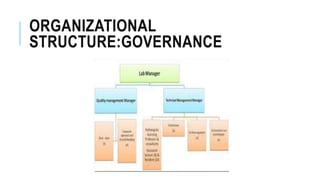
ORGANIZATIONAL
STRUCTURE:GOVERNANCE
RISK MANAGEMENT
Risk management is an essential and
central part of all laboratory work.
Organizations such as the Health
and Safety Executive (HSE) and the
Health Protection Agency (HPA) exist
to ensure the safety of employees,
patients and the general public.
WHAT RISK MANAGEMENT SEEKS TO
ACHIEVE
Issuing and enforcing standards for
workplace safety and health.
Implementing regulations that apply to
all work situations. Examples:
1.Health and Safety at Work Act 1974.
2.Control of Substances Hazardous to
Health (COSHH) Regulations.
3.Workplace (Health, Safety and Welfare)
Regulations.
4.Health and Safety Offences Act 2008.
WHAT RISK MANAGEMENT SEEKS
TO ACHIEVE CONTD…
The overall goal is to ensure that
employees are entitled to work in
environments where risks to their
health and safety are properly
controlled (i.e. minimized).
RISK MANAGEMENT CONTD…
Under health and safety law, the
primary responsibility is owed by
employers, with employees
expected to ensure their own
safety, and that of their colleagues
and/or patient’s by adhering to
policies
RISK MANAGEMENT CONTD…
To comply with legislation and
maintain accreditation, a laboratory
must have an effective risk
management policy.
BENCHMARKS FOR RISK
MANAGEMENT POLICY…
Any chance of something going wrong
should be either negated or minimized, and
therefore a laboratory’s risk management
process should have procedures in place for:
• Identifying all risks that exist within the
environment.
• Assessing those risks for likelihood and
severity.
• Eliminating those risks that can be removed.
RISK MANAGEMENT EXECUTION
The laboratory manager would be
concerned with all risks associated
with the department that they
manage.
He/she must also be familiar with
how these might impact on other
areas of the organization such as
porters transporting samples or
chemicals to the laboratory.
RISK MANAGEMENT EXECUTION
CONTD…
They would also be required to
alert the organization to the
presence of risks which cannot be
adequately controlled within
or by the department.
RISK MANAGEMENT EXECUTION
CONTD…
The laboratory management team
will deal with any laboratory-
associated risk by ensuring that
adequate resources are available
to deliver the service, and by
guaranteeing that the laboratory
provides a service that is safe both
for staff and patients.
RISK MANAGEMENT EXECUTION
CONTD…
The team must also ensure risk
management procedures are in
place for every aspect of a
laboratory’s processes and
environment.
RISK MANAGEMENT EXECUTION
CONTD…
The laboratory manager must
ensure that day-today errors do
not arise as a result of
inadequacies in laboratory
procedures and that quality
control checks are in place to
minimize the possibility of
KEY AREAS OF CONCERN
Staffing levels and competence.
Timeliness and quality of results.
Budgetary management.
Consumables and equipment
supplies.
Maintenance and infrastructural
improvement.
SYSTEMATIC APPROACH TO
STRATEGIC RISK ASSESSMENT.
Risk identification
Risk analysis/evaluation
Risk management
Risk funding
RISK IDENTIFICATION
The risks within each laboratory
section are best identified by the
section lead and members of that
team, working in conjunction with
the laboratory’s health and safety
lead.
This ensures that the broadest
possible spectrum of viewpoints is
RISK IDENTIFICATION (CATEGORIZATION)
CONTD…
It is also useful to divide the risks
into different categories, such as:
clinical
physical
chemical
infectious
organizational
financial
political
RISK ANALYSIS / EVALUATION
Analysis and evaluation of
potential risks is an essential part
of the process, and one that is used
to identify both the likelihood and
severity of these risks.
RISK SCORING
By scoring the risks for likelihood
and severity, it is then possible to
use a matrix to place a value on
specific risks in order to help
prioritize them for further action.
EXIGENCIES DOCUMENTATION
The risk manager should put a
system in place whereby all
incidents and accidents are reported
no matter how small.
It is only by recording data that the
full picture can be obtained and
analyzed and areas possibly
overlooked initially be risk assessed
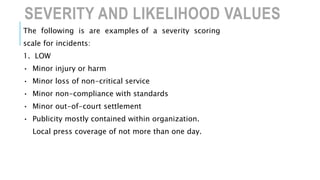
SEVERITY AND LIKELIHOOD VALUES
The following is are examples of a severity scoring
scale for incidents:
1. LOW
• Minor injury or harm
• Minor loss of non-critical service
• Minor non-compliance with standards
• Minor out-of-court settlement
• Publicity mostly contained within organization.
Local press coverage of not more than one day.
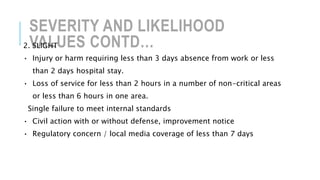
SEVERITY AND LIKELIHOOD
VALUES CONTD…2. SLIGHT
• Injury or harm requiring less than 3 days absence from work or less
than 2 days hospital stay.
• Loss of service for less than 2 hours in a number of non-critical areas
or less than 6 hours in one area.
Single failure to meet internal standards
• Civil action with or without defense, improvement notice
• Regulatory concern / local media coverage of less than 7 days
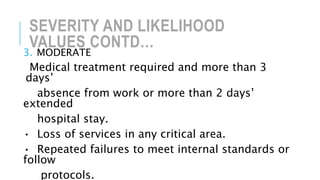
SEVERITY AND LIKELIHOOD
VALUES CONTD…
3. MODERATE
Medical treatment required and more than 3
days’
absence from work or more than 2 days’
extended
hospital stay.
• Loss of services in any critical area.
• Repeated failures to meet internal standards or
follow
protocols.
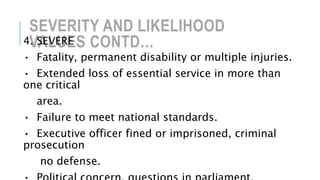
SEVERITY AND LIKELIHOOD
VALUES CONTD…4. SEVERE
• Fatality, permanent disability or multiple injuries.
• Extended loss of essential service in more than
one critical
area.
• Failure to meet national standards.
• Executive officer fined or imprisoned, criminal
prosecution
no defense.
SEVERITY AND LIKELIHOOD
VALUES CONTD…
5. CATASTROPHIC
• Multiple fatalities.
• Loss of multiple essential services in critical
areas.
• Failure to meet professional standards.
• Imprisonment of executive from
organization.
• Full public enquiry.
EVALUATION OF LIKELIHOOD BY
INCIDENTS SCORES
Incidents may also be scored 1–5 for likelihood:
1. Incident unlikely to occur.
2. Incident likely to occur once in a 5-year period.
3. Incident likely to occur yearly.
4. Incident likely to occur once in a 6-month period.
5. Incident likely to occur once every 4 weeks or more frequently.
THE RISK FACTOR IS THE SEVERITY
MULTIPLIED BY THE
LIKELIHOOD OF OCCURRENCE:Very Low Risk– The majority of control measures in place
or harm/severity small. Action may be long term.
Low Risk– Moderate probability of major harm or high
probability of minor harm if control measures are not
implemented. Action in the medium term.
Moderate Risk –Urgent action to remove or reduce the risk.
High Risk– Immediate action to remove/reduce the risk.
RISK FUNDING
May include insuring individual members of staff and the
laboratory facility.
All staff must carry medical liability insurance, which covers them
in the event of any negligence claims.
Similarly, professional indemnity insurance is commonly available
today for non-medical laboratory staff who are much more at risk
in today’s litigation-conscious society.
The decision regarding whether or not to insure should be based on
the risk assessment and the severity and likelihood of the risk.
Some risks will not be appropriate for insurance cover for
whatever reason, and in these instances the risk must be
accepted by the organization.
QUALITY MANAGEMENT
A quality management system is essential
in order to provide the best possible
service for the patient and clinicians.
Quality is defined as a measure of how
well a product or service does the job for
which it is designed (i.e. conformity to
specification).
TYPES OF QUALITY MANAGEMENT
SYSTEMS (QMS)
Internal QMS
Internal quality control (IQC) systems are
utilized to check work processes as an
important part of quality management, and
has been the traditional way that bench work has
been checked for many years.
It also includes processes utilized in the
laboratory to recognize and eliminate errors.
TYPES OF QUALITY MANAGEMENT
SYSTEMS (QMS)
External QMS
Utilizes External quality assurance (EQA)
schemes which provide benchmarks against
other laboratories and often provide access
to best practice methods and expert advice
on improving techniques / specific tests.
FACTORS THAT INFORM AN EFFECTIVE
INTERNAL QMS
Organization and liaison with users.
Premises, equipment and materials.
Examination procedures (SOPs)
Continuous quality improvement (CQI).
KEY FEATURES OF A ROBUST QMSA full quality management system should
also encompass systems to ensure:
consistency
quality of service
confidence
standardization
continual improvement of all laboratory
processes through monitoring and evaluation.
STAKEHOLDERS (FACTORS) THAT
INFLUENCE IMPLEMENTATION OF QMS
Patients / Clinicians
Human resources
Work premises
Local environment
Equipment resources
Information and Technology systems
Materials
PHASES OF APPLICATION OF QMS
Pre-examination phase
Examination phase
Post-examination phase
QMS APPLICATIONS: EXPECTED
OUTCOMES
A proper application of the QMS throughout the
production cycle will ensure regular auditing of the
various components of the systems.
Will provide evidence of compliance with
standards for accreditation.
It will also identify any trends and issues for
concern, and confirm quality systems are
working.
Overall, all these measures will identify areas for
quality
ACCREDITATION : INTERNATIONAL
ORGANIZATION FOR STANDARDIZATION
(ISO).
ISO 15189 – Medical laboratories – Particular requirements for quality and
competence. This is the main standard that affects medical laboratories and
that the majority will seek to become accredited to.
ISO 17043 – Conformity assessment – General requirements for proficiency
testing. This standard specifies general requirements for the competence of
providers of proficiency testing schemes, which would include external
quality assurance schemes.
ISO 17011– Conformity assessment – General requirements for
accreditation bodies accrediting conformity assessment bodies.

Lab management l100

  • 1.
    CLINICAL PATHOLOGY LABORATORY MANAGEMENTAND ADMINISTRATION I E.A. ASIAMAH
  • 2.
    INTRODUCTION Management is anintegral aspect of the day-to-day life of the pathology laboratory and is a major requirement of the accreditation process required by legislation in some countries. This seeks to streamline the operations of the lab and to produce the best
  • 3.
    THEMATIC AREAS OFLAB MANAGEMENT & ADMINISTRATION: GOVERNANCE Risk management Quality management Personnel management Financial management Relationship management
  • 4.
    OPERATIONAL / SERVICEUNITS Histology service Autopsy service General cytology Cervical Cancer Screening / Testing service
  • 5.
  • 6.
    RISK MANAGEMENT Risk managementis an essential and central part of all laboratory work. Organizations such as the Health and Safety Executive (HSE) and the Health Protection Agency (HPA) exist to ensure the safety of employees, patients and the general public.
  • 7.
    WHAT RISK MANAGEMENTSEEKS TO ACHIEVE Issuing and enforcing standards for workplace safety and health. Implementing regulations that apply to all work situations. Examples: 1.Health and Safety at Work Act 1974. 2.Control of Substances Hazardous to Health (COSHH) Regulations. 3.Workplace (Health, Safety and Welfare) Regulations. 4.Health and Safety Offences Act 2008.
  • 8.
    WHAT RISK MANAGEMENTSEEKS TO ACHIEVE CONTD… The overall goal is to ensure that employees are entitled to work in environments where risks to their health and safety are properly controlled (i.e. minimized).
  • 9.
    RISK MANAGEMENT CONTD… Underhealth and safety law, the primary responsibility is owed by employers, with employees expected to ensure their own safety, and that of their colleagues and/or patient’s by adhering to policies
  • 10.
    RISK MANAGEMENT CONTD… Tocomply with legislation and maintain accreditation, a laboratory must have an effective risk management policy.
  • 11.
    BENCHMARKS FOR RISK MANAGEMENTPOLICY… Any chance of something going wrong should be either negated or minimized, and therefore a laboratory’s risk management process should have procedures in place for: • Identifying all risks that exist within the environment. • Assessing those risks for likelihood and severity. • Eliminating those risks that can be removed.
  • 12.
    RISK MANAGEMENT EXECUTION Thelaboratory manager would be concerned with all risks associated with the department that they manage. He/she must also be familiar with how these might impact on other areas of the organization such as porters transporting samples or chemicals to the laboratory.
  • 13.
    RISK MANAGEMENT EXECUTION CONTD… Theywould also be required to alert the organization to the presence of risks which cannot be adequately controlled within or by the department.
  • 14.
    RISK MANAGEMENT EXECUTION CONTD… Thelaboratory management team will deal with any laboratory- associated risk by ensuring that adequate resources are available to deliver the service, and by guaranteeing that the laboratory provides a service that is safe both for staff and patients.
  • 15.
    RISK MANAGEMENT EXECUTION CONTD… Theteam must also ensure risk management procedures are in place for every aspect of a laboratory’s processes and environment.
  • 16.
    RISK MANAGEMENT EXECUTION CONTD… Thelaboratory manager must ensure that day-today errors do not arise as a result of inadequacies in laboratory procedures and that quality control checks are in place to minimize the possibility of
  • 17.
    KEY AREAS OFCONCERN Staffing levels and competence. Timeliness and quality of results. Budgetary management. Consumables and equipment supplies. Maintenance and infrastructural improvement.
  • 18.
    SYSTEMATIC APPROACH TO STRATEGICRISK ASSESSMENT. Risk identification Risk analysis/evaluation Risk management Risk funding
  • 19.
    RISK IDENTIFICATION The riskswithin each laboratory section are best identified by the section lead and members of that team, working in conjunction with the laboratory’s health and safety lead. This ensures that the broadest possible spectrum of viewpoints is
  • 20.
    RISK IDENTIFICATION (CATEGORIZATION) CONTD… Itis also useful to divide the risks into different categories, such as: clinical physical chemical infectious organizational financial political
  • 21.
    RISK ANALYSIS /EVALUATION Analysis and evaluation of potential risks is an essential part of the process, and one that is used to identify both the likelihood and severity of these risks.
  • 22.
    RISK SCORING By scoringthe risks for likelihood and severity, it is then possible to use a matrix to place a value on specific risks in order to help prioritize them for further action.
  • 23.
    EXIGENCIES DOCUMENTATION The riskmanager should put a system in place whereby all incidents and accidents are reported no matter how small. It is only by recording data that the full picture can be obtained and analyzed and areas possibly overlooked initially be risk assessed
  • 24.
    SEVERITY AND LIKELIHOODVALUES The following is are examples of a severity scoring scale for incidents: 1. LOW • Minor injury or harm • Minor loss of non-critical service • Minor non-compliance with standards • Minor out-of-court settlement • Publicity mostly contained within organization. Local press coverage of not more than one day.
  • 25.
    SEVERITY AND LIKELIHOOD VALUESCONTD…2. SLIGHT • Injury or harm requiring less than 3 days absence from work or less than 2 days hospital stay. • Loss of service for less than 2 hours in a number of non-critical areas or less than 6 hours in one area. Single failure to meet internal standards • Civil action with or without defense, improvement notice • Regulatory concern / local media coverage of less than 7 days
  • 26.
    SEVERITY AND LIKELIHOOD VALUESCONTD… 3. MODERATE Medical treatment required and more than 3 days’ absence from work or more than 2 days’ extended hospital stay. • Loss of services in any critical area. • Repeated failures to meet internal standards or follow protocols.
  • 27.
    SEVERITY AND LIKELIHOOD VALUESCONTD…4. SEVERE • Fatality, permanent disability or multiple injuries. • Extended loss of essential service in more than one critical area. • Failure to meet national standards. • Executive officer fined or imprisoned, criminal prosecution no defense.
  • 28.
    SEVERITY AND LIKELIHOOD VALUESCONTD… 5. CATASTROPHIC • Multiple fatalities. • Loss of multiple essential services in critical areas. • Failure to meet professional standards. • Imprisonment of executive from organization. • Full public enquiry.
  • 29.
    EVALUATION OF LIKELIHOODBY INCIDENTS SCORES Incidents may also be scored 1–5 for likelihood: 1. Incident unlikely to occur. 2. Incident likely to occur once in a 5-year period. 3. Incident likely to occur yearly. 4. Incident likely to occur once in a 6-month period. 5. Incident likely to occur once every 4 weeks or more frequently.
  • 30.
    THE RISK FACTORIS THE SEVERITY MULTIPLIED BY THE LIKELIHOOD OF OCCURRENCE:Very Low Risk– The majority of control measures in place or harm/severity small. Action may be long term. Low Risk– Moderate probability of major harm or high probability of minor harm if control measures are not implemented. Action in the medium term. Moderate Risk –Urgent action to remove or reduce the risk. High Risk– Immediate action to remove/reduce the risk.
  • 31.
    RISK FUNDING May includeinsuring individual members of staff and the laboratory facility. All staff must carry medical liability insurance, which covers them in the event of any negligence claims. Similarly, professional indemnity insurance is commonly available today for non-medical laboratory staff who are much more at risk in today’s litigation-conscious society. The decision regarding whether or not to insure should be based on the risk assessment and the severity and likelihood of the risk. Some risks will not be appropriate for insurance cover for whatever reason, and in these instances the risk must be accepted by the organization.
  • 32.
    QUALITY MANAGEMENT A qualitymanagement system is essential in order to provide the best possible service for the patient and clinicians. Quality is defined as a measure of how well a product or service does the job for which it is designed (i.e. conformity to specification).
  • 33.
    TYPES OF QUALITYMANAGEMENT SYSTEMS (QMS) Internal QMS Internal quality control (IQC) systems are utilized to check work processes as an important part of quality management, and has been the traditional way that bench work has been checked for many years. It also includes processes utilized in the laboratory to recognize and eliminate errors.
  • 34.
    TYPES OF QUALITYMANAGEMENT SYSTEMS (QMS) External QMS Utilizes External quality assurance (EQA) schemes which provide benchmarks against other laboratories and often provide access to best practice methods and expert advice on improving techniques / specific tests.
  • 35.
    FACTORS THAT INFORMAN EFFECTIVE INTERNAL QMS Organization and liaison with users. Premises, equipment and materials. Examination procedures (SOPs) Continuous quality improvement (CQI).
  • 36.
    KEY FEATURES OFA ROBUST QMSA full quality management system should also encompass systems to ensure: consistency quality of service confidence standardization continual improvement of all laboratory processes through monitoring and evaluation.
  • 37.
    STAKEHOLDERS (FACTORS) THAT INFLUENCEIMPLEMENTATION OF QMS Patients / Clinicians Human resources Work premises Local environment Equipment resources Information and Technology systems Materials
  • 38.
    PHASES OF APPLICATIONOF QMS Pre-examination phase Examination phase Post-examination phase
  • 39.
    QMS APPLICATIONS: EXPECTED OUTCOMES Aproper application of the QMS throughout the production cycle will ensure regular auditing of the various components of the systems. Will provide evidence of compliance with standards for accreditation. It will also identify any trends and issues for concern, and confirm quality systems are working. Overall, all these measures will identify areas for quality
  • 40.
    ACCREDITATION : INTERNATIONAL ORGANIZATIONFOR STANDARDIZATION (ISO). ISO 15189 – Medical laboratories – Particular requirements for quality and competence. This is the main standard that affects medical laboratories and that the majority will seek to become accredited to. ISO 17043 – Conformity assessment – General requirements for proficiency testing. This standard specifies general requirements for the competence of providers of proficiency testing schemes, which would include external quality assurance schemes. ISO 17011– Conformity assessment – General requirements for accreditation bodies accrediting conformity assessment bodies.