Survey of Lower Invertebrates

        Phylum Porifera
              &
        Phylum Cnidaria


(Domain Eukaryota, Kingdom Animalia)
Phylum Porifera (Sponges)
Etymology: From the Latin porus for pore and Ferre to bear,
           hence an animal with pores.

Key Characteristics:
•   Simplest members of Kingdom Animalia
•   Multicellular, no tissues or organs
•   Mostly asymmetrical
•   Acoelomates
•   Sexual or asexual,
•   Adults are sessile, zygotes are protozoan-like.
•   Live in aquatic environments
Phylum Porifera
    (Sponges)
Porifera Structures
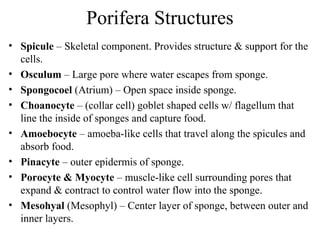
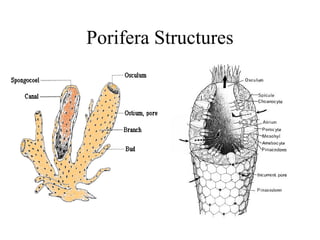
• Spicule – Skeletal component. Provides structure & support for the
  cells.
• Osculum – Large pore where water escapes from sponge.
• Spongocoel (Atrium) – Open space inside sponge.
• Choanocyte – (collar cell) goblet shaped cells w/ flagellum that
  line the inside of sponges and capture food.
• Amoebocyte – amoeba-like cells that travel along the spicules and
  absorb food.
• Pinacyte – outer epidermis of sponge.
• Porocyte & Myocyte – muscle-like cell surrounding pores that
  expand & contract to control water flow into the sponge.
• Mesohyal (Mesophyl) – Center layer of sponge, between outer and
  inner layers.
Porifera Structures
Porifera Structures
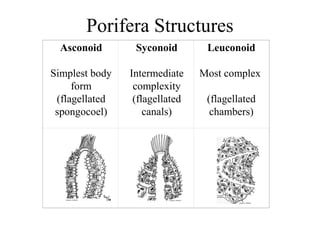
  Asconoid       Syconoid        Leuconoid

Simplest body   Intermediate    Most complex
     form        complexity
 (flagellated    (flagellated    (flagellated
 spongocoel)        canals)       chambers)
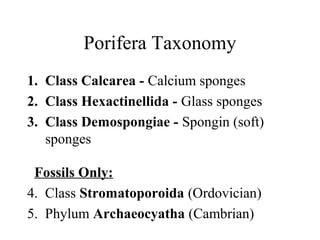
Porifera Taxonomy
1. Class Calcarea - Calcium sponges
2. Class Hexactinellida - Glass sponges
3. Class Demospongiae - Spongin (soft)
   sponges

 Fossils Only:
4. Class Stromatoporoida (Ordovician)
5. Phylum Archaeocyatha (Cambrian)
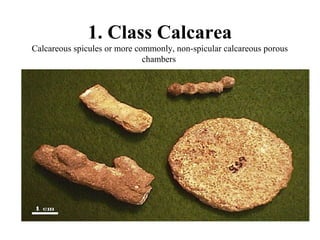
1. Class Calcarea
Calcareous spicules or more commonly, non-spicular calcareous porous
                              chambers
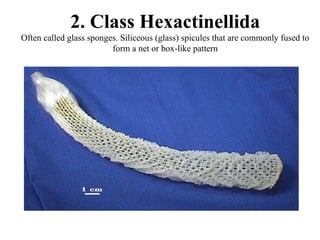
2. Class Hexactinellida
Often called glass sponges. Siliceous (glass) spicules that are commonly fused to
                         form a net or box-like pattern
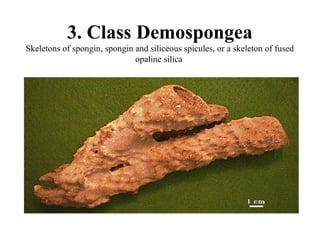
3. Class Demospongea
Skeletons of spongin, spongin and siliceous spicules, or a skeleton of fused
                              opaline silica
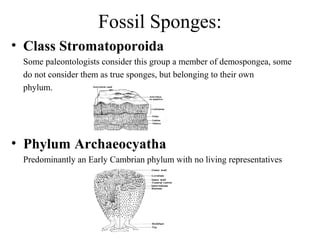
Fossil Sponges:
• Class Stromatoporoida
 Some paleontologists consider this group a member of demospongea, some
 do not consider them as true sponges, but belonging to their own
 phylum.


• Phylum Archaeocyatha
 Predominantly an Early Cambrian phylum with no living representatives
Phylum Cnidaria
(Jellyfish, Corals, Anemonies, Hydras)
Phylum Cnidaria (Jellyfish, Corals, Anemonies, Hydras)
 Etymology: from Latin “cnida”, Greek “knide” for "nettle,"
            from stem of knizein "to scratch scrape”, hence a
            phylum of stinging invertebrates.

 Key Characteristics:
 • Nematocysts – stinging cells
 • Sac-like Diploblastic Body – formed from
    two germ layers, endo & ectoderm.
 • tissue level of organization
 • radial symmetry
 • All have sessile phase
Life Cycle of Select Cnidarians

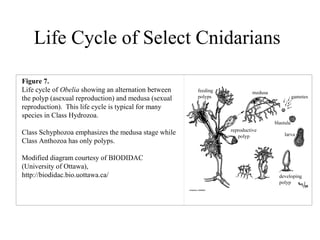
Figure 7.
Life cycle of Obelia showing an alternation between
the polyp (asexual reproduction) and medusa (sexual
reproduction). This life cycle is typical for many
species in Class Hydrozoa.

Class Schyphozoa emphasizes the medusa stage while
Class Anthozoa has only polyps.

Modified diagram courtesy of BIODIDAC
(University of Ottawa),
http://biodidac.bio.uottawa.ca/
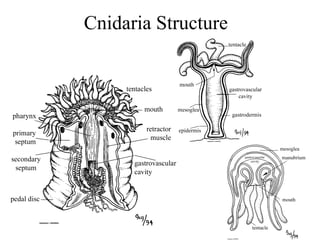
Cnidaria Structure
Cnidaria Taxonomy
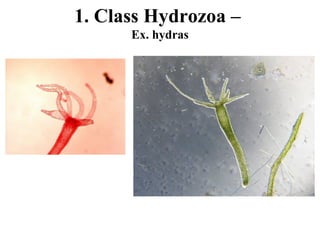
1. Class Hydrozoa – hydras
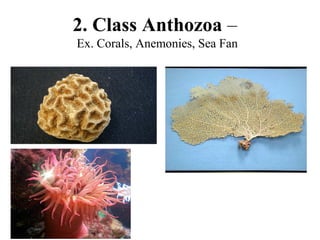
2. Class Anthozoa – Corals, Anemonies
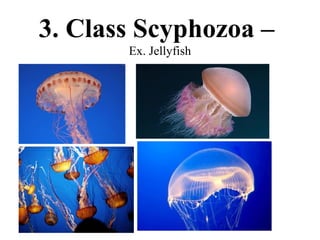
3. Class Scyphozoa – Jellyfish
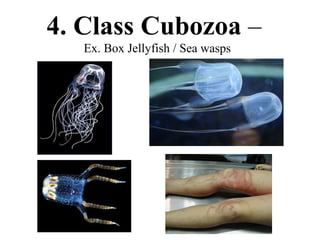
4. Class Cubozoa – Box Jellyfish / Sea
   wasps
1. Class Hydrozoa –
      Ex. hydras
2. Class Anthozoa –
Ex. Corals, Anemonies, Sea Fan
3. Class Scyphozoa –
       Ex. Jellyfish
4. Class Cubozoa –
   Ex. Box Jellyfish / Sea wasps

Lab 3 & 4 porifera & cnidaria

  • 1.
    Survey of LowerInvertebrates Phylum Porifera & Phylum Cnidaria (Domain Eukaryota, Kingdom Animalia)
  • 2.
    Phylum Porifera (Sponges) Etymology:From the Latin porus for pore and Ferre to bear, hence an animal with pores. Key Characteristics: • Simplest members of Kingdom Animalia • Multicellular, no tissues or organs • Mostly asymmetrical • Acoelomates • Sexual or asexual, • Adults are sessile, zygotes are protozoan-like. • Live in aquatic environments
  • 3.
  • 4.
    Porifera Structures • Spicule– Skeletal component. Provides structure & support for the cells. • Osculum – Large pore where water escapes from sponge. • Spongocoel (Atrium) – Open space inside sponge. • Choanocyte – (collar cell) goblet shaped cells w/ flagellum that line the inside of sponges and capture food. • Amoebocyte – amoeba-like cells that travel along the spicules and absorb food. • Pinacyte – outer epidermis of sponge. • Porocyte & Myocyte – muscle-like cell surrounding pores that expand & contract to control water flow into the sponge. • Mesohyal (Mesophyl) – Center layer of sponge, between outer and inner layers.
  • 5.
  • 6.
    Porifera Structures Asconoid Syconoid Leuconoid Simplest body Intermediate Most complex form complexity (flagellated (flagellated (flagellated spongocoel) canals) chambers)
  • 7.
    Porifera Taxonomy 1. ClassCalcarea - Calcium sponges 2. Class Hexactinellida - Glass sponges 3. Class Demospongiae - Spongin (soft) sponges Fossils Only: 4. Class Stromatoporoida (Ordovician) 5. Phylum Archaeocyatha (Cambrian)
  • 8.
    1. Class Calcarea Calcareousspicules or more commonly, non-spicular calcareous porous chambers
  • 9.
    2. Class Hexactinellida Oftencalled glass sponges. Siliceous (glass) spicules that are commonly fused to form a net or box-like pattern
  • 10.
    3. Class Demospongea Skeletonsof spongin, spongin and siliceous spicules, or a skeleton of fused opaline silica
  • 11.
    Fossil Sponges: • ClassStromatoporoida Some paleontologists consider this group a member of demospongea, some do not consider them as true sponges, but belonging to their own phylum. • Phylum Archaeocyatha Predominantly an Early Cambrian phylum with no living representatives
  • 12.
  • 13.
    Phylum Cnidaria (Jellyfish,Corals, Anemonies, Hydras) Etymology: from Latin “cnida”, Greek “knide” for "nettle," from stem of knizein "to scratch scrape”, hence a phylum of stinging invertebrates. Key Characteristics: • Nematocysts – stinging cells • Sac-like Diploblastic Body – formed from two germ layers, endo & ectoderm. • tissue level of organization • radial symmetry • All have sessile phase
  • 14.
    Life Cycle ofSelect Cnidarians Figure 7. Life cycle of Obelia showing an alternation between the polyp (asexual reproduction) and medusa (sexual reproduction). This life cycle is typical for many species in Class Hydrozoa. Class Schyphozoa emphasizes the medusa stage while Class Anthozoa has only polyps. Modified diagram courtesy of BIODIDAC (University of Ottawa), http://biodidac.bio.uottawa.ca/
  • 15.
  • 16.
    Cnidaria Taxonomy 1. ClassHydrozoa – hydras 2. Class Anthozoa – Corals, Anemonies 3. Class Scyphozoa – Jellyfish 4. Class Cubozoa – Box Jellyfish / Sea wasps
  • 17.
    1. Class Hydrozoa– Ex. hydras
  • 18.
    2. Class Anthozoa– Ex. Corals, Anemonies, Sea Fan
  • 19.
    3. Class Scyphozoa– Ex. Jellyfish
  • 20.
    4. Class Cubozoa– Ex. Box Jellyfish / Sea wasps