Sponges and Cnidarians
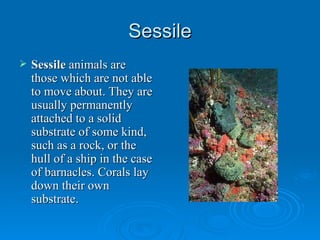
Sessile Sessile  animals are those which are not able to move about. They are usually permanently attached to a solid substrate of some kind, such as a rock, or the hull of a ship in the case of barnacles. Corals lay down their own substrate .
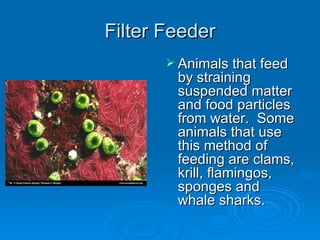
Filter Feeder Animals that feed by straining suspended matter and food particles from water.  Some animals that use this method of feeding are clams, krill, flamingos, sponges and whale sharks.
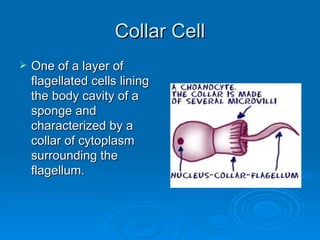
Collar Cell One of a layer of flagellated cells lining the body cavity of a sponge and characterized by a collar of cytoplasm surrounding the flagellum.
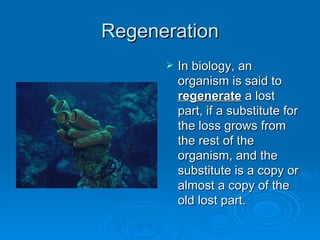
Regeneration In biology, an organism is said to  regenerate  a lost part, if a substitute for the loss grows from the rest of the organism, and the substitute is a copy or almost a copy of the old lost part.
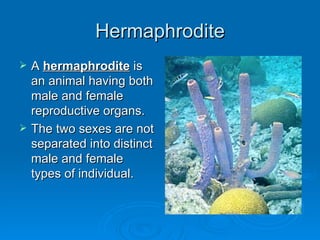
Hermaphrodite A  hermaphrodite  is an animal having both male and female reproductive organs.  The two sexes are not separated into distinct male and female types of individual.
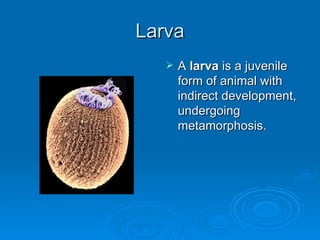
Larva A  larva  is a juvenile form of animal with indirect development, undergoing metamorphosis.
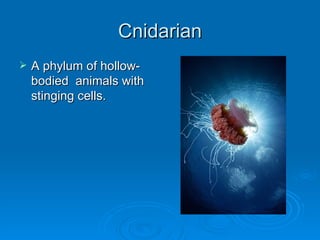
Cnidarian A phylum of hollow-bodied  animals with stinging cells.
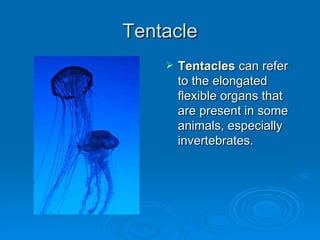
Tentacle Tentacles  can refer to the elongated flexible organs that are present in some animals, especially invertebrates.
Polyp a  polyp  is one of two forms of individuals found in many species of  cnidar i ans . The two are the polyp or hydroid and the medusa. Polyps are approximately cylindrical, elongated on the axis of the body.
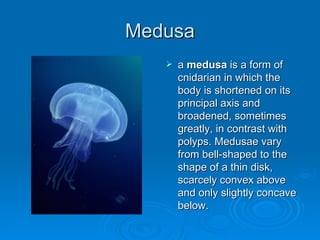
Medusa a  medusa  is a form of cnidarian in which the body is shortened on its principal axis and broadened, sometimes greatly, in contrast with polyps. Medusae vary from bell-shaped to the shape of a thin disk, scarcely convex above and only slightly concave below.

Sponges And Cnidarians

  • 1.
  • 2.
    Sessile Sessile animals are those which are not able to move about. They are usually permanently attached to a solid substrate of some kind, such as a rock, or the hull of a ship in the case of barnacles. Corals lay down their own substrate .
  • 3.
    Filter Feeder Animalsthat feed by straining suspended matter and food particles from water. Some animals that use this method of feeding are clams, krill, flamingos, sponges and whale sharks.
  • 4.
    Collar Cell Oneof a layer of flagellated cells lining the body cavity of a sponge and characterized by a collar of cytoplasm surrounding the flagellum.
  • 5.
    Regeneration In biology,an organism is said to regenerate a lost part, if a substitute for the loss grows from the rest of the organism, and the substitute is a copy or almost a copy of the old lost part.
  • 6.
    Hermaphrodite A hermaphrodite is an animal having both male and female reproductive organs. The two sexes are not separated into distinct male and female types of individual.
  • 7.
    Larva A larva is a juvenile form of animal with indirect development, undergoing metamorphosis.
  • 8.
    Cnidarian A phylumof hollow-bodied animals with stinging cells.
  • 9.
    Tentacle Tentacles can refer to the elongated flexible organs that are present in some animals, especially invertebrates.
  • 10.
    Polyp a polyp is one of two forms of individuals found in many species of cnidar i ans . The two are the polyp or hydroid and the medusa. Polyps are approximately cylindrical, elongated on the axis of the body.
  • 11.
    Medusa a medusa is a form of cnidarian in which the body is shortened on its principal axis and broadened, sometimes greatly, in contrast with polyps. Medusae vary from bell-shaped to the shape of a thin disk, scarcely convex above and only slightly concave below.