Serial Communication in Atmega328P
(Lecture-16)
R S Ananda Murthy
Associate Professor
Department of Electrical & Electronics Engineering,
Sri Jayachamarajendra College of Engineering,
Mysore 570 006
R S Ananda Murthy Serial Communication in Atmega328P
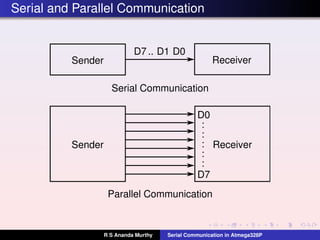
Serial and Parallel Communication
Sender Receiver
Sender Receiver
D0
D7
:
:
:
:
:
D0D1..D7
Serial Communication
Parallel Communication
R S Ananda Murthy Serial Communication in Atmega328P
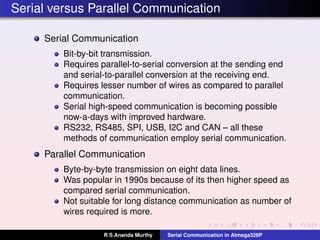
Serial versus Parallel Communication
Serial Communication
Bit-by-bit transmission.
Requires parallel-to-serial conversion at the sending end
and serial-to-parallel conversion at the receiving end.
Requires lesser number of wires as compared to parallel
communication.
Serial high-speed communication is becoming possible
now-a-days with improved hardware.
RS232, RS485, SPI, USB, I2C and CAN – all these
methods of communication employ serial communication.
Parallel Communication
Byte-by-byte transmission on eight data lines.
Was popular in 1990s because of its then higher speed as
compared serial communication.
Not suitable for long distance communication as number of
wires required is more.
R S Ananda Murthy Serial Communication in Atmega328P
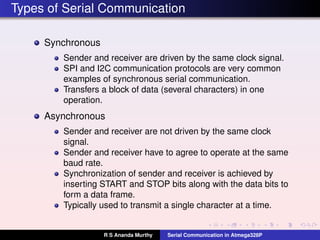
Types of Serial Communication
Synchronous
Sender and receiver are driven by the same clock signal.
SPI and I2C communication protocols are very common
examples of synchronous serial communication.
Transfers a block of data (several characters) in one
operation.
Asynchronous
Sender and receiver are not driven by the same clock
signal.
Sender and receiver have to agree to operate at the same
baud rate.
Synchronization of sender and receiver is achieved by
inserting START and STOP bits along with the data bits to
form a data frame.
Typically used to transmit a single character at a time.
R S Ananda Murthy Serial Communication in Atmega328P
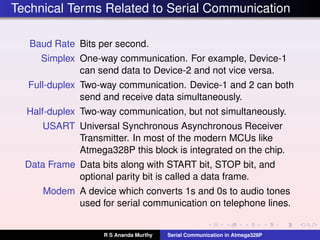
Technical Terms Related to Serial Communication
Baud Rate Bits per second.
Simplex One-way communication. For example, Device-1
can send data to Device-2 and not vice versa.
Full-duplex Two-way communication. Device-1 and 2 can both
send and receive data simultaneously.
Half-duplex Two-way communication, but not simultaneously.
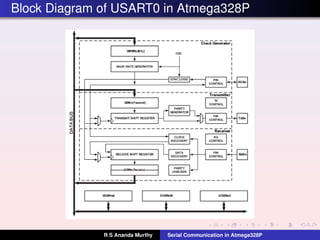
USART Universal Synchronous Asynchronous Receiver
Transmitter. In most of the modern MCUs like
Atmega328P this block is integrated on the chip.
Data Frame Data bits along with START bit, STOP bit, and
optional parity bit is called a data frame.
Modem A device which converts 1s and 0s to audio tones
used for serial communication on telephone lines.
R S Ananda Murthy Serial Communication in Atmega328P
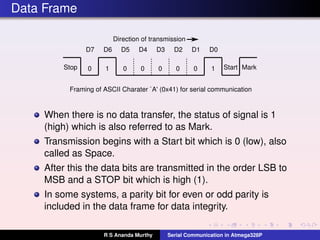
Data Frame
0 1 0 0 0 0 0Stop Start1
D0D1D2D3D4D5D6D7
Mark
Direction of transmission
Framing of ASCII Charater `A' (0x41) for serial communication
When there is no data transfer, the status of signal is 1
(high) which is also referred to as Mark.
Transmission begins with a Start bit which is 0 (low), also
called as Space.
After this the data bits are transmitted in the order LSB to
MSB and a STOP bit which is high (1).
In some systems, a parity bit for even or odd parity is
included in the data frame for data integrity.
R S Ananda Murthy Serial Communication in Atmega328P
RS232C Standard for Serial Communication
Proposed by Electronics Industries Association in 1960s.
Widely used for short distance serial communication even
today.
As per this standard, a voltage in the range −3 V to −25 V
represents a logical high (1) and a voltage level in the
range +3 V to +25 V represents a logical low (0).
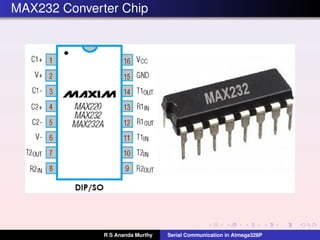
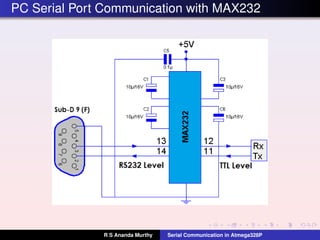
Since the voltage levels of this standard are not compatible
with TTL levels used by MCUs such as Atmega328P, we
need to use a voltage converter chip such as MAX232 or
MAX233.
R S Ananda Murthy Serial Communication in Atmega328P
MAX232 Converter Chip
R S Ananda Murthy Serial Communication in Atmega328P
PC Serial Port Communication with MAX232
R S Ananda Murthy Serial Communication in Atmega328P
Block Diagram of USART0 in Atmega328P
R S Ananda Murthy Serial Communication in Atmega328P
USART0 Pins of Atmega328P
TxD On this pin serial data is transmitted by the
USART0
RxD On this pin serial data is received by the USART0
XCK This pin is used for clock signal only during
synchronous serial communication.
R S Ananda Murthy Serial Communication in Atmega328P
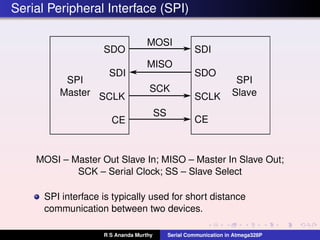
Serial Peripheral Interface (SPI)
SPI
Master
SPI
Slave
SDO
MOSI
SDI
SDI SDO
SCLK SCLK
SCK
CE CE
SS
MISO
MOSI – Master Out Slave In; MISO – Master In Slave Out;
SCK – Serial Clock; SS – Slave Select
SPI interface is typically used for short distance
communication between two devices.
R S Ananda Murthy Serial Communication in Atmega328P
Serial Peripheral Interface (SPI)
SPI, originally proposed by Motorola (now Freescale), uses
four wires – SDI (also called MOSI), SDO (also called
MISO), SCLK (also called SCK) , and CE (also called SS).
In SPI, one device will be master and the other device/s
will be slave/s.
Master always starts the communication by activating SS
and SCK.
SPI Communication is full-duplex.
In some systems SPI uses a common wire for both
MOSI/MISO, thus reducing the number of wires to three.
But such systems follow a different protocol for data
transmission as compared to 4-wire SPI systems.
R S Ananda Murthy Serial Communication in Atmega328P
SPI Architecture
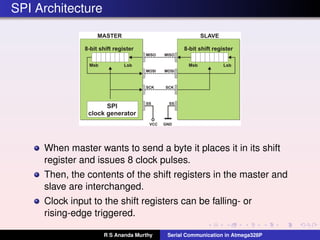
When master wants to send a byte it places it in its shift
register and issues 8 clock pulses.
Then, the contents of the shift registers in the master and
slave are interchanged.
Clock input to the shift registers can be falling- or
rising-edge triggered.
R S Ananda Murthy Serial Communication in Atmega328P
SPI Modes of Operation
Write Operation (indicated by D7 = 1 of the first byte)
Single-byte – write a byte to the slave.
Multi-byte – write multiple bytes to the slave.
Read Operation (indicated by D7 = 0 of the first byte)
Single-byte – read a byte from the slave.
Multi-byte – read multiple bytes from the slave
Multi-byte operations are also known as burst mode operations.
R S Ananda Murthy Serial Communication in Atmega328P
Single-byte SPI Write Operation
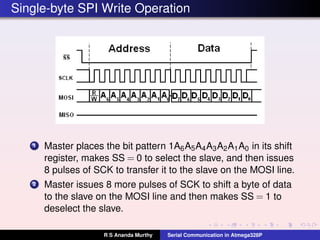
1 Master places the bit pattern 1A6A5A4A3A2A1A0 in its shift
register, makes SS = 0 to select the slave, and then issues
8 pulses of SCK to transfer it to the slave on the MOSI line.
2 Master issues 8 more pulses of SCK to shift a byte of data
to the slave on the MOSI line and then makes SS = 1 to
deselect the slave.
R S Ananda Murthy Serial Communication in Atmega328P
Single-byte SPI Read Operation
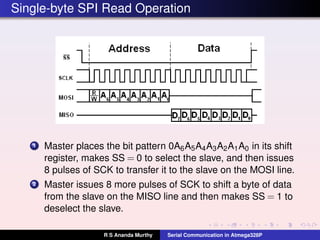
1 Master places the bit pattern 0A6A5A4A3A2A1A0 in its shift
register, makes SS = 0 to select the slave, and then issues
8 pulses of SCK to transfer it to the slave on the MOSI line.
2 Master issues 8 more pulses of SCK to shift a byte of data
from the slave on the MISO line and then makes SS = 1 to
deselect the slave.
R S Ananda Murthy Serial Communication in Atmega328P
SPI Burst Mode Operations
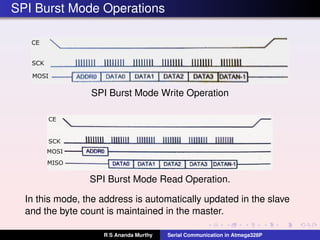
SPI Burst Mode Write Operation
SPI Burst Mode Read Operation.
In this mode, the address is automatically updated in the slave
and the byte count is maintained in the master.
R S Ananda Murthy Serial Communication in Atmega328P
License
This work is licensed under a
Creative Commons Attribution 4.0 International License.
R S Ananda Murthy Serial Communication in Atmega328P

L16 usart-atmega328 p

  • 1.
    Serial Communication inAtmega328P (Lecture-16) R S Ananda Murthy Associate Professor Department of Electrical & Electronics Engineering, Sri Jayachamarajendra College of Engineering, Mysore 570 006 R S Ananda Murthy Serial Communication in Atmega328P
  • 2.
    Serial and ParallelCommunication Sender Receiver Sender Receiver D0 D7 : : : : : D0D1..D7 Serial Communication Parallel Communication R S Ananda Murthy Serial Communication in Atmega328P
  • 3.
    Serial versus ParallelCommunication Serial Communication Bit-by-bit transmission. Requires parallel-to-serial conversion at the sending end and serial-to-parallel conversion at the receiving end. Requires lesser number of wires as compared to parallel communication. Serial high-speed communication is becoming possible now-a-days with improved hardware. RS232, RS485, SPI, USB, I2C and CAN – all these methods of communication employ serial communication. Parallel Communication Byte-by-byte transmission on eight data lines. Was popular in 1990s because of its then higher speed as compared serial communication. Not suitable for long distance communication as number of wires required is more. R S Ananda Murthy Serial Communication in Atmega328P
  • 4.
    Types of SerialCommunication Synchronous Sender and receiver are driven by the same clock signal. SPI and I2C communication protocols are very common examples of synchronous serial communication. Transfers a block of data (several characters) in one operation. Asynchronous Sender and receiver are not driven by the same clock signal. Sender and receiver have to agree to operate at the same baud rate. Synchronization of sender and receiver is achieved by inserting START and STOP bits along with the data bits to form a data frame. Typically used to transmit a single character at a time. R S Ananda Murthy Serial Communication in Atmega328P
  • 5.
    Technical Terms Relatedto Serial Communication Baud Rate Bits per second. Simplex One-way communication. For example, Device-1 can send data to Device-2 and not vice versa. Full-duplex Two-way communication. Device-1 and 2 can both send and receive data simultaneously. Half-duplex Two-way communication, but not simultaneously. USART Universal Synchronous Asynchronous Receiver Transmitter. In most of the modern MCUs like Atmega328P this block is integrated on the chip. Data Frame Data bits along with START bit, STOP bit, and optional parity bit is called a data frame. Modem A device which converts 1s and 0s to audio tones used for serial communication on telephone lines. R S Ananda Murthy Serial Communication in Atmega328P
  • 6.
    Data Frame 0 10 0 0 0 0Stop Start1 D0D1D2D3D4D5D6D7 Mark Direction of transmission Framing of ASCII Charater `A' (0x41) for serial communication When there is no data transfer, the status of signal is 1 (high) which is also referred to as Mark. Transmission begins with a Start bit which is 0 (low), also called as Space. After this the data bits are transmitted in the order LSB to MSB and a STOP bit which is high (1). In some systems, a parity bit for even or odd parity is included in the data frame for data integrity. R S Ananda Murthy Serial Communication in Atmega328P
  • 7.
    RS232C Standard forSerial Communication Proposed by Electronics Industries Association in 1960s. Widely used for short distance serial communication even today. As per this standard, a voltage in the range −3 V to −25 V represents a logical high (1) and a voltage level in the range +3 V to +25 V represents a logical low (0). Since the voltage levels of this standard are not compatible with TTL levels used by MCUs such as Atmega328P, we need to use a voltage converter chip such as MAX232 or MAX233. R S Ananda Murthy Serial Communication in Atmega328P
  • 8.
    MAX232 Converter Chip RS Ananda Murthy Serial Communication in Atmega328P
  • 9.
    PC Serial PortCommunication with MAX232 R S Ananda Murthy Serial Communication in Atmega328P
  • 10.
    Block Diagram ofUSART0 in Atmega328P R S Ananda Murthy Serial Communication in Atmega328P
  • 11.
    USART0 Pins ofAtmega328P TxD On this pin serial data is transmitted by the USART0 RxD On this pin serial data is received by the USART0 XCK This pin is used for clock signal only during synchronous serial communication. R S Ananda Murthy Serial Communication in Atmega328P
  • 12.
    Serial Peripheral Interface(SPI) SPI Master SPI Slave SDO MOSI SDI SDI SDO SCLK SCLK SCK CE CE SS MISO MOSI – Master Out Slave In; MISO – Master In Slave Out; SCK – Serial Clock; SS – Slave Select SPI interface is typically used for short distance communication between two devices. R S Ananda Murthy Serial Communication in Atmega328P
  • 13.
    Serial Peripheral Interface(SPI) SPI, originally proposed by Motorola (now Freescale), uses four wires – SDI (also called MOSI), SDO (also called MISO), SCLK (also called SCK) , and CE (also called SS). In SPI, one device will be master and the other device/s will be slave/s. Master always starts the communication by activating SS and SCK. SPI Communication is full-duplex. In some systems SPI uses a common wire for both MOSI/MISO, thus reducing the number of wires to three. But such systems follow a different protocol for data transmission as compared to 4-wire SPI systems. R S Ananda Murthy Serial Communication in Atmega328P
  • 14.
    SPI Architecture When masterwants to send a byte it places it in its shift register and issues 8 clock pulses. Then, the contents of the shift registers in the master and slave are interchanged. Clock input to the shift registers can be falling- or rising-edge triggered. R S Ananda Murthy Serial Communication in Atmega328P
  • 15.
    SPI Modes ofOperation Write Operation (indicated by D7 = 1 of the first byte) Single-byte – write a byte to the slave. Multi-byte – write multiple bytes to the slave. Read Operation (indicated by D7 = 0 of the first byte) Single-byte – read a byte from the slave. Multi-byte – read multiple bytes from the slave Multi-byte operations are also known as burst mode operations. R S Ananda Murthy Serial Communication in Atmega328P
  • 16.
    Single-byte SPI WriteOperation 1 Master places the bit pattern 1A6A5A4A3A2A1A0 in its shift register, makes SS = 0 to select the slave, and then issues 8 pulses of SCK to transfer it to the slave on the MOSI line. 2 Master issues 8 more pulses of SCK to shift a byte of data to the slave on the MOSI line and then makes SS = 1 to deselect the slave. R S Ananda Murthy Serial Communication in Atmega328P
  • 17.
    Single-byte SPI ReadOperation 1 Master places the bit pattern 0A6A5A4A3A2A1A0 in its shift register, makes SS = 0 to select the slave, and then issues 8 pulses of SCK to transfer it to the slave on the MOSI line. 2 Master issues 8 more pulses of SCK to shift a byte of data from the slave on the MISO line and then makes SS = 1 to deselect the slave. R S Ananda Murthy Serial Communication in Atmega328P
  • 18.
    SPI Burst ModeOperations SPI Burst Mode Write Operation SPI Burst Mode Read Operation. In this mode, the address is automatically updated in the slave and the byte count is maintained in the master. R S Ananda Murthy Serial Communication in Atmega328P
  • 19.
    License This work islicensed under a Creative Commons Attribution 4.0 International License. R S Ananda Murthy Serial Communication in Atmega328P