
Presentation On:
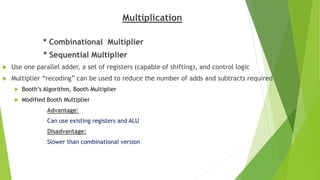
Multiplication
* Combinational Multiplier
* Sequential Multiplier
 Use one parallel adder, a set of registers (capable of shifting), and control logic
 Multiplier “recoding” can be used to reduce the number of adds and subtracts required
 Booth’s Algorithm, Booth Multiplier
 Modified Booth Multiplier
Advantage:
Can use existing registers and ALU
Disadvantage:
Slower than combinational version
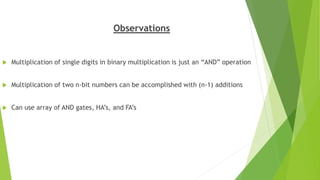
Observations
 Multiplication of single digits in binary multiplication is just an “AND” operation
 Multiplication of two n-bit numbers can be accomplished with (n-1) additions
 Can use array of AND gates, HA’s, and FA’s
Sequential Multiplication Algorithm
• Initialization:
– Load multiplicand in “M” register, multiplier in “Q” register
– Initialize “C” and “A” registers to all zeroes
• Repeat the following steps “n” times, where “n” is the number of bits in the multiplier
– If (LSB of Q register == 1)
-A = A + M (carry-out goes to “C” register)
– Treat the C, A and Q registers as one contiguous register and shift that
register’s contents right by one bit position
• After the completion of “n” steps
– Register “A” contains high-order half of product
– Register “Q” contains low-order half of product
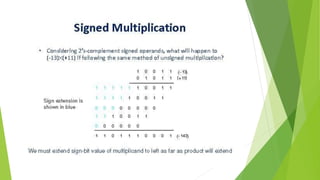
Signed Multiplication
• If the multiplier is +ve:
– The unsigned multiplication hardware works fine as long as it is
augmented to provide for sign extension of partial products
• If the multiplier is –ve:
– Form the 2’s-complement of both the multiplier and the multiplicand
and proceed as in the case of a +ve multiplier
– This is possible because complementation of both operands does not
change the value or the sign of the product
• A technique that works equally well for both negative and
positive multipliers – Booth algorithm
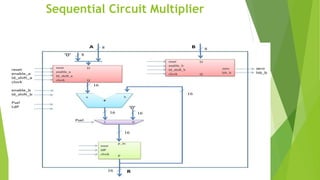
Sequential Circuit Multiplier
Multiplication with Signed Numbers
Case 1: multiplier X and multiplicand Y are positive
Case 2: X is positive and Y is negative
sign-extend the partial products during shifting
use the msb (most significant bit) of the partial product
Case 3: X is negative and Y is positive
add 1 final step of subtracting Y from the partial product
Case 4: both X and Y are negative
apply methods for both Case 2 and Case 3
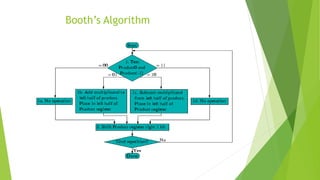
Booth’s Algorithm
Booth’s Algorithm
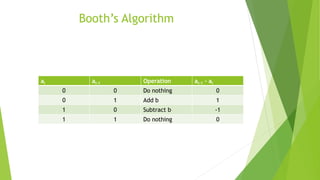
ai ai-1 Operation ai-1 - ai
0 0 Do nothing 0
0 1 Add b 1
1 0 Subtract b -1
1 1 Do nothing 0
Booth’s Algorithm
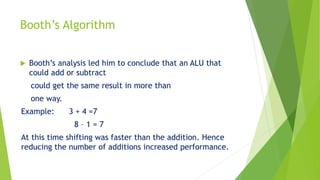
 Booth’s analysis led him to conclude that an ALU that
could add or subtract
could get the same result in more than
one way.
Example: 3 + 4 =7
8 – 1 = 7
At this time shifting was faster than the addition. Hence
reducing the number of additions increased performance.
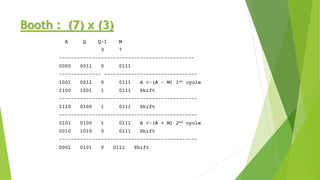
Booth : (7) x (3)
A Q Q-1 M
3 7
---------------------------------------------
0000 0011 0 0111
-------------- -------------------------------
1001 0011 0 0111 A <-(A - M) 1st cycle
1100 1001 1 0111 Shift
----------------------------------------------
1110 0100 1 0111 Shift
----------------------------------------------
0101 0100 1 0111 A <-(A + M) 2nd cycle
0010 1010 0 0111 Shift
----------------------------------------------
0001 0101 0 0111 Shift
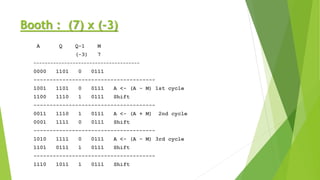
Booth : (7) x (-3)
A Q Q-1 M
(-3) 7
--------------------------------------
0000 1101 0 0111
--------------------------------------
1001 1101 0 0111 A <- (A - M) 1st cycle
1100 1110 1 0111 Shift
--------------------------------------
0011 1110 1 0111 A <- (A + M) 2nd cycle
0001 1111 0 0111 Shift
--------------------------------------
1010 1111 0 0111 A <- (A - M) 3rd cycle
1101 0111 1 0111 Shift
--------------------------------------
1110 1011 1 0111 Shift
Thank You

Sequential multiplication

  • 1.
  • 2.
    Multiplication * Combinational Multiplier *Sequential Multiplier  Use one parallel adder, a set of registers (capable of shifting), and control logic  Multiplier “recoding” can be used to reduce the number of adds and subtracts required  Booth’s Algorithm, Booth Multiplier  Modified Booth Multiplier Advantage: Can use existing registers and ALU Disadvantage: Slower than combinational version
  • 3.
    Observations  Multiplication ofsingle digits in binary multiplication is just an “AND” operation  Multiplication of two n-bit numbers can be accomplished with (n-1) additions  Can use array of AND gates, HA’s, and FA’s
  • 4.
    Sequential Multiplication Algorithm •Initialization: – Load multiplicand in “M” register, multiplier in “Q” register – Initialize “C” and “A” registers to all zeroes • Repeat the following steps “n” times, where “n” is the number of bits in the multiplier – If (LSB of Q register == 1) -A = A + M (carry-out goes to “C” register) – Treat the C, A and Q registers as one contiguous register and shift that register’s contents right by one bit position • After the completion of “n” steps – Register “A” contains high-order half of product – Register “Q” contains low-order half of product
  • 5.
    Signed Multiplication • Ifthe multiplier is +ve: – The unsigned multiplication hardware works fine as long as it is augmented to provide for sign extension of partial products • If the multiplier is –ve: – Form the 2’s-complement of both the multiplier and the multiplicand and proceed as in the case of a +ve multiplier – This is possible because complementation of both operands does not change the value or the sign of the product • A technique that works equally well for both negative and positive multipliers – Booth algorithm
  • 6.
  • 7.
    Multiplication with SignedNumbers Case 1: multiplier X and multiplicand Y are positive Case 2: X is positive and Y is negative sign-extend the partial products during shifting use the msb (most significant bit) of the partial product Case 3: X is negative and Y is positive add 1 final step of subtracting Y from the partial product Case 4: both X and Y are negative apply methods for both Case 2 and Case 3
  • 9.
  • 10.
    Booth’s Algorithm ai ai-1Operation ai-1 - ai 0 0 Do nothing 0 0 1 Add b 1 1 0 Subtract b -1 1 1 Do nothing 0
  • 11.
    Booth’s Algorithm  Booth’sanalysis led him to conclude that an ALU that could add or subtract could get the same result in more than one way. Example: 3 + 4 =7 8 – 1 = 7 At this time shifting was faster than the addition. Hence reducing the number of additions increased performance.
  • 12.
    Booth : (7)x (3) A Q Q-1 M 3 7 --------------------------------------------- 0000 0011 0 0111 -------------- ------------------------------- 1001 0011 0 0111 A <-(A - M) 1st cycle 1100 1001 1 0111 Shift ---------------------------------------------- 1110 0100 1 0111 Shift ---------------------------------------------- 0101 0100 1 0111 A <-(A + M) 2nd cycle 0010 1010 0 0111 Shift ---------------------------------------------- 0001 0101 0 0111 Shift
  • 13.
    Booth : (7)x (-3) A Q Q-1 M (-3) 7 -------------------------------------- 0000 1101 0 0111 -------------------------------------- 1001 1101 0 0111 A <- (A - M) 1st cycle 1100 1110 1 0111 Shift -------------------------------------- 0011 1110 1 0111 A <- (A + M) 2nd cycle 0001 1111 0 0111 Shift -------------------------------------- 1010 1111 0 0111 A <- (A - M) 3rd cycle 1101 0111 1 0111 Shift -------------------------------------- 1110 1011 1 0111 Shift
  • 14.