More Applications of Power Electronics
(Lecture-3)
R S Ananda Murthy
Associate Professor and Head
Department of Electrical & Electronics Engineering,
Sri Jayachamarajendra College of Engineering,
Mysore 570 006
R S Ananda Murthy More Applications of Power Electronics
Problems in Present Day Power Systems
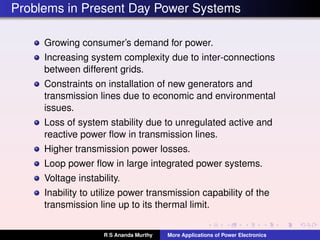
Growing consumer’s demand for power.
Increasing system complexity due to inter-connections
between different grids.
Constraints on installation of new generators and
transmission lines due to economic and environmental
issues.
Loss of system stability due to unregulated active and
reactive power flow in transmission lines.
Higher transmission power losses.
Loop power flow in large integrated power systems.
Voltage instability.
Inability to utilize power transmission capability of the
transmission line up to its thermal limit.
R S Ananda Murthy More Applications of Power Electronics
Inflexible Power Flow in Transmission Lines
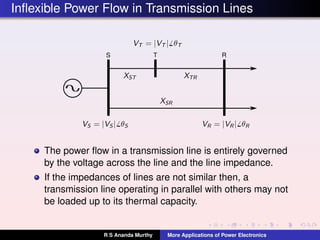
S RT
The power flow in a transmission line is entirely governed
by the voltage across the line and the line impedance.
If the impedances of lines are not similar then, a
transmission line operating in parallel with others may not
be loaded up to its thermal capacity.
R S Ananda Murthy More Applications of Power Electronics
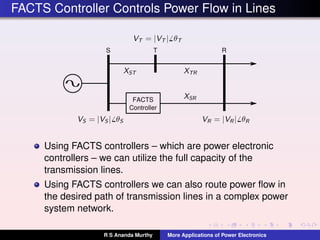
FACTS Controller Controls Power Flow in Lines
S RT
FACTS
Controller
Using FACTS controllers – which are power electronic
controllers – we can utilize the full capacity of the
transmission lines.
Using FACTS controllers we can also route power flow in
the desired path of transmission lines in a complex power
system network.
R S Ananda Murthy More Applications of Power Electronics
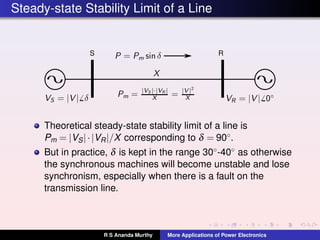
Steady-state Stability Limit of a Line
S R
Theoretical steady-state stability limit of a line is
Pm = |VS|·|VR|/X corresponding to δ = 90◦.
But in practice, δ is kept in the range 30◦-40◦ as otherwise
the synchronous machines will become unstable and lose
synchronism, especially when there is a fault on the
transmission line.
R S Ananda Murthy More Applications of Power Electronics
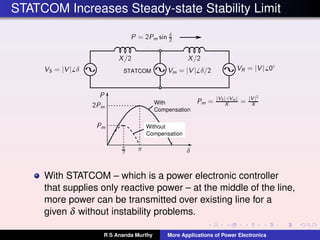
STATCOM Increases Steady-state Stability Limit
STATCOM
With
Compensation
Without
Compensation
With STATCOM – which is a power electronic controller
that supplies only reactive power – at the middle of the line,
more power can be transmitted over existing line for a
given δ without instability problems.
R S Ananda Murthy More Applications of Power Electronics
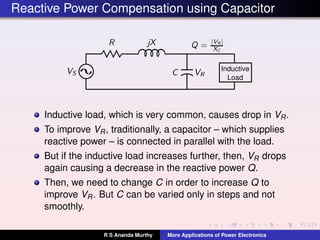
Reactive Power Compensation using Capacitor
Inductive
Load
Inductive load, which is very common, causes drop in VR.
To improve VR, traditionally, a capacitor – which supplies
reactive power – is connected in parallel with the load.
But if the inductive load increases further, then, VR drops
again causing a decrease in the reactive power Q.
Then, we need to change C in order to increase Q to
improve VR. But C can be varied only in steps and not
smoothly.
R S Ananda Murthy More Applications of Power Electronics
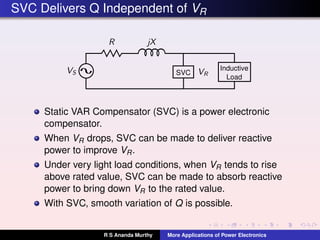
SVC Delivers Q Independent of VR
Inductive
Load
SVC
Static VAR Compensator (SVC) is a power electronic
compensator.
When VR drops, SVC can be made to deliver reactive
power to improve VR.
Under very light load conditions, when VR tends to rise
above rated value, SVC can be made to absorb reactive
power to bring down VR to the rated value.
With SVC, smooth variation of Q is possible.
R S Ananda Murthy More Applications of Power Electronics
Problems of Long Transmission Lines
Typically very long transmission lines carry power from
remote generating stations to the urban areas where user
loads are concentrated.
But very long lines have high inductive reactance due to
which the maximum power transmission capacity of the
line decreases which may lead to instability.
High impedance of long lines also causes low voltage at
the receiving end due to higher voltage drop in the line.
R S Ananda Murthy More Applications of Power Electronics
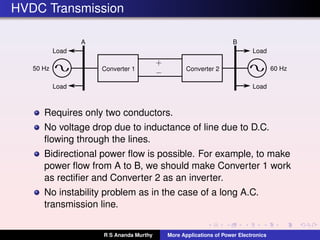
HVDC Transmission
Converter 1
A B
50 Hz 60 Hz
Load
Load
Load
Load
Converter 2
Requires only two conductors.
No voltage drop due to inductance of line due to D.C.
flowing through the lines.
Bidirectional power flow is possible. For example, to make
power flow from A to B, we should make Converter 1 work
as rectifier and Converter 2 as an inverter.
No instability problem as in the case of a long A.C.
transmission line.
R S Ananda Murthy More Applications of Power Electronics
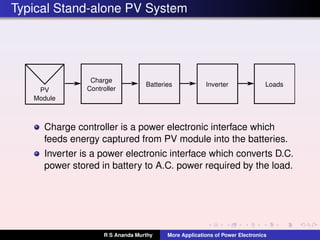
Typical Stand-alone PV System
PV
Module
Charge
Controller
Inverter LoadsBatteries
Charge controller is a power electronic interface which
feeds energy captured from PV module into the batteries.
Inverter is a power electronic interface which converts D.C.
power stored in battery to A.C. power required by the load.
R S Ananda Murthy More Applications of Power Electronics
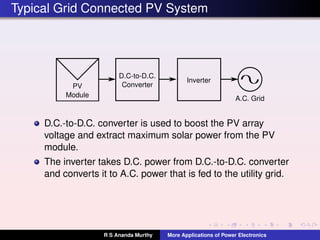
Typical Grid Connected PV System
PV
Module
D.C-to-D.C.
Converter
Inverter
A.C. Grid
D.C.-to-D.C. converter is used to boost the PV array
voltage and extract maximum solar power from the PV
module.
The inverter takes D.C. power from D.C.-to-D.C. converter
and converts it to A.C. power that is fed to the utility grid.
R S Ananda Murthy More Applications of Power Electronics
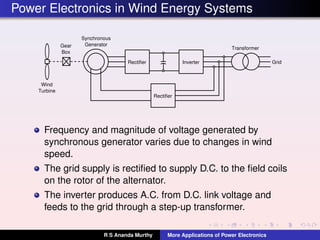
Power Electronics in Wind Energy Systems
Rectifier
Gear
Box
Inverter
Rectifier
Transformer
Synchronous
Generator
Grid
Wind
Turbine
Frequency and magnitude of voltage generated by
synchronous generator varies due to changes in wind
speed.
The grid supply is rectified to supply D.C. to the field coils
on the rotor of the alternator.
The inverter produces A.C. from D.C. link voltage and
feeds to the grid through a step-up transformer.
R S Ananda Murthy More Applications of Power Electronics
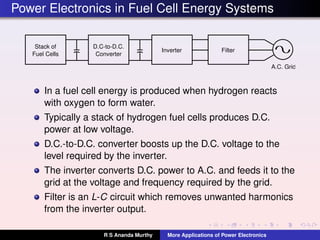
Power Electronics in Fuel Cell Energy Systems
D.C-to-D.C.
Converter
A.C. Grid
Stack of
Fuel Cells
Inverter Filter
In a fuel cell energy is produced when hydrogen reacts
with oxygen to form water.
Typically a stack of hydrogen fuel cells produces D.C.
power at low voltage.
D.C.-to-D.C. converter boosts up the D.C. voltage to the
level required by the inverter.
The inverter converts D.C. power to A.C. and feeds it to the
grid at the voltage and frequency required by the grid.
Filter is an L-C circuit which removes unwanted harmonics
from the inverter output.
R S Ananda Murthy More Applications of Power Electronics
Power Electronics Tries to Achieve These
In power electronics we always strive to achieve these —
High energy efficiency.
Compactness and light weight of hardware.
High reliability.
Economy.
R S Ananda Murthy More Applications of Power Electronics
Power Electronics is Enabling Technology
“In the highly automated industrial environment struggling
for high quality products with low cost, it appears that two
technologies will be most dominating: computers and
power electronics ...” – Bimal K. Bose, “Energy,
Environment and Advances in Power Electronics”, IEEE
Transactions on Power Electronics, Vol. 15, No. 4, July
2000, p. 680.
“Modern computers, communication and electronic
systems get life blood from power electronics. Modern
industrial processes, transportation and energy systems
benefit tremendously in productivity and quality
enhancement with the help of power electronics.”, ibid,
p. 693.
R S Ananda Murthy More Applications of Power Electronics
Next Lecture...
In the next lecture we will discuss semiconductor switching
devices used in power electronics.
Thank You.
R S Ananda Murthy More Applications of Power Electronics

Lecture-3 : More Applications of Power Electronics

  • 1.
    More Applications ofPower Electronics (Lecture-3) R S Ananda Murthy Associate Professor and Head Department of Electrical & Electronics Engineering, Sri Jayachamarajendra College of Engineering, Mysore 570 006 R S Ananda Murthy More Applications of Power Electronics
  • 2.
    Problems in PresentDay Power Systems Growing consumer’s demand for power. Increasing system complexity due to inter-connections between different grids. Constraints on installation of new generators and transmission lines due to economic and environmental issues. Loss of system stability due to unregulated active and reactive power flow in transmission lines. Higher transmission power losses. Loop power flow in large integrated power systems. Voltage instability. Inability to utilize power transmission capability of the transmission line up to its thermal limit. R S Ananda Murthy More Applications of Power Electronics
  • 3.
    Inflexible Power Flowin Transmission Lines S RT The power flow in a transmission line is entirely governed by the voltage across the line and the line impedance. If the impedances of lines are not similar then, a transmission line operating in parallel with others may not be loaded up to its thermal capacity. R S Ananda Murthy More Applications of Power Electronics
  • 4.
    FACTS Controller ControlsPower Flow in Lines S RT FACTS Controller Using FACTS controllers – which are power electronic controllers – we can utilize the full capacity of the transmission lines. Using FACTS controllers we can also route power flow in the desired path of transmission lines in a complex power system network. R S Ananda Murthy More Applications of Power Electronics
  • 5.
    Steady-state Stability Limitof a Line S R Theoretical steady-state stability limit of a line is Pm = |VS|·|VR|/X corresponding to δ = 90◦. But in practice, δ is kept in the range 30◦-40◦ as otherwise the synchronous machines will become unstable and lose synchronism, especially when there is a fault on the transmission line. R S Ananda Murthy More Applications of Power Electronics
  • 6.
    STATCOM Increases Steady-stateStability Limit STATCOM With Compensation Without Compensation With STATCOM – which is a power electronic controller that supplies only reactive power – at the middle of the line, more power can be transmitted over existing line for a given δ without instability problems. R S Ananda Murthy More Applications of Power Electronics
  • 7.
    Reactive Power Compensationusing Capacitor Inductive Load Inductive load, which is very common, causes drop in VR. To improve VR, traditionally, a capacitor – which supplies reactive power – is connected in parallel with the load. But if the inductive load increases further, then, VR drops again causing a decrease in the reactive power Q. Then, we need to change C in order to increase Q to improve VR. But C can be varied only in steps and not smoothly. R S Ananda Murthy More Applications of Power Electronics
  • 8.
    SVC Delivers QIndependent of VR Inductive Load SVC Static VAR Compensator (SVC) is a power electronic compensator. When VR drops, SVC can be made to deliver reactive power to improve VR. Under very light load conditions, when VR tends to rise above rated value, SVC can be made to absorb reactive power to bring down VR to the rated value. With SVC, smooth variation of Q is possible. R S Ananda Murthy More Applications of Power Electronics
  • 9.
    Problems of LongTransmission Lines Typically very long transmission lines carry power from remote generating stations to the urban areas where user loads are concentrated. But very long lines have high inductive reactance due to which the maximum power transmission capacity of the line decreases which may lead to instability. High impedance of long lines also causes low voltage at the receiving end due to higher voltage drop in the line. R S Ananda Murthy More Applications of Power Electronics
  • 10.
    HVDC Transmission Converter 1 AB 50 Hz 60 Hz Load Load Load Load Converter 2 Requires only two conductors. No voltage drop due to inductance of line due to D.C. flowing through the lines. Bidirectional power flow is possible. For example, to make power flow from A to B, we should make Converter 1 work as rectifier and Converter 2 as an inverter. No instability problem as in the case of a long A.C. transmission line. R S Ananda Murthy More Applications of Power Electronics
  • 11.
    Typical Stand-alone PVSystem PV Module Charge Controller Inverter LoadsBatteries Charge controller is a power electronic interface which feeds energy captured from PV module into the batteries. Inverter is a power electronic interface which converts D.C. power stored in battery to A.C. power required by the load. R S Ananda Murthy More Applications of Power Electronics
  • 12.
    Typical Grid ConnectedPV System PV Module D.C-to-D.C. Converter Inverter A.C. Grid D.C.-to-D.C. converter is used to boost the PV array voltage and extract maximum solar power from the PV module. The inverter takes D.C. power from D.C.-to-D.C. converter and converts it to A.C. power that is fed to the utility grid. R S Ananda Murthy More Applications of Power Electronics
  • 13.
    Power Electronics inWind Energy Systems Rectifier Gear Box Inverter Rectifier Transformer Synchronous Generator Grid Wind Turbine Frequency and magnitude of voltage generated by synchronous generator varies due to changes in wind speed. The grid supply is rectified to supply D.C. to the field coils on the rotor of the alternator. The inverter produces A.C. from D.C. link voltage and feeds to the grid through a step-up transformer. R S Ananda Murthy More Applications of Power Electronics
  • 14.
    Power Electronics inFuel Cell Energy Systems D.C-to-D.C. Converter A.C. Grid Stack of Fuel Cells Inverter Filter In a fuel cell energy is produced when hydrogen reacts with oxygen to form water. Typically a stack of hydrogen fuel cells produces D.C. power at low voltage. D.C.-to-D.C. converter boosts up the D.C. voltage to the level required by the inverter. The inverter converts D.C. power to A.C. and feeds it to the grid at the voltage and frequency required by the grid. Filter is an L-C circuit which removes unwanted harmonics from the inverter output. R S Ananda Murthy More Applications of Power Electronics
  • 15.
    Power Electronics Triesto Achieve These In power electronics we always strive to achieve these — High energy efficiency. Compactness and light weight of hardware. High reliability. Economy. R S Ananda Murthy More Applications of Power Electronics
  • 16.
    Power Electronics isEnabling Technology “In the highly automated industrial environment struggling for high quality products with low cost, it appears that two technologies will be most dominating: computers and power electronics ...” – Bimal K. Bose, “Energy, Environment and Advances in Power Electronics”, IEEE Transactions on Power Electronics, Vol. 15, No. 4, July 2000, p. 680. “Modern computers, communication and electronic systems get life blood from power electronics. Modern industrial processes, transportation and energy systems benefit tremendously in productivity and quality enhancement with the help of power electronics.”, ibid, p. 693. R S Ananda Murthy More Applications of Power Electronics
  • 17.
    Next Lecture... In thenext lecture we will discuss semiconductor switching devices used in power electronics. Thank You. R S Ananda Murthy More Applications of Power Electronics