Volume Studies
CIVL 4162/6162
Lesson Objectives
• Define critical parameters of interest in traffic
volume studies
• Compute and interpret hourly, daily, weekly,
and monthly adjustment factors
• Collect intersection traffic volume counts
• Describe origin-destination traffic volume
studies
Why are Volume Studies Needed?
• Transportation planning/forecasts
• Assessing operations
• Impact analysis
• Determining need for traffic control,
etc.
Traffic counts provide the primary
measure of demand.
Parameters of Interest (1)
• Volume
• Rate of flow
• Demand
• Capacity
Parameters of Interest (2)
• Volume
– The number of vehicles (or persons) passing a point
during a specified time period which is usually one
hour but need not be.
• Rate of Flow
– The rate at which vehicles (or persons) pass a
point during a specified time period less than an
hour, expressed as an equivalent hourly rate.
Parameters of Interest (3)
• Demand
– The number of vehicles (or persons) that desire to
travel past a point during a specified time period
(usually one hour).
• Capacity
– The maximum rate at which vehicles can traverse
a point or short segment during a specified time
period.
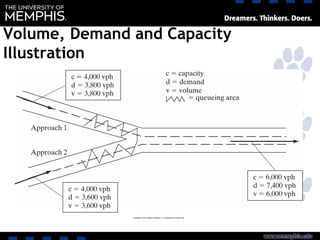
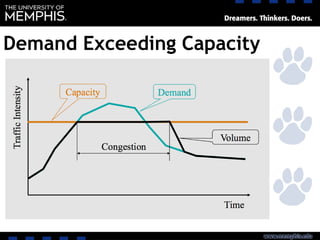
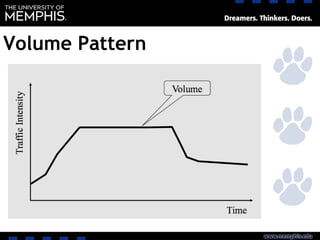
Volume, Demand and Capacity
Illustration
Demand Exceeding Capacity
Volume Pattern
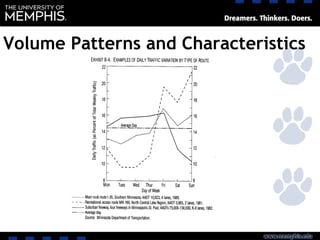
Volume Patterns and Characteristics
• Traffic demand varies!
• Choosing design hour may be complex
• Very important to understand volume
variation patterns
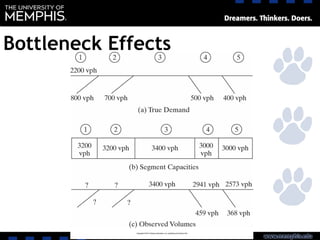
Bottleneck Effects
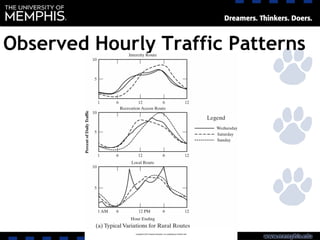
Observed Hourly Traffic Patterns
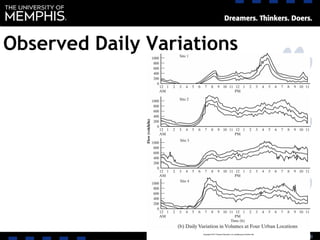
Observed Daily Variations
Volume Patterns and Characteristics
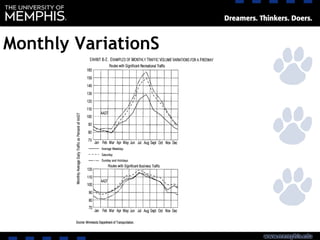
Monthly VariationS
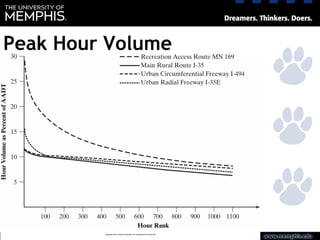
Peak Hour Volume
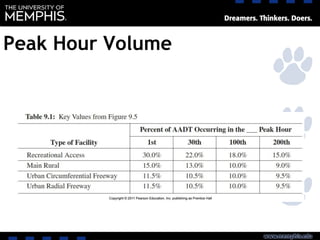
Peak Hour Volume
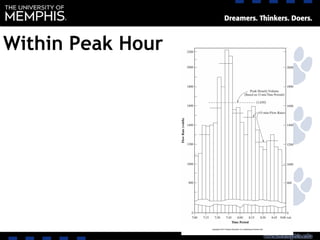
Within Peak Hour
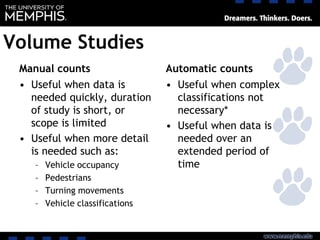
Volume Studies
Manual counts
• Useful when data is
needed quickly, duration
of study is short, or
scope is limited
• Useful when more detail
is needed such as:
– Vehicle occupancy
– Pedestrians
– Turning movements
– Vehicle classifications
Automatic counts
• Useful when complex
classifications not
necessary*
• Useful when data is
needed over an
extended period of
time
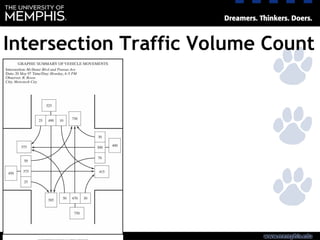
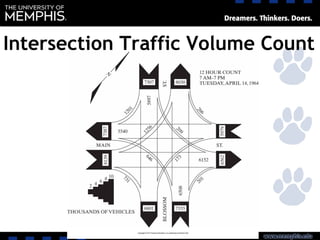
Intersection Traffic Volume Count
Limited Network Volume Studies
• Sampling techniques are used along
with statistical manipulation to
develop an hourly volume map for
the network
• Requires identification of locations
with similar demand patterns over
time
• Uses control and coverage counts
Limited Network Volume Studies
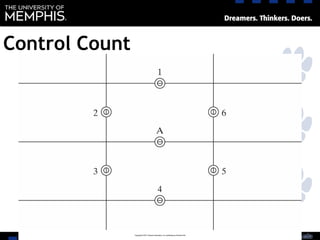
• Control count - maintained throughout study
period; selected locations are measured to
identify demand variation patterns
• Coverage count – taken at all locations in
study area for a portion of study period
(samples)
• Midblock counts
Limited Network Volume Studies
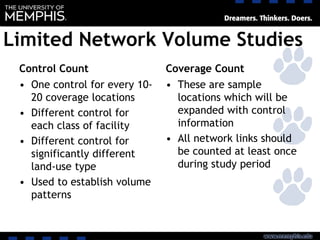
Control Count
• One control for every 10-
20 coverage locations
• Different control for
each class of facility
• Different control for
significantly different
land-use type
• Used to establish volume
patterns
Coverage Count
• These are sample
locations which will be
expanded with control
information
• All network links should
be counted at least once
during study period
Control Count
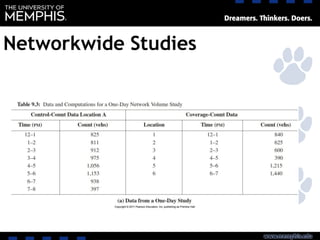
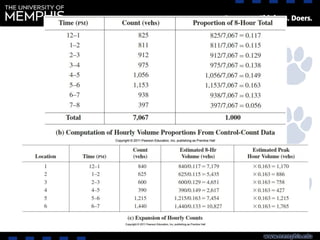
Networkwide Studies
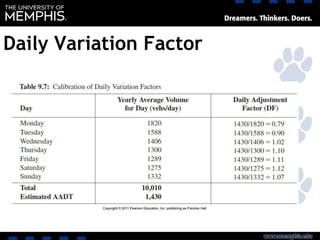
Daily Variation Factor
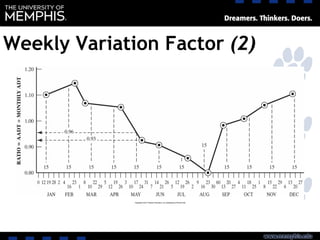
Weekly Variation Factor (2)
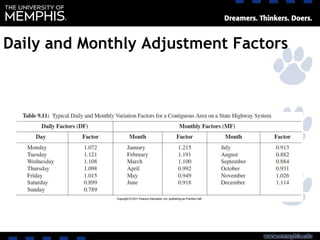
Daily and Monthly Adjustment Factors
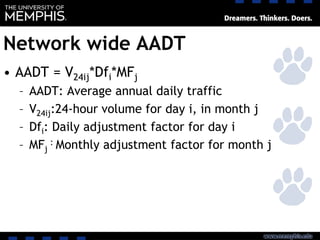
Network wide AADT
• AADT = V24ij*Dfi*MFj
– AADT: Average annual daily traffic
– V24ij:24-hour volume for day i, in month j
– Dfi: Daily adjustment factor for day i
– MFj
: Monthly adjustment factor for month j
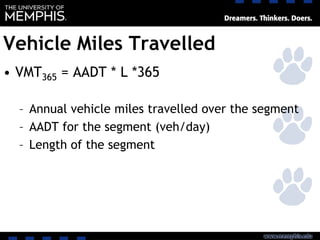
Vehicle Miles Travelled
• VMT365 = AADT * L *365
– Annual vehicle miles travelled over the segment
– AADT for the segment (veh/day)
– Length of the segment
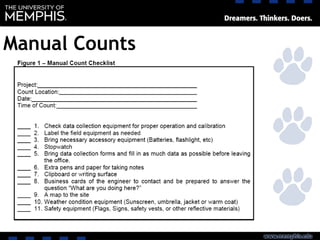
Manual Counts
http://jamartech.com
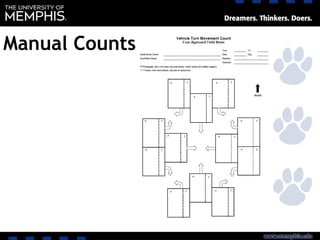
Manual Counts
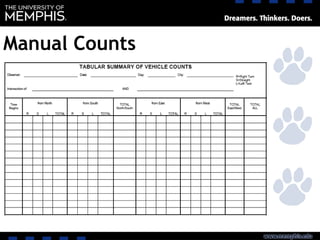
Manual Counts
Manual Counts
Field Considerations
• Everyone should be familiar with count
procedure/labels/equipment
• Must have enough members in field to
adequately record, provide relief, and to
address safety concerns
• Be prepared!!!
Field Considerations
• Observer locations (manual studies)
• Count location (automatic studies)
• Be sure to secure equipment for
automatic counts
• Install equipment during very low
volume time periods
• Safety vests!
Count Periods
• 2 hours, peak period
• 4 hours, am/pm peak period
• 6 hours, am/midday/pm peak periods
• 12 hours daytime (7am-7pm)
• 24 hours, week, month, etc. (automatic)
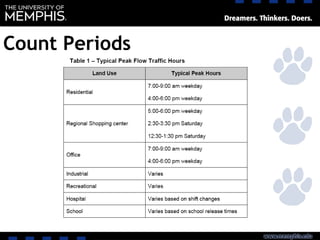
Count Periods
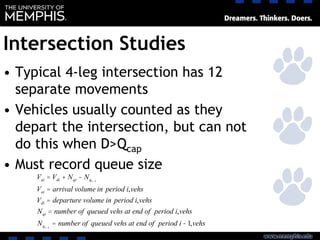
Intersection Studies
• Typical 4-leg intersection has 12
separate movements
• Vehicles usually counted as they
depart the intersection, but can not
do this when D>Qcap
• Must record queue size
Vai = Vdi + Nqi - Nqi-1
Vai = arrival volume in period i,vehs
Vdi = departure volume in period i,vehs
Nqi = number of queued vehs at end of period i,vehs
Nqi-1
= number of queued vehs at end of period i -1,vehs
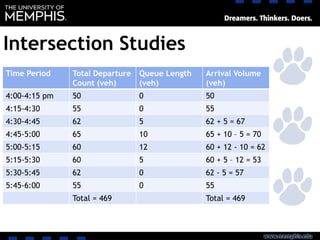
Intersection Studies
Time Period Total Departure
Count (veh)
Queue Length
(veh)
Arrival Volume
(veh)
4:00-4:15 pm 50 0 50
4:15-4:30 55 0 55
4:30-4:45 62 5 62 + 5 = 67
4:45-5:00 65 10 65 + 10 – 5 = 70
5:00-5:15 60 12 60 + 12 - 10 = 62
5:15-5:30 60 5 60 + 5 – 12 = 53
5:30-5:45 62 0 62 - 5 = 57
5:45-6:00 55 0 55
Total = 469 Total = 469
Statewide Programs
• Involves entire state highway system in
continuous study period
• AADT/ADT (http://ww3.tdot.state.tn.us/trafficHistory/)
• Vehicle-miles traveled
• Usually every 2 mile state hwy segment is
included in coverage count each year
• Develop AADT estimate for each coverage
location annually
• Control locations may be permanent; data
collected over entire year
Specialized Counting Studies
• Origin and destination counts
– Weaving areas
– Freeway studies
– Major activity centers
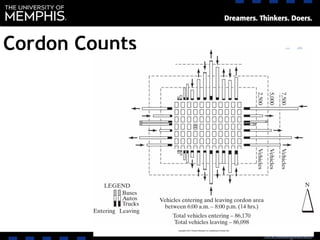
• Cordon counts
– Estimate vehicle and person accumulation within the cordon
– Used to supplement O-D studies or for trend analysis
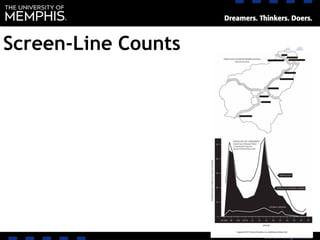
• Screen-line
– Record travel from one area to another
– Used to adjust results of O-D studies
For specialized counts, must have more than just
count data.
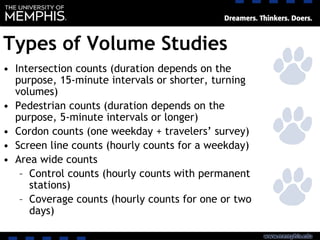
Types of Volume Studies
• Intersection counts (duration depends on the
purpose, 15-minute intervals or shorter, turning
volumes)
• Pedestrian counts (duration depends on the
purpose, 5-minute intervals or longer)
• Cordon counts (one weekday + travelers’ survey)
• Screen line counts (hourly counts for a weekday)
• Area wide counts
– Control counts (hourly counts with permanent
stations)
– Coverage counts (hourly counts for one or two
days)
Origin-Destination Counts
• License plate studies
– Recording license plates at entry and exit
• Postcard studies
– Handing out color coded post cards at entry points
and collecting them at exit
• Interview studies
– Stopping vehicles and interviewing them about trip
details
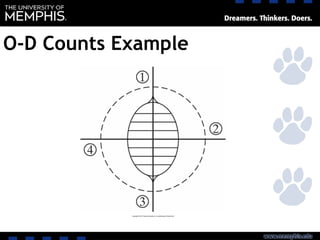
O-D Counts Example
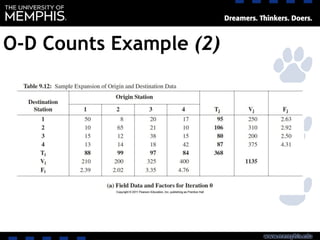
O-D Counts Example (2)
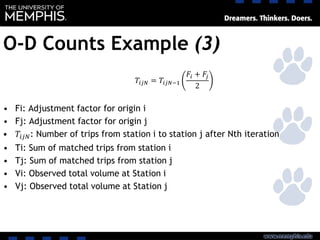
O-D Counts Example (3)
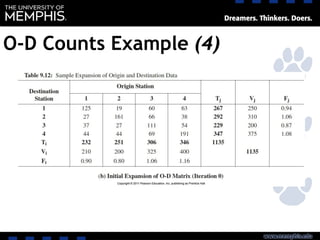
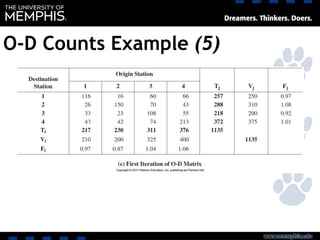
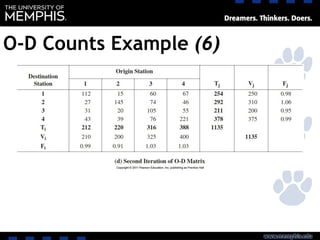
• Fi: Adjustment factor for origin i
• Fj: Adjustment factor for origin j
• 𝑇𝑖𝑗𝑁: Number of trips from station i to station j after Nth iteration
• Ti: Sum of matched trips from station i
• Tj: Sum of matched trips from station j
• Vi: Observed total volume at Station i
• Vj: Observed total volume at Station j
𝑇𝑖𝑗𝑁 = 𝑇𝑖𝑗𝑁−1
𝐹𝑖 + 𝐹𝑗
2
O-D Counts Example (4)
O-D Counts Example (5)
O-D Counts Example (6)
Cordon Counts
Screen-Line Counts
For more information…
• Chapter 2: Manual of
Transportation Engineering
Studies, 2nd Edition, ITE 2010.

L4 volume studies

  • 1.
  • 2.
    Lesson Objectives • Definecritical parameters of interest in traffic volume studies • Compute and interpret hourly, daily, weekly, and monthly adjustment factors • Collect intersection traffic volume counts • Describe origin-destination traffic volume studies
  • 3.
    Why are VolumeStudies Needed? • Transportation planning/forecasts • Assessing operations • Impact analysis • Determining need for traffic control, etc. Traffic counts provide the primary measure of demand.
  • 4.
    Parameters of Interest(1) • Volume • Rate of flow • Demand • Capacity
  • 5.
    Parameters of Interest(2) • Volume – The number of vehicles (or persons) passing a point during a specified time period which is usually one hour but need not be. • Rate of Flow – The rate at which vehicles (or persons) pass a point during a specified time period less than an hour, expressed as an equivalent hourly rate.
  • 6.
    Parameters of Interest(3) • Demand – The number of vehicles (or persons) that desire to travel past a point during a specified time period (usually one hour). • Capacity – The maximum rate at which vehicles can traverse a point or short segment during a specified time period.
  • 7.
    Volume, Demand andCapacity Illustration
  • 8.
  • 9.
  • 10.
    Volume Patterns andCharacteristics • Traffic demand varies! • Choosing design hour may be complex • Very important to understand volume variation patterns
  • 11.
  • 12.
  • 13.
  • 14.
    Volume Patterns andCharacteristics
  • 15.
  • 16.
  • 17.
  • 18.
  • 19.
    Volume Studies Manual counts •Useful when data is needed quickly, duration of study is short, or scope is limited • Useful when more detail is needed such as: – Vehicle occupancy – Pedestrians – Turning movements – Vehicle classifications Automatic counts • Useful when complex classifications not necessary* • Useful when data is needed over an extended period of time
  • 20.
  • 21.
  • 22.
    Limited Network VolumeStudies • Sampling techniques are used along with statistical manipulation to develop an hourly volume map for the network • Requires identification of locations with similar demand patterns over time • Uses control and coverage counts
  • 23.
    Limited Network VolumeStudies • Control count - maintained throughout study period; selected locations are measured to identify demand variation patterns • Coverage count – taken at all locations in study area for a portion of study period (samples) • Midblock counts
  • 24.
    Limited Network VolumeStudies Control Count • One control for every 10- 20 coverage locations • Different control for each class of facility • Different control for significantly different land-use type • Used to establish volume patterns Coverage Count • These are sample locations which will be expanded with control information • All network links should be counted at least once during study period
  • 25.
  • 26.
  • 28.
  • 29.
  • 30.
    Daily and MonthlyAdjustment Factors
  • 31.
    Network wide AADT •AADT = V24ij*Dfi*MFj – AADT: Average annual daily traffic – V24ij:24-hour volume for day i, in month j – Dfi: Daily adjustment factor for day i – MFj : Monthly adjustment factor for month j
  • 32.
    Vehicle Miles Travelled •VMT365 = AADT * L *365 – Annual vehicle miles travelled over the segment – AADT for the segment (veh/day) – Length of the segment
  • 33.
  • 34.
  • 35.
  • 36.
  • 37.
    Field Considerations • Everyoneshould be familiar with count procedure/labels/equipment • Must have enough members in field to adequately record, provide relief, and to address safety concerns • Be prepared!!!
  • 38.
    Field Considerations • Observerlocations (manual studies) • Count location (automatic studies) • Be sure to secure equipment for automatic counts • Install equipment during very low volume time periods • Safety vests!
  • 39.
    Count Periods • 2hours, peak period • 4 hours, am/pm peak period • 6 hours, am/midday/pm peak periods • 12 hours daytime (7am-7pm) • 24 hours, week, month, etc. (automatic)
  • 40.
  • 41.
    Intersection Studies • Typical4-leg intersection has 12 separate movements • Vehicles usually counted as they depart the intersection, but can not do this when D>Qcap • Must record queue size Vai = Vdi + Nqi - Nqi-1 Vai = arrival volume in period i,vehs Vdi = departure volume in period i,vehs Nqi = number of queued vehs at end of period i,vehs Nqi-1 = number of queued vehs at end of period i -1,vehs
  • 42.
    Intersection Studies Time PeriodTotal Departure Count (veh) Queue Length (veh) Arrival Volume (veh) 4:00-4:15 pm 50 0 50 4:15-4:30 55 0 55 4:30-4:45 62 5 62 + 5 = 67 4:45-5:00 65 10 65 + 10 – 5 = 70 5:00-5:15 60 12 60 + 12 - 10 = 62 5:15-5:30 60 5 60 + 5 – 12 = 53 5:30-5:45 62 0 62 - 5 = 57 5:45-6:00 55 0 55 Total = 469 Total = 469
  • 43.
    Statewide Programs • Involvesentire state highway system in continuous study period • AADT/ADT (http://ww3.tdot.state.tn.us/trafficHistory/) • Vehicle-miles traveled • Usually every 2 mile state hwy segment is included in coverage count each year • Develop AADT estimate for each coverage location annually • Control locations may be permanent; data collected over entire year
  • 44.
    Specialized Counting Studies •Origin and destination counts – Weaving areas – Freeway studies – Major activity centers • Cordon counts – Estimate vehicle and person accumulation within the cordon – Used to supplement O-D studies or for trend analysis • Screen-line – Record travel from one area to another – Used to adjust results of O-D studies For specialized counts, must have more than just count data.
  • 45.
    Types of VolumeStudies • Intersection counts (duration depends on the purpose, 15-minute intervals or shorter, turning volumes) • Pedestrian counts (duration depends on the purpose, 5-minute intervals or longer) • Cordon counts (one weekday + travelers’ survey) • Screen line counts (hourly counts for a weekday) • Area wide counts – Control counts (hourly counts with permanent stations) – Coverage counts (hourly counts for one or two days)
  • 46.
    Origin-Destination Counts • Licenseplate studies – Recording license plates at entry and exit • Postcard studies – Handing out color coded post cards at entry points and collecting them at exit • Interview studies – Stopping vehicles and interviewing them about trip details
  • 47.
  • 48.
  • 49.
    O-D Counts Example(3) • Fi: Adjustment factor for origin i • Fj: Adjustment factor for origin j • 𝑇𝑖𝑗𝑁: Number of trips from station i to station j after Nth iteration • Ti: Sum of matched trips from station i • Tj: Sum of matched trips from station j • Vi: Observed total volume at Station i • Vj: Observed total volume at Station j 𝑇𝑖𝑗𝑁 = 𝑇𝑖𝑗𝑁−1 𝐹𝑖 + 𝐹𝑗 2
  • 50.
  • 51.
  • 52.
  • 53.
  • 54.
  • 55.
    For more information… •Chapter 2: Manual of Transportation Engineering Studies, 2nd Edition, ITE 2010.