Module 1
Principles of Transportation Engineering
Prof.Shweta N.Vantamuri
Civil Engineering Department
S.G.B.I.T.
Belagavi
INTRODUCTION
• Mobility is a basic human need.
• Travels either for food or leisure.
• Transport of raw materials to a
manufacturing unit or finished goods for
consumption.
• “Transportation System” is used to refer
to the equipment and logistics of
transporting passengers and goods.
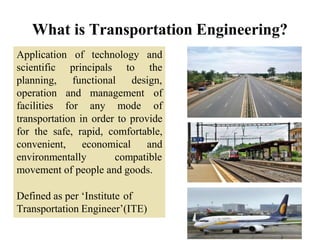
What is Transportation Engineering?
of technology and
the
Application
scientific
planning,
principals to
functional design,
operation and management of
facilities for any mode of
transportation in order to provide
for the safe, rapid, comfortable,
convenient, economical and
environmentally compatible
movement of people and goods.
Defined as per ‘Institute of
Transportation Engineer’(ITE)
 The evaluation and advancement in Transportation facilities
have been closely linked with the development of human being.
 The economic status of any country depends upon the how well
served the country is by different modes of transportation.
 For human need all the agricultural or industrial products need
to transport at various stages from production to distribution
 Transportation is essential for strategic movement in emergency
for defense of the country and to maintain low and order.
© S.Das
Importance of Transportation
Engineering
Transportation system
 Diverse characteristics
1. Multi-modal- air, land or sea
2. Multi-sector- government, private industry, and public.
3. Multi-problem - national and international policy, carrier
management issues, regulatory, institutional and financial
policies
4. Multi-objective -Aiming at national and regional economic
development, urban development, environment quality, and
social quality.
5. Multi-disciplinary - the theories and methods of engineering,
economics, operations research, political science, psychology,
other natural, and social sciences, management and law.
© S.Das
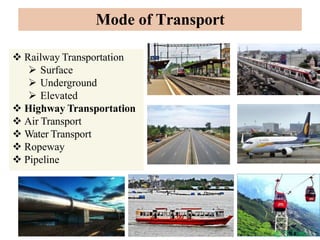
Mode of Transport
 Railway Transportation
 Surface
 Underground
 Elevated
 Highway Transportation
 Air Transport
 Water Transport
 Ropeway
 Pipeline
© S.Das
Advantage in Road Transport
Among all road transportation is nearest to the people
 Low Capital Investment
 Flexible Service
 More freedom to users while travelling
 Ability to accommodate various types of vehicle at a time
Quick and assured door to door service
Faster and cheaper service particularly for short distance
travel
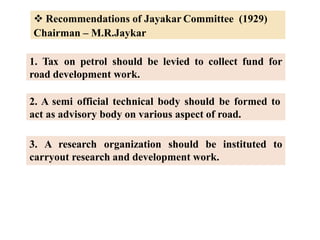
 Recommendations of Jayakar Committee (1929)
Chairman – M.R.Jaykar
1. Tax on petrol should be levied to collect fund for
road development work.
2. A semi official technical body should be formed to
act as advisory body on various aspect of road.
3. A research organization should be instituted to
carryout research and development work.
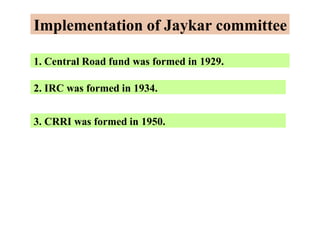
Implementation of Jaykar committee
1. Central Road fund was formed in 1929.
2. IRC was formed in 1934.
3. CRRI was formed in 1950.
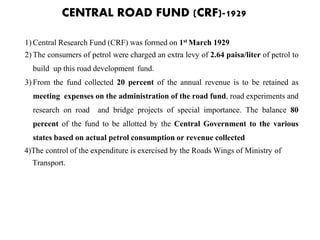
CENTRAL ROAD FUND (CRF)-1929
1) Central Research Fund (CRF) was formed on 1st March 1929
2) The consumers of petrol were charged an extra levy of 2.64 paisa/liter of petrol to
build up this road development fund.
3) From the fund collected 20 percent of the annual revenue is to be retained as
meeting expenses on the administration of the road fund, road experiments and
research on road and bridge projects of special importance. The balance 80
percent of the fund to be allotted by the Central Government to the various
states based on actual petrol consumption or revenue collected
4)The control of the expenditure is exercised by the Roads Wings of Ministry of
Transport.
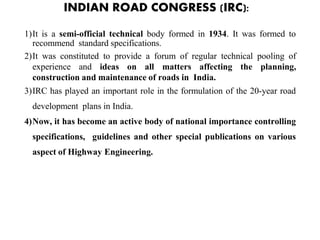
INDIAN ROAD CONGRESS (IRC):
1)It is a semi-official technical body formed in 1934. It was formed to
recommend standard specifications.
2)It was constituted to provide a forum of regular technical pooling of
experience and ideas on all matters affecting the planning,
construction and maintenance of roads in India.
3)IRC has played an important role in the formulation of the 20-year road
development plans in India.
4)Now, it has become an active body of national importance controlling
specifications, guidelines and other special publications on various
aspect of Highway Engineering.
CENTRAL ROAD RESEARCH INSTITUTE (CRRI):
1)CRRI was formed in the year 1950 at New Delhi
2)It was formed for research in various aspect of highway
engineering
3)It is one of the National laboratories of the Council of
Scientific and Industrial Research.
4)This institute is mainly engaged in applied research and offers
technical advice to state governments and the industries on
various problems concerning roads.
Classification of roads
• Classification is done on following bases.
– According to traffic.
– According to transport tonnage
– According to importance.
– According to Location and functions.
– According to materials.
Highway Development and Planning
1.According to Traffic
2.According to Transport tonnage
• AccordingtoMaterialused
– Earthenroad
– WaterboundmacadamRoad
– BituminousRoad
– Cementconcreteroad
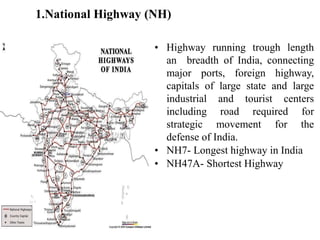
1.National Highway (NH)
• Highway running trough length
an breadth of India, connecting
major ports, foreign highway,
capitals of large state and large
industrial and tourist centers
including road required for
strategic movement for the
defense of India.
• NH7- Longest highway in India
• NH47A- Shortest Highway
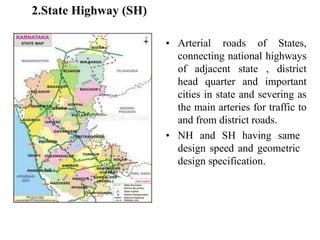
2.State Highway (SH)
• Arterial roads of States,
connecting national highways
of adjacent state , district
head quarter and important
cities in state and severing as
the main arteries for traffic to
and from district roads.
• NH and SH having same
design speed and geometric
design specification.
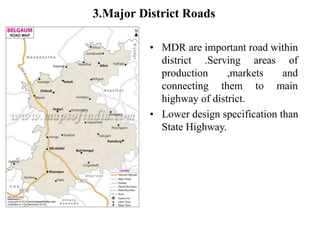
3.Major District Roads
• MDR are important road within
district .Serving areas of
production ,markets and
connecting them to main
highway of district.
• Lower design specification than
State Highway.
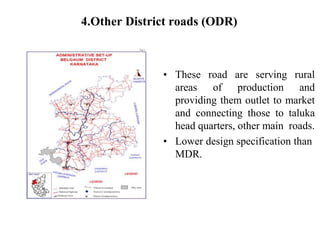
4.Other District roads (ODR)
• These road are serving rural
areas of production and
providing them outlet to market
and connecting those to taluka
head quarters, other main roads.
• Lower design specification than
MDR.
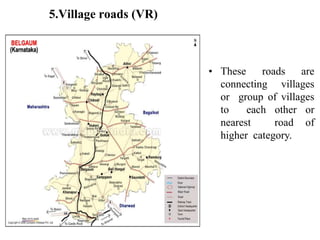
5.Village roads (VR)
• These roads are
connecting villages
or group of villages
to each other or
nearest road of
higher category.
Classification according to 3rd road development plan
• According to Third road development plan classification is as
follows
– Primary System
• Express way
• National Highway
– Secondary System
• State Highway
• Major District Road
– Tertiary System
• Other district road
• Village road
Classification of Urban road
• Arterial Road:
– High level traffic mobility
• Sub- Arterial Road:
– Low level traffic mobility compare to Arterial road.
• Collector Streets :
– Provide access to arterial road
– Collect and distribute traffic from local streets.
• Local Streets :
– Provide access to adjoining streets.
ROAD PATTERNS
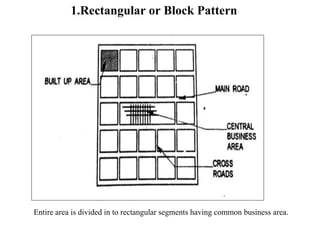
1. Rectangular or Block Pattern
2. Hexagonal Pattern
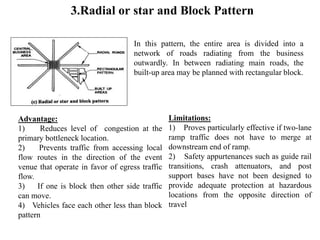
3. Radial or Star and block Pattern
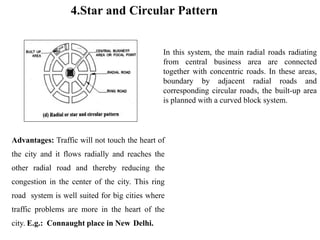
4. Radial or Star and circular Pattern
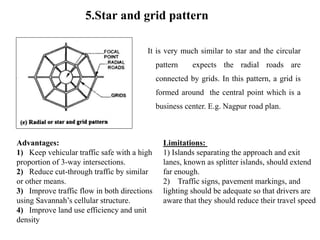
5. Radial or star and grid Pattern
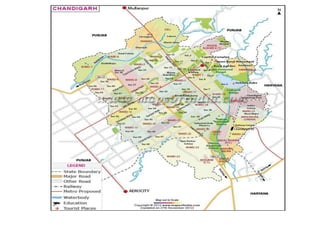
1.Rectangular or Block Pattern
Entire area is divided in to rectangular segments having common business area.
ADVANTAGE
The rectangular plots may be further divided into small rectangular blocks for
construction of buildings placed blocks to blocks having roads on their front. The
construction and maintenance of roads of this pattern is comparatively easier.
LIMITATION
This pattern is not very much convenient from traffic point of view, because at the
intersections, the vehicles face each other.
Ex.Chandigarh
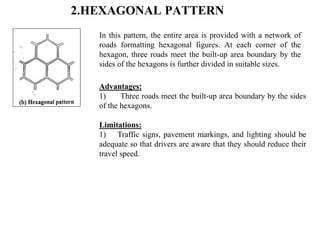
2.HEXAGONAL PATTERN
In this pattern, the entire area is provided with a network of
roads formatting hexagonal figures. At each corner of the
hexagon, three roads meet the built-up area boundary by the
sides of the hexagons is further divided in suitable sizes.
Advantages:
1) Three roads meet the built-up area boundary by the sides
of the hexagons.
Limitations:
1) Traffic signs, pavement markings, and lighting should be
adequate so that drivers are aware that they should reduce their
travel speed.
3.Radial or star and Block Pattern
In this pattern, the entire area is divided into a
network of roads radiating from the business
outwardly. In between radiating main roads, the
built-up area may be planned with rectangular block.
Advantage:
1) Reduces level of congestion at the
primary bottleneck location.
2) Prevents traffic from accessing local
flow routes in the direction of the event
venue that operate in favor of egress traffic
flow.
3) If one is block then other side traffic
can move.
4) Vehicles face each other less than block
pattern
Limitations:
1) Proves particularly effective if two-lane
ramp traffic does not have to merge at
downstream end of ramp.
2) Safety appurtenances such as guide rail
transitions, crash attenuators, and post
support bases have not been designed to
provide adequate protection at hazardous
locations from the opposite direction of
travel
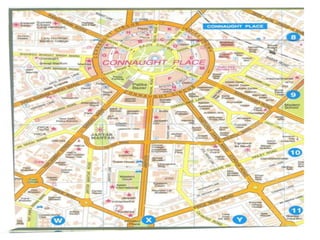
4.Star and Circular Pattern
In this system, the main radial roads radiating
from central business area are connected
together with concentric roads. In these areas,
boundary by adjacent radial roads and
corresponding circular roads, the built-up area
is planned with a curved block system.
Advantages: Traffic will not touch the heart of
the city and it flows radially and reaches the
other radial road and thereby reducing the
congestion in the center of the city. This ring
road system is well suited for big cities where
traffic problems are more in the heart of the
city. E.g.: Connaught place in New Delhi.
5.Star and grid pattern
It is very much similar to star and the circular
pattern expects the radial roads are
connected by grids. In this pattern, a grid is
formed around the central point which is a
business center. E.g. Nagpur road plan.
Advantages:
1) Keep vehicular traffic safe with a high
proportion of 3-way intersections.
2) Reduce cut-through traffic by similar
or other means.
3) Improve traffic flow in both directions
using Savannah’s cellular structure.
4) Improve land use efficiency and unit
density
Limitations:
1) Islands separating the approach and exit
lanes, known as splitter islands, should extend
far enough.
2) Traffic signs, pavement markings, and
lighting should be adequate so that drivers are
aware that they should reduce their travel speed

Principles of transportation engineering

  • 1.
    Module 1 Principles ofTransportation Engineering Prof.Shweta N.Vantamuri Civil Engineering Department S.G.B.I.T. Belagavi
  • 2.
    INTRODUCTION • Mobility isa basic human need. • Travels either for food or leisure. • Transport of raw materials to a manufacturing unit or finished goods for consumption. • “Transportation System” is used to refer to the equipment and logistics of transporting passengers and goods.
  • 3.
    What is TransportationEngineering? of technology and the Application scientific planning, principals to functional design, operation and management of facilities for any mode of transportation in order to provide for the safe, rapid, comfortable, convenient, economical and environmentally compatible movement of people and goods. Defined as per ‘Institute of Transportation Engineer’(ITE)
  • 4.
     The evaluationand advancement in Transportation facilities have been closely linked with the development of human being.  The economic status of any country depends upon the how well served the country is by different modes of transportation.  For human need all the agricultural or industrial products need to transport at various stages from production to distribution  Transportation is essential for strategic movement in emergency for defense of the country and to maintain low and order. © S.Das Importance of Transportation Engineering
  • 5.
    Transportation system  Diversecharacteristics 1. Multi-modal- air, land or sea 2. Multi-sector- government, private industry, and public. 3. Multi-problem - national and international policy, carrier management issues, regulatory, institutional and financial policies 4. Multi-objective -Aiming at national and regional economic development, urban development, environment quality, and social quality. 5. Multi-disciplinary - the theories and methods of engineering, economics, operations research, political science, psychology, other natural, and social sciences, management and law. © S.Das
  • 6.
    Mode of Transport Railway Transportation  Surface  Underground  Elevated  Highway Transportation  Air Transport  Water Transport  Ropeway  Pipeline © S.Das
  • 7.
    Advantage in RoadTransport Among all road transportation is nearest to the people  Low Capital Investment  Flexible Service  More freedom to users while travelling  Ability to accommodate various types of vehicle at a time Quick and assured door to door service Faster and cheaper service particularly for short distance travel
  • 8.
     Recommendations ofJayakar Committee (1929) Chairman – M.R.Jaykar 1. Tax on petrol should be levied to collect fund for road development work. 2. A semi official technical body should be formed to act as advisory body on various aspect of road. 3. A research organization should be instituted to carryout research and development work.
  • 9.
    Implementation of Jaykarcommittee 1. Central Road fund was formed in 1929. 2. IRC was formed in 1934. 3. CRRI was formed in 1950.
  • 10.
    CENTRAL ROAD FUND(CRF)-1929 1) Central Research Fund (CRF) was formed on 1st March 1929 2) The consumers of petrol were charged an extra levy of 2.64 paisa/liter of petrol to build up this road development fund. 3) From the fund collected 20 percent of the annual revenue is to be retained as meeting expenses on the administration of the road fund, road experiments and research on road and bridge projects of special importance. The balance 80 percent of the fund to be allotted by the Central Government to the various states based on actual petrol consumption or revenue collected 4)The control of the expenditure is exercised by the Roads Wings of Ministry of Transport.
  • 11.
    INDIAN ROAD CONGRESS(IRC): 1)It is a semi-official technical body formed in 1934. It was formed to recommend standard specifications. 2)It was constituted to provide a forum of regular technical pooling of experience and ideas on all matters affecting the planning, construction and maintenance of roads in India. 3)IRC has played an important role in the formulation of the 20-year road development plans in India. 4)Now, it has become an active body of national importance controlling specifications, guidelines and other special publications on various aspect of Highway Engineering.
  • 12.
    CENTRAL ROAD RESEARCHINSTITUTE (CRRI): 1)CRRI was formed in the year 1950 at New Delhi 2)It was formed for research in various aspect of highway engineering 3)It is one of the National laboratories of the Council of Scientific and Industrial Research. 4)This institute is mainly engaged in applied research and offers technical advice to state governments and the industries on various problems concerning roads.
  • 13.
    Classification of roads •Classification is done on following bases. – According to traffic. – According to transport tonnage – According to importance. – According to Location and functions. – According to materials. Highway Development and Planning
  • 14.
  • 15.
    • AccordingtoMaterialused – Earthenroad –WaterboundmacadamRoad – BituminousRoad – Cementconcreteroad
  • 16.
    1.National Highway (NH) •Highway running trough length an breadth of India, connecting major ports, foreign highway, capitals of large state and large industrial and tourist centers including road required for strategic movement for the defense of India. • NH7- Longest highway in India • NH47A- Shortest Highway
  • 17.
    2.State Highway (SH) •Arterial roads of States, connecting national highways of adjacent state , district head quarter and important cities in state and severing as the main arteries for traffic to and from district roads. • NH and SH having same design speed and geometric design specification.
  • 18.
    3.Major District Roads •MDR are important road within district .Serving areas of production ,markets and connecting them to main highway of district. • Lower design specification than State Highway.
  • 19.
    4.Other District roads(ODR) • These road are serving rural areas of production and providing them outlet to market and connecting those to taluka head quarters, other main roads. • Lower design specification than MDR.
  • 20.
    5.Village roads (VR) •These roads are connecting villages or group of villages to each other or nearest road of higher category.
  • 21.
    Classification according to3rd road development plan • According to Third road development plan classification is as follows – Primary System • Express way • National Highway – Secondary System • State Highway • Major District Road – Tertiary System • Other district road • Village road
  • 22.
    Classification of Urbanroad • Arterial Road: – High level traffic mobility • Sub- Arterial Road: – Low level traffic mobility compare to Arterial road. • Collector Streets : – Provide access to arterial road – Collect and distribute traffic from local streets. • Local Streets : – Provide access to adjoining streets.
  • 23.
    ROAD PATTERNS 1. Rectangularor Block Pattern 2. Hexagonal Pattern 3. Radial or Star and block Pattern 4. Radial or Star and circular Pattern 5. Radial or star and grid Pattern
  • 24.
    1.Rectangular or BlockPattern Entire area is divided in to rectangular segments having common business area.
  • 26.
    ADVANTAGE The rectangular plotsmay be further divided into small rectangular blocks for construction of buildings placed blocks to blocks having roads on their front. The construction and maintenance of roads of this pattern is comparatively easier. LIMITATION This pattern is not very much convenient from traffic point of view, because at the intersections, the vehicles face each other. Ex.Chandigarh
  • 27.
    2.HEXAGONAL PATTERN In thispattern, the entire area is provided with a network of roads formatting hexagonal figures. At each corner of the hexagon, three roads meet the built-up area boundary by the sides of the hexagons is further divided in suitable sizes. Advantages: 1) Three roads meet the built-up area boundary by the sides of the hexagons. Limitations: 1) Traffic signs, pavement markings, and lighting should be adequate so that drivers are aware that they should reduce their travel speed.
  • 28.
    3.Radial or starand Block Pattern In this pattern, the entire area is divided into a network of roads radiating from the business outwardly. In between radiating main roads, the built-up area may be planned with rectangular block. Advantage: 1) Reduces level of congestion at the primary bottleneck location. 2) Prevents traffic from accessing local flow routes in the direction of the event venue that operate in favor of egress traffic flow. 3) If one is block then other side traffic can move. 4) Vehicles face each other less than block pattern Limitations: 1) Proves particularly effective if two-lane ramp traffic does not have to merge at downstream end of ramp. 2) Safety appurtenances such as guide rail transitions, crash attenuators, and post support bases have not been designed to provide adequate protection at hazardous locations from the opposite direction of travel
  • 29.
    4.Star and CircularPattern In this system, the main radial roads radiating from central business area are connected together with concentric roads. In these areas, boundary by adjacent radial roads and corresponding circular roads, the built-up area is planned with a curved block system. Advantages: Traffic will not touch the heart of the city and it flows radially and reaches the other radial road and thereby reducing the congestion in the center of the city. This ring road system is well suited for big cities where traffic problems are more in the heart of the city. E.g.: Connaught place in New Delhi.
  • 31.
    5.Star and gridpattern It is very much similar to star and the circular pattern expects the radial roads are connected by grids. In this pattern, a grid is formed around the central point which is a business center. E.g. Nagpur road plan. Advantages: 1) Keep vehicular traffic safe with a high proportion of 3-way intersections. 2) Reduce cut-through traffic by similar or other means. 3) Improve traffic flow in both directions using Savannah’s cellular structure. 4) Improve land use efficiency and unit density Limitations: 1) Islands separating the approach and exit lanes, known as splitter islands, should extend far enough. 2) Traffic signs, pavement markings, and lighting should be adequate so that drivers are aware that they should reduce their travel speed