Plantlike Protists: Unicellular Algae Alex Gopar-Perez Biology 6 th  Period
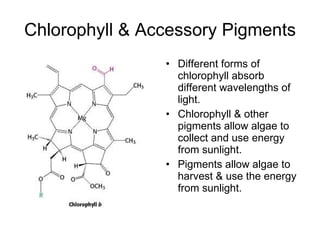
Chlorophyll & Accessory Pigments Different forms of chlorophyll absorb different wavelengths of light. Chlorophyll & other pigments allow algae to collect and use energy from sunlight. Pigments allow algae to harvest & use the energy from sunlight.
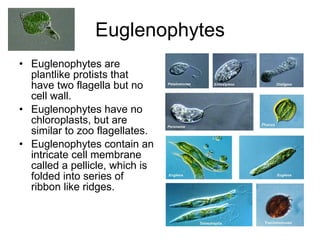
Euglenophytes Euglenophytes are plantlike protists that have two flagella but no cell wall. Euglenophytes have no chloroplasts, but are similar to zoo flagellates. Euglenophytes contain an intricate cell membrane called a pellicle, which is folded into series of ribbon like ridges.
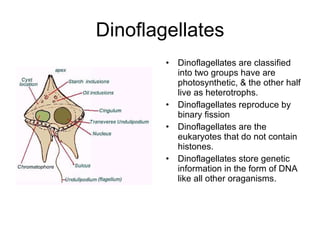
Dinoflagellates Dinoflagellates are classified into two groups have are photosynthetic, & the other half live as heterotrophs. Dinoflagellates reproduce by binary fission Dinoflagellates are the eukaryotes that do not contain histones. Dinoflagellates store genetic information in the form of DNA like all other oraganisms.
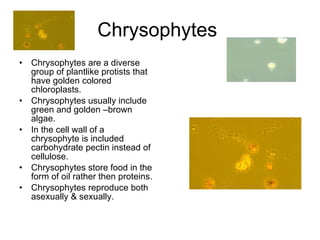
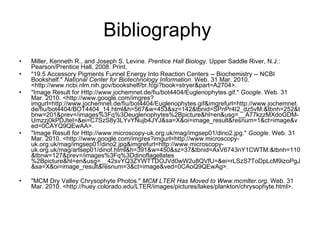
Chrysophytes  Chrysophytes are a diverse group of plantlike protists that have golden colored chloroplasts. Chrysophytes usually include green and golden –brown algae. In the cell wall of a chrysophyte is included carbohydrate pectin instead of cellulose. Chrysophytes store food in the form of oil rather then proteins.  Chrysophytes reproduce both asexually & sexually.
Bibliography  Miller, Kenneth R., and Joseph S. Levine.  Prentice Hall Biology.  Upper Saddle River, N.J.: Pearson/Prentice Hall, 2008. Print.  &quot;19.5 Accessory Pigments Funnel Energy Into Reaction Centers -- Biochemistry -- NCBI Bookshelf.&quot;  National Center for Biotechnology Information . Web. 31 Mar. 2010. <http://www.ncbi.nlm.nih.gov/bookshelf/br.fcgi?book=stryer&part=A2704>.  &quot;Image Result for Http://www.jochemnet.de/fiu/bot4404/Euglenophytes.gif.&quot;  Google . Web. 31 Mar. 2010. <http://www.google.com/imgres?imgurl=http://www.jochemnet.de/fiu/bot4404/Euglenophytes.gif&imgrefurl=http://www.jochemnet.de/fiu/bot4404/BOT4404_14.html&h=567&w=453&sz=142&tbnid=SPnPr4I2_dz5vM:&tbnh=252&tbnw=201&prev=/images%3Fq%3Deuglenophytes%2Bpicture&hl=en&usg=__A77kzzMXdoGDM-Umzzj0kPDJteI=&ei=C7SzS8y3LYvYNujb4JYJ&sa=X&oi=image_result&resnum=1&ct=image&ved=0CAYQ9QEwAA>. &quot;Image Result for Http://www.microscopy-uk.org.uk/mag/imgsep01/dino2.jpg.&quot;  Google . Web. 31 Mar. 2010. <http://www.google.com/imgres?imgurl=http://www.microscopy-uk.org.uk/mag/imgsep01/dino2.jpg&imgrefurl=http://www.microscopy-uk.org.uk/mag/artsep01/dinof.html&h=391&w=450&sz=37&tbnid=AxV6743nY1CWTM:&tbnh=110&tbnw=127&prev=/images%3Fq%3Ddinoflagellates%2Bpicture&hl=en&usg=__42svYQ3ZYWTTDOJVd0wW2u8QVfU=&ei=rLSzS7ToDpLcM9izoPgJ&sa=X&oi=image_result&resnum=3&ct=image&ved=0CAoQ9QEwAg>. &quot;MCM Dry Valley Chrysophyte Photos.&quot;  MCM LTER Has Moved to Www.mcmlter.org . Web. 31 Mar. 2010. <http://huey.colorado.edu/LTER/images/pictures/lakes/plankton/chrysophyte.html>.

Kyle Wood

  • 1.
    Plantlike Protists: UnicellularAlgae Alex Gopar-Perez Biology 6 th Period
  • 2.
    Chlorophyll & AccessoryPigments Different forms of chlorophyll absorb different wavelengths of light. Chlorophyll & other pigments allow algae to collect and use energy from sunlight. Pigments allow algae to harvest & use the energy from sunlight.
  • 3.
    Euglenophytes Euglenophytes areplantlike protists that have two flagella but no cell wall. Euglenophytes have no chloroplasts, but are similar to zoo flagellates. Euglenophytes contain an intricate cell membrane called a pellicle, which is folded into series of ribbon like ridges.
  • 4.
    Dinoflagellates Dinoflagellates areclassified into two groups have are photosynthetic, & the other half live as heterotrophs. Dinoflagellates reproduce by binary fission Dinoflagellates are the eukaryotes that do not contain histones. Dinoflagellates store genetic information in the form of DNA like all other oraganisms.
  • 5.
    Chrysophytes Chrysophytesare a diverse group of plantlike protists that have golden colored chloroplasts. Chrysophytes usually include green and golden –brown algae. In the cell wall of a chrysophyte is included carbohydrate pectin instead of cellulose. Chrysophytes store food in the form of oil rather then proteins. Chrysophytes reproduce both asexually & sexually.
  • 6.
    Bibliography Miller,Kenneth R., and Joseph S. Levine.  Prentice Hall Biology.  Upper Saddle River, N.J.: Pearson/Prentice Hall, 2008. Print. &quot;19.5 Accessory Pigments Funnel Energy Into Reaction Centers -- Biochemistry -- NCBI Bookshelf.&quot; National Center for Biotechnology Information . Web. 31 Mar. 2010. <http://www.ncbi.nlm.nih.gov/bookshelf/br.fcgi?book=stryer&part=A2704>. &quot;Image Result for Http://www.jochemnet.de/fiu/bot4404/Euglenophytes.gif.&quot; Google . Web. 31 Mar. 2010. <http://www.google.com/imgres?imgurl=http://www.jochemnet.de/fiu/bot4404/Euglenophytes.gif&imgrefurl=http://www.jochemnet.de/fiu/bot4404/BOT4404_14.html&h=567&w=453&sz=142&tbnid=SPnPr4I2_dz5vM:&tbnh=252&tbnw=201&prev=/images%3Fq%3Deuglenophytes%2Bpicture&hl=en&usg=__A77kzzMXdoGDM-Umzzj0kPDJteI=&ei=C7SzS8y3LYvYNujb4JYJ&sa=X&oi=image_result&resnum=1&ct=image&ved=0CAYQ9QEwAA>. &quot;Image Result for Http://www.microscopy-uk.org.uk/mag/imgsep01/dino2.jpg.&quot; Google . Web. 31 Mar. 2010. <http://www.google.com/imgres?imgurl=http://www.microscopy-uk.org.uk/mag/imgsep01/dino2.jpg&imgrefurl=http://www.microscopy-uk.org.uk/mag/artsep01/dinof.html&h=391&w=450&sz=37&tbnid=AxV6743nY1CWTM:&tbnh=110&tbnw=127&prev=/images%3Fq%3Ddinoflagellates%2Bpicture&hl=en&usg=__42svYQ3ZYWTTDOJVd0wW2u8QVfU=&ei=rLSzS7ToDpLcM9izoPgJ&sa=X&oi=image_result&resnum=3&ct=image&ved=0CAoQ9QEwAg>. &quot;MCM Dry Valley Chrysophyte Photos.&quot; MCM LTER Has Moved to Www.mcmlter.org . Web. 31 Mar. 2010. <http://huey.colorado.edu/LTER/images/pictures/lakes/plankton/chrysophyte.html>.