AP Biology
Archaebacteria
&
Bacteria
Classification
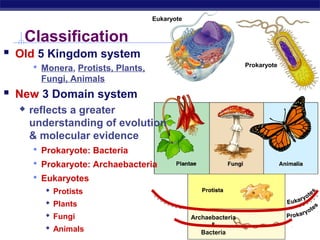
 Old 5 Kingdom system
 Monera, Protists, Plants,
Fungi, Animals
 New 3 Domain system
 reflects a greater
understanding of evolution
& molecular evidence
 Prokaryote: Bacteria
 Prokaryote: Archaebacteria
 Eukaryotes
 Protists
 Plants
 Fungi
 Animals
Prokaryote
Eukaryote
AP Biology
Kingdom
Protist
Kingdom
Fungi
Kingdom
Plant
Kingdom
Animal
Kingdom
Archaebacteria
Kingdom
Bacteria
AP Biology 2007-2008
Prokaryotes
Domain Bacteria
Domain Archaebacteria
Domain
Bacteria
Domain
Archaea
Domain
Eukarya
Common ancestor
AP Biology
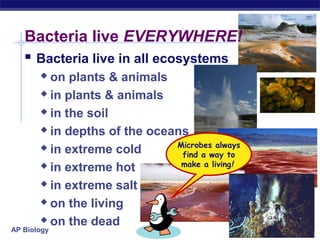
Bacteria live EVERYWHERE!
 Bacteria live in all ecosystems
 on plants & animals
 in plants & animals
 in the soil
 in depths of the oceans
 in extreme cold
 in extreme hot
 in extreme salt
 on the living
 on the dead
Microbes always
find a way to
make a living!
AP Biology
Bacterial diversity
rods and spheres and spirals… Oh My!
AP Biology
Prokaryote Structure
 Unicellular
 bacilli, cocci, spirilli
 Size
 1/10 size of eukaryote cell
 1 micron (1um)
 Internal structure
 no internal compartments
 no membrane-bound organelles
 only ribosomes
 circular chromosome, naked DNA
 not wrapped around proteins
prokaryote
cell
eukaryote cell
AP Biology
Prokaryote vs. Eukaryote Chromosome
double helix
Prokaryote
Eukaryote
AP Biology
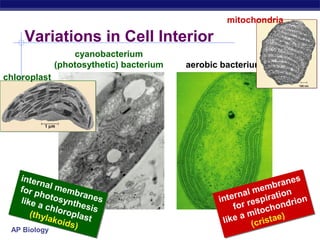
Variations in Cell Interior
internal membranes
for photosynthesis
like a chloroplast
(thylakoids)
internal membranes
for photosynthesis
like a chloroplast
(thylakoids)
internal membranes
for respiration
like a mitochondrion
(cristae)
internal membranes
for respiration
like a mitochondrion
(cristae)
aerobic bacterium
mitochondria
cyanobacterium
(photosythetic) bacterium
chloroplast
AP Biology
Prokaryote Cell Wall Structure
peptide side
chains
cell wall
peptidoglycan
plasma membrane
protein
Gram-positive bacteria
Gram-negative bacteria
peptidoglycan
plasma
membrane
outer
membrane
outer membrane of
lipopolysaccharides
cell wall
peptidoglycan = polysaccharides + amino acid chains
lipopolysaccharides = lipids + polysaccharides
That’s
important for
your doctor
to know!
AP Biology
Prokaryotic metabolism
 How do bacteria acquire their energy &
nutrients?
 photoautotrophs
 photosynthetic bacteria
 chemoautotrophs
 oxidize inorganic compounds
 nitrogen, sulfur, hydrogen…
 heterotrophs
 live on plant & animal matter
 decomposers & pathogens
AP Biology
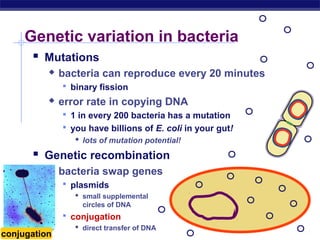
Genetic variation in bacteria
 Mutations
 bacteria can reproduce every 20 minutes
 binary fission
 error rate in copying DNA
 1 in every 200 bacteria has a mutation
 you have billions of E. coli in your gut!
 lots of mutation potential!
 Genetic recombination
 bacteria swap genes
 plasmids
 small supplemental
circles of DNA
 conjugation
 direct transfer of DNA
conjugation
AP Biology
Bacteria as pathogens
 Disease-causing microbes
 plant diseases
 wilts, fruit rot, blights
 animal diseases
 tooth decay, ulcers
 anthrax, botulism
 plague, leprosy, “flesh-eating” disease
 STDs: gonorrhea, chlamydia
 typhoid, cholera
 TB, pneumonia
 lyme disease
AP Biology
Bacteria as beneficial (& necessary)
 Life on Earth is dependent on bacteria
 decomposers
 recycling of nutrients from dead to living
 nitrogen fixation
 only organisms that can fix N from atmosphere
 needed for synthesis of proteins & nucleic acids
 plant root nodules
 help in digestion (E. coli)
 digest cellulose for herbivores
 cellulase enzyme
 produce vitamins K & B12 for humans
 produce foods & medicines
 from yogurt to insulin
AP Biology 2007-2008
Got any
Questions??
Ask da’ Boss!
AP Biology
before
nucleus
true
nucleus

Prokaryotes

  • 1.
    AP Biology Archaebacteria & Bacteria Classification  Old5 Kingdom system  Monera, Protists, Plants, Fungi, Animals  New 3 Domain system  reflects a greater understanding of evolution & molecular evidence  Prokaryote: Bacteria  Prokaryote: Archaebacteria  Eukaryotes  Protists  Plants  Fungi  Animals Prokaryote Eukaryote
  • 2.
  • 3.
    AP Biology 2007-2008 Prokaryotes DomainBacteria Domain Archaebacteria Domain Bacteria Domain Archaea Domain Eukarya Common ancestor
  • 4.
    AP Biology Bacteria liveEVERYWHERE!  Bacteria live in all ecosystems  on plants & animals  in plants & animals  in the soil  in depths of the oceans  in extreme cold  in extreme hot  in extreme salt  on the living  on the dead Microbes always find a way to make a living!
  • 5.
    AP Biology Bacterial diversity rodsand spheres and spirals… Oh My!
  • 6.
    AP Biology Prokaryote Structure Unicellular  bacilli, cocci, spirilli  Size  1/10 size of eukaryote cell  1 micron (1um)  Internal structure  no internal compartments  no membrane-bound organelles  only ribosomes  circular chromosome, naked DNA  not wrapped around proteins prokaryote cell eukaryote cell
  • 7.
    AP Biology Prokaryote vs.Eukaryote Chromosome double helix Prokaryote Eukaryote
  • 8.
    AP Biology Variations inCell Interior internal membranes for photosynthesis like a chloroplast (thylakoids) internal membranes for photosynthesis like a chloroplast (thylakoids) internal membranes for respiration like a mitochondrion (cristae) internal membranes for respiration like a mitochondrion (cristae) aerobic bacterium mitochondria cyanobacterium (photosythetic) bacterium chloroplast
  • 9.
    AP Biology Prokaryote CellWall Structure peptide side chains cell wall peptidoglycan plasma membrane protein Gram-positive bacteria Gram-negative bacteria peptidoglycan plasma membrane outer membrane outer membrane of lipopolysaccharides cell wall peptidoglycan = polysaccharides + amino acid chains lipopolysaccharides = lipids + polysaccharides That’s important for your doctor to know!
  • 10.
    AP Biology Prokaryotic metabolism How do bacteria acquire their energy & nutrients?  photoautotrophs  photosynthetic bacteria  chemoautotrophs  oxidize inorganic compounds  nitrogen, sulfur, hydrogen…  heterotrophs  live on plant & animal matter  decomposers & pathogens
  • 11.
    AP Biology Genetic variationin bacteria  Mutations  bacteria can reproduce every 20 minutes  binary fission  error rate in copying DNA  1 in every 200 bacteria has a mutation  you have billions of E. coli in your gut!  lots of mutation potential!  Genetic recombination  bacteria swap genes  plasmids  small supplemental circles of DNA  conjugation  direct transfer of DNA conjugation
  • 12.
    AP Biology Bacteria aspathogens  Disease-causing microbes  plant diseases  wilts, fruit rot, blights  animal diseases  tooth decay, ulcers  anthrax, botulism  plague, leprosy, “flesh-eating” disease  STDs: gonorrhea, chlamydia  typhoid, cholera  TB, pneumonia  lyme disease
  • 13.
    AP Biology Bacteria asbeneficial (& necessary)  Life on Earth is dependent on bacteria  decomposers  recycling of nutrients from dead to living  nitrogen fixation  only organisms that can fix N from atmosphere  needed for synthesis of proteins & nucleic acids  plant root nodules  help in digestion (E. coli)  digest cellulose for herbivores  cellulase enzyme  produce vitamins K & B12 for humans  produce foods & medicines  from yogurt to insulin
  • 14.
    AP Biology 2007-2008 Gotany Questions?? Ask da’ Boss!
  • 15.

Editor's Notes

  • #6 Bacillus = anthrax, BT Bordetella = pertussis or whooping cough, kennel cough Clostridium = botulism & tetanus Escherichia = E. coli Spirulina = blue-gren algae Staph Strep Salmonella
  • #10 Most pathogenic bacteria in humans are gram-negative organisms. Escherichia coli, Salmonella, and other Enterobacteriaceae, Pseudomonas, Moraxella, Helicobacter, Stenotrophomonas, Legionella and Wolbachia and many others, cyanobacteria, spirochaetes, green sulfur and green non-sulfur bacteria. Medically relevant Gram-negative cocci include three organisms, which cause a sexually transmitted disease (Neisseria gonorrhoeae), a meningitis (Neisseria meningitidis), and respiratory symptoms (Moraxella catarrhalis). Medically relevant Gram-negative bacilli include a multitude of species. Some of them primarily cause respiratory problems (Hemophilus influenzae, Klebsiella pneumoniae, Legionella pneumophila, Pseudomonas aeruginosa), primarily urinary problems (Escherichia coli, Proteus mirabilis, Enterobacter cloacae, Serratia marcescens), and primarily gastrointestinal problems (Helicobacter pylori, Salmonella enteritidis, Salmonella typhi). Classically, six gram-positive organisms are typically pathogenic in humans. Two of these, Streptococcus and Staphylococcus, are cocci (round bacteria). The remaining organisms are bacilli (rod-shaped bacteria) and can be subdivided based on their ability to form spores. The non-spore formers are Corynebacterium and Listeria (food poisoning w/ 25% mortality vs 1% in Salmonella), while Bacillus and Clostridium (botulism & tetanus) produce spores. The spore-forming bacteria can again be divided based on their respiration: Bacillus is a facultative anaerobe, while Clostridium is an obligate anaerobe.
  • #12 The adult human body contains an estimated 1 * 10^14 cells (a 1 followed by 14 zeros), 10% of which actually belong to us!! Thus, we have roughly 10 times more cells living in us than we do cells that make up our own bodies. Most of these 'outside' cells are bacteria living in the gastrointestinal tract. More than 400 species of microbes live in the colon alone, and can reach a density of 1 * 10^11 organism per milliliter of 'intestinal lumenal contents.' Direct transfer of DNA between 2 bacterial cells that are temporarily joined results from presence of F plasmid with F factor F for “fertility” DNA E. coli “male” extends sex pilli, attaches to female bacterium cytoplasmic bridge allows transfer of DNA