Mammals Dalton Settles Period 6 March 31, 2010
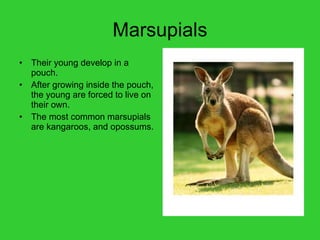
Marsupials Their young develop in a pouch. After growing inside the pouch, the young are forced to live on their own. The most common marsupials are kangaroos, and opossums.
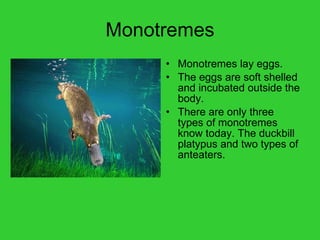
Monotremes Monotremes lay eggs. The eggs are soft shelled and incubated outside the body. There are only three types of monotremes know today. The duckbill platypus and two types of anteaters.
Placental Mammals In placental mammals, nutrients, oxygen, carbon dioxide, and wastes are exchanged between the embryo and the mother through the placenta. Insectivores: long narrow snouts and sharp claws that are used for digging. Sirenians: herbivores that live in rivers, bays, and warm coastal waters. These are large slow moving animals.
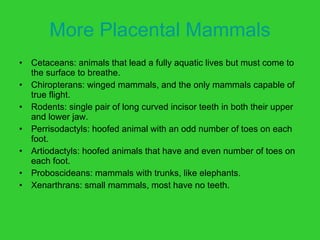
More Placental Mammals Cetaceans: animals that lead a fully aquatic lives but must come to the surface to breathe. Chiropterans: winged mammals, and the only mammals capable of true flight. Rodents: single pair of long curved incisor teeth in both their upper and lower jaw. Perrisodactyls: hoofed animal with an odd number of toes on each foot. Artiodactyls: hoofed animals that have and even number of toes on each foot. Proboscideans: mammals with trunks, like elephants. Xenarthrans: small mammals, most have no teeth.
Biogeography There has been convergent evolution around the world because there are many similar climates. Convergent Evolution: the appearance of similar structure in organism of different lines of descent.
Bibliography   Photograph. Web. <http://soer.justice.tas.gov.au/2003/image/559/ilw/p-platypus_m.jpg>. Web. <http://www.enchantedlearning.com/subjects/mammals/Placental.shtml>.    Web. <http://www.sacrs.org.za/ecm21/gallery/giraffe-01300813b.jpg>.  Web. <http://www.royalpetclub.com/blog/wp-content/uploads/2010/01/541447Australian-Kangaroo-Posters1.jpg>.  Miller, and Levine.  Biology . Print

Mammals

  • 1.
    Mammals Dalton SettlesPeriod 6 March 31, 2010
  • 2.
    Marsupials Their youngdevelop in a pouch. After growing inside the pouch, the young are forced to live on their own. The most common marsupials are kangaroos, and opossums.
  • 3.
    Monotremes Monotremes layeggs. The eggs are soft shelled and incubated outside the body. There are only three types of monotremes know today. The duckbill platypus and two types of anteaters.
  • 4.
    Placental Mammals Inplacental mammals, nutrients, oxygen, carbon dioxide, and wastes are exchanged between the embryo and the mother through the placenta. Insectivores: long narrow snouts and sharp claws that are used for digging. Sirenians: herbivores that live in rivers, bays, and warm coastal waters. These are large slow moving animals.
  • 5.
    More Placental MammalsCetaceans: animals that lead a fully aquatic lives but must come to the surface to breathe. Chiropterans: winged mammals, and the only mammals capable of true flight. Rodents: single pair of long curved incisor teeth in both their upper and lower jaw. Perrisodactyls: hoofed animal with an odd number of toes on each foot. Artiodactyls: hoofed animals that have and even number of toes on each foot. Proboscideans: mammals with trunks, like elephants. Xenarthrans: small mammals, most have no teeth.
  • 6.
    Biogeography There hasbeen convergent evolution around the world because there are many similar climates. Convergent Evolution: the appearance of similar structure in organism of different lines of descent.
  • 7.
    Bibliography   Photograph.Web. <http://soer.justice.tas.gov.au/2003/image/559/ilw/p-platypus_m.jpg>. Web. <http://www.enchantedlearning.com/subjects/mammals/Placental.shtml>.   Web. <http://www.sacrs.org.za/ecm21/gallery/giraffe-01300813b.jpg>. Web. <http://www.royalpetclub.com/blog/wp-content/uploads/2010/01/541447Australian-Kangaroo-Posters1.jpg>. Miller, and Levine. Biology . Print