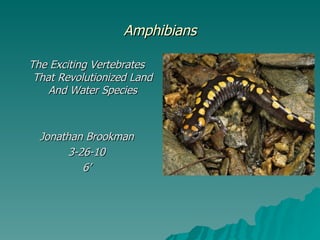
Amphibians The Exciting Vertebrates That Revolutionized Land And Water Species Jonathan Brookman 3-26-10 6’
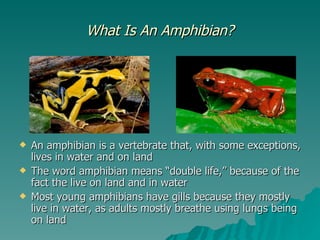
What Is An Amphibian? An amphibian is a vertebrate that, with some exceptions, lives in water and on land The word amphibian means “double life,” because of the fact the live on land and in water Most young amphibians have gills because they mostly live in water, as adults mostly breathe using lungs being on land
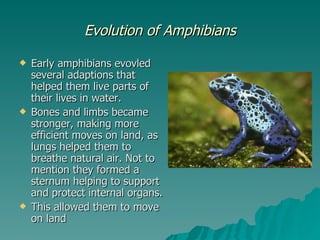
Evolution of Amphibians Early amphibians evovled several adaptions that helped them live parts of their lives in water. Bones and limbs became stronger, making more efficient moves on land, as lungs helped them to breathe natural air. Not to mention they formed a sternum helping to support and protect internal organs. This allowed them to move on land
Groups of Amphibians Salamanders  – Salamanders have long bodies and tails. They also have four legs. Frogs and Toads – Frogs and Toads share a phenomenal ability, that is to jump. Frogs tend to have long legs and make lengthy, as toads have shots legs for less then outstanding hops. Caecilians – The least known of the amphibians, caecilians are legless animals that mostly live in water.
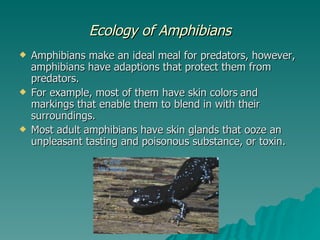
Ecology of Amphibians Amphibians make an ideal meal for predators, however, amphibians have adaptions that protect them from predators. For example, most of them have skin colors   and markings that enable them to blend in with their surroundings. Most adult amphibians have skin glands that ooze an unpleasant tasting and poisonous substance, or toxin.
Amphibians Bibliography &quot;Spotted Salamanders, Spotted Salamander Pictures, Spotted Salamander Facts - National Geographic.&quot; Animals, Animal Pictures, Wild Animal Facts - National Geographic. Web. 25 Mar. 2010. <http://animals.nationalgeographic.com/animals/amphibians/spotted-salamander/>. &quot;Poison Dart Frog Photos -- National Geographic.&quot; Animals, Animal Pictures, Wild Animal Facts - National Geographic. Web. 25 Mar. 2010. <http://animals.nationalgeographic.com/animals/photos/poison-dart-frogs/#dyeing-poison-dart-frog_5835_600x450.jpg>. &quot;Poison Dart Frog Photos -- National Geographic.&quot; Animals, Animal Pictures, Wild Animal Facts - National Geographic. Web. 25 Mar. 2010. <http://animals.nationalgeographic.com/animals/photos/poison-dart-frogs/#strawberry-poison-dart-frog_5869_600x450.jpg>.   &quot;Image Result for http://www.topnews.in/files/Amphibian.jpg.&quot;  Google . 31 Mar. 2010 <http://www.google.com/imgres?imgurl=http://www.topnews.in/files/Amphibian.jpg&imgrefurl=http://www.topnews.in/210mlnyrold-amphibian-had-bizarre-feeding-pattern-298362&h=333&w=500&sz=47&tbnid=TMSxmeoK1-DBtM:&tbnh=87&tbnw=130&prev=/images%3Fq%3DAmphibian%2Bpictures&hl=en&usg=__QWf_ViANsM9TVKzbv_xAWL5-9HI=&ei=WKezS5awDqXkNK_nsZoJ&sa=X&oi=image_result&resnum=3&ct=image&ved=0CA8Q9QEwAg>.
Amphibians Bibliography &quot;Blue-spotted salamander - Amybstoma laterale.&quot;  Michael F. Benard: Herp Photography . 31 Mar. 2010 <http://www.mister-toad.com/photos/salamander/ambystoma_laterale_01.html>.

Amphibians

  • 1.
    Amphibians The ExcitingVertebrates That Revolutionized Land And Water Species Jonathan Brookman 3-26-10 6’
  • 2.
    What Is AnAmphibian? An amphibian is a vertebrate that, with some exceptions, lives in water and on land The word amphibian means “double life,” because of the fact the live on land and in water Most young amphibians have gills because they mostly live in water, as adults mostly breathe using lungs being on land
  • 3.
    Evolution of AmphibiansEarly amphibians evovled several adaptions that helped them live parts of their lives in water. Bones and limbs became stronger, making more efficient moves on land, as lungs helped them to breathe natural air. Not to mention they formed a sternum helping to support and protect internal organs. This allowed them to move on land
  • 4.
    Groups of AmphibiansSalamanders – Salamanders have long bodies and tails. They also have four legs. Frogs and Toads – Frogs and Toads share a phenomenal ability, that is to jump. Frogs tend to have long legs and make lengthy, as toads have shots legs for less then outstanding hops. Caecilians – The least known of the amphibians, caecilians are legless animals that mostly live in water.
  • 5.
    Ecology of AmphibiansAmphibians make an ideal meal for predators, however, amphibians have adaptions that protect them from predators. For example, most of them have skin colors and markings that enable them to blend in with their surroundings. Most adult amphibians have skin glands that ooze an unpleasant tasting and poisonous substance, or toxin.
  • 6.
    Amphibians Bibliography &quot;SpottedSalamanders, Spotted Salamander Pictures, Spotted Salamander Facts - National Geographic.&quot; Animals, Animal Pictures, Wild Animal Facts - National Geographic. Web. 25 Mar. 2010. <http://animals.nationalgeographic.com/animals/amphibians/spotted-salamander/>. &quot;Poison Dart Frog Photos -- National Geographic.&quot; Animals, Animal Pictures, Wild Animal Facts - National Geographic. Web. 25 Mar. 2010. <http://animals.nationalgeographic.com/animals/photos/poison-dart-frogs/#dyeing-poison-dart-frog_5835_600x450.jpg>. &quot;Poison Dart Frog Photos -- National Geographic.&quot; Animals, Animal Pictures, Wild Animal Facts - National Geographic. Web. 25 Mar. 2010. <http://animals.nationalgeographic.com/animals/photos/poison-dart-frogs/#strawberry-poison-dart-frog_5869_600x450.jpg>. &quot;Image Result for http://www.topnews.in/files/Amphibian.jpg.&quot; Google . 31 Mar. 2010 <http://www.google.com/imgres?imgurl=http://www.topnews.in/files/Amphibian.jpg&imgrefurl=http://www.topnews.in/210mlnyrold-amphibian-had-bizarre-feeding-pattern-298362&h=333&w=500&sz=47&tbnid=TMSxmeoK1-DBtM:&tbnh=87&tbnw=130&prev=/images%3Fq%3DAmphibian%2Bpictures&hl=en&usg=__QWf_ViANsM9TVKzbv_xAWL5-9HI=&ei=WKezS5awDqXkNK_nsZoJ&sa=X&oi=image_result&resnum=3&ct=image&ved=0CA8Q9QEwAg>.
  • 7.
    Amphibians Bibliography &quot;Blue-spottedsalamander - Amybstoma laterale.&quot; Michael F. Benard: Herp Photography . 31 Mar. 2010 <http://www.mister-toad.com/photos/salamander/ambystoma_laterale_01.html>.