KYKO is an integrated model of
personality profile
KYKO combines the wisdom and compatible views of the
contemporary psychologists from 6 schools of personality
theories via psychodynamic, behaviorism, humanistic,
cognitive, biological and trait to predict human differences
KYKO PREMISE 1
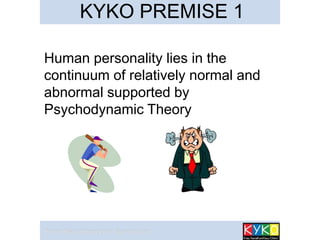
Human personality lies in the
continuum of relatively normal and
abnormal supported by
Psychodynamic Theory
KYKO PREMISE 2
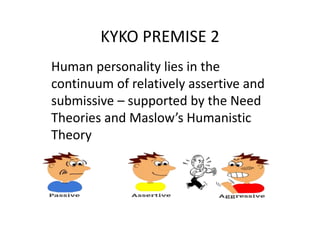
Human personality lies in the
continuum of relatively assertive and
submissive – supported by the Need
Theories and Maslow’s Humanistic
Theory
KYKO PREMISE 3
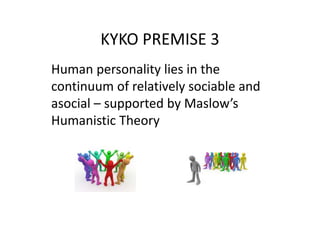
Human personality lies in the
continuum of relatively sociable and
asocial – supported by Maslow’s
Humanistic Theory
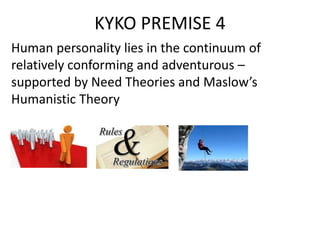
KYKO PREMISE 4
Human personality lies in the continuum of
relatively conforming and adventurous –
supported by Need Theories and Maslow’s
Humanistic Theory
KYKO PREMISE 5
Human personality lies in the continuum
of relatively simple and complex –
supported by Stimulus-Response Theory
(Behaviourism) and Stimulus – Gap –
Response (Cognitive Theory)
KYKO Premise 6
Human behavior is a function of the genes and
the environment supported by Biological and
Behaviorism Theory
KYKO PREMISE 7
No two personalities are alike
even though they are identical
twins growing up in the same
environment due to genetic
differences
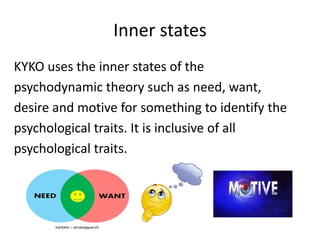
Inner states
KYKO uses the inner states of the
psychodynamic theory such as need, want,
desire and motive for something to identify the
psychological traits. It is inclusive of all
psychological traits.
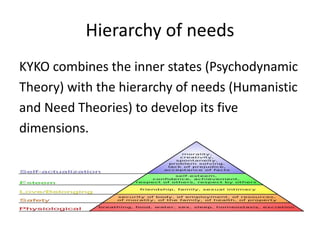
Hierarchy of needs
KYKO combines the inner states (Psychodynamic
Theory) with the hierarchy of needs (Humanistic
and Need Theories) to develop its five
dimensions.
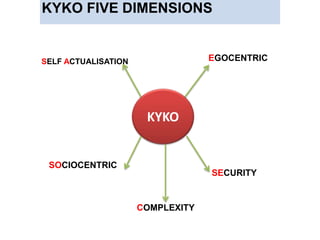
KYKO FIVE DIMENSIONS
KYKO
COMPLEXITY
EGOCENTRIC
SOCIOCENTRIC
SECURITY
SELF ACTUALISATION
Supported by the following theories:
• Maslow’s Self-Actualization
• Mc Cleland's Achievement Needs
• Carl Roger ‘s Peak of human development
• Henry Murray’s Needs for Achievement
• Clayton Alderfer’s Growth Needs
Self-Actualization Dimension
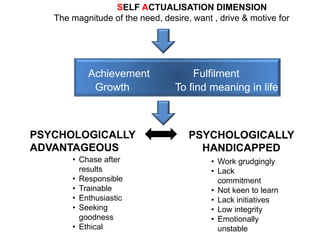
SELF ACTUALISATION DIMENSION
The magnitude of the need, desire, want , drive & motive for
Achievement
Growth
Fulfilment
To find meaning in life
PSYCHOLOGICALLY
ADVANTAGEOUS
PSYCHOLOGICALLY
HANDICAPPED
• Chase after
results
• Responsible
• Trainable
• Enthusiastic
• Seeking
goodness
• Ethical
• Work grudgingly
• Lack
commitment
• Not keen to learn
• Lack initiatives
• Low integrity
• Emotionally
unstable
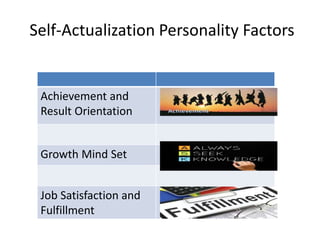
Self-Actualization Personality Factors
Achievement and
Result Orientation
Growth Mind Set
Job Satisfaction and
Fulfillment
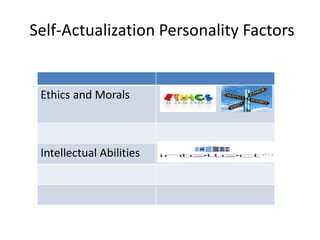
Self-Actualization Personality Factors
Ethics and Morals
Intellectual Abilities
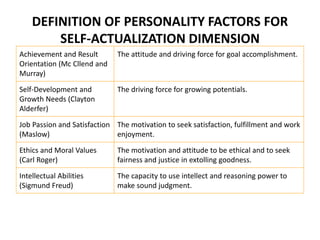
DEFINITION OF PERSONALITY FACTORS FOR
SELF-ACTUALIZATION DIMENSION
Achievement and Result
Orientation (Mc Cllend and
Murray)
The attitude and driving force for goal accomplishment.
Self-Development and
Growth Needs (Clayton
Alderfer)
The driving force for growing potentials.
Job Passion and Satisfaction
(Maslow)
The motivation to seek satisfaction, fulfillment and work
enjoyment.
Ethics and Moral Values
(Carl Roger)
The motivation and attitude to be ethical and to seek
fairness and justice in extolling goodness.
Intellectual Abilities
(Sigmund Freud)
The capacity to use intellect and reasoning power to
make sound judgment.
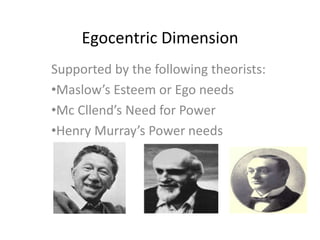
Egocentric Dimension
Supported by the following theorists:
•Maslow’s Esteem or Ego needs
•Mc Cllend’s Need for Power
•Henry Murray’s Power needs
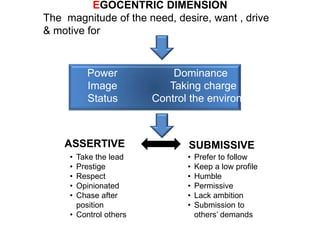
EGOCENTRIC DIMENSION
The magnitude of the need, desire, want , drive
& motive for
Power
Image
Status
Dominance
Taking charge
Control the environment
ASSERTIVE SUBMISSIVE
• Take the lead
• Prestige
• Respect
• Opinionated
• Chase after
position
• Control others
• Prefer to follow
• Keep a low profile
• Humble
• Permissive
• Lack ambition
• Submission to
others’ demands
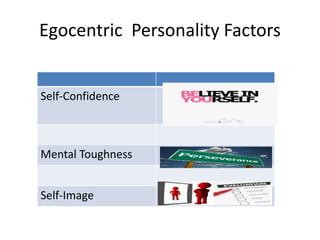
Egocentric Personality Factors
Self-Confidence
Mental Toughness
Self-Image
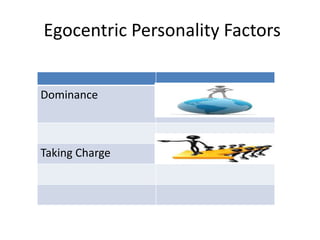
Egocentric Personality Factors
Dominance
Taking Charge
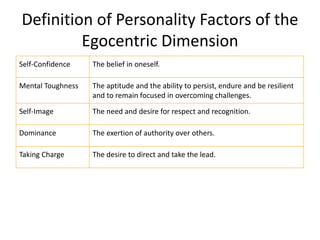
Definition of Personality Factors of the
Egocentric Dimension
Self-Confidence The belief in oneself.
Mental Toughness The aptitude and the ability to persist, endure and be resilient
and to remain focused in overcoming challenges.
Self-Image The need and desire for respect and recognition.
Dominance The exertion of authority over others.
Taking Charge The desire to direct and take the lead.
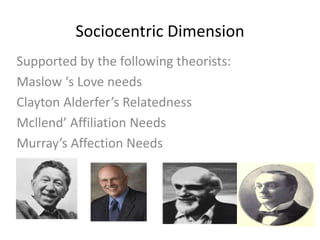
Sociocentric Dimension
Supported by the following theorists:
Maslow ‘s Love needs
Clayton Alderfer’s Relatedness
Mcllend’ Affiliation Needs
Murray’s Affection Needs
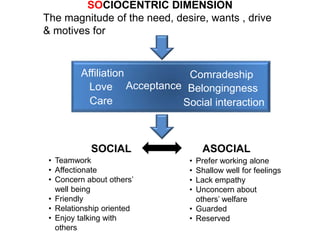
SOCIOCENTRIC DIMENSION
The magnitude of the need, desire, wants , drive
& motives for
Affiliation
Love
Care
Comradeship
Belongingness
Social interaction
SOCIAL ASOCIAL
• Teamwork
• Affectionate
• Concern about others’
well being
• Friendly
• Relationship oriented
• Enjoy talking with
others
• Prefer working alone
• Shallow well for feelings
• Lack empathy
• Unconcern about
others’ welfare
• Guarded
• Reserved
Acceptance
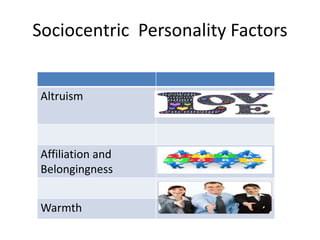
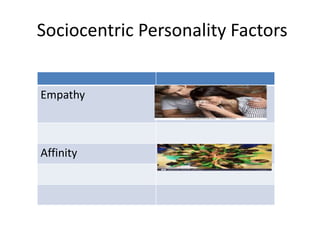
Sociocentric Personality Factors
Altruism
Affiliation and
Belongingness
Warmth
Sociocentric Personality Factors
Empathy
Affinity
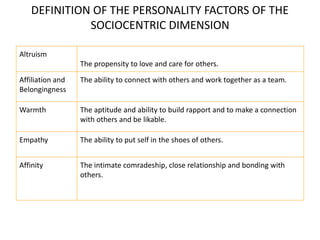
DEFINITION OF THE PERSONALITY FACTORS OF THE
SOCIOCENTRIC DIMENSION
Altruism
The propensity to love and care for others.
Affiliation and
Belongingness
The ability to connect with others and work together as a team.
Warmth The aptitude and ability to build rapport and to make a connection
with others and be likable.
Empathy The ability to put self in the shoes of others.
Affinity The intimate comradeship, close relationship and bonding with
others.
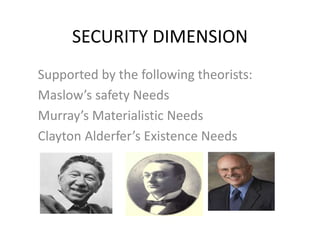
SECURITY DIMENSION
Supported by the following theorists:
Maslow’s safety Needs
Murray’s Materialistic Needs
Clayton Alderfer’s Existence Needs
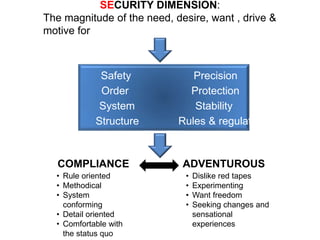
SECURITY DIMENSION:
The magnitude of the need, desire, want , drive &
motive for
Safety
Order
System
Structure
Precision
Protection
Stability
Rules & regulation
COMPLIANCE ADVENTUROUS
• Rule oriented
• Methodical
• System
conforming
• Detail oriented
• Comfortable with
the status quo
• Dislike red tapes
• Experimenting
• Want freedom
• Seeking changes and
sensational
experiences
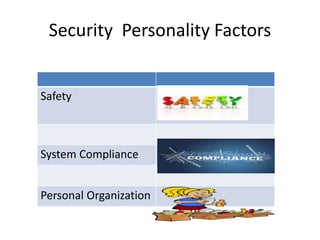
Security Personality Factors
Safety
System Compliance
Personal Organization
Security Personality Factors
Precision
Certainty
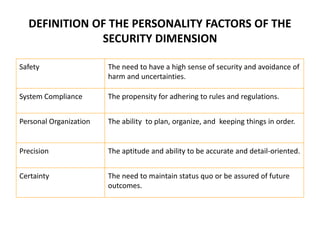
DEFINITION OF THE PERSONALITY FACTORS OF THE
SECURITY DIMENSION
Safety The need to have a high sense of security and avoidance of
harm and uncertainties.
System Compliance The propensity for adhering to rules and regulations.
Personal Organization The ability to plan, organize, and keeping things in order.
Precision The aptitude and ability to be accurate and detail-oriented.
Certainty The need to maintain status quo or be assured of future
outcomes.
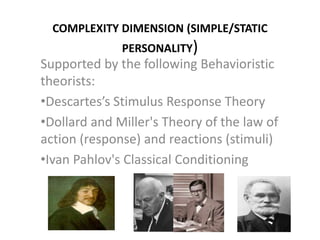
COMPLEXITY DIMENSION (SIMPLE/STATIC
PERSONALITY)
Supported by the following Behavioristic
theorists:
•Descartes’s Stimulus Response Theory
•Dollard and Miller's Theory of the law of
action (response) and reactions (stimuli)
•Ivan Pahlov's Classical Conditioning
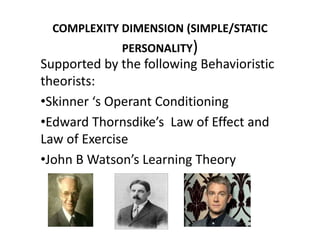
COMPLEXITY DIMENSION (SIMPLE/STATIC
PERSONALITY)
Supported by the following Behavioristic
theorists:
•Skinner ‘s Operant Conditioning
•Edward Thornsdike’s Law of Effect and
Law of Exercise
•John B Watson’s Learning Theory
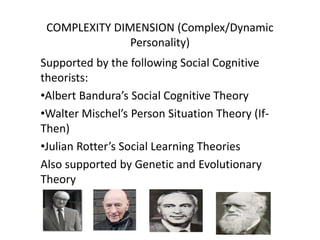
COMPLEXITY DIMENSION (Complex/Dynamic
Personality)
Supported by the following Social Cognitive
theorists:
•Albert Bandura’s Social Cognitive Theory
•Walter Mischel’s Person Situation Theory (If-
Then)
•Julian Rotter’s Social Learning Theories
Also supported by Genetic and Evolutionary
Theory
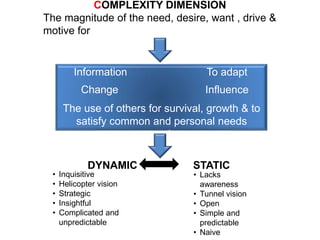
COMPLEXITY DIMENSION
The magnitude of the need, desire, want , drive &
motive for
Information
Change Influence
To adapt
The use of others for survival, growth & to
satisfy common and personal needs
needs
STATICDYNAMIC
• Inquisitive
• Helicopter vision
• Strategic
• Insightful
• Complicated and
unpredictable
• Lacks
awareness
• Tunnel vision
• Open
• Simple and
predictable
• Naive
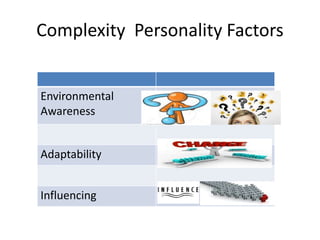
Complexity Personality Factors
Environmental
Awareness
Adaptability
Influencing
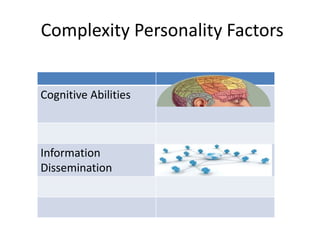
Complexity Personality Factors
Cognitive Abilities
Information
Dissemination
DEFINITION OF THE PERSONALITY FACTORS OF THE
COMPLEXITY DIMENSION
Environmental
Awareness
The aptitude and ability to be alert and well-informed.
Adaptability The aptitude and ability to adjust to people and situations.
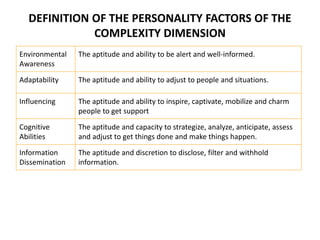
Influencing The aptitude and ability to inspire, captivate, mobilize and charm
people to get support
Cognitive
Abilities
The aptitude and capacity to strategize, analyze, anticipate, assess
and adjust to get things done and make things happen.
Information
Dissemination
The aptitude and discretion to disclose, filter and withhold
information.
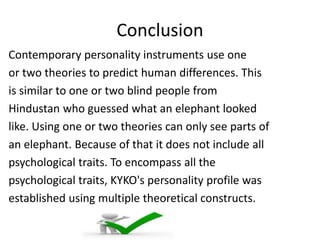
Conclusion
Contemporary personality instruments use one
or two theories to predict human differences. This
is similar to one or two blind people from
Hindustan who guessed what an elephant looked
like. Using one or two theories can only see parts of
an elephant. Because of that it does not include all
psychological traits. To encompass all the
psychological traits, KYKO's personality profile was
established using multiple theoretical constructs.

Kyko multiple theoretical construct premises and theories

  • 1.
    KYKO is anintegrated model of personality profile KYKO combines the wisdom and compatible views of the contemporary psychologists from 6 schools of personality theories via psychodynamic, behaviorism, humanistic, cognitive, biological and trait to predict human differences
  • 2.
    KYKO PREMISE 1 Humanpersonality lies in the continuum of relatively normal and abnormal supported by Psychodynamic Theory
  • 3.
    KYKO PREMISE 2 Humanpersonality lies in the continuum of relatively assertive and submissive – supported by the Need Theories and Maslow’s Humanistic Theory
  • 4.
    KYKO PREMISE 3 Humanpersonality lies in the continuum of relatively sociable and asocial – supported by Maslow’s Humanistic Theory
  • 5.
    KYKO PREMISE 4 Humanpersonality lies in the continuum of relatively conforming and adventurous – supported by Need Theories and Maslow’s Humanistic Theory
  • 6.
    KYKO PREMISE 5 Humanpersonality lies in the continuum of relatively simple and complex – supported by Stimulus-Response Theory (Behaviourism) and Stimulus – Gap – Response (Cognitive Theory)
  • 7.
    KYKO Premise 6 Humanbehavior is a function of the genes and the environment supported by Biological and Behaviorism Theory
  • 8.
    KYKO PREMISE 7 Notwo personalities are alike even though they are identical twins growing up in the same environment due to genetic differences
  • 9.
    Inner states KYKO usesthe inner states of the psychodynamic theory such as need, want, desire and motive for something to identify the psychological traits. It is inclusive of all psychological traits.
  • 10.
    Hierarchy of needs KYKOcombines the inner states (Psychodynamic Theory) with the hierarchy of needs (Humanistic and Need Theories) to develop its five dimensions.
  • 11.
  • 12.
    Supported by thefollowing theories: • Maslow’s Self-Actualization • Mc Cleland's Achievement Needs • Carl Roger ‘s Peak of human development • Henry Murray’s Needs for Achievement • Clayton Alderfer’s Growth Needs Self-Actualization Dimension
  • 13.
    SELF ACTUALISATION DIMENSION Themagnitude of the need, desire, want , drive & motive for Achievement Growth Fulfilment To find meaning in life PSYCHOLOGICALLY ADVANTAGEOUS PSYCHOLOGICALLY HANDICAPPED • Chase after results • Responsible • Trainable • Enthusiastic • Seeking goodness • Ethical • Work grudgingly • Lack commitment • Not keen to learn • Lack initiatives • Low integrity • Emotionally unstable
  • 14.
    Self-Actualization Personality Factors Achievementand Result Orientation Growth Mind Set Job Satisfaction and Fulfillment
  • 15.
    Self-Actualization Personality Factors Ethicsand Morals Intellectual Abilities
  • 16.
    DEFINITION OF PERSONALITYFACTORS FOR SELF-ACTUALIZATION DIMENSION Achievement and Result Orientation (Mc Cllend and Murray) The attitude and driving force for goal accomplishment. Self-Development and Growth Needs (Clayton Alderfer) The driving force for growing potentials. Job Passion and Satisfaction (Maslow) The motivation to seek satisfaction, fulfillment and work enjoyment. Ethics and Moral Values (Carl Roger) The motivation and attitude to be ethical and to seek fairness and justice in extolling goodness. Intellectual Abilities (Sigmund Freud) The capacity to use intellect and reasoning power to make sound judgment.
  • 17.
    Egocentric Dimension Supported bythe following theorists: •Maslow’s Esteem or Ego needs •Mc Cllend’s Need for Power •Henry Murray’s Power needs
  • 18.
    EGOCENTRIC DIMENSION The magnitudeof the need, desire, want , drive & motive for Power Image Status Dominance Taking charge Control the environment ASSERTIVE SUBMISSIVE • Take the lead • Prestige • Respect • Opinionated • Chase after position • Control others • Prefer to follow • Keep a low profile • Humble • Permissive • Lack ambition • Submission to others’ demands
  • 19.
  • 20.
  • 21.
    Definition of PersonalityFactors of the Egocentric Dimension Self-Confidence The belief in oneself. Mental Toughness The aptitude and the ability to persist, endure and be resilient and to remain focused in overcoming challenges. Self-Image The need and desire for respect and recognition. Dominance The exertion of authority over others. Taking Charge The desire to direct and take the lead.
  • 22.
    Sociocentric Dimension Supported bythe following theorists: Maslow ‘s Love needs Clayton Alderfer’s Relatedness Mcllend’ Affiliation Needs Murray’s Affection Needs
  • 23.
    SOCIOCENTRIC DIMENSION The magnitudeof the need, desire, wants , drive & motives for Affiliation Love Care Comradeship Belongingness Social interaction SOCIAL ASOCIAL • Teamwork • Affectionate • Concern about others’ well being • Friendly • Relationship oriented • Enjoy talking with others • Prefer working alone • Shallow well for feelings • Lack empathy • Unconcern about others’ welfare • Guarded • Reserved Acceptance
  • 24.
  • 25.
  • 26.
    DEFINITION OF THEPERSONALITY FACTORS OF THE SOCIOCENTRIC DIMENSION Altruism The propensity to love and care for others. Affiliation and Belongingness The ability to connect with others and work together as a team. Warmth The aptitude and ability to build rapport and to make a connection with others and be likable. Empathy The ability to put self in the shoes of others. Affinity The intimate comradeship, close relationship and bonding with others.
  • 27.
    SECURITY DIMENSION Supported bythe following theorists: Maslow’s safety Needs Murray’s Materialistic Needs Clayton Alderfer’s Existence Needs
  • 28.
    SECURITY DIMENSION: The magnitudeof the need, desire, want , drive & motive for Safety Order System Structure Precision Protection Stability Rules & regulation COMPLIANCE ADVENTUROUS • Rule oriented • Methodical • System conforming • Detail oriented • Comfortable with the status quo • Dislike red tapes • Experimenting • Want freedom • Seeking changes and sensational experiences
  • 29.
    Security Personality Factors Safety SystemCompliance Personal Organization
  • 30.
  • 31.
    DEFINITION OF THEPERSONALITY FACTORS OF THE SECURITY DIMENSION Safety The need to have a high sense of security and avoidance of harm and uncertainties. System Compliance The propensity for adhering to rules and regulations. Personal Organization The ability to plan, organize, and keeping things in order. Precision The aptitude and ability to be accurate and detail-oriented. Certainty The need to maintain status quo or be assured of future outcomes.
  • 32.
    COMPLEXITY DIMENSION (SIMPLE/STATIC PERSONALITY) Supportedby the following Behavioristic theorists: •Descartes’s Stimulus Response Theory •Dollard and Miller's Theory of the law of action (response) and reactions (stimuli) •Ivan Pahlov's Classical Conditioning
  • 33.
    COMPLEXITY DIMENSION (SIMPLE/STATIC PERSONALITY) Supportedby the following Behavioristic theorists: •Skinner ‘s Operant Conditioning •Edward Thornsdike’s Law of Effect and Law of Exercise •John B Watson’s Learning Theory
  • 34.
    COMPLEXITY DIMENSION (Complex/Dynamic Personality) Supportedby the following Social Cognitive theorists: •Albert Bandura’s Social Cognitive Theory •Walter Mischel’s Person Situation Theory (If- Then) •Julian Rotter’s Social Learning Theories Also supported by Genetic and Evolutionary Theory
  • 35.
    COMPLEXITY DIMENSION The magnitudeof the need, desire, want , drive & motive for Information Change Influence To adapt The use of others for survival, growth & to satisfy common and personal needs needs STATICDYNAMIC • Inquisitive • Helicopter vision • Strategic • Insightful • Complicated and unpredictable • Lacks awareness • Tunnel vision • Open • Simple and predictable • Naive
  • 36.
  • 37.
    Complexity Personality Factors CognitiveAbilities Information Dissemination
  • 38.
    DEFINITION OF THEPERSONALITY FACTORS OF THE COMPLEXITY DIMENSION Environmental Awareness The aptitude and ability to be alert and well-informed. Adaptability The aptitude and ability to adjust to people and situations. Influencing The aptitude and ability to inspire, captivate, mobilize and charm people to get support Cognitive Abilities The aptitude and capacity to strategize, analyze, anticipate, assess and adjust to get things done and make things happen. Information Dissemination The aptitude and discretion to disclose, filter and withhold information.
  • 39.
    Conclusion Contemporary personality instrumentsuse one or two theories to predict human differences. This is similar to one or two blind people from Hindustan who guessed what an elephant looked like. Using one or two theories can only see parts of an elephant. Because of that it does not include all psychological traits. To encompass all the psychological traits, KYKO's personality profile was established using multiple theoretical constructs.

Editor's Notes

  • #40 By developing KYKO personality dimensions from multiple personality theories, KYKO can predict more accurately than other contemporary instruments .