Definition of leadership
Leadership is the art of motivating and
influencing a group of people to act
towards achieving a common goal.
Achievement oriented leadership
style
Set SMART Goals
Motivate and develop his team on doing
the jobs well
Focus on productivity – producing tangible
results
Pros and Cons of Achievement-
Oriented - High Self-Actualization (HSA)
leader
PROS
Communicate clear goals
Set deadlines for performance targets
Leader visibility to coach, guide, advice and help the teams
Rewards tie to performance
Cons
Focus more on the task than the concerns of the team
Tendency to push the team too hard to produce results
May cause burnt out and high labor turnover.
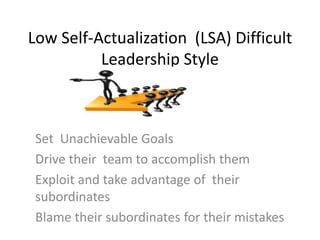
Low Self-Actualization (LSA) Difficult
Leadership Style
Set Unachievable Goals
Drive their team to accomplish them
Exploit and take advantage of their
subordinates
Blame their subordinates for their mistakes
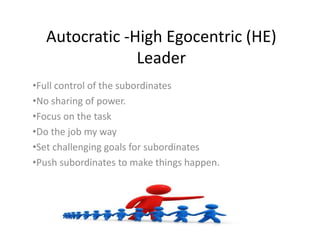
Autocratic -High Egocentric (HE)
Leader
•Full control of the subordinates
•No sharing of power.
•Focus on the task
•Do the job my way
•Set challenging goals for subordinates
•Push subordinates to make things happen.
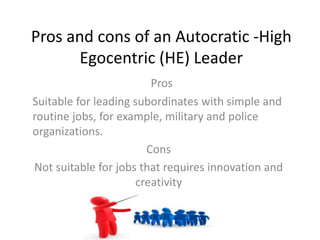
Pros and cons of an Autocratic -High
Egocentric (HE) Leader
Pros
Suitable for leading subordinates with simple and
routine jobs, for example, military and police
organizations.
Cons
Not suitable for jobs that requires innovation and
creativity
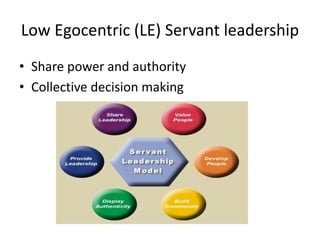
Low Egocentric (LE) Servant leadership
• Share power and authority
• Collective decision making
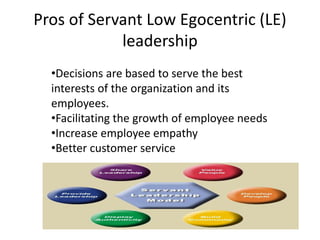
Pros of Servant Low Egocentric (LE)
leadership
•Decisions are based to serve the best
interests of the organization and its
employees.
•Facilitating the growth of employee needs
•Increase employee empathy
•Better customer service
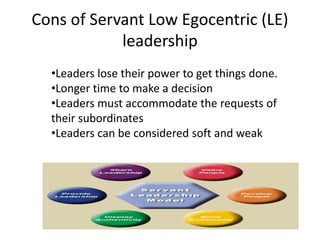
Cons of Servant Low Egocentric (LE)
leadership
•Leaders lose their power to get things done.
•Longer time to make a decision
•Leaders must accommodate the requests of
their subordinates
•Leaders can be considered soft and weak
Democratic/Participative - High
Sociocentric (HSO) Leader
•Focus on building high performance team
•Do the job together
•Set goals together
•Decision by consensus
•Share power, responsibility and accountability
Pros and Cons of Democratic - High
Sociocentric HSO) leader
PROS
Enhance job satisfaction
Facilitate the contribution of ideas
Better creativity
Cons
Slow down the decision-making process. May not work
well in places where making fast decision is crucial
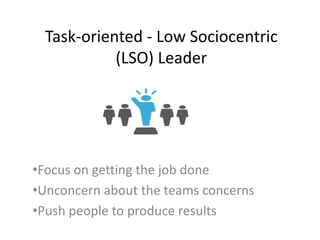
Task-oriented - Low Sociocentric
(LSO) Leader
•Focus on getting the job done
•Unconcern about the teams concerns
•Push people to produce results
Pros and Cons of a Task-oriented -
Low Sociocentric (LSO) Leader
Pros
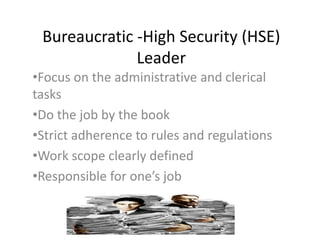
Bureaucratic -High Security (HSE)
Leader
•Focus on the administrative and clerical
tasks
•Do the job by the book
•Strict adherence to rules and regulations
•Work scope clearly defined
•Responsible for one’s job
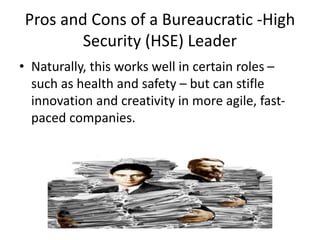
Pros and Cons of a Bureaucratic -High
Security (HSE) Leader
• Naturally, this works well in certain roles –
such as health and safety – but can stifle
innovation and creativity in more agile, fast-
paced companies.
Laissez-faire Low Security (LSE)
leadership
•Do the job your way
•Hands of approach to decisions
•Employees are empowered to get on with
their tasks as they see fit
Pros and cons of a Low Security -
Laissez-faire leadership
• Required minimum supervision
• Can be an effective style for experienced
employees who have the right attitude and
competencies.
• Motivate talented people to optimize their
potentials for success
• Beneficial to use this style for creative jobs
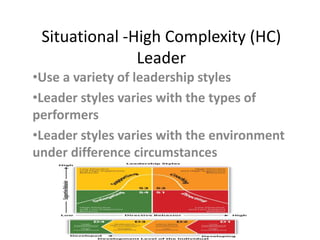
Situational -High Complexity (HC)
Leader
•Use a variety of leadership styles
•Leader styles varies with the types of
performers
•Leader styles varies with the environment
under difference circumstances
Situational -High Complexity (HC)
Leader
•Use a variety of leadership styles
•Leader styles varies with the types of
performers
•Leader styles varies with the environment
under difference circumstances
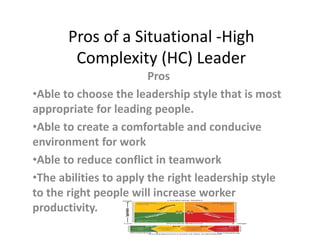
Pros of a Situational -High
Complexity (HC) Leader
Pros
•Able to choose the leadership style that is most
appropriate for leading people.
•Able to create a comfortable and conducive
environment for work
•Able to reduce conflict in teamwork
•The abilities to apply the right leadership style
to the right people will increase worker
productivity.
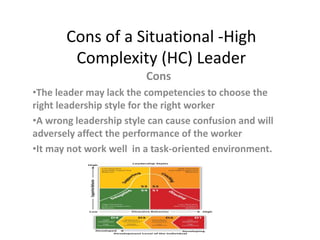
Cons of a Situational -High
Complexity (HC) Leader
Cons
•The leader may lack the competencies to choose the
right leadership style for the right worker
•A wrong leadership style can cause confusion and will
adversely affect the performance of the worker
•It may not work well in a task-oriented environment.
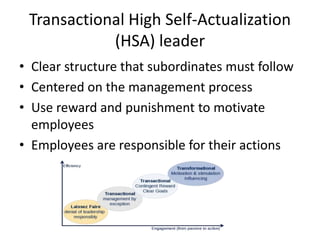
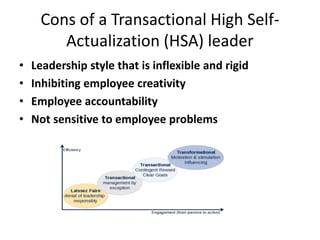
Transactional High Self-Actualization
(HSA) leader
• Clear structure that subordinates must follow
• Centered on the management process
• Use reward and punishment to motivate
employees
• Employees are responsible for their actions
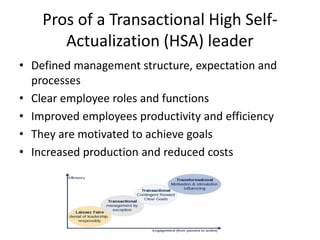
Pros of a Transactional High Self-
Actualization (HSA) leader
• Defined management structure, expectation and
processes
• Clear employee roles and functions
• Improved employees productivity and efficiency
• They are motivated to achieve goals
• Increased production and reduced costs
Cons of a Transactional High Self-
Actualization (HSA) leader
• Leadership style that is inflexible and rigid
• Inhibiting employee creativity
• Employee accountability
• Not sensitive to employee problems
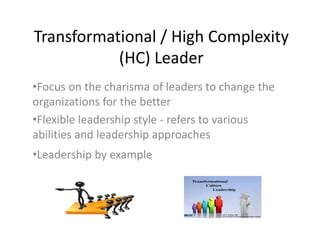
Transformational / High Complexity
(HC) Leader
•Focus on the charisma of leaders to change the
organizations for the better
•Flexible leadership style - refers to various
abilities and leadership approaches
•Leadership by example
Pros of a Transformational / High
Complexity (HC) Leader
•Focus on satellite vision formulation that can change the
organizational structure for improvement and growth
•Creating responsive change and innovation in a
favorable work environment
•Use inspiration to motivate people to give their best.
•Increase staff effectiveness by engaging in corporate
learning
•Reduce employee turnover
Cons of a transformational/High
Complexity (HC) Leader
•Facing serious detail challenges.
•Tends to ignore reality and truth
•Can experience possible abuse.
Conclusion
There is no one best leadership style to manage
people. Knowing the leadership styles helps us
understand the different types of leaders and
define their characteristics from diverse
perspectives. The choice of a leadership style in
a particular situation is a style that works and
make things
happen.

How kyko identify leadership styles

  • 1.
    Definition of leadership Leadershipis the art of motivating and influencing a group of people to act towards achieving a common goal.
  • 2.
    Achievement oriented leadership style SetSMART Goals Motivate and develop his team on doing the jobs well Focus on productivity – producing tangible results
  • 3.
    Pros and Consof Achievement- Oriented - High Self-Actualization (HSA) leader PROS Communicate clear goals Set deadlines for performance targets Leader visibility to coach, guide, advice and help the teams Rewards tie to performance Cons Focus more on the task than the concerns of the team Tendency to push the team too hard to produce results May cause burnt out and high labor turnover.
  • 4.
    Low Self-Actualization (LSA)Difficult Leadership Style Set Unachievable Goals Drive their team to accomplish them Exploit and take advantage of their subordinates Blame their subordinates for their mistakes
  • 5.
    Autocratic -High Egocentric(HE) Leader •Full control of the subordinates •No sharing of power. •Focus on the task •Do the job my way •Set challenging goals for subordinates •Push subordinates to make things happen.
  • 6.
    Pros and consof an Autocratic -High Egocentric (HE) Leader Pros Suitable for leading subordinates with simple and routine jobs, for example, military and police organizations. Cons Not suitable for jobs that requires innovation and creativity
  • 7.
    Low Egocentric (LE)Servant leadership • Share power and authority • Collective decision making
  • 8.
    Pros of ServantLow Egocentric (LE) leadership •Decisions are based to serve the best interests of the organization and its employees. •Facilitating the growth of employee needs •Increase employee empathy •Better customer service
  • 9.
    Cons of ServantLow Egocentric (LE) leadership •Leaders lose their power to get things done. •Longer time to make a decision •Leaders must accommodate the requests of their subordinates •Leaders can be considered soft and weak
  • 10.
    Democratic/Participative - High Sociocentric(HSO) Leader •Focus on building high performance team •Do the job together •Set goals together •Decision by consensus •Share power, responsibility and accountability
  • 11.
    Pros and Consof Democratic - High Sociocentric HSO) leader PROS Enhance job satisfaction Facilitate the contribution of ideas Better creativity Cons Slow down the decision-making process. May not work well in places where making fast decision is crucial
  • 12.
    Task-oriented - LowSociocentric (LSO) Leader •Focus on getting the job done •Unconcern about the teams concerns •Push people to produce results
  • 13.
    Pros and Consof a Task-oriented - Low Sociocentric (LSO) Leader Pros
  • 14.
    Bureaucratic -High Security(HSE) Leader •Focus on the administrative and clerical tasks •Do the job by the book •Strict adherence to rules and regulations •Work scope clearly defined •Responsible for one’s job
  • 15.
    Pros and Consof a Bureaucratic -High Security (HSE) Leader • Naturally, this works well in certain roles – such as health and safety – but can stifle innovation and creativity in more agile, fast- paced companies.
  • 16.
    Laissez-faire Low Security(LSE) leadership •Do the job your way •Hands of approach to decisions •Employees are empowered to get on with their tasks as they see fit
  • 17.
    Pros and consof a Low Security - Laissez-faire leadership • Required minimum supervision • Can be an effective style for experienced employees who have the right attitude and competencies. • Motivate talented people to optimize their potentials for success • Beneficial to use this style for creative jobs
  • 18.
    Situational -High Complexity(HC) Leader •Use a variety of leadership styles •Leader styles varies with the types of performers •Leader styles varies with the environment under difference circumstances
  • 19.
    Situational -High Complexity(HC) Leader •Use a variety of leadership styles •Leader styles varies with the types of performers •Leader styles varies with the environment under difference circumstances
  • 20.
    Pros of aSituational -High Complexity (HC) Leader Pros •Able to choose the leadership style that is most appropriate for leading people. •Able to create a comfortable and conducive environment for work •Able to reduce conflict in teamwork •The abilities to apply the right leadership style to the right people will increase worker productivity.
  • 21.
    Cons of aSituational -High Complexity (HC) Leader Cons •The leader may lack the competencies to choose the right leadership style for the right worker •A wrong leadership style can cause confusion and will adversely affect the performance of the worker •It may not work well in a task-oriented environment.
  • 22.
    Transactional High Self-Actualization (HSA)leader • Clear structure that subordinates must follow • Centered on the management process • Use reward and punishment to motivate employees • Employees are responsible for their actions
  • 23.
    Pros of aTransactional High Self- Actualization (HSA) leader • Defined management structure, expectation and processes • Clear employee roles and functions • Improved employees productivity and efficiency • They are motivated to achieve goals • Increased production and reduced costs
  • 24.
    Cons of aTransactional High Self- Actualization (HSA) leader • Leadership style that is inflexible and rigid • Inhibiting employee creativity • Employee accountability • Not sensitive to employee problems
  • 25.
    Transformational / HighComplexity (HC) Leader •Focus on the charisma of leaders to change the organizations for the better •Flexible leadership style - refers to various abilities and leadership approaches •Leadership by example
  • 26.
    Pros of aTransformational / High Complexity (HC) Leader •Focus on satellite vision formulation that can change the organizational structure for improvement and growth •Creating responsive change and innovation in a favorable work environment •Use inspiration to motivate people to give their best. •Increase staff effectiveness by engaging in corporate learning •Reduce employee turnover
  • 27.
    Cons of atransformational/High Complexity (HC) Leader •Facing serious detail challenges. •Tends to ignore reality and truth •Can experience possible abuse.
  • 28.
    Conclusion There is noone best leadership style to manage people. Knowing the leadership styles helps us understand the different types of leaders and define their characteristics from diverse perspectives. The choice of a leadership style in a particular situation is a style that works and make things happen.