Personality9/6/2011Organizational behaviour Lesson 21Individual DifferencesPart 1
PersonalityObjectives:Students should be able toExplain the basic sources of personality.Identify some personality traits that affect behaviour.9/6/2011Organizational behaviour Lesson 22
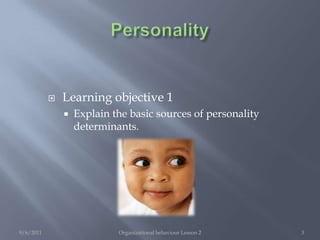
PersonalityLearning objective 1Explain the basic sources of personality determinants.9/6/2011Organizational behaviour Lesson 23
PersonalityPersonality conceptBehaviour involves a complex interaction of the person and the situation.Personality represents personal characteristics that lead to a consistent pattern of behaviour.Personality describes people commonalities and differences.Personality is stable over time.Definition : personality represents the overall profile or combination of stable psychological attributes that capture the unique nature of a person.9/6/2011Organizational behaviour Lesson 24
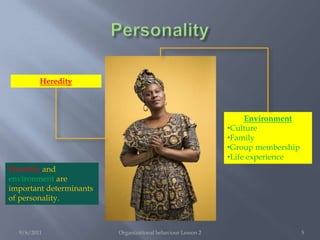
Personality9/6/2011Organizational behaviour Lesson 25HeredityEnvironmentCulture
Family
Group membership
Life experienceHeredity and environment are important determinants of personality.
PersonalityHeredityA source of personality differencesResearch shows strong genetics effects on human personality. Some research points to evidence of 50 to 55% of personality traits have been attributed to genetics.9/6/2011Organizational behaviour Lesson 26
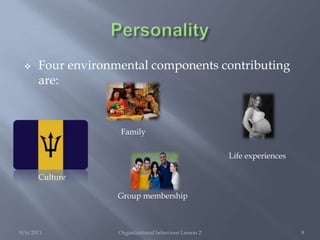
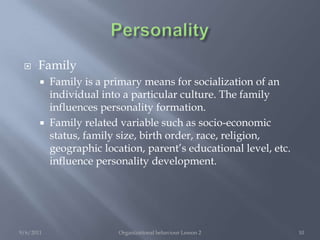
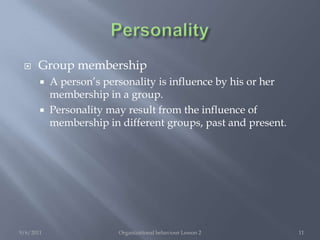
PersonalityEnvironment9/6/2011Organizational behaviour Lesson 27 Environment is considered to be a source of personality differences.PersonalityFour environmental components contributing are:9/6/2011Organizational behaviour Lesson 28FamilyLife experiencesCultureGroup membership
PersonalityCulture – the distinctive ways that people in different societies organize and live their lives.Culture determine societal values and morns as well as the role people play.Culture assist in determining broad patterns of behavioural similarities among people.Cultures are not homogenous. People of the same cultural background do not always respond the same way.Implication for managers:Managers of a same cultural background as their subordinate should not assume that their subordinates are like themselves in context of societal values, personality, or other individual characteristics.9/6/2011Organizational behaviour Lesson 29
PersonalityFamilyFamily is a primary means for socialization of an individual into a particular culture. The family influences personality formation.Family related variable such as socio-economic status, family size, birth order, race, religion, geographic location, parent’s educational level, etc. influence personality development.9/6/2011Organizational behaviour Lesson 210
PersonalityGroup membershipA person’s personality is influence by his or her membership in a group. Personality may result from the influence of membership in different groups, past and present.9/6/2011Organizational behaviour Lesson 211
PersonalityLife experiences:Specific events and experience can impact on one’s personality development.A complex series of events and interactions with others people shape an adult’s self-esteem.9/6/2011Organizational behaviour Lesson 212
PersonalityLearning Behaviour 2Indentify some personality traits that affect behaviour.9/6/2011Organizational behaviour Lesson 213
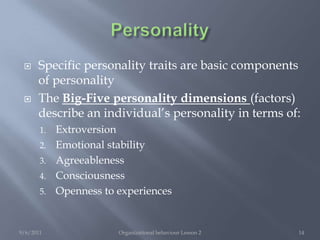
PersonalitySpecific personality traits are basic components of personalityThe Big-Five personality dimensions (factors) describe an individual’s personality in terms of:ExtroversionEmotional stabilityAgreeablenessConsciousnessOpenness to experiences9/6/2011Organizational behaviour Lesson 214
PersonalityExtroversionHigh : talkative, active, sociable, assertive, gregariousLow: reserved, quiet, introverted9/6/2011Organizational behaviour Lesson 215
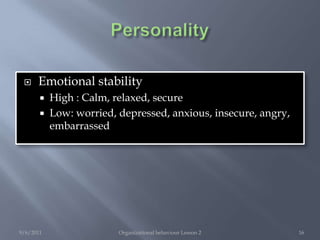
PersonalityEmotional stabilityHigh : Calm, relaxed, secureLow: worried, depressed, anxious, insecure, angry, embarrassed9/6/2011Organizational behaviour Lesson 216
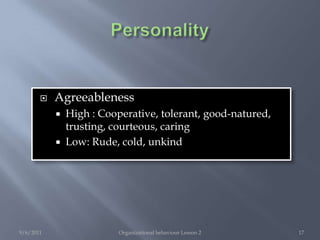
PersonalityAgreeablenessHigh : Cooperative, tolerant, good-natured, trusting, courteous, caringLow: Rude, cold, unkind9/6/2011Organizational behaviour Lesson 217
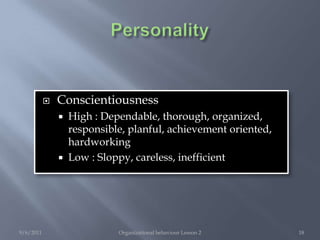
PersonalityConscientiousnessHigh : Dependable, thorough, organized, responsible, planful, achievement oriented, hardworkingLow : Sloppy, careless, inefficient9/6/2011Organizational behaviour Lesson 218
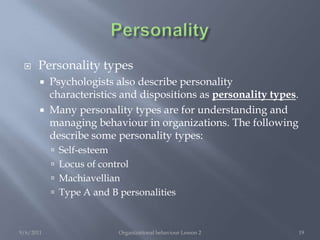
PersonalityPersonality typesPsychologists also describe personality characteristics and dispositions as personality types.Many personality types are for understanding and managing behaviour in organizations. The following describe some personality types:Self-esteemLocus of controlMachiavellianType A and B personalities9/6/2011Organizational behaviour Lesson 219
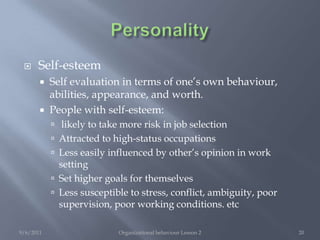
PersonalitySelf-esteemSelf evaluation in terms of one’s own behaviour, abilities, appearance, and worth.People with self-esteem: likely to take more risk in job selectionAttracted to high-status occupationsLess easily influenced by other’s opinion in work settingSet higher goals for themselvesLess susceptible to stress, conflict, ambiguity, poor supervision, poor working conditions. etc 9/6/2011Organizational behaviour Lesson 220
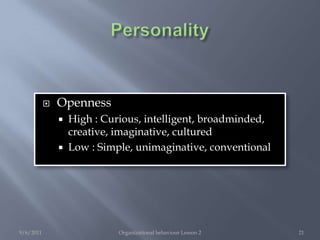
PersonalityOpennessHigh : Curious, intelligent, broadminded, creative, imaginative, culturedLow : Simple, unimaginative, conventional9/6/2011Organizational behaviour Lesson 221
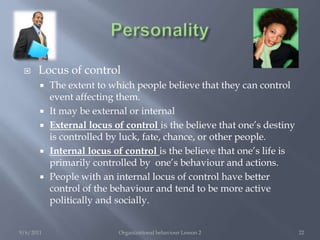
PersonalityLocus of controlThe extent to which people believe that they can control event affecting them.It may be external or internalExternal locus of control is the believe that one’s destiny is controlled by luck, fate, chance, or other people.Internal locus of control is the believe that one’s life is primarily controlled by  one’s behaviour and actions.People with an internal locus of control have better control of the behaviour and tend to be more active politically and socially.9/6/2011Organizational behaviour Lesson 222

Ob lesson 2 personality

  • 1.
  • 2.
    PersonalityObjectives:Students should beable toExplain the basic sources of personality.Identify some personality traits that affect behaviour.9/6/2011Organizational behaviour Lesson 22
  • 3.
    PersonalityLearning objective 1Explainthe basic sources of personality determinants.9/6/2011Organizational behaviour Lesson 23
  • 4.
    PersonalityPersonality conceptBehaviour involvesa complex interaction of the person and the situation.Personality represents personal characteristics that lead to a consistent pattern of behaviour.Personality describes people commonalities and differences.Personality is stable over time.Definition : personality represents the overall profile or combination of stable psychological attributes that capture the unique nature of a person.9/6/2011Organizational behaviour Lesson 24
  • 5.
  • 6.
  • 7.
  • 8.
    Life experienceHeredity andenvironment are important determinants of personality.
  • 9.
    PersonalityHeredityA source ofpersonality differencesResearch shows strong genetics effects on human personality. Some research points to evidence of 50 to 55% of personality traits have been attributed to genetics.9/6/2011Organizational behaviour Lesson 26
  • 10.
    PersonalityEnvironment9/6/2011Organizational behaviour Lesson27 Environment is considered to be a source of personality differences.PersonalityFour environmental components contributing are:9/6/2011Organizational behaviour Lesson 28FamilyLife experiencesCultureGroup membership
  • 11.
    PersonalityCulture – thedistinctive ways that people in different societies organize and live their lives.Culture determine societal values and morns as well as the role people play.Culture assist in determining broad patterns of behavioural similarities among people.Cultures are not homogenous. People of the same cultural background do not always respond the same way.Implication for managers:Managers of a same cultural background as their subordinate should not assume that their subordinates are like themselves in context of societal values, personality, or other individual characteristics.9/6/2011Organizational behaviour Lesson 29
  • 12.
    PersonalityFamilyFamily is aprimary means for socialization of an individual into a particular culture. The family influences personality formation.Family related variable such as socio-economic status, family size, birth order, race, religion, geographic location, parent’s educational level, etc. influence personality development.9/6/2011Organizational behaviour Lesson 210
  • 13.
    PersonalityGroup membershipA person’spersonality is influence by his or her membership in a group. Personality may result from the influence of membership in different groups, past and present.9/6/2011Organizational behaviour Lesson 211
  • 14.
    PersonalityLife experiences:Specific eventsand experience can impact on one’s personality development.A complex series of events and interactions with others people shape an adult’s self-esteem.9/6/2011Organizational behaviour Lesson 212
  • 15.
    PersonalityLearning Behaviour 2Indentifysome personality traits that affect behaviour.9/6/2011Organizational behaviour Lesson 213
  • 16.
    PersonalitySpecific personality traitsare basic components of personalityThe Big-Five personality dimensions (factors) describe an individual’s personality in terms of:ExtroversionEmotional stabilityAgreeablenessConsciousnessOpenness to experiences9/6/2011Organizational behaviour Lesson 214
  • 17.
    PersonalityExtroversionHigh : talkative,active, sociable, assertive, gregariousLow: reserved, quiet, introverted9/6/2011Organizational behaviour Lesson 215
  • 18.
    PersonalityEmotional stabilityHigh :Calm, relaxed, secureLow: worried, depressed, anxious, insecure, angry, embarrassed9/6/2011Organizational behaviour Lesson 216
  • 19.
    PersonalityAgreeablenessHigh : Cooperative,tolerant, good-natured, trusting, courteous, caringLow: Rude, cold, unkind9/6/2011Organizational behaviour Lesson 217
  • 20.
    PersonalityConscientiousnessHigh : Dependable,thorough, organized, responsible, planful, achievement oriented, hardworkingLow : Sloppy, careless, inefficient9/6/2011Organizational behaviour Lesson 218
  • 21.
    PersonalityPersonality typesPsychologists alsodescribe personality characteristics and dispositions as personality types.Many personality types are for understanding and managing behaviour in organizations. The following describe some personality types:Self-esteemLocus of controlMachiavellianType A and B personalities9/6/2011Organizational behaviour Lesson 219
  • 22.
    PersonalitySelf-esteemSelf evaluation interms of one’s own behaviour, abilities, appearance, and worth.People with self-esteem: likely to take more risk in job selectionAttracted to high-status occupationsLess easily influenced by other’s opinion in work settingSet higher goals for themselvesLess susceptible to stress, conflict, ambiguity, poor supervision, poor working conditions. etc 9/6/2011Organizational behaviour Lesson 220
  • 23.
    PersonalityOpennessHigh : Curious,intelligent, broadminded, creative, imaginative, culturedLow : Simple, unimaginative, conventional9/6/2011Organizational behaviour Lesson 221
  • 24.
    PersonalityLocus of controlTheextent to which people believe that they can control event affecting them.It may be external or internalExternal locus of control is the believe that one’s destiny is controlled by luck, fate, chance, or other people.Internal locus of control is the believe that one’s life is primarily controlled by one’s behaviour and actions.People with an internal locus of control have better control of the behaviour and tend to be more active politically and socially.9/6/2011Organizational behaviour Lesson 222