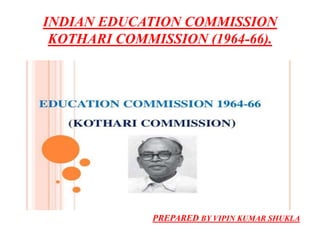

INDIAN EDUCATION COMMISSION
KOTHARI COMMISSION (1964-66).
PREPARED BY VIPIN KUMAR SHUKLA
(INTRODUCTION)
• National education commission (1964-66) popularly
known as “ Kothari Commission.
• Daulat Singh Kothari (6 July 1906- 4feb 1993) was an
Educationist).
• He was appointed as the chairman of UGC in the year
(1961) were he worked till (1973).
• He was the chairman of Indian education commission of
(1964-66) popularly known as Kothari Commission.
Contd….
• It was the first (AD-HOC) commission set up in India
for the modernization and standardization of
education in India.
• The most urgent reform needed in education is to
transform it, relate it to the life, needs and aspirations
of the people and thereby to make it a powerful tool
of social, economic and cultural transformations
necessary for realization of our national goal.
Contd….
• For this purpose education should be developed as to
increase the productivity achieve social and National
Integration.
• It also accelerate the pace of modernization and to
build the character by cultivation, social, moral and
spiritual value.
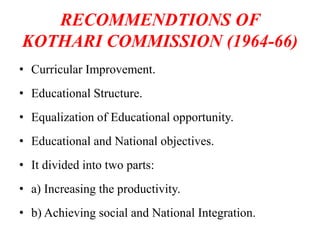
RECOMMENDTIONS OF
KOTHARI COMMISSION (1964-66)
• Curricular Improvement.
• Educational Structure.
• Equalization of Educational opportunity.
• Educational and National objectives.
• It divided into two parts:
• a) Increasing the productivity.
• b) Achieving social and National Integration.
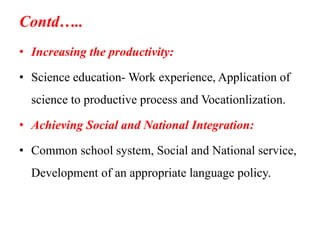
Contd…..
• Increasing the productivity:
• Science education- Work experience, Application of
science to productive process and Vocationlization.
• Achieving Social and National Integration:
• Common school system, Social and National service,
Development of an appropriate language policy.
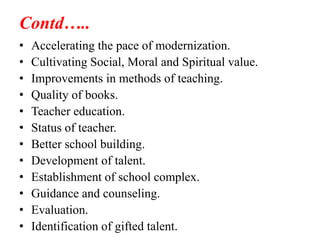
Contd…..
• Accelerating the pace of modernization.
• Cultivating Social, Moral and Spiritual value.
• Improvements in methods of teaching.
• Quality of books.
• Teacher education.
• Status of teacher.
• Better school building.
• Development of talent.
• Establishment of school complex.
• Guidance and counseling.
• Evaluation.
• Identification of gifted talent.
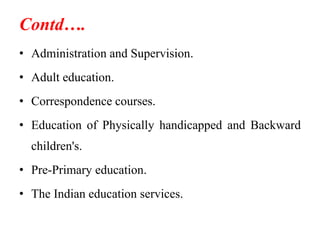
Contd….
• Administration and Supervision.
• Adult education.
• Correspondence courses.
• Education of Physically handicapped and Backward
children's.
• Pre-Primary education.
• The Indian education services.
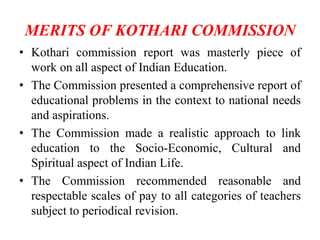
MERITS OF KOTHARI COMMISSION
• Kothari commission report was masterly piece of
work on all aspect of Indian Education.
• The Commission presented a comprehensive report of
educational problems in the context to national needs
and aspirations.
• The Commission made a realistic approach to link
education to the Socio-Economic, Cultural and
Spiritual aspect of Indian Life.
• The Commission recommended reasonable and
respectable scales of pay to all categories of teachers
subject to periodical revision.
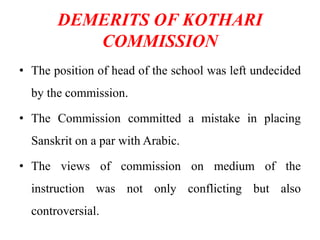
DEMERITS OF KOTHARI
COMMISSION
• The position of head of the school was left undecided
by the commission.
• The Commission committed a mistake in placing
Sanskrit on a par with Arabic.
• The views of commission on medium of the
instruction was not only conflicting but also
controversial.
Kothari commission

Kothari commission

  • 1.
    INDIAN EDUCATION COMMISSION KOTHARICOMMISSION (1964-66). PREPARED BY VIPIN KUMAR SHUKLA
  • 2.
    (INTRODUCTION) • National educationcommission (1964-66) popularly known as “ Kothari Commission. • Daulat Singh Kothari (6 July 1906- 4feb 1993) was an Educationist). • He was appointed as the chairman of UGC in the year (1961) were he worked till (1973). • He was the chairman of Indian education commission of (1964-66) popularly known as Kothari Commission.
  • 3.
    Contd…. • It wasthe first (AD-HOC) commission set up in India for the modernization and standardization of education in India. • The most urgent reform needed in education is to transform it, relate it to the life, needs and aspirations of the people and thereby to make it a powerful tool of social, economic and cultural transformations necessary for realization of our national goal.
  • 4.
    Contd…. • For thispurpose education should be developed as to increase the productivity achieve social and National Integration. • It also accelerate the pace of modernization and to build the character by cultivation, social, moral and spiritual value.
  • 5.
    RECOMMENDTIONS OF KOTHARI COMMISSION(1964-66) • Curricular Improvement. • Educational Structure. • Equalization of Educational opportunity. • Educational and National objectives. • It divided into two parts: • a) Increasing the productivity. • b) Achieving social and National Integration.
  • 6.
    Contd….. • Increasing theproductivity: • Science education- Work experience, Application of science to productive process and Vocationlization. • Achieving Social and National Integration: • Common school system, Social and National service, Development of an appropriate language policy.
  • 7.
    Contd….. • Accelerating thepace of modernization. • Cultivating Social, Moral and Spiritual value. • Improvements in methods of teaching. • Quality of books. • Teacher education. • Status of teacher. • Better school building. • Development of talent. • Establishment of school complex. • Guidance and counseling. • Evaluation. • Identification of gifted talent.
  • 8.
    Contd…. • Administration andSupervision. • Adult education. • Correspondence courses. • Education of Physically handicapped and Backward children's. • Pre-Primary education. • The Indian education services.
  • 9.
    MERITS OF KOTHARICOMMISSION • Kothari commission report was masterly piece of work on all aspect of Indian Education. • The Commission presented a comprehensive report of educational problems in the context to national needs and aspirations. • The Commission made a realistic approach to link education to the Socio-Economic, Cultural and Spiritual aspect of Indian Life. • The Commission recommended reasonable and respectable scales of pay to all categories of teachers subject to periodical revision.
  • 10.
    DEMERITS OF KOTHARI COMMISSION •The position of head of the school was left undecided by the commission. • The Commission committed a mistake in placing Sanskrit on a par with Arabic. • The views of commission on medium of the instruction was not only conflicting but also controversial.