 Kothari Education Commission, 1964-66, which
was the sixth commission in the history of
commission in India. The Five Years Plan, started
after independence helped the growth of the country
in many areas. However, the execution of these
plans expresses the inherent weakness due to which
the expected success was not being achieved.
Education appeared to be one of areas which
indicated many problems that needed our efforts for
immediate solutions. The government was fully
aware of the situation
APPOINTMENT OF THE COMMISSION
 The Commission was appointed under provision of a
resolution of the Government of India, dated 14th July,
1964. The Commission included eminent educationists in
diverse fields from India and abroad. It consisted of total
17 members, where 14 members, 1 member - secretary, 1
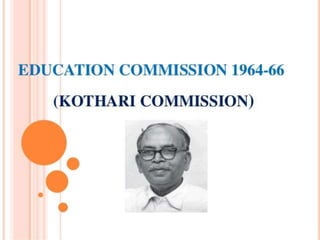
Associate - Secretary and Dr. D.S. Kothari, chairman
of the U.G.C. was appointed as the chairman of the
commission. Therefore, it is also known as the Kothari
Commission. Among the members of the commission 5
educationists were from England, America, France,
Japan and Russia. J.P. Naik was appointed as number
secretary of the commission and J.F McDougall as
associated secretary.
1) All the five earlier commissions did not deal with
education as a whole but focussed attention on
different levels of education. But this commission
was not to limit its enquiry to specific sectors or
aspects of education, but to have a
comprehensive review of the Entire Educational
System.
2) Another unique feature of the Commission was its
conviction that education is the most powerful
instrument of the national development. The
crucial role of education in national development
appears in all its vividness on every page of the
report.
Unique Feature of the Commission
 The commission started its work on the birthday of
Mahatma Gandhi, the father of the nation. It
constituted 12 task forces and 7 working groups for
studying the various problems of education in the
country. It interviewed about 9000 men and women
distinguished in public life, educators, scientists,
industrialists and scholars in different fields and others
interested in education. The Commission spent about
hundred days in visiting universities, colleges and
schools and held discussions with teachers,
educationists, administrators and students. It received
and scrutinized 2,400 Memorandum and notes. The
commission worked for 21 months and submitted it
report on June, 1966.
 The report of the commission is an excellent document
on education. In its report the commission expressed its
form belief that education is the most powerful instrument
of national development. The report of the commission
has been appropriately entitled as ‘education and
national development’.

The report is divided into four sections –
Section I : deal with general Problems.
Section II : deal with Education at different stages and in
different sectors.
Section III : deals with implementation of the various
recommendations and programmes suggested by the
commission.
Section IV : consists of supplementary papers.
 Education has a very extensive role to play in
changing the men and society. It has to be entirely
reformed and related to the life, needs and
aspirations of the people so that it may serve as a
powerful tool of social, economic and cultural
transformation.
 In order to relate education, the commission
recommended the following objectives-
1. Increase in Productivity.
2. Promoting social and National Integration
3. Education and Modernization
4. Developing social, moral and spiritual values.
 One to three years of pre-school education.
 A primary stage of 7 to 8 years divided into a lower
primary stage of 4 or 5 years and a higher primary
stage of 3 or 2 years.
 A lower secondary stage of 3 or 2 years of general
education or 1 to 3 years of vocational education.
 A higher secondary stage of 2 years of general
education or 1 to 3 years of vocational education, 50%
of the total would be under vocational education,
 A higher education stage of 3 years or more for the first
degree course followed by courses of varying durations
for the second or research degrees.
Ppt on kothari commission 1964-66

Ppt on kothari commission 1964-66

  • 2.
     Kothari EducationCommission, 1964-66, which was the sixth commission in the history of commission in India. The Five Years Plan, started after independence helped the growth of the country in many areas. However, the execution of these plans expresses the inherent weakness due to which the expected success was not being achieved. Education appeared to be one of areas which indicated many problems that needed our efforts for immediate solutions. The government was fully aware of the situation
  • 3.
    APPOINTMENT OF THECOMMISSION  The Commission was appointed under provision of a resolution of the Government of India, dated 14th July, 1964. The Commission included eminent educationists in diverse fields from India and abroad. It consisted of total 17 members, where 14 members, 1 member - secretary, 1 Associate - Secretary and Dr. D.S. Kothari, chairman of the U.G.C. was appointed as the chairman of the commission. Therefore, it is also known as the Kothari Commission. Among the members of the commission 5 educationists were from England, America, France, Japan and Russia. J.P. Naik was appointed as number secretary of the commission and J.F McDougall as associated secretary.
  • 4.
    1) All thefive earlier commissions did not deal with education as a whole but focussed attention on different levels of education. But this commission was not to limit its enquiry to specific sectors or aspects of education, but to have a comprehensive review of the Entire Educational System. 2) Another unique feature of the Commission was its conviction that education is the most powerful instrument of the national development. The crucial role of education in national development appears in all its vividness on every page of the report. Unique Feature of the Commission
  • 5.
     The commissionstarted its work on the birthday of Mahatma Gandhi, the father of the nation. It constituted 12 task forces and 7 working groups for studying the various problems of education in the country. It interviewed about 9000 men and women distinguished in public life, educators, scientists, industrialists and scholars in different fields and others interested in education. The Commission spent about hundred days in visiting universities, colleges and schools and held discussions with teachers, educationists, administrators and students. It received and scrutinized 2,400 Memorandum and notes. The commission worked for 21 months and submitted it report on June, 1966.
  • 6.
     The reportof the commission is an excellent document on education. In its report the commission expressed its form belief that education is the most powerful instrument of national development. The report of the commission has been appropriately entitled as ‘education and national development’.  The report is divided into four sections – Section I : deal with general Problems. Section II : deal with Education at different stages and in different sectors. Section III : deals with implementation of the various recommendations and programmes suggested by the commission. Section IV : consists of supplementary papers.
  • 7.
     Education hasa very extensive role to play in changing the men and society. It has to be entirely reformed and related to the life, needs and aspirations of the people so that it may serve as a powerful tool of social, economic and cultural transformation.  In order to relate education, the commission recommended the following objectives- 1. Increase in Productivity. 2. Promoting social and National Integration 3. Education and Modernization 4. Developing social, moral and spiritual values.
  • 8.
     One tothree years of pre-school education.  A primary stage of 7 to 8 years divided into a lower primary stage of 4 or 5 years and a higher primary stage of 3 or 2 years.  A lower secondary stage of 3 or 2 years of general education or 1 to 3 years of vocational education.  A higher secondary stage of 2 years of general education or 1 to 3 years of vocational education, 50% of the total would be under vocational education,  A higher education stage of 3 years or more for the first degree course followed by courses of varying durations for the second or research degrees.