KOTHARI COMMISION
Presented by
Dr. P. SUBRAMANIAN
Assistant Professor
Department of Educational Planning and Administration
Tamil Nadu Teachers Education University
Karapakkam, Chennai – 600 097.
INTRODUCTION
The National Education Commission was
appointed in 1964 and it reported in 1966.
Its chairman was Dr. D. S. Kothari,
Chairman, University Grants Commission.
The terms of reference were to advice
government on national pattern of
education and on the general principles
and policies for the development of
education at all stages and all its aspects.
SALIENT FEATURES OF
KOTHARI COMMISSION
 The recommendations laid down aims of
education – economic, political, emotional,
social, scientific, and personal.
 It recommended qualitative improvements and
quantitative expansion.
 Educational pyramid was to be built from pre-
primary to the university levels.
 Professional preparation of teachers was
considered crucial to the qualitative
improvement of education.
 Salary scales were fixed and improved.
 Curriculum was laid down from pre-primary to
university stages.
 New teaching methods were to be used.
 Guidance and counseling were to be the
integral part of education.
 Recommendations were made to ensure
equality in educational opportunities
between male and female population and
between advanced and backward sections of
society.
 Work experience was recommended for
students at all levels.
NATIONALAIMS
 Education was to be related to productivity and
national integration.
 It was to strengthen social integration and
consolidate democracy as a form of government
and help the country to adopt it as a way of life.
 It was to hasten the process of modernization.
 It was to strive to build character by activation of
social, moral and spiritual values.
STRUCTURE OF EDUCATION
• It was recommended that the educational pyramid
required division into stages and their
interrelationship,
• the duration of different stages,
• the quality of teachers,
• Curriculum,
• Methods of teaching and evaluation equipment
and building and utilization of available facilities.
STRUCTURE OF PRIMARY
EDUCATION
• Pre-primary education – pre-primary, pre-basic,
kindergarten, Montessori.
• Primary education – class I to VII or I to VIII
which included lower primary classes (I – IV) or
(I to V) in some States, lower primary in some
other states and lower elementary still in some
states.
• Higher primary education – Classes V-VII or VI –
VIII.
LOWER PRIMARY STAGE
(CLASS I – IV)
 One language – the mother tongue or the
regional language
 Mathematics
 Study of environment (covering science and
social studies in class III or IV)
 Creative activities
 Work experience and social service
 Health education
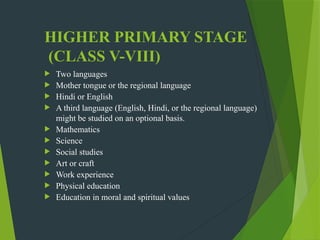
HIGHER PRIMARY STAGE
(CLASS V-VIII)
 Two languages
 Mother tongue or the regional language
 Hindi or English
 A third language (English, Hindi, or the regional language)
might be studied on an optional basis.
 Mathematics
 Science
 Social studies
 Art or craft
 Work experience
 Physical education
 Education in moral and spiritual values
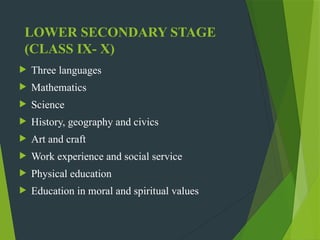
LOWER SECONDARY STAGE
(CLASS IX- X)
 Three languages
 Mathematics
 Science
 History, geography and civics
 Art and craft
 Work experience and social service
 Physical education
 Education in moral and spiritual values
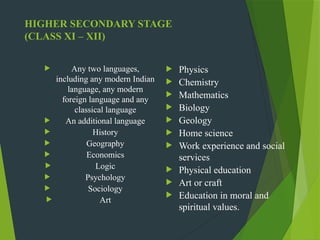
HIGHER SECONDARY STAGE
(CLASS XI – XII)
 Any two languages,
including any modern Indian
language, any modern
foreign language and any
classical language
 An additional language
 History
 Geography
 Economics
 Logic
 Psychology
 Sociology
 Art
 Physics
 Chemistry
 Mathematics
 Biology
 Geology
 Home science
 Work experience and social
services
 Physical education
 Art or craft
 Education in moral and
spiritual values.
 The commission recommended that tuition fees at
the primary level were to be abolished.
 Lower secondary education was to be free before
the end of the fifth plan.
 At primary level, free text books and working
material were to be provided.
 At the primary stage, scholarships were to be
awarded to a needy child
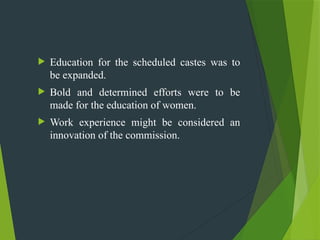
 Education for the scheduled castes was to
be expanded.
 Bold and determined efforts were to be
made for the education of women.
 Work experience might be considered an
innovation of the commission.
CONCLUSION
The commission recommended fewer
holidays, increase in working hours, decrease in
examination days, and home work in long holidays
and self study by using libraries, reading rooms,
laboratories and workshops etc.
REFERENCES
 Dutt, B. & Garg, Jyoti. (2012). Educational
Planning and administration. New Delhi: Global
Publications.
 Mathur, S. S. (1990). Educational administration
and management. India: The Indian Publications.
 Ministry of Education. (1966). Report of the
education commission (1964-66): Education and
national development. New Delhi: Govt. of India.
THANK
YOU

47_Kothari _Commission - PPT.pptxbsbdbjsnsbsbs sbs dbdbdbdbdbdbdbndjdjd

  • 1.
    KOTHARI COMMISION Presented by Dr.P. SUBRAMANIAN Assistant Professor Department of Educational Planning and Administration Tamil Nadu Teachers Education University Karapakkam, Chennai – 600 097.
  • 2.
    INTRODUCTION The National EducationCommission was appointed in 1964 and it reported in 1966. Its chairman was Dr. D. S. Kothari, Chairman, University Grants Commission. The terms of reference were to advice government on national pattern of education and on the general principles and policies for the development of education at all stages and all its aspects.
  • 3.
    SALIENT FEATURES OF KOTHARICOMMISSION  The recommendations laid down aims of education – economic, political, emotional, social, scientific, and personal.  It recommended qualitative improvements and quantitative expansion.  Educational pyramid was to be built from pre- primary to the university levels.
  • 4.
     Professional preparationof teachers was considered crucial to the qualitative improvement of education.  Salary scales were fixed and improved.  Curriculum was laid down from pre-primary to university stages.  New teaching methods were to be used.
  • 5.
     Guidance andcounseling were to be the integral part of education.  Recommendations were made to ensure equality in educational opportunities between male and female population and between advanced and backward sections of society.  Work experience was recommended for students at all levels.
  • 6.
    NATIONALAIMS  Education wasto be related to productivity and national integration.  It was to strengthen social integration and consolidate democracy as a form of government and help the country to adopt it as a way of life.  It was to hasten the process of modernization.  It was to strive to build character by activation of social, moral and spiritual values.
  • 7.
    STRUCTURE OF EDUCATION •It was recommended that the educational pyramid required division into stages and their interrelationship, • the duration of different stages, • the quality of teachers, • Curriculum, • Methods of teaching and evaluation equipment and building and utilization of available facilities.
  • 8.
    STRUCTURE OF PRIMARY EDUCATION •Pre-primary education – pre-primary, pre-basic, kindergarten, Montessori. • Primary education – class I to VII or I to VIII which included lower primary classes (I – IV) or (I to V) in some States, lower primary in some other states and lower elementary still in some states. • Higher primary education – Classes V-VII or VI – VIII.
  • 9.
    LOWER PRIMARY STAGE (CLASSI – IV)  One language – the mother tongue or the regional language  Mathematics  Study of environment (covering science and social studies in class III or IV)  Creative activities  Work experience and social service  Health education
  • 10.
    HIGHER PRIMARY STAGE (CLASSV-VIII)  Two languages  Mother tongue or the regional language  Hindi or English  A third language (English, Hindi, or the regional language) might be studied on an optional basis.  Mathematics  Science  Social studies  Art or craft  Work experience  Physical education  Education in moral and spiritual values
  • 11.
    LOWER SECONDARY STAGE (CLASSIX- X)  Three languages  Mathematics  Science  History, geography and civics  Art and craft  Work experience and social service  Physical education  Education in moral and spiritual values
  • 12.
    HIGHER SECONDARY STAGE (CLASSXI – XII)  Any two languages, including any modern Indian language, any modern foreign language and any classical language  An additional language  History  Geography  Economics  Logic  Psychology  Sociology  Art  Physics  Chemistry  Mathematics  Biology  Geology  Home science  Work experience and social services  Physical education  Art or craft  Education in moral and spiritual values.
  • 13.
     The commissionrecommended that tuition fees at the primary level were to be abolished.  Lower secondary education was to be free before the end of the fifth plan.  At primary level, free text books and working material were to be provided.  At the primary stage, scholarships were to be awarded to a needy child
  • 14.
     Education forthe scheduled castes was to be expanded.  Bold and determined efforts were to be made for the education of women.  Work experience might be considered an innovation of the commission.
  • 15.
    CONCLUSION The commission recommendedfewer holidays, increase in working hours, decrease in examination days, and home work in long holidays and self study by using libraries, reading rooms, laboratories and workshops etc.
  • 16.
    REFERENCES  Dutt, B.& Garg, Jyoti. (2012). Educational Planning and administration. New Delhi: Global Publications.  Mathur, S. S. (1990). Educational administration and management. India: The Indian Publications.  Ministry of Education. (1966). Report of the education commission (1964-66): Education and national development. New Delhi: Govt. of India.
  • 17.