The use of social software for
 Knowledge Management in
 globally distributed settings


   Jan Pawlowski & Henri Pirkkalainen
            Global Information Systems group
 Department of Computer Science and Information Systems

        TJTSD66 Advanced Topics in Social Media
Global Information Systems
Mission Statement
  Creating and validating new solutions for Information Systems in a
  global context - this includes the support of individuals and
  organizations to improve competitiveness, performance, and mutual
  understanding

Topics
  Designing work and learning processes in globally distributed
  organizations
  Design & development methods for global information systems
  Culture analysis and awareness
  Support tools for knowledge intensive processes in global
  organizations
  ICT4D: ICT for development
  E-Learning and knowledge management in global
  organizations
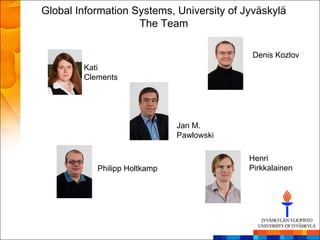
Global Information Systems, University of Jyväskylä
                    The Team

                                            Denis Kozlov
        Kati
        Clements


                              Jan M.
                              Pawlowski

                                           Henri
           Philipp Holtkamp                Pirkkalainen
Twitter feedback channel
             #GSKM13
You can provide feedback and ask questions
 regarding our part and the research topics
              through Twitter
Social Software for KM: Contents
 Knowledge Management in Global Settings


         Social Software – Vocabulary in IS field?


                  Starting point for global inspection - Barriers


                           Focus in KM – what has been studied and how?


                                     Towards unexplored research territories
A first question


What is common
  knowledge?
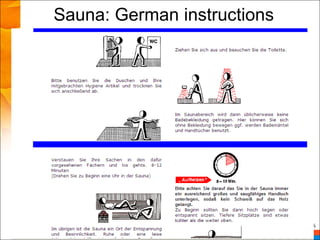
Sauna: German instructions
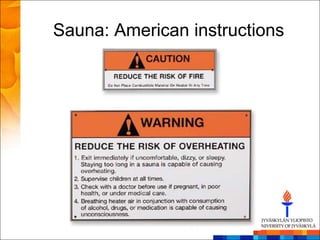
Sauna: American instructions
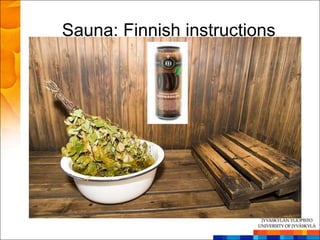
Sauna: Finnish instructions
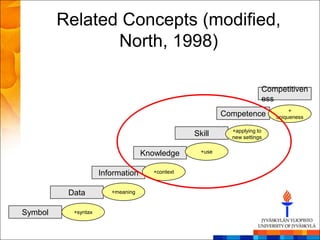
Related Concepts (modified,
                North, 1998)

                                                                       Competitiven
                                                                       ess
                                                                                +
                                                          Competence       uniqueness

                                                            +applying to
                                                 Skill      new settings


                                   Knowledge       +use


                     Information      +context


          Data          +meaning


Symbol     +syntax
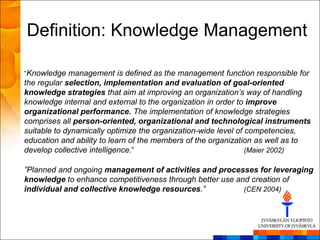
Definition: Knowledge Management

“Knowledge management is defined as the management function responsible for
the regular selection, implementation and evaluation of goal-oriented
knowledge strategies that aim at improving an organization’s way of handling
knowledge internal and external to the organization in order to improve
organizational performance. The implementation of knowledge strategies
comprises all person-oriented, organizational and technological instruments
suitable to dynamically optimize the organization-wide level of competencies,
education and ability to learn of the members of the organization as well as to
develop collective intelligence.“                               (Maier 2002)

”Planned and ongoing management of activities and processes for leveraging
knowledge to enhance competitiveness through better use and creation of
individual and collective knowledge resources.”           (CEN 2004)
A first question…


Why is Knowledge a
  Global Success
      Factor?
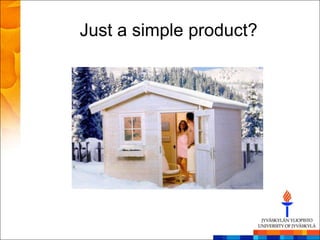
Just a simple product?
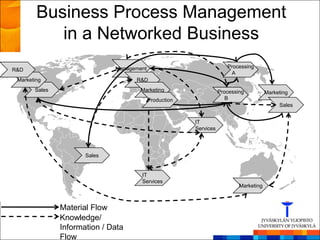
Business Process Management
           in a Networked Business
                              Management                              Processing
R&D
                                                                       A
 Marketing                          R&D
       Sales                          Marketing                    Processing          Marketing
                                           Production                 B
                                                                                            Sales


                                                        IT
                                                        Services


                      Sales


                                      IT
                                      Services
                                                                           Marketing


               Material Flow
               Knowledge/
               Information / Data
               Flow
Some random questions…
Decision questions
– Where to produce?
– How to build partnerships (joint ventures, contractors, …)
– Which systems to exchange knowledge?
Operational questions
– How to process wood?
– When will the next shipment arrive?
– How to market the product in Japan?
– How to explain the concept and advantages of Finnish
  saunas?
– How to find the main problems of customers?
– Which are import and safety regulations?
This means…
Knowledge is a key to global success

Global KM managers need to understand the value
chain and knowledge requirements
Global KM managers need to understand
knowledge processes and culture
Global KM managers are the main hubs for smooth
operations in production and service enterprises

Which kind of IS support is promising or proven
successful?
Summary
Knowledge as a critical success factor
Knowledge management to support businesses
Global aspects
–   Understanding the context
–   Process design
–   Systems and tool support
–   Cultural aspects
Social Software as a promising tool to combine
human- and technology-orientation
– Which tools for which context?
– How to overcome cultural differences?
– How to embed tools?
Social Software?
Social Software
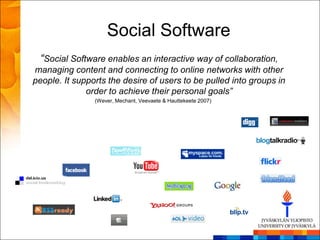
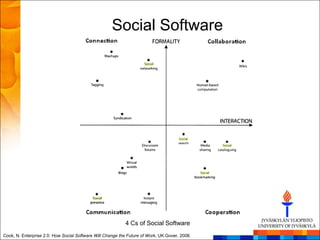
 “Social Software enables an interactive way of collaboration,
managing content and connecting to online networks with other
people. It supports the desire of users to be pulled into groups in
              order to achieve their personal goals”
                (Wever, Mechant, Veevaete & Hauttekeete 2007)
Social Software


                                                           4 Cs of Social Software
Cook, N. Enterprise 2.0: How Social Software Will Change the Future of Work, UK:Gover, 2008.
Intertwined terminologies!
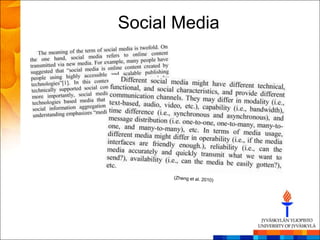
Social Media
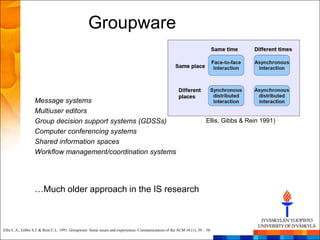
Groupware


                  Message systems
                  Multiuser editors
                  Group decision support systems (GDSSs)                                                                Ellis, Gibbs & Rein 1991)
                  Computer conferencing systems
                  Shared information spaces
                  Workflow management/coordination systems


                  …Much older approach in the IS research


Ellis C.A., Gibbs S.J. & Rein C.L. 1991. Groupware: Some issues and experiences. Communications of the ACM 34 (1), 39 – 58.
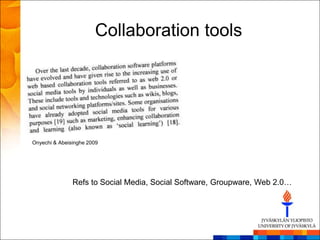
Collaboration tools


Onyechi & Abeisinghe 2009


               Refs to Social Media, Social Software, Groupware, Web 2.0…
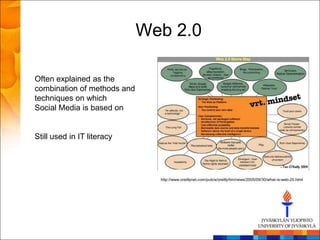
Web 2.0

Often explained as the
combination of methods and
techniques on which
Social Media is based on


Still used in IT literacy


                               http://www.oreillynet.com/pub/a/oreilly/tim/news/2005/09/30/what-is-web-20.html
What do you focus on when addressing
           Social Software?
Research Trends for KM & SoSo
Constructive / Design-oriented research
– Tools to improve knowledge exchange and distribution


Do we really understand how global KM works: Qualitative
Research
– Understanding which influence factors and relations emerge in
  global settings
– For example: Barriers to KM (why and how)


Relating and quantifying: Quantitative Research
– Understanding behavior in KM settings
– E.g. ISSM, TAM, KM Success Model
    • What type of relations, how strong, cause-effect etc.
    • Applied for example in Social networking studies, also Web 2.0 focus
Barriers?
Discussed from the viewpoint of an individual or group of people

Can relate to social interaction and as an example to factors that
hinder or challenge knowledge exchange

Might relate to challenges and risks when adopting or using a
specific technology

Challenges set by diverse workers, hierarchies and cultural
influences within an organization

In many cases tied to a specific context

Can be presented as a wider concept “cultural distance”
         …or as a question that is formed from the problem,
“How to reward contribution?”…
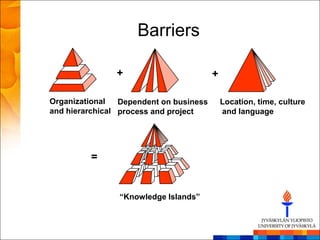
Barriers

                +                        +

Organizational   Dependent on business       Location, time, culture
and hierarchical process and project         and language


         =


                “Knowledge Islands”
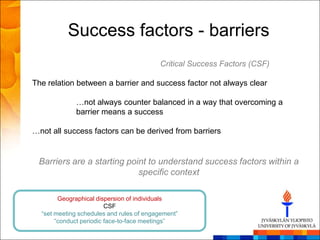
Success factors - barriers
                                          Critical Success Factors (CSF)

The relation between a barrier and success factor not always clear

             …not always counter balanced in a way that overcoming a
             barrier means a success

…not all success factors can be derived from barriers


 Barriers are a starting point to understand success factors within a
                            specific context

        Geographical dispersion of individuals
                         CSF
  “set meeting schedules and rules of engagement”
       “conduct periodic face-to-face meetings”
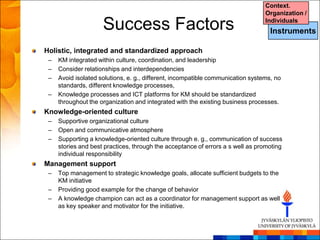
Context.
                                                                                 Organization /

                     Success Factors                                             Individuals
                                                                                   Instruments

Holistic, integrated and standardized approach
 –   KM integrated within culture, coordination, and leadership
 –   Consider relationships and interdependencies
 –   Avoid isolated solutions, e. g., different, incompatible communication systems, no
     standards, different knowledge processes,
 –   Knowledge processes and ICT platforms for KM should be standardized
     throughout the organization and integrated with the existing business processes.
Knowledge-oriented culture
 –   Supportive organizational culture
 –   Open and communicative atmosphere
 –   Supporting a knowledge-oriented culture through e. g., communication of success
     stories and best practices, through the acceptance of errors a s well as promoting
     individual responsibility
Management support
 –   Top management to strategic knowledge goals, allocate sufficient budgets to the
     KM initiative
 –   Providing good example for the change of behavior
 –   A knowledge champion can act as a coordinator for management support as well
     as key speaker and motivator for the initiative.
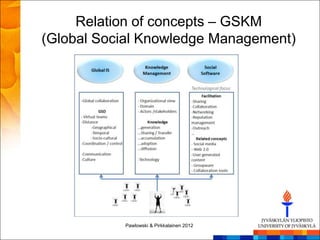
Relation of concepts – GSKM
(Global Social Knowledge Management)


           Pawlowski & Pirkkalainen 2012
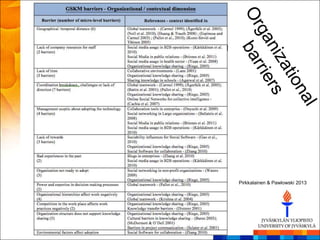
Pirkkalainen & Pawlowski 2013
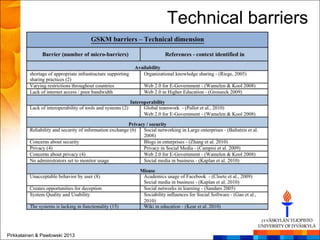
Technical barriers


Pirkkalainen & Pawlowski 2013
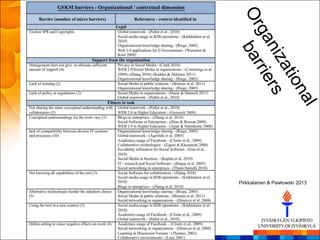
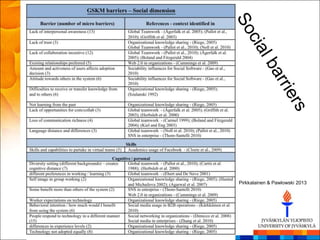
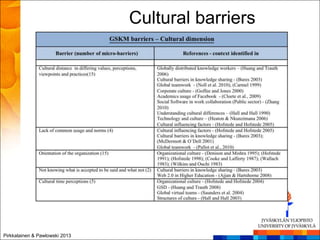
Cultural barriers


Pirkkalainen & Pawlowski 2013
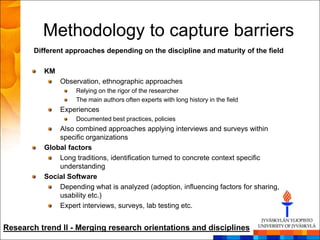
Methodology to capture barriers
        Different approaches depending on the discipline and maturity of the field

           KM
                Observation, ethnographic approaches
                     Relying on the rigor of the researcher
                     The main authors often experts with long history in the field
                Experiences
                     Documented best practices, policies
               Also combined approaches applying interviews and surveys within
               specific organizations
           Global factors
               Long traditions, identification turned to concrete context specific
               understanding
           Social Software
               Depending what is analyzed (adoption, influencing factors for sharing,
               usability etc.)
               Expert interviews, surveys, lab testing etc.


Research trend II - Merging research orientations and disciplines
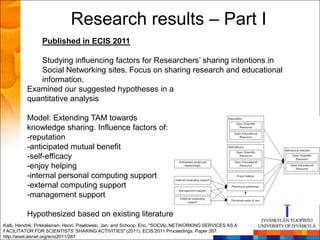
Research results – Part I
                 Published in ECIS 2011

             Studying influencing factors for Researchers’ sharing intentions in
             Social Networking sites. Focus on sharing research and educational
             information.
          Examined our suggested hypotheses in a
          quantitative analysis

          Model: Extending TAM towards
          knowledge sharing. Influence factors of:
          -reputation
          -anticipated mutual benefit
          -self-efficacy
          -enjoy helping
          -internal personal computing support
          -external computing support
          -management support

          Hypothesized based on existing literature
Kalb, Hendrik; Pirkkalainen, Henri; Pawlowski, Jan; and Schoop, Eric, "SOCIAL NETWORKING SERVICES AS A
FACILITATOR FOR SCIENTISTS’ SHARING ACTIVITIES" (2011). ECIS 2011 Proceedings. Paper 267.
http://aisel.aisnet.org/ecis2011/267
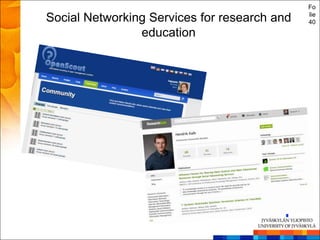
Fo
                                              lie
Social Networking Services for research and   40
                education
Research results – Part I
        Survey: 54 eligible responses

        Data analysis was conducted using the Partial Least Squares (PLS) approach and the SmartPLS
        software. PLS is a structural equation modeling technique (SEM) – well fitting to confirmatory research

        Results:
        Expected reputation through sharing activities is an important predictor of the intention

        the perceived usefulness of an SNS influences the intention to share information
             To influence the usefulness in our context we found as antecedents the anticipated
             reciprocal relationships through knowledge sharing in the system, the perceived
             ease of use of the system and management support
             ….and Influence of enjoy helping on the intention to share educational resources in
             a SNS

        Not significant: internal and external support, we can not find support for the hypotheses
        H5a and H5b, which propose a positive influence of self-efficacy on sharing behavior.


Kalb, Hendrik; Pirkkalainen, Henri; Pawlowski, Jan; and Schoop, Eric, "SOCIAL NETWORKING SERVICES AS A
FACILITATOR FOR SCIENTISTS’ SHARING ACTIVITIES" (2011). ECIS 2011 Proceedings. Paper 267.
http://aisel.aisnet.org/ecis2011/267
Research results – Part II
Currently studied

Studying barrier significance for using OER portals.

Contextualization of the previously presented barriers with OER
focus


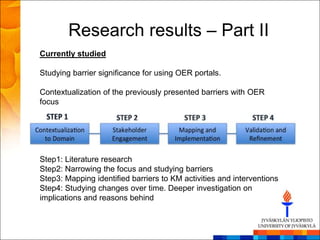
Step1: Literature research
Step2: Narrowing the focus and studying barriers
Step3: Mapping identified barriers to KM activities and interventions
Step4: Studying changes over time. Deeper investigation on
implications and reasons behind
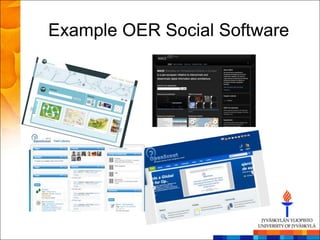
Example OER Social Software
Research results – Part II
Currently studied

Combining engagement activities (focus group) with the survey
instrument.

Running teacher workshops across Europe
   - Presenting OER portals for teachers, running a scenario,
      discussing SWOT, change enablers
   - Filling the survey on-site or online

1176 eligible responses from 20 countries

Extending current OER research to Social Software (portal focus) to
understand most significant challenges.

Data analysis in progress… Variance analysis (One-way ANOVA)
depicts the significance of barriers dependent on the nationality of
the stakeholders.
Research results – Part II
Currently studied

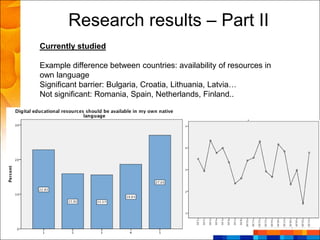
Example difference between countries: availability of resources in
own language
Significant barrier: Bulgaria, Croatia, Lithuania, Latvia…
Not significant: Romania, Spain, Netherlands, Finland..
Social Software in
   Knowledge Management
   Individuals, process/culture, technology
   In many cases generalizing the purpose of Social
   Software/media unnecessarily
 E.g. “social media is essentially a social networking site, with subscribing”


   Support of Social Software for different levels of KM:
  Knowledge evolution, knowledge use/reuse, knowledge            sharing/transfer


Not to replace but to support?

          Are we discussing a specific service
          or about the web in general?
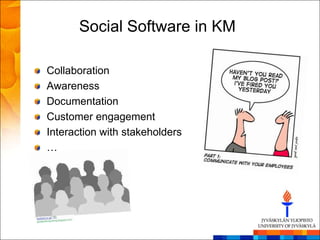
Social Software in KM

Collaboration
Awareness
Documentation
Customer engagement
Interaction with stakeholders
…
Research trends III
Analyzing the cultural, organizational, and individual
context
Identifying barriers and potential success factors
Choosing and creating solutions (=interventions /
methods)
–   Aligned with strategies and processes
–   Addressing barriers
–   Involving all stakeholders
–   Not overloading people
Utilizing barrier-knowledge in KM processes
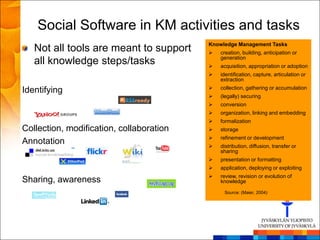
Social Software in KM activities and tasks
                                          Knowledge Management Tasks
   Not all tools are meant to support        creation, building, anticipation or
                                              generation
   all knowledge steps/tasks                 acquisition, appropriation or adoption
                                             identification, capture, articulation or
                                              extraction
                                             collection, gathering or accumulation
Identifying
                                             (legally) securing
                                             conversion
                                             organization, linking and embedding
                                             formalization
Collection, modification, collaboration      storage
                                             refinement or development
Annotation                                   distribution, diffusion, transfer or
                                              sharing
                                             presentation or formatting
                                             application, deploying or exploiting
                                             review, revision or evolution of
Sharing, awareness                            knowledge

                                               Source: (Maier, 2004)
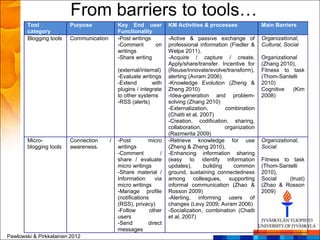
From barriers to tools…
        Tool             Purpose             Key End user            KM Activities & processes               Main Barriers
        category                             Functionality
        Blogging tools   Communication       -Post writings          -Active & passive exchange of           Organizational,
                                             -Comment       on       professional information (Fiedler &     Cultural, Social
                                             writings                Welpe 2011).
                                             -Share writing          -Acquire / capture / create,            Organizational
                                                                     Apply/share/transfer. Incentive for     (Zhang 2010),
                                             (external/internal)     (Reuse/innovate/evolve/transform),      Fitness to task
                                             -Evaluate writings      alerting (Avram 2006)                   (Thom-Santelli
                                             -Extend        with     -Knowledge Evolution (Zheng &           2010)
                                             plugins / integrate     Zheng 2010)                             Cognitive   (Kim
                                             to other systems        -Idea-generation and problem-           2008)
                                             -RSS (alerts)           solving (Zhang 2010)
                                                                     -Externalization,        combination
                                                                     (Chatti et al, 2007)
                                                                     -Creation, codification, sharing,
                                                                     collaboration,           organization
                                                                     (Razmerita 2009)
        Micro-           Connection      /   -Post         micro     -Retrieve knowledge for use             Organizational,
        blogging tools   awareness.          writings                (Zheng & Zheng 2010),                   Social
                                             -Comment            /   -Enhancing information sharing
                                             share / evaluate        (easy to identify information           Fitness to task
                                             micro writings          updates),       building    common      (Thom-Santelli
                                             -Share material /       ground, sustaining connectedness        2010),
                                             Information      via    among colleagues, supporting            Social    (trust)
                                             micro writings          informal communication (Zhao &          (Zhao & Rosson
                                             -Manage profile         Rosson 2009)                            2009)
                                             (notifications          -Alerting, informing users of
                                             (RSS), privacy)         changes (Levy 2009; Avram 2006)
                                             -Follow        other    -Socialization, combination (Chatti
                                             users                   et al, 2007)
                                             -Send         direct
                                             messages
Pawlowski & Pirkkalainen 2012
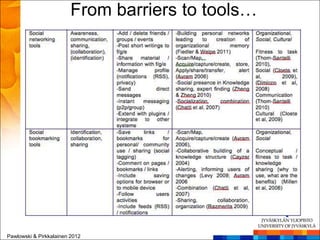
From barriers to tools…


Pawlowski & Pirkkalainen 2012
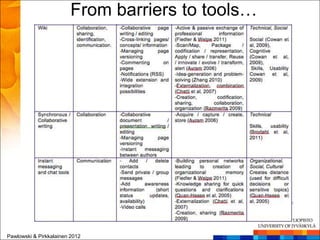
From barriers to tools…


Pawlowski & Pirkkalainen 2012
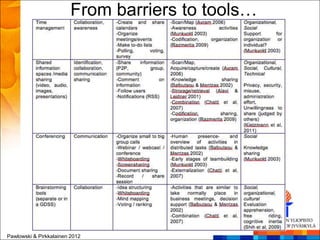
From barriers to tools…


Pawlowski & Pirkkalainen 2012
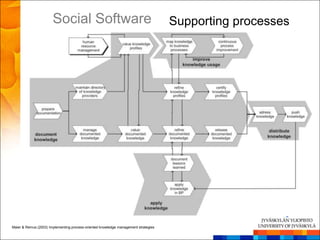
Social Software                                               Supporting processes


Maier & Remus (2003) Implementing process-oriented knowledge management strategies
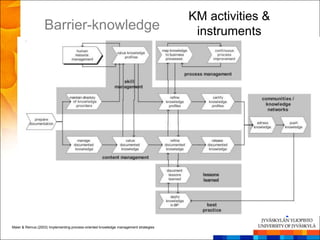
KM activities &
                  Barrier-knowledge                                                   instruments


Maier & Remus (2003) Implementing process-oriented knowledge management strategies
Focus points for research
Ranging from smaller to large research activities

Distributed teams (local to global, small vs massive)
– What type of challenges they face in their work
– How could Social Software support / how should it be
  integrated to the working activities / how to ensure adoption /
  how could it bridge the gap to other communities or
  collaborators/competitors
    • For example analyzing where do the collaborators or relevant
      stakeholders interact (European projects one perfect example).
– Setting clear Social Software policy that differentiates
  between internal/external work, customer relations etc.
– …
Thank You
Contact Information
Prof. Dr. Jan M. Pawlowski
jan.pawlowski@jyu.fi
Skype: jan_m_pawlowski
Office: Room 514.2
Telephone +358 14 260 2596
http://users.jyu.fi/~japawlow

Henri Pirkkalainen
henri.j.pirkkalainen@jyu.fi
Office: Room 511.1
Telephone +358 400247684
Readings
Zheng, Y., Li, L., & Zheng, F. (2010). Social Media Support for
Knowledge Management. In Proceedings of the International
Conference on Management and Service Science, pp. 1-4. dpi:
10.1109/ICMSS.2010.5576725 [IEEE Xplore at Nelli]
Levy, M. (2009). WEB 2.0 implications on knowledge
management. Journal of Knowledge Management, 13(1), 120-
134. [Nelli e-journals]
Pawlowski, J.M., Pirkkalainen, H. (2012): Global Social
Knowledge Management: The Future of Knowledge
Management Across Borders? Proc. of European Conference on
Knowledge Management, June 2012, Spain. Retrieved from:
http://users.jyu.fi/~japawlow/Global%20Social%20Knowledge%2
0Management_ECKM2012_citation.pdf

Research Issues in Knowledge Management and Social Media

  • 1.
    The use ofsocial software for Knowledge Management in globally distributed settings Jan Pawlowski & Henri Pirkkalainen Global Information Systems group Department of Computer Science and Information Systems TJTSD66 Advanced Topics in Social Media
  • 2.
    Global Information Systems MissionStatement Creating and validating new solutions for Information Systems in a global context - this includes the support of individuals and organizations to improve competitiveness, performance, and mutual understanding Topics Designing work and learning processes in globally distributed organizations Design & development methods for global information systems Culture analysis and awareness Support tools for knowledge intensive processes in global organizations ICT4D: ICT for development E-Learning and knowledge management in global organizations
  • 3.
    Global Information Systems,University of Jyväskylä The Team Denis Kozlov Kati Clements Jan M. Pawlowski Henri Philipp Holtkamp Pirkkalainen
  • 4.
    Twitter feedback channel #GSKM13 You can provide feedback and ask questions regarding our part and the research topics through Twitter
  • 5.
    Social Software forKM: Contents Knowledge Management in Global Settings Social Software – Vocabulary in IS field? Starting point for global inspection - Barriers Focus in KM – what has been studied and how? Towards unexplored research territories
  • 6.
    A first question Whatis common knowledge?
  • 7.
  • 8.
  • 9.
  • 10.
    Related Concepts (modified, North, 1998) Competitiven ess + Competence uniqueness +applying to Skill new settings Knowledge +use Information +context Data +meaning Symbol +syntax
  • 11.
    Definition: Knowledge Management “Knowledgemanagement is defined as the management function responsible for the regular selection, implementation and evaluation of goal-oriented knowledge strategies that aim at improving an organization’s way of handling knowledge internal and external to the organization in order to improve organizational performance. The implementation of knowledge strategies comprises all person-oriented, organizational and technological instruments suitable to dynamically optimize the organization-wide level of competencies, education and ability to learn of the members of the organization as well as to develop collective intelligence.“ (Maier 2002) ”Planned and ongoing management of activities and processes for leveraging knowledge to enhance competitiveness through better use and creation of individual and collective knowledge resources.” (CEN 2004)
  • 12.
    A first question… Whyis Knowledge a Global Success Factor?
  • 13.
    Just a simpleproduct?
  • 14.
    Business Process Management in a Networked Business Management Processing R&D A Marketing R&D Sales Marketing Processing Marketing Production B Sales IT Services Sales IT Services Marketing Material Flow Knowledge/ Information / Data Flow
  • 15.
    Some random questions… Decisionquestions – Where to produce? – How to build partnerships (joint ventures, contractors, …) – Which systems to exchange knowledge? Operational questions – How to process wood? – When will the next shipment arrive? – How to market the product in Japan? – How to explain the concept and advantages of Finnish saunas? – How to find the main problems of customers? – Which are import and safety regulations?
  • 16.
    This means… Knowledge isa key to global success Global KM managers need to understand the value chain and knowledge requirements Global KM managers need to understand knowledge processes and culture Global KM managers are the main hubs for smooth operations in production and service enterprises Which kind of IS support is promising or proven successful?
  • 17.
    Summary Knowledge as acritical success factor Knowledge management to support businesses Global aspects – Understanding the context – Process design – Systems and tool support – Cultural aspects Social Software as a promising tool to combine human- and technology-orientation – Which tools for which context? – How to overcome cultural differences? – How to embed tools?
  • 18.
  • 19.
    Social Software “SocialSoftware enables an interactive way of collaboration, managing content and connecting to online networks with other people. It supports the desire of users to be pulled into groups in order to achieve their personal goals” (Wever, Mechant, Veevaete & Hauttekeete 2007)
  • 20.
    Social Software 4 Cs of Social Software Cook, N. Enterprise 2.0: How Social Software Will Change the Future of Work, UK:Gover, 2008.
  • 21.
  • 22.
  • 23.
    Groupware Message systems Multiuser editors Group decision support systems (GDSSs) Ellis, Gibbs & Rein 1991) Computer conferencing systems Shared information spaces Workflow management/coordination systems …Much older approach in the IS research Ellis C.A., Gibbs S.J. & Rein C.L. 1991. Groupware: Some issues and experiences. Communications of the ACM 34 (1), 39 – 58.
  • 24.
    Collaboration tools Onyechi &Abeisinghe 2009 Refs to Social Media, Social Software, Groupware, Web 2.0…
  • 25.
    Web 2.0 Often explainedas the combination of methods and techniques on which Social Media is based on Still used in IT literacy http://www.oreillynet.com/pub/a/oreilly/tim/news/2005/09/30/what-is-web-20.html
  • 26.
    What do youfocus on when addressing Social Software?
  • 27.
    Research Trends forKM & SoSo Constructive / Design-oriented research – Tools to improve knowledge exchange and distribution Do we really understand how global KM works: Qualitative Research – Understanding which influence factors and relations emerge in global settings – For example: Barriers to KM (why and how) Relating and quantifying: Quantitative Research – Understanding behavior in KM settings – E.g. ISSM, TAM, KM Success Model • What type of relations, how strong, cause-effect etc. • Applied for example in Social networking studies, also Web 2.0 focus
  • 28.
    Barriers? Discussed from theviewpoint of an individual or group of people Can relate to social interaction and as an example to factors that hinder or challenge knowledge exchange Might relate to challenges and risks when adopting or using a specific technology Challenges set by diverse workers, hierarchies and cultural influences within an organization In many cases tied to a specific context Can be presented as a wider concept “cultural distance” …or as a question that is formed from the problem, “How to reward contribution?”…
  • 29.
    Barriers + + Organizational Dependent on business Location, time, culture and hierarchical process and project and language = “Knowledge Islands”
  • 30.
    Success factors -barriers Critical Success Factors (CSF) The relation between a barrier and success factor not always clear …not always counter balanced in a way that overcoming a barrier means a success …not all success factors can be derived from barriers Barriers are a starting point to understand success factors within a specific context Geographical dispersion of individuals CSF “set meeting schedules and rules of engagement” “conduct periodic face-to-face meetings”
  • 31.
    Context. Organization / Success Factors Individuals Instruments Holistic, integrated and standardized approach – KM integrated within culture, coordination, and leadership – Consider relationships and interdependencies – Avoid isolated solutions, e. g., different, incompatible communication systems, no standards, different knowledge processes, – Knowledge processes and ICT platforms for KM should be standardized throughout the organization and integrated with the existing business processes. Knowledge-oriented culture – Supportive organizational culture – Open and communicative atmosphere – Supporting a knowledge-oriented culture through e. g., communication of success stories and best practices, through the acceptance of errors a s well as promoting individual responsibility Management support – Top management to strategic knowledge goals, allocate sufficient budgets to the KM initiative – Providing good example for the change of behavior – A knowledge champion can act as a coordinator for management support as well as key speaker and motivator for the initiative.
  • 32.
    Relation of concepts– GSKM (Global Social Knowledge Management) Pawlowski & Pirkkalainen 2012
  • 33.
  • 34.
  • 35.
  • 36.
  • 37.
  • 38.
    Methodology to capturebarriers Different approaches depending on the discipline and maturity of the field KM Observation, ethnographic approaches Relying on the rigor of the researcher The main authors often experts with long history in the field Experiences Documented best practices, policies Also combined approaches applying interviews and surveys within specific organizations Global factors Long traditions, identification turned to concrete context specific understanding Social Software Depending what is analyzed (adoption, influencing factors for sharing, usability etc.) Expert interviews, surveys, lab testing etc. Research trend II - Merging research orientations and disciplines
  • 39.
    Research results –Part I Published in ECIS 2011 Studying influencing factors for Researchers’ sharing intentions in Social Networking sites. Focus on sharing research and educational information. Examined our suggested hypotheses in a quantitative analysis Model: Extending TAM towards knowledge sharing. Influence factors of: -reputation -anticipated mutual benefit -self-efficacy -enjoy helping -internal personal computing support -external computing support -management support Hypothesized based on existing literature Kalb, Hendrik; Pirkkalainen, Henri; Pawlowski, Jan; and Schoop, Eric, "SOCIAL NETWORKING SERVICES AS A FACILITATOR FOR SCIENTISTS’ SHARING ACTIVITIES" (2011). ECIS 2011 Proceedings. Paper 267. http://aisel.aisnet.org/ecis2011/267
  • 40.
    Fo lie Social Networking Services for research and 40 education
  • 41.
    Research results –Part I Survey: 54 eligible responses Data analysis was conducted using the Partial Least Squares (PLS) approach and the SmartPLS software. PLS is a structural equation modeling technique (SEM) – well fitting to confirmatory research Results: Expected reputation through sharing activities is an important predictor of the intention the perceived usefulness of an SNS influences the intention to share information To influence the usefulness in our context we found as antecedents the anticipated reciprocal relationships through knowledge sharing in the system, the perceived ease of use of the system and management support ….and Influence of enjoy helping on the intention to share educational resources in a SNS Not significant: internal and external support, we can not find support for the hypotheses H5a and H5b, which propose a positive influence of self-efficacy on sharing behavior. Kalb, Hendrik; Pirkkalainen, Henri; Pawlowski, Jan; and Schoop, Eric, "SOCIAL NETWORKING SERVICES AS A FACILITATOR FOR SCIENTISTS’ SHARING ACTIVITIES" (2011). ECIS 2011 Proceedings. Paper 267. http://aisel.aisnet.org/ecis2011/267
  • 42.
    Research results –Part II Currently studied Studying barrier significance for using OER portals. Contextualization of the previously presented barriers with OER focus Step1: Literature research Step2: Narrowing the focus and studying barriers Step3: Mapping identified barriers to KM activities and interventions Step4: Studying changes over time. Deeper investigation on implications and reasons behind
  • 43.
  • 44.
    Research results –Part II Currently studied Combining engagement activities (focus group) with the survey instrument. Running teacher workshops across Europe - Presenting OER portals for teachers, running a scenario, discussing SWOT, change enablers - Filling the survey on-site or online 1176 eligible responses from 20 countries Extending current OER research to Social Software (portal focus) to understand most significant challenges. Data analysis in progress… Variance analysis (One-way ANOVA) depicts the significance of barriers dependent on the nationality of the stakeholders.
  • 45.
    Research results –Part II Currently studied Example difference between countries: availability of resources in own language Significant barrier: Bulgaria, Croatia, Lithuania, Latvia… Not significant: Romania, Spain, Netherlands, Finland..
  • 46.
    Social Software in Knowledge Management Individuals, process/culture, technology In many cases generalizing the purpose of Social Software/media unnecessarily E.g. “social media is essentially a social networking site, with subscribing” Support of Social Software for different levels of KM: Knowledge evolution, knowledge use/reuse, knowledge sharing/transfer Not to replace but to support? Are we discussing a specific service or about the web in general?
  • 47.
    Social Software inKM Collaboration Awareness Documentation Customer engagement Interaction with stakeholders …
  • 48.
    Research trends III Analyzingthe cultural, organizational, and individual context Identifying barriers and potential success factors Choosing and creating solutions (=interventions / methods) – Aligned with strategies and processes – Addressing barriers – Involving all stakeholders – Not overloading people Utilizing barrier-knowledge in KM processes
  • 49.
    Social Software inKM activities and tasks Knowledge Management Tasks Not all tools are meant to support  creation, building, anticipation or generation all knowledge steps/tasks  acquisition, appropriation or adoption  identification, capture, articulation or extraction  collection, gathering or accumulation Identifying  (legally) securing  conversion  organization, linking and embedding  formalization Collection, modification, collaboration  storage  refinement or development Annotation  distribution, diffusion, transfer or sharing  presentation or formatting  application, deploying or exploiting  review, revision or evolution of Sharing, awareness knowledge Source: (Maier, 2004)
  • 50.
    From barriers totools… Tool Purpose Key End user KM Activities & processes Main Barriers category Functionality Blogging tools Communication -Post writings -Active & passive exchange of Organizational, -Comment on professional information (Fiedler & Cultural, Social writings Welpe 2011). -Share writing -Acquire / capture / create, Organizational Apply/share/transfer. Incentive for (Zhang 2010), (external/internal) (Reuse/innovate/evolve/transform), Fitness to task -Evaluate writings alerting (Avram 2006) (Thom-Santelli -Extend with -Knowledge Evolution (Zheng & 2010) plugins / integrate Zheng 2010) Cognitive (Kim to other systems -Idea-generation and problem- 2008) -RSS (alerts) solving (Zhang 2010) -Externalization, combination (Chatti et al, 2007) -Creation, codification, sharing, collaboration, organization (Razmerita 2009) Micro- Connection / -Post micro -Retrieve knowledge for use Organizational, blogging tools awareness. writings (Zheng & Zheng 2010), Social -Comment / -Enhancing information sharing share / evaluate (easy to identify information Fitness to task micro writings updates), building common (Thom-Santelli -Share material / ground, sustaining connectedness 2010), Information via among colleagues, supporting Social (trust) micro writings informal communication (Zhao & (Zhao & Rosson -Manage profile Rosson 2009) 2009) (notifications -Alerting, informing users of (RSS), privacy) changes (Levy 2009; Avram 2006) -Follow other -Socialization, combination (Chatti users et al, 2007) -Send direct messages Pawlowski & Pirkkalainen 2012
  • 51.
    From barriers totools… Pawlowski & Pirkkalainen 2012
  • 52.
    From barriers totools… Pawlowski & Pirkkalainen 2012
  • 53.
    From barriers totools… Pawlowski & Pirkkalainen 2012
  • 54.
    Social Software Supporting processes Maier & Remus (2003) Implementing process-oriented knowledge management strategies
  • 55.
    KM activities & Barrier-knowledge instruments Maier & Remus (2003) Implementing process-oriented knowledge management strategies
  • 56.
    Focus points forresearch Ranging from smaller to large research activities Distributed teams (local to global, small vs massive) – What type of challenges they face in their work – How could Social Software support / how should it be integrated to the working activities / how to ensure adoption / how could it bridge the gap to other communities or collaborators/competitors • For example analyzing where do the collaborators or relevant stakeholders interact (European projects one perfect example). – Setting clear Social Software policy that differentiates between internal/external work, customer relations etc. – …
  • 57.
  • 58.
    Contact Information Prof. Dr.Jan M. Pawlowski jan.pawlowski@jyu.fi Skype: jan_m_pawlowski Office: Room 514.2 Telephone +358 14 260 2596 http://users.jyu.fi/~japawlow Henri Pirkkalainen henri.j.pirkkalainen@jyu.fi Office: Room 511.1 Telephone +358 400247684
  • 59.
    Readings Zheng, Y., Li,L., & Zheng, F. (2010). Social Media Support for Knowledge Management. In Proceedings of the International Conference on Management and Service Science, pp. 1-4. dpi: 10.1109/ICMSS.2010.5576725 [IEEE Xplore at Nelli] Levy, M. (2009). WEB 2.0 implications on knowledge management. Journal of Knowledge Management, 13(1), 120- 134. [Nelli e-journals] Pawlowski, J.M., Pirkkalainen, H. (2012): Global Social Knowledge Management: The Future of Knowledge Management Across Borders? Proc. of European Conference on Knowledge Management, June 2012, Spain. Retrieved from: http://users.jyu.fi/~japawlow/Global%20Social%20Knowledge%2 0Management_ECKM2012_citation.pdf

Editor's Notes

  • #28 Pure technological focus not too interesting since the challenges often are not technological
  • #29 Other starting points as well, opportunities etc. Barriers are a powerful way to start an inspection
  • #33 Our focus is on globally distributed Social Software supported KM activities. Large playground still
  • #48 Different purposes for using SoSoDifferent tools for managing different things
  • #55 Can support various stages-some applications to identify, some to share, etc.Related to barrier knowledge explained later.
  • #56 Multiple entry points depending on what do you want to focus on (improving the process, application of technologies, communication channels, communication flow etc.)