KNOWLEDGE MANAGEMENT
“Processing data can be performed by machine but only the
human mind can process
KNOWLEDGE”
By
Sneha Shekheran(PRN-52)
Snehal Rathi (PRN-53)
Subrata Mandal(PRN-54)
What is knowledge management?
“Knowledge management (KM) is an effort to increase
useful knowledge within the organization. Ways to do
this include encouraging communication, offering
opportunities to learn, and promoting the sharing of
appropriate knowledge artifacts.”
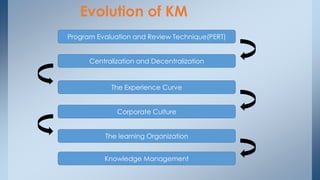
Evolution of KM
Program Evaluation and Review Technique(PERT)
Centralization and Decentralization
The Experience Curve
Corporate Culture
The learning Organization
Knowledge Management
What KM is not about?
KM is not knowledge engineering.
KM is about process, not just digital networks.
KM is not about building a smarter intranet.
KM is not about a one time investment.
KM is not about enterprise-wide “Infobahn's”
Different types of knowledge
= People knowledge
= Media-basedExplicit
Written down
Tacit
in People’s head
Individuals
Multimedia
Digitally-Indexed
Digitally-Active
Intellectual Property
Patents
Groups
Paper-based
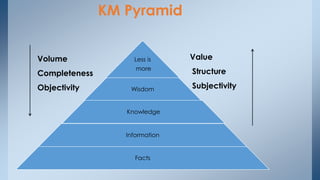
KM Pyramid
Less is
more
Wisdom
Knowledge
Information
Facts
Volume
Completeness
Objectivity
Value
Structure
Subjectivity
KM Life cycle
• Sharing
• Capturing
• Accessing
• Converting
Map
Capture
Organize
Transfer
Utilize
• Map knowledge asset
• Priorities
• Plan
Mapping tool
The 10-step KM road map
Analyze the Existing
Infrastructure
Align Knowledge Management
and Business Strategy
Design the Knowledge
Management Infrastructure
Audit Existing Knowledge Assets
and Systems
Design the Knowledge
Management Team
Create the Knowledge
Management Blueprint
Develop the Knowledge
Management System
Deploy using the results-driven
Incremental Method
Manage Change, Culture and
Reward Structures
Evaluate Performance , Measure
ROI & Incrementally Refine the
KMS
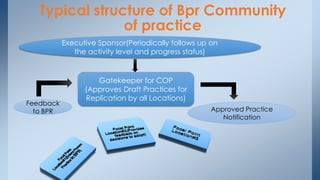
Typical structure of Bpr Community
of practice
Executive Sponsor(Periodically follows up on
the activity level and progress status)
Gatekeeper for COP
(Approves Draft Practices for
Replication by all Locations)
Feedback
to BPR Approved Practice
Notification
KM processes at ford
KM tools and technologies at Ford
• BPR APPLICATION
Oracle database combined with a mix of JavaScript, HTML & Pearl code delivered by Sun Operating
System
 Internal benchmarking process
 Safety derivative
 Environmental reporting system
 Policy deployment
 Nagware
 Collaboration tool
• Portals
 Hub
 Knowledge-Based Engineering(KBE)
Technology Oils the Wheels
• Knowledge Sharing Sessions
• Cross Functional Teams
• Internet
• Portals
• Web Pages
Group
Collaboration
System
• Expert Systems
• Neural Networks
• Fuzzy Logic
• Robotics
Artificial
Intelligence
System
KM Advantages
 Ensures Just-In-Time access to knowledge. Encourages collaboration, sharing and team
feelings among employees.
 Avoids re-inventing the wheel. Similarly avoids past mistakes and failures.
 Helps to combat global competition and pace of change through best sharing practices,
product development knowledge and problem resolution.
 Improves knowledge and information sharing across the enterprise and reduces the efforts
and cost of information sharing
 Improve customer support activities.
 Adds to the firms intelligence and provides increased flexibility.
 Many More…...
Knowledge management barriers
1. Lack of top management commitment
2. Lack of technological infrastructure
3. Lack of methodology
4. Lack of organizational structure
5. Lack of organizational culture
6. Lack of motivation and reward
7. Staff retirement
8. Lack of ownership of problem
9. Staff Deflection
Structural self-interaction matrix
Initial reachability matrix
Levels of KM barriers
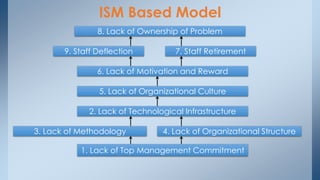
ISM Based Model
1. Lack of Top Management Commitment
6. Lack of Motivation and Reward
2. Lack of Technological Infrastructure
3. Lack of Methodology 4. Lack of Organizational Structure
7. Staff Retirement9. Staff Deflection
8. Lack of Ownership of Problem
5. Lack of Organizational Culture
Knowledge management  siom

Knowledge management siom

  • 1.
    KNOWLEDGE MANAGEMENT “Processing datacan be performed by machine but only the human mind can process KNOWLEDGE” By Sneha Shekheran(PRN-52) Snehal Rathi (PRN-53) Subrata Mandal(PRN-54)
  • 2.
    What is knowledgemanagement? “Knowledge management (KM) is an effort to increase useful knowledge within the organization. Ways to do this include encouraging communication, offering opportunities to learn, and promoting the sharing of appropriate knowledge artifacts.”
  • 3.
    Evolution of KM ProgramEvaluation and Review Technique(PERT) Centralization and Decentralization The Experience Curve Corporate Culture The learning Organization Knowledge Management
  • 4.
    What KM isnot about? KM is not knowledge engineering. KM is about process, not just digital networks. KM is not about building a smarter intranet. KM is not about a one time investment. KM is not about enterprise-wide “Infobahn's”
  • 5.
    Different types ofknowledge = People knowledge = Media-basedExplicit Written down Tacit in People’s head Individuals Multimedia Digitally-Indexed Digitally-Active Intellectual Property Patents Groups Paper-based
  • 6.
  • 7.
    KM Life cycle •Sharing • Capturing • Accessing • Converting Map Capture Organize Transfer Utilize • Map knowledge asset • Priorities • Plan Mapping tool
  • 8.
    The 10-step KMroad map Analyze the Existing Infrastructure Align Knowledge Management and Business Strategy Design the Knowledge Management Infrastructure Audit Existing Knowledge Assets and Systems Design the Knowledge Management Team Create the Knowledge Management Blueprint Develop the Knowledge Management System Deploy using the results-driven Incremental Method Manage Change, Culture and Reward Structures Evaluate Performance , Measure ROI & Incrementally Refine the KMS
  • 9.
    Typical structure ofBpr Community of practice Executive Sponsor(Periodically follows up on the activity level and progress status) Gatekeeper for COP (Approves Draft Practices for Replication by all Locations) Feedback to BPR Approved Practice Notification
  • 10.
  • 11.
    KM tools andtechnologies at Ford • BPR APPLICATION Oracle database combined with a mix of JavaScript, HTML & Pearl code delivered by Sun Operating System  Internal benchmarking process  Safety derivative  Environmental reporting system  Policy deployment  Nagware  Collaboration tool • Portals  Hub  Knowledge-Based Engineering(KBE)
  • 12.
    Technology Oils theWheels • Knowledge Sharing Sessions • Cross Functional Teams • Internet • Portals • Web Pages Group Collaboration System • Expert Systems • Neural Networks • Fuzzy Logic • Robotics Artificial Intelligence System
  • 13.
    KM Advantages  EnsuresJust-In-Time access to knowledge. Encourages collaboration, sharing and team feelings among employees.  Avoids re-inventing the wheel. Similarly avoids past mistakes and failures.  Helps to combat global competition and pace of change through best sharing practices, product development knowledge and problem resolution.  Improves knowledge and information sharing across the enterprise and reduces the efforts and cost of information sharing  Improve customer support activities.  Adds to the firms intelligence and provides increased flexibility.  Many More…...
  • 14.
    Knowledge management barriers 1.Lack of top management commitment 2. Lack of technological infrastructure 3. Lack of methodology 4. Lack of organizational structure 5. Lack of organizational culture 6. Lack of motivation and reward 7. Staff retirement 8. Lack of ownership of problem 9. Staff Deflection
  • 15.
  • 16.
  • 17.
    Levels of KMbarriers
  • 18.
    ISM Based Model 1.Lack of Top Management Commitment 6. Lack of Motivation and Reward 2. Lack of Technological Infrastructure 3. Lack of Methodology 4. Lack of Organizational Structure 7. Staff Retirement9. Staff Deflection 8. Lack of Ownership of Problem 5. Lack of Organizational Culture