April 10, 2001 A  performance-based  view of KMS . . .  for the sake of the enterprise shareholders,  customers, employees, and suppliers Push-Pull performance-based   Knowledge Management Systems P-1020 ISPI Conference San Francisco, April 2001 Presented by: Guy W. Wallace  EPPIC, Inc.
This session will present Session Open Session Description The marketing concept of  push-pull  as it applies to performance-based  Knowledge Management Systems  (KMS) The use of  ISD methods  and customer-supplier teams to deliberately populate the KMS and Push  knowledge products to high-payback  processes  and  human performers  audiences  Chunk and store  the knowledge products for additional, user-friendly retrieval to meet the needs of  pull  audiences A KMS  business case  outline and  four KMS implementation stages
Session Open Session Objectives Participants will be able to Describe a  performance-based  KMS Describe the  push-pull  orientation to performance-based KMS to better ensure shareholder ROI Describe the  use of performance-based ISD and HPT   methodologies  to populate a KMS Describe the  organizational teams  and their roles to implement, operate, and maintain a performance-based KMS Describe a  four-stage implementation plan  for KMS
Session Open Session Agenda 1. Session open 2. What is KM and KMS Knowledge Management Knowledge Management Systems 3. Push-pull KMS  4. Performance-based/push-pull KMS 5. Four stages of KMS implementation The KMS business case Calculating potential “returns” and “investment costs” for KMS KMS teams, roles, and responsibilities ISD methodologies in populating KMS 6. Session close
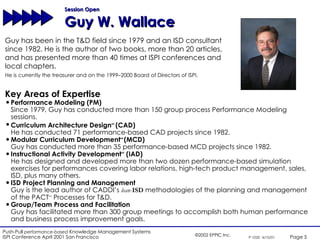
Session Open Guy W. Wallace Key Areas of Expertise Performance Modeling (PM) Since 1979, Guy has conducted more than 150 group process Performance Modeling sessions. Curriculum Architecture Design SM   (CAD) He has conducted 71 performance-based CAD projects since 1982.  Modular Curriculum Development SM  (MCD) Guy has conducted more than 35 performance-based MCD projects since 1982. Instructional Activity Development SM  (IAD) He has designed and developed more than two dozen performance-based simulation exercises for performances covering labor relations, high-tech product management, sales, ISD, plus many others.  ISD Project Planning and Management Guy is the lead author of CADDI’s  lean - ISD  methodologies of the planning and management of the PACT SM  Processes for T&D. Group/Team Process and Facilitation Guy has facilitated more than 300 group meetings to accomplish both human performance and business process improvement goals. Guy has been in the T&D field since 1979 and an ISD consultant since 1982. He is the author of two books, more than 20 articles, and has presented more than 40 times at ISPI conferences and local chapters.  He is currently the treasurer and on the 1999–2000 Board of Directors of ISPI.
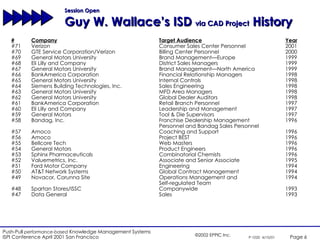
Session Open Guy W. Wallace’s ISD  via CAD Project  History # Company Target Audience Year #71 Verizon Consumer Sales Center Personnel 2001 #70 GTE Service Corporation/Verizon Billing Center Personnel 2000 #69 General Motors University Brand Management—Europe 1999 #68 Eli Lilly and Company District Sales Managers 1999 #67 General Motors University Brand Management—North America 1999 #66 BankAmerica Corporation Financial Relationship Managers 1998 #65 General Motors University Internal Controls 1998 #64 Siemens Building Technologies, Inc. Sales Engineering 1998 #63 General Motors University MFD Area Managers 1998 #62 General Motors University Global Dealer Auditors 1998 #61 BankAmerica Corporation Retail Branch Personnel 1997 #60 Eli Lilly and Company Leadership and Management 1997 #59 General Motors Tool & Die Supervisors 1997 #58 Bandag, Inc. Franchise Dealership Management 1996 Personnel and Bandag Sales Personnel #57 Amoco Coaching and Support 1996 #56 Amoco Project BEST 1996 #55 Bellcore Tech Web Masters 1996 #54 General Motors Product Engineers 1996 #53 Sphinx Pharmaceuticals Combinatorial Chemists 1996 #52 Valuemetrics, Inc. Associate and Senior Associate 1995 #51 Ford Motor Company Engineering 1994 #50 AT&T Network Systems Global Contract Management 1994 #49 Novacor, Corunna Site Operations Management and 1994 Self-regulated Team #48 Spartan Stores/ISSC Companywide 1993 #47 Data General Sales 1993
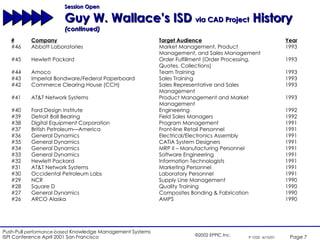
Session Open Guy W. Wallace’s ISD  via CAD Project  History  (continued) # Company Target Audience Year #46 Abbott Laboratories Market Management, Product 1993 Management, and Sales Management #45 Hewlett Packard Order Fulfillment (Order Processing, 1993 Quotes, Collections) #44 Amoco Team Training 1993 #43 Imperial Bondware/Federal Paperboard Sales Training 1993 #42 Commerce Clearing House (CCH) Sales Representative and Sales 1993 Management #41 AT&T Network Systems Product Management and Market 1993 Management #40 Ford Design Institute Engineering 1992 #39 Detroit Ball Bearing Field Sales Managers 1992 #38 Digital Equipment Corporation Program Management 1991 #37 British Petroleum—America Front-line Retail Personnel 1991 #36 General Dynamics Electrical/Electronics Assembly 1991 #35 General Dynamics CATIA System Designers 1991 #34 General Dynamics MRP II – Manufacturing Personnel 1991 #33 General Dynamics Software Engineering 1991 #32 Hewlett Packard Information Technologists 1991 #31 AT&T Network Systems Marketing Personnel 1991 #30 Occidental Petroleum Labs Laboratory Personnel 1991 #29 NCR Supply Line Management 1990 #28 Square D Quality Training 1990 #27 General Dynamics Composites Bonding & Fabrication 1990 #26 ARCO Alaska AMPS 1990
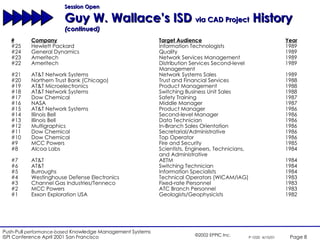
Session Open Guy W. Wallace’s ISD  via CAD Project  History  (continued) # Company Target Audience Year #25 Hewlett Packard Information Technologists 1989 #24 General Dynamics Quality 1989 #23 Ameritech Network Services Management 1989 #22 Ameritech Distribution Services Second-level 1989 Management #21 AT&T Network Systems Network Systems Sales 1989 #20 Northern Trust Bank (Chicago) Trust and Financial Services 1988 #19 AT&T Microelectronics Product Management 1988 #18 AT&T Network Systems Switching Business Unit Sales 1988 #17 Dow Chemical Safety Training 1987 #16 NASA Middle Manager 1987 #15 AT&T Network Systems Product Manager 1986 #14 Illinois Bell Second-level Manager 1986 #13 Illinois Bell Data Technician 1986 #12 Multigraphics In-Branch Sales Orientation 1986 #11 Dow Chemical Secretarial/Administrative 1986 #10 Dow Chemical Top Operator 1986 #9 MCC Powers Fire and Security 1985 #8 Alcoa Labs Scientists, Engineers, Technicians, 1984 and Administrative #7 AT&T AETM 1984 #6 AT&T Switching Technician 1984 #5 Burroughs Information Specialists 1984 #4 Westinghouse Defense Electronics Technical Operators (WICAM/IAG) 1983 #3 Channel Gas Industries/Tenneco Fixed-rate Personnel 1983 #2 MCC Powers ATC Branch Personnel 1983 #1 Exxon Exploration USA Geologists/Geophysicists 1982
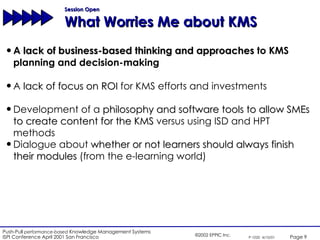
Session Open What Worries Me about KMS A  lack of business-based thinking and approaches  to KMS planning and decision-making A  lack of focus on ROI  for KMS efforts and investments Development of a  philosophy and software tools to allow SMEs to create content for the KMS  versus using ISD and HPT methods Dialogue about  whether or not learners should always finish their modules  (from the e-learning world)
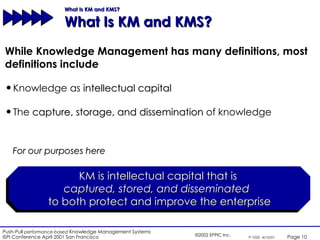
What Is KM and KMS? What Is KM and KMS? While Knowledge Management has many definitions, most definitions include Knowledge as  intellectual capital The  capture, storage, and dissemination  of knowledge KM is intellectual capital that is  captured, stored, and disseminated   to both protect and improve the enterprise For our purposes here
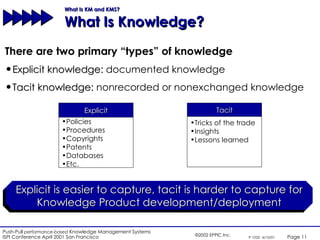
What Is KM and KMS? What Is Knowledge? There are two primary “types” of knowledge Explicit is easier to capture, tacit is harder to capture for Knowledge Product development/deployment Explicit knowledge:  documented knowledge Tacit knowledge:  nonrecorded or nonexchanged knowledge Tricks of the trade Insights Lessons learned Tacit Policies Procedures Copyrights Patents Databases Etc. Explicit
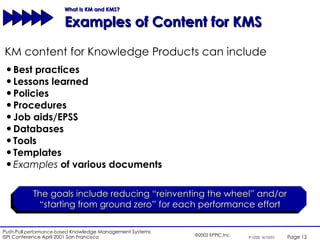
What Is KM and KMS? Examples of Content for KMS Best practices Lessons learned Policies Procedures Job aids/EPSS Databases Tools Templates Examples  of various documents The goals include reducing “reinventing the wheel” and/or “starting from ground zero” for each performance effort KM content for Knowledge Products can include
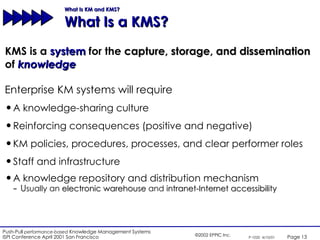
What Is KM and KMS?  What Is a KMS? KMS is a  system  for the  capture, storage, and dissemination   of  knowledge Enterprise KM systems will require A knowledge-sharing culture Reinforcing consequences (positive and negative) KM policies, procedures, processes, and clear performer roles Staff and infrastructure A knowledge repository and distribution mechanism U sually an  electronic warehouse  and  intranet-Internet accessibility
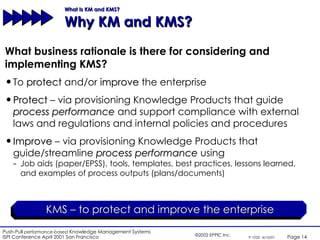
What Is KM and KMS?  Why KM and KMS? What business rationale is there for considering and implementing KMS? KMS – to protect and improve   the enterprise To  protect  and/or  improve  the enterprise Protect  – via provisioning Knowledge Products that guide  process performance  and support compliance with external laws and regulations and internal policies and procedures Improve  – via provisioning Knowledge Products that guide/streamline  process performance  using Job aids (paper/EPSS), tools, templates, best practices, lessons learned, and examples of process outputs (plans/documents)
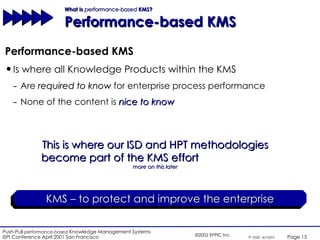
What Is  performance-based  KMS?  Performance-based KMS Performance-based KMS KMS – to protect and improve the enterprise This is where our ISD and HPT methodologies become part of the KMS effort  more on this later Is where all Knowledge Products within the KMS Are  required to know  for enterprise process performance None of the content is  nice to know
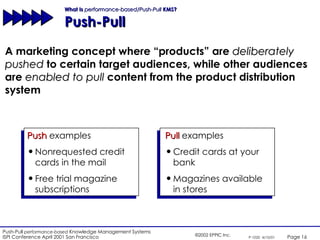
What Is  performance-based/Push-Pull  KMS?  Push-Pull A marketing concept where “products” are  deliberately pushed  to certain target audiences, while other audiences are  enabled to pull  content from the product distribution system  Push  examples Nonrequested credit cards in the mail Free trial magazine subscriptions Pull  examples Credit cards at your bank Magazines available in stores
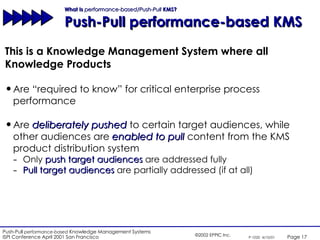
What Is  performance-based/Push-Pull  KMS?  Push-Pull performance-based KMS This is a Knowledge Management System where all Knowledge Products Are “required to know” for critical enterprise process performance Are  deliberately pushed  to certain target audiences, while other audiences are  enabled to pull  content from the KMS product distribution system  Only  push target audiences  are addressed fully Pull target audiences  are partially addressed (if at all)
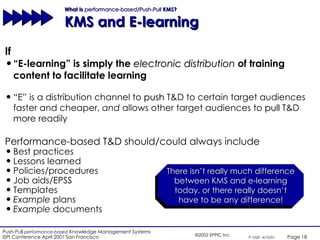
What Is  performance-based/Push-Pull  KMS?  KMS and E-learning If “ E-learning” is simply the  electronic distribution  of training content to facilitate learning There isn’t really much difference between KMS and e-learning today, or there really doesn’t have to be any difference! Performance-based T&D should/could always include Best practices Lessons learned Policies/procedures Job aids/EPSS Templates Example  plans Example  documents “ E” is a distribution channel to  push  T&D to certain target audiences faster and cheaper,  and  allows other target audiences to  pull  T&D more readily
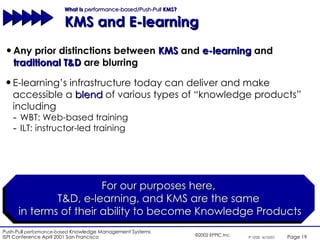
What Is  performance-based/Push-Pull  KMS?  KMS and E-learning Any prior distinctions between  KMS  and  e-learning  and  traditional T&D  are blurring For our purposes here,  T&D, e-learning, and KMS are the same  in terms of their ability to become Knowledge Products E-learning’s infrastructure today can deliver and make accessible a  blend  of various types of “knowledge products” including  WBT: Web-based training ILT: instructor-led training
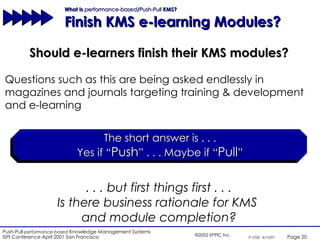
What Is  performance-based / Push-Pull  KMS?  Finish KMS e-learning Modules? Should e-learners finish their KMS modules? The short answer is . . . Yes if “ Push ” . . . Maybe if “ Pull ” . . . but first things first . . . Is there business rationale for KMS  and module completion? Questions such as this are being asked endlessly in magazines and journals targeting training & development and e-learning
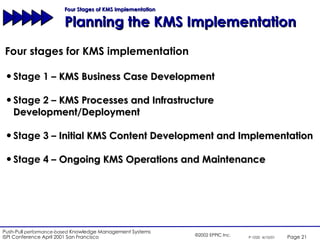
Four Stages of KMS Implementation  Planning the KMS Implementation Four stages for KMS implementation Stage 1 –  KMS Business Case Development Stage 2 –  KMS Processes and Infrastructure Development/Deployment Stage 3 –  Initial KMS Content Development and Implementation Stage 4 –  Ongoing KMS Operations and Maintenance
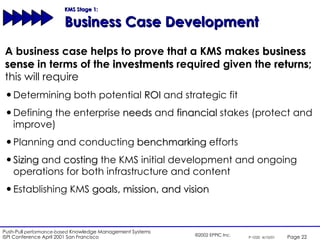
KMS Stage 1:  Business Case Development A business case helps to prove that a KMS makes  business sense  in terms of the  investments  required given the  returns ; this will require Determining both potential  ROI  and strategic fit Defining the enterprise  needs  and  financial  stakes (protect and improve) Planning and conducting  benchmarking  efforts Sizing  and  costing  the KMS initial development and ongoing operations for both infrastructure and content Establishing KMS  goals, mission, and vision
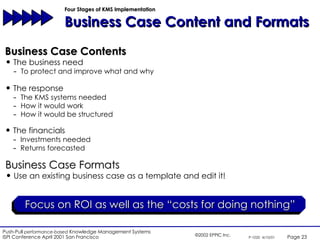
Four Stages of KMS Implementation  Business Case Content and Formats Business Case Contents Focus on ROI as well as the “costs for doing nothing” The response The KMS systems needed How it would work How it would be structured The financials Investments needed Returns forecasted Business Case Formats Use an existing business case as a template and edit it! The business need  To protect and improve what and why
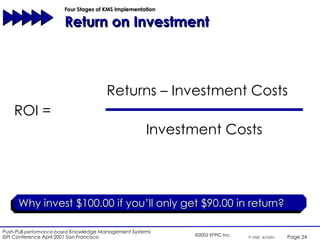
Four Stages of KMS Implementation  Return on Investment ROI = Why invest $100.00 if you’ll only get $90.00 in return? Returns – Investment Costs Investment Costs
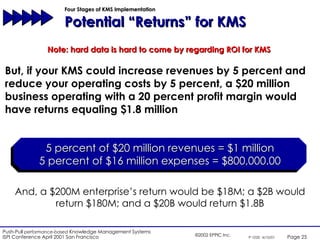
Four Stages of KMS Implementation  Potential “Returns” for KMS Note: hard data is hard to come by regarding ROI for KMS But, if your KMS could increase revenues by 5 percent and reduce your operating costs by 5 percent, a $20 million business operating with a 20 percent profit margin would have returns equaling $1.8 million And, a $200M enterprise’s return would be $18M; a $2B would return $180M; and a $20B would return $1.8B 5 percent of $20 million revenues = $1 million 5 percent of $16 million expenses = $800,000.00
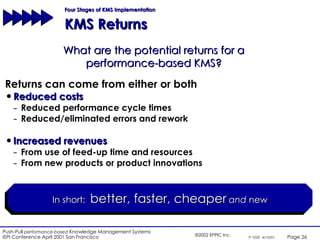
Four Stages of KMS Implementation   KMS Returns Returns can come from either or both Reduced costs Reduced performance cycle times Reduced/eliminated errors and rework Increased revenues From use of feed-up time and resources From new products or product innovations In short:  better, faster, cheaper   and  new What are the potential returns for a performance-based KMS?
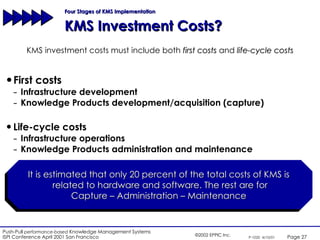
Four Stages of KMS Implementation   KMS Investment Costs? First costs Infrastructure development Knowledge Products development/acquisition (capture)  Life-cycle costs Infrastructure operations Knowledge Products administration and maintenance It is estimated that only 20 percent of the total costs of KMS is  related to hardware and software. The rest are for Capture – Administration – Maintenance  KMS investment costs must include both  first costs  and  life-cycle costs
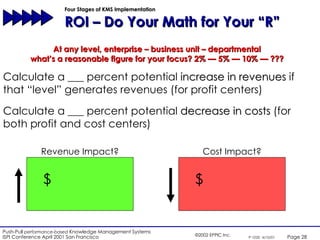
Four Stages of KMS Implementation  ROI – Do Your Math for Your “R” At any level, enterprise – business unit – departmental what’s a reasonable figure for your focus? 2% — 5% — 10% — ??? Calculate a ___ percent potential  increase in revenues  if that “level” generates revenues (for profit centers) Calculate a ___ percent potential  decrease in costs  (for both profit and cost centers) Revenue Impact? $ Cost Impact? $
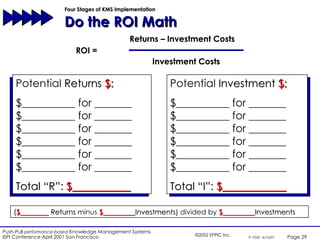
Four Stages of KMS Implementation  Do the ROI Math Potential  Returns   $: $__________ for _______ $__________ for _______ $__________ for _______ $__________ for _______ $__________ for _______ $__________ for _______ Total “R”:  $___________ Potential  Investment   $: $__________ for _______ $__________ for _______ $__________ for _______ $__________ for _______ $__________ for _______ $__________ for _______ Total “I”:  $____________ ( $________  Returns   minus   $_________ Investments)   divided by   $_________ Investments
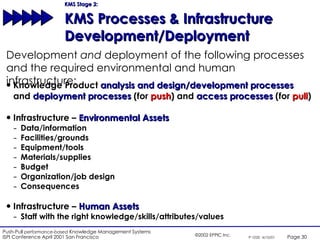
KMS Stage 2:   KMS Processes & Infrastructure Development/Deployment Knowledge Product  analysis and design/development processes  and  deployment processes  (for  push ) and  access processes  (for  pull )  Infrastructure –  Environmental Assets   Data/information  Facilities/grounds Equipment/tools Materials/supplies Budget Organization/job design Consequences Infrastructure –  Human Assets Staff with the right knowledge/skills/attributes/values Development  and  deployment of the following processes and the required environmental and human infrastructure:
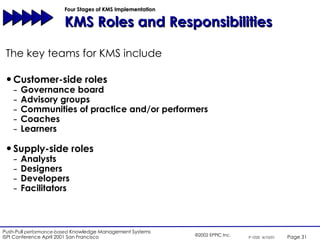
Four Stages of KMS Implementation  KMS Roles and Responsibilities Customer-side roles Governance board Advisory groups Communities of practice and/or performers Coaches Learners Supply-side roles Analysts Designers Developers Facilitators The key teams for KMS include
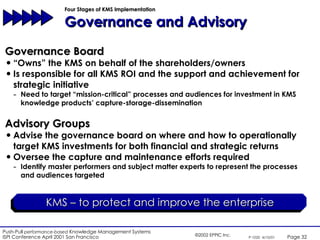
Four Stages of KMS Implementation  Governance and Advisory Governance Board “ Owns” the KMS on behalf of the shareholders/owners Is responsible for all KMS ROI and the support and achievement for strategic initiative Need to target “mission-critical” processes and audiences for investment in KMS knowledge products’ capture-storage-dissemination Advisory Groups Advise the governance board on where and how to operationally target KMS investments for both financial and strategic returns Oversee the capture and maintenance efforts required Identify master performers and subject matter experts to represent the processes and audiences targeted KMS – to protect and improve   the enterprise
Four Stages of KMS Implementation  Communities of Process/Performers Communities of “Process” Are enterprise process (target process) focused Provide a cross-functional orientation Provide a content source for ISD efforts e.g., strategic planning processes, supplier qualification processes, new product development processes Communities of “Performers” Are enterprise performers (target audience) focused Provide a functional discipline orientation Provide a content source for ISD efforts e.g., ISD professionals, electrical engineers, programmers, counter sales staff Note: Select one approach to addressing content capture— either processes or performers
Four Stages of KMS Implementation  Learners and Coaches Learners These are the users of KMS and can/should include anyone/everyone—as either  push  or  pull  target audiences Coaches Help transfer knowledge (explicit and tacit) to the  learners/users as on-the-job coaches and mentors, as well as classroom instructors and facilitators
Four Stages of KMS Implementation  ISD Roles Using traditional and nontraditional ISD methods to capture and maintain Knowledge Products ISD Analysts Determine both the performance requirements and the enabling K/S ISD Designers Chunk and “tag” (e.g., S.C.O.R.M.) content objects for both push and pull audiences ISD Developers Develop content within “e” (electronic) or “t” (traditional) templates for storage and assembly (for push) and retrieval (for pull) ISD Facilitators Deploy content as instructors/coaches/facilitators
KMS Stage 3: Initial KMS Content Development and Implementation The initial KMS content is captured (created), stored, deployed (for  push ), or retrieved (for  pull ) This is costly; and, according to our model, only push-audience needs are addressed, but addressed (chunked and stored) in such a manner as to facilitate related pull-audience needs By definition, the needs of pull audiences never warrant meeting those needs; if we discover that there is a return on meeting those needs, then the pull becomes push
Four Stages of KMS Implementation   Using ISD/HPT for KMS ISD and HPT methodologies can be used to capture/store/ disseminate KMS content for  performance-based  Knowledge Products Awareness/knowledge/skills  via capture, storage and dissemination of   Best practices Lessons learned Policies/procedures Tools/techniques Job aids/EPSS Templates Example  documents Etc.
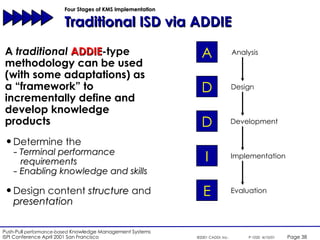
Four Stages of KMS Implementation  Traditional ISD via ADDIE A  traditional   ADDIE -type methodology can be used (with some adaptations) as a “framework” to incrementally define and develop knowledge products Determine the  Terminal performance requirements   Enabling   knowledge and skills Design content  structure  and  presentation A D D I E Analysis Design Development Implementation Evaluation
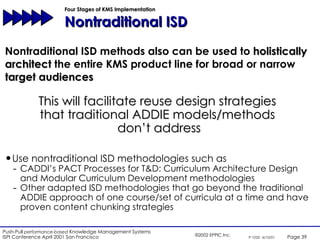
Four Stages of KMS Implementation  Nontraditional ISD Nontraditional ISD methods also can be used to  holistically architect  the entire KMS product line for broad or narrow  target audiences Use nontraditional ISD methodologies such as  CADDI’s PACT Processes for T&D: Curriculum Architecture Design and Modular Curriculum Development methodologies Other adapted ISD methodologies that go beyond the traditional ADDIE approach of one course/set of curricula at a time and have proven content chunking strategies This will facilitate reuse design strategies  that traditional ADDIE models/methods  don’t address
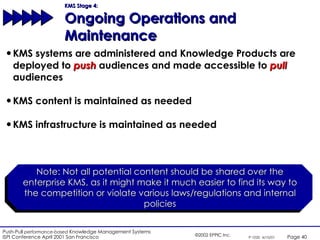
KMS Stage 4: Ongoing Operations and Maintenance KMS systems are administered and Knowledge Products are deployed to  push  audiences and made accessible to  pull  audiences  KMS content is maintained as needed KMS infrastructure is maintained as needed Note: Not all potential content should be shared over the enterprise KMS, as it might make it much easier to find its way to the competition or violate various laws/regulations and internal policies
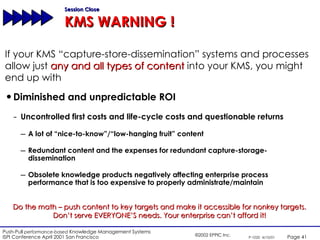
Diminished and unpredictable ROI Uncontrolled first costs and life-cycle costs and questionable returns A lot of “nice-to-know”/“low-hanging fruit” content Redundant content and the expenses for redundant capture-storage-dissemination  Obsolete knowledge products negatively affecting enterprise process performance that is too expensive to properly administrate/maintain Session Close KMS WARNING ! Do the math – push content to key targets and make it accessible for nonkey targets. Don’t serve EVERYONE’S needs. Your enterprise can’t afford it! If your KMS “capture-store-dissemination” systems and processes allow just  any and all types of content  into your KMS, you might end up with
Session Close Session Close Objectives review Describe a  performance-based  KMS Describe the  push-pull  orientation to performance-based KMS to better ensure shareholder ROI Describe the  use of performance-based ISD and HPT methodologies  to populate a KMS Describe the  organizational teams  and their roles to implement, operate, and maintain a performance-based KMS Describe the  four-stage implementation plan  for KMS Thank you for your time, attention, and feedback

Push Pull KMS - Knowledge Management Systems

  • 1.
    April 10, 2001A performance-based view of KMS . . . for the sake of the enterprise shareholders, customers, employees, and suppliers Push-Pull performance-based Knowledge Management Systems P-1020 ISPI Conference San Francisco, April 2001 Presented by: Guy W. Wallace EPPIC, Inc.
  • 2.
    This session willpresent Session Open Session Description The marketing concept of push-pull as it applies to performance-based Knowledge Management Systems (KMS) The use of ISD methods and customer-supplier teams to deliberately populate the KMS and Push knowledge products to high-payback processes and human performers audiences Chunk and store the knowledge products for additional, user-friendly retrieval to meet the needs of pull audiences A KMS business case outline and four KMS implementation stages
  • 3.
    Session Open SessionObjectives Participants will be able to Describe a performance-based KMS Describe the push-pull orientation to performance-based KMS to better ensure shareholder ROI Describe the use of performance-based ISD and HPT methodologies to populate a KMS Describe the organizational teams and their roles to implement, operate, and maintain a performance-based KMS Describe a four-stage implementation plan for KMS
  • 4.
    Session Open SessionAgenda 1. Session open 2. What is KM and KMS Knowledge Management Knowledge Management Systems 3. Push-pull KMS 4. Performance-based/push-pull KMS 5. Four stages of KMS implementation The KMS business case Calculating potential “returns” and “investment costs” for KMS KMS teams, roles, and responsibilities ISD methodologies in populating KMS 6. Session close
  • 5.
    Session Open GuyW. Wallace Key Areas of Expertise Performance Modeling (PM) Since 1979, Guy has conducted more than 150 group process Performance Modeling sessions. Curriculum Architecture Design SM (CAD) He has conducted 71 performance-based CAD projects since 1982.  Modular Curriculum Development SM (MCD) Guy has conducted more than 35 performance-based MCD projects since 1982. Instructional Activity Development SM (IAD) He has designed and developed more than two dozen performance-based simulation exercises for performances covering labor relations, high-tech product management, sales, ISD, plus many others.  ISD Project Planning and Management Guy is the lead author of CADDI’s lean - ISD methodologies of the planning and management of the PACT SM Processes for T&D. Group/Team Process and Facilitation Guy has facilitated more than 300 group meetings to accomplish both human performance and business process improvement goals. Guy has been in the T&D field since 1979 and an ISD consultant since 1982. He is the author of two books, more than 20 articles, and has presented more than 40 times at ISPI conferences and local chapters. He is currently the treasurer and on the 1999–2000 Board of Directors of ISPI.
  • 6.
    Session Open GuyW. Wallace’s ISD via CAD Project History # Company Target Audience Year #71 Verizon Consumer Sales Center Personnel 2001 #70 GTE Service Corporation/Verizon Billing Center Personnel 2000 #69 General Motors University Brand Management—Europe 1999 #68 Eli Lilly and Company District Sales Managers 1999 #67 General Motors University Brand Management—North America 1999 #66 BankAmerica Corporation Financial Relationship Managers 1998 #65 General Motors University Internal Controls 1998 #64 Siemens Building Technologies, Inc. Sales Engineering 1998 #63 General Motors University MFD Area Managers 1998 #62 General Motors University Global Dealer Auditors 1998 #61 BankAmerica Corporation Retail Branch Personnel 1997 #60 Eli Lilly and Company Leadership and Management 1997 #59 General Motors Tool & Die Supervisors 1997 #58 Bandag, Inc. Franchise Dealership Management 1996 Personnel and Bandag Sales Personnel #57 Amoco Coaching and Support 1996 #56 Amoco Project BEST 1996 #55 Bellcore Tech Web Masters 1996 #54 General Motors Product Engineers 1996 #53 Sphinx Pharmaceuticals Combinatorial Chemists 1996 #52 Valuemetrics, Inc. Associate and Senior Associate 1995 #51 Ford Motor Company Engineering 1994 #50 AT&T Network Systems Global Contract Management 1994 #49 Novacor, Corunna Site Operations Management and 1994 Self-regulated Team #48 Spartan Stores/ISSC Companywide 1993 #47 Data General Sales 1993
  • 7.
    Session Open GuyW. Wallace’s ISD via CAD Project History (continued) # Company Target Audience Year #46 Abbott Laboratories Market Management, Product 1993 Management, and Sales Management #45 Hewlett Packard Order Fulfillment (Order Processing, 1993 Quotes, Collections) #44 Amoco Team Training 1993 #43 Imperial Bondware/Federal Paperboard Sales Training 1993 #42 Commerce Clearing House (CCH) Sales Representative and Sales 1993 Management #41 AT&T Network Systems Product Management and Market 1993 Management #40 Ford Design Institute Engineering 1992 #39 Detroit Ball Bearing Field Sales Managers 1992 #38 Digital Equipment Corporation Program Management 1991 #37 British Petroleum—America Front-line Retail Personnel 1991 #36 General Dynamics Electrical/Electronics Assembly 1991 #35 General Dynamics CATIA System Designers 1991 #34 General Dynamics MRP II – Manufacturing Personnel 1991 #33 General Dynamics Software Engineering 1991 #32 Hewlett Packard Information Technologists 1991 #31 AT&T Network Systems Marketing Personnel 1991 #30 Occidental Petroleum Labs Laboratory Personnel 1991 #29 NCR Supply Line Management 1990 #28 Square D Quality Training 1990 #27 General Dynamics Composites Bonding & Fabrication 1990 #26 ARCO Alaska AMPS 1990
  • 8.
    Session Open GuyW. Wallace’s ISD via CAD Project History (continued) # Company Target Audience Year #25 Hewlett Packard Information Technologists 1989 #24 General Dynamics Quality 1989 #23 Ameritech Network Services Management 1989 #22 Ameritech Distribution Services Second-level 1989 Management #21 AT&T Network Systems Network Systems Sales 1989 #20 Northern Trust Bank (Chicago) Trust and Financial Services 1988 #19 AT&T Microelectronics Product Management 1988 #18 AT&T Network Systems Switching Business Unit Sales 1988 #17 Dow Chemical Safety Training 1987 #16 NASA Middle Manager 1987 #15 AT&T Network Systems Product Manager 1986 #14 Illinois Bell Second-level Manager 1986 #13 Illinois Bell Data Technician 1986 #12 Multigraphics In-Branch Sales Orientation 1986 #11 Dow Chemical Secretarial/Administrative 1986 #10 Dow Chemical Top Operator 1986 #9 MCC Powers Fire and Security 1985 #8 Alcoa Labs Scientists, Engineers, Technicians, 1984 and Administrative #7 AT&T AETM 1984 #6 AT&T Switching Technician 1984 #5 Burroughs Information Specialists 1984 #4 Westinghouse Defense Electronics Technical Operators (WICAM/IAG) 1983 #3 Channel Gas Industries/Tenneco Fixed-rate Personnel 1983 #2 MCC Powers ATC Branch Personnel 1983 #1 Exxon Exploration USA Geologists/Geophysicists 1982
  • 9.
    Session Open WhatWorries Me about KMS A lack of business-based thinking and approaches to KMS planning and decision-making A lack of focus on ROI for KMS efforts and investments Development of a philosophy and software tools to allow SMEs to create content for the KMS versus using ISD and HPT methods Dialogue about whether or not learners should always finish their modules (from the e-learning world)
  • 10.
    What Is KMand KMS? What Is KM and KMS? While Knowledge Management has many definitions, most definitions include Knowledge as intellectual capital The capture, storage, and dissemination of knowledge KM is intellectual capital that is captured, stored, and disseminated to both protect and improve the enterprise For our purposes here
  • 11.
    What Is KMand KMS? What Is Knowledge? There are two primary “types” of knowledge Explicit is easier to capture, tacit is harder to capture for Knowledge Product development/deployment Explicit knowledge: documented knowledge Tacit knowledge: nonrecorded or nonexchanged knowledge Tricks of the trade Insights Lessons learned Tacit Policies Procedures Copyrights Patents Databases Etc. Explicit
  • 12.
    What Is KMand KMS? Examples of Content for KMS Best practices Lessons learned Policies Procedures Job aids/EPSS Databases Tools Templates Examples of various documents The goals include reducing “reinventing the wheel” and/or “starting from ground zero” for each performance effort KM content for Knowledge Products can include
  • 13.
    What Is KMand KMS? What Is a KMS? KMS is a system for the capture, storage, and dissemination of knowledge Enterprise KM systems will require A knowledge-sharing culture Reinforcing consequences (positive and negative) KM policies, procedures, processes, and clear performer roles Staff and infrastructure A knowledge repository and distribution mechanism U sually an electronic warehouse and intranet-Internet accessibility
  • 14.
    What Is KMand KMS? Why KM and KMS? What business rationale is there for considering and implementing KMS? KMS – to protect and improve the enterprise To protect and/or improve the enterprise Protect – via provisioning Knowledge Products that guide process performance and support compliance with external laws and regulations and internal policies and procedures Improve – via provisioning Knowledge Products that guide/streamline process performance using Job aids (paper/EPSS), tools, templates, best practices, lessons learned, and examples of process outputs (plans/documents)
  • 15.
    What Is performance-based KMS? Performance-based KMS Performance-based KMS KMS – to protect and improve the enterprise This is where our ISD and HPT methodologies become part of the KMS effort more on this later Is where all Knowledge Products within the KMS Are required to know for enterprise process performance None of the content is nice to know
  • 16.
    What Is performance-based/Push-Pull KMS? Push-Pull A marketing concept where “products” are deliberately pushed to certain target audiences, while other audiences are enabled to pull content from the product distribution system Push examples Nonrequested credit cards in the mail Free trial magazine subscriptions Pull examples Credit cards at your bank Magazines available in stores
  • 17.
    What Is performance-based/Push-Pull KMS? Push-Pull performance-based KMS This is a Knowledge Management System where all Knowledge Products Are “required to know” for critical enterprise process performance Are deliberately pushed to certain target audiences, while other audiences are enabled to pull content from the KMS product distribution system Only push target audiences are addressed fully Pull target audiences are partially addressed (if at all)
  • 18.
    What Is performance-based/Push-Pull KMS? KMS and E-learning If “ E-learning” is simply the electronic distribution of training content to facilitate learning There isn’t really much difference between KMS and e-learning today, or there really doesn’t have to be any difference! Performance-based T&D should/could always include Best practices Lessons learned Policies/procedures Job aids/EPSS Templates Example plans Example documents “ E” is a distribution channel to push T&D to certain target audiences faster and cheaper, and allows other target audiences to pull T&D more readily
  • 19.
    What Is performance-based/Push-Pull KMS? KMS and E-learning Any prior distinctions between KMS and e-learning and traditional T&D are blurring For our purposes here, T&D, e-learning, and KMS are the same in terms of their ability to become Knowledge Products E-learning’s infrastructure today can deliver and make accessible a blend of various types of “knowledge products” including WBT: Web-based training ILT: instructor-led training
  • 20.
    What Is performance-based / Push-Pull KMS? Finish KMS e-learning Modules? Should e-learners finish their KMS modules? The short answer is . . . Yes if “ Push ” . . . Maybe if “ Pull ” . . . but first things first . . . Is there business rationale for KMS and module completion? Questions such as this are being asked endlessly in magazines and journals targeting training & development and e-learning
  • 21.
    Four Stages ofKMS Implementation Planning the KMS Implementation Four stages for KMS implementation Stage 1 – KMS Business Case Development Stage 2 – KMS Processes and Infrastructure Development/Deployment Stage 3 – Initial KMS Content Development and Implementation Stage 4 – Ongoing KMS Operations and Maintenance
  • 22.
    KMS Stage 1: Business Case Development A business case helps to prove that a KMS makes business sense in terms of the investments required given the returns ; this will require Determining both potential ROI and strategic fit Defining the enterprise needs and financial stakes (protect and improve) Planning and conducting benchmarking efforts Sizing and costing the KMS initial development and ongoing operations for both infrastructure and content Establishing KMS goals, mission, and vision
  • 23.
    Four Stages ofKMS Implementation Business Case Content and Formats Business Case Contents Focus on ROI as well as the “costs for doing nothing” The response The KMS systems needed How it would work How it would be structured The financials Investments needed Returns forecasted Business Case Formats Use an existing business case as a template and edit it! The business need To protect and improve what and why
  • 24.
    Four Stages ofKMS Implementation Return on Investment ROI = Why invest $100.00 if you’ll only get $90.00 in return? Returns – Investment Costs Investment Costs
  • 25.
    Four Stages ofKMS Implementation Potential “Returns” for KMS Note: hard data is hard to come by regarding ROI for KMS But, if your KMS could increase revenues by 5 percent and reduce your operating costs by 5 percent, a $20 million business operating with a 20 percent profit margin would have returns equaling $1.8 million And, a $200M enterprise’s return would be $18M; a $2B would return $180M; and a $20B would return $1.8B 5 percent of $20 million revenues = $1 million 5 percent of $16 million expenses = $800,000.00
  • 26.
    Four Stages ofKMS Implementation KMS Returns Returns can come from either or both Reduced costs Reduced performance cycle times Reduced/eliminated errors and rework Increased revenues From use of feed-up time and resources From new products or product innovations In short: better, faster, cheaper and new What are the potential returns for a performance-based KMS?
  • 27.
    Four Stages ofKMS Implementation KMS Investment Costs? First costs Infrastructure development Knowledge Products development/acquisition (capture) Life-cycle costs Infrastructure operations Knowledge Products administration and maintenance It is estimated that only 20 percent of the total costs of KMS is related to hardware and software. The rest are for Capture – Administration – Maintenance KMS investment costs must include both first costs and life-cycle costs
  • 28.
    Four Stages ofKMS Implementation ROI – Do Your Math for Your “R” At any level, enterprise – business unit – departmental what’s a reasonable figure for your focus? 2% — 5% — 10% — ??? Calculate a ___ percent potential increase in revenues if that “level” generates revenues (for profit centers) Calculate a ___ percent potential decrease in costs (for both profit and cost centers) Revenue Impact? $ Cost Impact? $
  • 29.
    Four Stages ofKMS Implementation Do the ROI Math Potential Returns $: $__________ for _______ $__________ for _______ $__________ for _______ $__________ for _______ $__________ for _______ $__________ for _______ Total “R”: $___________ Potential Investment $: $__________ for _______ $__________ for _______ $__________ for _______ $__________ for _______ $__________ for _______ $__________ for _______ Total “I”: $____________ ( $________ Returns minus $_________ Investments) divided by $_________ Investments
  • 30.
    KMS Stage 2: KMS Processes & Infrastructure Development/Deployment Knowledge Product analysis and design/development processes and deployment processes (for push ) and access processes (for pull ) Infrastructure – Environmental Assets Data/information Facilities/grounds Equipment/tools Materials/supplies Budget Organization/job design Consequences Infrastructure – Human Assets Staff with the right knowledge/skills/attributes/values Development and deployment of the following processes and the required environmental and human infrastructure:
  • 31.
    Four Stages ofKMS Implementation KMS Roles and Responsibilities Customer-side roles Governance board Advisory groups Communities of practice and/or performers Coaches Learners Supply-side roles Analysts Designers Developers Facilitators The key teams for KMS include
  • 32.
    Four Stages ofKMS Implementation Governance and Advisory Governance Board “ Owns” the KMS on behalf of the shareholders/owners Is responsible for all KMS ROI and the support and achievement for strategic initiative Need to target “mission-critical” processes and audiences for investment in KMS knowledge products’ capture-storage-dissemination Advisory Groups Advise the governance board on where and how to operationally target KMS investments for both financial and strategic returns Oversee the capture and maintenance efforts required Identify master performers and subject matter experts to represent the processes and audiences targeted KMS – to protect and improve the enterprise
  • 33.
    Four Stages ofKMS Implementation Communities of Process/Performers Communities of “Process” Are enterprise process (target process) focused Provide a cross-functional orientation Provide a content source for ISD efforts e.g., strategic planning processes, supplier qualification processes, new product development processes Communities of “Performers” Are enterprise performers (target audience) focused Provide a functional discipline orientation Provide a content source for ISD efforts e.g., ISD professionals, electrical engineers, programmers, counter sales staff Note: Select one approach to addressing content capture— either processes or performers
  • 34.
    Four Stages ofKMS Implementation Learners and Coaches Learners These are the users of KMS and can/should include anyone/everyone—as either push or pull target audiences Coaches Help transfer knowledge (explicit and tacit) to the learners/users as on-the-job coaches and mentors, as well as classroom instructors and facilitators
  • 35.
    Four Stages ofKMS Implementation ISD Roles Using traditional and nontraditional ISD methods to capture and maintain Knowledge Products ISD Analysts Determine both the performance requirements and the enabling K/S ISD Designers Chunk and “tag” (e.g., S.C.O.R.M.) content objects for both push and pull audiences ISD Developers Develop content within “e” (electronic) or “t” (traditional) templates for storage and assembly (for push) and retrieval (for pull) ISD Facilitators Deploy content as instructors/coaches/facilitators
  • 36.
    KMS Stage 3:Initial KMS Content Development and Implementation The initial KMS content is captured (created), stored, deployed (for push ), or retrieved (for pull ) This is costly; and, according to our model, only push-audience needs are addressed, but addressed (chunked and stored) in such a manner as to facilitate related pull-audience needs By definition, the needs of pull audiences never warrant meeting those needs; if we discover that there is a return on meeting those needs, then the pull becomes push
  • 37.
    Four Stages ofKMS Implementation Using ISD/HPT for KMS ISD and HPT methodologies can be used to capture/store/ disseminate KMS content for performance-based Knowledge Products Awareness/knowledge/skills via capture, storage and dissemination of Best practices Lessons learned Policies/procedures Tools/techniques Job aids/EPSS Templates Example documents Etc.
  • 38.
    Four Stages ofKMS Implementation Traditional ISD via ADDIE A traditional ADDIE -type methodology can be used (with some adaptations) as a “framework” to incrementally define and develop knowledge products Determine the Terminal performance requirements Enabling knowledge and skills Design content structure and presentation A D D I E Analysis Design Development Implementation Evaluation
  • 39.
    Four Stages ofKMS Implementation Nontraditional ISD Nontraditional ISD methods also can be used to holistically architect the entire KMS product line for broad or narrow target audiences Use nontraditional ISD methodologies such as CADDI’s PACT Processes for T&D: Curriculum Architecture Design and Modular Curriculum Development methodologies Other adapted ISD methodologies that go beyond the traditional ADDIE approach of one course/set of curricula at a time and have proven content chunking strategies This will facilitate reuse design strategies that traditional ADDIE models/methods don’t address
  • 40.
    KMS Stage 4:Ongoing Operations and Maintenance KMS systems are administered and Knowledge Products are deployed to push audiences and made accessible to pull audiences KMS content is maintained as needed KMS infrastructure is maintained as needed Note: Not all potential content should be shared over the enterprise KMS, as it might make it much easier to find its way to the competition or violate various laws/regulations and internal policies
  • 41.
    Diminished and unpredictableROI Uncontrolled first costs and life-cycle costs and questionable returns A lot of “nice-to-know”/“low-hanging fruit” content Redundant content and the expenses for redundant capture-storage-dissemination Obsolete knowledge products negatively affecting enterprise process performance that is too expensive to properly administrate/maintain Session Close KMS WARNING ! Do the math – push content to key targets and make it accessible for nonkey targets. Don’t serve EVERYONE’S needs. Your enterprise can’t afford it! If your KMS “capture-store-dissemination” systems and processes allow just any and all types of content into your KMS, you might end up with
  • 42.
    Session Close SessionClose Objectives review Describe a performance-based KMS Describe the push-pull orientation to performance-based KMS to better ensure shareholder ROI Describe the use of performance-based ISD and HPT methodologies to populate a KMS Describe the organizational teams and their roles to implement, operate, and maintain a performance-based KMS Describe the four-stage implementation plan for KMS Thank you for your time, attention, and feedback

Editor's Notes

  • #28 Source = Internet KMS site chat room comment