Carla Cordero - Carles De Oleza - Alex Doldán - Patricia Igual - Luis Pérez
How to transfer core
competencies to other
     countries?
Outline
• History Overview
     - Vision, Mission and Goals

• Interna & External Analysis
      -Value Chain
      -SWOT & Pestel Analysis
      -5 Forces Model
      -Main Competitors

•Internationalization
     -Driving Forces
     -Entry decisions
     -Examples of success and failure

•Suggestions
History Overview
• 1962: Walten Brothers opened fist Walmart in
  Arkansas
• 1970: Walmart became public
• 1990: 1st National retailer
• 1991: International Expansion
• 1993: Creation of “Great Value”
• 2003: Largest corporation in the world
• 2012: 50th Anniversary
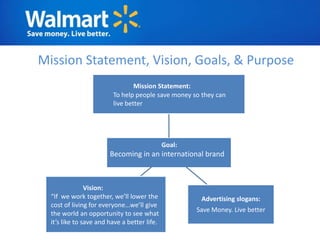
Mission Statement, Vision, Goals, & Purpose
                                 Mission Statement:
                         To help people save money so they can
                         live better


                                              Goal:
                        Becoming in an international brand


                Vision:
  “If we work together, we’ll lower the                Advertising slogans:
  cost of living for everyone…we’ll give
                                                      Save Money. Live better
  the world an opportunity to see what
  it’s like to save and have a better life.
Customer Target
• “Wal-Mart's targeted demographic:
  – Modest incomes
  – Shoppers interested in prices
• But the customer base is changing
Internal & External
     Analysis
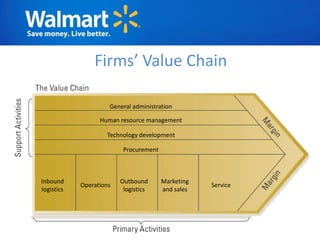
Firms’ Value Chain

                     General administration

                  Human resource management

                    Technology development

                          Procurement


Inbound                  Outbound       Marketing
            Operations                              Service
logistics                 logistics     and sales
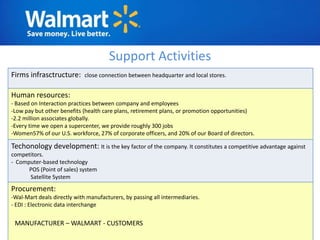
Support Activities
Firms infrasctructure:       close connection between headquarter and local stores.


Human resources:
- Based on Interaction practices between company and employees
-Low pay but other benefits (health care plans, retirement plans, or promotion opportunities)
-2.2 million associates globally.
-Every time we open a supercenter, we provide roughly 300 jobs
-Women57% of our U.S. workforce, 27% of corporate officers, and 20% of our Board of directors.

Techonology development: It is the key factor of the company. It constitutes a competitive advantage against
competitors.
- Computer-based technology
      POS (Point of sales) system
      Satellite System
Procurement:
-Wal-Mart deals directly with manufacturers, by passing all intermediaries.
- EDI : Electronic data interchange

 MANUFACTURER – WALMART - CUSTOMERS
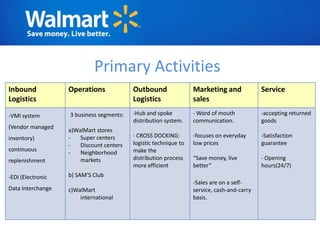
Primary Activities
Inbound            Operations             Outbound                Marketing and             Service
Logistics                                 Logistics               sales

-VMI system        3 business segments:   -Hub and spoke          - Word of mouth           -accepting returned
                                          distribution system.    communication.            goods
(Vendor managed
                   a)WalMart stores
inventory)         -   Super centers      - CROSS DOCKING:        -focuses on everyday      -Satisfaction
                   -   Discount centers   logistic technique to   low prices                guarantee
continuous                                make the
                   -   Neighborhood
replenishment          markets            distribution process    “Save money, live         - Opening
                                          more efficient          better”                   hours(24/7)
-EDI (Electronic   b) SAM’S Club
                                                                  -Sales are on a self-
Data Interchange   c)WalMart                                      service, cash-and-carry
                       international                              basis.
Business Formats
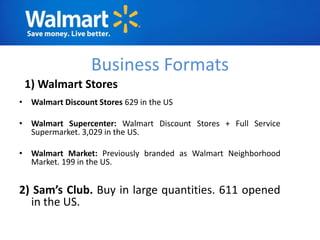
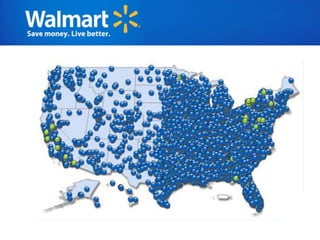
 1) Walmart Stores
• Walmart Discount Stores 629 in the US

• Walmart Supercenter: Walmart Discount Stores + Full Service
  Supermarket. 3,029 in the US.

• Walmart Market: Previously branded as Walmart Neighborhood
  Market. 199 in the US.


2) Sam’s Club. Buy in large quantities. 611 opened
  in the US.
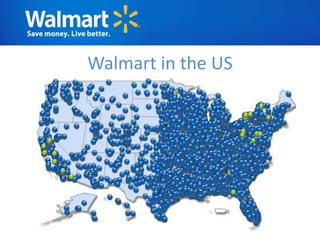
Walmart in the US
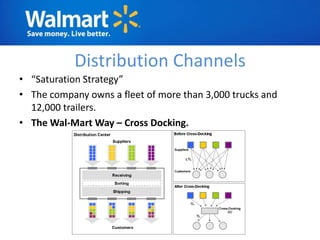
Distribution Channels
• “Saturation Strategy”
• The company owns a fleet of more than 3,000 trucks and
  12,000 trailers.
• The Wal-Mart Way – Cross Docking.
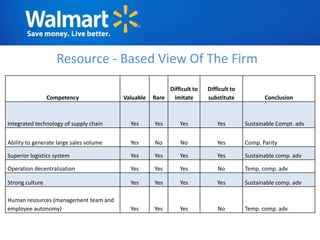
Resource - Based View Of The Firm
                                                         Difficult to   Difficult to
                 Competency              Valuable   Rare  imitate       substitute            Conclusion


Integrated technology of supply chain      Yes      Yes       Yes           Yes        Sustainable Compt. adv


Ability to generate large sales volume     Yes      No        No            Yes        Comp. Parity

Superior logistics system                  Yes      Yes       Yes           Yes        Sustainable comp. adv

Operation decentralization                 Yes      Yes       Yes           No         Temp. comp. adv

Strong culture                             Yes      Yes       Yes           Yes        Sustainable comp. adv

Human resources (management team and
employee autonomy)                         Yes      Yes       Yes           No         Temp. comp. adv
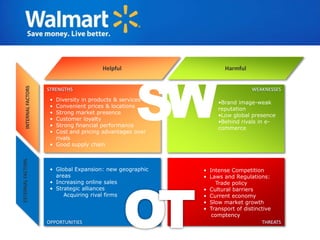
SW
                                            Helpful                    Harmful
      INTERNAL FACTORS


                         STRENGTHS                                               WEAKNESSES
                          • Diversity in products & services
                                                                    •Brand image-weak
                          • Convenient prices & locations
                                                                    reputation
                          • Strong market presence
                                                                    •Low global presence
                          • Customer loyalty
                                                                    •Behind rivals in e-
                          • Strong financial performance
                                                                    commerce
                          • Cost and pricing advantages over
                            rivals
                          • Good supply chain
EXTERNAL FACTORS


                          • Global Expansion: new geographic   • Intense Competition
                            areas                              • Laws and Regulations:
                          • Increasing online sales                Trade policy
                          • Strategic alliances                • Cultural barriers
                               Acquiring rival firms           • Current economy
                                                               • Slow market growth
                                                               • Transport of distinctive
                                                                  comptency
                         OPPORTUNITIES                                               THREATS
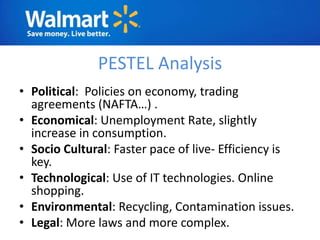
PESTEL Analysis
• Political: Policies on economy, trading
  agreements (NAFTA…) .
• Economical: Unemployment Rate, slightly
  increase in consumption.
• Socio Cultural: Faster pace of live- Efficiency is
  key.
• Technological: Use of IT technologies. Online
  shopping.
• Environmental: Recycling, Contamination issues.
• Legal: More laws and more complex.
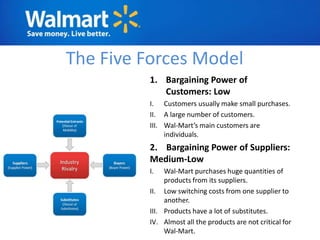
The Five Forces Model
         1. Bargaining Power of
            Customers: Low
         I. Customers usually make small purchases.
         II. A large number of customers.
         III. Wal-Mart’s main customers are
              individuals.
         2. Bargaining Power of Suppliers:
         Medium-Low
         I.   Wal-Mart purchases huge quantities of
              products from its suppliers.
         II. Low switching costs from one supplier to
              another.
         III. Products have a lot of substitutes.
         IV. Almost all the products are not critical for
              Wal-Mart.
The Five Forces Model
3. Potential entrants / Barriers to entry:
   Medium-High
I.     Economies of scale.
II.    High capital requirements.
III.   Customers mainly look for products with low prices and
       standard quality.
IV.    Low switching costs among companies for customers.
V.     Requires a precise distribution system.
4.     Power of Substitutes: High
I.     Prices and quality of substitute products are very competitive.
II.    Performance of substitute products are similar.
III.   Consumer switching costs are low.
The Five Forces Model
• 5. Potential Competitors/ Rivalry: High
I.     Wal-Mart represents the 25% share of the U.S. Supermarket
       business.
II.    Competitors have similar sizes.
III.   Industry growth is slow.
IV.    Exit barriers are high.
V.     There is a high production capacity

                      WAL-MART main competitors:

              Retailer Industry:      Supermarket Industry:
                  • Target            • Dollar General
                 • K-Mart             • Lowe’s Food.
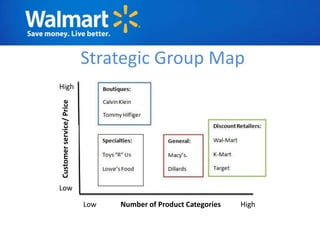
Strategic Group Map
High
Customer service/ Price


Low

                          Low   Number of Product Categories   High
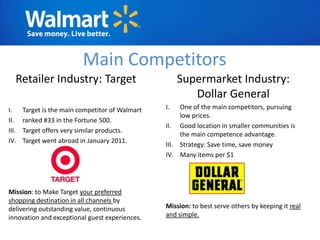
Main Competitors
   Retailer Industry: Target                           Supermarket Industry:
                                                          Dollar General
I.     Target is the main competitor of Walmart   I.   One of the main competitors, pursuing
                                                       low prices.
II.    ranked #33 in the Fortune 500.
                                                  II. Good location in smaller communities is
III.   Target offers very similar products.
                                                       the main competence advantage.
IV.    Target went abroad in January 2011.
                                                  III. Strategy: Save time, save money
                                                  IV. Many items per $1


Mission: to Make Target your preferred
shopping destination in all channels by
delivering outstanding value, continuous          Mission: to best serve others by keeping it real
innovation and exceptional guest experiences.     and simple.
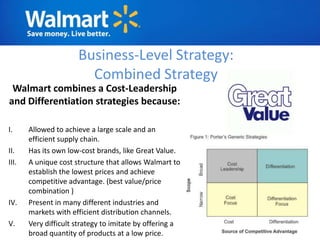
Business-Level Strategy:
                        Combined Strategy
 Walmart combines a Cost-Leadership
and Differentiation strategies because:

I.     Allowed to achieve a large scale and an
       efficient supply chain.
II.    Has its own low-cost brands, like Great Value.
III.   A unique cost structure that allows Walmart to
       establish the lowest prices and achieve
       competitive advantage. (best value/price
       combination )
IV.    Present in many different industries and
       markets with efficient distribution channels.
V.     Very difficult strategy to imitate by offering a
       broad quantity of products at a low price.
Internationalization
•   Reasons for expanding abroad
•   Risks
•   International Strategy
•   Success
•   Key issues
Forces Favoring Globalization
• 3 main reasons
    – Saturated domestic market
    – United States represents only 4% of world’s
      population (missing of 96% of potential customers)
    – Emerging Markets with lower disposable income offer
      huge platforms for growth in discount retailer.
•   Economies of Scale
•   Growth
•   Revenues
•   Reduce political risk
Risks of Expanding Abroad
• Management Risk
  – Culture, language, customer
    preferences, distribution systems.
• High investment

• Political and Economic risks

• Exchange Rates risk
Entry Decisions
• Important decisions any company needs to
  face when going international:

  – What markets to enter, when and what size.
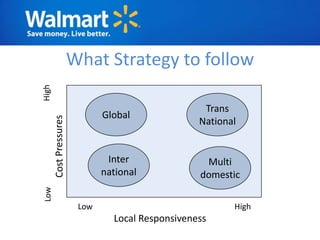
  – What strategy to follow.
  – What mode of entry.
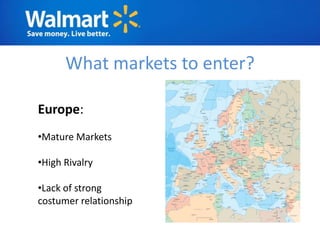
What markets to enter?

Europe:
•Mature Markets

•High Rivalry

•Lack of strong
costumer relationship
What markets to enter?
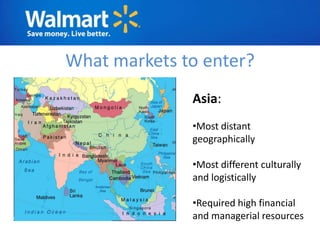
              Asia:
              •Most distant
              geographically

              •Most different culturally
              and logistically

              •Required high financial
              and managerial resources
What markets to enter?
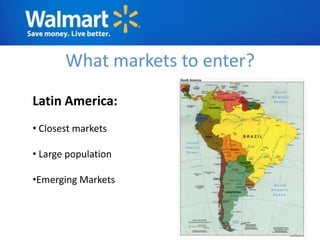
Latin America:
• Closest markets

• Large population

•Emerging Markets
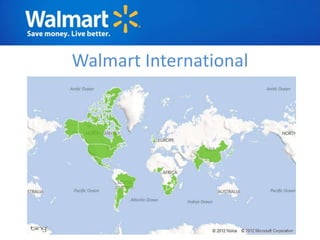
Walmart International
What Strategy to follow

                            Trans
       Global
                           National


        Inter               Multi
       national            domestic

 Low                              High
         Local Responsiveness
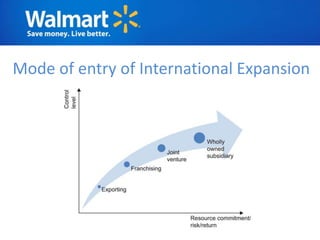
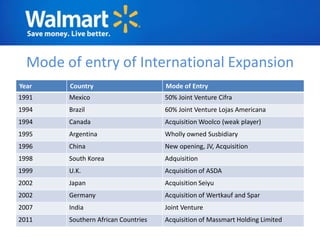
Mode of entry of International Expansion
Year    Country                      Mode of Entry
1991    Mexico                       50% Joint Venture Cifra
1994    Brazil                       60% Joint Venture Lojas Americana
1994    Canada                       Acquisition Woolco (weak player)
1995    Argentina                    Wholly owned Susbidiary
1996    China                        New opening, JV, Acquisition
1998    South Korea                  Adquisition
1999    U.K.                         Acquisition of ASDA
2002    Japan                        Acquisition Seiyu
2002    Germany                      Acquisition of Wertkauf and Spar
2007    India                        Joint Venture
2011    Southern African Countries   Acquisition of Massmart Holding Limited
Examples of International Success
• Mexico:
  – Largest Walmart’s foreign presence (68%)
  – 38% Retail Market Share in Mexico
• Canada
  – One of the most successful international expansion
  – Acquired Woolco Stores and changed structure

• Both countries are close and were exposed to
  Walmart.
Examples of International Success
• China:
  – Most populous country
  – Lower income in middle-class families
  – Adaptation to market
  – 85% of products from local suppliers.
Examples of International Failure
• Germany
  – Walmart was not able to benefit from economies of scale
  – Unable to become cost leader
  – Mode of entry:
     • Wertkauf (right move)
     • Spar (wrong move)
  – Culture differences
  – Low profitability market
  – Lost $1 Billion
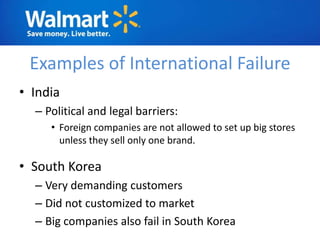
Examples of International Failure
• India
  – Political and legal barriers:
     • Foreign companies are not allowed to set up big stores
       unless they sell only one brand.

• South Korea
  – Very demanding customers
  – Did not customized to market
  – Big companies also fail in South Korea
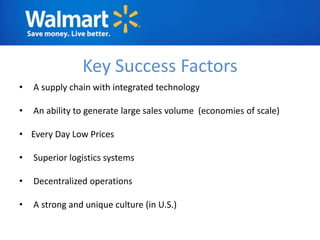
Key Success Factors
•   A supply chain with integrated technology

•   An ability to generate large sales volume (economies of scale)

• Every Day Low Prices

•   Superior logistics systems

•   Decentralized operations

•   A strong and unique culture (in U.S.)
Suggestions
“Think local, act global”
• Locally leveraged:
  – Shared knowledge between units.

• Worldwide learning:
  – Advantages of interconnected economies.

• Adaptation:
  – To locally customize processes and services
Questions & Answers

WalMart Analysis

  • 1.
    Carla Cordero -Carles De Oleza - Alex Doldán - Patricia Igual - Luis Pérez
  • 2.
    How to transfercore competencies to other countries?
  • 3.
    Outline • History Overview - Vision, Mission and Goals • Interna & External Analysis -Value Chain -SWOT & Pestel Analysis -5 Forces Model -Main Competitors •Internationalization -Driving Forces -Entry decisions -Examples of success and failure •Suggestions
  • 4.
    History Overview • 1962:Walten Brothers opened fist Walmart in Arkansas • 1970: Walmart became public • 1990: 1st National retailer • 1991: International Expansion • 1993: Creation of “Great Value” • 2003: Largest corporation in the world • 2012: 50th Anniversary
  • 5.
    Mission Statement, Vision,Goals, & Purpose Mission Statement: To help people save money so they can live better Goal: Becoming in an international brand Vision: “If we work together, we’ll lower the Advertising slogans: cost of living for everyone…we’ll give Save Money. Live better the world an opportunity to see what it’s like to save and have a better life.
  • 6.
    Customer Target • “Wal-Mart'stargeted demographic: – Modest incomes – Shoppers interested in prices • But the customer base is changing
  • 7.
  • 8.
    Firms’ Value Chain General administration Human resource management Technology development Procurement Inbound Outbound Marketing Operations Service logistics logistics and sales
  • 9.
    Support Activities Firms infrasctructure: close connection between headquarter and local stores. Human resources: - Based on Interaction practices between company and employees -Low pay but other benefits (health care plans, retirement plans, or promotion opportunities) -2.2 million associates globally. -Every time we open a supercenter, we provide roughly 300 jobs -Women57% of our U.S. workforce, 27% of corporate officers, and 20% of our Board of directors. Techonology development: It is the key factor of the company. It constitutes a competitive advantage against competitors. - Computer-based technology POS (Point of sales) system Satellite System Procurement: -Wal-Mart deals directly with manufacturers, by passing all intermediaries. - EDI : Electronic data interchange MANUFACTURER – WALMART - CUSTOMERS
  • 10.
    Primary Activities Inbound Operations Outbound Marketing and Service Logistics Logistics sales -VMI system 3 business segments: -Hub and spoke - Word of mouth -accepting returned distribution system. communication. goods (Vendor managed a)WalMart stores inventory) - Super centers - CROSS DOCKING: -focuses on everyday -Satisfaction - Discount centers logistic technique to low prices guarantee continuous make the - Neighborhood replenishment markets distribution process “Save money, live - Opening more efficient better” hours(24/7) -EDI (Electronic b) SAM’S Club -Sales are on a self- Data Interchange c)WalMart service, cash-and-carry international basis.
  • 11.
    Business Formats 1)Walmart Stores • Walmart Discount Stores 629 in the US • Walmart Supercenter: Walmart Discount Stores + Full Service Supermarket. 3,029 in the US. • Walmart Market: Previously branded as Walmart Neighborhood Market. 199 in the US. 2) Sam’s Club. Buy in large quantities. 611 opened in the US.
  • 12.
  • 13.
    Distribution Channels • “SaturationStrategy” • The company owns a fleet of more than 3,000 trucks and 12,000 trailers. • The Wal-Mart Way – Cross Docking.
  • 14.
    Resource - BasedView Of The Firm Difficult to Difficult to Competency Valuable Rare imitate substitute Conclusion Integrated technology of supply chain Yes Yes Yes Yes Sustainable Compt. adv Ability to generate large sales volume Yes No No Yes Comp. Parity Superior logistics system Yes Yes Yes Yes Sustainable comp. adv Operation decentralization Yes Yes Yes No Temp. comp. adv Strong culture Yes Yes Yes Yes Sustainable comp. adv Human resources (management team and employee autonomy) Yes Yes Yes No Temp. comp. adv
  • 15.
    SW Helpful Harmful INTERNAL FACTORS STRENGTHS WEAKNESSES • Diversity in products & services •Brand image-weak • Convenient prices & locations reputation • Strong market presence •Low global presence • Customer loyalty •Behind rivals in e- • Strong financial performance commerce • Cost and pricing advantages over rivals • Good supply chain EXTERNAL FACTORS • Global Expansion: new geographic • Intense Competition areas • Laws and Regulations: • Increasing online sales Trade policy • Strategic alliances • Cultural barriers Acquiring rival firms • Current economy • Slow market growth • Transport of distinctive comptency OPPORTUNITIES THREATS
  • 16.
    PESTEL Analysis • Political:Policies on economy, trading agreements (NAFTA…) . • Economical: Unemployment Rate, slightly increase in consumption. • Socio Cultural: Faster pace of live- Efficiency is key. • Technological: Use of IT technologies. Online shopping. • Environmental: Recycling, Contamination issues. • Legal: More laws and more complex.
  • 17.
    The Five ForcesModel 1. Bargaining Power of Customers: Low I. Customers usually make small purchases. II. A large number of customers. III. Wal-Mart’s main customers are individuals. 2. Bargaining Power of Suppliers: Medium-Low I. Wal-Mart purchases huge quantities of products from its suppliers. II. Low switching costs from one supplier to another. III. Products have a lot of substitutes. IV. Almost all the products are not critical for Wal-Mart.
  • 18.
    The Five ForcesModel 3. Potential entrants / Barriers to entry: Medium-High I. Economies of scale. II. High capital requirements. III. Customers mainly look for products with low prices and standard quality. IV. Low switching costs among companies for customers. V. Requires a precise distribution system. 4. Power of Substitutes: High I. Prices and quality of substitute products are very competitive. II. Performance of substitute products are similar. III. Consumer switching costs are low.
  • 19.
    The Five ForcesModel • 5. Potential Competitors/ Rivalry: High I. Wal-Mart represents the 25% share of the U.S. Supermarket business. II. Competitors have similar sizes. III. Industry growth is slow. IV. Exit barriers are high. V. There is a high production capacity WAL-MART main competitors: Retailer Industry: Supermarket Industry: • Target • Dollar General • K-Mart • Lowe’s Food.
  • 20.
    Strategic Group Map High Customerservice/ Price Low Low Number of Product Categories High
  • 21.
    Main Competitors Retailer Industry: Target Supermarket Industry: Dollar General I. Target is the main competitor of Walmart I. One of the main competitors, pursuing low prices. II. ranked #33 in the Fortune 500. II. Good location in smaller communities is III. Target offers very similar products. the main competence advantage. IV. Target went abroad in January 2011. III. Strategy: Save time, save money IV. Many items per $1 Mission: to Make Target your preferred shopping destination in all channels by delivering outstanding value, continuous Mission: to best serve others by keeping it real innovation and exceptional guest experiences. and simple.
  • 22.
    Business-Level Strategy: Combined Strategy Walmart combines a Cost-Leadership and Differentiation strategies because: I. Allowed to achieve a large scale and an efficient supply chain. II. Has its own low-cost brands, like Great Value. III. A unique cost structure that allows Walmart to establish the lowest prices and achieve competitive advantage. (best value/price combination ) IV. Present in many different industries and markets with efficient distribution channels. V. Very difficult strategy to imitate by offering a broad quantity of products at a low price.
  • 23.
  • 24.
    Internationalization • Reasons for expanding abroad • Risks • International Strategy • Success • Key issues
  • 26.
    Forces Favoring Globalization •3 main reasons – Saturated domestic market – United States represents only 4% of world’s population (missing of 96% of potential customers) – Emerging Markets with lower disposable income offer huge platforms for growth in discount retailer. • Economies of Scale • Growth • Revenues • Reduce political risk
  • 27.
    Risks of ExpandingAbroad • Management Risk – Culture, language, customer preferences, distribution systems. • High investment • Political and Economic risks • Exchange Rates risk
  • 28.
    Entry Decisions • Importantdecisions any company needs to face when going international: – What markets to enter, when and what size. – What strategy to follow. – What mode of entry.
  • 29.
    What markets toenter? Europe: •Mature Markets •High Rivalry •Lack of strong costumer relationship
  • 30.
    What markets toenter? Asia: •Most distant geographically •Most different culturally and logistically •Required high financial and managerial resources
  • 31.
    What markets toenter? Latin America: • Closest markets • Large population •Emerging Markets
  • 32.
  • 33.
    What Strategy tofollow Trans Global National Inter Multi national domestic Low High Local Responsiveness
  • 34.
    Mode of entryof International Expansion
  • 35.
    Mode of entryof International Expansion Year Country Mode of Entry 1991 Mexico 50% Joint Venture Cifra 1994 Brazil 60% Joint Venture Lojas Americana 1994 Canada Acquisition Woolco (weak player) 1995 Argentina Wholly owned Susbidiary 1996 China New opening, JV, Acquisition 1998 South Korea Adquisition 1999 U.K. Acquisition of ASDA 2002 Japan Acquisition Seiyu 2002 Germany Acquisition of Wertkauf and Spar 2007 India Joint Venture 2011 Southern African Countries Acquisition of Massmart Holding Limited
  • 36.
    Examples of InternationalSuccess • Mexico: – Largest Walmart’s foreign presence (68%) – 38% Retail Market Share in Mexico • Canada – One of the most successful international expansion – Acquired Woolco Stores and changed structure • Both countries are close and were exposed to Walmart.
  • 37.
    Examples of InternationalSuccess • China: – Most populous country – Lower income in middle-class families – Adaptation to market – 85% of products from local suppliers.
  • 38.
    Examples of InternationalFailure • Germany – Walmart was not able to benefit from economies of scale – Unable to become cost leader – Mode of entry: • Wertkauf (right move) • Spar (wrong move) – Culture differences – Low profitability market – Lost $1 Billion
  • 39.
    Examples of InternationalFailure • India – Political and legal barriers: • Foreign companies are not allowed to set up big stores unless they sell only one brand. • South Korea – Very demanding customers – Did not customized to market – Big companies also fail in South Korea
  • 40.
    Key Success Factors • A supply chain with integrated technology • An ability to generate large sales volume (economies of scale) • Every Day Low Prices • Superior logistics systems • Decentralized operations • A strong and unique culture (in U.S.)
  • 41.
  • 42.
    “Think local, actglobal” • Locally leveraged: – Shared knowledge between units. • Worldwide learning: – Advantages of interconnected economies. • Adaptation: – To locally customize processes and services
  • 43.